Thursdays With Spurgeon—Security

This is a weekly series with things I’m reading and pondering from Charles Spurgeon. You can read the original seed thought here, or type “Thursdays With Spurgeon” in the search box to read more entries.

Listen to the podcast of this post by clicking on the player below, and you can also subscribe on iTunes or Spotify.

Security 

[God] alone is my rock and my salvation (Psalm 62:2).

     I do not reckon that is salvation that regenerates me and then puts me in such a position that I may fall out of the covenant and be lost. I cannot call that a bridge that only goes halfway over the stream. I cannot call that salvation that does not carry me all the way to heaven, wash me perfectly clean, and put me among the glorified who sing constant hosannas around the throne. … 

     Do I live to God a holy life? It is not I, but Christ who lives in me. Am I sanctified? I did not sanctify myself. God’s Holy Spirit sanctifies me. Am I weaned from the world? I am weaned by God’s chastisements. Do I grow in knowledge? The great Instructor teaches me.

From God Alone The Salvation Of His People


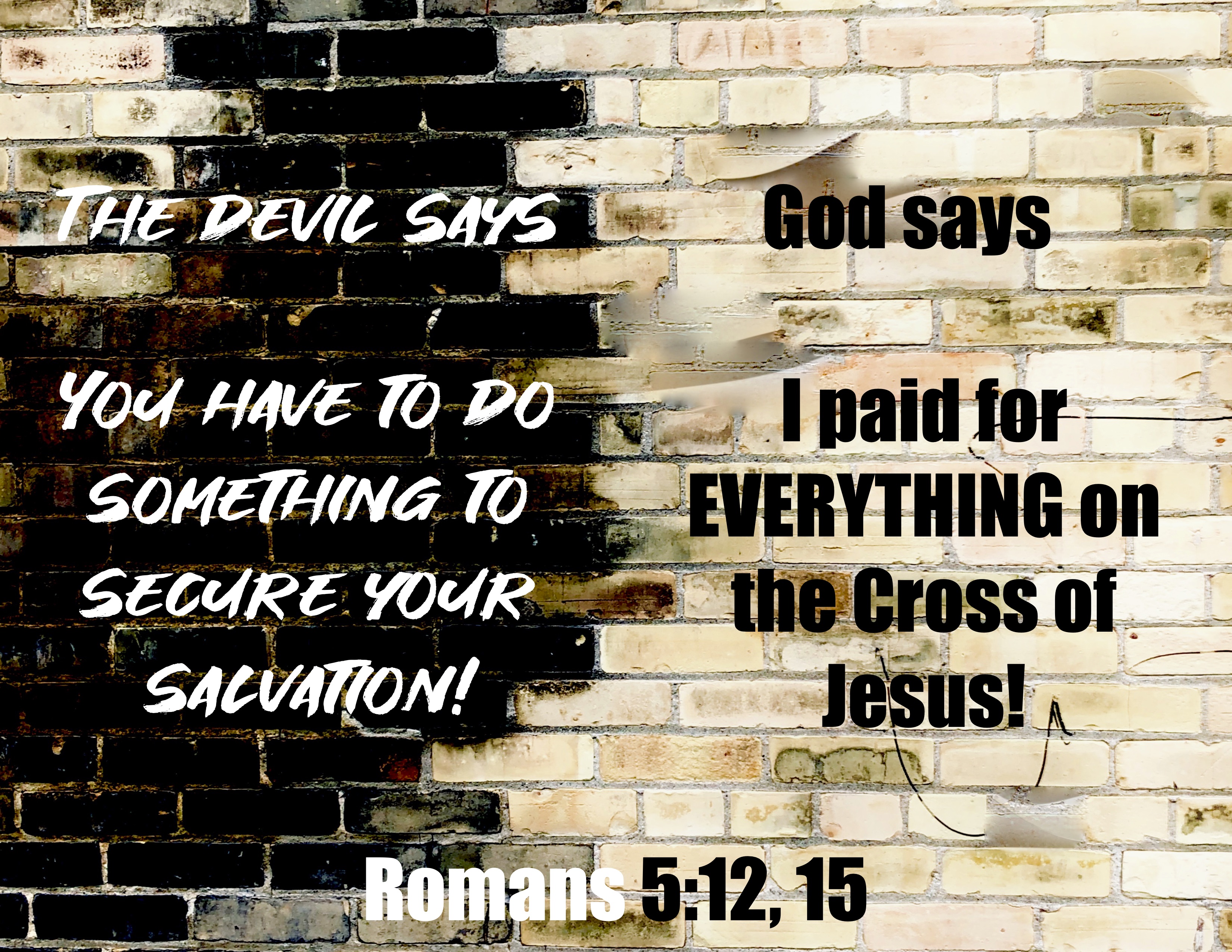
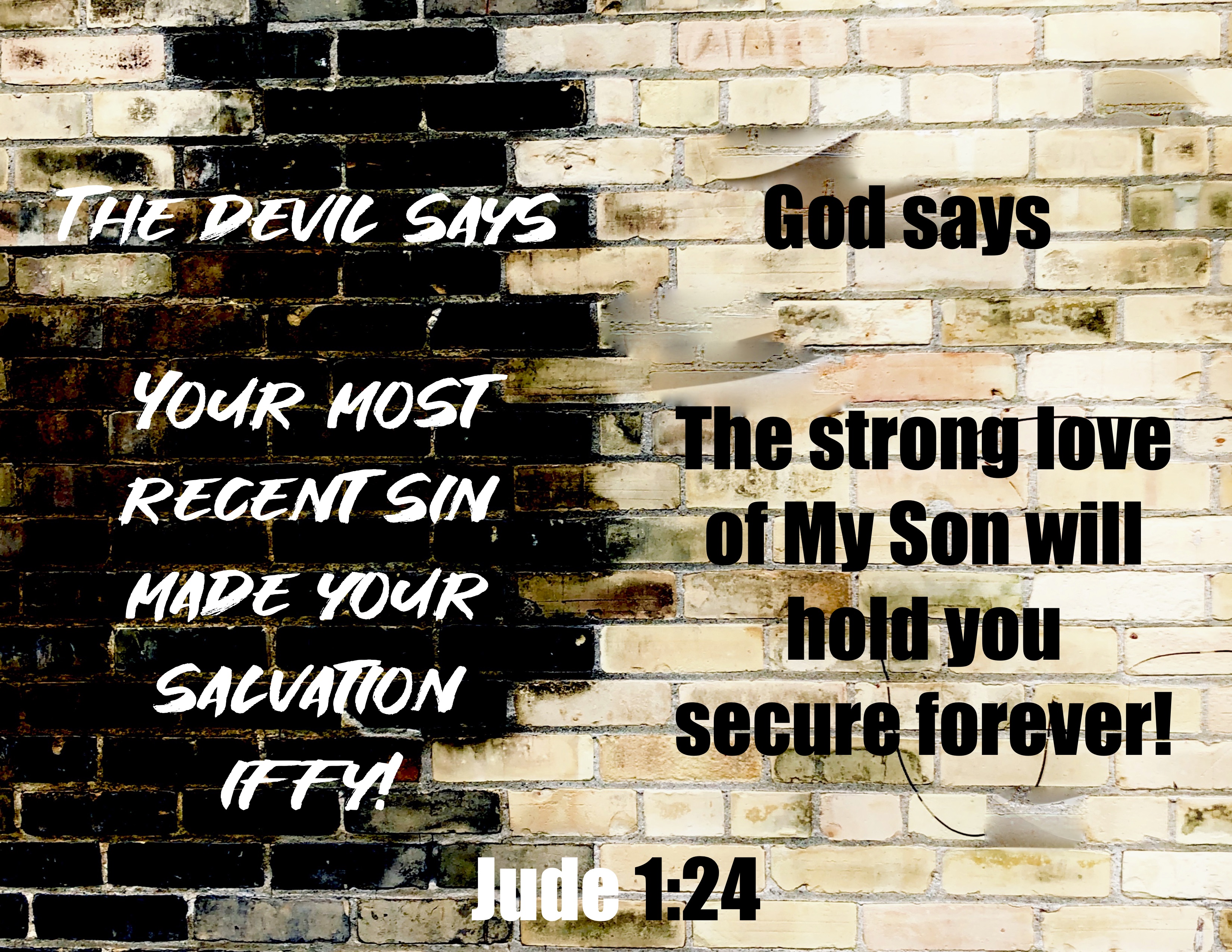
A few months ago I began designing a series of graphics under the heading, “Says who?” I took some of the lies of satan and put them side-by-side with the truth from God’s Word. 

When God is our Savior, we are secure. The devil would love to make us think that our salvation is hanging by a thread, that we have to work harder to make sure we don’t miss out, that a single sin can disqualify us from God’s favor, and a hundred other lies. But they are all just that: lies! 

We have to learn to capture each of these thoughts, and if they are thoughts that don’t align with God’s Word, then we need to confront them with the truth. I have found it very helpful to speak these truths out loud. To see some of the ways I suggested thinking differently about the devil’s lies, check out this post on reversing your thinking.

As the old hymn says, “Jesus paid it all, all to Him I owe.” You don’t have to earn your salvation or make your position secure—your salvation has been paid-in-full and you are perfectly secure! Now what you owe to Jesus is to allow Him to take you safely home. 

►► Would you please prayerfully consider supporting this ministry? ◀︎◀︎
The Mercyseat

Listen to the podcast of this post by clicking on the player below, and you can also subscribe on Apple or Spotify.

Hear my cry for mercy … He has heard my cry for mercy (Psalm 28:2, 6).

For David, his cry for mercy was never a one-and-done action. The verb in verse 2 makes this verse read more like, “Hear my cry for mercy as I am continually calling to You for help, as I am continually lifting up my hands toward Your Most Holy Place.” 

Why the Most Holy Place? What was there? Inside the Most Holy Place was the ark of the covenant of the Lord which represented the presence of God. 

What was on top of the ark of the covenant, covering and superseding the Law that was inside the ark? It was the mercyseat (or the “atonement cover” in some translations). The mercyseat is where the high priest sprinkled the blood of the sacrificial lamb every year to make atonement for sins.

Jesus became the once-for-all sacrificial Lamb to make ultimate atonement for all who would believe in Him. When Jesus had finished His work on the Cross, the curtain separating us from the Most Holy Place was torn in two. The ark of the covenant of the Lord with its covering mercyseat—the presence of God—was now accessible to all of us! It was accessible because it was in Jesus, and when I have taken Jesus as my atonement, He is in me and He takes me in to the Father. The mercyseat of my heart has been sprinkled with the blood of the Lamb (see Hebrews 9:1-5, 11-14; 10:19-22). 

Whether David was saying, “Hear my cry,” or “He has heard my cry,” the Hebrew word means to listen with interest and full attention. Whenever you pray, God listens to you with interest and full attention because you are praying right in His presence! Your very breath can be a continual crying, a continual lifting of your voice toward the mercyseat where God meets with you! 

God is not far away from us. He is closer than we usually think. That’s why David says, “My heart leaps for joy, and with my song I praise Him”! 

Keep this in mind the next time you are asking God to hear your cry: He listens to you with full attention because Jesus has taken you right into His presence.

Would you please prayerfully consider supporting this ministry?

Thursdays With Spurgeon—My Rock

This is a weekly series with things I’m reading and pondering from Charles Spurgeon. You can read the original seed thought here, or type “Thursdays With Spurgeon” in the search box to read more entries.

Listen to the podcast of this post by clicking on the player below, and you can also subscribe on iTunes or Spotify.

My Rock 

[God] alone is my rock and my salvation (Psalm 62:2).

     How noble a title; it is so sublime, suggestive, and overpowering. ‘My rock.’ It is a figure so divine that to God alone will it ever be applied. …  

     Unchangeable He is in His being, firm in His own sufficiency. He keeps Himself immutably the same. And ‘therefore you are not consumed, O sons of Jacob’ (Malachi 3:6). … So is our God a sure defense, and we will not be moved if He has set our feet upon a rock and established our goings (see Psalm 40:2). …  

     ‘He is my rock.’ How glorious a thought! How safe am I and how secure and how may I rejoice in the fact that when I wade through Jordan’s stream He will be my rock! I will not walk upon a slippery foundation, but I will tread on Him who cannot betray my feet. And I may sing when I am dying, ‘He is my rock, and there is no unrighteousness in Him’ (Psalm 92:15).

From God Alone The Salvation Of His People

Spurgeon mentioned singing about God our Rock even when we come to death’s door. Immediately a couple of songs from my childhood sprang to mind.

Rock of Ages, cleft for me,
Let me hide myself in Thee;
Let the water and the blood,
From Thy wounded side which flowed,
Be of sin the double cure,
Save from wrath and make me pure.

While I draw this fleeting breath,
When my eyes shall close in death,
When I rise to worlds unknown,
And behold Thee on Thy throne,
Rock of Ages, cleft for me,
Let me hide myself in Thee. (Augustus Toplady)

Where do I go when there’s nobody else to turn to?
Who do I turn to when nobody wants to listen?
Who do I lean on when there’s no foundation stable?
I go to the Rock, I know He’s able, I go to the Rock.

I go to the Rock of my salvation,
I go to the Stone that the builders rejected,
I run to the Mountain and the Mountain stands by me.
When the earth all around me is sinking sand
On Christ, the Solid Rock, I stand
When I need a shelter, when I need a friend, I go to the Rock. (Dottie Rambo)

My friend, no matter how unstable things may seem, no matter how uncertain the future may appear, remember the One and Only Rock. He alone is my rock and my salvation! Jesus is the same yesterday, today, and forever. Don’t try to make your own secure place, but run to the Rock of Ages, and this immovable Mountain will stand by you and keep you secure for all of eternity! 

Would you please prayerfully consider supporting this ministry? 


6 Quotes From “Voice Of A Prophet”

Listen to the podcast of this post by clicking on the player below, and you can also subscribe on Apple or Spotify.

A.W. Tozer pulls no punches in the way he confronts modern-day preachers (those he calls “sons of the prophets”). He challenges pastors to return to the Scriptures, hit their knees in prayer, and do some serious soul searching on where they may be falling short of the standard set by the biblical prophets. You can read my full book review of Voice Of A Prophet by clicking here. 

“It is not the messenger, it is the message that needs to be proclaimed. If you study the Old and New Testaments you will discover that no prophet can ever be a celebrity. The most significant thing about the prophet is the message he conveys, and that message had better by rooted in the heart of God.” 

“The responsibility of the prophet is not to come up with his own message, but to faithfully deliver the message—the warning—that is coming from God.” 

“The song of the prophet is, ‘Thus saith the Lord.’ Any other song will never do for God’s man to be God’s voice to his generation.” 

“God takes so much delight in us that He will go to any length to bring us back to that delight.” 

“Jesus said that our problem is a spiritual danger, not a physical danger, and our visible enemies are rarely our real enemies. The man who comes at you with a gun is not your real enemy, though his intention may be to kill you. Your real enemy is that enemy within you that makes you vulnerable to him. Esau was Jacob’s enemy because of what Jacob had done to him, but Esau was not Jacob’s real enemy. Jacob was Jacob’s enemy. The crookedness in Jacob’s heart was against Jacob, and when God straightened that out, Esau was not his enemy anymore.” 

“Well do I know, Thou God of the prophets and the apostles, that as long as I honor Thee Thou will honor me. Help me therefore to take this solemn vow to honor Thee in all my future life and labors, whether by gain or by loss, by life or by death, and then to keep that vow unbroken while I live. … Save me from the error of judging a church by its size, its popularity or the amount of its yearly offering. Help me to remember that I am a prophet—not a promoter, not a religious manager, but a prophet. Let me never become a slave to crowds.” 

Would you please prayerfully consider supporting this ministry?

Voice Of A Prophet (book review)

Listen to the podcast of this post by clicking on the player below, and you can also subscribe on Apple or Spotify.

I’ve always appreciated A.W. Tozer’s prophetic voice. By that I mean, his unabashed call for Christians to live up to the Christlike standard given to us in the Scriptures. But in Voice Of A Prophet, Tozer hits a little closer to home for me (and for all of us who are in ministry positions) as he specifically calls on pastors to live up to the prophetic standard given to us in the Bible. 

Sometimes people misunderstand the title “prophet” to be one who foretells future events. At times, that is the function of a prophet, but primarily the prophet is more of a forthteller than a foreteller. The prophet is called upon to boldly proclaim God’s truth and tell forth where godly people are falling short. Prophets are God’s messengers to God’s people, usually sent to reawaken His people to truths that they have forgotten or strayed from. 

Tozer calls modern-day pastors and preachers—those he calls “the sons of the prophets”—to look to the prophetic fathers of the Scripture. He calls us to live up to the God-fearing standard of the prophets like Elijah, Isaiah, John the Baptist, and Jesus. He forthtells how too many have succumbed to the voice of culture instead of adhering to the voice of their Lord, and how they have traded “Thus saith the Lord” for “Thus saith me.” 

The opening chapter of Voice Of A Prophet reprints a prayer that Tozer wrote out when he was ordained in 1920. Part of that prayer for himself should remain a prayer for all who are called by God to be pastors today: “Let me stand before the great or minister to the poor and lowly; that choice is not mine, and I would not influence it if I could. I am Thy servant to do Thy will, and that will is sweeter to me than position or riches or fame and I choose it above all things on earth or in heaven.”

Voice Of A Prophet is an important read for those in pastoral ministry. FAIR WARNING: You will be challenged and convicted by Tozer’s timeless words! But if you will heed those words, God will be pleased to bless your efforts. I would also recommend this book to anyone who would like to know how they can better support and pray for their pastor, as I think they will find valuable insights in this book. 

Would you please prayerfully consider supporting this ministry?

First In Forgiveness

Listen to the podcast of this post by clicking on the player below, and you can also subscribe on Apple or Spotify.

From David’s bookend prayers to Jesus making prayer the central, empowering practice of the Christian lifestyle, I hope you’re beginning to see that prayer starts it, prayer sustains it, prayer successfully concludes it! 

There is another thing both David and Jesus agree upon. They both tell us that there is one thing that can block our prayer: unconfessed, unrepented sin. 

David wrote, “If I regard iniquity in my heart, the Lord will not hear.” The Hebrew word translated “regard” means to be aware of something. David teaches us that we have to be made aware of our sin in order to confess our sin and ask forgiveness. We become aware of our sin through prayer and reading the Bible (Psalm 139:23; James 1:25; Romans 7:7-12). 

The NIV translates the same Hebrew word in Psalm 66:18 as “cherished.” After becoming aware of our sin, we have to be careful not to make excuses or justifications for it. And then the NLT translates the same word “not confessed.” After becoming aware of our sin and accepting responsibility for it, then we can confess it to God. 

In teaching us to pray, Jesus said our forgiveness of others had a direct correlation to the forgiveness we would receive from our Heavenly Father (Matthew 6:12, 14-15). Jesus further expounds this thought when He tells Peter to forgive others “seventy times seven times”; in other words: countless times. 

Think of it this way: Have you asked God’s forgiveness more than seven times? How about more than seven times for the same sin? I have! So Jesus is really asking Peter, “Do you want God to put a limit on how many times He will forgive you? If not, then don’t you put a limit on how many times you will forgive others.” 

The Amplified Bible has a great definition of forgiveness in Matthew 6:12—left, remitted, let go of the debts, and have given up resentment against. The Hebrew word David uses in Psalm 32:1 has a similar feel—lifted up, taken away, carried off. 

Our forgiven sins are forgotten sins. Every time we come to God for forgiveness, it’s like it is the first time. And Jesus says this is the same way we need to treat others. 

Let’s all strive to be first responders in confessing our own debts to God so we can be forgiven, AND then let’s also be first responders in forgiving the debts others have incurred against us. 

As I’ve said before: A mark of a maturing saint is one who is closing the gap between awareness of his sin and making his confession of that sin. 

But this is just as true: 

A mark of a maturing saint is one who is closing the gap between being injured and forgiving the offender. 

We do this again and again and again—countless times!—because that’s how often our Heavenly Father forgives us. 

Be a first responder in both asking for forgiveness and giving forgiveness.
Don’t let your debts block your prayers.
Don’t let your unreceived forgiveness weigh you down.
Don’t let your ungiven forgiveness weigh others down.

If you’ve missed any of the other messages in this series on prayer, you can find the full list by clicking here. 

Would you please prayerfully consider supporting this ministry?

Poetry Saturday—Must I My Brother Keep?

Listen to the podcast of this post by clicking on the player below, and you can also subscribe on Apple or Spotify.

Must I my brother keep,
And share his pain and toil;
And weep for those who weep,
And smile with those who smile;
And act to each a brother’s part,
And feel his sorrows in my heart?

Must I his burden bear,
As though it were my own,
And do as I would care,
Should to myself be done;
And faithful to his interests prove,
And as myself my neighbor love?

Then Jesus at Thy feet
A student let me be,
And learn as it is meet,
My duty, Lord, of Thee;
For Thou didst come on mercy’s plan,
And all Thy life was love to man.

Oh! make me as Thou art;
Thy Spirit, Lord, bestow—
The kind and gentle heart
That feels another’s woe.
May I be thus like Christ my Head,
And in my Savior’s footsteps tread! —Thomas Raffles

Would you please prayerfully consider supporting this ministry? 

Thursdays With Spurgeon—Do I Have Faith?

This is a weekly series with things I’m reading and pondering from Charles Spurgeon. You can read the original seed thought here, or type “Thursdays With Spurgeon” in the search box to read more entries.

Listen to the podcast of this post by clicking on the player below, and you can also subscribe on iTunes or Spotify.

Do I Have Faith? 

     Man cannot please God without bringing to himself a great amount of happiness…. It is because [God] gives him the blessings of adoption, pours upon him the bounties of His grace, makes him a blessed man in this life, and ensures him a crown of everlasting life, which he will wear and which will shine with unfading luster when the wreaths of earth’s glory have all been melted away. … If, then, we are right in saying that to please God is to be happy, the one important question is, how can I please God? … 

     Without faith it is impossible to please [God]’ (Hebrews 11:6). That is to say, do what you may, strive as earnestly as you can, live as excellently as you please, make what sacrifices you choose, be as eminent as you can for everything that is lovely and of good repute—yet none of these things can be pleasing to God unless they are mixed with faith. …  

     Have you faith? Shall I help you to answer that question? I will give you three tests, as briefly as ever I can, not to weary you….

    1. He who has faith has renounced his own righteousness. 
    2. Then true faith may be known by this: It begets a great esteem for the person of Christ. Do you love Christ? Could you die for Him? Do you seek to serve Him? Do you love His people? 
    3. He who has true faith will have true obedience. If a man says he has faith and has no works, he lies. If any man declares that he believes in Christ and yet does not lead a holy life, he lies.

From Faith

Both my parents and my grandparents on both sides of my family tree were Christians. They had faith in the God of the Bible. In my younger years, I thought just believing what they believed was good enough. But I had to come to a point where I could say, “I don’t have faith in God because my parents and grandparents do, but because I really believe it is true.” In other words, not just Jesus is the Savior, but Jesus is MY Savior. 

Does having faith mean I have no doubts? No, there are still things I don’t fully understand. Faith means believing God for the things I do understand and still trusting Him with the things I don’t understand yet. 

That’s pretty much the resume of every person in the great faith chapter of the Bible (Hebrews 11). For instance, Noah didn’t understand what a worldwide flood was, but he built an ark in faith; Abraham didn’t know how God would make him the father of many nations, but he moved from his homeland by faith; Joseph didn’t know how God would deliver the Israelites from Egypt, but he gave instructions by faith; and on and on the list goes. 

I commented on Hebrews 11:4 on YouVersion, “I want to live my life so in step with God that people can say of me as the writer of Hebrews said of Abel: ‘Although Craig is long dead, he still speaks to us by his example of faith.’ Don’t you want that for your life too?” 

The Bible itself tells us that faith comes into our heart by hearing the Word of God. If your faith is struggling, I would encourage you to open your Bible, ask the Holy Spirit to illuminate the Word to you, and begin reading with an open heart and mind. That’s exactly what I did, and I came to the conclusion that I believed the God of the Bible not because my parents did, but because He showed Himself to me to be Real. 

If you are struggling with your faith in God, I’d love to talk with you. Please get in touch with me and let’s begin a dialogue.

Our Daily Diet

Listen to the podcast of this post by clicking on the player below, and you can also subscribe on Apple or Spotify.

A couple of weeks ago I shared how Jesus made prayer the literal heart of His Sermon on the Mount. Prayer is what empowers us to live a perfect, God-honoring life. In the introduction of His model prayer, Jesus gives us two don’ts and one do. 

DON’T #1: Don’t be a hypocrite. That word literally means a play-actor. More than anyone else ever will, God sees who we really are. We cannot fool Him so there is no reason to fake it. For proof, check out some of the gut-level-honest prayers David records in the psalms!  

DON’T #2: Don’t babble. The Greek word here is unique: It’s made up of the name of a poet named Battus who was needlessly wordy, and the Greek word for word. In Greek, the word battologeō is an onomatopoeic word (like our English words that sound like what they really are describing: words like whoosh, buzz, or smack). It means rambling with our mouth, but our hearts and heads simply aren’t engaged as well. 

DO: Jesus gives us a DO, which is built right into the two don’ts: Do come to God as your Father (also see Luke 11:9-13). Our perfect Father knows perfectly what we need, and He alone can perfectly meet that need. Jesus uses our need for daily food to show how even earthly fathers provide for their children. So the very first petition in His model prayer for us is, “Give us today our daily bread.” 

“When prayer has become secondary, or incidental, it has lost its power. Those who are conspicuously men of prayer are those who use prayer as they use food, or air, or light, or money.” —M.E. Andross 

My friend’s trainer recently told him, “You cannot out-exercise a bad diet.” I think this is just as true in the realm of prayer: You cannot out-________ a bad prayer diet. You cannot…

  • …out-religion a bad prayer diet, as though your religious exercises can make up for a lack of prayerful food.  
  • …out-talk a bad prayer diet, or “babble,” as Jesus said.  
  • …out-strategize a bad prayer diet, as one successful man attempted to do (see Luke 12:16-20).

Jesus said our heavenly Father is just waiting for us to ask Him for what we need. In Psalm 5, David explained how attentive God is, even understanding our cries, our sighs, and our groans. So David’s conclusion was: “Lord, every morning You hear my voice. Every morning, I tell You what I need, and I wait for Your answer. 

Friends, we need to be first responders in prayer. Make it a habit every morning to let God hear your voice before anyone else does. DON’T make a show out of it or babble some words you don’t really feel, but DO talk with your loving heavenly Father about what you need for this upcoming day. He has already prepared a good, healthy diet for you, so ask Him to give you this day what you need, and then be expectant all day long in the ways your Father will answer you.

If you’re missed any of the other messages in our Be A First Responder series in prayer, you can access the full list by clicking here.

Thursdays With Spurgeon—Talking Back To Your Old Family

This is a weekly series with things I’m reading and pondering from Charles Spurgeon. You can read the original seed thought here, or type “Thursdays With Spurgeon” in the search box to read more entries.

Listen to the podcast of this post by clicking on the player below, and you can also subscribe on iTunes or Spotify.

Talking Back To Your Old Family

     When a man is adopted into a family and comes thereby under the regime of his new father, he has nothing whatever to do with the old family he has left behind and he is released from subjection to those whom he has left. And so, the moment I am taken out of the family of satan, the prince of this world has nothing to do with me as my father and he is no more my father. I am not a son of satan; I am not a child of wrath. 

     …When the law comes to a Christian with all its terrible threats and horrible denunciations, the Christian says, ‘Law! Why do you threaten me? I have nothing to do with you. I follow you as my rule, but I will not have you to be my ruler. I take you to be my pattern and mold, because I cannot find a better code of morality and of life, but I am not under you as my condemning curse.’ …  

     If one man adopts another child into his family, he cannot give it his own nature as his own child would have had. And if that child whom he will adopt should have been a fool, it may still remain so. He cannot make it a child worthy of him. But our heavenly Father, when He comes to carry out adoption, gives us not only the name of children, but the nature of children, too. He gives us a nature like His well-beloved Son, Jesus Christ.

From Adoption

Charles Spurgeon was called “the prince of preachers” for good reason! His word pictures are so biblically-accurate and so easy to recall, that anyone can grasp the concepts he shares from the Scripture. I have two takeaways from this portion of his sermon: 

First, we need to talk back to our old family. The name “satan” means accuser: he accuses, condemns, slanders, and does his best to separate. When a Christian has been adopted into God’s family, there is no condemnation for the one who now calls God, “Abba Father” (see Romans 8:1-17). 

This is where we need to call out satan’s lies. I mean literally call them out. We need to talk back to the devil and tell him the truth, just as Spurgeon said in his example of talking back to the Law. Let me say it again: literally speak the truth out loud. The devil needs to hear it and your own ears need to hear it too: “I am no longer subject to your jurisdiction. You have no say over me any longer. I am a child of God. My sins have been forgiven and forgotten; therefore, there are no grounds left for any condemnation!”


Second, we need to talk back to our old nature. After being adopted into God’s family, the Holy Spirit undertakes a process to conform us to the image of Jesus. This process is called sanctification, but I like to call it saint-ification. 

This is where we call out what we used to be. And, again, I challenge to literally speak these words out loud. Don’t say, “I’m so impatient,” but tell yourself (out loud!), “I am becoming the patient saint Jesus wants me to be.” Don’t say, “I’ll never get this right,” but tell yourself, “I am learning more and more about Christ’s nature with each attempt.” Talk back to these old habits from your old family, and tell them about the new saintly habits the Holy Spirit is developing in you. 

The book of Revelation tells us that the saints overcame the slanderous devil by the blood of Jesus and by the words of their testimony. Speak out those life-affirming words every time that slanderer tries to make you forget into whose family you have been adopted!