Listen to the podcast of this post by clicking on the player below, and you can also subscribe on Apple or Spotify.
Eternal Spirit, we confess
And sing the wonders of Your grace!
Your power conveys our blessings down
From God the Father and the Son.
Enlightened by Your heavenly ray,
Our shades and darkness turn to day.
Your inward teachings make us know
Our danger and our refuge, too.
Your power and glory work within,
And break the chains of reigning sin,
Does our imperious lusts subdue,
And forms our wretched hearts anew.
The troubled conscience knows Your voice,
Your cheering words awake our joys;
Your words allay the stormy wind,
And calm the surges of the mind.
*Spurgeon used this poem as a conclusion to his sermon entitled Human Depravity and Divine Mercy. I was unable to find this poem attributed to anyone else, so I am assuming it was written by Spurgeon himself.
This is a weekly series with things I’m reading and pondering from Charles Spurgeon. You can read the original seed thought here, or type “Thursdays With Spurgeon” in the search box to read more entries.
Listen to the podcast of this post by clicking on the player below, and you can also subscribe on iTunes or Spotify.
Simple Faith Is Still Powerful Faith
I would have you note that the faith that justified Abram was still an imperfect faith, although it perfectly justified him. It was imperfect beforehand, for he had prevaricated as to his wife and bid Sarai, ‘Say you are my sister’ (Genesis 12:13).
It was imperfect after it had justified him, for the next chapter we find him taking Hager, his wife’s handmaid, in order to effect the divine purpose, and so showing a lack of confidence in the working of the Lord. It is a blessing for you and for me that we do not need perfect faith to save us! ‘If you have faith as a mustard seed, you will say to this mountain, “Move from here to there,” and it will move; and nothing will be impossible for you’ (Matthew 17:20). If you have but the faith of a little child, it will save you. Though your faith is not always at the same pitch as the patriarch’s when he staggered not at the promise through unbelief, yet if it is simple and true, if it confides alone in the promise of God, it is an unhappy thing that it is no stronger, and you ought daily to pray, ‘Lord, increase my faith,’ but still it will justify you through Christ Jesus! A trembling hand may grasp the cup that bears a healing draught to the lip, but the weakness of the hand will not lessen the power of the medicine.
From Justification By Faith
A prayer that Jesus loved was simply this: “Lord, I believe; help me overcome my unbelief” (Mark 9:14-27). The recognition that Jesus alone could help is the essence of faith.
I’ve often said that the simplest, most powerful prayer we can pray is, “Lord, help!” In just those two words we are saying, “I cannot do a thing to help myself, but, Lord, I believe Your power is limitless to help me!”
Small faith is still powerful faith—even faith as small as a mustard seed—because it can move mountains. Childlike faith touches the heart of God. I love how Spurgeon reminds us that the weakness of the hand that grasps the cup promise does not lessen the power of the medicine in the cup.
The best way to learn to pray in faith is simply to pray in faith. A baby doesn’t wait until he has a fully-formed vocabulary to ask his father or mother for help. Just pray! The Holy Spirit can turn even your childlike prayers into pleasing sounds in your Heavenly Father’s ears.
Maybe you could paraphrase that father who was in desperate need of Christ’s help, “Lord, I am praying; help me to keep on praying!”
Listen to the podcast of this post by clicking on the player below, and you can also subscribe on Apple or Spotify.
Jesus has just broken a 3-hour silence with His megaphone-voice cry: “My God, My God, why have You forsaken Me?” Now His final three statements will follow in rather short order, beginning with, “I am thirsty.”
It might seem trivial that Jesus expressed His desire for a drink, especially since He also knew that there was no thirst-quenching water nearby. Far from being trivial, however, this was eternally important because it completed His mission.
Before saying, “I am thirsty,” John tells us that Jesus knew “that all was now completed.” The Greek word for know is sometimes translated as “see” and sometimes “know.” When it’s “see” it’s always in the past tense—“saw” or “have seen.” Perhaps in His 3-hour silence, Jesus was reviewing His earthly life, looking back to see what He had accomplished. Make no mistake about it, Jesus was on-mission for all 30+ years of His life in Israel.
But now that He has seen His life, He “knows.” This word is in the perfect tense. He’s seen it all and He knows He has accomplished all He set out to complete. As He had told His audience earlier in His life, “For assuredly, I say to you, till heaven and earth pass away, one jot or one tittle will by no means pass from the law till ALL is fulfilled” (Matthew 5:18).
In looking back on His life, Jesus saw one final thing: He needed to be given vinegar to drink just as David prophesied (Psalm 69:13-21). With that sour sip, ALL the Ts are crossed and ALL the Is are dotted!
When John writes, “Knowing all was now completed, and so the Scripture would be fulfilled,” he uses the Greek word which means mission accomplished!
Why did Jesus need to fulfill ALL the prophecies and complete ALL the law? Check out His earlier statement from the Amplified Bible: “For truly I tell you, until the sky and earth pass away and perish, not one smallest letter nor one little hook identifying certain Hebrew letters will pass from the Law until all things it FORESHADOWS are accomplished.”
The law was just our temporary guardian and the temple practices were just a shadow of the realities of Heaven (see Galatians 3:23-25; Hebrews 10:1-10). ALL of them were merely pointing to Jesus, so Jesus made sure ALL of them were completed.
His “I am thirsty” statement was really His “Amen” to His completed mission.
Jesus fulfilled every Scripture so that we could stand on every promise!
Check this out: “For no matter how many promises God has made, they are ‘Yes’ in Christ. And so through Him the ‘Amen’ is spoken by us to God” (2 Corinthians 1:20).
The shadows of the law were turned into the substance on which we can come boldly before the throne of God’s grace! In just three words—“I am thirsty”—Jesus completed His mission for God’s glory and for our eternal help!
This is a weekly series with things I’m reading and pondering from Charles Spurgeon. You can read the original seed thought here, or type “Thursdays With Spurgeon” in the search box to read more entries.
Listen to the podcast of this post by clicking on the player below, and you can also subscribe on iTunes or Spotify.
Never Beyond God’s Love
Lost, perishing sinners, hear the voice of God, for it speaks to you.
“Where art thou? for I am come to seek thee.”
“Lord, I am in such a place that I cannot do anything for myself.”
“Then I am come to seek thee and do all for thee.”
“Lord, I am in such a place that the law threatens me and justice frowns upon me.”
“I am come to answer the threatenings of the law, and to bear all the wrath of justice.”
“But, Lord, I am in such a place that I cannot repent as I would.”
“I am come to seek thee, and I am exalted on high to give repentance and remission of sins.”
“But, Lord, I cannot believe in Thee, I cannot believe as I would.”
“A bruised reed I will not break, and a smoking flax will I not quench; I am come to give thee faith.”
“But, Lord, I am in such a state that my prayers can never be acceptable.”
“I am come to pray for thee, and then to grant thee thy desires.”
“But, Lord, Thou dost not know what a wretch I am.”
“Yes, I know thee. Though I asked thee the question, ‘Where art thou?’ it was that thou mightest know where thou art, for I know well enough.”
“But, Lord, I have been the chief of sinners; none can have so aggravated their guilt as I have.”
“But wherever thou mayest be, I have come to save thee.”
“But I am an outcast from society.”
“But I am come to gather together the outcasts of Israel.”
“O but I have sinned beyond all hope.”
“Yes, but I have come to give hope to hopeless sinners.”
“But, then I deserve to be lost.”
“Yes, but I have come to magnify the law and make it honorable, and so to give thee thy deserts in the person of Christ, and then to give thee My mercy because of His merits.” —Charles Spurgeon
My friend, there isn’t anything you can do to make God love you any less or any more—God IS Love. You are never beyond His love!
There is never a hole so deep, or a burden so heavy that God cannot rescue you—God IS All-mighty. You are never beyond His rescue!
You cannot escape the powerful love of your Heavenly Father. Jesus purchased your salvation with His blood, and the Holy Spirit is calling to your heart today. Will you come to Him in faith? O, please, my friend, receive God’s love today!
Listen to the podcast of this post by clicking on the player below, and you can also subscribe on Apple or Spotify.
John Bunyan was in prison for refusing to bow to the dictates of the ecclesiastical rulers of England, but prison could not silence his pen. Before writing The Pilgrim’s Progress, which Bunyan said came to him in a dream, he wrote two manuscripts on prayer which can only have come from a visit to a much more substantial heavenly realm.
Prayer is actually two books written in the mid-seventeenth century. The first book is A Discourse Touching Prayer in which Bunyan dives deep on the apostle Paul’s desire, “I will pray with my spirit, but I will also pray with my understanding” (1 Corinthians 14:15). The second book is The Saints’ Privilege And Profit, which is a deep dive into the idea of “the throne of grace” (Hebrews 4:15).
When I say “deep dive” I mean that John Bunyan gives us a masters’ level course on prayer! This is not reading for a new Christian nor for someone who merely utters a superficial prayer here and there. These books are for the mature Christian who is dissatisfied with their current level of prayer and longs for a deeper level of intimacy in communion with our Heavenly Father.
Let me reiterate that Bunyan wrote these books from jail. Not exactly the idyllic setting for contemplation, nor an environment for pious platitudes that are reserved for the serene time of prayer in a place of comfort. Just imagine: Bunyan uses just one verse from the Bible for each of these works, and then keeps drilling down and down into the immeasurable riches that are found in our relationship with God.
If you’re ready to take your prayer to an entirely new and more intimate place, spend some time with your Bible and these two short books from John Bunyan.
Listen to the podcast of this post by clicking on the player below, and you can also subscribe on Apple or Spotify.
“Jesus is risen indeed!” This is the glorious good news that Christians around the world celebrate.
But good news is really only good news when you fully realize how bad the bad news was. Like when the doctor comes in to tell you, “You’re going to be fine,” and you breathe a sigh of relief. And then the doctor goes on to explain what your condition was and all of the heroic efforts that were undertaken on your behalf, and you realize how close to death you actually were that your sigh of relief turns into a shout of joy!
Our fourth foundational belief says: “Man was created good and upright…. However, man by voluntary transgression fell and thereby incurred not only physical death but also spiritual death, which is separation from God.”
They sinned. “And sure enough, they then had knowledge of good and evil, but it was from the standpoint of becoming evil and remembering how good they once were,” said Nancy Guthrie. Because they sinned, now all of us are unable not to sin. Why? Because no one has been able to demonstrate to us how to be able not to sin.
Their sin had consequences for them that have extended to us:
they felt shame at their vulnerability before God
they were fearful to be in God’s presence
they were separated from God
and they doomed all of us to live an utterly meaningless existence forever!
But Adam and Eve’s sin didn’t send God scrambling for a remedy. Our fifth foundational truth says: “Man’s only hope of redemption is through the shed blood of Jesus Christ the Son of God.”
Jesus turned the absolutely worst news into the most eternally, overwhelmingly good news ever!
Jesus was made the cure for sin from before the foundation of the world. God made Jesus to be our sin (not just to carry our sins). In order for this to happen, Jesus had to become human like us. That means that Jesus, like Adam and Eve, had the same choice to sin or to not sin but He did not sin. This allowed Him to be our perfect sacrifice on the Cross.
When He died on the Cross, Jesus removed the uncrossable abyss between us and God. Jesus made it possible once again for us to be able not to sin. Not only that, but Jesus covers the shame that would linger even after our sin is forgiven by clothing us in His own righteousness!
Sin had us doomed to not only a meaningless existence on earth, but also to an utterly meaningless existence for the eternity following death. Jesus became our sin to allow us to be reunited with God and reclothed in Christ’s righteousness. This is not just good news, it’s eternally, overwhelmingly good news!
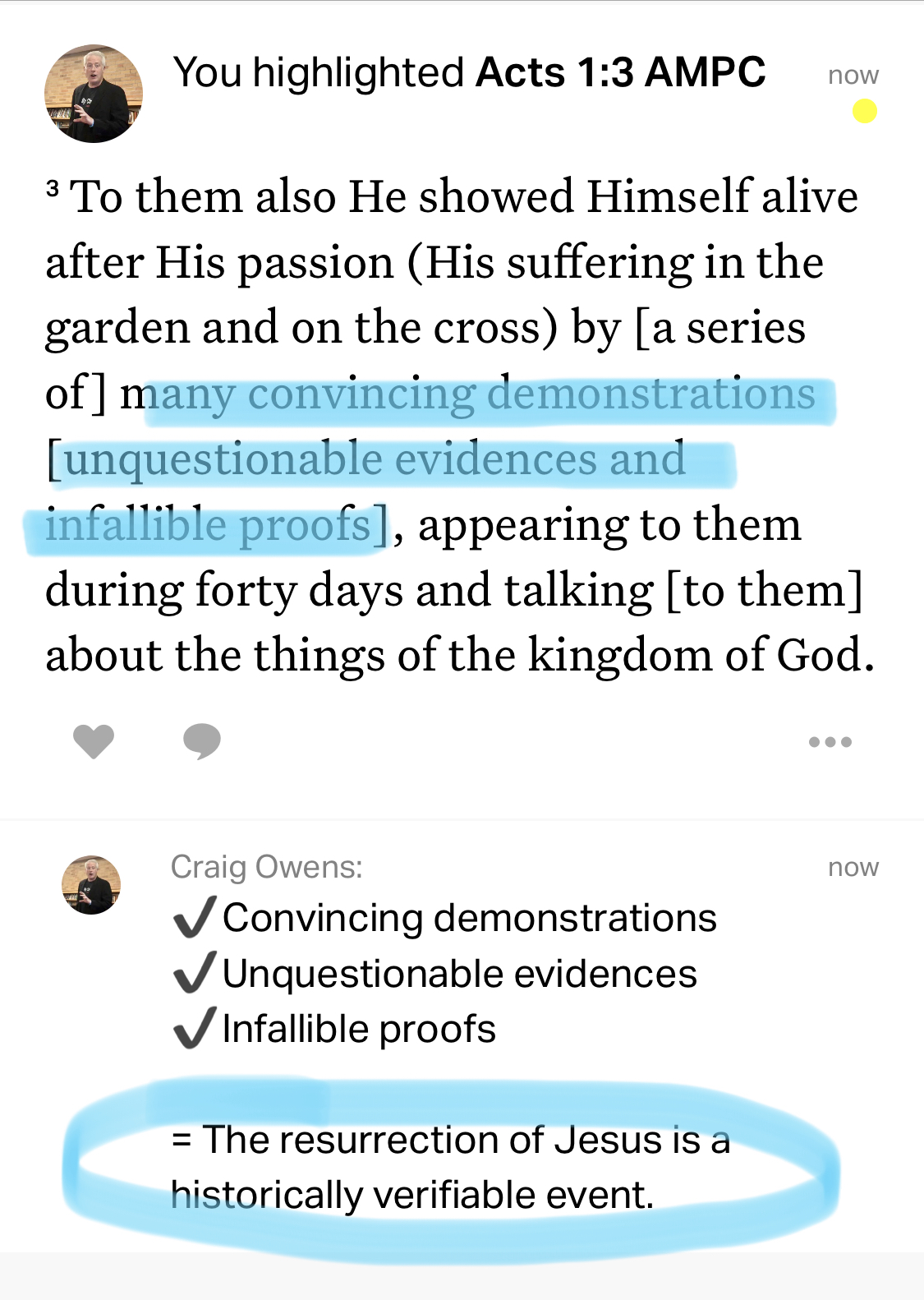
Jesus gave us ample evidence of His bodily resurrection. This is a recreation of a chart found in The Quest Study Bible:I also previously shared an infographic from The Infographic Bible. The historicity of the life, death, and resurrection of Jesus is firmly established making it a historically verifiable event.
Listen to the podcast of this post by clicking on the player below, and you can also subscribe on Apple or Spotify.
Jesus has been hanging on the Cross silently for three hours. And now He gathers His strength for four final statements that all come in pretty close proximity. His first three dying declarations have been declarations of love:
Care for His mother was storgé love by entrusting her to John’s care, which was motivated by philos love
But now comes a word of sheer, unparalleled agony. A word from a heart that is experiencing the depths of betrayal and pain that has never been known—or even approached—in all of human history: Eloi, Eloi, lama sabachthani! (Matthew 27:45-46; Mark 15:33-34)
Does this sound like a good Friday message: My God, My God, why have You forsaken Me?
This is the only one of the seven dying declarations of Jesus that Matthew and Mark record, and they do it nearly identically:
It’s spoken in the everyday language of the people: Aramaic
It’s translated into the worldwide language of business and literature: Greek
It’s a direct quotation of Hebrew Scripture
This is a word for everyone: Jews and Greek, nobles and commoners, religious people and pagans.
This dying declaration comes from words taken directly from Psalm 22. David wrote this psalm 1000 years before the crucifixion of Jesus, but note the amazing accuracy in the despicable treatment of Jesus, gambling for Christ’s clothes, even the crucifixion itself (which was unknown in David’s time), and then there’s the heart-wrenching cry My God, My God, why have You forsaken Me?
Matthew and Mark say Jesus “cried out.” This can mean a cry of joy or a cry of pain. They also record that He cried out with “a loud voice.” The Greek words here will sound very familiar even to English ears—“loud” is the word megas, and “voice” is the word phoné. Literally: Jesus raised a megaphone voice to make sure everyone heard His cry!
Remember that cried out can either be a cry of joy or of pain? Which one was it? You could make the case that it is both of these meanings. But there is a third way of using this word: a cry for help.
Jesus is about to take a plunge. He is about to descend deeper than anyone else ever has. He is about to voluntarily go into Hell itself. This megaphone cry is His battlecry before storming the gates of Hell!
Christ’s megaphone battlecry was heard in Hell and in Heaven as Jesus descended to decisively defeat hell, death, and the grave! Make no mistake, Jesus undoubtedly won that battle! That same descriptive word megas is also used for…
…the stone in front of His grave is a megas stone
…the earthquake that rolled away that stone on Resurrection morning was a megas earthquake
…the joy of Christ’s friends at seeing the tomb empty was a megas joy
…the trumpet sound at Christ’s Second Coming when He returns to earth as the Conquering King will be a megas blast, and His shout a megaphone cry (Matthew 24:31; 1 Thessalonians 4:16)!
Jesus went to the deepest depths to take us to the highest heights!
His megaphone declaration from the Cross on Good Friday was a cry of pain over our sin, a battlecry as He stormed the gates of Hell, and a cry of joy over His coming victory!
So now we can say, “Where, O Death, is your victory? Oh yeah, you don’t have one because my Savior has totally defeated you!”



 Eternal Spirit, we confess





 Craig T. Owens