Listen to the podcast of this post by clicking on the player below, and you can also subscribe on Apple, Spotify, or Audible.
May the Lord direct your hearts into God’s love and Christ’s perseverance. (2 Thessalonians 3:5 NIV)
God’s love and the patient steadfastness of Jesus is the winning combination, and is the prayer Paul desires us to pray for ourselves and others.
I like some of the aspects of this verse that are amplified in different translations:
May the Lord direct your hearts into realizing and showing the love of God and the steadfastness and patience of Christ and in waiting for His return. (AMPC)
May the Lord lead your hearts into a full understanding and expression of the love of God and the patient endurance that comes from Christ. (NLT)
And check out what Jesus said to the Church at Ephesus about not losing hold of their first love as they patiently endure (Revelation 2:3-4).
The agape love of our Heavenly Father
+ The patient endurance of Jesus
+ The instruction and encouragement of the Holy Spirit
= My loving endurance which is a testimony to others
Listen to the podcast of this post by clicking on the player below, and you can also subscribe on Apple, Spotify, or Audible.
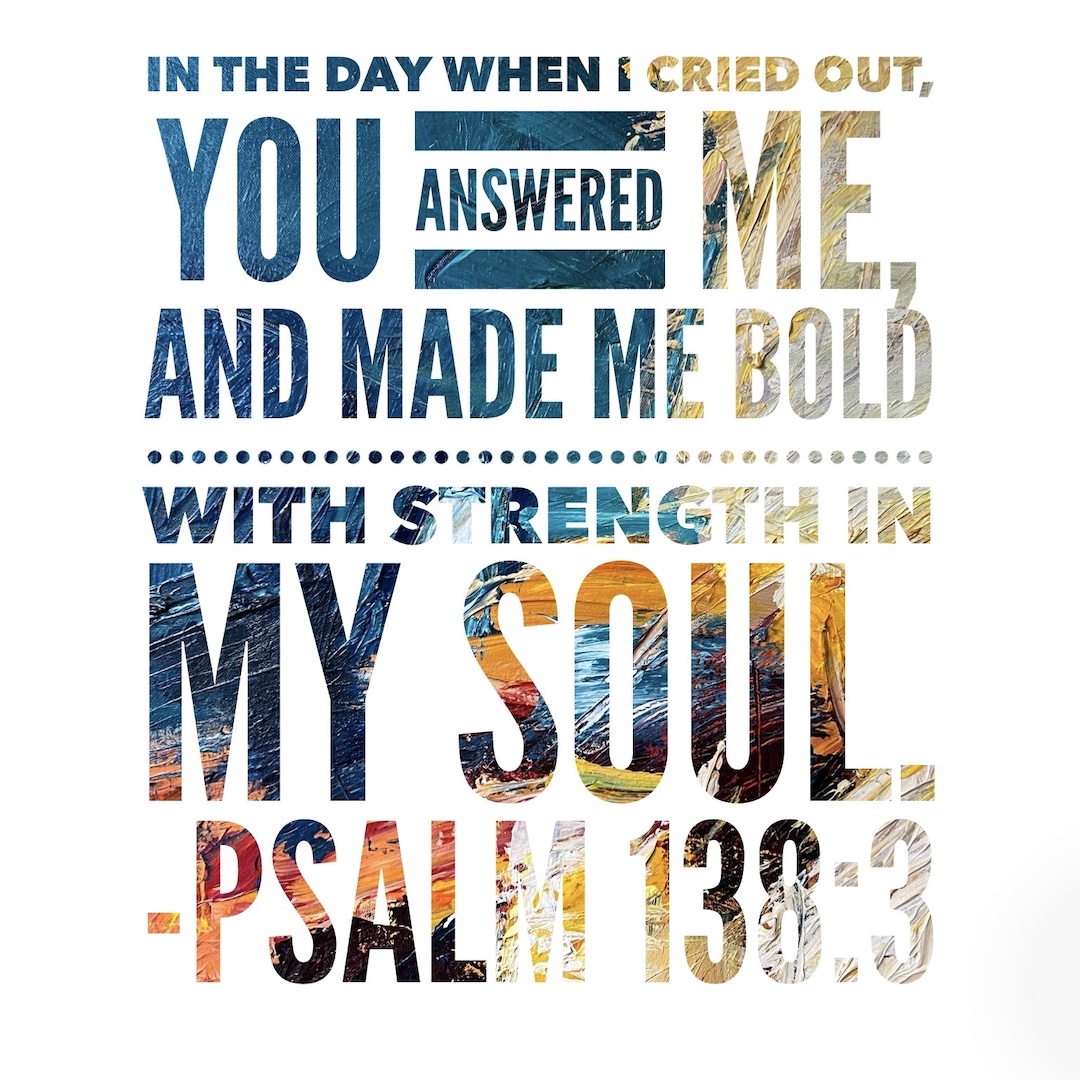
In the day when I cried out, You answered me, and made me bold with strength in my soul. (Psalm 138:3 NKJV)
Prayer requires stick-to-it-iveness, which means it takes strength to pray.
Therefore, being physically or emotionally drained makes it challenging to be alert and attentive in prayer. When we’re tired, our thoughts often drift; it’s hard to stay focused.
Sometimes one of the most helpful things you can do for your spiritual growth is to get a good night’s sleep (or take a nap).
Jesus did this (Matthew 14:22-23). He was very aware of His physical and emotional levels. When He was tired, He took a nap; when He was drained from ministry, He got alone with His Heavenly Father for refreshing (Mark 1:35, Luke 5:16).
Jesus told His disciples to pray so they wouldn’t give in to temptation (Luke 22:40, 45-46). Prayer does strengthen us against the enemy’s attack, but physical and emotional stamina helps us too.
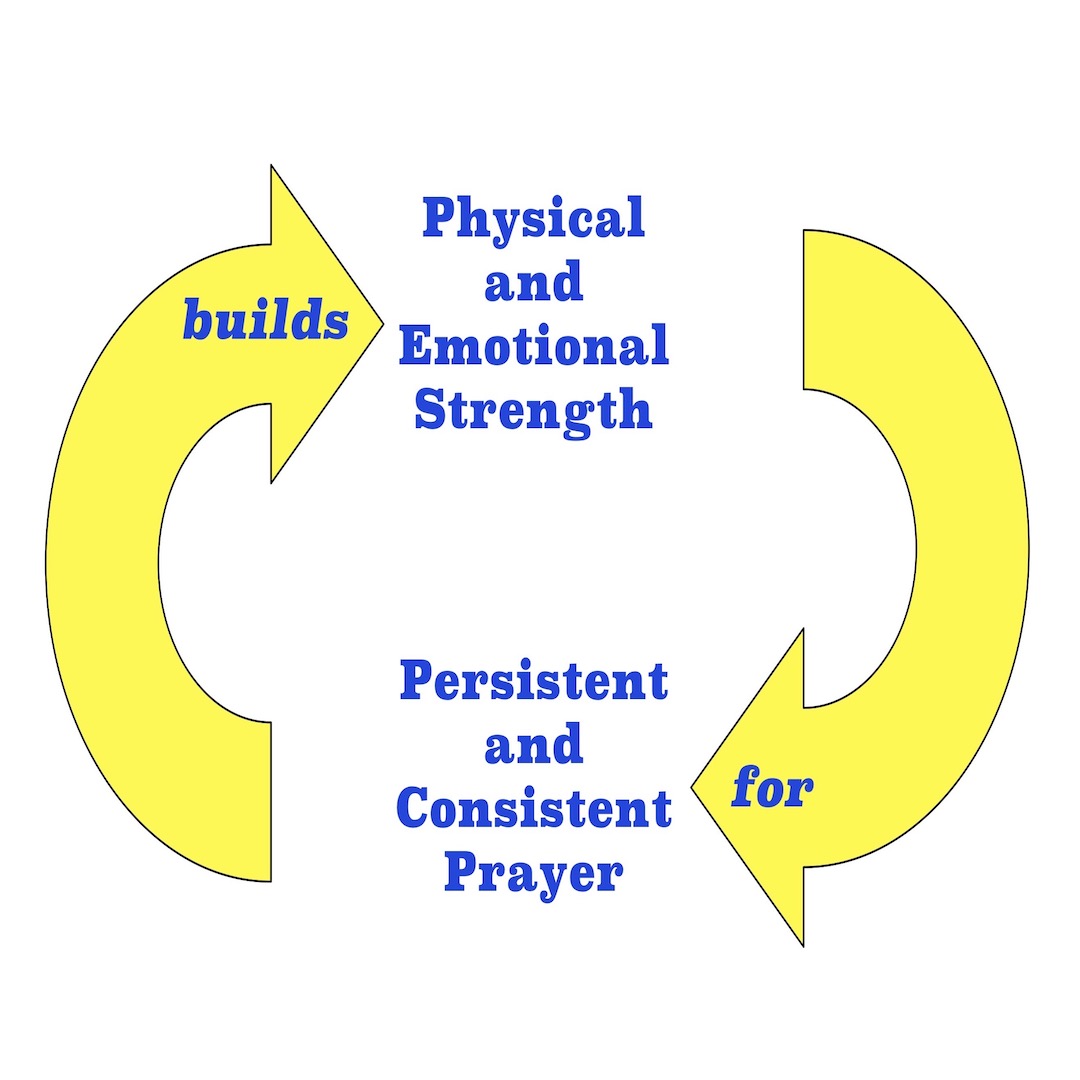
Notice the full cycle—we need physical and emotional strength to pray persistently and consistently, and prayer enhances our physical and emotional reserves to help us pray. So do all three:
When all three components of your being—spirit, body, soul—are alert and healthy, you will find your prayer life fully engaged. If one area becomes depleted, listen to the always-practical counsel of the Holy Spirit. Pray, rest, talk to a friend or a counselor so you can return to the optimal position of strength.
Yes, it takes strength to pray, but in prayer your strength is renewed.
Listen to the podcast of this post by clicking on the player below, and you can also subscribe on Apple, Spotify, or Audible.
Prayer can unleash God’s miracles. Sometimes the most visible miracles are the changes that are seen in us—our attitude, our expectation, our focus, and our maturity.
Maturity is not stuffy and stodgy. Those folks actually become quite childish when others around them don’t “act right,” according to their standards. The most mature people are the most childlike.
Do you want proof for that last statement? The most mature Person to ever live on earth was Jesus, and He loved being around kids and having children around Him (Mark 10:13-14).
His teaching examples were frequently quite simple—farmers, birds, flowers, trees, and even going to the bathroom!. He knew their songs (Luke 7:31-32), and many of His interactions with the overly-mature religious leaders were quite playful and childlike (Mark 11:27-33).
Jesus wants us to come to our Father like children (Mark 10:15-16). “Like a little child” means childlike, which is the exact opposite of childish. Those who think they are too mature for such simplistic things are actually the ones who are childish.
Jesus uses the Father-child relationship over and over to teach us about praying to a Father who is desirous of giving us the best things (Matthew 6:7-9; Luke 12:32).
One of the Psalms of Ascent written by David strikes this childlike note (Psalm 131). Verse 1 describes the childishness he’s giving up, and verse 2 describes the childlikeness he is taking on:
“my heart is not proud”—not focused on me (v. 1a)
“my eyes are not haughty”—overly grown up (v. 1b)
“I don’t concern myself with matters too great or too awesome for me to grasp” (v. 1c NLT)
instead I am stilled, quieted, trustingly at peace (v. 2)
and then David calls all of us to this same childlikeness (v. 3)
Jesus taught about persistent prayer in Luke 18:1-8 and then used a scenario from the temple to illustrate His point (Luke 18:9-17), contrasting the childish pseudo-maturity of the overly-religious man and the childlike maturity the childlike man. And then, as directed by the Holy Spirit, Luke includes the same exchange Mark used about Jesus taking up children in His arms to bless them.
Childlike is loving dependent; childish is fiercely independent.
Childlike is trusting someone wise; childish always knows best.
Childlike is imaginative; childish is realistic.
Childlike is persistent; childish is whining.
I love the Henry Wadsworth Longfellow poem called The Children’s Hour. As you read through this, imagine our Heavenly Father as Longfellow and yourself as his three daughters.
Between the dark and the daylight,
When the night is beginning to lower,
Comes a pause in the day’s occupations,
That is known as the Children’s Hour.
I hear in the chamber above me
The patter of little feet,
The sound of a door that is opened,
And voices soft and sweet.
From my study I see in the lamplight,
Descending the broad hall stair,
Grave Alice, and laughing Allegra,
And Edith with golden hair.
A whisper, and then a silence:
Yet I know by their merry eyes
They are plotting and planning together
To take me by surprise.
A sudden rush from the stairway,
A sudden raid from the hall!
By three doors left unguarded
They enter my castle wall!
They climb up into my turret
O’er the arms and back of my chair;
If I try to escape, they surround me;
They seem to be everywhere.
They almost devour me with kisses,
Their arms about me entwine,
Till I think of the Bishop of Bingen
In his Mouse-Tower on the Rhine!
Do you think, O blue-eyed banditti,
Because you have scaled the wall,
Such an old mustache as I am
Is not a match for you all!
I have you fast in my fortress,
And will not let you depart,
But put you down into the dungeon
In the round-tower of my heart.
And there will I keep you forever,
Yes, forever and a day,
Till the walls shall crumble to ruin,
And moulder in dust away! —Henry Wadsworth Longfellow
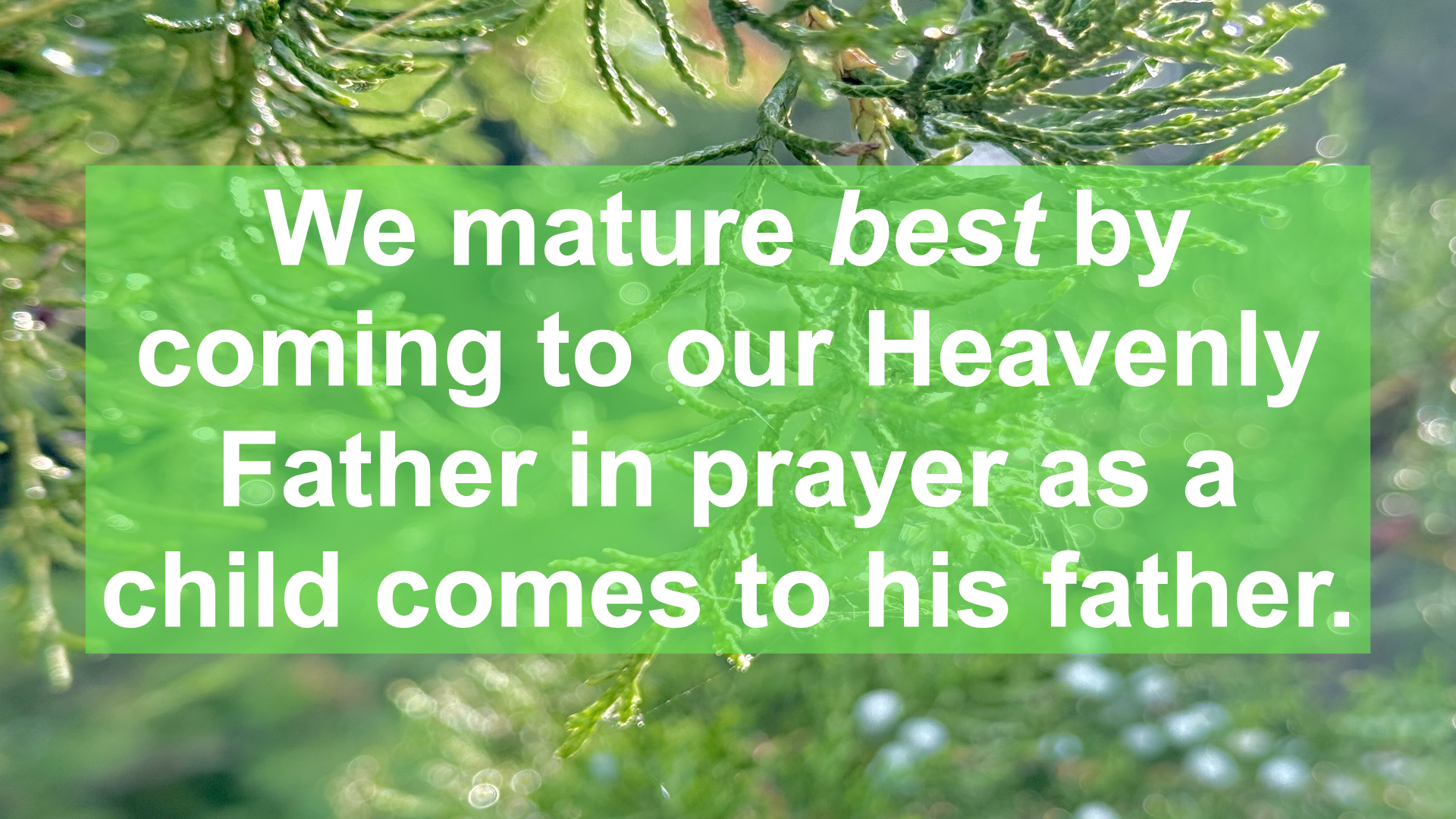
We mature by trading childishness for childlikeness. We mature best by coming to God our Father in prayer as a child comes to his father.
Let prayer change your maturity!
If you’ve missed any of the other messages in this series on how prayer changes us, you can find them all here.
Listen to the podcast of this post by clicking on the player below, and you can also subscribe on Apple, Spotify, or Audible.
Discussions about end times events and thoughts about the Second Coming of Jesus are sure to make some people uneasy. Even Christians can feel a little uncertain over the details of this topic.
This isn’t anything new. In the first century, the apostle Paul was already writing about this to the saints, particularly in his two letters to the church at Thessalonica. Paul wants to bring us reassurance about God’s resolute plan, and he also wants to reassure any fearful hearts.
In 2 Thessalonians, I see two little words that Paul uses to give us both certainty and security—those words are “the” and “our.” Paul especially uses these words when he mentions the Father, the Son, and the Spirit.
The definite article “the” distinguishes the True and the Authentic from the deception that the antichrist will bring. The “the” tells us that there is only One that is certain.
Think of it this way: If I tell you that some supplies I brought for you are in my car, I can give you the one and only car to go to. You don’t have to check just any car in the parking lot, but you have one certain car—the car—that can supply your needs. This is what we have in our Savior Jesus.
I shared more details about this in an exclusive 5-minute video for my Patreon supporters. You can become a supporter and get access to all of my exclusive content by clicking here.
The pronoun “our” then assures us of the security we have in our relationship with God. Much like Jesus taught us to pray “Our Father” we can feel comforted in knowing the assurance the Holy Spirit gives us that the Savior has opened the way for us to come to the Father—to our Heavenly Father!
Check out both of these powerful little words in this passage—
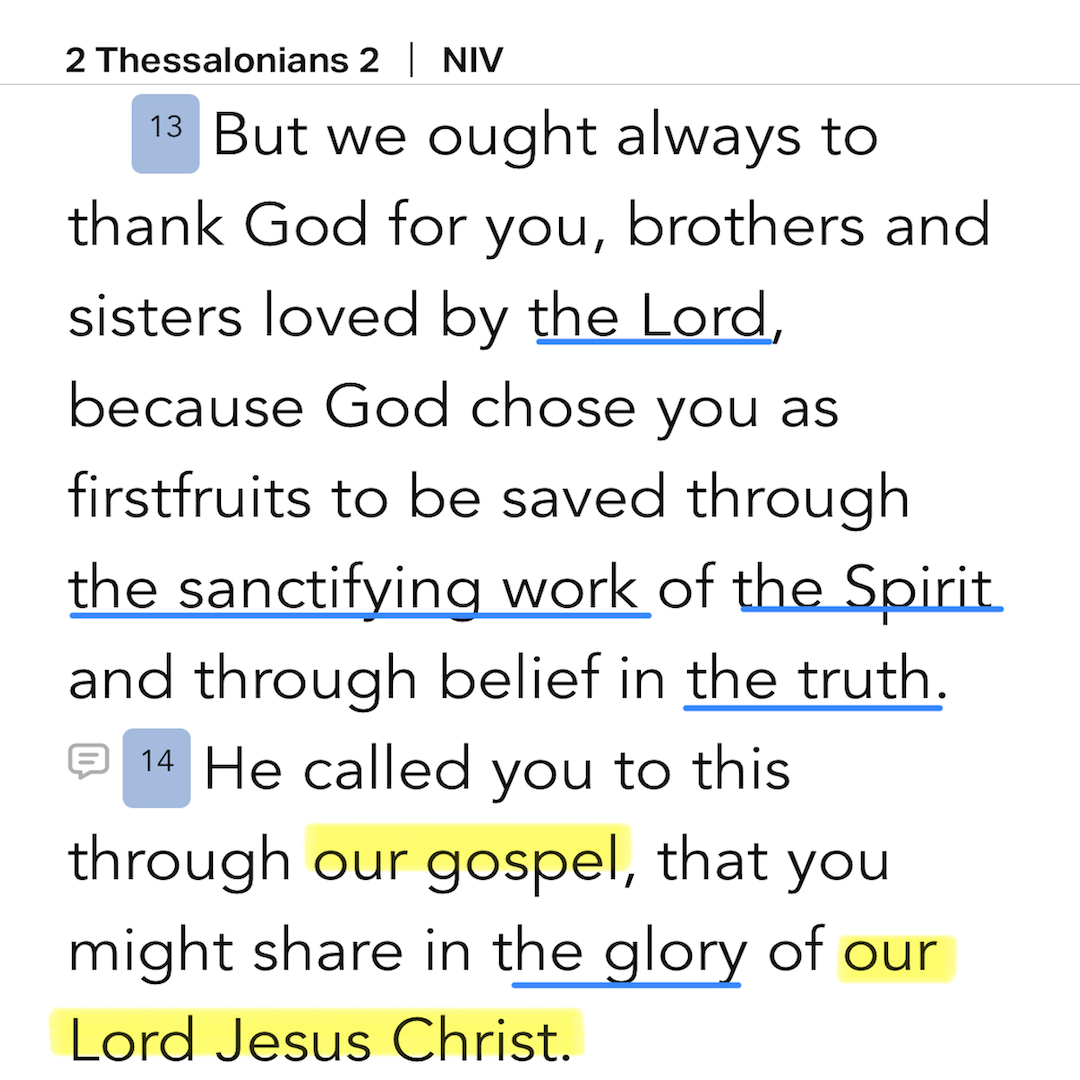
But we ought always to thank God for you, brothers and sisters loved bytheLord, because God chose you as firstfruits to be saved throughthesanctifying work oftheSpirit and through belief in thetruth. He called you to this through ourgospel, that you might share in theglory of ourLord Jesus Christ. (2 Thessalonians 2:13-14)
“The” gives us certainty and “our” gives us security to know that we are lovingly held in God’s hands—held securely for all of eternity.
Listen to the podcast of this post by clicking on the player below, and you can also subscribe on Apple, Spotify, or Audible.
The apostle Paul writes one of the simplest but most profound statements about Jesus the Christ in his letter to the church at Colosse. He said, “The Son is the image of the invisible God, the firstborn overall creation” (Colossians 1:15).
Actually, Paul may be quoting something even closer to the time of Christ’s resurrection from the grave. Verses 15-20 are thought by many scholars to be a Christian hymn that Paul is quoting. And what a profound song it is!
Notice that the definitive article “the” is prominent in this hymn, highlighting the unique and exclusive Person of Jesus. He is called—
the Son
the image of God
the firstborn over all creation
the head of the Body—the Church
the Beginning of all things
the Supreme One
Not only is Christ’s position exclusive and unassailable, His power is unrivaled—
He is over all creation because He created all things
He controls all things
He is before all things
He holds all things together
He has supremacy over all things
He possesses all the fullness of God
He alone can reconcile all things to Himself
Our human language runs out of words and phrases to describe this majestic King of kings, but I love when people try their best to paint a picture of this King. S.M. Lockridge did just that in a sermon entitled “That’s my King!” Check out this portion of this message—
He’s the greatest phenomenon that ever crossed the horizon of this world.
He’s God’s Son…
He’s a sinner’s Savior…
He’s the centerpiece of civilization… He stands in the solitude of Himself… He’s august and…
He’s unique…
He’s unparalleled…
He’s unprecedented…
He’s the loftiest idea in literature…
He’s the highest personality in philosophy…
He’s the supreme problem in higher criticism…
He’s the fundamental doctrine of true theology…
He’s the cardinal necessity for spiritual religion…
He’s the miracle of the age…
He’s the superlative of everything good that you choose to call Him… He’s the only one qualified to be an all-sufficient Savior…
And you may also want to check out a series of messages I shared on the Royal Psalms called All hail, King Jesus!
For in Christ lives all the fullness of God in a human body. So you also are complete through your union with Christ, who is the head over every ruler and authority. (Colossians 2:9-10 NLT)
Don’t ever stop getting to know this King more and more intimately for yourself. He wants you to see Him in all of His glory so that your life is unalterably changed.
Listen to the podcast of this post by clicking on the player below, and you can also subscribe on Apple, Spotify, or Audible.
Last week we talked about how the title “God” can mean different things to different people. When we are talking about the One True God as He is revealed to us in the Person of Jesus, there is no doubt of Whom we are speaking. The opponents of Christianity knew this too, which is why they tried to get the early saints to not use the name Jesus.
Isaiah 9:6 says that a Child is born and a Son is given, but this Son is given the unusual title of Everlasting Father. Jesus acknowledged this unusualness in this exchange with the Pharisees in Matthew 22:41-45.
“Everlasting” means continuous existence; existing in perpetuity; the Chief by which all other things are ordered and aligned. We see this in Genesis 1:1, where “In the beginning” signifies God started Time but He existed before that moment.
In John 1:1, similar words are used,but here “in the beginning” means if you stand at the moment Time began and were able to look back into the immeasurable eternity that existed before that, God was there. More specifically, the Word of God (Jesus) was there as God. Jesus Himself affirmed this in Revelation 1:8 and 3:14.
Then in 1 John 1:1, the phrase “from the beginning” means that after Time ends, you can look into the infinite eternity that still exists and God is there. Again, Jesus Himself affirms this in Revelation 22:13.
“Father” this is the first word in our biblical Hebrew dictionary. It means father, the head or founder of a family, the protector of the family. Paul says that Jesus fulfills all of these definitions (Colossians 2:9-10, 1:15-22), and the writer of Hebrew opens his epistle with the same thought (Hebrews 1:1-3).
No one on earth has seen God the Father. This makes it difficult to follow Him. Which is why Jesus made His appearing among us (John 1:1, 14, 18).
Paul wanted people to know“the mystery of God, namely, Christ” (Colossians 2:2), and he said that Jesus is the Key that unlocks the treasure-trove of God’s rich love for us. Notice Paul’s progression: teaching the Word (1:25-27) so that we mature (1:28), so that we have the full riches of complete understanding, in order that we may know the mystery of God, namely, Christ (2:2-4).
When Jesus was born, Simeon gave us the same assurance when he saw Jesus and announced that Jesus was the Christ that had been prophesied (Luke 2:25-32), and Jesus Himself told His disciples the exact same thing (John 14:8-9).
Let people see God’s love through your life, all year-round but especially at Christmas. As we said last week, when we talk about Jesus and live for Jesus, we invite others to God, through Jesus, by the Spirit’s illumination.
Listen to the podcast of this post by clicking on the player below, and you can also subscribe on Apple, Spotify, or Audible.
During the first year of [Darius’] reign, I, Daniel, learned from reading the Word of the Lord, as revealed to Jeremiah the prophet, that Jerusalem must lie desolate for seventy years. So I turned to the Lord God and pleaded with Him in prayer and fasting. I also wore rough burlap and sprinkled myself with ashes. (Daniel 9:2-3 NLT)
Reading the Word of God prompted Daniel to pray to the God that is revealed in the Word, and the prayer he offered to God was grounded in biblical promises—in God’s own promises (vv. 4-19).
It’s like when children are speaking to their earthly fathers and say, “Dad, you promised,” it gets the attention of that father’s heart because he wants to keep his word.
God hasn’t forgotten His promises; in fact, He is always at work to fulfill what He has said. But when we pray, “Father, according to Your promise to me,” we are praying words that resonate with His heart. He delights for His children to see Him at work. And He is glorified when we praise Him for fulfilling what He has promised.
When we end our prayer with “in the name of Jesus, Amen,” that is not just some magical phrase that we tag on, but it is a reminder that we can come boldly before God’s throne with our petition. And prayers that are aligned with the heart of God—prayers that are grounded in the Word of God—have the “Amen” of Jesus added to them (Hebrews 10:19-22; 2 Corinthians 1:20).
We never need to be at a loss for words when we go to our Heavenly Father in prayer. Read His Word, see the Holy Spirit illuminate and apply the Word to your circumstances, and then pray confidently in the name of Jesus.
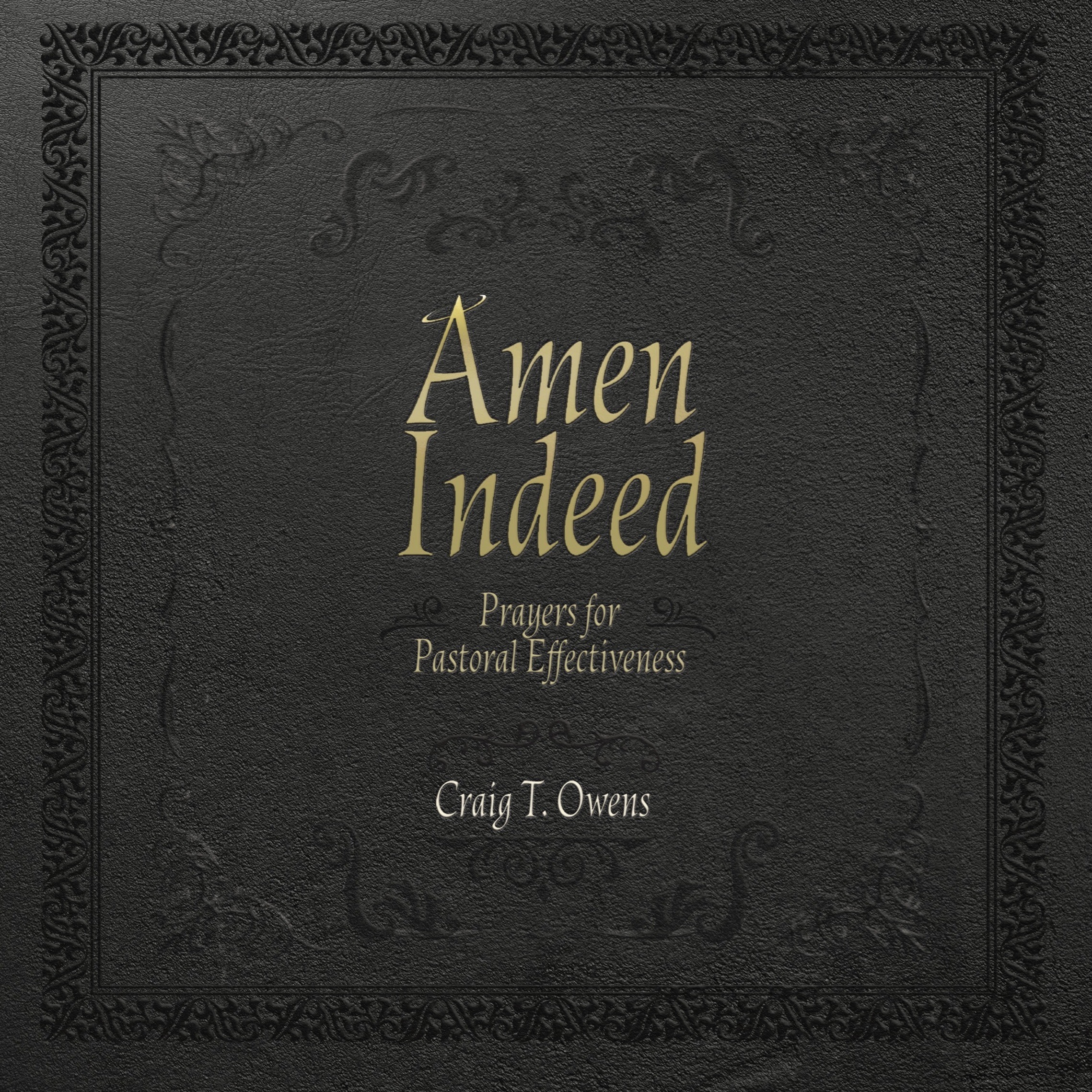
For pastors and shepherd leaders, my book Amen Indeed contains over 100 biblically-based prayers for many of the situations we face in our ministries. My prayer for you is that this book will help you learn how to use the Bible as your Prayer Book.
Listen to the podcast of this post by clicking on the player below, and you can also subscribe on Apple, Spotify, or Audible.
Have you ever heard the phrase “in name only”? For instance, someone might say, “He’s the boss around here in name only, but the one who really calls the shots is someone else.” We might give the title “boss” to someone just for convenience because “The guy who thinks he’s in charge” is probably too awkward to keep saying! We know the true boss by what he or she says or does, and how people respond to him or her.
I think this is true when someone says, “God,” you might wonder just what they mean by that. Sennacherib’s field commander appeared to be confused by this, as he uses both “God” and “god” interchangeably in 2 Kings 18:19-22, 32-35. But the foretelling of the Advent of the Christ makes it perfectly clear to Whom the prophets were pointing (Isaiah 9:6-7).
Let’s consider the title Mighty God. The word God is the Hebrew word el. It is translated many ways, but let’s find out which definition is correct in this foretelling of Jesus.
A god-like person
A mighty hero
An angel
A manmade god
The One True God
We can eliminate “a god-like person” from Exodus 15:11.
We can eliminate “a mighty hero” from Psalm 82:1.
We can eliminate “an angel” from Psalm 29:1 and Isaiah 6:1-3.
We can eliminate “a manmade god” from Isaiah 14:12-15.
So it must mean He is The One True God! One of Isaiah’s favorite phrases is “the Lord Almighty” which he uses 61 times (e.g. Isaiah 47:4)!
Isaiah 40 is one of the most descriptive chapters of the Lord Almighty. In here we see that…
He forgives sin (vv. 1-2)
He is beyond description (v. 12)—holding the world’s 326 quintillion gallons of water in the hollow of His hand, fitting the 10 septillion stars of the cosmos across the breadth of His hand, and carrying the weight of the Earth (1.3 octillion pounds) easily in His basket!
He is distinguished from manmade gods (vv. 18-20, 25)
His strength is absolutely unrivaled (vv. 26, 28)
How do we know these descriptive words in Isaiah point to Jesus? Look at these First Testament Scriptures compared to Christ’s First Advent:
Isaiah 40:3-5 foretells the messenger who would herald Christ’s arrival. Zechariah is inspired by the Holy Spirit to make this connection to his son John (Luke 1:76-77), and then John lives this out (Mark 1:1-3).
Remember that 40:1-2 says that The One True God forgives sins, which is what John the Baptizer sees in Jesus (John 1:29).
In 41:10, 13-14 we read of God shining His light into darkness to set people free, which is another thing that Zechariah connects to Jesus (Luke 1:67-75).
Jesus wasn’t God in name only, but His words and action—and the response of those who saw and heard Him—affirmed that He is the Mighty God that was foretold (John 8:48-59; Mark 14:60-64).
Notice also how the early New Testament saints proclaimed Christ’s unique deity, stating clearly that He is the fulfillment of all of the prophetic words that point to Him as The One True God (Acts 4:8-10, 12, 18; 5:27-32).
Peter and John said, “We are witnesses of this.” We too are witnesses of this if we have accepted Jesus as our Lord and Savior. We get to proclaim His Lordship by our verbal testimony and our lifestyle. As C.S. Lewis said, “A man who was merely a man and said the sort of things Jesus said would not be a great man or a moral teacher. He would either be a lunatic—on the level with the man who says he is a poached egg—or else he would be the devil of hell. You must take your choice. Either this was, and is, the Son of God; or else a madman or something worse. You can shut Him up for a fool…or you can fall at His feet and call Him Lord and God.”
In Philippians 2:9-11, Paul points out that Jesus has the name above every name and that every knee must bow to Him and every tongue confess that He is Mighty God! Today, let us bow our knee to Him and lift our voices proclaiming that He is Lord and God until our One True God takes us home or returns at His Second Advent.
If you’ve missed any of the other message in our Advent series called Jesus Is…, you can find them all here.
When the Holy Spirit shines His light on a biblical promise, and you turn that into a prayer, write it down! You may need to go back to this again and again. When God answers your prayer, write it down again! This can become a testimony journal that you and others can use to recall God’s provision.
“The pathway to maturity and to solid biblical food is not first becoming an intelligent person, but becoming an obedient person.” —John Piper
“Somehow or other an extraordinary idea has arisen that the disbelievers in miracles consider them coldly and fairly, while believers in miracles accept them only in connection with some dogma. The fact is quite the other way. The believers in miracles accept them (rightly or wrongly) because they have evidence for them. The disbelievers in miracles deny them (rightly or wrongly) because they have a doctrine against them.” —G.K. Chesterton
“At every moment, we always have a choice, even if it feels as if we don’t. Sometimes that choice may simply be to think a more positive thought.” —Tina Turner
Every day should be a day of thanksgiving!
“We are strangers on Earth; our homeland is in Heaven. Our walk is here; our hearts are there.” —Dr. Henry Halley
I have already shared the first two posts in the latest archeological research on the biblical city of Jericho. Here is part three.
“Success is no accident. It is hard work, perseverance, learning, studying, sacrifice, and most of all, love of what you are doing or learning to do.” —Pelé
“The greatest leader is not necessarily the one who does the greatest things. He is the one who gets people to do the greatest things.” —Ronald Reagan
Husbands, love your wives, just as Christ loved the church and gave Himself up for her to make her holy, cleansing her by the washing with water through the Word. (Ephesians 5:25-26)
Dr. Henry Halley points to seven images the Bible portrays of how Jesus interacts with His saints.
“1. The Shepherd and the sheep emphasizes both the warm leadership and protection of Christ and the helplessness and dependency of believers (John 10:1-18).
2. The vine and the branches points out the necessity for Christians to depend on Christ’s sustaining strength for growth (John 15:1-8).
4. The cornerstone and building stones (Matthew 21:42) accents the foundational value of Christ to everything the church is and does, as well as Christ’s value to the unity of believers. Love is to be the mortar which solidly holds the living stones together (1 Corinthians 3:9; 13:1-13; Ephesians 2:19-22; 1 Peter 2:5).
5. The head and many-membered body, the church, is a vibrant organism, not merely an organization; it draws its vitality and direction from Christ, the Head, and each believer has a unique and necessary place in its growth (1 Corinthians 12:12-13, 27; Ephesians 4:4).
6. The last Adam and new creation presents Christ as the initiator of a new creation of believers as Adam was of the old creation (1 Corinthians 15:22, 45; 2 Corinthians 5:17).
7. The bridegroom and bride beautifully emphasizes the intimate fellowship and co-ownership existing between Christ and the church (Ephesians 5:25-33; Revelation 19:7-8; 21:9).”
You can read all of the Bible verses listed in this post by clicking here.








 Craig T. Owens