Thursdays With Oswald—Thinking Like Christians

Oswald ChambersThis is a weekly series with things I’m reading and pondering from Oswald Chambers. You can read the original seed thought here, or type “Thursdays With Oswald” in the search box to read more entries.

Thinking Like Christians 

     The New Testament insists on an instructed mind as well as a vital experience. … 

     There is always a quarrel between our common sense and the revelations made in God’s Book. We must lose our soul in order to find it. We have to be born from above and receive the Holy Spirit into our spirit, and then begin to construct another soul, or way of reasoning, and to do this we must accept not only the facts that come to us through our common sense, but the facts that come by revelation. We say seeing is believing, but it is not. We must believe a thing is possible before we should believe it even though we saw it (John 20:29). … 

     Our beliefs will mock us unless something comes into us from God, because nothing has any power to alter us save the incoming of the life of God. The Holy Spirit is the One Who makes experimentally real in us what Jesus Christ did for us. … The great need for men and women is to receive the Holy Spirit. Our creeds teach us to believe in the Holy Spirit; the New Testament says we must receive Him (Luke 11:13). Are you powerless in your life? Then, for Christ’s sake, get at Reality! Ask God for the Holy Spirit. … 

     We starve our minds as Christians by not thinking, and we cannot think as Christians until we are born from above. So many of us have a good spiritual experience, but we have never thought things out on Christian lines. It is just as true that a man may live a Christian life without thinking as that a man may think a Christian life without living it. We have to learn to combine the two, and to do this we must build up our minds on these great truths. 

From The Psychology Of Redemption

How are you doing at thinking AND living a Christian life? To do both, you must receive the Holy Spirit, and begin to rely on Him for both Christian thinking and living.

7 Quotes From “Hope … The Best Of All Things”

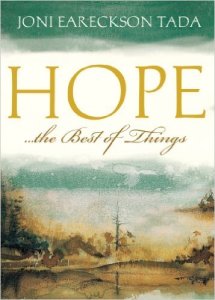
HopeJoni Eareckson Tada knows what it is to battle darkness and depression. And she also know the power of hope in those dark places. Hope … The Best Of All Things is an encouraging book for anyone going through a difficult place (please check out my book review here).

Here are some of the quotes from Hope which especially stood out to me.

“People are angry; cynicism and despair are on the rise, and the nightly news reminds us we are only one terrorist plot away from another national nightmare. Oh, how we need to grasp the soul-settling hope found in the pages of God’s Word—not only grasp it, but allow the hope of God to fill and overflow our hearts, transforming us into people who are confident and at peace with themselves, their God, and their circumstances.”

“For me, suffering is still that jackhammer breaking apart my rocks of resistance every day. It’s still the chisel that God is using to chip away at my self-sufficiency and my self-motivation and my self-consumption. Suffering is still that sheepdog snapping and barking at my heels, driving me down the road to Calvary where otherwise I do not want to go. My human nature, my flesh, does not want to endure hardship like a good soldier (2 Timothy 2:3) or follow Christ’s example (1 Peter 2:21) or welcome a trial as friend. No, my flesh does not want to rejoice in suffering (Romans 5:3) or be holy as He is holy (1 Peter 1:15). But it is at Calvary, at the Cross, where I meet suffering on God’s terms.”

“Do you know who the truly handicapped people are? They are the ones—and many of them are Christians—who hear the alarm clock go off at seven-thirty in the morning, throw back the covers, jump out of bed, take a quick shower, choke down breakfast, and zoom out the front door. They do all this on automatic pilot without stopping once to acknowledge their Creator, their great God Who gives them life and strength each day. Christian, if you live that way, do you know that James 4:6 says God opposes you? ‘God opposes the proud, but gives grace to the humble.’”

“Take up your cross daily and follow the Lord Jesus (Luke 9:23). I must qualify that statement. Please know that when I take up my cross every day I am not talking about my wheelchair. My wheelchair is not my cross to bear. Neither is your cane or walker your cross. Neither is your dead-end job or your irksome in-laws. Your cross to bear is not your migraine headaches, not your sinus infection, not your stiff joints. That is not your cross to bear. My cross is not my wheelchair; it is my attitude. Your cross is your attitude about your dead-end job and your in-laws. It is your attitude about your aches and pains. Any complaints, any grumblings, any disputings or murmurings, any anxieties, any worries, any resentments or anything that hints of a raging torrent of bitterness—these are the things God calls me to die to daily.”

“You see, we are to God the fragrance of Christ. The world can’t see Jesus endure suffering with grace because He’s not here on earth, but you and I are. And we can fill up in our flesh what is lacking in His afflictions (Colossians 1:24), and in so doing become that sweet fragrance, that perfume, that aroma of Christ to God.”

“God mandates that we go out into the streets and the alleys and the highways and the byways. He mandates that we find the poor, the blind, the disabled, and the lame, and help them get busy living, because misery might love company, but joy craves a crowd. And the Father and the Son and the Holy Spirit crave a crowd of joy, joy spilling over and splashing and filling the hearts of thirsty people in this world who are absolutely dehydrated from a lack of hope.”

“The hope we wait for is our only hope, the blessed hope, the glorious appearing of our great God and Savior, Jesus Christ (Titus 2:13). It is Jesus for Whom we have prevailed through all of this suffering, and, oh, for the sweetness of melding one heart into His in that intimacy that is so precious. … Our hope is for the Desire of the nations. Our hope is the Healer of broken hearts, the Friend of sinners, the God of all encouragement, the Father of all comfort, the Lord of all hope. And it is my prayer that the eyes of your heart might be enlightened so that you might know this hope to which He has called you.”

The Key Decision For Influential Men

Influence like JesusNo matter how you look at it, being a Dad is hard work! Men have this constant balancing act between being tough and being tender. Guys have to have their game face on at work, and their family face on at home. They’ve got to work hard knocking down work competitors, and then work just as hard building up their family members.

But there is one key decision that will determine how successful a man will be at work, at home, in his social circles, and even in his relationship with God. 

In Acts 10 we meet a centurion named Cornelius. Centurions were professional military officers in charge of a centuria (usually 100 soldiers). Centurions were always “on the clock,” never letting down their guard nor their professionalism.

All of the centurions mentioned in the New Testament have noble characteristics associated with them. Whereas someone might be uncertain how a typical Roman soldier would behave, people felt more assured when the centurion was on the scene. Even Roman governors like Pilate, and Jewish kings like Herod, all seemed to fully trust the judgement, honesty, and resourcefulness of centurions.

Centurions worked hard to get where they were, and had some well-earned perks:

  • Good pay (one built a temple, Luke 7:1-5).
  • “Men of authority” with soldiers and servants reporting to them (Matthew 8:8-9).
  • Opportunity for advancement (Rome was the dominate world force).
  • A certain degree of autonomy (they had their own residences (Matthew 8; Acts 10).

In order to keep this position, they would have to buy into kurios Caesar (Caesar is lord). To do otherwise was to put their position and future advancement at risk.

Yet Cornelius was different. 

He was a trusted centurion, but something unusual stood out about his life. Luke the historian describes him as devout and God-fearing, mentioning his pious activities of prayer and giving to the poor. Cornelius’ own soldiers referred to him as righteous and respected by notable people in the community.

But probably most telling of all: God noticed how committed Cornelius was (see Acts 10:3-4)!

Cornelius had a lot to lose by rejecting kurios Caesar for, as the Christians said, kurios Iesous (Jesus is Lord). Yet after carefully weighing his options, he saw that trusting God was the best thing he could do for his family. His view of the eternal outweighed anything that he could gain in the temporal.

This one decision changed everything! 

Because Cornelius trusted God, look at the expansiveness of his influence, not only at home, but at work, and among his friends and extended family, and throughout his community:

  • His family—ALL his family were devout and God-fearing (v. 2)
  • His employees—a devout soldier (v. 7)
  • His community—respected by ALL the Jewish people (v. 22)
  • His relatives and friends—his relatives and close friends (v. 24)
  • In fact everyone around him—we are ALL here in the presence of God (v. 33)
  • And most importantly, with God—your prayers and gifts have come up as a memorial offering before God (v. 4)

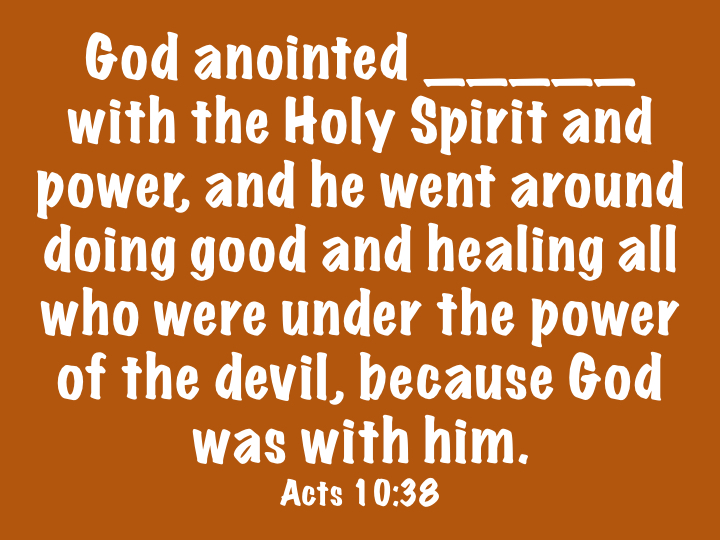
Fellas, you can have this same level of influence if you, too, will decide to live karios Iesous: Jesus is Lord. If you will do that, you can have said about your life what was said about Cornelius and Jesus: “God anointed ___________ with the Holy Spirit and power, and he went around doing good and healing all who were under the power of the devil, because God was with him!” (see Acts 10:38).

Thursdays With Oswald—Is Jesus Worth It?

Oswald ChambersThis is a weekly series with things I’m reading and pondering from Oswald Chambers. You can read the original seed thought here, or type “Thursdays With Oswald” in the search box to read more entries.

Is Jesus Worth It? 

     With regard to all the pleasures and sciences and interests of this life, push this simple consideration, “Is this the kind of thing the Son of God is doing in the world, or is it what the prince of this world is doing?” Not, “Is it right?” but “Is it the kind of thing the Son of God would be doing in the world?” If it is not, then don’t touch it. 

     If you only give up wrong things for Jesus Christ, don’t talk any more about being in love with Him. If you want to do a thing all the time, it is no virtue not to do it! Jesus Christ takes the “want to” out of us and enables us to do in this world the things He would be doing if He were here. 

     We say, “Why shouldn’t I? It isn’t wrong!” What a sordid thing to say! When we love a person, do we only give up what is wrong for him? Love is not measured by what it gets, but by what it costs, and our relationship to Jesus Christ can never be on the line of, “Why shouldn’t I do this?” Our Lord simply says, “If any man will be My disciple, those are the conditions” (see Luke 14:26-27 and 33). Is He worth it?

From The Psychology Of Redemption

What do you think: Is Jesus worth it?

4 Ways To Share The Good News With Everyone

Everybody EveryoneJesus told His followers that their ministry assignment was to take His message of salvation throughout the entire world. One requirement to do this, is to be able to communicate with lots of people. Actually to be able to communicate with everyone.

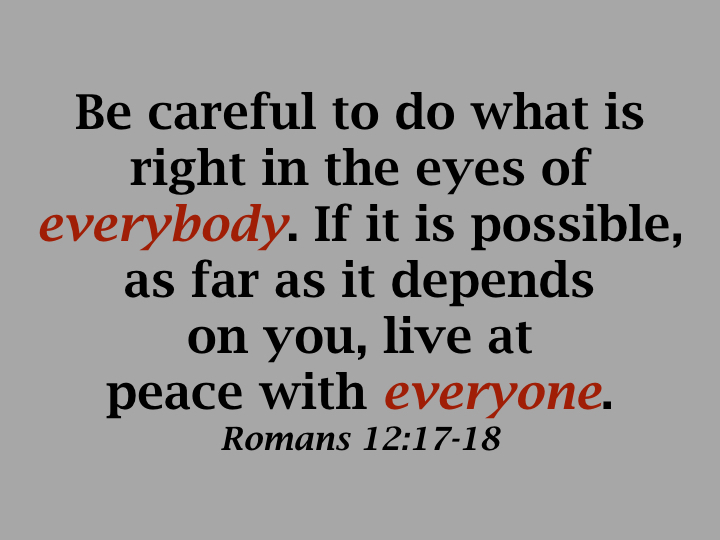
Be careful to do what is right in the eyes of everybody. If it is possible, as far as it depends on you, live at peace with everyone. (Romans 12:17-18)

Really? Everybody and everyone?!

Yes!

Jesus said our Helper would be the Holy Spirit. He would come to empower us to be witnesses to everyone, everybody, everywhere (Acts 1:8).

We have been learning how to communicate with others better, but noticing their communication style “accent.” Check out this post to get some more insight into this. In a nutshell…

  • Doers are action-oriented
  • Planners like to work out all the details
  • People want to make sure everyone is connected
  • Visions are imagining a better future

So if you are a Doer, and you’re trying to share the Good News about Jesus with a Planner, you can probably see a potential problem. The Doer is speaking in bullet points, but the Planner is wanting a lot more facts and figures.

This is where the Holy Spirit can help us. He has the insight that we don’t, and He can direct our words, just as He directed Christ’s words (see John 12:49-50).

Here’s how to talk their talk when you’re sharing the Good News:

(1) Doer

  • Keep it brief
  • Share more facts than stories
  • Stress now/today
  • Rely on the Gospel of Mark (action oriented)

(2) Planner

  • Tell them the who, what, where, when, why, and how
  • Be ready for lots of questions
  • Give them time to process your information
  • Rely on the Gospel of Matthew (lots of background, lots of Old Testament references to answer the who, what, where, when, why and how)

(3) People

  • Develop a friendship first
  • Share more stories than facts
  • Don’t tell them, show them your personal life
  • Rely on the Gospel of Luke (lots of personal stories about changed lives)

(4) Vision

  • Share both the facts and the stories
  • Encourage them to “Imagine what would happen …”
  • Give them time to ask questions
  • Rely on the Gospel of John (very poetic and image-rich)

You can connect with everyone, everybody, everywhere and share the Gospel with them in an effective way. Allow the Holy Spirit to give you the insight you need.

Check out how I describe this in more detail here…

The Rewards For Getting Along With Difficult People

How To Get Along With OthersHere’s a shocking statement—Difficult people are difficult to get along with. I know, I probably just blew your mind with that one, but sometimes it’s important to state the obvious.

Christians should be the best at getting along with others. First of all, because they have the Holy Spirit to help them, and, second, because the world is watching to see if having a relationship with Jesus really does make a difference.

We’ve already learned that in order to change our behavior toward difficult people, we can’t change our behavior (check out my post on that topic here). Instead, we need to change our thoughts first. One thought to change is about ourselves, and another thought to change is the fact that Jesus promised rewards for those who loved difficult people—

If you love those who love you, what credit is that to you? Even sinners love those who love them. And if you do good to those who are good to you, what credit is that to you? Even sinners do that. And if you lend to those from whom you expect repayment, what credit is that to you? Even sinners lend to sinners, expecting to be repaid in full. But love your enemies, do good to them, and lend to them without expecting to get anything back. Then your reward will be great, and you will be children of the Most High, because he is kind to the ungrateful and wicked. (Luke 6:32-35)

One way to love others is by learning to “speak their language.” Most of us communicate with four different accents: Doer, People, Planner, Vision.

You can watch the video where I explain these styles in more detail, but you can learn their accent by listening for…

(1) How they handle stressful situations:

  • Doer—get hyper-focused
  • Planner—withdraw to plan
  • People—call a meeting
  • Vision—take time to daydream

(2) How they listen to others:

  • Doer—take short bullet points and then quick action
  • Planner—take detailed notes, and ask lots of detailed questions
  • People—make good eye contact, take very little notes, and then reiterate what was said
  • Vision—doodle, and express “ping pong ball” thoughts

(3) How they speak about folks with other “accents”:

  • Doer—this is taking too long; nothing ever gets done; they’re daydreamers
  • Planner—they jump the gun; they’re swayed by emotions; they’re unpredictable
  • People—why don’t they want to meet; they’re too aggressive; they’re too robotic
  • Vision—they don’t see the big picture; they’re too rigid; they’re too emotional

You CAN get along better with everyone. Romans 12:18 tells us that peaceful living with others depends on you and me. Let’s do this well so that Jesus is glorified!

4 Ways To Evaluate Biblical Evidence

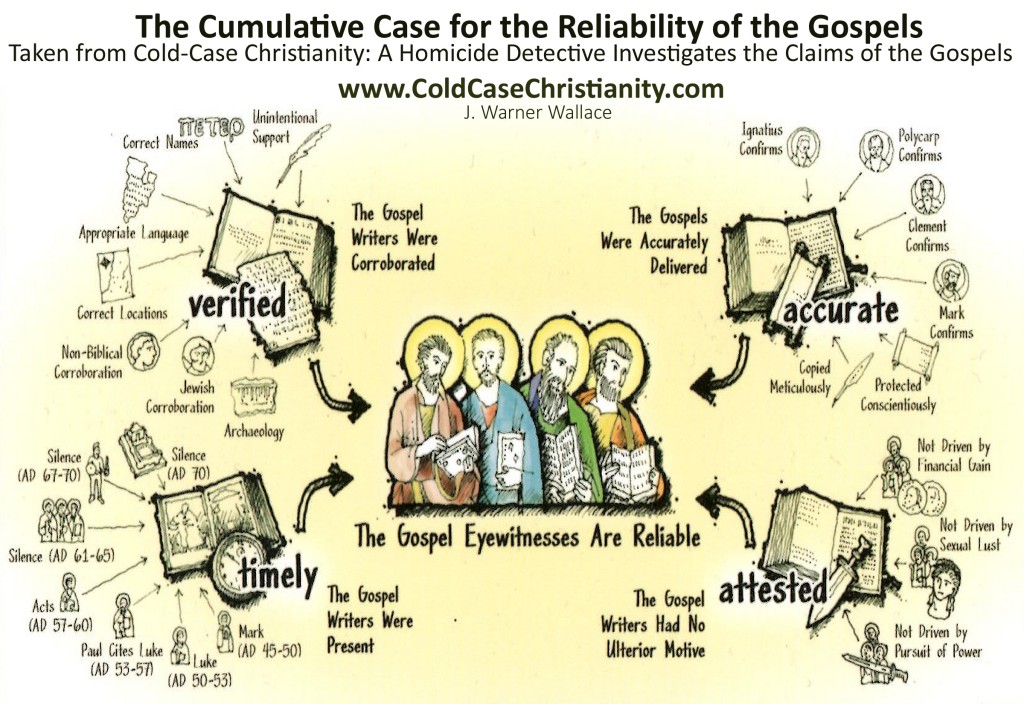
Reliability of the GospelsTo be honest, if someone hasn’t heard the biblical account of the life of Jesus Christ before, it can sound quite fantastic! Jesus was born of a virgin, lived a sinless life, performed miracles no one had seen before, died a horrific martyr’s death, was raised back to life three days later, and then ascended back into heaven until He returns to Earth again.

But as fantastic as this sounds, there is still enough evidence to reasonably believe it’s all true. An unreasonable faith believes in something in spite of the evidence; a blind faith believes in something without any evidence; and reasonable faith believes in something because of the evidence.

The Bible gives us eyewitness testimony about the life of Jesus which we can matter-of-factly evaluate. 

In a modern-day court of law, eyewitness testimony is evaluated on…

  • …the determination that the witnesses were actually present.
  • …the ability to corroborate their testimony.
  • …the consistency of their testimony over time.
  • …any biases they have that would cause them to exaggerate or misrepresent their testimony.

Let’s consider the testimony of the four Gospel writers: Matthew, Mark, Luke and John.

(1) Were The Eyewitnesses Present?

  • Luke is considered a credible historian, even by modern standards. He wrote the book of Acts following the ascension of Jesus into Heaven. Because he did not mention three major events in Jewish history (the Jewish uprising, the Roman siege of Jerusalem in response to that uprising, and the Roman destruction of the temple), we can determine that Acts was written before 61 AD.
  • Luke wrote the Gospel that bears his name before he wrote Acts. The Apostle Paul referenced portions of Luke’s Gospel in letters we can date by Paul’s Roman imprisonment, which means Luke was written prior to 53-57 AD.
  • Luke uses the Gospel of Mark as one of his references, which means Mark was probably written in 45-50 AD, just 10-15 years after the events of Christ’s life.
  • Mark was closely associated with the Apostle Peter, who was most assuredly Mark’s “source” in writing his Gospel, and Peter was one of the original twelve apostles called by Jesus.
  • Matthew and John were both apostles of Jesus, living and working closely with Jesus for over three years.

(2) Is Their Testimony Corroborated?

  • Archeological finds continually demonstrate the accuracy of the people, titles, places and details the Gospel writers mention.
  • Outside—or extra-biblical—sources like Josephus (a Jewish historian who wanted to preserve the purity of Judaism), Tacitus (a Roman historian), and Mara Bar-Serapion (a Syrian historian)—all who wrote between 40-70 AD—affirm things like where Jesus lived, the miracles He performed, the manner of His death, His resurrection, and the changed lives of people who believed in Jesus Christ.
  • In addition, Paul wrote of the “five hundred of the brothers” who were also eyewitnesses to the resurrected Christ (1 Corinthians 15:3-8).

(3) Has Their Testimony Remain Unchanged Over Time?

  • The history and accuracy of the scribes had already been demonstrated in the preservation and transmission of the Old Testament over a period of 1400 years.
  • These same scribal techniques were not only used in the transmission of the New Testament, but in subsequent years the Masoretic scribes became even more meticulous in the techniques they used.
  • The “chain of custody” of evidence can be absolutely traced from the Gospel authors, to their students, and to the writings of the Church Fathers.
  • In fact into the third-century AD, the writings of the Church Fathers contain so many direct quotations from the New Testament, that we can almost completely reconstruct the New Testament from their writings.

(4) Is Their Testimony Unbiased?

  • These eyewitnesses didn’t gain anything financially by their testimony. In fact, many of them lost or gave up all their possessions to tell others about Jesus.
  • They didn’t gain political power or influence that could save their own lives. All of the original apostles (except John) died a gruesome martyrs’ death.
  • In short, they had nothing to gain by making up and reporting a false story about Jesus.

All of these points make it reasonable to believe the evidence presented in the Bible about Jesus Christ is true. Check out this video where I elaborate a little more on each of these points—

If you live in the Cedar Springs area and don’t have a home church, I would love for you to visit with us Easter Sunday morning at 10:30am. We’ll be examining the evidence for Christ’s resurrection from the dead. Click here to get more details.

Rewards And Consequences

Rewards and ConsequencesThe Bible consistently gives us—right up front—the rewards for right living, and the consequences for wrong living. No one ever has to be surprised. 

For example, take this message from Jesus in Luke 6.

  1. If you don’t want others to judge you, don’t be judgmental (v. 37).
  2. If you don’t want to be condemned by others, don’t condemn others (v. 37).
  3. If you want to be forgiven, forgive others first (v. 37).
  4. If you want to receive, be the first to give to others (v. 38).
  5. If you want to teach, find a good teacher and then be a good learner first (vv. 39-40).
  6. If you want to help others with their problems, first look in the mirror at yourself (vv. 41-42).
  7. If you want to speak good words, put good words inside yourself (vv. 43-45).
  8. If you want to stand strong through adversity, build on the right foundation (vv. 46-49).

God doesn’t miss a thing! He told us how to stay in the place where He can bless us, and how we can avoid life’s negative consequences.

We would all do well to hear these words and put them into practice (v. 47)!

4 Terrible Ways & 4 Great Ways To Study Your Bible

Isaac Newton Bible study.001There are two Greek words in the New Testament that have to do with trying to figure things out. One of them leads to less knowledge, and one opens the way for greater learning. Not surprisingly, Jesus never used the first way, but He confronts people who try to.

The first Greek word is defined as learning through self-calculation. In other words, I try to get at the right answer by either teaching myself, or by talking with people who don’t know any more than I do. This way leaves me in the dark.

For example, notice the phrase “discussed among themselves” in Matthew 16:7 and Mark 11:31. These are people who wanted to try to get answers without going to someone who could teach them. So that leads to four terrible ways to study your Bible—

  1. Approach your Bible with a know-it-all attitude.
  2. Try to figure out what the Bible is saying all on your own.
  3. Try to be your own Bible teacher.
  4. Grade your own tests as to your answers being right or wrong.

These are not only terrible ways to learn, but they are the exact opposite of what God desires. God says things like, “Come, let us reason together” (Isaiah 1:18), and “Call to Me and I will tell you things you do not know” (Jeremiah 33:3).

There is another Greek word which means to learn by having a conversation with someone more knowledgable than myself. So that means four great ways to study your Bible are—

  1. Ask the Holy Spirit to illuminate Scripture to you (John 16:13).
  2. Study the Bible in a daily systematic way (Acts 19:9).
  3. Don’t take anyone else’s word for what the Word says (Acts 17:11).
  4. If you’re confused, ask God to make it clear to you (Jeremiah 33:3).

Luke records an important story for us that took place on the day Jesus was raised from the dead. Two men were walking along “discussing these things with each other,” but not consulting the Scriptures. The result: they were sad and confused. Jesus join them on their journey (although they didn’t recognize Him at first), and took them to the Scriptures that showed them the answers for which they were yearning. They even said, “When He talked to us from the Scriptures, that’s when our hearts burned within us!” (see Luke 24:13-32).

You can try to figure life out on your own, and you will probably end up stymied like the religious leaders in Mark 11, or downcast like the disciples in Luke 24. Or you can ask the Holy Spirit to show you truths from the Scriptures, and have your eyes opened, like the two disciples after Jesus met with them. I think the choice is obvious!

Join me next week as we continue our series How To Study Your Bible.

4 Reasons To Study Your Bible

Commitment to readYou probably hear Christians say quite frequently, “You should read your Bible.” But one thing you may not hear as often is why you should read your Bible. There are probably many more reasons, but here are four reasons why I believe reading your Bible should be a daily part of your life.

(1) To help spot errors.

When the devil tempted Jesus, it is noteworthy that Jesus didn’t try to use logic, or persuasion, or even willpower. Every temptation was blocked by Jesus saying, “It is written” as He quoted Scripture.

In the second temptation, the devil tried the same tactic. He, too, quoted a couple of verses from the Psalms, but he took them out of their context. So notice Christ’s reply, “It is also written” (Matthew 4:7). The best way to spot error is to know the full counsel of God’s Word. This tactic the devil tried with Jesus wasn’t something new, but it was something he used on the very first humans: “Did God really say…” (Genesis 3:1), and he will try it again on you!

(2) To clarify your emotions.

Most of us allow our emotions to control our actions. Or sometimes we wrestle with, “My heart says one thing, but my head says something else!” In this tug-of-war, we allow our emotions to determine our beliefs, and then our beliefs determine our actions. This is not only dangerous, but it is contrary to what the Bible teaches.

The healthy way to respond is by fully knowing what we believe, and then acting according to our beliefs. Our proper emotional response will then follow those actions.

Look at the example of Jesus in John 2:13-16. He was ticked off at how people were misusing His Father’s house, and He did some serious house cleaning! Just reading those four verses, you may get the idea that Christ’s emotions carried Him away. But check out verse 17, in which we see He was acting in accordance to His beliefs, which were fully grounded in Scripture.

(3) To know prophesy.

All of the Scriptures point to Jesus, so all of the Scriptures are illuminated by Christ (Luke 24:27, 45). If you want to know what is happening in our world, turn to the pages of Scripture and see how Jesus is revealed. This will help you put even current events into perspective.

(4) To give sound answers.

When people need help, I want to be able to give them real answers. Not my opinion, but truth that they can apply. The Apostle Peter told us to always be prepared to give people an answer that is based on our knowledge of Jesus (1 Peter 3:15).

“Beware of saying, ‘I haven’t time to read the Bible, or to pray’; say rather, ‘I haven’t disciplined myself to do these things.’” —Oswald Chambers

Can I challenge you to do something I challenged my whole church to do … Make a commitment to read the Bible every day for the next seven days. See what happens as God meets with you, and reveals Himself and His wisdom to you, every day.

We’ll be learning some Bible study strategies next Sunday, and I invite you to join us.