In The Shadow Of The Cross

Listen to the podcast of this post by clicking on the player below, and you can also subscribe on AppleSpotify, or Audible.

Some people really know how to find the deals when they’re shopping. They know where to shop, when to shop, where to find the coupons, and how to find the rebates.

Rebates have always amazed me. I wondered how companies could give away money and still make a profit. Then I read that often up to 70 percent of rebates go unclaimed. Some people say it’s too much work to fill out all the correct forms, others say it takes too long to get their rebate, and still others think the amount they get back isn’t worth the effort.

I’m concerned about Christians who slip into a rebate mentality with God. It seems some Christians believe that they need to “fill out the right forms” in order to claim all that God has for them. They seem to think that salvation isn’t enough, and that they have to add church attendance, offerings, good works, Bible reading and other activities to make sure they don’t miss out.

Not that there’s anything wrong with those activities, but there is something wrong with thinking we have to do something to keep our salvation at its full effectiveness.

If we have placed our faith in Christ’s work on an old rugged Cross, then all of our sins have been forgiven (see Psalm 103:1-5, 10-12; Jeremiah 33:8). This is a gift that is available to everyone (Acts 10:43).

But here’s when I think satan steps in to deceive us: It’s when we feel convicted by the Holy Spirit. God’s Spirit is constantly refining us to make Christ’s image visible in us. But satan wants to twist and pervert this conviction into condemnation.

It’s only in the shadow of the old rugged Cross that I can see my sin correctly. Consider these four points:

(1) The Holy Spirit’s conviction of sin tells me that He desires for me to be more like Jesus―John 14:25-27.

(2) Sin isn’t my master any longer―Romans 6:1-2, 8-11.

(3) My sin never diminishes God’s love for me―1 John 1:8-2:2.

(4) Sin cannot condemn me―Romans 8:1-2.

As we remember and celebrate what Jesus did on Calvary for us, let’s also remember to stay in the shadow of the Cross. It’s only there we can see ourselves accurately from Heaven’s point of view.

If you are in the area and don’t have a church home, I would love for you to celebrate Resurrection Sunday with us! We’ll continue our look at what happened on the old rugged Cross.

►► Would you please prayerfully consider supporting this ministry? My Patreon supporters get behind-the-scenes access to exclusive materials. ◀︎◀︎
7 Bible Study Ideas From D.L. Moody

Pleasure & ProfitAs I read D.L. Moody’s book Pleasure & Profit In Bible Study, I made note of several ideas that could stimulate a great Bible study. Check out my review of this book by clicking here, then check out these great study-starters:

“If you are impatient, sit down quietly and commune with Job. If you are strong-headed, read of Moses and Peter. If you are weak-kneed, look at Elijah. If there is no song in your heart, listen to David. If you are a politician, read Daniel. If you are getting sordid, read Isaiah. If you are chilly, read of the beloved disciple. If your faith is low, read Paul. If you are getting lazy, watch James. If you are losing sight of the future, read in Revelation of the promised land.” —Richard Baxter 

“Every chapter [of Mark] but the first, seventh, eighth and fourteenth begins with ‘And,’ as if there was no pause in Christ’s ministry.”

“Matthew begins with Abraham; Mark with Malachi; Luke with John the Baptist; but John with God Himself. Matthew sets forth Christ as the Jew’s Messiah. Mark as the active worker. Luke as a man. John as a personal Savior.”

“[In John’s Gospel] the word repent does not occur once, but the word believe occurs ninety-eight times.”

“Dr. A. T. Pierson says: Let the introduction cover five P’s; place where written; person by whom written; people to whom written; purpose for which written; period at which written.” 

“Some time ago a man wanted to take my Bible home to get a few things out of it, and when it came back I found this noted in it:

  • Justification, a change of state, a new standing before God.
  • Repentance, a change of mind, a new mind about God.
  • Regeneration, a change of nature, a new heart from God.
  • Conversion, a change of life, a new life for God.
  • Adoption, a change of family, new relationship towards God.
  • Sanctification, a change of service, separation unto God.
  • Glorification, a new state, a new condition with God.”

“I was wonderfully blessed by taking the seven ‘Blesseds’ of the Revelation. … Or you may take the eight ‘overcomes’ in Revelation…. I have been greatly blessed by going through the ‘believings’ of John. Every chapter but two speaks of believing. … Take the six ‘precious’ things in Peter’s Epistles. And the seven ‘walks’ of the Epistle to the Ephesians. And the five ‘much mores’ of Romans 5. Or the two ‘receiveds’ of John 1. Or the seven ‘hearts’ in Proverbs 13, and especially an eighth. Or ‘the fear of the Lord’ in Proverbs.” 

“No scripture is exhausted by a single explanation. The flowers of God’s garden bloom, not only double, but seven-fold: they are continually pouring forth fresh fragrance.” —Charles Spurgeon

7 Quotes From “Did Jesus Rise From The Dead?”

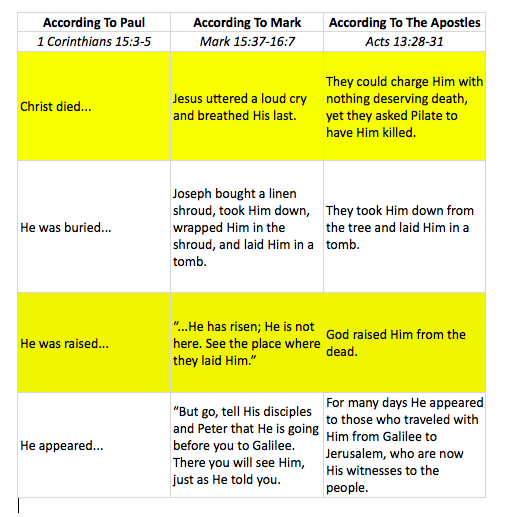
Did Jesus Rise From The DeadDid Jesus Rise From The Dead? is an excellent apologetic for both the biblical skeptic and the biblical student. You can read my full book review by clicking here. Below are seven noteworthy quotes and one infographic from this fascinating book.

“One of the most noteworthy facts about the early Christian belief in Jesus’ resurrection was that it flourished in the very city where Jesus had been publicly crucified. So long as the inhabitants of Jerusalem thought that Jesus’ corpse lay in the tomb, few would have been prepared to believe such silliness as the claim that God had raised Jesus from the dead.”

“We have the extraordinary number of at least five independent sources for Jesus’ burial, some of which are extremely early. The Gospels describe Joseph as a rich man, a member of the Jewish Sanhedrin. As a member of the Jewish Sanhedrin that condemned Jesus, Joseph of Arimathea is unlikely to be a Christian invention. The Sanhedrin was a sort of Jewish high court made up of seventy of the leading men of Judaism, which presided in Jerusalem. There was an understandable hostility among early Christians toward the Jewish Sanhe-drists, for Christians blamed the Sanhedrists for engineering a judicial murder of Jesus at the hands of the Romans. … Therefore, Jesus’ burial by Joseph is very probably historical, since it would be almost inexplicable why Christians would invent a story about a Jewish Sanhedrist who gives Jesus a proper burial.”

“Matthew is clearly working with an independent source, for he includes the story of the guard at the tomb, which is not derived from Mark and is unique to his Gospel; moreover, his comment that the rumor that the disciples had stolen Jesus’ body, ‘And this story has been spread among the Jews to this day,’ (Matthew 28:15) shows that the guard is not Matthew’s own creation, but was part of prior tradition. Luke also has an independent source, for he tells the story, not found in Mark, of two disciples’ inspecting the tomb to verify the women’s report that the tomb was vacant. This story cannot be regarded as Luke’s own creation, since the incident is independently reported in John’s Gospel. And, again, given John’s independence of the other three Gospels, we have yet another independent report of the empty tomb.”

Did Jesus Rise From The Dead infographic

(click image for a larger view)

“To appreciate how restrained Mark’s narrative is, we need only read the account in the second-century apocryphal Gospel of Peter. It describes Jesus’ triumphant exit from the tomb as a gigantic figure whose head reaches above the clouds, supported by giant angels, followed by a talking cross, heralded by a voice from heaven, and all witnessed by a Roman guard, the Jewish leaders, and a multitude of spectators! This is how real legends look: They’re richly decorated with theological and apologetical motifs. By contrast, Mark’s account is stark in its simplicity.”

“Think about that: ‘His disciples came by night and stole Him away’ [Matthew 28:13]. The Jewish authorities did not deny the fact that Jesus’ tomb was empty; instead they entangled themselves in a hopeless series of absurdities, trying to explain it away. In other words, the Jewish claim that the disciples stole the body presupposes that the body was, in fact, missing. Therefore, we have evidence from the very adversaries of the early Christian movement for the fact of the empty tomb.”

“All the followers of those first century messianic movements were fanatically committed to the cause…. But in no case right across the century before Jesus and the century after Him do we hear of any Jewish group saying that their executed leader had been raised from the dead, and he really was the Messiah after all.” —N.T. Wright

“A supernatural explanation of the empty tomb, the resurrection appearances, and the origin of the Christian faith is not contrived given the context of Jesus’ own unparalleled life, ministry, and personal claims.”

Thursdays With Oswald—The Historicity Of The Cross

This is a weekly series with things I’m reading and pondering from Oswald Chambers. You can read the original seed thought here, or type “Thursdays With Oswald” in the search box to read more entries.

The Historicity Of The Cross 

     It is essential to have an historic basis for our Christian faith: our faith must be centered in the Life and Death of the historic Jesus. Why is it that that Life and Death have an importance out of all proportion to every other historic fact? Because there the Redemption is brought to a focus. 

     Jesus Christ was not a Man who twenty centuries ago lived on this earth for thirty-three years and was crucified; He was God Incarnate, manifested at one point of history. All before look forward to that point; all since look back to it. The presentation of this fact produces what no other fact in the whole of history ever could produce, viz.: the miracle of God at work in human souls. The death of Jesus was not the death of a martyr, it was the revelation of the Eternal heart of God. That is why the Cross is God’s last word.

From Conformed To His Image

This is THE Fact of history—

For God loved the world so much that He gave His One and Only Son, so that everyone who believes in Him will not perish but have eternal life. God sent His Son into the world not to judge the world, but to save the world through Him. (John 3:16-17)

God-Oriented & People-Focused

God-oriented & People-focusedYou can spin it around, roll it down the stairs, throw it high in the air, and still it isn’t phased one bit. It doesn’t matter if you’re moving fast or slow, if you’re at high altitudes or in Death Valley, it still works. The needle of the compass always points north.

It can’t help it: it is naturally oriented to the north pole. Whether it’s pitch-black outside, or 40 degrees below zero; whether you feel like north is “north” or not, the needle will always point its way back to north.

Jesus could be cheered by the crowds or jeered by them. People could shout “Hosanna!” or “Crucify Him!” The weather could be calm or stormy, His disciples could be courageous or scared to death, and still Jesus was oriented to His Father.

Every word Jesus said, every action He undertook, every lesson He taught, every prayer He prayed was God-oriented.

But not only that, even as much as people ridiculed Him, snubbed Him, rejected Him, or denied Him, Jesus was still people-focused. After being so cruelly treated, I think I may have turned from some people, or even turned on some people with some not-so-kind words. I may have even begun to withdraw from people. But despite the way people mistreated Him, Jesus remained lovingly people-focused (see 1 Peter 2:21-23).

Jesus us told us that if we stand for Him, we will be mistreated as well (see Luke 21:17 and John 15:20). But He also told us there was a reward for that mistreatment (see Matthew 5:11-12).

When asked what the greatest of all the commandments was, Jesus replied that it was to be God-focused and people-oriented

Jesus replied, “The most important commandment is this: ‘Listen, O Israel! The Lord our God is the one and only Lord. And you must love the Lord your God with all your heart, all your soul, all your mind, and all your strength.’ The second is equally important: ‘Love your neighbor as yourself.’ No other commandment is greater than these.” (Mark 12:29-31)

So a good check-up question for us all: How am I doing at being God-oriented and people-focused, no matter what the circumstances are?

UPDATE: I explore the example of how Jesus responded to His critics in a couple of chapters of my book When Sheep Bite.

The North Star

The North StarIn our series called The Star Of CHRISTmas, Pastor Josh reminded us that Jesus is the North Star.

The North Star never wavers, never moves; it’s always constant.

But as Josh reminded us, light pollution sometimes makes it hard to see the North Star. The bright lights of the city, airplane lights, and even street lights make it difficult to know for sure we are following the North Star.

Jesus is the North Star—“I am the way, the truth, and the light” (John 14:6). But there are so many things that bring light pollution to His bright, unwavering, unchanging light. Lights that say, “This is important,” or “This light will get you where you need to go,” or even “All lights are equal.”

In this busy time of year, it’s important for us to take the time to filter out light pollution, and make sure that we are truly following Jesus. David prayed a great prayer, “Search me, O God, see if there is any offensive ways in me” (Psalm 139:23-24). It’s a great prayer for us to pray too.

Check out the other ways Jesus shined brightly at His Advent in our series The Star Of CHRISTmas.

Jesus Is The Supernova

Listen to the podcast of this post by clicking on the player below, and you can also subscribe on AppleSpotify, or Audible. 

In astronomical terms, a supernova is an explosion almost beyond compare. For a brief moment the explosion is the brightest point in the universe, sending enriching energy reverberating in every direction.

There was a supernova in the opening words of the Old Testament—in the beginning God created (Genesis 1:1). There was an explosion of God’s love that was the brightest spot in the universe He just created. But shortly after a supernova explodes, it appears to go dark for a period of time.

In history this could be seen as the time in-between the in the beginning of the Old Testament and the time before Jesus is born. Isaiah describes this as a people walking around in darkness and gloomy distress. Then all of sudden Isaiah says a great light explodes on the scene—

Nevertheless, there will be no more gloom for those who were in distress…. The people walking in darkness have seen a great light; on those living in the land of deep darkness a light has dawned. … For to us a Child is born, to us a Son is given, and the government will be on His shoulders. And He will be called Wonderful Counselor, Mighty God, Everlasting Father, Prince of Peace. (Isaiah 9:1-2, 6)

The reverberation of God’s supernova in the opening words of the Old Testament show up again in the opening words of the New Testament—A record of the genealogy of Jesus Christ (Matthew 1:1). The light of Jesus exploded on the scene!

And the Christ became flesh and tabernacled among us; and we actually saw His glory, such glory as an only begotten Son receives from His Father, full of grace and truth. (John 1:14)

Because of the energy released in the supernova of Creation and the reverberation of Christ’s First Advent, we are the beneficiaries. Astronomers tell us that the explosion of a supernova makes it possible for other stars to be born. That’s you and me!

Live clean, innocent lives as children of God, shining like bright stars in a world full of crooked and perverse people. (Philippians 2:15)

May this Advent season remind you of the supernova explosion of love of Jesus Christ, and our ability to shine brightly because of His life in us. Shine brightly!

Check out the other ways Jesus shined brightly at His Advent in our series The Star Of CHRISTmas.

►► Would you please prayerfully consider supporting this ministry? My Patreon supporters get behind-the-scenes access to exclusive materials. ◀︎◀︎
A Harmony Of The Gospels (book review)

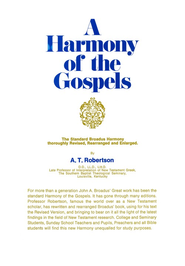
HarmonyFor anyone who wants to read the four New Testament gospels with greater insight, I highly recommend A Harmony Of The Gospels For Students Of The Life Of Christ by A.T. Robertson.

Dr. Robertson wrote: “The purpose of a harmony is not to teach theology, but to make available for men of any faith the facts in the Gospels concerning Jesus of Nazareth.” And that’s exactly what this book does.

It is one of the more interesting ways I have ever read Matthew, Mark, Luke and John. When I followed the outline in Robertson’s book, instead of reading each gospel straight through, I read them in chronological order. For instance, in reading about John’s message announcing the soon-arrival of Jesus, I was reading Mark 1:7-8, Matthew 3:11-12, and Luke 3:15-18.

In other words, you will be reading the four gospels in chronological order as the events unfolded in Christ’s ministry. Right alongside each section of study are Dr. Robertson’s fascinating and insightful notes. Reading the gospels this way really brought out details that you may have missed when just reading through the gospels in a more traditional manner.

You don’t have to be a scholar to use this book, you just need to be desirous to learn more about Jesus.

No Apologies Needed

Listen to the podcast of this post by clicking on the player below, and you can also subscribe on AppleSpotify, or Audible. 

Jesus spoke.
A lot.
In fact,
He’s called the Word.
He told stories,
He quoted Scripture,
He used nursery rhymes.
He laughed,
He cried,
He thundered.
He spoke to the religious,
And the irreligious;
To Jews,
To Gentiles,
To Samaritans.
His words excited,
And angered,
Healed,
And restored.
But…
Not once did He misspeak,
Or stumble,
Or apologize.
How could He do this?
“I did not speak of My own accord,
But the Father who sent Me
Commanded Me what to say
And how to say it …
So whatever I say
Is just what the Father
Has told Me to say” (John 12:49-50)
You and I can speak like this too:
We, too, can slow down, listen, and then speak only those Holy Spirit-directed words. If we can do that, we won’t ever need to apologize.

Check out my video called Time To Check The Mirror where I talk about so-called Freudian slips, and my blog post A Leader’s Sincere Apology.

►► Would you please prayerfully consider supporting this ministry? My Patreon supporters get behind-the-scenes access to exclusive materials. ◀︎◀︎
Act Or Attitude?

Listen to the podcast of this post by clicking on the player below, and you can also subscribe on AppleSpotify, or Audible.

Yesterday morning I showed my congregation this verse: As every man hath received the gift, even so minister the same one to another… (1 Peter 4:10 KJV). I then asked them, “What do you think of when you see the word minister in this verse?” The first answer given was “pastor.” Others said things like “encourager” and “helper.”

Then I shared that the Greek word for minister is the word from which we get deacon. I then asked them what deacon made them think of. They answered “administrator” and “leader.”

But the closest definition to what we have today for that Greek word is waiter or waitress. The NIV tries to capture this thought when it translates the same verse: Each of you should use whatever gift you have received to serve others….

Serving is not something that comes naturally to most people, as typically we prefer to be served.    

In biblical times, a disciple was always very devoted to his rabbi. The disciple would serve almost in the role of a servant to his rabbi.

Almost.

Even the rabbis didn’t requite their disciples to remove their sandals, because it was considered so menial and demeaning to the disciple. So foot washing was reserved for the lowliest of servants.

Then along comes Jesus who knows that God has placed all authority under Him (John 13:3), who uses His authority to take on the lowest of lowliest positions: a foot-washer. As He finishes washing, He says, “Now that you’ve seen Me do this, you need to do the same thing: Be the humblest of servants.”

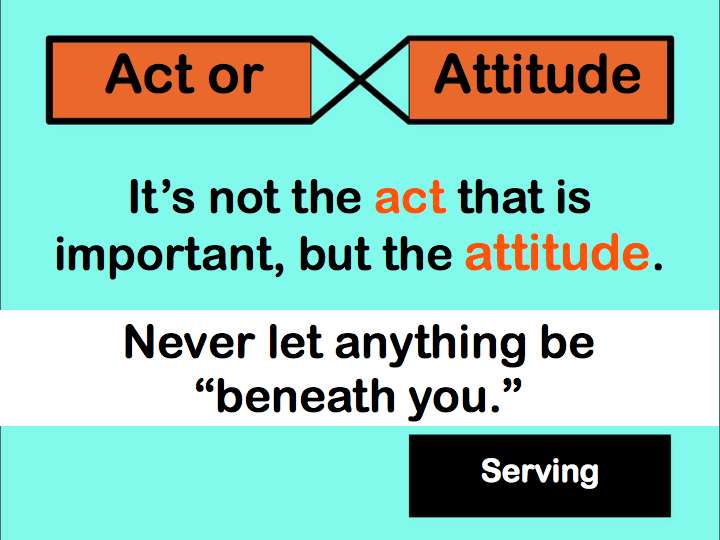
In our culture, most people don’t need to have their feet washed when they come into your home or a restaurant, like they did in first century Israel. It is not the act that is important, but the attitude. Jesus stooped to wash His disciples’ feet. He made Himself lower than anyone else in the room. Jesus showed us that there was nothing beneath Him.

I’ve heard this before: “How do you know you have a servant’s attitude? When you don’t mind that someone treats you like a servant.”

But I think a better question might be: “Do I think anything (or anyone) is beneath me?” If I do, my attitude is not Christ-like (Philippians 2:5-7), nor is it Christ-blessable (John 13:17).

Jesus calls us to be servants—to be waiters and waitresses to others. This will show the love of Jesus like nothing else can.

Check out all of the other messages in our series Live Together by clicking here.

►► Would you please prayerfully consider supporting this ministry? My Patreon supporters get behind-the-scenes access to exclusive materials. ◀︎◀︎