You Are An Empowered Peacemaker

My new attitude“The whole world—with one minor exception—is made up of others,” says John Maxwell. The ‘one minor exception’ is that person who’s looking back at you from the mirror every morning, so if you want to be successful in life, you better learn to get along with ‘the others.’

I believe this is especially important for those who call themselves Christians. Here are three reasons why—

  1. Our interaction with other Christians is a testimony to outsiders—John 13:34-35.
  2. Our positive interaction with outsiders can draw others to Christ—Colossians 4:5.
  3. Our negative interaction with outsiders can repel others from Christ—1 Peter 2:12.

So although it can be very (sometimes very, very!) challenging, we are called to find ways to get along with others. The Apostle Paul said:

Be careful to do what is right in the eyes of everybody. If it is possible, as far as it depends on you, live at peace with everyone (Romans 12:17-18, emphasis added).

When you see the phrase “if it is possible” you may think that Paul has given us an “out.” We could say, “I tried really hard to get along with that guy, but it just hasn’t worked, so I’m off the hook!”

But consider how another translation of the Bible states this phrase: Do all that you can to live in peace with everyone.

Jesus was asked to do something that had never been done before: heal two men born blind. Jesus asked these men, “Do you believe I am able to do this?” (Matthew 9:28). The men answered an emphatic, “Yes!” On another occasion a father asked Jesus to heal his son by saying, “If You can, please help us.” Jesus said, “‘If I can? All things are possible to those who believe.” The father immediately replied, “I do believe; please help my unbelief” (Mark 9:22-24).

If you are Christian, the Spirit of Jesus lives in you. So the question Jesus asks us about our difficult relationships is, “Do you believe I am able to help you?” Or perhaps more accurately He asks us, “Will you let Me help you?”

So the part of the verse which says, “if it is possible, as far at it depends on you” is really saying, “If you really believe Jesus is stronger than this strained relationship, will you let Him do something in you to bring about peace?”

We aren’t asking Jesus to change the other person; we’re asking Him to change us. We aren’t asking someone else to get on our page, or to see the world from our perspective; we’re asking the Holy Spirit to help us get on their page, to help us see the world they way they see it.

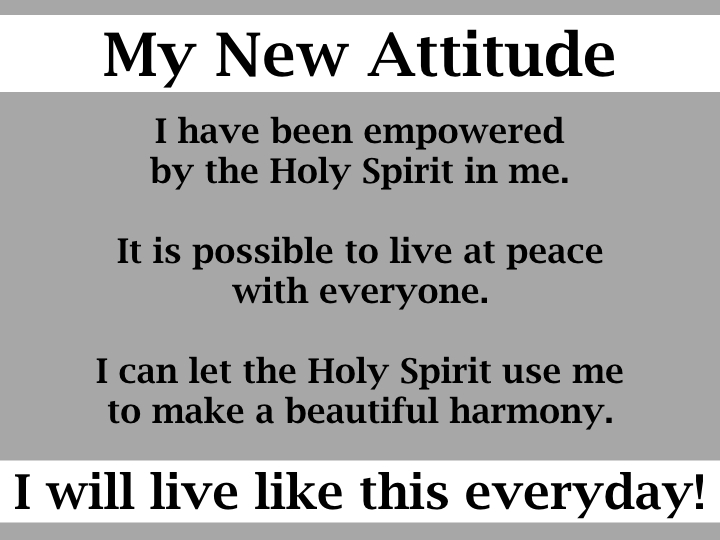
We need to have a new attitude. And I believe that attitude comes from a prayer like this—

I have been empowered by the Spirit of Christ in me. 
It is now possible for me to live at peace with everyone. 
I can let the Holy Spirit use to me make a beautiful harmony. 
I will keep on living like this every day.

Next Sunday we will be looking at some practical techniques and more biblical insights to help us excel in getting along with all ‘the others’ that make up the world. Please join us in person or on Periscope.
3 Possibilities For An Empty Tomb

3 possibilitiesLast week we explored the validity of the evidence for the accuracy of the biblical accounts for the life of Jesus (you can check that out here). You might be one who says, “Okay, I think Jesus was a good Man, but I think it’s a bit of a stretch to believe that anyone could be raised from the dead after three days.” I think that’s a reasonable thing to explore…

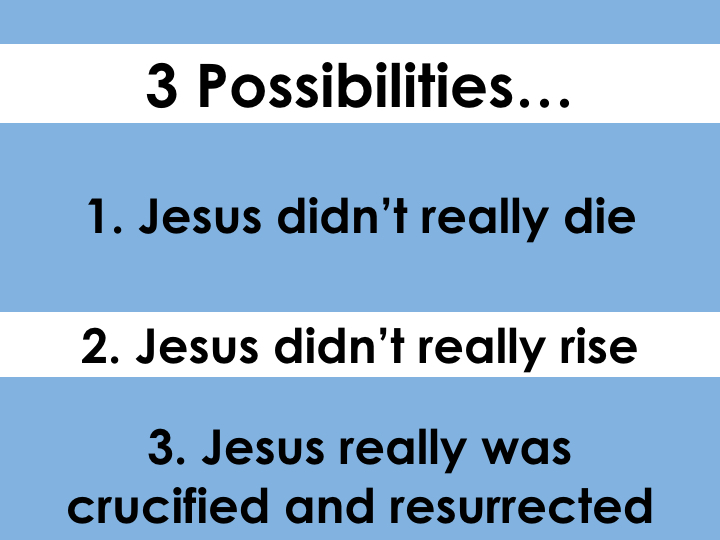
If the tomb where Jesus was placed is really empty, then there are only three possibilities for us to consider.

(1) Jesus didn’t really die.

  • It’s hard to imagine anyone could go through the intense torture Jesus did prior to His crucifixion unscathed.
  • The crucifixion process itself is one of the most gruesome forms of execution man has ever invented.
  • As a result, forensic science shows that Jesus most likely died of a heart attack. The mention in John 19:34 of the blood and water that flowed from Christ’s body is an indication of the cardiac distress His body experienced.
  • Men who were followers of Jesus handled His dead body, and undoubtedly would have checked for any signs life (John 19:38-40).
  • A Roman centurion reported to the Roman governor Pilate that Jesus had in fact died (Mark 15:43-45).
  • Extra-biblical historians, many of whom were unfriendly to Jews and Christians, reported Christ’s death as an historical fact.

(2) Jesus didn’t really rise.

  • Some have claimed that Christ’s followers “saw” Jesus only in a grief-induced hallucination. The problem is, Jesus appeared to individuals, small groups, and large groups multiple times and in multiple settings over the course of 40 days (1 Corinthians 15:3-8).
  • At least one of Christ’s closest followers said he wouldn’t be convinced by verbal testimony alone, but needed to touch Christ’s body for Himself (John 20:24-28).
  • The disciples were afraid and lacked any military training that would have allowed them to get past the trained soldiers guarding the tomb (Matthew 27:62-66; 28:11-15).

(3) Jesus really did die on a Cross and was raised back to life.

Arthur Conan Doyle’s Sherlock Holmes rightly said, “When you have eliminated the impossible, whatever remains, however improbable, must be the truth.”

Real-life cold-case detective J. Warner Wallace explains how detectives use abductive reasoning to examine all of the evidence and infer to the most reasonable explanation from that. As a result, Detective Wallace says about this third explanation:

“The last explanation (although it is a miraculous, supernatural explanation) suffers from the least number of liabilities and deficiencies. If we simply enter into the investigation without a pre-existing bias against anything supernatural, the final explanation accounts for all of the evidence without any difficulty. The final explanation accounts for the evidence most simply and most exhaustively, and it is logically consistent…. The final explanation is also superior to all other accounts (given that it does not suffer from all the problems we see with the other explanations).” —J. Warner Wallace, Alive

The truth is Jesus loved you so much that He had to die for you. He had to pay the penalty for your sins. And God loved His Son so much, that He raised Him back to life. Jesus can live in you now, and you can live with Him forever, if you will simply believe what He did for you on Calvary.

Jesus left an empty tomb behind to show how powerful His love and life is!

4 Terrible Ways & 4 Great Ways To Study Your Bible

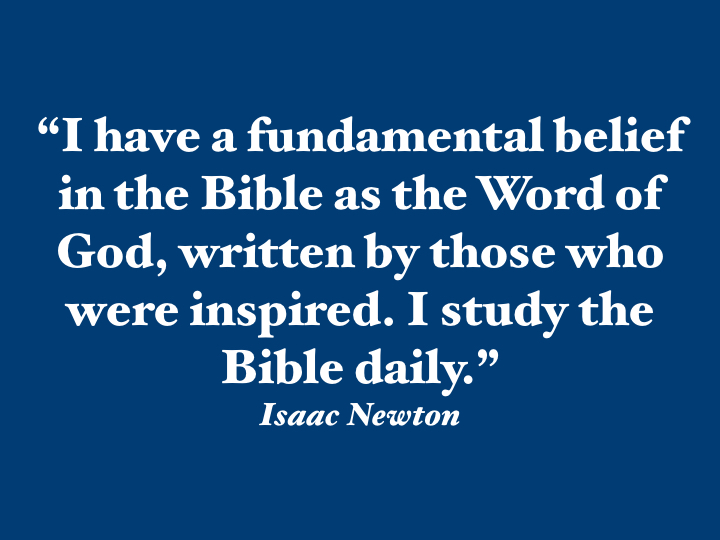
Isaac Newton Bible study.001There are two Greek words in the New Testament that have to do with trying to figure things out. One of them leads to less knowledge, and one opens the way for greater learning. Not surprisingly, Jesus never used the first way, but He confronts people who try to.

The first Greek word is defined as learning through self-calculation. In other words, I try to get at the right answer by either teaching myself, or by talking with people who don’t know any more than I do. This way leaves me in the dark.

For example, notice the phrase “discussed among themselves” in Matthew 16:7 and Mark 11:31. These are people who wanted to try to get answers without going to someone who could teach them. So that leads to four terrible ways to study your Bible—

  1. Approach your Bible with a know-it-all attitude.
  2. Try to figure out what the Bible is saying all on your own.
  3. Try to be your own Bible teacher.
  4. Grade your own tests as to your answers being right or wrong.

These are not only terrible ways to learn, but they are the exact opposite of what God desires. God says things like, “Come, let us reason together” (Isaiah 1:18), and “Call to Me and I will tell you things you do not know” (Jeremiah 33:3).

There is another Greek word which means to learn by having a conversation with someone more knowledgable than myself. So that means four great ways to study your Bible are—

  1. Ask the Holy Spirit to illuminate Scripture to you (John 16:13).
  2. Study the Bible in a daily systematic way (Acts 19:9).
  3. Don’t take anyone else’s word for what the Word says (Acts 17:11).
  4. If you’re confused, ask God to make it clear to you (Jeremiah 33:3).

Luke records an important story for us that took place on the day Jesus was raised from the dead. Two men were walking along “discussing these things with each other,” but not consulting the Scriptures. The result: they were sad and confused. Jesus join them on their journey (although they didn’t recognize Him at first), and took them to the Scriptures that showed them the answers for which they were yearning. They even said, “When He talked to us from the Scriptures, that’s when our hearts burned within us!” (see Luke 24:13-32).

You can try to figure life out on your own, and you will probably end up stymied like the religious leaders in Mark 11, or downcast like the disciples in Luke 24. Or you can ask the Holy Spirit to show you truths from the Scriptures, and have your eyes opened, like the two disciples after Jesus met with them. I think the choice is obvious!

Join me next week as we continue our series How To Study Your Bible.

4 Reasons To Study Your Bible

Commitment to readYou probably hear Christians say quite frequently, “You should read your Bible.” But one thing you may not hear as often is why you should read your Bible. There are probably many more reasons, but here are four reasons why I believe reading your Bible should be a daily part of your life.

(1) To help spot errors.

When the devil tempted Jesus, it is noteworthy that Jesus didn’t try to use logic, or persuasion, or even willpower. Every temptation was blocked by Jesus saying, “It is written” as He quoted Scripture.

In the second temptation, the devil tried the same tactic. He, too, quoted a couple of verses from the Psalms, but he took them out of their context. So notice Christ’s reply, “It is also written” (Matthew 4:7). The best way to spot error is to know the full counsel of God’s Word. This tactic the devil tried with Jesus wasn’t something new, but it was something he used on the very first humans: “Did God really say…” (Genesis 3:1), and he will try it again on you!

(2) To clarify your emotions.

Most of us allow our emotions to control our actions. Or sometimes we wrestle with, “My heart says one thing, but my head says something else!” In this tug-of-war, we allow our emotions to determine our beliefs, and then our beliefs determine our actions. This is not only dangerous, but it is contrary to what the Bible teaches.

The healthy way to respond is by fully knowing what we believe, and then acting according to our beliefs. Our proper emotional response will then follow those actions.

Look at the example of Jesus in John 2:13-16. He was ticked off at how people were misusing His Father’s house, and He did some serious house cleaning! Just reading those four verses, you may get the idea that Christ’s emotions carried Him away. But check out verse 17, in which we see He was acting in accordance to His beliefs, which were fully grounded in Scripture.

(3) To know prophesy.

All of the Scriptures point to Jesus, so all of the Scriptures are illuminated by Christ (Luke 24:27, 45). If you want to know what is happening in our world, turn to the pages of Scripture and see how Jesus is revealed. This will help you put even current events into perspective.

(4) To give sound answers.

When people need help, I want to be able to give them real answers. Not my opinion, but truth that they can apply. The Apostle Peter told us to always be prepared to give people an answer that is based on our knowledge of Jesus (1 Peter 3:15).

“Beware of saying, ‘I haven’t time to read the Bible, or to pray’; say rather, ‘I haven’t disciplined myself to do these things.’” —Oswald Chambers

Can I challenge you to do something I challenged my whole church to do … Make a commitment to read the Bible every day for the next seven days. See what happens as God meets with you, and reveals Himself and His wisdom to you, every day.

We’ll be learning some Bible study strategies next Sunday, and I invite you to join us.

How To Study Your Bible

How To Study Your BibleMaybe first we should ask, “Why should we study the Bible?” Many people loudly proclaim, “All that is needed for salvation is faith in Jesus.” This is correct, but remember this—Faith [for salvation] comes from hearing the message, and the message is heard through the Word of Christ (Romans 10:17).

Then after our faith in Jesus brings us the forgiveness for our sins, there is an ongoing process of walking out our faith, something the Bible calls sanctification. Here again the Bible plays a vital role. Jesus prayed for His followers this way: Sanctify them by the truth; Your Word is truth (John 17:17).

The bottom line … Our Christian walk is nearly impossible to maintain without the resources found in the Scriptures! 

But the Bible is a large book, and many people don’t know where or how to begin to study it. That’s why we are taking the time to learn together some practical ideas for studying God’s Word.

Please join us at Calvary Assembly of God over the next few weeks as we learn the practices which will help us make the most of our time studying the Bible. If you cannot join us in person, we will be broadcasting all of our messages live on Periscope (follow @craigtowens to be notified when the broadcasts begin).

If you are ready to take your Bible study to a new level, please join us beginning this Sunday!

Thursdays With Oswald—At Home With Jesus

Oswald ChambersThis is a weekly series with things I’m reading and pondering from Oswald Chambers. You can read the original seed thought here, or type “Thursdays With Oswald” in the search box to read more entries.

At Home With Jesus

     Beware of the people who tell you life is simple. Life is such a mass of complications that no man is safe apart from God. Coming to Jesus does not simplify life, it simplifies my relationship to God. … 

     God’s idea is that individual Christians should become identified with His purpose for the world. When Christianity becomes over-organized and denominational it is incapable of fulfilling our Lord’s commission; it doesn’t “feed His sheep,” it can’t (see John 21:15-17). …  

     If my religion is not based on a personal history with Jesus it becomes something I suffer from, not a joyous thing, but something that keeps me from doing what I want to do. 

From Disciples Indeed

Jesus came to give us life to the full. He didn’t come to help simplify life or organize our religion. The key word for our relationship with Jesus is personal. He wants you, not your religious ideas or religious activities.

Jesus died for you. Jesus lives for you. And Jesus wants to live in and through you. Jesus replied, “All who love Me will do what I say. My Father will love them, and We will come and make Our home with each of them” (John 14:23).

Will you let Him be at home with you?

Confession: I Struggle With Being An Atheist

ITLWYou see, I love my day to be highly organized. I like to get to all my meetings on time, and then have them run smoothly and efficiently. I like to setup my To Do list, and then methodically check off each item as I go through my day. I like to be in charge of my day.

I am an atheist.

I’m the one calling the shots. I set my agenda. I determine my day. I decide who to see and what project to accept.

There was a guy that Jesus talked about who did the exact same thing. This guy thought to himself and talked to himself all about his plans. Seriously, in just three verses he says me/I/my a dozen times (Luke 12:17-19)!

But God said, “You fool!” The word for fool means without mind. He didn’t mind his mind. He thought the thoughts he wanted to think, without ever consulting anyone else. Not even God.

Jesus made prayer a priority every day (Mark 1:35). What do you think He prayed? Do you think He said, “Here’s what I’m going to do today, and I want You to bless it, Father”? No way!

When Jesus taught us to pray He said, “Your kingdom come, Your will be done” (Matthew 6:9-13). Not only did Jesus pray this way, He lived this way too. He didn’t do a single thing unless His Father directed Him to do it (John 6:38), and He didn’t say a single word unless His Father directed Him to say it (John 12:49).

The problem is not going into my prayer closet to meet with God in the morning, the problem is thinking I can leave God in the closet as I go about my day! That is atheism!

The Apostle James gave us this sound counsel: Instead of making my plans all on my own, I should say, “If the Lord wills, this is what I will do today” (James 4:13-17). And wise King Solomon said I shouldn’t lean on my own thoughts when planning my days, but lean onto God, and then watch to see how He will direct my life in the right way (Proverbs 3:5-6).

I’ve begun writing I.T.L.W. on the top of my daily calendar. It’s my reminder to say, “If The Lord Wills” this is what I will do today. And if something else comes up, I quickly acknowledge that God is directing my path where He needs me to go.

Your Kingdom come means my kingdom has to go. Your will be done means my agenda takes a distant second.

If you’re feeling stressed about your schedule, that should be your reminder to pray: “God, what do You want to have done here.” Silence the atheistic thoughts that sound like, “I have to get my list done.” Stop and pray right there on the spot.

Here’s the full video of my message on this topic—

We will be continuing our series called Practical Prayer this Sunday. If you don’t have a home church in Cedar Springs, please come be our guest. Or you can tune into our live broadcast via Periscope.

Week Of Prayer—Sunday

WOP_2016_Slide_SunWe are starting the New Year with a time of prayer. Each day of this week has a special prayer focus, as we believe God for greater things in 2016.

Sunday’s focus—

Pray that God will stir faith in your heart to accomplish greater things than you could imagine in and through your life this year.

When I pray, I love to pray God’s Word. Perhaps on Sunday you could pray something like this:

Jesus, You told me that whoever believes in You will do the works You have been doing. Not only that, but also I will be able to do even greater things than those, all because You are going to the Father to intercede for me. You also said that You will do whatever I ask in Your name, so that my Heavenly Father may be glorified in You. You promised me that I may ask You for anything in Your name, and You will do it. [John 14:12-14] 

I don’t want 2016 to be just “another” year. I don’t believe You desire for 2016 to be a year of status quo in my life. You are able to do immeasurably more than all I can ask or imagine, according to Your power that is at work within me, so that You will receive all the glory! [Ephesians 3:20-21].  So I am believing You to do things in my life I never even imagined before. I am ready! In Jesus’ name I pray. Amen.

Try Reverse Thinking

Listen to the podcast of this post by clicking on the player below, and you can also subscribe on Apple or Spotify.

Today was the absolute worst day ever
And don’t try to convince me that
There’s something good in every day
Because, when you take a closer look,
This world is a pretty evil place.
Even if
Some goodness does shine through once in a while
Satisfaction and happiness don’t last.
And it’s not true that
It’s all in the mind and heart
Because
True happiness can be obtained
Only if one’s surroundings are good
It’s not true that good exists
I’m sure you can agree that
The reality
Creates
My attitude
It’s all beyond my control
And you’ll never in a million years hear me say that
Today was a good day
(now read from the bottom to the top)

Psychologists call it metacognition when we think about what we’re thinking about. The Bible calls it capturing every thought (2 Corinthians 10:5).

Sometimes it takes reversing our thinking.

The devil has a singular agenda: He wants to steal joy from your life, he wants to kill any hope you have for the future, and he wants your end to be utter destruction.

Jesus has a singular agenda for you too: I have come that you might have abundant life.

Try reversing your thinking. Try thinking about your thinking a different way.

The devil says, “Life has no purpose.” God says, “I created you on purpose.”

The devil says, “You’re nothing special.” God says, “You’re one-of-a-kind.”

The devil says, “God remembers you blew it.” God says, “I’ve forgotten everything I’ve forgiven.”

The devil says, “This life is all there is.” God says, “You can’t even imagine what’s coming next!”

The devil says, “You’ll never find true love.” God says, “I love you so much that I died for you.”

Reverse your thinking to listen to what God says. Then you will be able to reverse today was the absolute worst day ever to today was a good day!

►► Would you please prayerfully consider supporting this ministry? My Patreon supporters get behind-the-scenes access to exclusive materials. ◀︎◀︎

4 Powerful Truths About Peacefulness

PeacefulnessHave you ever noticed the importance the Apostle Paul gives to “peace”? Not just any kind of peace, but the peace that is linked with God’s grace.

Paul always puts grace and peace together. Every one of his letters opens with “grace and peace.” The only exceptions are his two personal letters to Timothy where he says “grace, mercy and peace.”

In his letter to the Colossians we get a clue to why this is, when he writes, “Let the peace of Christ rule in your hearts, since as members of one body you were called to peace. And be thankful” (Colossians 3:15).

Let me start at the end of the verse. The word “thankful” is the Greek word euchristos. It’s where we get our word Eucharist (or Communion). The root word (charizomai) means to (a) live gracefully, (b) forgive gracefully, (c) rescue gracefully, (d) restore gracefully. That’s just how Jesus—the Prince of Peace—lived on earth, and that’s what His broken body and spilled blood purchased for us: peace with God.

So a thankful Christian is a peaceful Christian. Or another way of saying this: a Christian’s peace-fullness comes from thank-fullness.

When we “let the peace of Christ rule” in our heats, it’s because we understand what His grace has purchased for us. And we want others to know this grace and peace as well!

  1. Peacefulness is contagious—a peace-full person has plenty of peace to share.
  2. Peacefulness is unifying—fear makes people run away, but peace brings them close to God and close to each other (Luke 2:14; John 14:27).
  3. Peacefulness promotes worship—we don’t worship what we fear, but we worship what we are drawn to (Luke 19:38; Hebrews 10:22).
  4. Peacefulness signals victory—the absence of conflict is peace (Romans 16:20).

If you don’t have peace in your life, can I suggest that you might want to start by looking at your thank-fulness level. When you are thankful for what the Prince of Peace did on the Cross for you, it’s so much easier to become thankful for all the other blessings that He gives as well. This thank-fullness will raise your level of peace-fullness!

On Sunday we are going to continue to look at the power and beauty of grace-filled gratitude. Please join us!