“[God] does not need us. If we stay away He is not impoverished. He does not need us in order to be happy in the fellowship of the Trinity. But He magnifies His mercy by giving us free access through His Son, in spite of our sin, to the one Reality that can satisfy us completely and forever, namely, Himself. ‘You make known to me the path of life; in Your presence there is fullness of joy; at Your right hand are pleasures forevermore’ (Psalm 16:11).” —John Piper
“Good preachers are good learners, and not just of the Scriptures. They need to understand the times and the ways the times impact the people they are called to serve. Preachers who know their sheep well, as our Good Shepherd exemplified for us, will hear their concerns, understand their thoughts, discern their hopes and fears, and be able to preach in a way that speaks directly to their souls with transforming grace and power. Let us strive to be sons of Issachar when it comes to the ministry of God’s Word.” —T.M. Moore
This week I shared another exclusive video with my Patreon supporters. Please consider supporting this ministry at just $5 per month. I also shared this public video especially for my fellow pastors:
John Stonestreet wrote about our amazing brain. What a marvelous thing our Creator has given us! Here is just one example: “In 2013, a collaboration between Japanese and German scientists created one of the most realistic brain simulations ever attempted. They used what was, at that time, the world’s fourth-largest computer, containing over 700,000 processor cores and producing an eye-popping 1.4 million gigabytes of RAM. The machine worked at top speed, crunching numbers for over 40 minutes. In the end, it produced just one second of simulated brain activity.”
Listen to the podcast of this post by clicking on the player below, and you can also subscribe on Apple, Spotify, or Audible.
One of my favorite classes that I took in college was a philosophy class where we studied the rules of logic. I found it so intriguing to learn how to construct or deconstruct an argument by looking at the premises and its conclusion.
One of the keywords that we would look at is “therefore.” This helped us understand what the conclusion of an argument was. If the argument was made well, what came after the “therefore” was a natural progression from the premises. With that in mind, I always keep an eye out for the “therefores” when I am reading my Bible.
Except I have noticed that God frequently uses “therefore” in unexpected ways.
The classic rules of logic lay out connecting and supporting premises that flow to a natural “therefore” conclusion. But God’s conclusions typically defy natural, conventional logic. His conclusions are frequently supernatural!
Notice a couple of examples from Isaiah. God’s people are suffering the natural consequences for their open rebellion against God. In my mind, the natural “therefore” would be: “You are getting what you deserve.” However, God’s supernatural “therefore” is: “I have taken this cup of My wrath from you” (Isaiah 51:21–22).
In another example, the way God’s people were behaving and the way the enemies of God’s people were treating them, the natural “therefore” that I would expect is: “No one revered God’s name any longer.” But God’s supernatural “therefore” declares: “All people will know My name. All people will know I have fulfilled what I foretold, and all will revere Me” (Isaiah 52:6).
Ultimately, these supernatural conclusions were proven true by Jesus. Our Savior drank our cup of wrath on our behalf and gave us His cup of righteousness in its place. The natural conclusion of Christ’s work for us is also God’s supernatural conclusion: God exalted Jesus to the highest place of honor and reverence (Philippians 2:5–11).
My natural logic fails. God’s supernatural logic succeeds. Always!
His supernatural conclusions should always lead to my revering and glorifying Him even more. Let me encourage you in your Bible study time to pay close attention to God’s “therefores” and rejoice in His Christ-exalting supernatural work.
Listen to the podcast of this post by clicking on the player below, and you can also subscribe on Apple, Spotify, or Audible.
A friend of mine who was in a position of leadership in the Assemblies of God used to joke with people, “Since you’re bowing and walking backwards out of my office, would you like to kiss my ring too?” There are some people that we feel are in a special class so that we have to approach them differently.
If we feel that way about certain people, what might we be thinking when we consider approaching the supreme, awesome, preeminent, incomparable Jesus?! It’s very likely that we could feel Him to be unapproachable, as though we aren’t worthy of His attention.
But when Jesus Himself told us, “When [not ‘if’] you pray,” He is assuming that we will pray. And then He adds this amazing thought: “And I will do whatever you ask in My name, so that the Father may be glorified in the Son” (John 14:13)!
Jesus loves to help us. He died a cruel death on the Cross so that He could help us! Jesus ties our trusting prayer with His willingness to serve us (Luke 12:22-37). Note this last line from our approachable Savior:
It will be good for those servants whose Master finds them watching when He comes. Truly I tell you, He will dress Himself to serve, will have them recline at the table and will come and wait on them. (v. 37)
Jesus serves us?! What an amazing thought! But does this make Jesus somehow less majestic? I like what John Piper has to say about this: “Does this belittle the risen Christ—to say that He was and is and will ever be the servant of His people? It would, if ‘servant’ meant ‘one who takes orders,’ or if we thought we were His masters. Yes, that would dishonor Him. But it does not dishonor Him to say that we are weak and need His help.”
The childlike attitude is one of wonder and trust. One that calls God, “Daddy.” One that is lovingly dependent on Him. One that says, “I don’t understand what I’m going through right now, but I trust Your wisdom.”
The childish attitude is one who treats majestic things flippantly. Perhaps the childish one talks about God as “the Big Guy upstairs.” Or one who remains selfishly independent, or who says, “Do it my way—now!”
The childlike attitude glorifies Jesus as our approachable Servant Savior.
Prayer not only unlocks deeper, proper intimacy with Jesus, but it conforms our heart more and more to His heart. As we are conformed to Him, we reflect His approachable glory to others (2 Corinthians 4:6, 3:18).
We approach the awesome Jesus reverently in childlike faith. It’s in God’s presence that the Holy Spirit matures our faith so that we become glory-reflectors that point others to Jesus.
Listen to the podcast of this post by clicking on the player below, and you can also subscribe on Apple, Spotify, or Audible.
C.S. Lewis, like many atheists, wondered if the God of the Bible might be an egomaniac because He is always encouraging people to praise Him. In his book Reflections on the Psalms, Lewis wrote a thoughtful response to this after he had become a Christian:
“Just as men spontaneously praise whatever they value, so they spontaneously urge us to join them in praising it. ‘Isn’t she lovely? Wasn’t it glorious? Don’t you think that magnificent?’ … I think we delight to praise what we enjoy because the praise not merely expresses but completes the enjoyment; it is its appointed consummation. It is not out of compliment that lovers keep on telling one another how beautiful they are; the delight is incomplete till it is expressed. … This is so even when our expressions are inadequate, as of course they usually are. But how if one could really and fully praise even such things to perfection—utterly ‘get out’ in poetry or music or pain the upsurge of appreciation which almost bursts you? Then indeed the object would be fully appreciated and our delight would have attained perfect development. The worthier the object, the more intense this delight would be.”
His phrase, “our expressions are inadequate” is especially true when we are attempting to appreciate and praise the Infinite, the Eternal, the Omnipresence, the Omnipotence of our God and Savior! But the biblical authors call for Christians to mature in this—we want to keep praising, keep expressing, until we finally find the perfect fulfillment in His presence.
Paul talks about the maturing nature of love—when I was a child, I talked like a child, I thought like a child, I reasoned like a child (1 Corinthians 13:11)—but then he prays for us to grow in both our understanding and our expressions of our Savior’s love (Ephesians 1:17-19).
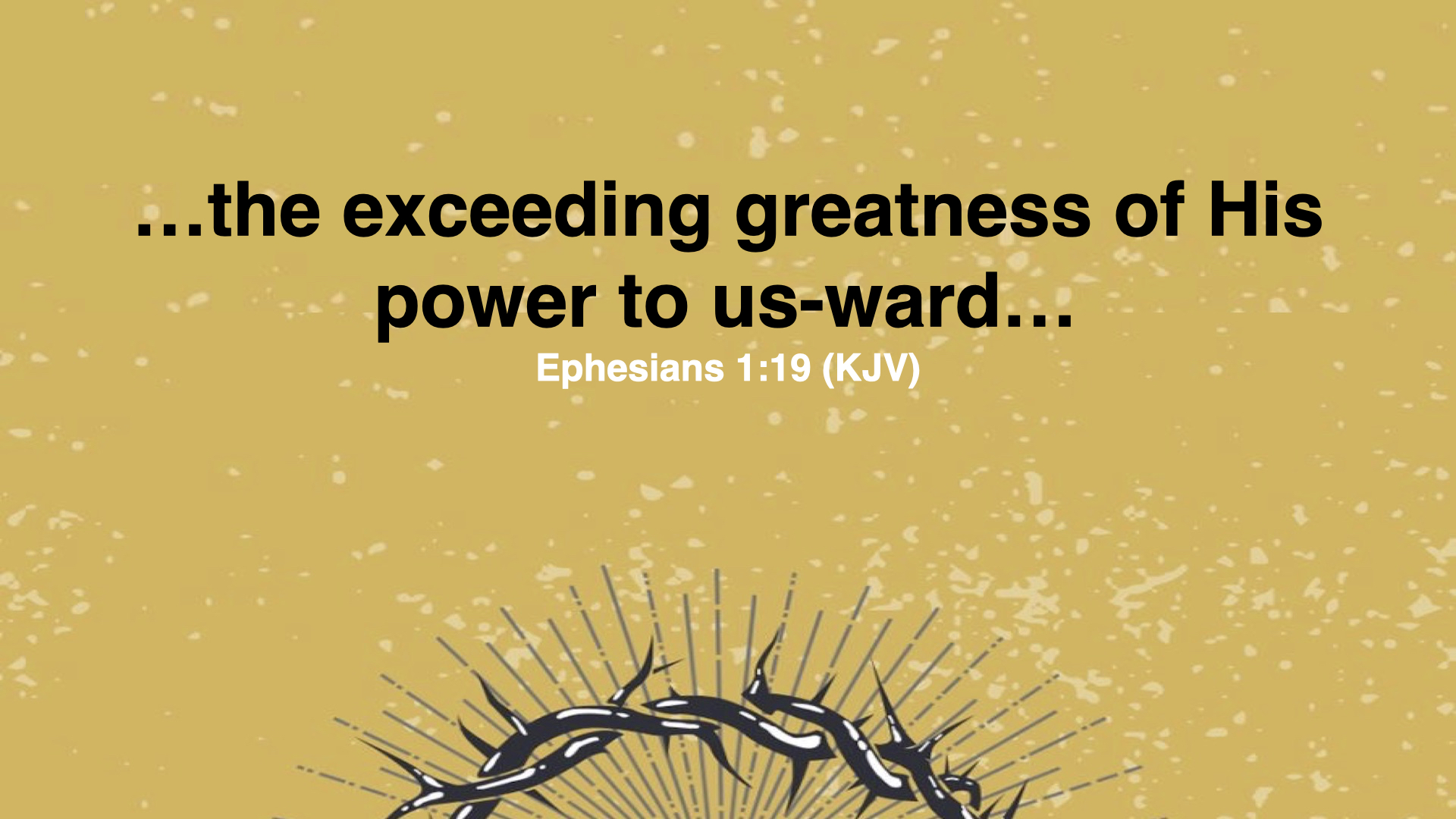
I like the wording of Ephesians 1:19 in the King James Version: the exceeding greatness of His power to us-ward. The word “exceeding” means God pours out in a way that is beyond human imagining. The Greek word that Paul uses for “greatness” is only used here, and it reinforces the truth that God is beyond our full comprehension. And then Paul adds that this overflowing, incomparable power is directed “to us-ward”!
Paul then prays for us to be able to understand ever-increasing new dimensions of this transcendent power and ability that God directs to us through His Son Jesus, and for us to be able to express it (Ephesians 3:14-19). In other words, we are to grow in our experience of Jesus so that we can grow in our praise to Jesus.
The incomparable Jesus means at least four things for us. It means Jesus is…
…beyond comparison. Isaiah, God Himself, and the psalmists ask rhetorically, “Who is like God? Who could ever compare to Him?” (Isaiah 40:13-14, 18, 25; Psalm 89:5-8).
…matchless in His power. Isaiah 40:12 says God holds the waters of the world in the hollow of His hand. How much water is this? Scientists estimate the Earth’s water supply to be 326 quintillion gallons of water (that’s 326 followed by 18 zeros)! Not only does God hold all of the water, but He directs its activities on behalf of His children (Exodus 15:11-13).
…unequaled in knowledge.Isaiah 40:12, 26 tell us that all of the stars in our universe fit onto God’s outstretched hand, and that He knows all of the stars by name. How many stars is this? Astronomers calculate the heavens to contain 10 septillion stars (that’s 10 followed by 24 zeros)! Not only does God know each star by name, He knows each human by name, and thesmallest of details about each of them (Isaiah 49:16; Matthew 10:29-31).
…inimitable in His care. We humans can get to the end of our strength, but God never does. He cares for us unlike anyone else or anything else ever can (Isaiah 40:28-31). The Lord hears His people when they call to Him for help. He rescues them from all their troubles (Psalm 34:17).
Knowing we have a Savior like this, why would you ever settle for anything less The Genuine?!
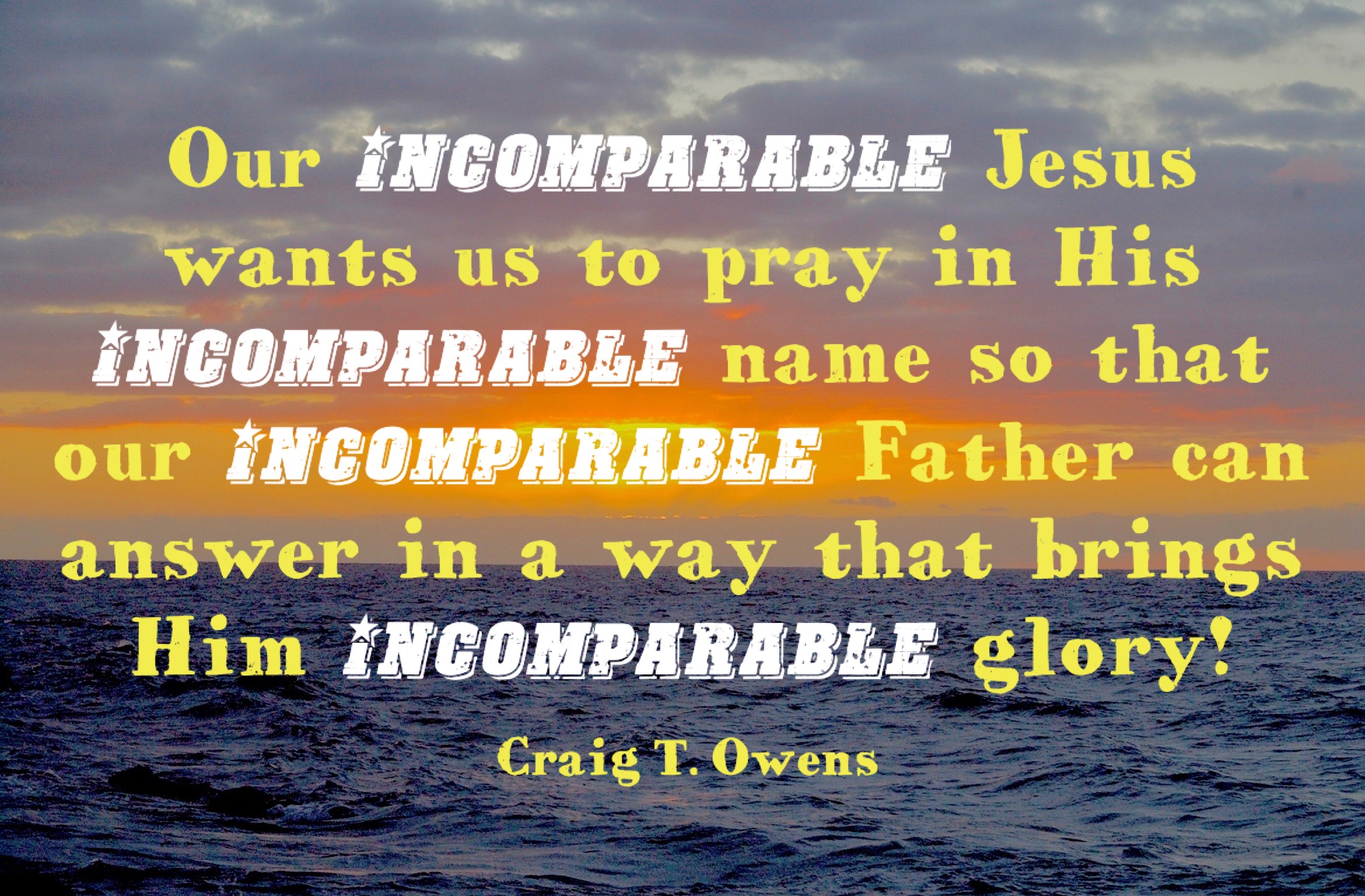
Our incomparable Jesus wants us to pray in His incomparable name so that our incomparable Father can answer in a way that brings Him incomparable glory! We’re helped, He’s lifted up, and others are drawn to Him.
Listen to the podcast of this post by clicking on the player below, and you can also subscribe on Apple, Spotify, or Audible.
…the fear of the Lord is the key to this treasure (Isaiah 33:6).
What treasure is Isaiah referring to? There is an amazing list of blessings in this chapter! Things like…
God’s graciousness
God’s strength
Salvation
God’s justice
God’s righteousness
A sure foundation
“A rich store of salvation and wisdom and knowledge”
Eternally secure in God’s presence
Seeing God’s beauty
Having evil people removed from my life
Peace
How do I get the key to this treasure? By placing my faith in Jesus. Jesus paid the price, so He could take the key from the devil and hold it securely. When I am in Him, I have access to this key to God’s riches!
With all of this treasure accessible to me, how do I now live? In a word: Nobly. “But the noble make noble plans, and by noble deeds they stand” (Isaiah 32:8). I am a child of God, a joint-heir with Jesus. I lack no good thing, so I can live securely, gracefully, and nobly. I must live this way to bring glory to my Lord and my Master every single day!
Listen to the podcast of this post by clicking on the player below, and you can also subscribe on Apple, Spotify, or Audible.
Let’s get on the same page with a few facts:
Nearly 1-of-5 adults in the United States age 18 and older battle some form of anxiety disorder.
Being anxious is not a sin but we can grieve God’s heart if we don’t train ourselves to turn to Him as our First Source. Notice that David said, “When[not “if”] I am afraid, I put my trust in You” (Psalm 56:3).
A third definition of anxiety is found here: “Cast your cares on the Lord and He will sustain you; He will never let the righteous be shaken” (Psalm 55:22). This word for cares or anxieties is the only time this Hebrew word is used in the Bible. The idea is a heavy burden, which the Amplified Bible captures like this: “Cast your burden on the Lord—releasing the weight of it—and He will sustain you….”
We can be burdened because we pick up and carry things on our own. But the word for cares or burdens in Psalm 55:22 can mean not only things we pick up, but things given to us by God or allowed by God. You might ask, “Why would God give me a burden?”
Sometimes it’s allowed—God allowed satan to afflict Job within limits, and He allowed Joseph’s brothers to ambush him (Job 1:8-12; 2:3-7; Genesis 50:20).
Sometimes it’s given—God gave Jesus a bitter cup to drink, and He gave Paul a “thorn in the flesh” (Matthew 26:39-42; 2 Corinthians 12:7).
In every instance, the limits are perfectly measured to accomplish what God wants to do. The way we respond glorifies Him and keeps us dependent on Him (Job 1:20; 2:10; Genesis 50:20; 2 Corinthians 12:8-10; Hebrews 10:10).
Still in the middle of this, the burdens can seem overwhelming and anxiety-inducing. That’s why God tells us what to do with these burdens: Cast them off!
In Psalm 55:22, David gives us the word “cast” in the imperative mood, which means it’s a command. Literally, the word means to throw away or shed the burden.
How often do we do this? David said he prayed “evening, morning, and noon” for God’s help (Psalm 55:16-17).
What does God do when we cast off these burdens? He sustains and supports us—“He will sustain you; He will never let the righteous be shaken.”
The apostle Peter quotes the opening words of this verse when he writes, “Cast all your anxiety on Him,” and then he tells us why we can do this: “Because He cares for you” (1 Peter 5:7). Just like David said he prayed for his burdens to be released “evening, morning, and noon,” the verb tense Peter uses implies the same thing. We don’t just release our burdens once, but we continue to do it again and again and again!
The word Peter uses for “cast” is only used twice in all the New Testament. The word means not just to drop our burdens at our feet—where we may trip over them or be tempted to pick them up again—but to throw our burdens on someone else. The only other place this word is used is when on the day Jesus rode into Jerusalem the disciples “threw their cloaks on the colt and put Jesus on it” (Luke 19:35).
Peter tells us that this casting off of our burdens requires us to humble ourselves before God. Pride makes us think we can handle it on our own, and that same pride robs God of the glory He would receive when He provides relief from our heavy load. We cast these burdens onto Jesus so that we can be alert to the enemy’s sneaky tactics, and help others who are also being attacked. And just as David said God supported and sustained him, Peter said the same thing (1 Peter 5:6-10). I especially like the wording from the King James Version—
But the God of all grace, Who hath called us unto His eternal glory by Christ Jesus, after that ye have suffered a while, make you perfect, stablish, strengthen, settle you. (1 Peter 5:10 KJV)
Jesus can X-out the instability that comes with carrying heavy burdens and make us stablished, strengthened, and settled in Him.
Don’t try to carry these anxiety-inducing burdens on your own, but cast them on Jesus every evening, morning, and noon. Let Him carry those burdens so you can live in a way that glorifies Him every single day.
Listen to the podcast of this post by clicking on the player below, and you can also subscribe on Apple, Spotify, or Audible.
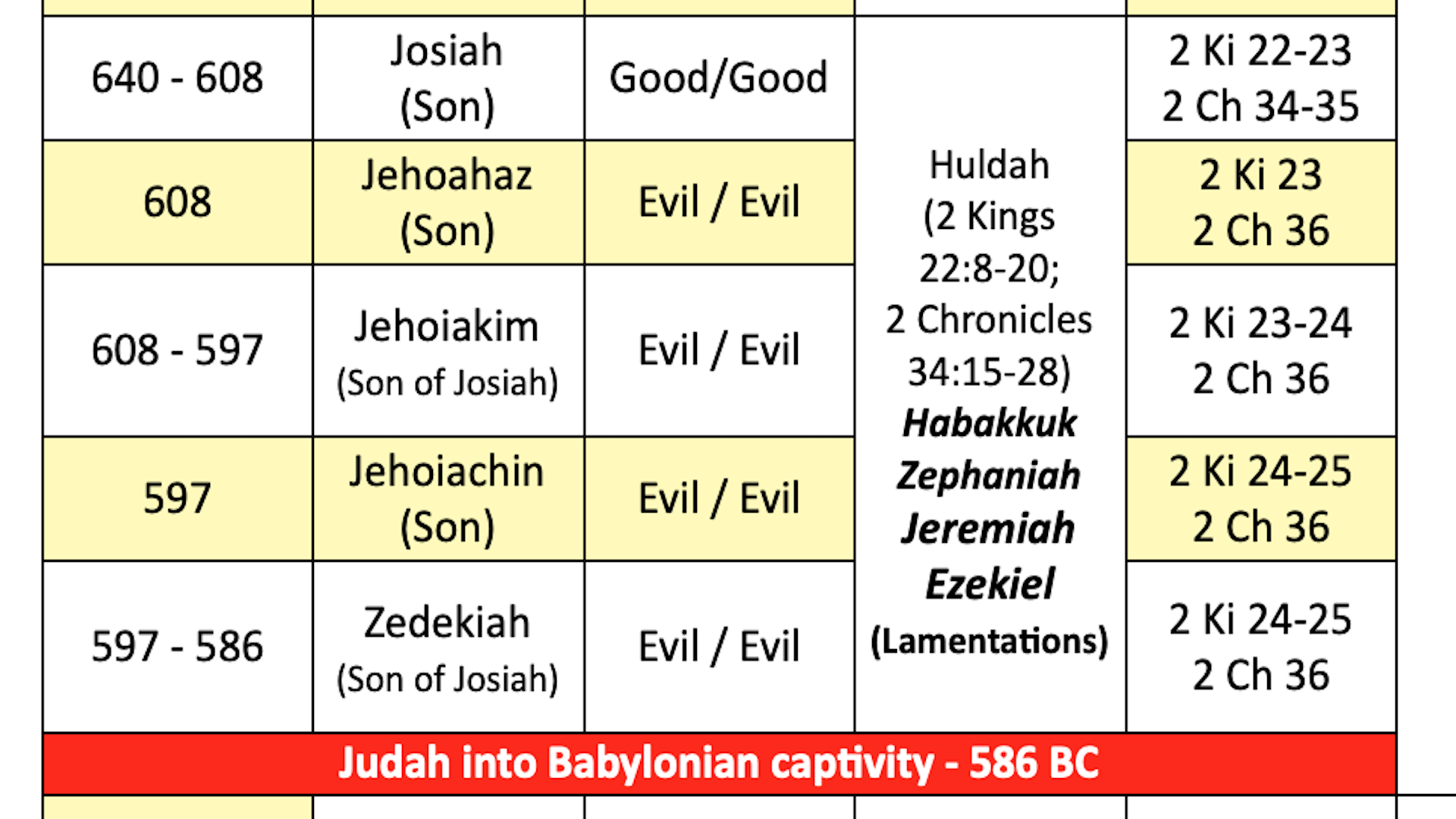
One of the things I love about the minor prophets is the reminder of the historicity of the Bible. Habakkuk, and the other prophets, lived in an actual moment of history. Check out some of the key dates during the ministry of Habakkuk:
605 BC—Nebuchadnezzar invades Judah and carries off Daniel and his friends
597 BC—the Babylonians attack Judah again and take 10,000 exiles back to Babylon, including the prophet Ezekiel
586 BC—Judah is besieged and defeated, and all remaining residents are exiled to Babylon
Jeremiah, a contemporary of Habakkuk, preached to faithless Israelites, imploring them to return to God, while Habakkuk attempted to encourage faithful Israelites to continue to trust Jehovah.
Habakkuk recognized that he was delivering a heavy word. When he opens this book by saying this is “the oracle” that he received from God, that word is better translated “burden.” Part of this burden may have been due to the fact that Habakkuk had something on his heart that we often have: a complaint.
Can we complain to God?
Habakkuk complained to God—twice!—and God doesn’t reprimand him, so there must be a right way to vent about our frustrations and confusions. Here’s what we can learn from Habakkuk’s two complaints:
Instead of making accusations, ask questions. Habakkuk asks God eight questions in his two complaints. I think this is an attitude issue. Complaints are saying, “God I disagree with what You’re doing,” while questions seem to be more like, “God, I don’t understand what You’re doing.”
Desire God’s glory to be seen. At the conclusion of both of Habakkuk’s complaints he uses the word “therefore” (1:4, 16). His conclusion is something along the lines of, “God, if You let this continue, it appears that Your glory is being obscured by the activities of wicked people.”
After your complaint, close your mouth and open your eyes and ears. After Habakkuk’s first complaint, God tells him to “look” at all He is going to do. And after the second complaint, God tells him to “write down the revelation” God gives him and then “wait for it” to be fulfilled” (2:2, 3).
Then Habakkuk does something that isn’t seen anywhere else in the Bible outside of the book of Psalms: he calls for us to Selah pause three times!
Habakkuk shows us that our best response to what God reveals to us should be worship:
Selah (3:3)—pause to consider what God has done
Selah (3:9)—pause to stand in awe of His very present glory
Selah (3:13)—pause in anticipation of His righteous justice and awesome glory that will be revealed
Key phrases from Habakkuk are quoted in the New Testament, and at least three of them are directly tied to these Selah pauses:
“The earth WILL be filled with the knowledge of the glory of the Lord” (2:14), is echoed in the way all of humanity will see the glory of the risen Jesus.
“The righteous WILL live by his faith” (2:4), is quoted as a Christian’s ongoing interaction with the indwelling Holy Spirit.
“I WILL rejoice in the Lord my God … I WILL be joyful in God my Savior” (3:17-18) figures prominently in Mary’s song after she realizes that she is pregnant with the soon-to-be-born Savior.
Can you air your complaints to God? Yes, but do it the right way. Then silently listen, patiently wait, and then eagerly tell others about the coming judgment that they can avoid by having their sins forgiven through faith in Jesus our Savior. Only then can we also echo the “I will” statements of Habakkuk that are echoed in the New Testament—I will live by faith, I will look forward to the glory of God being fully revealed, I will continue to rejoice in God my Savior every day, and I will tell others how they, too, can live this way themselves!
This is a weekly series with things I’m reading and pondering from Charles Spurgeon. You can read the original seed thought here, or type “Thursdays With Spurgeon” in the search box to read more entries.
Listen to the podcast of this post by clicking on the player below, and you can also subscribe on iTunes or Spotify.
Useful To The Master
In a large house there are articles not only of gold and silver, but also of wood and clay; some are for special purposes and some for common use. Those who cleanse themselves from the latter will be instruments for special purposes, made holy, useful to the Master and prepared to do any good work. (2 Timothy 2:20-21)
On the vessels of honor, you can see the hallmark. What is the hallmark that denotes the purity of the Lord’s golden vessels? Well, He has only one stamp for everything. When He laid the foundation, what was the seal He put upon it? ‘The Lord knows those who are His, and, everyone who confesses the name of the Lord must turn away from wickedness’ (2 Timothy 2:19). That was God’s seal! That was the impress of the great King upon the foundation stone. Do we find it here? Yes, we do. ‘Those who cleanse themselves from the latter will be instruments for special purposes, made holy, useful to the Master and prepared to do any good work’ (2 Timothy 2:21). Do you see, then, that the man who is the golden or silver vessel departs from all iniquity, and that is the token of his genuine character. …
Brethren, I count it an honor to be useful to the meanest child of God, but I confess that the honor lies mainly in the fact that I am thereby serving the Master Himself. Oh, to be used by God! This is to answer the end of our being. If you can feel that God has used you, then you may rejoice indeed!
There are some Christians whom the Lord cannot much use because, first of all, they are not cleansed from selfishness. They have an eye to their own honor or aggrandizement. The Lord will not be in complicity with selfish aims! Some men are self-confident—there is too much of the ‘I’ about them, and our Master will not use them. He will have our weakness but not our strength!
From The Great House And The Vessels In It
The Church of Jesus Christ is made up of many members. The Bible uses pictures of a body, a building, and a bride to describe how all of the parts work together to bring strength and vitality to the whole. But Jesus is always the central object: He is the Head of the body, the Chief Cornerstone of the building, the beloved Bridegroom to the bride.
Don’t let either the extremes of selfishness of self-abasement limit the good work you were created to do in making the body of Christ, the building of Christ, and the bride of Christ something radiantly God-glorifying!



 I love the humanitarian work of Convoy of Hope wherever there is a need. They are on the front lines of Ukraine right now. If you are looking for a good organization to support financially, please check out their current efforts and click the Donate button on their page.