Listen to the podcast of this post by clicking on the player below, and you can also subscribe on Apple, Spotify, or Audible.
“…the Jews there tried to stone You, and yet You are going back?” (John 11:8).
The disciples were sitting around Jesus contemplating the next steps when they heard the news that Jesus’ friend Lazarus was sick and on death’s doorstep.
This statement seems to be a very logical thought. At least it is logical from a human perspective. But God sees wider, farther, and deeper than we ever will, so His logic is both perfect and limitless.
Yes, the Jews had tried to stone Jesus (8:59; 10:31, 39), and for mere men operating and thinking as men, staying away from danger is a logical conclusion.
But Jesus was on-mission from His Father (5:19). He had to go to Bethany because the sickness of Lazarus “will not end in death. No, it is for God’s glory so that God’s Son may be glorified through it” (11:4). Later, at the tomb of Lazarus, Jesus prayed, “This is for the benefit of the people standing here, that they may believe that You sent Me” (v. 42). When the dead Lazarus was returned to life and came out of the grave, God indeed was glorified!
Jesus declares that when we walk with Him, we always walk in the light (v. 9). This is because He IS the light of the world (8:12; 9:5). And as we walk with Him, we too bear the light wherever He calls us to walk (Matthew 5:14).
To walk in our own logic is to stumble in the darkness (John 11:10). We calculate and plan from a place of scarcity and fear. As a result, we stumble right past—or we sit still out of fear—and miss the opportunities for God’s glory to be displayed.
My logic always has a dark edge that I cannot see past. But the logic of God has no dark places because He can see from beginning to end perfectly.
I must daily walk in His light, even into those places where my limited logic would tell me to avoid. It is there that I will be able to witness God’s glory that I wouldn’t have seen had I sat still in my “safe” place.
Listen to the podcast of this post by clicking on the player below, and you can also subscribe on Apple, Spotify, or Audible.
I did a series of Advent messages a few years ago called “The Carols of Christmas” with the premise that many of our old familiar carols had become too familiar and we had lost the true meaning in those beautiful songs.
I think the same is true with the sentiment of wanting to experience the glory of God. Sometimes you will hear people say, “We just want to see God’s glory!” but I’m not sure they really mean this or really want it.
Throughout the Bible, “glory” comes from the Hebrew word which means weightiness. When God appears—or even one of His angels glowing with His glorious presence—people collapse under the weight of His glory. Look at the examples of Moses, Isaiah, Daniel, and even John the beloved disciple of Jesus (Exodus 3:6; Isaiah 6:3-5; Daniel 8:15-17; Revelation 1:12-17).
In the light of Christ’s glory everything is exposed. We have no excuses for our sin. We are seen exactly as we are, and the fear of God’s judgment causes us to collapse under that weight.
But the First Advent story is filled with the phrase “Fear not.” Let me show you two examples. First, notice the strong emotions when the angels appear to the shepherds—
An angel of the Lord appeared to them, and the glory of the Lord shone around them, and they were terrified. But the angel said to them, “Do not be afraid. I bring you good news that will cause great joy for all the people.” (Luke 2:9-10)
What was this good news that would turn their fear into joy? Listen to the angelic message to Joseph—
Joseph son of David, do not be afraid to take Mary home as your wife, because what is conceived in her is from the Holy Spirit. She will give birth to a Son, and you are to give Him the name Jesus, because He will save His people from their sins. (Matthew 1:20-21)
Notice the phrase, “HE will save His people from their sins.” Part of what contributes to our fear of God’s glorious presence is knowing that we are helpless to remove our sins. The fact that Jesus would do this for us was foretold in prophecies like Isaiah 25:7-9 and 59:15-16.
How will Jesus do this? In 1 Corinthians 15:53, Paul says that in order to enter into God’s presence our perishable, mortal lives have to be exchanged for something imperishable and immortal. We are unable to do this, but in the Incarnation, the immortal God put on mortal flesh!
Paul goes on in 1 Corinthians 15 to say, “When the perishable has been clothed with the imperishable, and the mortal with immortality, then the saying that is written will come true: “Death has been swallowed up in victory.” Where, O death, is your victory? Where, O death, is your sting?” (1 Corinthians 15:54-55)!
If our sins were still clinging to us, spending eternity in the presence of the King of Glory would be torturous! Our fear of His weighty glory is only changed into joy when we accept that He has saved us from the penalty of our sins. Now our fear of His glory isn’t a crippling fear, but as we worship Him for His salvation our fear becomes reverential worship.
Or we could say it this way—When we fear the King of Glory we fear nothing else!
Charitie Lees Bancroft captures that idea in these stanzas of her poem:
When satan tempts me to despair
And tells me of the guilt within,
Upward I look and see Him there
Who made an end of all my sin.
Because the sinless Savior died,
My sinful soul is counted free;
For God the Just is satisfied
To look on Him and pardon me.
Behold Him there! The risen Lamb,
My perfect, spotless righteousness;
The great unchangeable “I AM,”
The King of glory and of grace!
One with Himself I cannot die,
My soul is purchased by His blood;
My life is hid with Christ on high,
With Christ, my Savior and my God.
With our sins forgiven by our faith in Jesus, we can now enjoy an eternity in the weighty, awesome presence of the King of Glory!
It is His word: “No word from God will ever fail.” It is not the way I desire it to be, or the way culture wants it to be, but it is the way the All-Loving, All-Powerful One has already determined it is going to be.
God’s words never fail, but they always prevail. It doesn’t matter how dark, hopeless, or even impossible it may seem, His plan always triumphs!
When I have God’s word on it, I can confidently say, “Worry, be gone! Striving, cease! Doubt, you are a liar! I belong to the One who has spoken His word. I will rest assured in Him until His word prevails. I say as Mary replied to Gabriel, ‘May it be to me as you have said’” (Luke 1:38).
Listen to the podcast of this post by clicking on the player below, and you can also subscribe on Apple, Spotify, or Audible.
The dad knew it was impossible. His son knew it was impossible since he had lived with it nearly all of his life. All of their family and friends knew it was impossible because they had seen the devastation. The disciples of Jesus even proved it was impossible.
The son was plagued by a demon. In a last-ditch effort, the beleaguered dad brought his boy to the disciples of Jesus. But the disciples were stymied. The dad said to Jesus, “I begged Your disciples to drive it out, but they could not” (see Luke 9:37-43; Mark 9:14-27).
Jesus loves “impossible” situations.
What seems impossible to humans is merely an opportunity for the greatness of God to be seen.
Don’t run from your difficulties.
Don’t quake at the impossibilities.
Don’t try to solve the seemingly unsolvable on your own.
Bring the “impossible” to Jesus.
Jesus said to the dad, “Bring your son here.” Jesus rebuked the impure spirit, healed the boy, and gave him back to his father.
This is why Jesus loves it when we bring the impossible to Him: God’s glory is made abundantly clear. Luke records, “And they were all amazed at the greatness of God.”
The greater the difficulty, the greater the glory of God is seen in the deliverance.
Don’t throw in the towel on your situation. Don’t throw up your hands in despair. Instead, bring your impossibility to the One who is never stymied, never at a loss, never too weak or too busy to meet your need. Bring it to Jesus and let Him do what only He can do.
Listen to the podcast of this post by clicking on the player below, and you can also subscribe on Apple, Spotify, or Audible.
The Bible is not only the inspired Word of God but it is rooted in history too. Every prayer was prayed by a real person in distress, and every song of praise was lifted up by someone who personally experienced God’s deliverance.
The reason why this is so important is that it makes God’s Word relatable and applicable to us. If the Bible merely contained moral stories set in some make-believe world, we may have a hard time seeing how to apply the principles to our daily lives. But, thankfully, this isn’t the case. We can read the real-life experiences of real historical people and then we can allow the Holy Spirit to help us apply this inspired Word to our lives.
There is a collection of 15 songs in the Book of Psalms called “The Songs of Ascent.” Even these songs have an important historical background.
Second Chronicles ends with this proclamation from King Cyrus: “The Lord, the God of heaven, has given me all the kingdoms of the earth and He has appointed me to build a temple for Him at Jerusalem in Judah. Anyone of His people among you—may the Lord his God be with him, and let him go up” (2 Chronicles 26:23).
The phrase “let him go up” is both literal (since Jerusalem is 2500 feet above sea level) and spiritual. Listen to these words from King Solomon, “The way of life winds upward for the wise, that he may turn away from hell below” (Proverbs 15:24 NKJV).
The Songs of Ascent were a rallying cry—an encouragement to all pilgrims to keep climbing up.
In Hebrew literature, the main point is usually found in the middle of the poem or story, unlike our Western literature which puts the payoff at the end. In the first Song of Ascent, the middle is verse 4. But the second half of Psalm 120 seems out of place for people ascending up to Jerusalem to worship God. Verse 5 begins with the words, “Woe to me.”
The psalmist is expressing his pain in living among the people of Meshech and Kedar. The people of Meshech were vicious people who traded human lives for money and who conducted themselves as terrorists (Ezekiel 27:13; 32:26). Their name literally means “drawing away.” The people of Kedar were nomadic sons of Ishmael. Being nomadic means they were never at rest. Their name literally means “dark place.” Very noteworthy is that there is no mention of God in verses 5-7.
The middle verse of this song (v. 4) turns the people of Meshech and Kedar over to God. It is a reminder that we are not the ones to dispense justice. If God knew how to overthrow the powerful kingdoms of Judah, Babylon, and the Medes, if He knew to call Cyrus by name at just the right moment, He also knows how to deal with these sinners.
This Song of Ascent shows the stark contrast between keeping our eyes on the dark culture around us versus keeping our eyes on the God who is never weighed down by the darkness. As we go higher up, we focus more on God; as His saints focus on Him, His light shines on them; as His light shines on them, they point sinners living in dark valleys to the God of light and love.
Staying down is easy. Getting up requires intentional effort. Going up requires us to overcome the pull of sin and the frustration of watching for judgment to fall on sinners.
Continually going up glorifies God, has eternal rewards for saints, and creates a compelling testimony for sinners.
Going up is a lot of effort, but the rewards are so worth it! As the apostle Paul reminded his friends in Rome, “I consider that our present sufferings are not worth comparing with the glory that will be revealed in us” (Romans 8:18). Let’s keep climbing up and let’s keep lifting our eyes to the only One who has the eternal light.
There is something very important that mature leaders need to remind themselves of so that they can help emerging leaders become successful. You can watch out this full conversation about mulligans and do-overs on the most recent episode of The Craig and Greg Show. Be sure to check out all of my videos on my YouTube channel.
In my sermon on Sunday, I talked about the sovereignty of God over world affairs and world leaders. This is a great reminder from John Newton:
Sovereignty is but another name for the unlimited exercise of wisdom and goodness.
Merat Sultan was born in the shah of Iran’s palace in 1876. He became the chief of police and of the army in Tabriz, Iran. When the Russians invaded and occupied that area, they made plans to execute Sultan. How he escaped actually led him to a relationship with Jesus as Sultan became a Christian. Check out this fascinating story from the website Praying For Muslims. I would also urge you to check out their weekly prayer guide.
“No voice. No contribution. No significance. No meaning.
“Invisible.
“That’s the way many women probably felt at the time Jesus lived. And every person with an illness—cancer, leprosy, epilepsy, mental disabilities—every one of those people were marginalized. In Jesus’ day, what careers were on the lowest rung of the corporate ladder?—fishermen and shepherds. Yet when you read every account of Jesus, who do you see Him hanging around? Fishermen, shepherds, women, and people dealing with health issues.
“Jesus wanted it that way. He took every opportunity He had to bring people in from the fringes and give them His full attention. He saw them. He listened to them. He loved them in ways they’ve never been loved before. They had never experienced anything like it.”
T.M. Moore wrote, “We are becoming so accustomed to the forsaking of traditional values, the undermining and fragmenting of long-established institutions, and the breakdown of morality and civility that we can begin to think that these conditions are the new normal, the best we can hope for in an age in flight from God. Everywhere we look in our day, the prophetic words of William Butler Yeats, in his 1919 poem, ‘The Second Coming,’ seem to be coming true: ‘Things fall apart; the centre cannot hold;/Mere anarchy is loosed upon the world./The blood-dimmed tide is loosed, and everywhere/the ceremony of innocence is drowned.’ But the appearances, which press upon us daily, are only a matter of perspective.” Check out the rest of his post.
When things are going well, how can we talk about our success in a way that glorifies God? John Piper had a thoughtful answer to a businessman who asked how he could talk about the success of his business and make God look great while he was doing so.
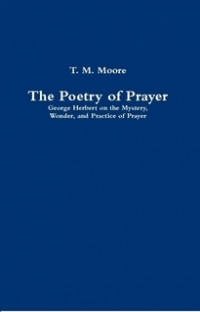
In The Poetry Of Prayer, T.M. Moore not only introduces us to the imaginative poetry of George Herbert, but he also shows us what Herbert was trying to portray: There’s an undiscovered world in our prayer time! You can check out my full book review by clicking here.
“The imagination is a wonderful if much-neglected resource. It is that place in the soul where mind, heart, and conscience, most fruitfully overlap to enhance, enrich, and enlarge each other.
“When our imaginations are functioning as God intends, they can open the windows of refreshment into our souls, so that we think bigger and more clearly and excitedly; we feel with more urgency and delight; and we establish new priorities and values.
“Poetry stretches the imagination by inviting it on to familiar ground and then changing the nature of that ground, right under our feet. Images, metaphors, rhyme, rhythm, and in an agreeable form can lead us, through our imaginations, into seeing familiar things in new and exciting ways.”
“Prayer fixes the focus of our minds on unchanging spiritual realities. Prayer engages our imaginations—what Paul calls ‘the eyes of your understanding’—with visions of unseen glories and wonders. …
“At the same time, as we gaze in prayer upon the beauty of Christ, and commune with Him in His glory, we find that our hearts are enlarged in love for the Lord. The sheer beauty, majesty, and immensity of God can suck the breath out of us and fill us with the Spirit of the Lord at the same time. Lesser things lose their thrall as we drink in the vision of Christ and pour out heartfelt words of worship, adoration, and praise. These, in turn, exercise our heart in love for the Lord, just as our physical muscles are exercised during a workout.”
“We feed our souls in prayer when, having entered His presence, we fill our minds with the vision of His glory, our hearts with the joy and pleasure of His presence, and our wills with iron resolve to serve this glorious God at every moment.”
“Even now, as the Apostle Paul indicates [2 Corinthians 4:6], we who feast at the banquet table of prayer can glimpse the glory of God in the face of Jesus Christ and know daily revival and renewal in His grace.”
“Prayer brings us from earth to heaven, and then brings heaven to earth in our transformed souls and renewed commitments for the day ahead.”
My Patreon supporters have been given all the rest of the quotes I pulled from this book. If you would like to have access to all of the content I regularly share with my Patreon team, please click here.
Listen to the podcast of this post by clicking on the player below, and you can also subscribe on Apple, Spotify, or Audible.
I was playing golf with a pastor and a missionary when the starter asked if a single player could join us to make a foursome. We happily agreed. About 4-5 holes into our game, our guest asked what we did. My pastor friend started out, “I’m a pastor, and this guy is a missionary, and—”
Our guest interrupted and blurted out, “You guys are Christians?! I’ve never had so much fun! I always heard Christians were boring.”
When did it come about that people thought of Christians as boring—or even worse, as sourpusses and killjoys? Sadly, too many Christians have helped cement this idea in people’s minds. I think this is largely because those Christians are misinformed and frustrated. This frustration, I believe, comes from the mistaken idea that Christians are supposed to squelch any urges or cravings that we have.
But check out this Q&A from the Westminster Catechism—
Q: What is the chief end of man?
A: To glorify God and to enjoy Him forever.
Glorifying God is supposed to result in enjoyment—enjoying both God’s presence and the life He has given us. We are created to crave the fuel of His Spirit that satisfies and energizes us.
Just as your car would at best under-perform if you attempted to run it with anything else but gasoline, so our lives will under-perform and feel like drudgery if we are trying to fuel our cravings with anything other than God.
The dictionary defines “craving” as a great or eager desire, or a yearning. But I believe the Bible defines God-honoring craving as the longing for an intimate relationship with God that is implanted by God Himself.
The people of Judah had gone astray from God and were trying to satisfy their urges with foreign gods and pagan idolatry. When King Asa called these backsliders back to God, here’s how he did it—
[Asa] commanded Judah to seek the Lord, the God of their fathers—to inquire of and for Him and crave Him as a vital necessity—and to obey the law and the commandment. (2 Chronicles 14:4 AMP)
Contrast this with the temporary cravings of earth—
But those who crave to be rich fall into temptation and a snare and into many foolish, useless, godless, and hurtful desires… (1 Timothy 6:9 AMP)
This world is fading away, along with everything that people crave. But anyone who does what pleases God will live forever (1 John 2:17 NLT).
Nowhere are godly cravings and earthly cravings better contrasted than in James 4:1-6.
In this passage, the Greek word for desires (v. 1) and pleasures (v. 3) is hedone. This is where we get our English word “hedonism.” There is nothing wrong with pleasure—for God Himself takes pleasure—but it’s what pleasures we are craving that can make them ungodly. James rightly points out that the wrong hedonism is a craving to fulfill “your desires,” “your pleasures,” and to desire “friendship with the world” (v. 1, 3, 4)
Jesus talked about worldly cravings—using the same word hedone—when He said, “The seed that fell among thorns stands for those who hear, but as they go on their way they are choked by life’s worries, riches and pleasures [hedone], and they do not mature” (Luke 8:14).
Notice the same thing in Isaiah 58:2 where God declares that people “seem eager” to delight in God, but it’s only a show for them to satisfy fleshly cravings. John Piper noted, “God means they are delighting in their business and not in the beauty of their God. He does not rebuke their hedonism. He rebukes the weakness of it. They have settled for secular interests and thus honor them above the Lord.”
Instead, notice the fulfilled cravings when we seek God: “If you keep your feet from breaking the Sabbath and from doing as you please on My holy day, if you call the Sabbath a delight and the Lord’s holy day honorable, and if you honor it by notgoing your own way and notdoing as you please or speaking idle words, then you will find your joy in the Lord, and I will cause you to ride in triumph on the heights of the land and to feast on the inheritance of your father Jacob. For the mouth of the Lord has spoken” (Isaiah 58:13-14).
I like that reminder that “the mouth of the Lord has spoken.” The origin of the word craving is the Old Norse word krefja, which means to lay claim on something because of a promise. God has promised, and so we can claim it.
James assures us that the spirit God implanted in us envies intensely (James 4:5). We were made to crave God’s presence, we were made to find ultimate satisfaction in His presence, we were made to find eternal delight in knowing Him more intimately!
The proud person says, “God, I know what I want. Give it to me.” The humble person says, “God, I know Your presence is the only thing that will satisfy me. Give it to me.”
The craving in our spirit can be redirected from earthly yearnings to God-honoring yearnings by yielding to the Holy Spirit. I would humbly suggest that our prayer should be something like this—
“Father, grant that my cravings are for Your name to be hallowed, Your kingdom to be made visible, and Your will to be done. Let the enjoyment I have in Your presence shine out of me in a way that invites others to be dissatisfied with their earthly cravings and find their ultimate satisfaction in a personal relationship with You through Jesus Christ. Holy Spirit, continue to refine and redirect all of my cravings away from earthly things to eternal pleasures. In Jesus’ name I pray, Amen.”



 “…the Jews there tried to stone You, and yet You are going back?” (John 11:8).