Soul And Spirit

If I were to ask you to define the material/physical part of you versus the immaterial part of you, it probably wouldn’t be too difficult. Obviously, we can touch the physical part but we cannot touch the immaterial part. 

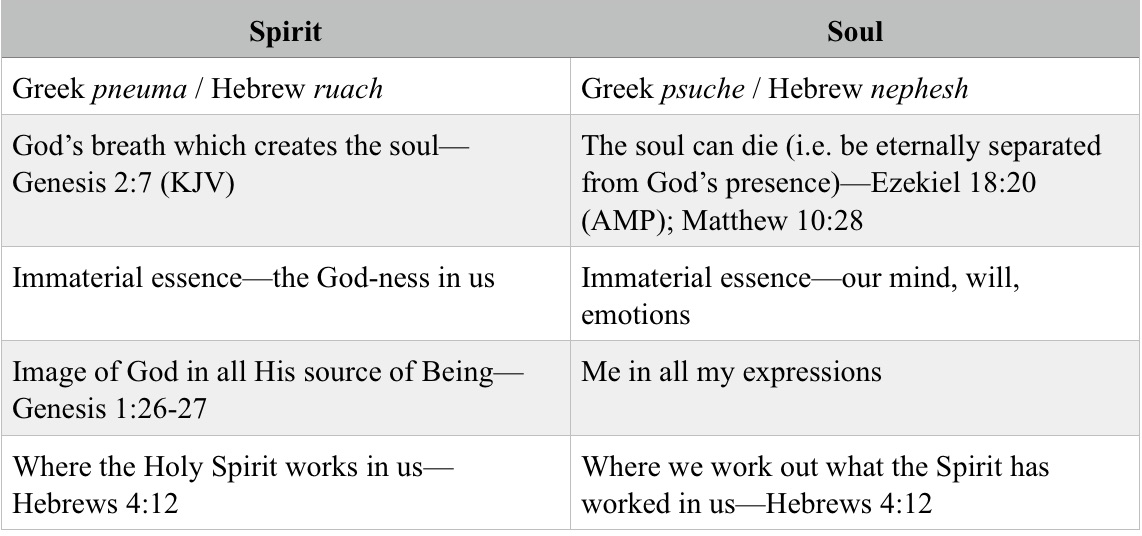
But human as a three-part being—we have a body, a soul, and a spirit. So if I were to now ask you to describe the “dividing line” between the two immaterial parts of us (the soul and the spirit), you would probably have a more difficult time coming up with a definition. 

Both terms are used throughout the Bible. Sometimes it seems the words soul and spirit are almost used interchangeably, but they are most assuredly two separate parts of what makes us us. 

Please check out this chart that I shared with my friends at Calvary Assembly of God, and perhaps even take a few minutes to watch the video below. If you would like to download a PDF version of this chart, you may do so by clicking here → Soul and spirit side-by-side

Verses referenced—Genesis 1:26-27, 2:7; Ezekiel 18:20; Matthew 10:28; Hebrews 4:12

The Empowerment Of Pentecost

The Feast of Pentecost was an annual celebration for Jewish people for a long time, with nothing really noteworthy happening. Until…

…on the Day of Pentecost that took place just 10 days after Jesus ascended into heaven, a new breed of Christian was unleashed on the world. Those followers of Jesus who were baptized in the Holy Spirit on that day begin living a lifestyle that we now refer to as Pentecostal. 

Most people were familiar with water baptism is an outward sign of an inward commitment. It’s not something that was new to Christianity: Greek philosophy teachers and Jewish rabbis baptized their followers. So did John the baptizer (or the Baptist). 

But John, as the forerunner of Jesus, promised that there would be something more—a baptism in the Holy Spirit that Jesus would bring. Jesus Himself said this baptism was so important that He didn’t want His followers to even attempt to begin to evangelize the world until they received this baptism (Luke 3:3, 16; 24:44-49; Acts 1:4-8). 

What is important about this Holy Spirit baptism? What are its origins? To answer these questions, we have to go back to the very beginning of Time itself. When God created humans, the Holy Spirit was breathed into us, giving us a living soul (Genesis 1:26, 2:7). This Spirit-breath set us apart from all other living creatures (Job 33:4, 32:8; Proverbs 20:27).

We were created to be intimately connected with God, but our sin severed that. Our hearts became sin-calloused and selfish and stone-hard toward God. 

The Cross of Jesus allowed us to be reconciled to God. By placing our faith in what Jesus did for us on the Cross, we could receive forgiveness of our sins. We were now saved from the penalty of our sins, but Jesus wanted more for us—He wanted us also to be saved to a new life that was as intimately connected to God’s heart as His life was. 

So Jesus told His followers to wait and pray for the promised baptism in the Holy Spirit. 

They prayed. And on that Day of Pentecost, they were indeed baptized in the Holy Spirit (Acts 2:1-4). Actually, the word filled literally means “fulfilled”—the baptism in the Holy Spirit fulfilled what Jesus had promised. 

From that day forward, those who are baptized in the Holy Spirit are called Pentecostal people. I know there are some who would argue that was only for “back then,” but let me tell you from personal experience that there is no other way that I would try to live the Christian life than by being an unashamed Pentecostal! 

Jesus wants us to not only be water baptized to announce our faith in Him for forgiveness of sins, but also to be baptized in the Holy Spirit to empower us to live holy, extraordinary, fulfilling lives. If you haven’t been baptized in the Holy Spirit, you can be simply by asking God (Luke 11:13).

Join me next Sunday as we continue to explore what it means to live the Pentecostal lifestyle.

If you missed any of the messages in this series, you can access the full list of messages by clicking here.

Returning Home

And Abram went on his journey from the south as far as Bethel, to the place where his tent had been at the beginning … to the place of the altar which he had made there at first. And there Abram called on the name of the Lord (Genesis 13:3, 4).

While he was in Egypt, Abram pitched no tents nor did he set up any altar of worship. In fact, it was probably unwise of him to go to Egypt in the first place, as there is no record of God telling him to do so. While he was sojourning there, Abram also perpetrated a lie as an attempt to protect himself.

Whenever we take an unwise detour—and then realize it—part of repentance is to return to where we know we previously had met with God. Abram returned it to the place where he had first set up his tents, and worshipped God once again at the altar he had built at first. There he once again “called on the name of the Lord.”

It was from this place (not from Egypt) that God could say to Abram, “Arise, and walk in the land through its length and width, for I give it to you” (v. 17). “THEN” (v. 18)—and only then—was it safe for Abram to move his tents and set up a new altar of worship. 

Prayer—Father, I am sure I have strayed into an Egypt before, sojourning where my wits—and not Your voice—have led me. Thank You, Lord, for protecting me there, and for allowing me to “return home” to the place You intended for me, to the place where Your blessings flow. May I not move forward again unless You direct me. In Jesus name, Amen.

Blessing Follows Obedience

Listen to the podcast of this post by clicking on the player below, and you can also subscribe on AppleSpotify, or Audible.

Thus Noah did; according to all that God commanded him, so he did (Genesis 6:22).

Noah did ALL that God commanded him to do. Noah was asked to…

  • … remain pure in a depraved, everything-goes generation 
  • … build an ark in a place nowhere close to water, when it had never rained on the earth, let alone flooded 
  • … gather animals from all over the world 
  • … secure food for himself, his family, and all of the animals he had collected
  • … convince his family this ark was needed to escape the world-wide flood God was sending, and 
  • … keep convincing his family to hang in there with him for the next 100 years! 

And Noah did all of this: Everything that God told him to do. 

“No matter how unusual, or unconventional, or even unheard of, if God commands I must fully obey. I must do according to all that God says.” —Craig T. Owens 

In doing so, God saw that Noah was “righteous before Me in this generation” (Genesis 7:1). This allowed God to pronounce a blessing on Noah and his family (9:1). 

God’s blessing always follows our obedience. 

God doesn’t say, “I have blessed you, now obey Me.” But He says, “If you obey Me I will bless you.” 

Here’s a prayer we should consider offering—

     Holy Spirit, help me to obey all that You are instructing me to do. May my obedience be as pleasing to my Heavenly Father as Noah’s obedience was. May God be glorified by my full and quick obedience, and may others be drawn to Christ as they see the blessings that follow my obedience. No matter how unusual, or unconventional, or even unheard of, may I be quick to obey. In Jesus name I pray. Amen!

►► Would you please prayerfully consider supporting this ministry? My Patreon supporters get behind-the-scenes access to exclusive materials. ◀︎◀︎

9 Prayers From “Praying The Promises”

In Praying The Promises, Max Lucado gives us valuable instruction on how to turn Scriptural promises into powerful prayers. Here are a few of those prayers (the biblical reference in brackets is the passage that helped form the prayer). 

Thank you for being a God who wants me to know You.… Your wisdom surpasses all wisdom on this earth. Your ways are so much higher than mine. I could study You and Your Word for the rest of my life and still only scratched the surface of the depths of who You are. You are at once knowable and unknowable.… Deepen my knowledge of You, God. [Psalm 19:1-2; Isaiah 55:8-9; Romans 1:19-20]

Help me rely on Your promise of grace because I have been found righteous through Jesus. When trouble comes, use those troubles to increase my faith and draw me nearer to You. [Hebrews 7:25]

Father, sometimes I convince myself that I need to earn Your salvation. I feel like I should do more, be more, and achieve more. But You simply want my faith. Help me let go of my striving and this need to perform for You and for others. [Romans 4:5; Philippians 3:4-7] 

Guide me during the difficult times. Give me hope as I pray and wait. Remind me of Your power and authority so that I will trust Your ways, even when I can’t see where the path before me is going. [Genesis 50:20-21; Ephesians 1:11-12; Romans 5:3] 

Forgive me when I look for guidance outside of Your Word. When I ask friends what to do before I open my Bible. When I am resistant to reading Your Word because I want to guide myself rather than be guided by You. Renew my desire and passion for reading the Bible. … May I learn something new about You and Your character each time I read it. [Psalm 32:8; 2 Timothy 3:16-17] 

When a worry arises, remind me of Your presence so I will turn to You and not fear. [Psalm 23:1, 4]

Gracious Father, nobody is beyond Your redemption. Because of Your love and mercy, You provided a Redeemer for us in Christ, who graciously stopped us while we were on the path of sin, gave us refuge, and pointed us toward the road of redemption. [Galatians 4:4-5]

Forgive me when I try to fight my own battles. … If I try to fight for myself, I end up feeling exhausted and defeated by my own efforts. You have said You are fighting for me. Help me believe that truth even when I am so tempted to fight for myself. Go before me this week as I face temptation. Go before me as I face anxiety, fear, and uncertainty. Protect me in every spiritual battle. Fight for me and help me surrender each battle to You. [Exodus 14:14; Deuteronomy 1:30; Psalm 20:7-8]

As concerns and questions come up, remind me to turn each of them over to You in prayer. I lift up my family to You. I lift up my work to You. I lift up my to-do list to You. Cover each worry with Your peace. Prioritize my day so that it aligns with Your will and not mine. [1 John 5:14]

You can check out my review of Praying The Promises by clicking here, and you can read some other quotes from this book by clicking here.

Thursdays With Oswald—Isaiah 24-29

Oswald ChambersThis is a weekly series with things I’m reading and pondering from Oswald Chambers. You can read the original seed thought here, or type “Thursdays With Oswald” in the search box to read more entries.

Isaiah 24-29

[These are notes on Oswald Chambers’ lecture on Isaiah 24-29.] 

     The Bible reveals that the material world has been blighted by reason of man’s sin. … Man was intended by God to govern Nature (see Genesis 1:26); instead, he has infected it with his sin and it has become a partaker of the curse with him, so that “the whole creation groans and travails in pain together until now.”

     Men say “We are going to build a holy city on this earth”—you cannot; the earth is infected, it is a diseased chamber, and the holy city will never be on it until God has purged it with fire and taken the epidemic out of it. … God cannot bring in the Millennium by moral renovation, but only by cremation…. 

     The great note of the Bible revelation is not immortality but Resurrection. The doctrine of the Resurrection is that something comes from God Himself direct into the dust of death. … He has swallowed up death forever, the sovereign Lord will wipe away the tears from all faces; He will remove the disgrace of His people from all the earth. The Lord has spoken. In that day they will say, ‘Surely this is our God; we trusted in Him, and He saved us. This is the Lord, we trusted in Him; let us rejoice and be glad in His salvation’ (Isaiah 25:8-9). … 

     The judgments of God are for another purpose than the vindictive spirit of man would like to make out. … You never find that spirit in the prophets; if there is destruction and death it is for one purpose only—deliverance. God is on the line of salvation, not of damnation; He only damns the damnable things. … 

     In our own day we seem to have come to the conclusion that God has made a number of blunders and we have to put them right; we have private notions of our own which if put down in black and white would prove that we do not believe God is intelligent in allowing the history of the world to go on as it has, in allowing sin and war. … We won’t see that behind the whole thing is the wisdom of God, that neither bad men nor the devil himself can do one thing without the direct permission of God. … 

     The devil likes to make us believe that we are in a losing battle. Nothing of the sort! We have to overcome all the things that try to obscure God. The rugged truths of Isaiah point out not only the appalling state of the world as it is, but that we have to live a holy life in it by the power of God, not a sequestered life in particular temples or rituals, but real genuine magnificent men and women of God, no matter what the devil or the world or the flesh may do.

From Notes On Isaiah 

Are you letting God be God? Are you letting God resurrect you and make you holy? Are you giving in to the lie of the devil that you are losing the battle, or are you letting God speak to your mind that you are one of the real genuine magnificent men and women of God who are shining His light and love in a diseased world? 

8 More Quotes From “Whisper”

In Whisper, Mark Batterson gives us seven love languages which God uses to speak to us (check out my review of Whisper here). Mark always does a masterful job of weaving together Scripture, quotes from other authors, historical and his own personal accounts. Here are some of the quotes he shared from others.

“The voice of the Spirit is as gentle as a zephyr. So gentle that unless you are living in a perfect communion with God, you never hear it.” —Oswald Chambers

“The sole cause of man’s unhappiness is that he does not know how to stay quietly in his room.” —Blaise Pascal

“The best translation of the Hebrew in Genesis 1 was not ‘and God said’ but ‘and God sang.’” —Leonard Bernstein

“How much happier you would be, how much more of you there would be, if the hammer of a higher God could smash your small cosmos!” —G.K. Chesterton

“Vocatus atque non vacates, Deus aderit. Bidden or not bidden, God is here.” —Desiderius Erasmus

“A Bible that’s falling apart usually belongs to someone who isn’t.” —Charles Spurgeon

“The Christian shoemaker does his duty not by putting little crosses on the shoes, but by making good shoes, because God is interested in good craftsmanship.” —Martin Luther

“No crooked table legs or ill-fitting drawers ever, I dare swear, came out of the Carpenter’s shop at Nazareth.” —Dorothy Sayers

For more quotes from Whisper, click here.

Handling Tough Texts

How do you handle a hard passage in the Bible? Peter wrote this about Paul, “His letters contain some things that are hard to understand….” But if we don’t take the time to wrestle with that passage, Peter says this is what happens next: “…which ignorant and unstable people distort, as they do the other Scriptures, to their own destruction” (2 Peter 3:16).

So here’s a 5-step plan I use when I am working through a challenging passage of Scripture.

  1. Ask the Holy Spirit to help you

All Scripture is inspired by the Holy Spirit (2 Timothy 3:16), and the same Holy Spirit lives in a Christian (1 John 2:20). Think about that: the same Holy Spirit that inspired an author to write the words of Scripture is the same Spirit that will illuminate them to you!

  1. Read the difficult passage in context

We will make our task much easier when we “zoom out” from the difficult text and read the whole passage surrounding the difficult verse/phrase. Perhaps we need to “zoom out” even farther to understand why the whole chapter or book was written.

  1. Identify the parts that are clear

Start off by identifying the parts that you do understand, and then see what light that shines on the tricky text.

  1. Cross reference with other Scriptures

Never, ever, ever draw a conclusion from just one passage of Scripture. Paul reminded his audience that he used the “whole counsel of God’s Word” (Acts 20:27) in forming his sermons. If the challenging passage contains an Old Testament passage, look it up; if it references an historical event, read that history. I also like to use biblegateway.com’s excellent search feature to find cross references.

  1. Draw conclusions on what appears to be the main point

Only after you have done step #1-4 should you attempt to draw some conclusions. You will set yourself up for error if you draw a conclusion first, and then try to find other texts in the Bible that agree with you.

The Apostle Peter writes something rather challenging in his first letter. In fact, Martin Luther said this about 1 Peter 3:18-22: “A wonderful text is this, and a more obscure passage perhaps than any other in the New Testament, so that I do not know for a certainty just what Peter means.” If you would like to see how I walk through the 5-step plan on this “obscure passage,” please check out the video below.

If you’ve missed any messages in this series, you may find the complete list by clicking here.

The Mystery & Meaning Of Marriage

John Piper’s insight of both the Old Testament and New Testament meaning of marriage is profound!

Here are the links to the Scriptures he references:

Piper’s conclusions:

  1. God modeled marriage on the covenant love between Christ and the church.
  2. Therefore, marriage has always been a witness (or a drama or a parable) of covenant love between Christ and the church.
  3. Therefore, the roles of husband and wife derive from the roles God designed for Christ and the church.
  4. Therefore, confusing or minimizing these roles obscures the meaning of marriage as a drama of the covenant love between Christ and the church.
  5. Therefore, let every husband seek to love and lead and nourish and protect like Christ, and let every wife love her husband and honor his Christ-like role, joining hands in Christ-exalting mission as God meant for the church to do.

You Are A Masterpiece!

“‘For we are His workmanship, created in Christ Jesus for good works, which God prepared beforehand so that we would walk in them’ (Ephesians 2:10). The Greek word for workmanship is poiema, from which we get the English word poem. It can also mean masterpiece. …

“The book of Genesis tells us that God created each of us in His image. You and I are created to be so much more than normal. Being normal is safe. And easy. It doesn’t require much work or effort or change on our part. But it always leads to mediocrity. When you strive to be just like everyone else, you never have a chance to be special. When you start to embrace and even celebrate how different God made you, you can begin to do extraordinary things. You can begin to see yourself through His eyes. You can begin to live in the uniqueness with which you were created.” —Tim Tebow, in Know Who You Are, Live Like It Matters (emphasis mine)