Don’t judge your creative efforts by the world’s likes (or even by its silence). If you did your best with the talents that God gave you, the applause from nail-scarred hands is all that really matters.
“It will be vain for me to stock my library, or organize societies, or project schemes, if I neglect the culture of myself; for books, and agencies, and systems, are only remotely instruments of my holy calling; my own spirit, soul, and body, are my nearest machinery for sacred service; my spiritual faculties, and my inner life, are my battle axe and weapons of war.” —Charles Spurgeon
“A man who has faith must be prepared not only to be a martyr, but to be a fool.” —G.K. Chesterton
The paleontological evidence of dinosaur fossils is most easily explained by the Flood described in the Bible. ICR reports, “Virtually every dinosaur fossil ever found is ensconced in sedimentary or (rarely) volcanic sediments, indicating a sudden and catastrophic deposition. … So why would paleontologists entertain bizarre extinction explanations such as slipped discs, sunspots, or magnetic reversals? Because if a scientist dismisses the global Flood out of hand, then anything goes when trying to explain the dinosaur demise.”
Listen to the podcast of this post by clicking on the player below, and you can also subscribe on Apple, Spotify, or Audible.
Last week we saw that if we make prayer our priority, we can expect that our eyes will be opened to the answers that God has for us. Hagar and Eliezer seemed to get pretty quick answers. Nehemiah had to wait four months for the answer to his prayer.
We saw in Psalm 5 that David laid his requests before God first thing in the morning, and then he went out of his prayer closet in expectation of an answer (Psalm 5:1-3). But how long did he wait?
Psalm 6 may not happen historically right after Psalm 5, but listen to David’s heart, “Have mercy on me, LORD, for I am faint; heal me, LORD, for my bones are in agony. My soul is in deep anguish. How long, LORD, how long? (Psalm 6:2-3). And then again in Psalm 13:1-3, David asks, “How long?” four times in the first two verses!
When we read the training Jesus gave His disciples about prayer in Luke 11:9-10, we see how He implores them (and us) to keep on praying. It becomes even more emphatic in the Amplified Bible—
So I say to you, ask and keep on asking and it shall be given you; seek and keep on seeking and you shall find; knock and keep on knocking and the door shall be opened to you. For everyone who asks and keeps on asking receives; and he who seeks and keeps on seeking finds; and to him who knocks and keeps on knocking, the door shall be opened.
But once again we have to ask: how long are we to continue asking, seeking, and knocking? This is what Job asked in the middle of his trial (Job 6:8, 11-13).
Charles Spurgeon said, “God has measured the crosses of all His children: Israel in Egypt, 430 years; Joseph in prison, 3 years; Judah in Babylon, 70 years.” That means that God knows what He is doing, God knows His timing for answering, and that our part is to simply to continue to ask, seek, and knock as we throw our total trust on Him!
I remember my affliction and my wandering, the bitterness and the gall.I well remember them, and my soul is downcast within me.Yet this I call to mind and therefore I have hope.Because of the LORD’s great love we are not consumed, for His compassions never fail.They are new every morning; great is Your faithfulness.I say to myself, “The LORD is my portion; therefore I will wait for Him.” (Lamentations 3:19-24)
During these times of waiting, we need to keep recalling what we know:
God’s love is unfathomable—Romans 5:5, 8:38-39
God’s timing is perfect—Deuteronomy 32:4
God’s method is flawless—Romans 8:28
God’s gifts are good—Luke 11:11-13, 12:32
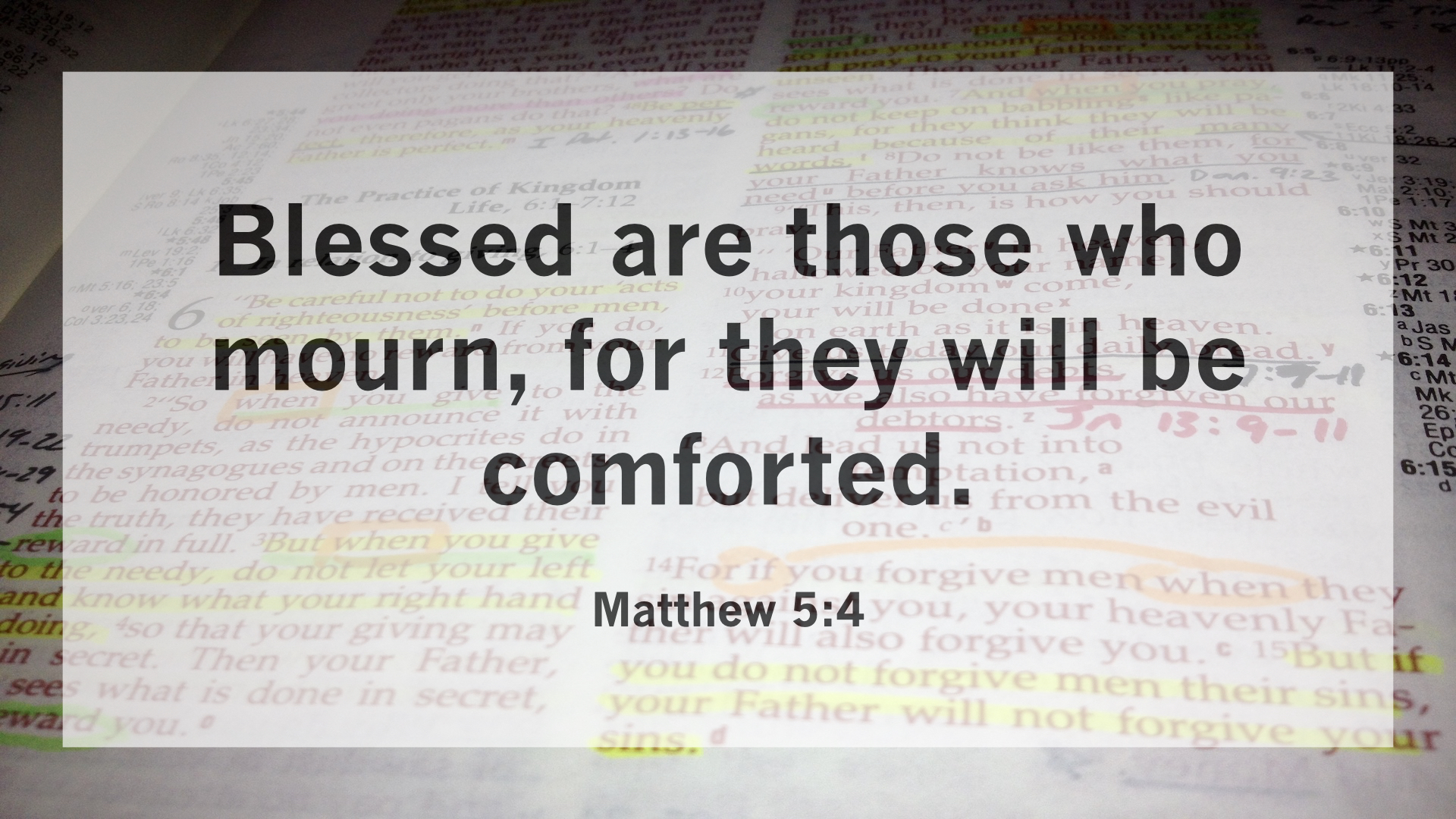
In Psalms 6 & 13, David doesn’t record any answers from God, but listen to this assurance from Jesus, “Blessed are those who mourn, for they will be comforted” (Matthew 5:4).
Jesus doesn’t tell us how or when God will bring us comfort, but He does assure us that we will be comforted!
In a couple of the examples from David, you can see this assurance as he continues his prayers (Psalm 6:2-4, 8-10; 13:1-6). Paul also experienced this confidence (2 Corinthians 12:7-10), and so did Jesus (Matthew 26:38-39, 50-54).
The writer of Hebrews assures us that Jesus was heard in His, “How long?” cries, and therefore He knows exactly how to intercede for us today as we lift up the same cry (Hebrews 5:7-8; 2:10, 14, 17-18)!
How long? Quite simply stated: Until God answers or until He lifts our burden.
In the meantime, the examples in Scripture and the assurance of Christ’s intercession for us us encourages us to…
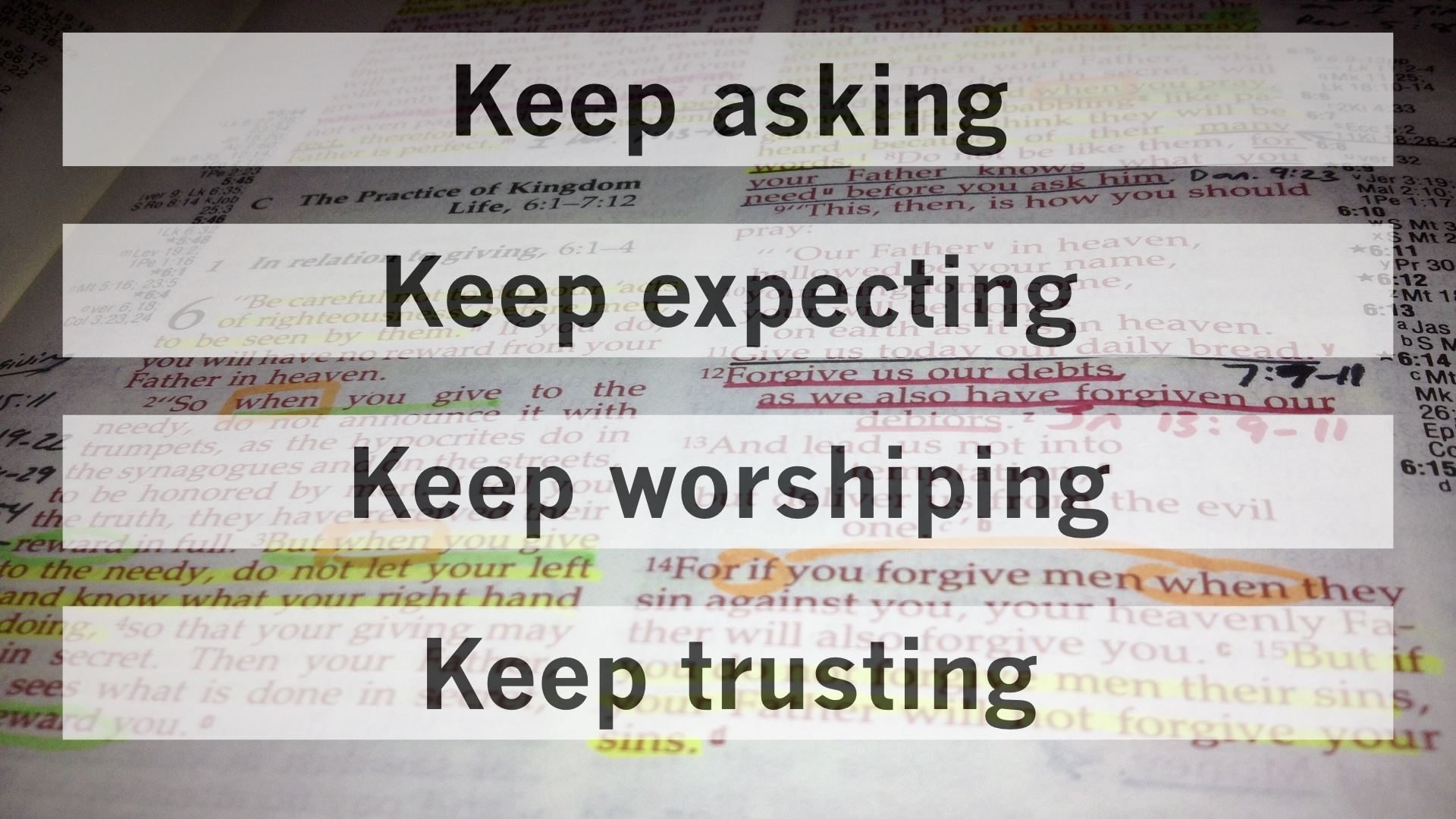
Keep asking with full confidence that God hears you
Keep expecting an answer
Keep worshiping God for Who He is
Keep trusting that your Heavenly Father wants to give you the very best!
Listen to the podcast of this post by clicking on the player below, and you can also subscribe on Apple, Spotify, or Audible.
Charles Spurgeon said, “We too often rush into the presence of God without forethought or humility. We are like people who present themselves before a king without a petition, and what wonder is it that we often miss the end of prayer?” I hope you are starting to…
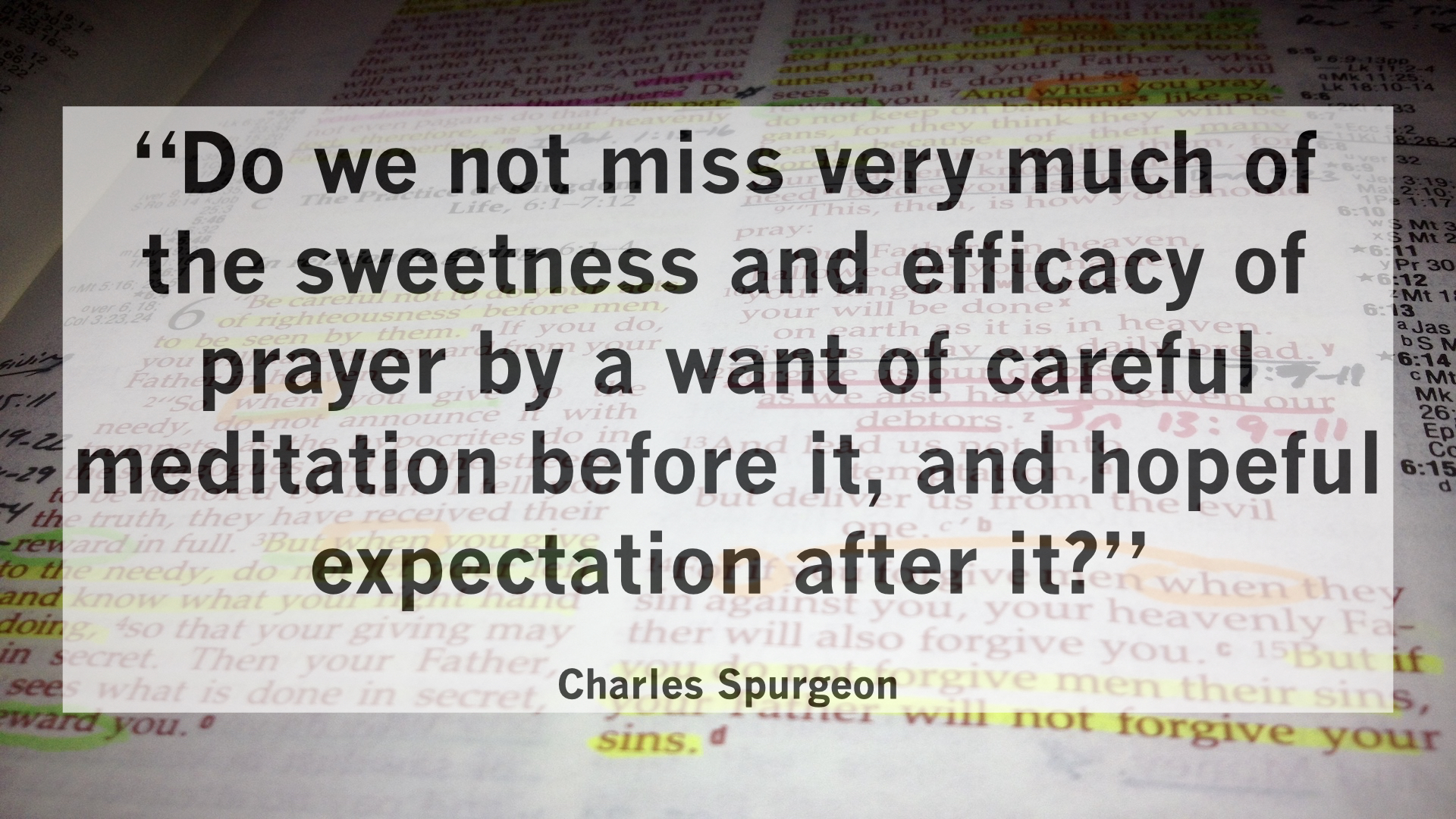
Spurgeon also asked an important question: “Do we not miss very much of the sweetness and efficacy of prayer by a want of careful meditation before it, and hopeful expectation after it?”
We talked about competing priorities, but also how Jesus made prayer the priority for His life. This means that some things we call important may have to temporarily be set aside.
Let’s look at the example of Jesus. He prioritized prayer over:
Training. In Luke 5:16 and 9:18 we see Jesus praying in private even though His disciples were right there with Him. This was so revolutionary to the disciples that it prompted them to ask Jesus how they could pray like He did (Luke 11:1-13).
Sleep. Mark 1:32-35 tells us Jesus was up after sunset ministering to the needs of people, and that He was up and praying while it was still dark. And Luke 6:12 tells us Jesus spent the whole night in prayer before making a big decision.
Strategizing. The big decision Jesus had to make was choosing the twelve men who would be His apostles—the ones He would spend the most time training and preparing. He didn’t hold strategizing sessions or interviews with the perspective candidates, but He spent the night praying for wisdom (Luke 6:12-13).
Ministering. People were looking for Jesus, but He guarded His prayer time so the Holy Spirit could guide Him into His ministry time (Mark 1:37).
Why did He treat prayer this way? Because He knew that God knows our day better than we do. He knows the people will encounter, the conversations that we need to have, the decisions that await us. So we must prayerfully entrust our days to Him (Proverbs 16:9, 3:5-6).
Remember that Spurgeon said “careful meditation” before prayer and then “hopeful expectation after it.” This is exactly what David said in Psalm 5:1-3 where he was expectant of God’s answers throughout the day.
We see this example throughout the Bible, but let me give you three quick examples:
Hagar’s eyes were opened to see the supply of water that was already there (Genesis 21:14-19)
Eliezer had success in finding a wife for Isaac by seeing a woman that was already at the well (Genesis 24:7, 12-15, 21, 27)
Nehemiah prayed for 4 months so he could pray in the moment that the king asked him what he needed to be successful (Nehemiah 1:4, 11; 2:1-4, 8)
I think this is what Paul meant when he told us to “pray continually “ (1 Thessalonians 5:17).
Jesus could announce that everything He did (John 5:19) and everything He said (John 12:49) was directed by the Father.
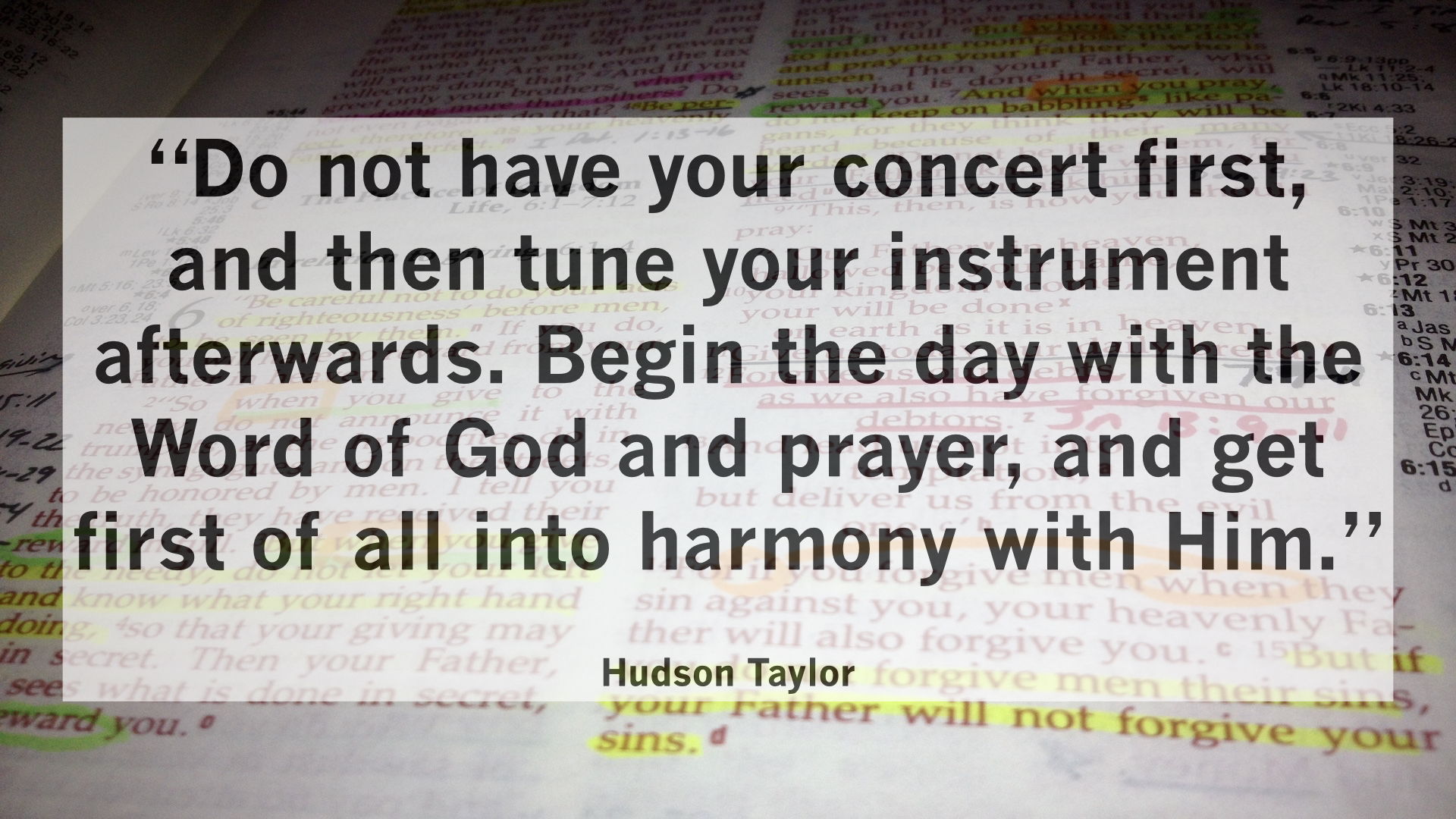
We can live like this too, if we will only make prayer the priority that sets the order for any other thing that we call a priority. Missionary Hudson Taylor said, “Do not have your concert first, and then tune your instrument afterwards. Begin the day with the Word of God and prayer, and get first of all into harmony with Him.”
If you have missed any of the messages in our series called Our Prayer Book, you can find them all by clicking here.
Listen to the podcast of this post by clicking on the player below, and you can also subscribe on Apple, Spotify, or Audible.
We have the candles of hope and peace burning brightly. Romans 15:13 tells us that our hope in God’s fulfilled promises and our hope in His fulfilling of His future promises is what brings us not only peace but joy as well.
William Gurnall noted, “Joy is the highest testimony which can be given to our peace.” That means that hope bubbles up in peace and joy, but joy then sustains and fuels future hope, which allows us to experience peace all over again!
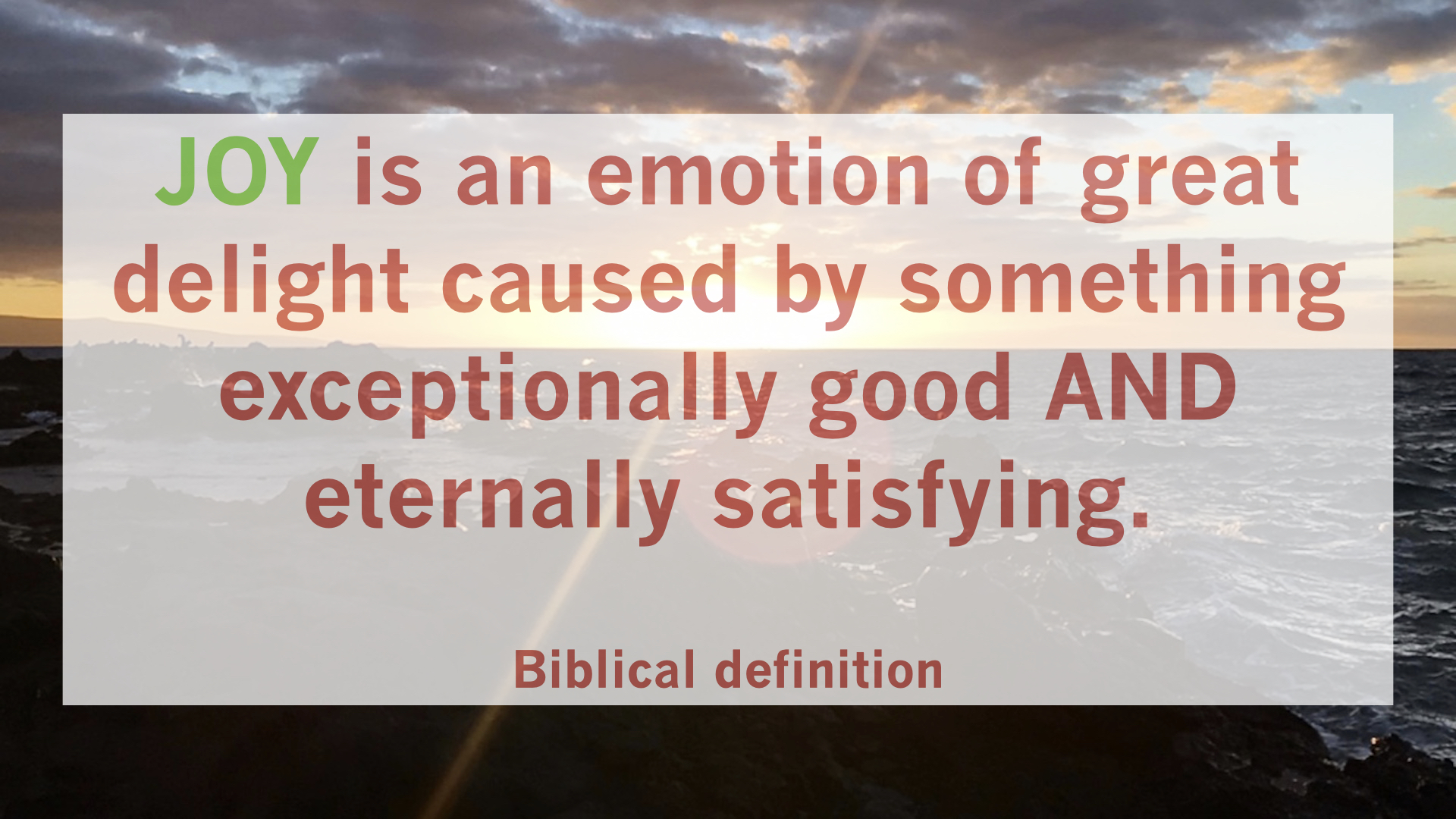
The English dictionary has the right definition for joy: the emotion of great delight caused by something exceptionally good or satisfying. Unfortunately, all of the examples the dictionary gives for joy are fleeting external things.
The Bible makes it quite clear that pleasure is not the same thing as joy, but still people try to find what they call joy in things that bring them pleasure. C.S. Lewis wrote, “Joy is never in our power and pleasure often is.”
Just ask the wisest and richest man who ever lived: King Solomon. He wrote the Book of Ecclesiastes which is all about his pursuit of pleasure, yet every attempts ends with him crying, “Vanity! Meaningless!” But notice something: every time he says this, the phrase “under the sun” is adjacent to it. In other words, nothing on earth can provide true joy.
Paul experienced the same thing in the New Testament (see Romans 7:18-20).
Just like we said about these candles that darkness is not the opposite of light, but it is the absence of light, so too, this wretched state of joylessness is the absence of things that are eternally satisfying.
That means we need something other-worldly—something higher than the sun—to truly bring light and satisfaction. The prophet Isaiah foretold the light that Jesus would bring from Heaven, and this light would be our eternal joy and salvation (Isaiah 9:1-3, 6-7; Matthew 1:21).
Notice how the angelic announcement of Christ’s birth ties together the thoughts of joy with Savior (Luke 2:8-11).
Isaiah foretold this First Advent which Jesus fulfilled (Isaiah 61:1-3; Luke 4:18-19), and which Paul come to discover as well (Romans 7:24-25).
Another biblical definition for the word joy is delighting in God’s grace in our trials because we understand that these trials enlarge our capacity for even greater joy. This is the joy we can know as we live between the two Advents of Jesus. We see this in the example of Jesus fixing His eyes on the eternal joy even as He walked toward Calvary, and how His Father then exalted Him for that (Hebrews 12:2; Philippians 2:9-11).
In a similar, Jesus prepares us for the joy following our time of grief (John 16:17-24). The writer of Hebrews agreed with this (Hebrews 12:11), as did the writer of the 126th Psalm (notice the word joy being used four times in just six verses here!).
The Second Advent of Jesus will be eternally satisfying joy beyond anything we can imagine! I love how Isaiah 35 foretells what we can read on the last pages of the Book of Revelation.
This thought from Charles Spurgeon is spot-on: “We who trust in Jesus are the happiest of people, not constitutionally, for some of us are much tried and are brought to the utter depths of poverty, but inwardly, truly, our heart’s joy is not to be excelled.”
May we all live in that hope-filled, peace-fueled joy every single day until Christ returns or calls us Home!
If you missed it, check out the lights of hope and peace in our previous messages in this series by clicking here.
Listen to the podcast of this post by clicking on the player below, and you can also subscribe on Apple, Spotify, or Audible.
Do you remember this song: “If you’re happy and you know it clap your hands”? It goes on to say, “If you’re happy and you know, then your life will surely show it….” Frankly, I’m concerned about Christians that are unhappy.
Charles Spurgeon was talking to his students and he said, “I commend cheerfulness to all who would win souls; not levity and frothiness, but a genial, happy spirit. There are more flies caught with honey than with vinegar, and there will be more souls led to heaven by a man who wears heaven in his face than by one who bears Tartarus in his looks.” Tartarus, in Greek mythology, is a sunless abyss, below Hades, in which Zeus imprisoned the Titans, which is the exact opposite of the Paradise described in the Bible.
Unhappiness generally comes from ingratitude. An unhappy Christian gives God no praise, robs Him of glory, and paints God in a bad light. A happy Christian lifts God high and invites others to know this All-Good, All-Happy God too!
Christians need to fight against the downward pull of negativity in which our culture seems to so easily gravitate. In his letter to the Philippians, the apostle Paul says that a Christian who doesn’t engage in the complaining that the world is known for will shine brightly. Quite simply, thankfulness is the antidote to complaining (Philippians 2:14-18).
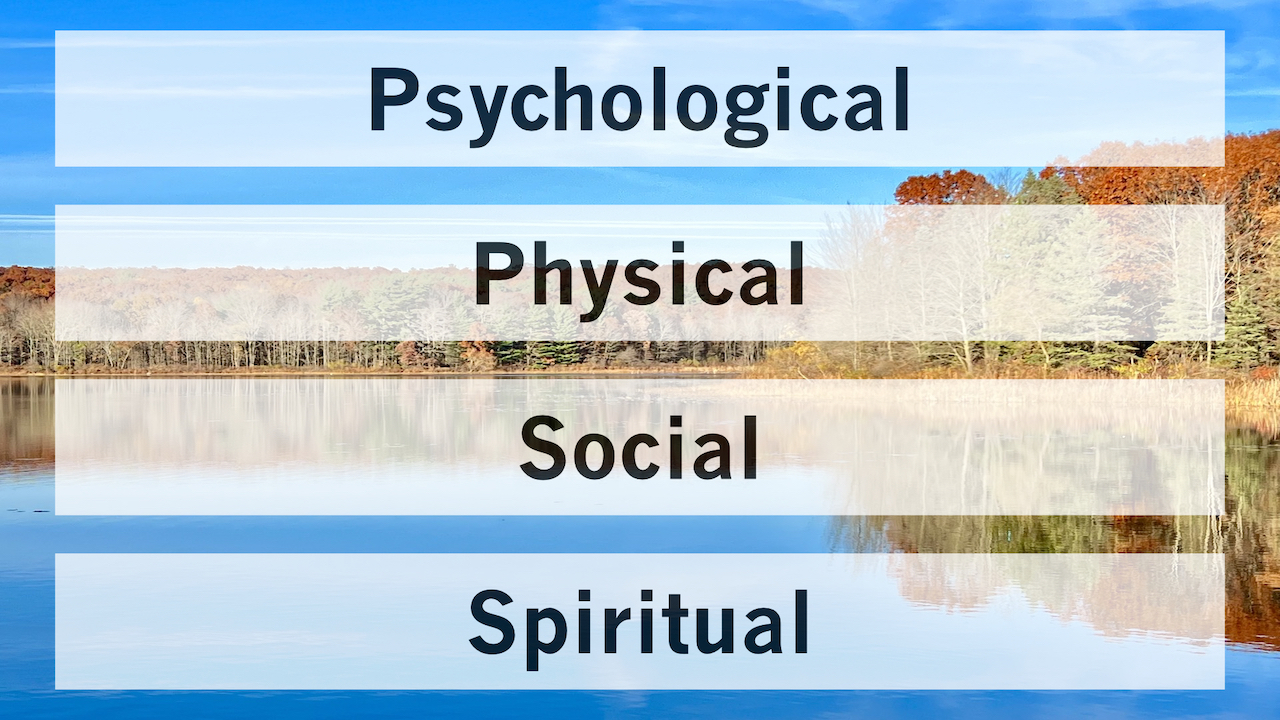
Even those who may not recognize the the authority of Scripture have extolled the benefits of gratitude. Psychologists and medical professionals have identified three benefits from a thankful heart:
Physical benefits—stronger immune system, less body aches and pains, regulated blood pressure, a better sleep-wake cycle
Social benefits—better communication with others, increased empathy, increased likability
And Christians can add one more benefit to this list:
Spiritual benefits—more dynamic corporate worship, enchanted Christian testimony, perseverance through trials, fortification against giving in to temptation
The well-known Cleveland Clinic reported that an attitude of gratitude leads to overall wellness. When you are grateful for what you have, it improves your outlook mentally, physically, spiritually, and relationally.
Here are five things you can start doing today that will increase your gratitude levels, enhance your Christian testimony, and generally improve your life:
Switch your perspective. Worry is focusing on what you don’t have. Make the switch to gratitude by giving thanks for what you do have (Matthew 6:25-34).
Strengthen your relationships. It’s fine to weep with those who weep, but let’s encourage others and be encouraged by others so that we can rejoice with those who rejoice (1 Thessalonians 3:6-10),
Foster healthy habits. Dr. Luke gives us the pyramid of health that Jesus demonstrated in Luke 2:52. The pinnacle is strong relationships, and grateful people are more empathetic and likable.
Keep a gratitude journal so that you don’t forget what God has done for you (Psalm 106:7).
Talk about your gratitude. This instills thankfulness in other saints (Isaiah 63:7) and in future generations of your family (Isaiah 46:4), and it becomes a testimony for seekers (1 Peter 3:15).
Let me close with this observation from Blaise Pascal: “There are three kinds of people in the world; those who have sought God and found Him and now serve Him, those who are seeking Him, but have not yet found Him, and those who neither seek Him nor find Him. The first are reasonable and happy, the second reasonable and unhappy, and the third unreasonable and unhappy.”
Reasonable, happy saints are the ones who lift God high and invite others to know this All-Good, All-Happy God too! Not just at the Thanksgiving season, but starting now and then going all year long!
Follow along with all of the messages in this series called Be Thankful by clicking here.
By it’s very definition, stepping out of your comfort zone is UNcomfortable and sometimes fearful. God promises to be close by while you’re in the Discomfort Zone!
I have lots of new content every week, which you can check out on my YouTube channel.
“Some believe it is only great power that can hold evil in check, but that is not what I have found. I have found it is the small everyday deeds of ordinary folk that keep the darkness at bay. Small acts of kindness and love.” —J.R.R Tolkien
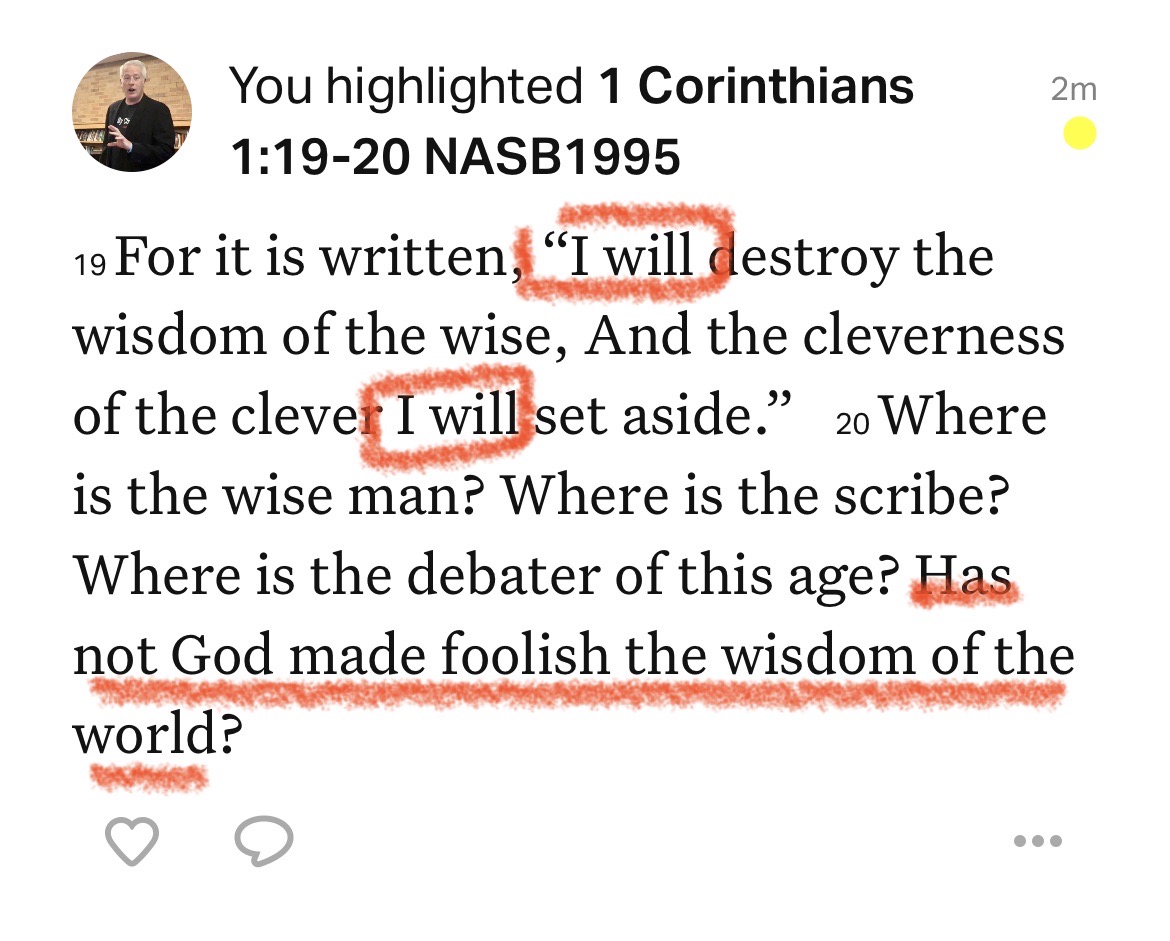
“It cannot be exaggerated how much God hates our trying to do His work when it comes to vengeance or vindication. Whether it be vengeance or vindication, either is solely the Lord’s sovereign right. He does not like it when you or I try to punish someone, to vindicate ourselves, making ourselves look good or clearing our own names.” —R.T. Kendall
The world’s arguments are a lot of noise and very little substance. Don’t get into a shouting match, but quietly, gently, and respectfully keep returning to God’s Word. Charles Spurgeon was once asked how he could defend the Bible and he responded, “The Bible is like a lion: I let it out and it defends itself!”
Christians should run their entire race with joy—we should soar across the finish line! Check out this full sermon on Psalm 132.
I have lots of new content every week, which you can check out on my YouTube channel.
“Joy is never in our power and pleasure often is.” —C.S. Lewis
John Piper points out that thinking and knowing are essential for Christian maturity, but there is also a danger in knowledge. How do we find the correct balance?
I talked about a Christian’s self-examination this week, and then I came across this from T.M. Moore: “Christians do not fear to examine themselves. Especially when it seems something may be lacking in our walk with and work for the Lord, we need to heed the words of the apostle Paul and do some serious soul-searching and altering of our life course (2 Corinthians 13:5). Examining ourselves involves carefully considering how we use our time (Ephesians 5:15-17) as well as what’s going on in our soul and our life. We must not fear to examine ourselves nor resent when others may encourage us to do so.”
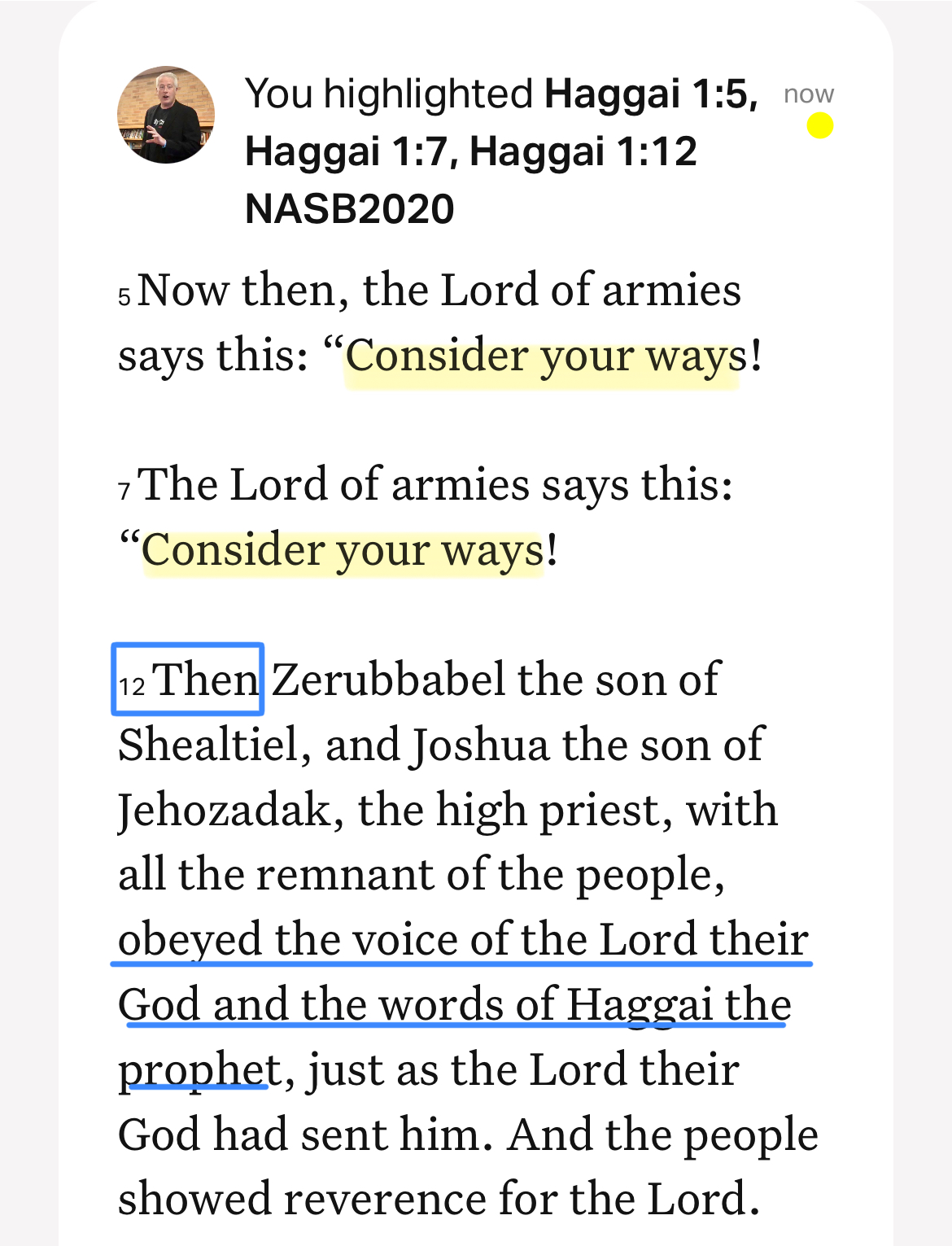
God’s messengers call people to consider the way they are currently living in comparison to the way God has called them to behave. Wise people will heed this call and repent from any ways that deviate from God’s way. I talked in more depth about Haggai and his message of considering our ways in my series on the minor prophets.
“Come to Jesus by quitting every other hope, by thinking of Him, believing God’s testimony about Him, and trusting everything to Him. If you thus come to Him, the rest which He will give you will be deep, safe, holy, and everlasting.” —Charles Spurgeon
One more from T.M. Moore: “We will only hunger and thirst for more of the Lord and His promises as we consider how far short of that might and greatness we fall. … I suspect that most Christians today are fairly satisfied with the state of their faith. They have a ‘good enough’ experience of Jesus and they’re not really thirsting for much more. But the work of shepherds is to help people realize that splashing around in the mud puddle of faith is not to be compared with sailing on the ocean of God’s grace and power.”
A.W. Tozer said, “There’s an awesomeness about God which is missing in our day altogether; there’s little sense of admiring awe in the Church of Christ these days.” May we repent of little prayers and boldly pray to an awesome God who wants to do awesome things that will bring Him glory!
I have lots of new content every week, which you can check out on my YouTube channel.
This is a very informative Q&A session with cold case detective and Christian apologist J. Warner Wallace. But I especially like his answer to the first question: Do Christians have to investigate every other religion to be convinced that the Bible is true?
“Faith untried may be true faith, but it is sure to be little faith, and it is likely to remain dwarfish so long as it is without trials. Faith never prospers so well as when all things are against her: tempests are her trainers, and lightnings are her illuminators. … No flowers wear so lovely a blue as those which grow at the foot of the frozen glacier; no stars gleam so brightly as those which glisten in the polar sky; no water tastes so sweet as that which springs amid the desert sand; and no faith is so precious as that which lives and triumphs in adversity. … Faith increases in solidity, assurance, and intensity, the more it is exercised with tribulation. Faith is precious, and its trial is precious too.” —Charles Spurgeon
“Mature Christians can be recognized by a variety of indicators. They feast on the Word of God (Hebrews 5:14), persevere in love and good works (Hebrews 6:9-10), bear the fruit of the Spirit rather than the marks of the flesh (Galatians 6:16-23), use their gifts to help build the church (1 Corinthians 12:7-11; Ephesians 4:12-16), teach the things of Jesus to others (Hebrews 5:12: Acts 1:8), and more. This, the New Testament insists, is the condition toward which every Christian strives.” —T.M. Moore (check out all of the Scriptures T.M. references here)
“Now is the accepted time, not tomorrow, not some more convenient season. It is today that our best work can be done.” —W.E.B. Du Bois
Jesus shows us that only secure people can serve others. Insecure people won’t ever make themselves vulnerable, and so they miss out on God’s blessing. I address this in more depth in my book Shepherd Leadership.
You are a one-of-a-kind creation on purpose! God’s plan for your life is as unique as you are. I had the privilege of speaking at Country Chapel’s week-long revival services, and this is a clip from my sermon.
I have lots of new content every week, which you can check out on my YouTube channel.
What “began 90 years ago in Seattle as ‘an agency to supply candidates for the ministry to our churches and on the mission field,’” is now celebrating its 90th anniversary as Northwest University. It is really cool to see the hand of God supplying in miraculous ways for those who were so passionate about this endeavor.
“How thankful we are, Father God, for a crucified Redeemer. Nothing in heaven or earth is such an amazing wonder as this; nothing can compete with it for excellence. May all the many charms of sin be overcome by this ravishing love, which bubbles up in every drop of our Redeemer’s blood. How can we, with thoughts of the Cross alive in our hearts, sin against so much tenderness, compassion, and grace, and all the other perfections of You, our God, which sound so loud in our ears from the Cross of Jesus?” —Stephen Charnock
“Where shall language be found which shall describe Your matchless love, Your unparalleled love, toward the children of men? Your love is so vast and boundless that, as the swallow skims the water without diving into its depths, so all descriptive words merely touch the surface of Your love, while depths immeasurable lie beneath. … The most inspired mind must utterly fail to fathom this love. Here is love! And truly it is love that surpasses knowledge. Oh, let this love fill our hearts with adoring gratitude and lead us to practical manifestations of its power.” —Charles Spurgeon
When a leader admits a need for help to his or her team, it actually increases the level of respect the team has for that leader.
What does pornography have to do with loneliness? “Dr. Gary Brooks, a psychologist who has worked with people struggling with unwanted porn habits for the last 30 years, explains that ‘Anytime [a person] spends much time with the usual pornography usage cycle, it can’t help but be a depressing, demeaning, self-loathing kind of experience.’”
Leaders may have to talk about people on their team, but how do we do this without crossing the line into gossip? Greg and I discussed this on a recent episode of our leadership podcast.
I have lots of new content every week, which you can check out on my YouTube channel.
“The Christian ideal has not been tried and found wanting. It has been found difficult; and left untried.” —G.K. Chesterton
“Christianity does not consist in telling the truth, or walking in a conscientious way, or adhering to principles; Christianity is something other than all that, it is adhering in absolute surrender to a Person, the Lord Jesus Christ.” —Oswald Chambers, in Baffled To Fight Better
“Critics may nitpick the Scriptures upon which we base our beliefs, but each year, the Lord will increasingly demonstrate that His Word contains no errors, exaggerations, or omissions. … We won’t feel ashamed of our hope. It will unfold just as the Lord has promised. We will be nourished, guided, blessed, and comforted. Our Lord will return, and then our days of sorrow will be over. How we will exult in the Lord, who first gave us a vibrant hope and then fulfilled that which we hoped for!” —Charles Spurgeon



 Don’t judge your creative efforts by the world’s likes (or even by its silence). If you did your best with the talents that God gave you, the applause from nail-scarred hands is all that really matters.