Battle Ready

The Bible says that satan prowls around like a lion, looking for an opening to devour Christians. Are you battle ready? The Apostle Peter gives us all of the battle preparation that we will need to be victorious!

One of the most important things we need to do is prepare ourselves before the battle even begins. Peter lists two key components: (1) self-control and (2) alertness (1 Peter 5:8-11). 

This Greek word for self-control is only used six times in all of the New Testament. Peter uses it three times in his first epistle, and the Apostle Paul also uses the word three times. It’s amazing to see the similarity in uses between the two of them. 

Both apostles use self-control in the context of the value of prayer (1 Thessalonians 5:6, 8; 1 Peter 4:7). In other words, Christians don’t wear armor to fight; they wear armor to pray. We have to be self-controlled enough to stick to the business of prayer. 

Restraining prayer, we cease to fight 
Prayer makes the Christian’s armor bright 
And satan trembles when he sees 
The weakest saint upon his knees. —William Cowper

Then both apostles use the Greek word for self-control in the context of using God’s Word as a spiritual weapon (2 Timothy 4:1-5; 1 Peter 1:10-13). Jesus used this same strategy in his battle in the desert against satan (Matthew 4:1-10)—Jesus was praying before the devil came to tempt Him, and then He defeated the devil’s temptations by quoting Scripture. 

Peter says the devil “prowls around like a roaring lion.” Notice that important word: like. The devil has always been an imitator—trying to be like God, he was expelled from Heaven, and then he deceived Adam and Eve by telling them they could be like God too. He’s using the same strategy now. 

Augustine pointed out, “Christ is called a Lion because of His courage; the devil because of his ferocity. The Lion comes to conquer, the other to hurt.” 

So Peter encourages us to “resist him, standing firm in the faith.” You resist the devil when you… 

  • …stay submitted to God 
  • …remember the blood of the Jesus—THE Lion of Judah—that won your victory 
  • …stay self-controlled in prayer
  • …remain alert in the Scriptures

Ask the Holy Spirit to keep you battle ready by helping you to develop the self-control and alertness you need. 

If you’ve missed any messages in this series, you may find the complete list by clicking here.

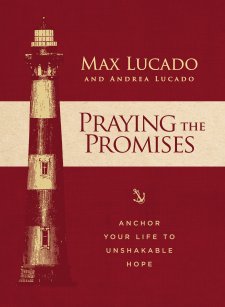
9 Prayers From “Praying The Promises”

In Praying The Promises, Max Lucado gives us valuable instruction on how to turn Scriptural promises into powerful prayers. Here are a few of those prayers (the biblical reference in brackets is the passage that helped form the prayer). 

Thank you for being a God who wants me to know You.… Your wisdom surpasses all wisdom on this earth. Your ways are so much higher than mine. I could study You and Your Word for the rest of my life and still only scratched the surface of the depths of who You are. You are at once knowable and unknowable.… Deepen my knowledge of You, God. [Psalm 19:1-2; Isaiah 55:8-9; Romans 1:19-20]

Help me rely on Your promise of grace because I have been found righteous through Jesus. When trouble comes, use those troubles to increase my faith and draw me nearer to You. [Hebrews 7:25]

Father, sometimes I convince myself that I need to earn Your salvation. I feel like I should do more, be more, and achieve more. But You simply want my faith. Help me let go of my striving and this need to perform for You and for others. [Romans 4:5; Philippians 3:4-7] 

Guide me during the difficult times. Give me hope as I pray and wait. Remind me of Your power and authority so that I will trust Your ways, even when I can’t see where the path before me is going. [Genesis 50:20-21; Ephesians 1:11-12; Romans 5:3] 

Forgive me when I look for guidance outside of Your Word. When I ask friends what to do before I open my Bible. When I am resistant to reading Your Word because I want to guide myself rather than be guided by You. Renew my desire and passion for reading the Bible. … May I learn something new about You and Your character each time I read it. [Psalm 32:8; 2 Timothy 3:16-17] 

When a worry arises, remind me of Your presence so I will turn to You and not fear. [Psalm 23:1, 4]

Gracious Father, nobody is beyond Your redemption. Because of Your love and mercy, You provided a Redeemer for us in Christ, who graciously stopped us while we were on the path of sin, gave us refuge, and pointed us toward the road of redemption. [Galatians 4:4-5]

Forgive me when I try to fight my own battles. … If I try to fight for myself, I end up feeling exhausted and defeated by my own efforts. You have said You are fighting for me. Help me believe that truth even when I am so tempted to fight for myself. Go before me this week as I face temptation. Go before me as I face anxiety, fear, and uncertainty. Protect me in every spiritual battle. Fight for me and help me surrender each battle to You. [Exodus 14:14; Deuteronomy 1:30; Psalm 20:7-8]

As concerns and questions come up, remind me to turn each of them over to You in prayer. I lift up my family to You. I lift up my work to You. I lift up my to-do list to You. Cover each worry with Your peace. Prioritize my day so that it aligns with Your will and not mine. [1 John 5:14]

You can check out my review of Praying The Promises by clicking here, and you can read some other quotes from this book by clicking here.

Thursdays With Oswald—Dealing With Spiritually Stupid People

Oswald ChambersThis is a weekly series with things I’m reading and pondering from Oswald Chambers. You can read the original seed thought here, or type “Thursdays With Oswald” in the search box to read more entries.

Dealing With Spiritually Stupid People

     I would like you to notice what the word “stupid” means. It does not mean ignorant, but anything formed or done without reason or judgment. Ignorance is being without knowledge “and the times of this ignorance God winked at [‘overlooked’]” (Acts 17:30). Do distinguish between ignorance and stupidity! … 

     [Passages to consider—1 Samuel 26:21 [I have acted like a fool]; Titus 3:3 [at one time we too were foolish, disobedient, deceived and enslaved]; 2 Timothy 3:6-7 [silly and weak-natured and spiritually dwarfed women, loaded down with the burden of their sins and easily swayed and led away by various evil desires and seductive impulses]; and Hebrews 5:12 [you actually need someone to teach you over again the very first principles of God’s Word]]

     What are we to do when we come across stupid souls? Ignorant souls we can deal with, they need knowledge; the stupid soul does not need knowledge; the stupid soul needs to have the Word of God until it is worried by it. … 

     Never water down the Word of God to the understanding of your people. … “The words that I speak unto you, they are spirit, and they are life.” The Word of God is “a lamp” and “a light,” but when people get off on the “stupid” lines, it is all instincts, impressions, vague ideas—“ever learning, and never able to come to the knowledge of the truth.”

From Workmen Of God

I know the word “stupid” seems like an inflammatory word, but don’t get distracted from Chambers’ pertinent point on account of this word. The Bible makes it clear that we will come across people who are stupid in regard to the things of God. Our course of action is not argument or persuasion, but—as Chambers says—“the Word of God, the Word of God, the Word of God, first second and last; no sympathy, no help, only the Word of God.”

Handling Tough Texts

How do you handle a hard passage in the Bible? Peter wrote this about Paul, “His letters contain some things that are hard to understand….” But if we don’t take the time to wrestle with that passage, Peter says this is what happens next: “…which ignorant and unstable people distort, as they do the other Scriptures, to their own destruction” (2 Peter 3:16).

So here’s a 5-step plan I use when I am working through a challenging passage of Scripture.

  1. Ask the Holy Spirit to help you

All Scripture is inspired by the Holy Spirit (2 Timothy 3:16), and the same Holy Spirit lives in a Christian (1 John 2:20). Think about that: the same Holy Spirit that inspired an author to write the words of Scripture is the same Spirit that will illuminate them to you!

  1. Read the difficult passage in context

We will make our task much easier when we “zoom out” from the difficult text and read the whole passage surrounding the difficult verse/phrase. Perhaps we need to “zoom out” even farther to understand why the whole chapter or book was written.

  1. Identify the parts that are clear

Start off by identifying the parts that you do understand, and then see what light that shines on the tricky text.

  1. Cross reference with other Scriptures

Never, ever, ever draw a conclusion from just one passage of Scripture. Paul reminded his audience that he used the “whole counsel of God’s Word” (Acts 20:27) in forming his sermons. If the challenging passage contains an Old Testament passage, look it up; if it references an historical event, read that history. I also like to use biblegateway.com’s excellent search feature to find cross references.

  1. Draw conclusions on what appears to be the main point

Only after you have done step #1-4 should you attempt to draw some conclusions. You will set yourself up for error if you draw a conclusion first, and then try to find other texts in the Bible that agree with you.

The Apostle Peter writes something rather challenging in his first letter. In fact, Martin Luther said this about 1 Peter 3:18-22: “A wonderful text is this, and a more obscure passage perhaps than any other in the New Testament, so that I do not know for a certainty just what Peter means.” If you would like to see how I walk through the 5-step plan on this “obscure passage,” please check out the video below.

If you’ve missed any messages in this series, you may find the complete list by clicking here.

The Mystery & Meaning Of Marriage

John Piper’s insight of both the Old Testament and New Testament meaning of marriage is profound!

Here are the links to the Scriptures he references:

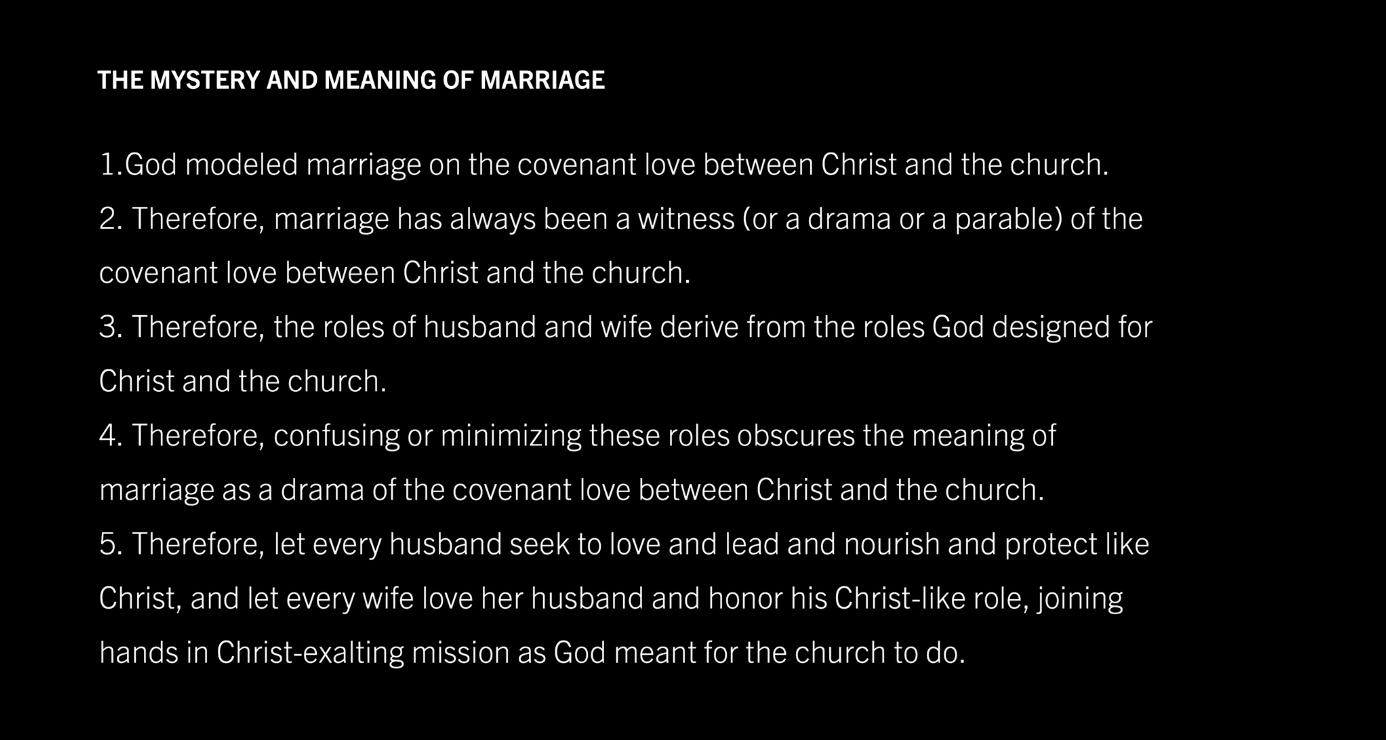
Piper’s conclusions:

  1. God modeled marriage on the covenant love between Christ and the church.
  2. Therefore, marriage has always been a witness (or a drama or a parable) of covenant love between Christ and the church.
  3. Therefore, the roles of husband and wife derive from the roles God designed for Christ and the church.
  4. Therefore, confusing or minimizing these roles obscures the meaning of marriage as a drama of the covenant love between Christ and the church.
  5. Therefore, let every husband seek to love and lead and nourish and protect like Christ, and let every wife love her husband and honor his Christ-like role, joining hands in Christ-exalting mission as God meant for the church to do.

10 Great Reasons To Go To Church Regularly

Without exception, all human beings have exactly 168 hours in a week. No one gets any bonus time and no one has any hours taken away. We’re supposed to get 8 hours of sleep a night, and most of us work about 40 hours each week. So let’s do the math…

168 hours per week
– 56 hours for sleeping
– 40 hours for work
=72 discretionary hours

In those 72 hours there must be time for eating and taking care of chores. But what about going to church? The problem for many people is looking at church attendance as just another “chore” or item on their “To Do” list.

But instead of thinking of going to church as “I have to,” how about if you looked at all of the “I get to” benefits?

Here are 10 great reasons for going to church regularly. I get to…

  1. …draw closer to my Heavenly Father, just like Jesus did (Luke 2:49)
  2. …be an example to others (1 Timothy 4:12)
  3. …hang out with some really great people (Hebrews 10:24)
  4. …get to know Jesus and my brothers and sisters better (1 John 1:3)
  5. …reaffirm the priority that God is first in my life (Matthew 6:33)
  6. …learn to better understand Scripture (2 Timothy 2:15)
  7. …join with a choir of God worshipers (John 4:23-24)
  8. …grow spiritually (1 Peter 2:2-5)
  9. …complete the Body of Chris (1 Corinthians 12:12)
  10. …avoid becoming isolated and possibly lost (Proverbs 18:1)

“Sometimes we make it sound like we’re making a sacrifice to go to church, but think about the very real sacrifice Jesus made so that we could meet together as brothers and sisters!” —Scott Troost

How about it? Do you think you could invest an hour or two of your 72 discretionary hours in a local church this week?

My thanks to my brother, Scott Troost, for sharing such a timely message!

Thursdays With Oswald—Teach Them While They’re Young

Oswald ChambersThis is a weekly series with things I’m reading and pondering from Oswald Chambers. You can read the original seed thought here, or type “Thursdays With Oswald” in the search box to read more entries.

Teach Them While They’re Young

      We need a personal knowledge of God through all our life. The time to discover Him for ourselves is in life’s earliest morning—“that from a child thou hast known the holy Scriptures, which are able to make thee wise unto salvation,” wrote Paul to Timothy (2 Timothy 3:15). “And ye fathers, provoke not your children to wrath: but nurture them in the chastening and admonition of the Lord” (Ephesians 6:4).

     We are so built that in childhood we can more easily come to a knowledge of God in simplicity than in later years. And in those formative years the personal life can be shaped and fitted to God’s standard more surely than later on.

From Shade Of His Hand

At the end of Ecclesiastes, Solomon wrote, “Remember your Creator in the days of your youth, before the days of trouble come” (Ecclesiastes 12:1).

Oswald Chambers notes that parents lay a much stronger foundation for their children’s future spiritual attainment by talking often of the love of God while those children are still young.

Parents—start early, keep at it often, and don’t ever quit telling your children about God’s love. 

These commandments that I give you today are to be on your hearts. Impress them on your children. Talk about them when you sit at home and when you walk along the road, when you lie down and when you get up. Tie them as symbols on your hands and bind them on your foreheads. Write them on the doorframes of your houses and on your gates. (Deuteronomy 6:6-9)

Train up a child in the way he should go: and when he is old, he will not depart from it. (Proverbs 22:6)

[Mom and Dad, be sure to check out Andrew Murray’s exceptional book Raising Your Child To Love God. You can read some quotes from Murray’s book here, and some of his prayers for children here.]

#MOWT

justice-mercy-graceLast week I blogged about justice, mercy, and grace. Justice is getting the penalty we deserve, mercy is not getting the penalty we deserve, and grace is getting blessings we don’t deserve.

If we are truly grace-full people, then we should be thank-full people as well. As we approach Thanksgiving Day, people are naturally thinking about things for which they can give thanks during this past year. But Christians should be the most full-of-thanks people on the planet, because we have been showered with so much grace! 

I’d like us to think about a word that I believe will increase our level of thankfulness: Appreciation. Appreciation goes beyond merely being thankful for blessings, as it sees the high value in those blessings, and then continually looks for ways to express even more gratitude for them. In other words, appreciation can begin a cycle of gratitude that grows and grows and GROWS!

Check out three parts to the definition of appreciation

[1] Gratitude; thankful recognition. Did you know that being grateful is actually good for you? Research has shown that increasing your gratitude levels increases your:

  • Physical health. “A state of gratitude, according to research by the Institute of HeartMath, also improves the heart’s rhythmic functioning, which helps us to reduce stress, think more clearly under pressure and heal physically. It’s actually physiologically impossible to be stressed and thankful at the same time” —Jon Gordon
  • Emotional health. Dr. Robert Emmons says gratitude decreases envy, resentment, and feelings of retaliation; and increases empathy, emotional resilience, and self-esteem.
  • Spiritual health. Notice how ingratitude is included in the list of a whole lot of ugliness (2 Timothy 3:1-4), but spiritual health is restored simply by being thankful (Ephesians 5:3-4).

[2] Estimating qualities and giving them their proper value. In order to determine value, we must have a standard of comparison. What’s your standard? Is it what your neighbor has? Is it what you don’t have? Or is it thankfulness for what God has given you? 

Max Lucado said, “To reflect on your blessings is to rehearse God’s accomplishments. To rehearse His accomplishments is to discover His heart. Gratitude always leaves us looking at God and away from dread.”

[3] Assessing the true worth of our blessings. Assessing leads to appreciation, and appreciation begins to give us a return on investment. I like how Jeff Anderson says it: “If you want to grow your faith, grow your gratitude. To grow your gratitude, take time to count your blessings.”

Remember: gratitude isn’t gratitude if it isn’t expressed. David made his gratitude known, and other afflicted people around him began to join with him in thanking God for His blessings (see Psalm 34:1-3). In other words, David’s thanksgiving went viral!

mowtHere’s how we can make our gratitude go viral: #MOWT. Let’s count our blessings every day, and let’s appreciate what God has done for us. Then let’s share our gratitude not only with God, but with others as well. Post it on Facebook or Twitter or Instagram with #MOWT: my one word thanks. Maybe include a photo and “family” #MOWT, or “protection” #MOWT, or even “paycheck” #MOWT.

Let’s give God so much glory for His grace gifts, that we tell the world about our appreciation!

6 Quotes From “Light & Truth—The Lesser Epistles”

Light & Truth The Lesser EpistlesHoratius Bonar’s insights on the Scriptures are amazing! So far I’ve read and reviewed three of the four commentaries he has prepared on the New Testament (you can read those reviews here, here and here). These are a few quotes from the third book on the epistles Galatians through Jude. Any reference in brackets is the passage from the Bible on which Bonar is commenting.

“It is a busy, lighthearted, laughing, pleasure-seeking world. But sin is here, and pain is here, and broken hearts are here, and weeping is here, and death is here, and the grave is here. Oh! in spite of all its laughter and vanity, it is an evil world. And the great proof of its evil is, that it cost the death of the Son of God to deliver you from it. … Give yourselves to Him Who came to deliver you from it, and Who stretches out His hands to you all day long, asking you to allow Him to deliver you. He yearns over you; and with sincere earnestness proffers to you His love, His friendship, His great salvation. Consent, O man, consent! His desire is to bless, and not to curse; to save, and not to destroy.” [Galatians 1:4]

“There never have been two gospels. There is not an Old Testament gospel and a New Testament Gospel. There is not one gospel for the Jew, and another for the Gentile, one gospel for the first century, and another for the nineteenth. It is but one gospel, as there is but one Cross and one Savior. Many ages, but one gospel; many sinners, but one gospel; many prophets and apostles, but one gospel. As our earth has had but one sun, so it has had but one gospel. Nor does it need more; that one is sufficient.” [Galatians 1:6-9]

“As the earth without rain or sunshine turns to barrenness, so is it with the Church or soul without the Spirit. … The age thinks it can do without the Spirit. Let the Church watch against this blasphemy. Let her keep hold of the Lord’s promise, the promise of the Father. Let her prize the gift; long for more of it. Let every saint seek more of it. Let our cry be continually: More of the Holy Spirit; more of His fullness; more of His gifts and graces!”

“Strength for the race is needed, hourly strength, superhuman strength; for it is no earthly race, but something lofty, supernatural, divine. Forgetting the supernatural source of strength, we betake ourselves to the internal or the simply external. And so we weary. For only God can supply the power which keeps us running. By Him only shall we run, and not be weary.” [Galatians 5:7]

“‘To Him who is able’—He is the Mighty One, the mighty God, the Lord God Almighty. Hear how this word ‘able’ is used. ‘He is able to subdue all things unto Himself’ (Philippians 3:21). ‘He is able to help them that are tempted’ (Hebrews 2:18). ‘He is able to save to the uttermost’ (Hebrews 7: 25). ‘He is able to keep us from falling’ (Jude 24). It is with the mighty God that we have to do; mightier than ourselves or our foes; mightier than earth or hell; omnipotent.” [Ephesians 3:20]

“Are you expecting the Lord? Are you living in this expectation? Is it a deep-seated, abiding, cherished hope? Is it a hope that tells upon your character, your life, your daily actings in public or private, your opinions, your whole man? Does it quicken you? Does it purify you? Does it keep you separate from the world? Does it keep you calm in the midst of earth’s most exciting events, or most untoward changes? Does it give you a new view of history as well as prophecy? … Let your expectation of the Lord’s coming be a calm and healthy one; not one that excites, but one that tranquilizes; not one that unfits for duty, but one that nerves you more firmly for it; not one that paralyzes exertion, but one that invigorates you for it; not one that makes you indifferent to present duty, but one that makes you doubly in earnest about everything that your hand findeth to do; not one that stops liberality, and prayer, and work, but one that increases all these a hundred fold; not one that dwells exclusively on the future’s dark side—the judgments that are at hand—but one that realizes the glory and the joy of Messiah’s approaching victory and triumphant reign.” [Philippians 3:20]

7 Quotes On Hungering & Thirsting From “The Blessing Of Humility”

The Blessing Of HumilityAs I stated in my review of Jerry Bridges’ book The Blessing Of Humility, reading through these thoughts slowly—Beatitude by Beatitude—would bring about the most life-changing impact. In that spirit, I will be sharing some noteworthy quotes one Beatitude at a time. Here are some quotes on blessed are those who hunger and thirst for righteousness (Matthew 5:6)…

“To hunger and thirst for righteousness, then, indicates a strong overwhelming desire for righteousness. … Righteousness denotes the state of being right. Biblically, it means perfect according to God’s law in every way: thought, word, deed, and even motive.”

“At the moment we trusted Christ as Savior, we were justified—declared by God to be righteous. You will never be more or less righteous before God any day of your life than you were the moment you trusted Christ as your Savior. This raises another question: Why should I hunger and thirst for that which I already have? The answer is that the more we grow and mature in the Christian life, the more sensitive we become to the sin and failure we see in our lives. It is not that we necessarily sin more but rather that we become more aware of and mourn over the sin that is already there. As that happens, we hunger more and more after the righteousness we have only in Christ.”

“There is a legitimate sense in which we are to hunger and thirst for that perfect righteousness we already have in Christ. This should be a continual daily attitude of all growing Christians because we continue to sin every day.”

“There is a second righteousness that we should hunger and thirst for: the experiential righteousness we are to pursue every day. God has inextricably linked together the righteousness we have in Christ and the righteousness we should pursue. He does not give one without the other. Therefore, whoever hungers and thirsts after the righteousness we have in Christ will also hunger and thirst to be righteous in his or her daily experience.” [See 2 Timothy 2:2; 1 Peter 2:24; 1 John 3:10]

“It is clear from Scripture, then, that we are to pursue an experiential righteousness. But what will cause us to hunger and thirst for it? The answer is twofold. First, as we have already observed, the new nature is inclined by the Holy Spirit to pursue righteousness. … The second motivation is gratitude for the righteousness we have in Christ.”

“There will be no growth in experiential righteousness apart from a regular intake of the Word of God.”

“We are absolutely dependent on the Holy Spirit to work in us Himself and to enable us to work. We cannot make one inch of progress toward experiential righteousness without His divine enablement.”

I have previously shared quotes on:

Quotes on the remaining Beatitudes will be posted next week so stay tuned. Even better: subscribe to my blog, and you’ll receive the new quotes directly in your email inbox.