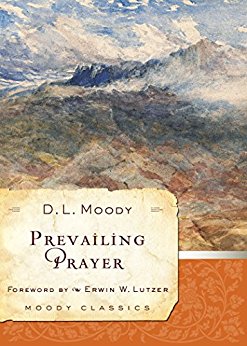
While I was growing up I heard an oft-repeated phrase around our church: “I prayed it through.” I think this would resonate with the heart of Dwight Moody, as he clearly articulates this concept in his book Prevailing Prayer.
Quite simply, Moody defines prevailing prayer as prayer that “involves the whole of our being. It affects our minds because we are occupied with God; it affects our wills because we desire to be yielded to God; and it affects our emotions because we are consumed with a love for God.” But many people—even seasoned Christians—wold probably confess that praying like this is challenging. Moody would agree with this, which is why he has given us such a practical book.
Moody not only lays out for us what will increase the likelihood that we will prevail in prayer, but he also diagnoses some of the roadblocks to this kind of consuming prayer. Each chapter links with the other chapters to build a convincing case that every Christian can learn how to prevail in prayer.
Moody uses stories from the Bible, stories from his own life and ministry, quotes from other Christian thinkers, as well as common-sensical ideas to create a desire to pray in this powerful, sustained way.
Whether you are a brand new Christian or a “seasoned saint,” Prevailing Prayer will energize your prayer life!
“One of the great mistakes of the people of Israel in the Old Testament was to seek and wallow in the temporal blessings of God so much that they missed the great blessing of God Himself. We are in danger of doing the same today. …
“Having failed to pursue the presence of the Lord, Israel ultimately came to despise His many blessings, attributing them instead to their own prowess or to the false idols and pagan deities of their unbelieving neighbors.
“Yet God promised that their highest pleasures and most lasting joys would be found in Him, and not in the conditions of their lives. Not in His blessings, but in Him. Israel completely missed the mark, and we today are in just the same place.
“As long as we continue to seek our happiness in the blessings God provides rather than in the God Who provides blessings, we will be in danger of falling short of the exceedingly great and precious promises of God. ‘Come to Me,’ Jesus insisted, ‘and I will give you rest’ (Matthew 11:28). We will never know complete contentedness in the presence of the Lord as long we count our blessings primarily in terms of conditions and things. …
“Until seeking Him, knowing Him, dwelling with Him, walking with Him, delighting in Him, and partaking of Him is the greatest blessing, richest pleasure, and surest joy we know, we will be in danger of falling into idolatry and failing at our Kingdom-and-glory calling from the Lord.” —T.M. Moore
Christians often talk about God in terms of the “Trinity.” That is, the One True God revealed in three Persons: Father, Son, and Holy Spirit.
This is sometimes a difficult concept to grasp, especially since the word Trinity doesn’t specifically appear in the Bible. But make no mistake, just because the word isn’t there doesn’t mean it’s not true. Consider…
God’s Three-in-One nature is first exhibited when man is created (Genesis 1:26).
When the prophesy is given about Jesus being born in human flesh, He is given all the titles of the three Persons of the Godhead (Isaiah 9:6).
At Christ’s baptism we see Jesus in human form, we see the Holy Spirit descending as a dove, and we hear the Father’s voice announcing His approval of His Son (Matthew 3:16-17).
Jesus Himself said He would ask the Father to send the Holy Spirit to the Christians (John 14:16).
And just as Jesus ascended into Heaven, He told His followers to baptize people into all three Persons of the Godhead (Matthew 28:19).
But I think the best expression of the Trinity is revealed in three simple words. John talks about how all three Persons of the Trinity are involved in the life of a Christian. And then he sums it all up in three words—
“GOD IS LOVE”
Each Person of the Godhead is encouraging and illuminating and pointing to the other Persons in the Trinity. Love is perpetually being received and given. We humans are created in God’s image … we are created to receive and to give God’s love. That’s why John tells us that we know and rely on the love God has for us (that’s the receiving part), and that whoever lives in love lives in God, and God in him (that’s the giving part).
When Adam and Eve sinned, they were dis-membered from God. As a result, every human in their natural state longs for connection with God and others, but feels separated, isolated, unloved, and even unlovable.
Love re-members!
Jesus came to be broken and crushed and to feel the pain of separation from God. It was out of this brokenness that He could do the work of re-membering us to the fullness of the Trinity.
When Jesus shared His last supper with His disciples, He took bread (which is made from broken wheat kernels) and wine (which is made from crushed grapes). He told us as often as we eat the bread and drink the wine we are to remember how He was broken and crushed for us.
Remembering Christ’s work on the Cross re-members us to the fullness of the Trinity.
Sin and satan want to keep us feeling separated, unloved, and unloveable. But when we were the least worthy of His love, God—Who IS love—was broken and crushed to re-member us to Him.
If you feel lonely, separated, isolated, unloved or unloveable, I urge you to remember what Jesus did for you. He loved you enough to be broken and crushed for your re-membering to all of God’s love.
Check out this video where I explain this amazing thought in more detail…
“How odd that the most famous Bible in history should bear the name of a hard-drinking, foul-mouthed, ego-driven homosexual who rejected all demands for reform within the church.
“James VI of Scotland, son of imprisoned Mary, Queen of Scots, was raised in drafty Scottish castles by self-serving lords. He grew up religious and well-trained in theology. He went to church every day. But he was rude, rough, loud, conceited, and bisexually immoral. He was also shrewd.
“At age 37 he managed to succeed his cousin, Elizabeth I, as England’s monarch. As he traveled from Scotland to London, he met a group of Puritans bearing a ‘Millenary Petition’ signed by nearly 1,000 pastors. It demanded renewal within the church. The Puritans, stirred by the Geneva translation of the Bible and by Foxe’s popular Book of Martyrs, wanted to purify the church. The established clergy opposed Puritan demands, and the new king realized his kingdom was torn.
“He convened a conference for church leaders at his Hampton Court estate on January 12, 1604, and the Puritans vigorously presented their concerns. James rejected their requests, sometimes thundering against them, white with rage. At the conclusion of the conference he flung his arm toward the Puritans, shouting, ‘I shall make them conform or I will harry them out of this land, or do worse.’ Many of the dispirited Puritans, abandoning hope for the Anglican Church, began worshiping in small groups as they felt the Bible taught them. They were tagged Separatists, but from these persecuted cells came the Baptists in 1611, the Pilgrims who fled to America in 1620, and other dissenting groups.
“But on one issue at Hampton Court the king and Puritans had agreed. When Puritan John Rainolds requested a new translation of the Bible, James promptly approved it, saying, ‘I have never yet seen a Bible well-translated. But I think the Geneva is the worst.’ Seven years later the Authorized Version was unveiled, ironically making vice-prone King James one of the best-recognized names in English church history.” —Robert Morgan, On This Day
This is a weekly series with things I’m reading and pondering from Oswald Chambers. You can read the original seed thought here, or type “Thursdays With Oswald” in the search box to read more entries.
What To Do With Spiritual Barriers
The inevitable barriers are there in every one of our lives. … The thing to do is to recognize that the barriers are inscrutable, that they are not by chance but entirely by God’s permission, and they should be faced and not ignored. …
The peril of the inevitable barriers is that if I have not faced the facts sufficiently, I am apt to blame God for them. There is one fact more that I do not know, and that fact lies entirely with God, not with me. It is no use to spend my time saying, I wish I was not like this, I am just like it. The practical point in Christianity is—Can Jesus Christ and His religion be of any use to me as I am, not as I am not? Can He deal with me where I am, in the condition I am in?
From Shade Of His Hand
What a wretched man I am! Who will rescue me from this body that is subject to death? Thanks be to God, Who delivers me through Jesus Christ our Lord!(Romans 7:24-25)
To keep me from becoming conceited because of these surpassingly great revelations, there was giving me a thorn in my flesh, a messenger of satan, to torment me. Three times I pleaded with the Lord to take it away from me. But He said to me, “My grace is sufficient for you, for My power is made perfect in weakness.” Therefore I will boast all the more gladly about my weaknesses, so that Christ’s power may rest on me. That is why, for Christ’s sake, I delight in weaknesses, in insults, and hardships, persecutions, and difficulties. When I am weak, then I am strong. (2 Corinthians 12:7-10)
For I am convinced that neither death nor life, neither angels nor demons, neither the present nor the future, nor any powers, neither height nor depth, nor anything else in all creation, will be able to separate us from the love of God that is in Christ Jesus our Lord.(Romans 8:38-39)
“The Bible point of view seems to cover most of the facts” (Oswald Chambers).
“This incense was to be ‘offered with’ or ‘laid upon’ so as to cover or envelope the ‘prayers of all saints’—yes, all saints, from Able downwards; for this seems to be the gathering into one of all prayers from the beginning, that at length they may be answered (Luke 18:3, 7). Upon the golden altar in front of the throne the prayers of the saints of all ages have been laid; there they have accumulated; the unanswered ‘How longs?’ not forgotten.
“Not one petition, even the poorest or feeblest, has dropped from that altar, or been swept away, or lost in the process of time. All, all are there. In themselves the are poor, having no fragrance; but their intrinsic imperfection cannot change the nature of that altar on which they are laid. There they are preserved— each sigh, each tear, each cry, from child or aged man, from the chief of sinners, from the thief upon the cross, from the chamber of weakness and sorrow, from the crushed spirit and the broken heart—there they are: the groanings that cannot be uttered; the ‘God be merciful to me, a sinner;’ the ‘How long?’ of the tortured martyrs; the moan of the suffering saint upon his tossing sick-bed—there they are: the father’s prayer, ‘Lord, save my child;’ the child’s prayer, ‘Lord, save my father’— there they are: the pleadings for the church of God, for the overthrow of Antichrist, for the binding of satan, for the deliverance of earth, for the consummation of the eternal purpose! Not one cry lost; not one petition gone astray. All there!
“There is no such thing as unanswered prayer. Delay will only add to the fullness of the answer, and increase our joy when it comes. And it will come. He is faithful that promised. He cannot deny Himself.” —Horatius Bonar, in Light & Truth: Revelation(emphasis mine)
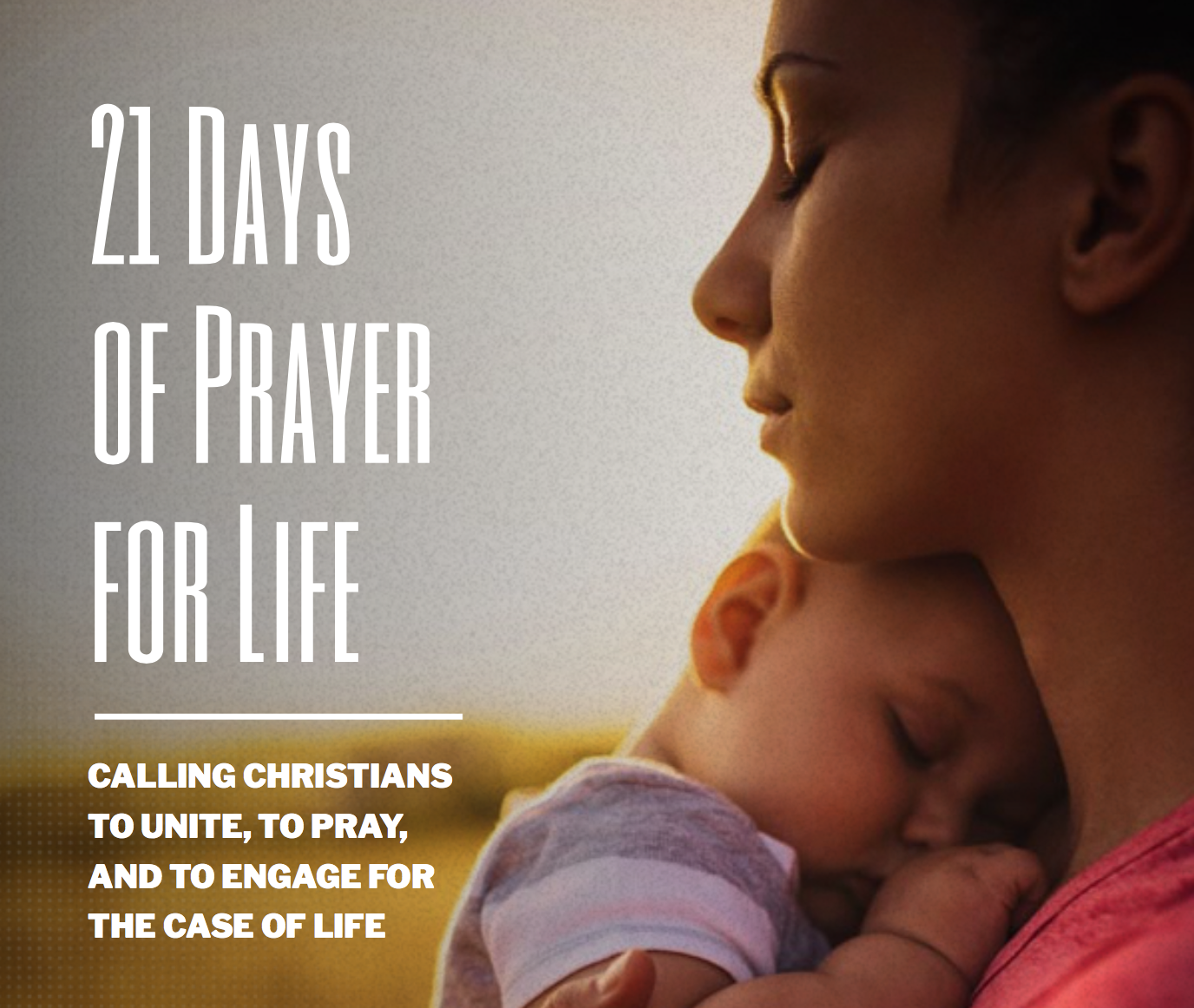
This is an excerpt from the 21-Days For Life Prayer Guide (which I highly recommend) that outlines a clear moral pro-life philosophy.
There is no morally significant difference between the embryo you once were and the adult you are today that justifies killing you at that earlier stage of development. Differences of size, level of development, environment, and degree of dependency are not good reasons for saying you could be killed then but not now. Stephen Schwarz suggests the acronym SLED as a helpful reminder of those non-essential differences:
Size: You were smaller as an embryo, but does body size determine value? Of course not!
Level of Development: You were less developed as an embryo, but infants are less developed than teenagers physically and mentally. Do we think they have less value? Of course not!
Environment: Where you are has no bearing on what you are. Does an eight-inch journey through the birth canal change the essential value of the unborn? Of course not!
Degree of Dependency: You depended on your mother for survival, but does dependence on another human determine value? Of course not! (Consider those with disability, or conjoined twins, for example.)
In short, humans are equal by nature, not by function.
We all differ immensely in our respective degrees of development, but are nonetheless equal because we share a common human nature. We had that human nature from the moment we began to exist. If that isn’t true then human equality is a fiction.
Download this 21-day prayer guide for prayer points, encouraging pro-life stories, and helpful information that will equip you to articulate an effective pro-life position.
God said, “Behold, I am doing a new thing! Now it springs forth; do you not perceive and know it and will you not give heed to it? I will even make a way in the wilderness andrivers in the desert” (Isaiah 43:19). This verse perfectly sums up the dominant message in Lettie Cowman’s book Streams In The Desert.
Everyone has been there: things haven’t gone as we planned … we’re not sure how we could have ended up in such a dry, barren place … it seems like nothing is working out right … we begin to think that even God has lost sight of us. But it’s in this painful, desert place that God is ready to do something unheard of!
Lettie Cowman knew the pain of sickness and disappointment and thwarted dreams. Yet in the midst of her desert place, as she poured out her raw emotions, she began to see a river springing up in her wilderness. This book is a heaven-sent blessing to anyone in those dark, barren places.
Each day you will get a glimpse of God’s spring, as Lettie shares her personal discoveries, insights from Scripture, quotes from other desert wanderers, poems of reflection, and even prayers for help. Each day’s short reading is thirst-quenching and soul-satisfying.
If you are going through a desert place, get a copy of this book for yourself. If you have a friend who is struggling, buy a copy for them, and find times to get together to discuss each day’s reading. There’s a reason why this book has stood the test of time and has been an immense help to so many throughout the years.
“Beware of loving praise from men more than praise from Me. One of the effects of the Fall is that people are overly concerned about what others think of them…. I don’t want you to be preoccupied with how other people view you. I have lovingly shielded you from being able to read the minds of others. What they think of you is really ‘none of your business.’ People’s thoughts are unreliable—distorted by their sinfulness, weaknesses, and insecurities. Even if they praise you to your face, some of their thoughts about you will be quite different. I am the only One who sees you as you truly are. … Instead of seeking praise from men, seek to see Me looking at you. My loving approval of you is shining from My face.” —Jesus (in Sarah Young’ s book Jesus Always)



 While I was growing up I heard an oft-repeated phrase around our church: “I prayed it through.” I think this would resonate with the heart of Dwight Moody, as he clearly articulates this concept in his book Prevailing Prayer.






 Craig T. Owens