9 Quotes From “Shepherding God’s Flock”

T.M. Moore has given pastors a phenomenal training resource in Shepherding God’s Flock. Please be sure to check out my full book review by clicking here. 

“The work of church leaders today—and especially of that class of leaders called elders, with which this study is concerned—has been shaped and conditioned more by the temper of our times than by the teaching of God’s Word.” 

“According to Paul, any church that does not have in place elders—and other leaders working with them—who are functioning as shepherds is a church that is not in order.… A church without a strong ministry of shepherding is a flock without genuine pastoral care, oversight, and equipping. It may be very active, even happy, and may be ‘growing’ in what some consider impressive ways. But without shepherding as the framework and integrating dynamic, such a church will always be something less than what God intends.” 

“Where the work of shepherding is being faithfully pursued, the gospel goes forth with power, lost sheep are located, and the flocks of God grow as He adds new souls to the fold.” 

“Where faithful shepherds are at work, the Lord’s sheep will be well fed. Both milk and the meat of the Word will be their daily diet, according to the needs and callings of each. Well-fed sheep are healthy, strong, and fruitful in their own contributions.” 

“The work of shepherding begins in relationships of mutual love and trust, spiritual friendships where sheep and shepherd know, love, and care about one another.” 

“Only when the people feel known and loved, and only when they know and love those who are called to lead them—only then will they be willing to follow where the shepherds of the church are seeking to take them.” 

“In the Christian life, people tend to live up to or achieve, not the level of their abilities, for their abilities are virtually limitless, given the presence of the indwelling Spirit of God. Rather, they tend to live up to the level of their vision—of what they see for their lives in Christ. Unless we are leading them into God’s vision for their lives, the people of God will settle for something less than the prize of the upward call of God in Christ Jesus.” 

“When temptation arises we can follow one of two courses. Either we will fall through temptation into sin, or we will grow through temptation into a higher stage of sanctification. … The shepherd’s task is twofold: first, he must help the Lord’s sheep to recognize temptation, by grounding them firmly in the law and Word of God; second, he must equip and encourage them in finding the way of escape from temptation, so that they may grow as the Lord intends.” 

“Jesus’ approach to bearing witness was thus energetic, proactive, continuous, compassionate, and pioneering. Should we expect anything less from the shepherds He has left to bring other lost sheep into His fold?”
The Genealogy of a Healthy Church

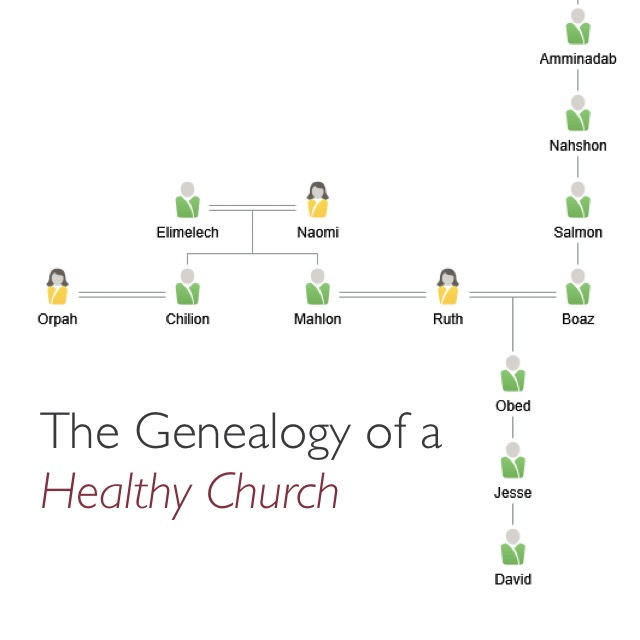
And the things you have heard me say in the presence of many witnesses entrust to reliable people who will also be qualified to teach others. (2 Timothy 2:2)

Paul list four generations in this healthy church—Paul ➡️ Timothy ➡️ faithful Christians ➡️ others. 

We all have a role to play, and every role is vital in a healthy church. Are you a…

Paul: a first generation Christian that needs to start the ball rolling?

Timothy: one who needs to pass along what you have learned to the next generation?

faithful Christian: someone that is actively living out what has been taught to you?

member of the Body of Christ: one that needs to reach out to someone who isn’t a part of the Body yet?

Every single role is indispensable if the Church is going to remain healthy. If any part of this genealogy is lost, the whole Church suffers.

Shepherding God’s Flock (book review)

T.M. Moore founded the Fellowship of Ailbe, a ministry patterned after the example of the Irish Christians who kept the spread of the Gospel alive during history’s dark times. A key component of the Fellowship’s ministry is the equipping of pastors for their tasks, and Shepherding God’s Flock masterfully lays out the role of pastors like few other resources. 

Throughout the Scriptures, God uses the picture of a shepherd caring for his sheep as a consistent image of how God cares for His people, and how He desires for pastors/elders to care for those under their care as well. God has stern warnings for shepherd-leaders who misuse or abuse their positions, but He also showers His blessings on those shepherd-leaders whose hearts beat with God’s heart. David talked lovingly of the Lord being our Shepherd, Jesus called Himself the Good Shepherd, and the Apostle Peter called for elders in the church to shepherd the flock under their care. 

Shepherding God’s Flock helps pastors work through the practicalities of their shepherding role. And I do mean work through these concepts. This book is as much a workbook as it is a textbook. T.M. Moore gives valuable insights for pastors, but he intersperses penetrating discussion questions throughout his teaching. You will also need to keep your Bible handy while reading Shepherding because Moore will send you to passage after passage to undergird the principles he is teaching. 

I can’t recommend this book highly enough to both current pastors and those preparing to enter into pastoral ministry. It would probably be a good idea for lead pastors to read this book alongside their elder/deacon boards. 

As Moore notes in his closing words, “Shepherding is the work God has chosen for the care and nurture of His flocks. We’ve neglected this ministry for too long. Let us resolve to bring the work of shepherding to bear on the task of building Christ’s Church.” 

To that, I add my hearty “Amen!”

Hidden Treasure And One Valuable Pearl

I am always blessed to sit under the ministry of Jeff Hlavin! These are some of my notes from his message Calvary Assembly of God on Sunday, but you really should watch the whole message. 

The kingdom of heaven is like a treasure hidden in the field, which a man found and hid; and from joy over it he goes and sells all that he has, and buys that field.  Again, the kingdom of heaven is like a merchant seeking fine pearls, and upon finding one pearl of great value, he went and sold all that he had, and bought it. (Matthew 13:44-46)

There are at least two possible perspectives about the meaning and the application of these two parables:

First Perspective: Jesus is the One who finds and seeks. 

The field is the world, and Jesus paid the price for the whole field/world to be His. 

Second Perspective: We are the ones doing the discovering. 

Jesus provides Himself as the Treasure of treasures. So taking up our cross to follow Him is not a morbid thing. There is overwhelming joy because of the extravagant treasure that is ours when we do so! 

1. It’s about our response to discovering His Kingdom.

2. It’s about our appropriate response to His Kingdom.

3. It’s about the whole-hearted appropriate response which the Kingdom of God requires.

4. It’s about the value of His Kingdom.

5. It’s about the primacy of His Kingdom.

Three Observations:

Both individuals are alike in that…

  1. Both of them know there is more to life than what they have. Neither one of them considers what they’re doing as a sacrifice because of what they’re gaining! 
  2. Both of them recognize what is missing when they find it.
  3. Both of them recognize that what they have found is of far more inestimable value than everything else they have.

Poetry Saturday—If

If you can keep your head when all about you   
    Are losing theirs and blaming it on you,   
If you can trust yourself when all men doubt you,
    But make allowance for their doubting too;   
If you can wait and not be tired by waiting,
    Or being lied about, don’t deal in lies,
Or being hated, don’t give way to hating,
    And yet don’t look too good, nor talk too wise:

If you can dream—and not make dreams your master;   
    If you can think—and not make thoughts your aim;   
If you can meet with Triumph and Disaster
    And treat those two impostors just the same;   
If you can bear to hear the truth you’ve spoken
    Twisted by knaves to make a trap for fools,
Or watch the things you gave your life to, broken,
    And stoop and build ’em up with worn-out tools:

If you can make one heap of all your winnings
    And risk it on one turn of pitch-and-toss,
And lose, and start again at your beginnings
    And never breathe a word about your loss;
If you can force your heart and nerve and sinew
    To serve your turn long after they are gone,   
And so hold on when there is nothing in you
    Except the Will which says to them: ‘Hold on!’

If you can talk with crowds and keep your virtue,   
    Or walk with Kings—nor lose the common touch,
If neither foes nor loving friends can hurt you,
    If all men count with you, but none too much;
If you can fill the unforgiving minute
    With sixty seconds’ worth of distance run,   
Yours is the Earth and everything that’s in it,   
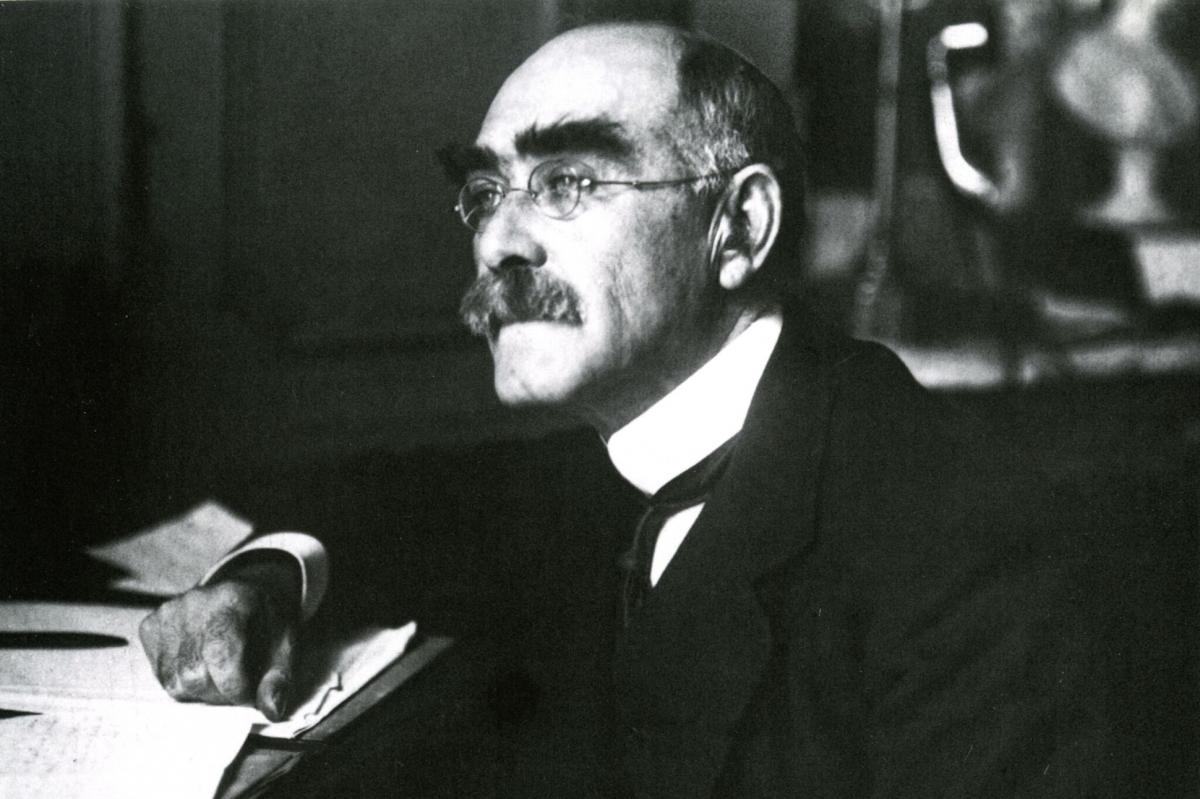
    And—which is more—you’ll be a Man, my son! —Rudyard Kipling

20 Helpful Thoughts On Criticism

“Criticism is something you can avoid easily—by saying nothing, doing nothing and being nothing.” —Aristotle 

“The Lord uses critics to show us our own hearts, even if what they say is not fully true, informed, or even fair. There is almost always a germ of truth in what our critics (in their own pain and disappointment) shout at us. The wise leader will humble himself and look for the truth embedded in every oppositional interaction.” —Dick Brogden [see 2 Samuel 16:5-12] 

“Feedback is the breakfast of champions.” —Ken Blanchard 

“Criticism can be received as a gift from God. It is an opportunity to pray, search Scripture, evaluate your own heart, and offer grace to others. The right response to criticism should not be retaliation or pride (which just perpetuates hurt), but rather humility.” —Jeremy Carr

“There is a growing trend to attack, criticize, and resent anyone who has talent or achievements that sets them apart from others. This tendency extends to those who resent the efforts of leaders who challenge the status quo. Opponents of change initiatives often attempt to marginalize leaders by attacking their character and questioning their motives. If the messenger is flawed, then the message and vision they offer cannot be trusted. As disappointing as it is, these challenges come with the territory of leadership.” —Dr. J. Lee Whittington

“If I were to attempt to answer all the criticisms and complaints I receive, I would have no time for any other business. From day to day I do the best I can and will continue to do so till the end. If in the end I come out all right, then the complaints and criticisms and what is said against me will make no difference. But, if the end brings me out wrong, then ten angels coming down from heaven to swear I was right would still make no difference.” —Abraham Lincoln

“If a ministry is God-anointed, it doesn’t matter who criticizes it. If it’s not anointed, it doesn’t matter who praises it.” —Rick Warren 

“Your critics have information that your friends are withholding.” —John Maxwell 

“God never gives us discernment so that we may criticize, but that we may intercede.” —Oswald Chambers 

“No leader is exempt from criticism and his humility will nowhere be seen more clearly than in the manner in which he accepts and reacts to it.” —J. Oswald Sanders 

“Criticism may not be agreeable, but it is necessary. It fulfills the same function as pain in the human body: It calls attention to an unhealthy state of things.” —Winston Churchill 

“Every man needs a blind eye and a deaf ear, so when people applaud, you’ll only hear half of it, and when people salute, you’ll only see part of it. Believe only half the praise and half the criticism.” —C.H. Spurgeon 

“Any fool can criticize, condemn and complain—and most fools do. But it takes character and self-control to be understanding and forgiving.” —Dale Carnegie

“A mark of a godly leader is one so focused on God’s plan that he pays no attention to his critics or enemies.” —Craig T. Owens

“Never be afraid of honest criticism. If the critic is wrong, you can help him; and if you’re wrong, he can help you. Either way, somebody’s helped.” —A.W. Tozer 

“It’s so much easier to teach correct principles than it is to know and love a person. It’s so much easier to give brilliant advice than to empathize and be open. It’s so much easier to live independently than to live interdependently. It’s so much easier to be a judge than to be a light. It’s so much easier to be a critic than to be a model.” —Stephen Covey

“When is it inappropriate to praise a critical person? One: When you are being criticized for outright sin, and the criticism is accurate. If what is said is true, the tension you feel will be relieved only one way: confession. Two: when you are falsely accused of sin. Sin is a serious charge, obviously more serious than those ‘against you’ realize or they would have done their homework.” —Blaine Allen

Don’t let an arrow of criticism pierce your heart unless it first passes through the filter of Scripture.” —Mark Batterson

“There is no better antidote for unjust criticism than a clear conscience before God.” —James Hernando

“It is not the critic who counts; nor the many who point out how the strong man stumbles, or where the doer of deeds could have done them better. The credit belongs to the man in the arena, whose face is marred by dust and sweat and blood, who strives valiantly… who knows the great enthusiasms, the great devotions, who spends himself in a worthy cause, who at the best knows in the end the triumph of high achievement, and who at the worst, if he fails, at least fails while daring greatly, so that his place shall never be with those cold and timid souls who have never known neither victory nor defeat.” —Teddy Roosevelt 

Thursdays With Spurgeon—Our Fight For Faith

This is a weekly series with things I’m reading and pondering from Charles Spurgeon. You can read the original seed thought here, or type “Thursdays With Spurgeon” in the search box to read more entries.

Our Fight For Faith

     Our faith at times has to fight for its very existence. The old Adam within us rages mightily, and the new spirit within us, like a young lion, disdains to be vanquished; and so these two strong ones contend, till our spirit is full of agony. …

     Christ alone was tempted in all points as we are, though without sin. No one man is tempted in all points exactly like another man, and each one has certain trials in which he must stand alone amid the rage of war, with not even a book to help him, or a biography to assist him—no man ever having gone that way before except that one Man whose trail reveals a nail-pierced foot. He alone knows all of the devious paths of sorrow. Yet even in such byways, the Lord is with us, helping us, sustaining us, and giving us grace to conquer at the close. … 

     So satan, loath to leave a soul, pursues it hotfoot. He will have it back if he can; and often, soon after conversion, there comes a time of dreadful conflict, when the soul seems as if it could not live. … 

     Once, when the tempter had grievously assailed me, I went to see my dear old grandfather. I told him about my terrible experience, and then I wound up by saying, “Grandfather, I am sure I cannot be a child of God, or else I should never have such evil thoughts as these.” 

     “Nonsense, Charles,” answered the good old man. “It is just because you are a Christian that you are thus tempted. These blasphemies are no children of yours; they are the devil’s brats, which he delights to lay at the door of a Christian. Don’t you own them as yours; give them neither house-room or heart-room.” 

From The Autobiography Of Charles Spurgeon

The apostle Peter says our adversary the devil continually prowls around looking for a follower of Jesus that he can devour. This shouldn’t be surprising to us since Jesus said that the devil’s agenda was to steal, kill, and destroy. (See 1 Peter 5:8-9; John 10:10.)

But the apostle Paul also tells us that we aren’t supposed to be unaware of the devil’s schemes. Instead, we are to capture every thought and make them obedient to Jesus (2 Corinthians 10:5). That means, as Spurgeon’s grandfather counseled him, we recognize those evil thoughts as the devil’s brats and don’t allow them to take up room in our house nor our heart. 

Stand firm—those who are in Christ are more than conquerors! 

Forever Love

“His love endures forever” (NIV)
“His lovingkindness is everlasting” (NASB)
“His love never quits” (MSG)
“His faithful love endures forever” (NLT)
“His mercy and loving-kindness endure forever” (AMP)
“His loyalty continues forever” (EXP)
“His loyal love endures forever” (LEX)
“His loving-kindness continues forever” (TLB)
“His tender love for us continues on forever” (TPT)

The psalmist says this in every single verse of Psalm 136.

Get the point? Just in case you missed it—

You cannot outrun, use up, wear out, or lose God’s forever love!

A Very Present Help

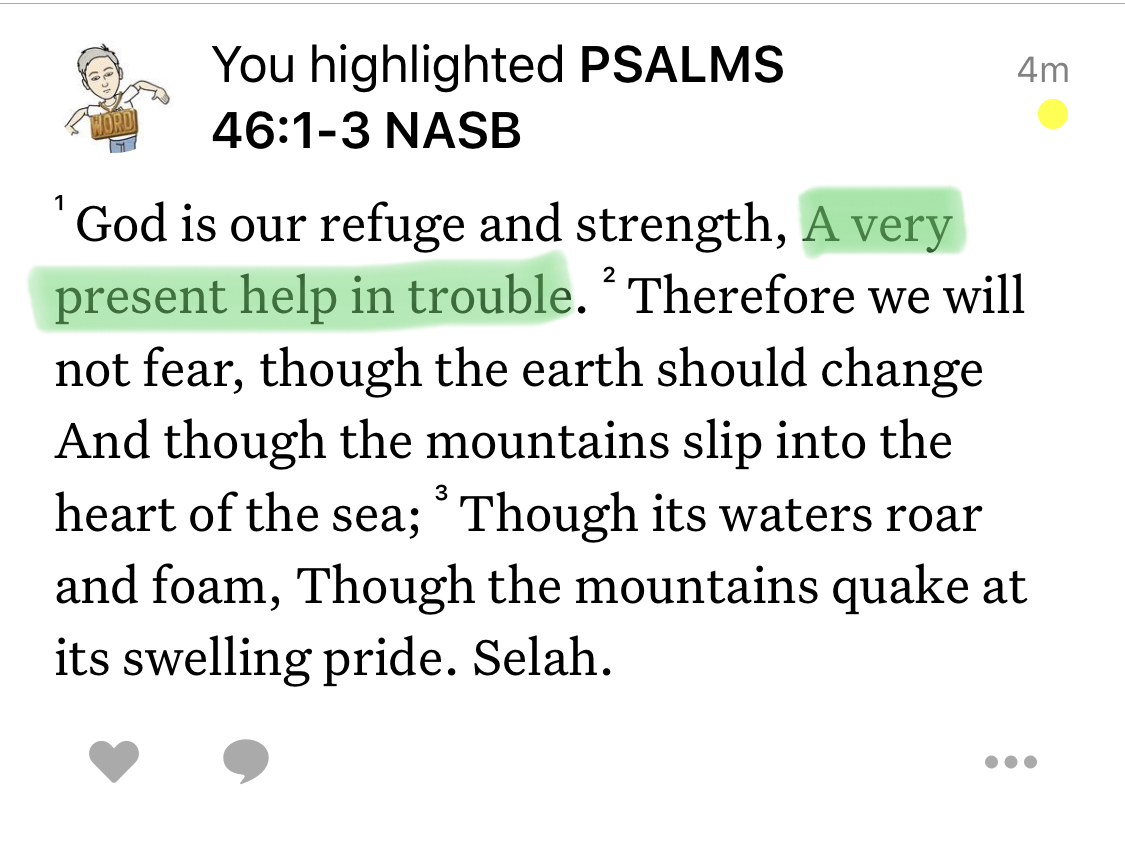
God is our refuge and strength, a very present help in trouble. (Psalm 46:1)

God is not just present—He is very present! 

God is not merely in the room with you, He is fully attentive to you. He’s never distracted, preoccupied, or disinterested. 

Regardless of the quaking or roaring around you, He is so very present that He knows your quietest sigh. You don’t have to look anywhere else for help because He is VERY present at this VERY moment. 

The rest of this psalm reiterates this promise:

  • God is in the midst
  • God will help
  • The Lord of hosts is with us
  • God is our stronghold 

God Himself speaks the words of the natural conclusion we should draw when we realize that He is VERY present at this VERY moment—

“Be still, and know that I am God!”

Everyday Evidence

Last week we learned that speaking in tongues was one of the most noticeable and consistent characteristics of those who were baptized in the Holy Spirit. 

Speaking in tongues as the Spirit enables you is the unmistakable, objective, outward, initial physical evidence. The Bible makes clear that continuing to pray in tongues has huge benefits for both our personal prayer lives and for the corporate church body. But don’t stop there! 

The initial, outward evidence is primarily for the individual Christian—it’s a way of knowing that you know that you have indeed been baptized in the Spirit. But there also needs to be some everyday evidence for others that testifies to them that something is different about your life. 

Consider the disciples of Jesus before and after being baptized in the Holy Spirit…

Their vocabulary

Before being baptized in the Spirit they said stupid things because they didn’t know what to say (Mark 9:5-6) But after being baptized in the Spirit there was no more foot-in-mouth disease. Just as the Holy Spirit enabled them to praise God in an unlearned tongue, He also empowered their natural dialect. The same Greek word is used in Acts 2:4 (enabled by the Holy Spirit), 2:14 (Peter addressed the crowd), and 26:25 (what I am saying is true and reasonable). 

Their spiritual power

Before it was limited, and often thwarted, but afterward, it was limitless and effortless (Mark 9:17-18; Acts 3:1-8; 5:15; 6:8).

Their understanding of servanthood

Before they argued about who was the greatest. Afterward, they gladly gave all that they had to others (Mark 9:33-34; Acts 2:44-45). 

Their boldness in the face of adversity

Before they abandoned Jesus, ran away, and hid in locked rooms. Afterward, there was no intimidating or silencing them (Acts 4:8, 13, 18-20). 

Their understanding of Scripture

Before they had virtually no understanding of Scripture’s application. Afterward, they understood how to apply God’s Word in almost every situation (Acts 2:16, 33-35; 4:24-26). 

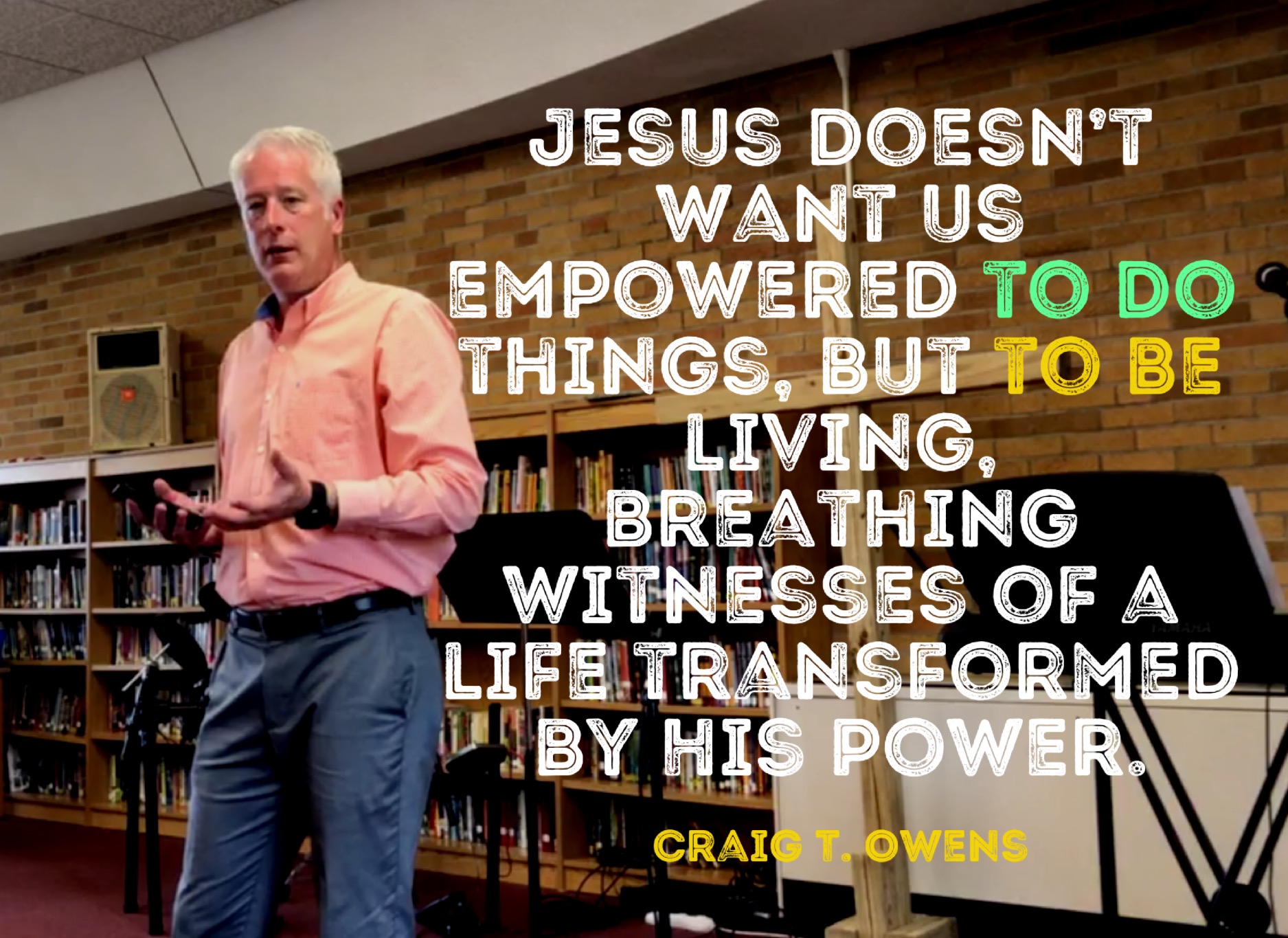
Jesus promised that the baptism in the Holy Spirit would empower us TO BE His witnesses (Acts 1:8). Not just to do things for Him. There’s nothing wrong about doing Jesus-glorifying things, but in themselves, they are too short-sighted. Jesus doesn’t want us empowered to do things, but TO BE a living, breathing, walking, talking witness of a life transformed by His power. That’s the reason why I say to you again and again: Don’t stop at salvation. Press on and press in to be baptized in the Holy Spirit so that you can BE an empowered, transformed and transforming witness for Jesus!

If you missed any of the messages in this series, you can access the full list of messages by clicking here