Do I Have Standing?

Listen to this post as a podcast by clicking here:

If it is true that I have gone astray, my error remains my concern alone (Job 19:4).

Why do we find it necessary to stick our noses in where they are not wanted? Why do we feel like the other person needs to hear our opinion? 

The law dictionary defines “standing” as the right to file a lawsuit or file a petition under the circumstances. In legal terms, Job’s three friends had no standing to bring charges against him. Job himself even said he didn’t want to hear their opinions. Instead, all Job asked for was, “Have pity on me, my friends, have pity.” He goes on to ask, “Why do you pursue me as God does? Will you never get enough of my flesh?” 

And then Job gives this warning: “If you say, ‘How we will hound him, since the root of trouble lies in him,’ you should fear the sword yourselves.” Despite this warning, Zophar still begins his argument by stating, “I hear a rebuke that dishonors me so I have to speak up.” 

There are indeed times when our friends may be going astray and the loving thing we can do for them is speak a word of truth, but that is something entirely different than feeling compelled to share an opinion or sticking our noses in where they don’t belong. A good question to ask ourselves before speaking: Do I have standing here?

Far better for us to apply the Golden Rule this way: Treat others in their condition the way I would want to be treated in the same condition. And if I do feel as though I have standing, and need to speak a loving word, I need to examine myself first.

Job tells his friends, “You are miserable comforters, all of you!” (16:2). One of the best things they did for him was to simply sit silently in mourning alongside him. It was when they felt compelled to argue that they not only disappointed Job, but they dishonored God too. 

My checklist before speaking:

  1. Do I have standing? 
  2. Have I examined myself? 
  3. Can I speak truth in love (and not just air my opinion)? 
  4. Have I considered the Golden Rule? 

If I can answer “Yes” to all four questions, then speak; otherwise, it’s far more loving to remain silent. 
Think, Do, Evaluate, Propose

Listen to the podcast of this post by clicking on the player below, and you can also subscribe on AppleSpotify, or Audible.

The seed thought for me was this quote from John Maxwell: 

“Nothing you do will be perfect, so embrace the reality and benefits of failure by releasing yourself from the burden of not making mistakes.” 

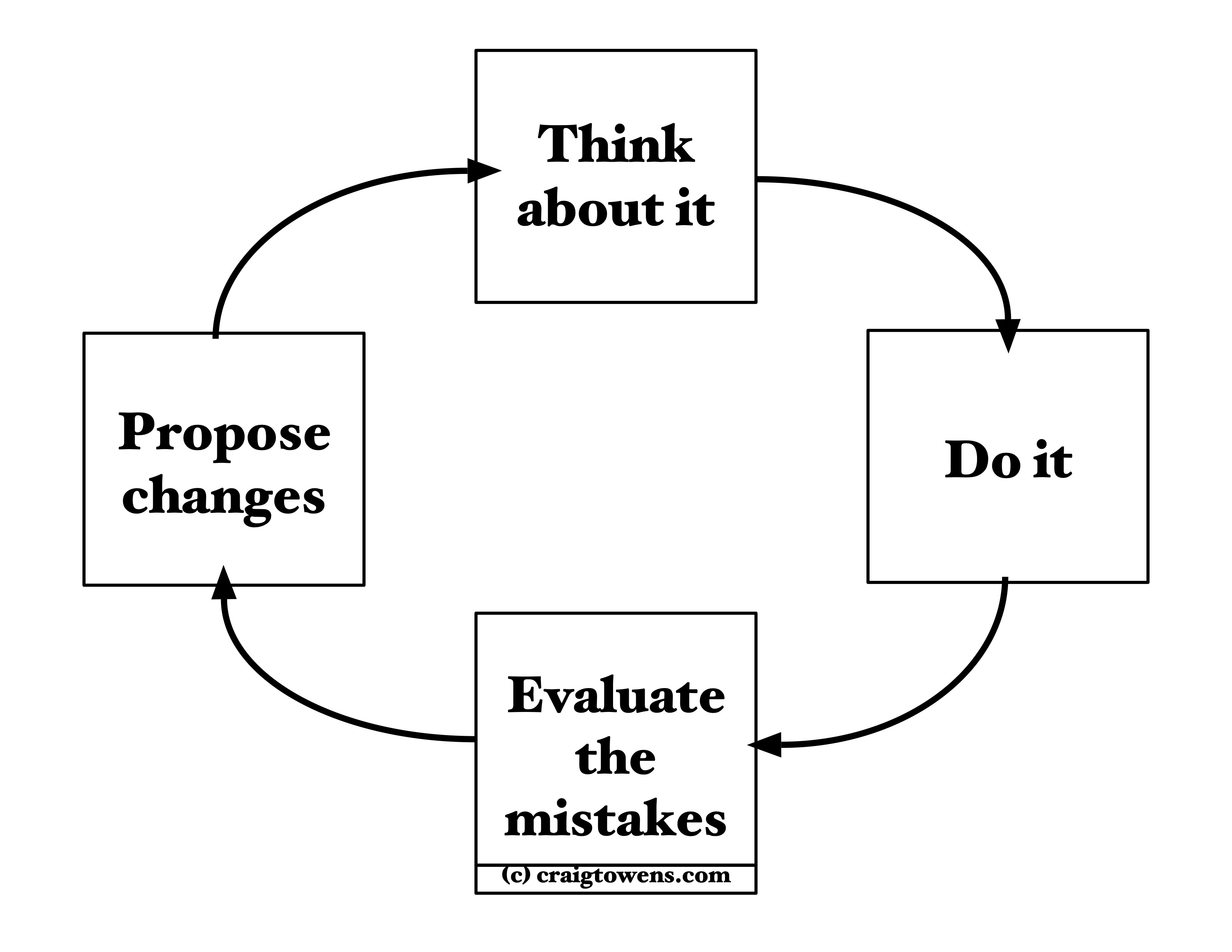
Here’s what I am endeavoring to implement: Think, Do, Evaluate, Propose. And then Repeat. 

THINK ABOUT IT—It’s important to put some thought into what you want to do before you do it, but we cannot camp-out here forever. I like to think in terms of goals I want to accomplish, whether those are for me personally or for organizations I lead. 

DO IT—At some point, I must launch out. Many people point out that Peter began to sink under the waves when he took his eyes off Jesus and began to look at the storm. But let’s not forget that Peter was the only one of the disciples who actually got out of the boat and walked on water! I often remind people who are hesitant to begin something that you cannot steer a parked car. We have to get moving first. 

EVALUATE THE MISTAKES—Let’s remove all doubt: you will make mistakes. But those mistakes are beneficial because it gives you something on which to work. Get some wise friends around you that can help you evaluate your mistakes. And always remember I failed ≠ I am a failure (here’s another post where I elaborate on this point). 

PROPOSE CHANGES—After evaluating your mistakes or shortcomings, you now have evidence that can be processed for your next attempt. This evidence can be taken back into the laboratory of the “Think” box as you prepare to try again, except now you are more informed than you were in your first attempt. 

REPEAT THE PROCESS AGAIN—No one is an overnight success, so keep trying again and again and again.

Leaders, walk through this process with your team members. Help guide their thinking, and then move them to action. Let them know that mistakes are okay because they have given you some invaluable feedback you can use as you make your proposals for your next attempt. 

Success is a continual run through the Think-Do-Evaluate-Propose cycle, with each revolution moving you closer to success. 

►► Would you please prayerfully consider supporting this ministry? My Patreon supporters get behind-the-scenes access to exclusive materials. ◀︎◀︎

Miracles Out Of Somewhere (book review)

Fans of the band Kansas will recognize that the title of Kerry Livgren’s book is just a slight variation from one of the band’s well-known songs. Miracles Out Of Somewhere recognizes both the miracles and the Source of those miraculous encounters. 

For my listening enjoyment, I am always quick to pull up anything written by Kerry Livgren—his solo work, Kansas, AD, or Proto-Kaw are musical masterpieces and lyrically enriching. One of Kerry’s songs was entitled “Miracles out of nowhere,” in which we are surprised by the serendipitous occurrences that cross our paths. But in this book, Kerry makes it clear that he sees God at work in his life. 

Miracles Out Of Somewhere is a memoir spanning all of Kerry’s life. He takes us back to his boyhood home, to the pre-Kansas days, to the heyday of Kansas, and to his life since leaving the popular rock band. The book is not written in chronological order, but almost as if Kerry were sitting on the front porch and reminiscing with you. 

I have always found Kerry (and all his Kansas bandmates) to be very down-to-earth guys. They enjoyed their success without letting it go to their head. This book has that same accessible, guy-next-door feel to it, which makes it extremely engaging and enjoyable. Kerry simply shares his stories and lets the reader come to their own conclusion of what sort of miracle may (or may not) have happened. 

If you enjoy the music of Kerry Livgren, I think you will appreciate the messages in his songs even more after taking this behind-the-scenes tour with him. 

ADDED BONUS REVIEW: The band Kansas has a rockumentary about the band’s beginnings and its “miracles” that put them on top of Billboard’s greatest hits. This Miracles Out Of Nowhere DVD is very enjoyable and well worth the time of any Kansas fan. 

A Proper Perspective In An Evil Culture

Do these phrases sound familiar? 

  • The foundations are being destroyed, what can the righteous do? 
  • The faithful have vanished from among men 
  • Everyone lies to his neighbor 
  • The boastful say, “We will triumph with our tongues” 
  • The wicked freely strut about when what is vile is honored among men 

This could be said today in my neighborhood. And 20 years ago in Washington DC. And 500 years ago in Europe. But it was said over 3000 years ago!

In times like these it’s important to remember that there have always been times like these! 

In the United States, elections bring regular changes in leadership. Around the world and throughout history violent dictators are toppled, benevolent monarchies fall, dominate personalities shine brightly and fade from the scene, even people who called themselves “Great” or “the king of kings” have disappeared. What should our perspective be in changing cultures—whether they are good or evil?

In Psalms 9-12, David shares some timeless reminders.  

In Psalm 9, he contrasts the temporary track record of mortals with the transcendency of Yahweh. His Selah pauses in this psalm invite us to consider the question: Who benefits me ultimately and affects me eternally: mortals or God?

In the Septuagint, Psalms 9 and 10 make up one psalm. In our English Bible, Psalm 9 closes with the phrase “they are but men” and Psalm 10 closes by calling mankind “mere earthly mortals.” Contrast that with Yahweh who is described as “the LORD reigns forever” and “the LORD is King for ever and ever.” 

In between these eternal affirmations of God, mere earthly mortals are described as: 

  • arrogant 
  • boastful—literally saying “hallelujah” to themselves 
  • blessing all who are like them in their wicked thoughts
  • having no room in their thoughts for God 
  • even praying to themselves—which is the literal meaning of “he says to himself” that David repeats three times 

Literally this mere earthly mortal thinks of himself as god! But even as he says “nothing will ever hurt me while I’m alive” he acknowledges his mortality, admitting that he is indeed finite. 

In Psalms 11 and 12, David gives the righteous the proper perspective to handle all of this. In a word, David wants the godly to remember:

  • Remember God sees everything 
  • Remember God punishes the wicked and rewards the righteous 
  • Remember God gets the final word 

Christians can only live exemplary, anxiety-free, and God-honoring lives when we stay focused on the Infinite, on the Eternal God. With this perspective we can live out our roles as “aliens and strangers”—as the apostle Peter calls us—while we live in this evil culture.

Poetry Saturday—Indispensable Man

Sometime when you’re feeling important;
Sometime when your ego’s in bloom;
Sometime when you take for granted
You’re the best qualified in the room.

Sometime when you feel that your going
Would leave an unfillable hole;
Just follow this simple instruction,
And see how it humbles your soul.

Take a bucket and fill it with water,
Put your hand in it up to the wrist;
Pull it out and the hole that’s remaining,
Is a measure of how you’ll be missed.

You may splash all you please when you enter,
You can stir up the water galore;
But stop and you’ll find in a minute,
That it looks quite the same as before.

The moral of this quaint example
Is to do just the best that you can;
Be proud of yourself, but remember
There’s no indispensable man —Saxon White Kessinger

Thursdays With Spurgeon—The Plan Of The Cross

This is a weekly series with things I’m reading and pondering from Charles Spurgeon. You can read the original seed thought here, or type “Thursdays With Spurgeon” in the search box to read more entries.

The Plan Of The Cross

What we have received is not the spirit of the world, but the Spirit who is from God, so that we may understand what God has freely given us. (1 Corinthians 2:12) 

     The course of our fallen race has been a succession of failures. Whenever there has been an apparent rise, it has been followed by a real fall. Into ever-increasing darkness the human mind seems resolved to plunge itself in its struggles after a false light. When men have been fools, they have danced in a delirium of sin. When they have been sober, they have given themselves up to a phantom wisdom of their own that has revealed their folly more than ever. It is a sad story, the story of mankind! Read it in the light of God’s Word and it will bring tears from your very heart.

     The only hope for man was that God should interpose. And He has interposed, as though He began a new creation or worked a resurrection out of the kingdom of death. God has come into human history and here the bright lights begin. … See yonder avalanche rushing down the steep mountainside? Such is humanity left to itself. Lo, God in Christ Jesus throws Himself in the way. He so interposes as to be crushed beneath the descending rocks. But beloved, He rises from the dreadful burial. He stops the avalanche in its terrible path. He hurls back the tremendous mass and changes the whole aspect of history. … 

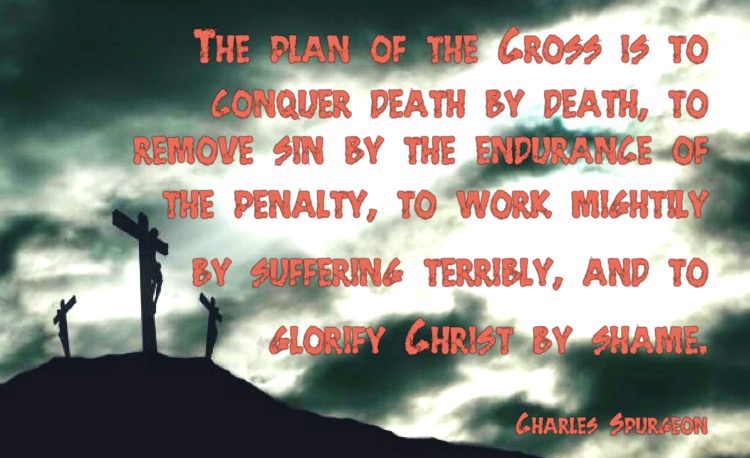
     The plan of the Cross is to conquer death by death, to remove sin by the endurance of the penalty, to work mightily by suffering terribly, and to glorify Christ by shame.

From Grace For Grace

This sermon reminds me of the poignant words from Isaac Watts—

When I survey the wondrous Cross 
On which the Prince of Glory died, 
My richest gain I count but loss, 
And pour contempt on all my pride. 
Forbid it, Lord, that I should boast, 
Save in the death of Christ my God! 
All the vain things that charm me most, 
I sacrifice them to His blood.
 

All of man’s attempts to control his universe, or determine his fate, or even make himself acceptable to God have been an abysmal failure. So God Himself stepped in, but He came in a way that no one could have imagined and no one could claim as their idea. The prophet Isaiah said it this way, “The Lord looked and was displeased that there was no justice. He saw that there was no one, He was appalled that there was no one to intervene; so His own arm achieved salvation for Him, and His own righteousness sustained Him” (Isaiah 59:15-16). 

It is by grace alone, through faith alone, in Christ alone that we have hope of our salvation. And for that we give all glory to God alone. Sola Deo gloria!


The Craig And Greg Show: Leaders Are Healthy

On this episode of “The Craig And Greg Show” we talk about: 

  • the premier biblical historian Luke tells us how important it was that Jesus grew wholly healthy 
  • unhealthiness in one aspect affects every area of a leader’s life 
  • we need to guard against what we let in our minds and bodies  
  • our emotional/social health is what really shows our leadership health  
  • self-care is never selfish; it’s vital  
  • leaders can only give health to others when they are first healthy themselves 
  • stress can erode a leader’s health, so leaders need to be self-aware
  • the importance of getting feedback
  • most of us won’t change until the pain of staying the same becomes greater than the pain of changing

Check out this episode and subscribe on YouTube so you can watch all of the upcoming episodes. You can also listen to our podcast on Spotify and iTunes.

9 Quotes From “To The Work!”

D.L. Moody passionately and persuasively dismantles all of the hesitations Christians have to being active and outspoken about their relationship with Jesus. Check out my full book review by clicking here. 

“I have often said that if I had to convict men of sin I would have given up the work long ago. That is the work of the Holy Ghost. What we have to do is to scatter the good seed of the Word, and expect that God will bless it to the saving of men’s souls.” 

“One of the great obstacles in the way of God’s work today is this want of love among those who are the disciples of the Lord Jesus Christ. … To address men well they must be loved much.” 

“Those who have been greatly used of God in all ages have been men of courage. If we are full of faith we shall not be full of fear, distrusting God all the while. That is the trouble with the Church of Christ today—there are so many who are fearful, because they do not believe that God is going to use them. What we need is to have the courage that will compel us to move forward.” 

“If you cannot engage in any active work yourselves you can do a good deal by cheering on others.” 

“Let us not be discouraged, but let us use all these wonderful opportunities, and honor God by expecting great things. If we do we will not be disappointed. God is ready and willing to work, if we are ready and willing to let Him, and to be used by Him.” 

“A good many people are afraid of the word enthusiasm. Do you know what the word means? It means ‘In God.’ … People say that if we go on in that way many mistakes will be made. Probably there will. You never saw any boy learning a trade who did not make a good many mistakes. If you do not go to work because you are afraid of making mistakes, you will probably make one great mistake—the greatest mistake of your life—that of doing nothing. If we all do what we can, then a good deal will be accomplished.” 

“When God wanted to bring the children of Israel out of bondage, He did not send an army; He sent one solitary man. So in all ages God has used the weak things of the world to accomplish His purposes.” 

“If this world is going to be reached, I am convinced it must be done by men and women of average talent. After all there are comparatively few people in the world who have great talents. … I do not believe, either, that all God’s work is going to be done by ministers, and other officers in the Churches. This lost world will never be reached and brought back to loyalty to God, until the children of God wake up to the fact that they have a mission in the world.” 

“Philip was called away from a great work in Samaria to go and speak to one man in the desert. Christ’s great sermon on Regeneration was addressed to one man; and that wonderful discourse by our Lord on the Water of Life was spoken to one poor sinful woman. I pity those Christians who are not willing to speak to one soul; they are not fit for God’s service. We shall not accomplish much for God in the world, if we are not willing to speak to the ones and twos. … The Lord expects us to do what we can. We can all do something.”

Two Joys

…joy… (Nehemiah 8) 

Although the word in English is “joy,” there are two different Hebrew words used here. Think of them this way—one is the root and the other is the flower. 

In verse 10, the Hebrew word chedvah is only used twice in all of the Old Testament (it’s also used in 1 Chronicles 16:27). This word describes the source of joy—or the root—which is found exclusively in God’s presence. 

In verses 12 and 17 the word for “joy” is simchah. This word essentially becomes the outward expression—or the flower—because it is nourished by the chedvah root. 

Here’s how it plays out in the book of Nehemiah. Because the people had heard and been given understanding of God’s Word, they joyfully celebrated. And because God helped them complete the wall around Jerusalem and reestablish worship at the temple, they also happily celebrated. God was the chedvah root of their joy, and their outward celebration was the simchah flower. 

God alone is the Root—the Source—of chedvah. My simchah celebration both glorifies Him as the Source and points others to Him. My simchah flower will make others desirous for the chedvah root that has brought about this outward joyful expression from me. 

To be a joyless Christian is a contradiction of terms. To not express simchah means either I am not abiding deeply in the root of chedvah, or that I don’t believe it is worthwhile enough to share with others. But of course, if I have truly been to the Source, I will want others to enjoy this relationship with God as well.

Two questions for me to ask myself: (1) Is my heart abiding deeply in God as my Source of joy? And (2) Is my outward joy a making others desirous to know this Source of joy for themselves? 

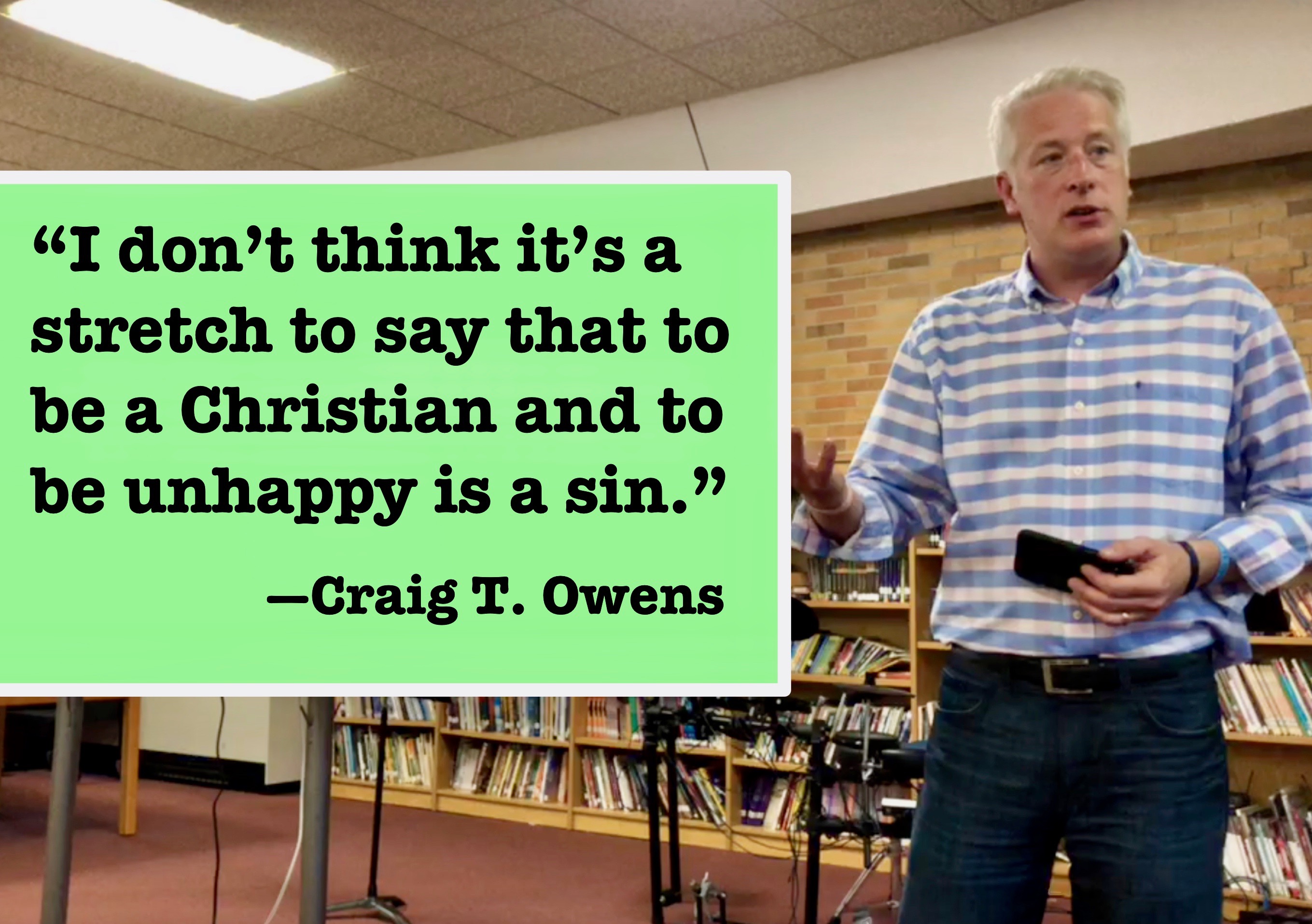
I don’t think it’s a stretch to say that to be a Christian and to be unhappy is a sin. A joyless, unhappy Christian gives God no praise, robs Him of glory, and paints God in a bad light. A happy Christian knows the Lord is his strength, his comfort, his supply. The joy-filled, happy Christian lifts God high and invites others to know this All-Good, All-Happy God too! 

God Delights In Me

It’s been said that the bookends of success are starting well and finishing well. I believe that! 

David started well when he lifted up a prayer of thankfulness to God when he became king over the united nation of Israel. Prayer at the the beginning puts us on a path toward success. 

Have you ever begun to assemble a child’s toy or a piece of furniture, gotten completely stumped, and only then read the instruction manual? We’ve all been there! There are many things in life that we start on our own and then hit our knees in prayer only after we’ve exhausted all of our human resources. Fortunately, after we pray and God answers, we often end up finishing well with a prayer of praise and thanksgiving. The question is: what do we do when we again get ready to start something else? Do we pause to start well with prayer, or do we dive in on our own again? 

I think one of the biggest reasons we don’t go to prayer quickly is because we feel unworthy to go into the presence of a holy, righteous God. 

One commentator said about Psalm 18 that David probably prayed this “before he committed his terrible sin” with Bathsheba and Uriah. That may be, but with very few minor changes, David prayed this exact same prayer (2 Samuel 22) at the very end of his reign. His reign as king was bookended with the same prayer. 

Between the bookend prayers of Psalm 18 and 2 Samuel 22, David prayed another prayer—this one was after he had sinned against God, Bathsheba, and Uriah. David truly believed that God forgave that sin and wiped the slate clean, so much so that he noted this great blessing on his life: “He brought me out into a spacious place; He rescued me because He delighted in me. 

He rescued me because He delighted in me?! Yes! 

David knew that God had told us that He delights in those who obey Him. The example of God’s delight was seen in Jesus. Because Jesus paid the price for the forgiveness of my sins, I can be completely cleansed. Then Jesus comes in me, and takes me into Him, and takes both of us into the Father. So now when our Heavenly Father looks at a forgiven sinner, He sees only the righteousness of Jesus—something He utterly delights to see! (Check out all of the biblical passages I’m referencing by clicking here.)  

David said his sin had been washed “whiter than snow” (Psalm 51:7), So now look at what he could claim—

The Lord has dealt with me according to my righteousness; according to the cleanness of my hands He has rewarded me. For I have kept the ways of the Lord; I am not guilty of turning from my God. All His laws are before me; I have not turned away from His decrees. I have been blameless before Him and have kept myself from sin. The Lord has rewarded me according to my righteousness, according to my cleanness in His sight” (2 Samuel 22:21-25). 

…according to my cleanness in His sight. 

In GOD’S sight! The devil wants to accuse me. He wants my sight to dominate. The devil doesn’t want me to see myself as God sees me. But I declare it out loud: I am clean IN HIS SIGHT! 

This cleanness allows me full, bold, confident access to Almighty God! I can take everything to God in prayer because I am clean in His sight! 

If you would like to read more of the posts in our prayer series called Be A First Responder, please click here.