And a voice came from the throne, saying, “Give praise to our God, all you His bond-servants, you who fear Him, the small and the great.” Then I heard something like the voice of a great multitude and like the sound of many waters, and like the sound of mighty peals of thunder, saying, “Hallelujah! For the Lord our God, the Almighty, reigns.” (Revelation 19:5-6)
What a song of praise is raised in Heaven!
You can join that heavenly choir every day when your life (and words) express your firm belief that your God is sovereign and you are His servant. That means your life lifts a mighty “Hallelujah!” when you live like this: “Not my will but Yours! May Your will be done on earth as it is in Heaven. Not to me, but may all of the glory and honor go to You!”
When we speak God things TO God about God, and when we speak good things TO God about our neighbors, then we will have good things FROM God to speak to our neighbors.
The Greek word for “bless” (eulogeo) literally means good (eu-) words (logos). We can bless people simply by saying good words to them, as well as good words about them to both God and others.
Listen to the podcast of this post by clicking on the player below, and you can also subscribe on Apple, Spotify, or Audible.
I take some time at the end of each calendar year for a quick recap of everything we have learned during this year at Calvary Assembly of God. I do this because I want to make sure we are all on the same page with each other before we move into a new year. And I also think it’s very important that we are continually reminded and reassured of what God has done for us. In our series on gratitude we talked about the dangers of forgetting to remember and re-tell the blessings of God. We see in the letters from the apostles both a re-telling of their own words, and reusing and amplifying the words of Jesus and other apostles.
You can click on the sermon series title to find a list of all of the sermons in that series. Clicking on those individual sermons will give you a short written recap of that message, and it will also give you the link to watch the video of the full sermon.
Kingdom Praying. Jesus made it clear time and time again that He came to reveal the Kingdom of God to us. He described what the Kingdom was like and told us that He came to be the means by which we could enter God’s Kingdom. He also told us how God’s children could access the power and privileges of our Heavenly Father through the means of prayer. He assured us with words like, “Do not be afraid, little flock, for your Father has been pleased to give you the Kingdom” (Luke 12:32). Jesus said quite simply that we had access to our Father through prayer. And then to make sure we didn’t miss out on this awesome privilege, He instructed us, “This, then, is how you should pray” (Matthew 6:8).
Jots and Tittles. As we get closer to the death and resurrection of Jesus, there are an increasing number of prophecies that are fulfilled in these events. Jesus appears to have been very attentive to making sure that each and every one of these prophecies were fulfilled to the smallest detail. Near the beginning of His public ministry, Jesus noted that not one iota—or “one jot or tittle” in the Old English vocabulary—of any of God’s promises would be left unfulfilled (Matthew 5:18). It’s amazing that Jesus so carefully attended to all of these, but it’s also important to ask ourselves what these fulfilled prophecies mean to us today.
Takin’ Him to the Streets. Just before Jesus ascended to Heaven, He told His followers that they would have the joyful responsibility of taking the good news of forgiveness and eternal life to all the highways and byways of every nation. Later on, Paul would get more specific about all of the groups to which he was taking the message of Jesus (see Luke 24:46-47; 1 Corinthians 9:20-22). That commission is still in effect for Christians today: We are to share the gospel with everyone—from easy street to skid row, from Wall Street to Main Street, and every street in between. The streets on which you live and work are different from the streets where I travel. In fact, all of us live on different streets, but everyone we meet on every street needs to hear about Jesus. In this new series of messages, we are going to learn how the Holy Spirit can help us be ready to take Jesus to those on each street where God sends us.
Ascending. Every year, Jews from around the world made four pilgrimages up to Jerusalem for various feasts and sacrifices. These journeys reminded them of God’s goodness as they went to the Temple to worship, and they helped refocus on God’s ways as they returned to their regular routines. Jerusalem is over 2500 feet above sea level, so the pilgrimage there was a physical workout as well as a spiritual workout. These workouts were beneficial for God’s people, preparing them to minister in their cities in the following months. The Book of Psalms contains 15 songs that these pilgrims would sing to and with each other as they traveled up to Jerusalem. These Psalms of Ascent are still instructive for Christians today.
Living in your Gift Zone. God created each and every human being uniquely. We all come in different shapes and sizes, but we all share one thing in common: He created each of us with a unique personality and a unique gift package. By unique, I truly mean that we are all one-of-a-kind creations that have never existed in all of history! Here’s another thing we all have in common: We usually live in a comfort zone that is far smaller than our gift zone. Living this way keeps us from soaring through life in the way that God intended. He wants each of us to know our gifts, and to use our gifts in a way that benefits our world and brings Him glory. It starts with believing that we are indeed gifted by our Creator. Then we must have the courage to step out of our comfort zone into the much larger gift zone God has given us.
Is that in the Bible? A meme that makes me chuckle every time I see it is a “quote” attributed to Abraham Lincoln in which he says, “The problem with quotes found on the internet is that they are often not true.” (Not to spoil the joke for you, but unless Lincoln knew how to time travel to the future, I don’t think he knew about the modern internet!). I love this meme because it captures something that so many people fall into: a quick acceptance of a statement without verifying its source or thinking through the implications of the statement’s truthfulness. In this series I think you may be surprised to discover just how many phrases we call biblical aren’t, and how many phrases there are that we never realized are actually in the Bible.
Be Thankful. It’s so easy to spot the negative things. It’s so easy to gripe about the bad stuff with others. It’s so easy to complain about what’s wrong with the world. But the Bible repeatedly calls the saints of God to rise above this downward pull of negativity. In fact, for those who have a relationship with their Heavenly Father, who call Jesus their Savior, and who call the Holy Spirit their Counselor, there is really only one way to live: Grateful!
Christ’s Advents. The word Advent means the appearing—something that bursts onto the scene. At this time of year we are actually thinking about TWO Advents. We look backward in gratitude to celebrate the first Advent of Jesus when He was born in a manger in Bethlehem. And then we look forward in joyful expectation to the second Advent of Jesus when He will return to earth again as King of kings. As Christians live in this time between the two Advents, our celebration and expectation should bring four noticeable attributes from our lives: hope, peace, joy, and love.
This next year promises to be another amazing time of learning and growing. If you live in northern Kent County and don’t have a home church, I would love for you to visit us!
Listen to the podcast of this post by clicking on the player below, and you can also subscribe on Apple, Spotify, or Audible.
Paul’s first visit to Philippi didn’t go so well!
It started off with some success—Lydia and her household accepted Jesus as their Messiah, and a demon-possessed girl was set free—but then things turned sour very quickly! Paul and Silas were falsely accused of subverting Roman law, and without any sort of trial they were beaten and thrown into prison.
Even after the local magistrates realized their mistake in mistreating Roman citizens in this way, they simply asked Paul and Silas to leave town. You can read this story in Acts 16:11-40.
But there were seeds planted in this city. Not just Lydia’s family, but the jailer’s family as well, became followers of Jesus. And what about the girl set free from demonic oppression? I have a hunch she joined with the Christians in praising God too! This group of believers then became the first financial supporters of Paul’s missionary work.
Paul knew that his brief imprisonment in Philippi had resulted in a thriving group of believers. And now as he writes a letter to these saints from a Roman jail, he is once again starting to see what God is going to do through this hardship—
Now I want you to know, brothers and sisters, that my circumstances have turned out for the greater progress of the gospel, so that my imprisonment in the cause of Christ has become well known throughout the praetorian guard and to everyone else, and that most of the brothers and sisters, trusting in the Lord because of my imprisonment, have far more courage to speak the word of God without fear. (Philippians 1:12-14)
Paul was not embittered by his imprisonment, but he was rejoicing in all of the good things God was accomplishing because of his imprisonment.
✅ An attitude of thankfulness allows our eyes to stay open to God’s blessings even in hardships.
❌ A grumbling attitude prevents us from acknowledging what God is doing.
Paul’s trust in God’s provision gave him an attitude of gratitude in a difficult place, and he now encourages his friends to adopt this same mindset. In the next chapter, he writes—
Finally, my brothers and sisters, rejoice in the Lord. To write the same things again is no trouble for me, and it is a safeguard for you. (Philippians 3:1)
Paul knew that in a heart full of gratitude there is no room for grumbling. That’s why always rejoicing in the Lord is “a safeguard” for Christians. Rejoicing in God’s character and God’s blessings keeps our mind on Him, making it very difficult for any temptation to ambush us.
Let’s proactively keep a heart full of gratitude so that no grumbling can seep in. But if we do find ourselves in a dark place that may prompt us to grumble, let’s react quickly to turn any complaints into praying and singing hymns to God, just as Paul and Silas had done in the Philippian jail, and undoubtedly as they were also doing now in their Roman jail.
Listen to the podcast of this post by clicking on the player below, and you can also subscribe on Apple, Spotify, or Audible.
In preparing for our Be Thankful series at my church, I have been reading and studying quite a bit about gratitude. For example, my wife and I are reading a devotional on the YouVersion Bible app call “Practicing Gratitude.”
The other morning, our devotional writer shared this thought: “When the prophet Jonah was having a terrible day at work, he found gratitude by looking at God’s provision through the physical environment. God made a bush for shade and ‘Jonah was very happy about the bush’ (Jonah 4:6).”
In our shared notes, my wife had an insightful word. She wrote, “Jonah’s gratitude didn’t last long. This is a great reminder to pursue a lifestyle of gratitude. It is sometimes very challenging in the midst of hard days to recognize God’s blessings, but it forces me to take my eyes off myself and place them back on my Lord and Savior!”
My studies, this devotional plan, and Betsy’s insight got me thinking even more about the most valuable praise we can offer to our God.
Ah, yes, poor Jonah is a microcosm of the whole Old Testament: God’s blessings are only appreciated for a moment until the complaining starts up again.
Especially in the hard times where it feels like our difficulties are just so unfair.
Paul wrote, “In everything give thanks; for this is the will of God for you in Christ Jesus” (1 Thessalonians 5:18).
“In everything” is not the same thing as “for everything.” This means that I can still be God-focused in my painful circumstances, even though I may not be thankful for those circumstances.
But as I remain thankfully God-focused, perhaps I may begin to see what He is accomplishing because of my painful circumstances. Just as Jesus saw “the joy set before Him” (Hebrews 12:2) and knew that His Father would triumph even in that horrific time, perhaps as I keep my eyes on Jesus I can begin to get a glimpse of God’s coming glory.
Isn’t it “the will of God” that I know—beyond a shadow of a doubt—that I am irremovable from my position “in Christ Jesus”?
For I am convinced that neither death, nor life, nor angels, nor principalities, nor things present, nor things to come, nor powers, nor height, nor depth, nor any other created thing will be able to separate us from the love of God that is IN Christ Jesus our Lord. (Romans 8:38-39 NASB)
Shouldn’t my assurance of that truth produce a joy that prompts praise from my lips that brings glory to God? Isn’t that praise of greater value precisely because it comes from a person in a setting where thankfulness seems impossible?
God is magnified even more when praise comes from a thankful heart that is in a place where humanly there seems to be absolutely nothing praiseworthy.
It is in this place that my praise is to God simply because He is God and He is worthy to be praised simply because of who He is!
So I will praise Him no matter what—“in all things”—because I am secure that I am “in Christ Jesus.” That hope produces a reward that is invaluable. That hope produces a praise that is beautiful in God’s ears.
…And we boast IN the hope of the glory of God. Not only so, but we also glory IN our sufferings, because we know that suffering produces perseverance; perseverance, character; and character, hope. And hope does not put us to shame, because God’s love has been poured out INTO our hearts through the Holy Spirit, who has been given to us. (Romans 5:2-5)
We give God our MVP—our most valuable praise—when it is lifted to Him in that place and time where the natural response would be grumbling and complaining. In those moments, remind yourself that you are IN Christ Jesus, which means even here in this dark moment you can be thankful IN all things.
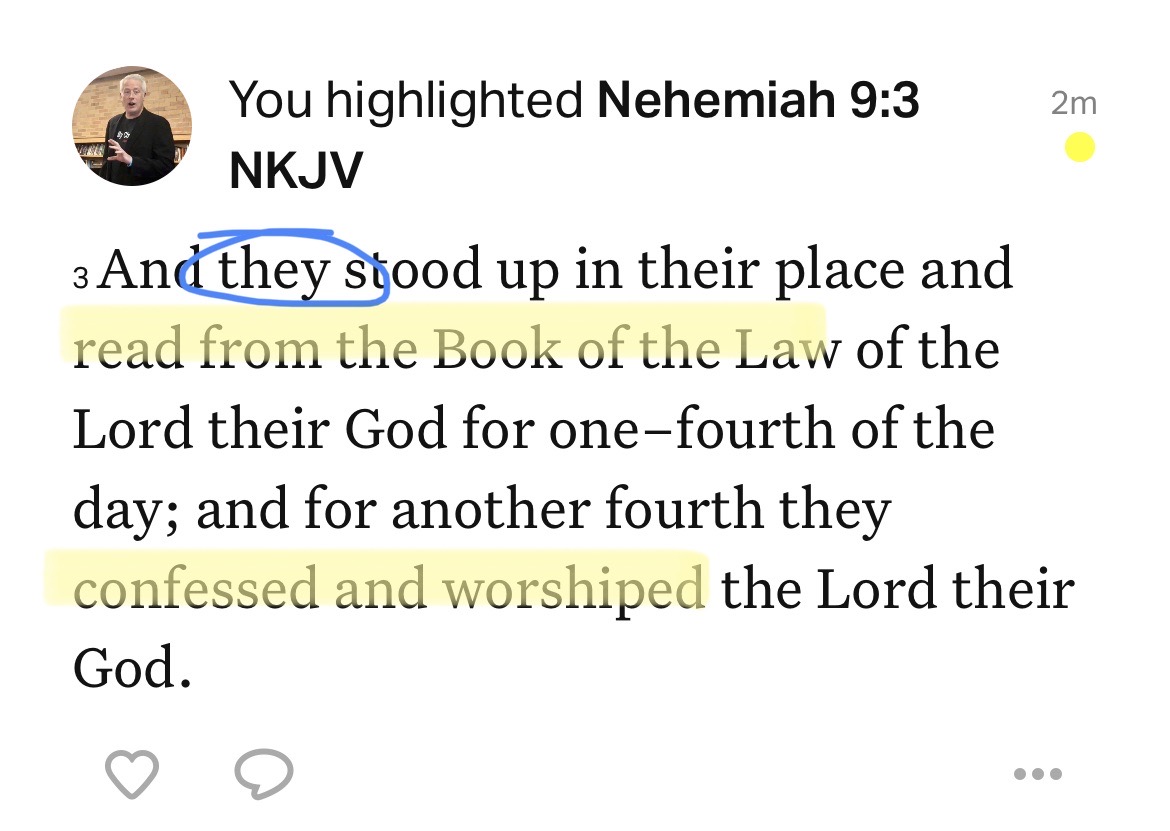
And they stood up in their place and read from the Book of the Law of the Lord their God for one-fourth of the day; and for another fourth they confessed and worshiped the Lord their God. (Nehemiah 9:3)
I have three takeaways from this verse—
(1) When we read God’s Word, the Holy Spirit illuminates it to us. Confession and worship should be normal responses to the Word and the Spirit.
Listen to the podcast of this post by clicking on the player below, and you can also subscribe on Apple, Spotify, or Audible.
The 12th Song of Ascent (Psalm 131) was written by David to remind us to rely on God’s help even more as we progress on the journey (or mature in our faith). In the 13th Song (Psalm 132), the psalmist says, “Remember David” and his passion for God’s people to experience God’s righteousness and joy. In order for us to know that, we have to remember Jesus.
Those who put this collection of Songs of Ascent together now include David’s fourth song (Psalm 133) in this collection which expresses his desire for unity among God’s people.
Can you imagine the pilgrims starting out from their individual villages? Maybe there’s not very many of them to begin with and traveling is pretty easy, but they do have to be vigilant against dangers on the road.
As they progress, they begin to join with pilgrims from other villages. Maybe these are from the same tribe, perhaps even distant relatives. The journey may go a bit slower now that there are more people to keep track of, and some complications of personality may start to arise. But the level of safety and assistance also increases.
Soon the group is getting larger as they now join with pilgrims from other tribes. These aren’t near relatives at this point, so there may be more complications, but there is even greater encouragement, safety, and potential.
Aha! Potential.
We’ve gone singing with a small ensemble to singing in a choir. And David is anticipating us singing in an even larger, majestic choir! There will undoubtedly be more problems, but there is also assuredly so much more potential, beauty, and strength in their combined worship.
My friend Dan Chastain has over 20 years of experience in the United States Army. He points out that the Army did the same things in his day as we read in the Old Testament.
The unity of a fighting force, Dan said, is a blessing. David was a professional soldier. Many people today join the military because of this professional, unity, and camaraderie. Maintaining this unity is the responsibility of everyone, because disunity leads to mistrust, chaos, and defeat.
David says this choir paints a picture—“it is like” (v. 2) and “it is as if” (v. 3). He is saying that God desires overflowing blessings on His people (v. 2), and that God desires saturating blessings on His people (v. 3). Why? Because God wants to give us more than enough for our needs so that there is plenty left for those who aren’t brothers and sisters yet. He longs for our choir to include people from every tribe, race, and nation.
Just as we said last week that a Christian’s joy is a testimony, a choir of Christians is an even more compelling testimony!
David calls this unity “good” which really means so much better than the alternative. And he calls this unity “pleasant.” The Hebrew word literally means singing a sweet sound!
The Hebrew word for “unity” here is also instructive. It means to be together in the same place—not just in spirit and desire—but in physical proximity. This is exactly the picture we see in the first Church (Acts 2:44, 46-47), as well as the picture of the choir from every nation, tribe, people, and language singing around God’s throne in Heaven (Revelation 7:9-10).
In order to navigate all of the differences of personality that could keep us from this unity, we have to work at. We need the attitude of Jesus (Philippians 2:1-5). This requires a daily transformation of our minds (Romans 12:1-3), and this transformed mind is what helps us move from a small ensemble to a majestic choir (Romans 12:4-5, 16-18).
Listen to the podcast of this post by clicking on the player below, and you can also subscribe on Apple, Spotify, or Audible.
Anti-anxiety medications are prescribed at a higher rate than any other medication. As a nation, we have become—literally—a nervous wreck!
I think much of our handwringing and stomach churning is from our obsession with keeping up with “current events.” We have alerts endlessly dinging, screaming at us, “Look at this! Can you believe he said that?! Did you hear about this? We must do something about that!”
Christian, where is your hope? In what are you trusting for relief?
God says through Isaiah that sinners are terrified and godless people tremble at the news—
Sinners in Zion are terrified; trembling has seized the godless. “Who among us can live with the consuming fire? Who among us can live with everlasting burning?” (Isaiah 33:14)
As these anxiety-plagued people are wondering how they can survive the latest deluge of terrible news, God answers the burning question of real security. He says it is…
…One who walks righteously and speaks with integrity, one who rejects unjust gain and shakes his hands so that they hold no bribe; one who stops his ears from hearing about bloodshed and shuts his eyes from looking at evil; he will dwell on the heights, his refuge will be the impregnable rock; his bread will be given him, his water will be sure. (Isaiah 33:15-16)
Did you catch what was in the middle of that list? Stop listening to the reports of bloodshed and stop watching all the news reports of evil people doing evil things.
Instead, God says that we should be watching our own lives closely so that we are:
walking righteously
speaking with integrity
not falling for the latest fads
not being “bribed” by so-called influencers to see things their way
When we are focused on God and on living our lives according to His righteous standards, we won’t have any time or mental energy to give to the evil and bloodshed in the headlines. Rather, we will live securely—protected and blessed by our loving Savior and Lord!
Isaiah 33 goes on to describe what we will notice when we turn off the world’s news and gaze at God: “Your eyes will see the King in His beauty” (v. 17), you will no longer be shaken by “fierce people” (v. 19), but you will know that “the majestic One, the Lord, will be for us…and will save us” (vv. 21-22).
Turn off the world’s news and dive into God’s Good News instead. You will immediately feel God’s peace replacing any fearful trembling in your heart and mind.
John Piper was asked to weigh-in on the value of repetitive phrases in worship songs. He said, “The issue’s not repetition per se but whether there is enough substance, enough rich content of truth about God woven into the repetitions to justify them, to warrant them. That’s the issue. There’s a difference between repetitions that are called forth by the repeated crescendo of new, glorious truth, and repetitions that serve as a kind of mantra without sufficient truth that is simply used to sustain or intensify a mood. Moods in worship should be awakened and sustained primarily by truth, assisted by music—not primarily by music with a little truth thrown in to justify the singing.”
Pastor John Piper used Psalm 136 as an example in the post above. T.M. Moore also shared this thought about Psalm 136: “The term most frequently used to describe this everywhere-present-and-always-at-work love of God is translated as ‘lovingkindness’ or, in some versions, ‘steadfast love.’ Especially Psalm 136, with its antiphonal arrangement of verses, insists that the cosmos is upheld, sustained, and pervaded by the lovingkindness of God. … It would improve our learning to pray without ceasing if we simply took some time out during the day to thank the Lord for the many ways His steadfast love surrounds, sustains, and swarms us at every moment!”
“When people refer to a man as a man of the Book, meaning the Bible, he’s generally found to be a man of multitudinous books, which simply isolates the one Book to its proper grandeur. The man who reads only the Bible does not as a rule know it or human life.” —Oswald Chambers
Men’s Health magazine shared an interview with Jeremy Renner, who was nearly killed in a tragic accident. I love his attitude about making today better than yesterday. His words remind me of a poem my grandma used to use to motivate me to keep “besting” what I had already done.
Christopher Ash writes about reading the Psalms through the lens of Jesus. He concludes this way: “I remember seeing on the wall of a church the words of Psalm 20:4: ‘May [the Lord] grant you your heart’s desire and fulfill all your plans!’ How wonderful, you might think. The Bible promises me all that my heart desires. Until you read the psalm and realize that Psalm 20 is a prayer for the king in David’s line. Ultimately, it is a prayer that Jesus will have His heart’s desire granted and that His plans will be fulfilled. And they will! The Psalms are not all about me. If I think they are, I will end up disillusioned. But when I grasp that they are all about Christ, my heart lifts in joy that He is the blessed Man and I belong to Him.”












 Craig T. Owens