Everyday Evidence

Last week we learned that speaking in tongues was one of the most noticeable and consistent characteristics of those who were baptized in the Holy Spirit. 

Speaking in tongues as the Spirit enables you is the unmistakable, objective, outward, initial physical evidence. The Bible makes clear that continuing to pray in tongues has huge benefits for both our personal prayer lives and for the corporate church body. But don’t stop there! 

The initial, outward evidence is primarily for the individual Christian—it’s a way of knowing that you know that you have indeed been baptized in the Spirit. But there also needs to be some everyday evidence for others that testifies to them that something is different about your life. 

Consider the disciples of Jesus before and after being baptized in the Holy Spirit…

Their vocabulary

Before being baptized in the Spirit they said stupid things because they didn’t know what to say (Mark 9:5-6) But after being baptized in the Spirit there was no more foot-in-mouth disease. Just as the Holy Spirit enabled them to praise God in an unlearned tongue, He also empowered their natural dialect. The same Greek word is used in Acts 2:4 (enabled by the Holy Spirit), 2:14 (Peter addressed the crowd), and 26:25 (what I am saying is true and reasonable). 

Their spiritual power

Before it was limited, and often thwarted, but afterward, it was limitless and effortless (Mark 9:17-18; Acts 3:1-8; 5:15; 6:8).

Their understanding of servanthood

Before they argued about who was the greatest. Afterward, they gladly gave all that they had to others (Mark 9:33-34; Acts 2:44-45). 

Their boldness in the face of adversity

Before they abandoned Jesus, ran away, and hid in locked rooms. Afterward, there was no intimidating or silencing them (Acts 4:8, 13, 18-20). 

Their understanding of Scripture

Before they had virtually no understanding of Scripture’s application. Afterward, they understood how to apply God’s Word in almost every situation (Acts 2:16, 33-35; 4:24-26). 

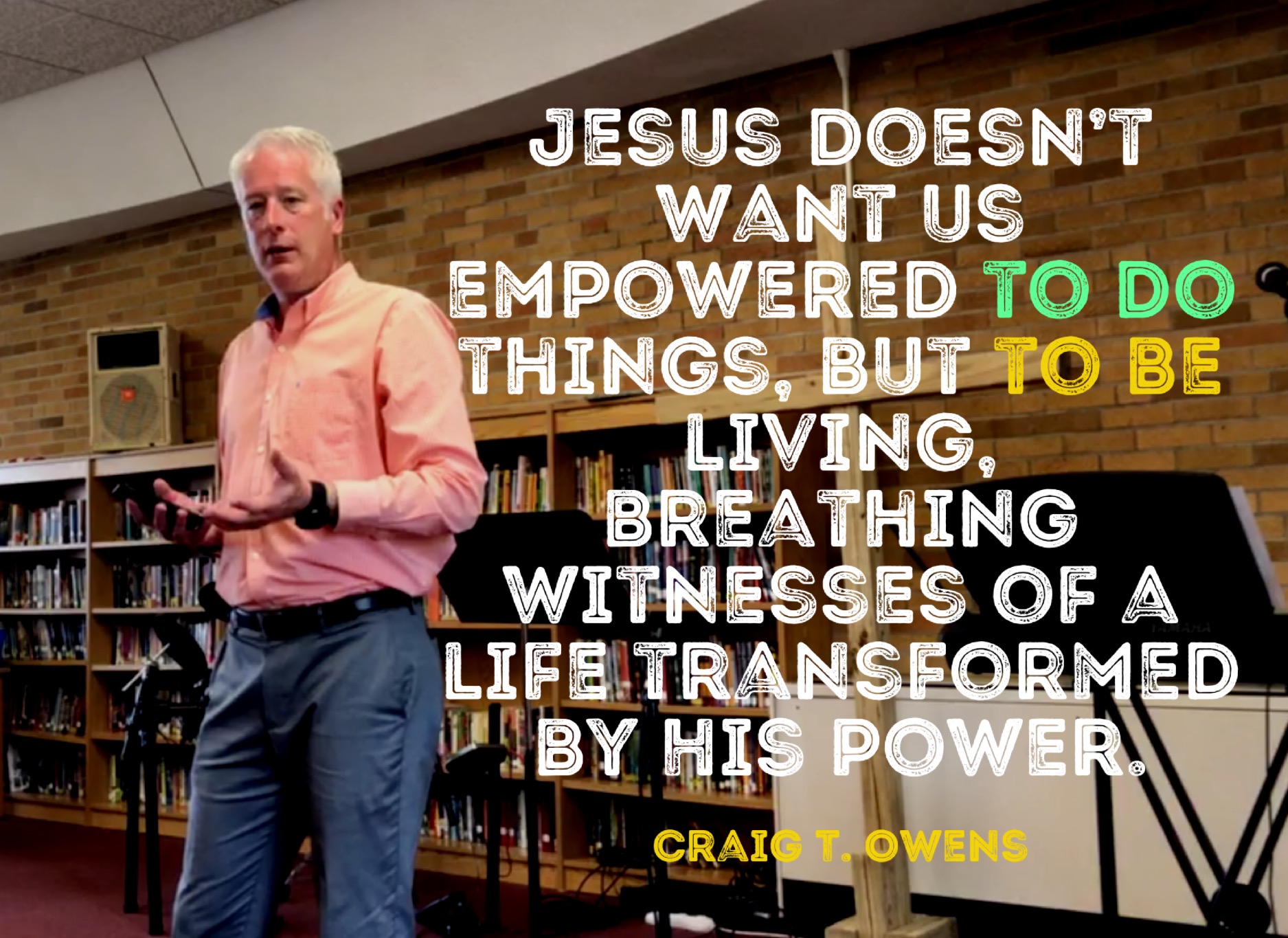
Jesus promised that the baptism in the Holy Spirit would empower us TO BE His witnesses (Acts 1:8). Not just to do things for Him. There’s nothing wrong about doing Jesus-glorifying things, but in themselves, they are too short-sighted. Jesus doesn’t want us empowered to do things, but TO BE a living, breathing, walking, talking witness of a life transformed by His power. That’s the reason why I say to you again and again: Don’t stop at salvation. Press on and press in to be baptized in the Holy Spirit so that you can BE an empowered, transformed and transforming witness for Jesus!

If you missed any of the messages in this series, you can access the full list of messages by clicking here

Thursdays With Spurgeon—Blessed Assurance

This is a weekly series with things I’m reading and pondering from Charles Spurgeon. You can read the original seed thought here, or type “Thursdays With Spurgeon” in the search box to read more entries.

Blessed Assurance

     The Holy Spirit, who enabled me to believe, gave me peace through believing. I felt as sure that I was forgiven as before I felt sure of condemnation. I had been certain of my condemnation because the Word of God declared it, and my conscience bore witness to it; but when the Lord Jesus justified me, the same witnesses made me equally certain. The Word of the Lord in the Scripture says, “He who believes in Him is not condemned” (John 3:18), and my conscience bore witness that I believed, and that God in pardoning me was just. Thus I had the witness of the Holy Spirit and also of my own conscience, and these two agreed in one. …  

     I find the apostle Paul speaking by the Holy Spirit and saying, “Having been justified by faith, we have peace with God” (Romans 5:1). If I know that my trust is fixed on Jesus only, and that I have faith in Him, were it not ten thousand times more absurd for me not to be at peace than for me to be filled with joy unspeakable? It is but taking God at His Word, when the soul knows as a necessary consequence of its faith that it is saved. …  

     Has Jesus saved me? I dare not speak with any hesitation here; I know He has. His word is true; therefore I am saved. My evidence that I am saved does not lie in the fact that I preach, or that I do this or that. All my hope lies in this, that Jesus Christ came to save sinners. I am a sinner, I trust Him, then He came to save me, and I am saved. I live habitually in the enjoyment of this blessed fact, and it is long since I have doubted the truth of it, for I have His own Word to sustain my faith.

From The Autobiography Of Charles Spurgeon

The joy that Spurgeon recounts in his conversion is the same joy that is available to all who call on Jesus in faith. As Spurgeon was prone to quoting passages of hymns in his sermons and books, these words of his remind me of a favorite hymn as well—

Blessed assurance, Jesus is mine;
Oh, what a foretaste of glory divine! 
Heir of salvation, purchase of God,
Born of His Spirit, washed in His blood. 
This is my story, this is my song,
Praising my Savior all the day long!

Thursdays With Spurgeon—Keep The Focus On The Savior

This is a weekly series with things I’m reading and pondering from Charles Spurgeon. You can read the original seed thought here, or type “Thursdays With Spurgeon” in the search box to read more entries.

Keep The Focus On The Savior

     I have heard men tell the story of their conversion, and of their spiritual life, in such a way that my heart has loathed them and their story, too, for they have told of their sins as if they did boast in the greatness of their crime, and they have mentioned the love of God, not with a tear of gratitude, not with the simple thanksgiving of the really humble heart, but as if they as much exalted themselves as they exalted God. Oh! When we tell the story of our own conversion, I would have it done with great sorrow, and with great joy and gratitude, remembering how little we deserve these things. … 

     My Master, I cannot understand how You stoop Your awful head to such a death as the death of the Cross, how You could take from Your brow the coronet of stars that from old eternity had shone resplendent there. But how You should permit the thorn-crown to gird Your temples astonishes me far more. That You should cast away the mantle of Your glory, the azure of Your everlasting empire, I cannot comprehend. But how You should have become veiled in the ignominious purple for a while and then be mocked by impious men who bowed to You as a pretended king; and how You should be stripped naked to Your shame, without a single covering, and die a felon’s death. This is still more incomprehensible. But the marvel is that You should have suffered all this for me! … 

     I, a lad, found the Lord of glory. I, a slave to sin, found the great Deliverer. I, the child of darkness, found the Light of Life. I, the uttermost of the lost, found my Savior and my God. I, widowed and desolate, found my Friend, my Beloved, my Husband. Oh, how I wondered that I should be pardoned! It was not the pardon that I wondered at so much; the wonder was that it should come to me. 

From The Autobiography Of Charles Spurgeon

How sad that many times the story of our salvation focuses more on how bad we were, and gives so little glory to how amazing our Savior’s rescue was. 

Just as the Apostle Paul called himself the chief of sinners, and stood in amazement that Christ’s love would reconcile him to God, so Spurgeon stood amazed that Jesus would stoop to die for “the uttermost of the lost.” 

It’s fine to tell people what used to be, but please make sure your story focuses more on how amazing it is that God’s love saved you from those sins. Amazing love! How can it be that You, my King, would die for me? 

Let’s keep the focus on the Savior! 

Your Incense…

…to God and the world.

Let’s follow this thread from the Old Testament into the New Testament—

“When Aaron trims the lamps at twilight, he shall burn incense. There shall be perpetual incense before the LORD throughout your generations.” (Exodus 30:8)

“Therefore I urge you, brethren, by the mercies of God, to present your bodies a living and holy sacrifice, acceptable to God, which is your spiritual service of worship.” (Romans 12:1)

“For we are a fragrance of Christ to God among those who are being saved and among those who are perishing.” (2 Corinthians 2:15)

“The incense which you shall make, you shall not make in the same proportions for yourselves; it shall be holy to you for the LORD.” (Exodus 30:37)

“Our lives are not to be about us, lived out in private and for self-glory. Our lives are to be about God, lived out in full view of the nations and for His name’s sake.” —Dick Brogden

What incense is your life—your witness, your testimony—sharing with those around you?

Thursdays With Oswald—Swine And Testimonies

Oswald ChambersThis is a weekly series with things I’m reading and pondering from Oswald Chambers. You can read the original seed thought here, or type “Thursdays With Oswald” in the search box to read more entries.

Swine And Testimonies

     Jesus Christ is inculcating the need to examine carefully what we present in the way of God’s truth to others [Matthew 7:6]. … 

     Over and over again men water down the Word of God to suit those who are not spiritual, and consequently the Word of God is trampled under the feet of “swine.” Ask yourself, “Am I in any way flinging God’s truth to unspiritual swine?” “Be careful,” Jesus says, “not to give God‘s holy things to ‘dogs.’” …  

     Our Lord never tells us to confess anything but Himself, ‘Whosoever…shall confess ME before men…’ (Matthew 10:32). Testimonies to the world on the subjective line are always wrong, they are for saints, for those who are spiritual and who understand; but our testimony to the world is our Lord Himself, confess Him, “He saved me, He sanctified me, He put me right with God.” … 

     If we are only true to a doctrine of Christianity instead of to Jesus Christ, we drive our ideas home with sledge-hammer blows, and the people who listen to us say, “Well, that may be true”; but they resent the way it is presented. When we follow Jesus Christ the domineering attitude and the dictatorial attitude go and concentration Jesus comes in. 

From Studies In The Sermon On The Mount

The apostle Paul also talked about wanting to make sure that Jesus was seen above all else. More harm than good is done when we talk about our personal experiences with God, which have now become our personal doctrines about God. 

Let God be as unique with others as He is with you. Don’t make other people fall in line with what you believe. Just point them to Jesus. As Chambers says, our testimony should be nothing but “He saved me, He sanctified me, He put me right with God.” Anything else, and we run the risk of casting pearl before swine. 

13 Quotes On The Gospel Of Luke

J.C. Ryle has given us a wonderful commentary on the Gospels in his Expository Thoughts On The Gospels. Check out my full book review here, and then enjoy a few quotes from Ryle’s insights on the Gospel of Luke.

“Lay firm hold on Bible promises. It is of the deepest importance to our peace to do so. Promises are, in fact, the manna that we should daily eat and the water that we should daily drink as we travel through the wilderness of this world.” 

“Christ’s loving kindness to His people never changes and never fails. It is a deep well of which no one ever found the bottom.” 

“There is not enough of a missionary spirit among Christians. It should not satisfy us to be safe ourselves. We ought also to try to do good to others. All cannot go to the heathen, but every believer should strive to be a missionary to his fellow man.” 

“No man shall ever be a loser in the long run by deeds of self-denying charity and patient love. At times he may seem to get nothing by his conduct. He may appear to reap nothing but ridicule, contempt, and injury. His kindness may sometimes tempt men to impose on him. His patience and forbearance may be abused. But at the last he will always be found a gainer.” 

“Have we the word of Christ’s promises? Then let us rest on it and fear nothing. Let us not doubt that every word that Christ has spoken shall be made good. The word of Christ is a sure foundation. He that leans upon it shall never be confounded.” 

“How much we ought to hate sin! Instead of loving it, cleaving to it, dallying with it, excusing it, playing with it, we ought to hate it with a deadly hatred. Sin is the great murderer, and thief, and pestilence, and nuisance of this world. Let us make no peace with it. Let us wage a ceaseless warfare against it.” 

“We must give up the vain idea of trying to please everybody. The thing is impossible and the attempt is mere waste of time. We must be content to walk in Christ’s steps and let the world say what it likes. Do what we will we shall never satisfy it or silence its ill-natured remarks. It first found fault with John the Baptist and then with his blessed Master. And it will go on caviling and finding fault with that Master’s disciples so long as one of them is left up on earth.” 

“Occasional retirement, self-inquiry, meditation, and secret communion with God are absolutely essential to spiritual health. The man who neglects them is in great danger of a fall. To be always preaching, teaching, speaking, writing, and working public works is, unquestionably, a sign of zeal. But it is not always a sign of zeal according to knowledge. It often leads to untoward consequences. We must make time occasionally for sitting down and calmly looking within, and examining how matters stand between our own selves and Christ. The omission of the practice is the true account of many a backsliding which shocks the church and gives occasion to the world to blaspheme.” 

“Let us beware of allowing traditions, old preconceived notions, unsound interpretations, or baseless theories in religion to find a root in our hearts. There is but one test of truth: ‘What says the Scripture?’” 

“The kindness of a Christian towards others should not be in word and in tongue only, but in deed and in truth. His love should be a practical love, a love which entails on him self-sacrifice and self-denial, both in money, and time and trouble. His charity should be seen not merely in his talking but his acting—not merely in his profession but in his practice. He should think it no misspent time to work as hard in doing good to those who need help as others work in trying to get money. … Such brotherly love the world may not understand. The returns of gratitude which such love meets with may be few and small. But to show such brotherly love is to walk in the steps of Christ. … What are we doing to help those who are troubled in mind, body, or estate? There are many such in this world. There are always some near our own door. What are we doing for them? Anything, or nothing at all? May God help us to answer these questions! The world would be a happier world if there was more practical Christianity.” 

“Never let us forget that to be content with sitting in the congregation and hearing sermons, while we bear no fruit in our lives, is conduct which is most offensive to God.” 

“Let us endeavor to live daily in the sight of a holy God. So living, it will matter little how much we are ‘watched’ by an ill-natured and malicious world. Let us exercise ourselves to have a conscience void of offense toward God and man, and to do nothing which can give occasion to the Lord’s enemies to blaspheme.” 

“An idea appears to prevail in some men’s minds that true religion may be separated from common honesty, and that soundness about matters of doctrine may cover over swindling and cheating in matters of practice! Against this wretched idea our Lord’s words were a plain protest. Against this idea let us watch and be on our guard.” 

You can read Ryle’s quote on The Gospel of Matthew here, and on the Gospel of Mark here. 

Come And See What Our God Has Done

Check out the opening verses of Psalm 66—

Shout joyful praises to God, all the earth!
Sing about the glory of His name!
Tell the world how glorious He is.
Say to God, “How awesome are Your deeds!
    Your enemies cringe before Your mighty power.
    Everything on earth will worship You;
    they will sing Your praises,
    shouting Your name in glorious songs.” Interlude 
Come and see what our God has done,
    what awesome miracles He performs for people! (66:1-5 NLT)

I’d like to explore with you this phrase—come and see what our God has done. 

In so many of the Psalms we get at least a little context. We might be told the type of song it is or the kinds of musical instruments to be sung. We might know who wrote the psalm or at least why he wrote it. We might even hear what was happening in the psalmist’s world at the time he wrote the song or maybe at what event he wanted the song to be sung. All of these things would give us context clues into when/where to use the song—when I’m afraid? when I’m under attack? when I’m happy? when I’m depressed? 

For this psalm all the context we know is—For the choir director: A song. A psalm. 

But let me ask you: does it really matter? If you’re up or down, flush with cash or barely hanging on, winning the fight or feeling like you’re being beaten down—in any circumstance, can you still say come and see what our God has done? 

I think the answer is yes. I think this is the reason why no context is given us, because this psalm is appropriate regardless of the circumstances.

Just as the apostle Paul wrote, “I know how to live on almost nothing or with everything. I have learned the secret of living in every situation, whether it is with a full stomach or empty, with plenty or little. For I can do everything through Christ, who gives me strength” (Philippians 4:12-13).

As Christians, we’ve been called to step alongside people in their messy, broken lives. Yes, we are to weep with those who weep, but we’re not to keep them there but to take them to the One who can heal their messy, broken lives. 

The reasons to say, “Come and see what our God has done” are all around us. 

Earth’s crammed with heaven, 
And every common bush afire with God; 
But only he who sees, takes off his shoes, 
The rest sit round it and pluck blackberries, 
And daub their natural faces unaware. —Elizabeth Barrett Browning

Don’t just pluck blackberries; realize that those berries are the produce of a loving Creator. Don’t miss the opportunities to give God glory. Good times are wonderful opportunities to start. But those are just the starting points. Find the reasons even in hard times—I have learned the secret of being content in any and every situation, whether well fed or hungry, whether living in plenty or in want.

Anywhere … everywhere … no matter the context … HE IS STILL GOD. He is still worthy to be praised. There is still ample reason for us to say, “Come and see what our God has done!” 

People Are Watching 👀

 “…they watched Him closely… (Luke 14:1). 

The skeptics were always watching Jesus. As with our Master, so with us.

They wanted to find an inconsistency with which they could discount all that Jesus stood for. Thankfully, they found none! May the same be said of you and me.

May our lives and speech (or silence) never cause skeptics to discount the Gospel or—even worse—blaspheme God, nor may our lives cause a weak Christian to doubt or stumble.

This requires from us—

  • Self-awareness … I have to know my tendencies and avoid those things that cause offense.
  • Boldness … to speak the truth in love.
  • Knowledge of the Scripture … and its correct application.
  • God-confidence … so that we’re not intimidated by man’s disapproval.
  • Humility … to not seek things for our own benefit.
  • Charity … as we demonstrate our faith in loving action.
  • Focus … on eternity and on the greater treasure in Heaven.

Holy Spirit, empower us to live like our Master every day. “Adam’s likeness now efface, stamp Thine image in its place.” May people see and hear Jesus in us. No matter how closely they watch us, may they see no inconsistencies.

Poetry Saturday—Exhortation To Prayer

William CowperWhat various hindrances we meet
In coming to a mercy-seat!
Yet who that knows the worth of prayer,
But wishes to be often there?

Prayer makes the darken’d cloud withdraw,
Prayer climbs the ladder Jacob saw,
Gives exercise to faith and love,
Brings every blessing from above.

Restraining prayer, we cease to fight,
Prayer makes the Christian’s armor bright;
And satan trembles when he sees
The weakest saint upon his knees.

While Moses stood with arms spread wide,
Success was found on Israel’s side;
But when through weariness they fail’d,
That moment Amalek prevail’d.

Have you no words? Ah! think again,
Words flow apace when you complain,
And fill your fellow-creature’s ear
With the sad tale of all your care.

Were half the breath thus vainly spent
To Heaven in supplication sent,
Your cheerful song would oftener be,
“Hear what the Lord has done for me.” —William Cowper


Thursdays With Oswald—Getting The Order Right

Oswald ChambersThis is a weekly series with things I’m reading and pondering from Oswald Chambers. You can read the original seed thought here, or type “Thursdays With Oswald” in the search box to read more entries.

Getting The Order Right

     Beware of walking in the spiritual life according to your natural affinities. We all have natural affinities—some people we like and others we do not; some people we get on well with and others we do not. Never let those likes and dislikes be the rule of your Christian life. “If we walk in the light, as He is in the light, we have fellowship one with another” [1 John 1:7], i.e., God gives us fellowship with people for whom we have no natural affinity. …  

     Our example is not a good man, not even a Christian man, but God Himself. We do not allow the big surprise of this to lay hold of us sufficiently. Jesus nowhere says, “Follow your Father which is in heaven—that you may be good men? that you may be lovable to all men?” No, “that you may be the children of your Father which is in heaven” [Matthew 5:44-45], and that implies a strong family likeness to Jesus Christ. …  

     It takes a long time to get the full force of our Lord’s statements. “I say unto you, love your enemies”—an easy thing to do when you have no enemies; an impossible thing when you have. “Bless them that curse you”—easy when no one is cursing you, but impossible when someone is. “Do good to them that hate you, and pray for them that despitefully use you.” It seems easy to do all this when we have no enemies, when no one is cursing or persecuting us; but if we have an enemy who slanders and annoys and systematically vexes us, and we read Jesus Christ’s statement “I say to you, Love your enemies”—how are we going to do it? Unless Jesus Christ can remake us within, His teaching is the biggest mockery human ears ever listened to. …

     “I say unto you, love your enemies.” Jesus does not say, “Love every one.” The Bible never speaks vaguely, it always speaks definitely. People speak about loving “mankind,” and loving “the heathen”; Jesus says, “Love your enemies.” Our Lord does not say, “Bless your enemies,” He says, “Love your enemies.” He does not say, “Love them that curse you”; He says, “Bless them that curse you.” “Do good to them that hate you”—not bless them. He does not say, “Do good to them that despitefully use you”; He says, “Pray for them that despitefully use you.” Each one of these commands is stamped with sheer impossibility to the natural man. If we reverse the order Jesus has given it can be done with strain, but in His order I defy any man on earth to be able to do it unless he has been regenerated by God the Holy Ghost. When a man does love his enemies, he knows that God has done a tremendous work in him, and everyone else knows it too. 

From Studies In The Sermon On The Mount

It’s impossible to do what Jesus commands if we’re trying to do it solely in our own strength. But when we allow the Holy Spirit to remake us from within, we can do what Jesus says:

  • If someone is your enemy—love them.
  • If someone persecutes you—pray for them. 
  • If someone curses you—bless them.
  • If someone hates you—do good to them. 

When we operate this way, we know that God has made this possible in us—and everyone else knows it too!