How Will You Respond To Jesus?

Although most nativity scenes show the wise men visiting Jesus alongside the shepherds the night He was born, in reality the Magi showed up much later. 

They came first to Israel’s capital city—Jerusalem—and went to the man who currently bore the title King of the Jews—Herod—with an odd question, “Where is He who has been born King of the Jews? We’ve come to worship Him.”

The call to come to worship the Christ has always stirred different responses in people’s hearts. But I have noticed that the responses today aren’t any different than they were over 2000 years ago at Christ’s first Advent. 

Notice these four responses in the Gospel of Matthew:

  1. King Herodwhen King Herod heard this he was disturbed.

The word disturbed means an inward commotion, someone robbed of any calmness; someone who has become restless and agitated. 

King Herod wasn’t all that different from a lot of people today who have their personal lives organized according to their own plans. They have everything figured out. They are masters of their own fate. They know how everything is supposed to work. They are god of their own world. 

But inside it’s a different story. They may not acknowledge it to anyone else, but they are uneasy. King Herod was political, not religious. He knew how to play the games with the right Jewish leaders and Roman politicians to get and keep his throne. So when he hears, “Where is He who is born KING OF THE JEWS?” you can understand why he instantly becomes so agitated! He feels like his well-ordered world and best-laid plans are about to crash in on him! 

  1. All JerusalemKing Herod…was disturbed, and all Jerusalem with him. 

The people of Jerusalem had a love-hate relationship with King Herod. If you were on his side, he could be quite generous with his gifts and favorable with his influence. But if you were against him, he could be incredibly cruel (just take a look at verse 16!). 

So when Herod got upset, you can imagine why the citizens of Jerusalem were as well. They all longed for the Messiah—the Christ—to come and set them free, but in the meantime they were trying to keep their options open. They wanted the Messiah, if they could have Him, but they didn’t want to abandon Herod yet, just in case the Messiah couldn’t follow through.  

  1. Religious leadersHerod…called together all the people’s chief priests and teachers of the law. 

Of all the people looking for the Christ, you would think the chief priests and teachers of the law would be the most excited! When Herod asked them for the birthplace of the Messiah, they immediately knew the answer, but after they delivered this information to King Herod they aren’t mentioned again in this narrative. Bethlehem was only 6 miles away, but they didn’t do a single thing! The Messiah being born in such a lowly manner didn’t fit the image they had concocted in their minds. Later on, Jesus would challenge them on this (see John 5:38-40). 

  1. MagiMagi from the east came to Jerusalem. 

Whereas the Jewish religious leaders were only 6 miles away, the Magi that came from the east might have been anywhere from 400-800 miles away. They left the comforts of their home to travel perhaps as long as 4 months. But, Oh! the journey was so worth the effort! They got to see the Christ with their very own eyes! We read that they were overjoyed, and that they bowed down and worshiped Him and opened their treasures. 

What’s your idea about Jesus? 

  • King Herod wanted a Savior that would enable him to continue to run his own life, but he didn’t want a King that would call the shots. 
  • The people of Jerusalem wanted access to God’s power, but they didn’t want to give their full allegiance to Jesus. 
  • The religious leaders wanted Jesus to fit their mold, but they didn’t want to have to change anything about their own lives. 
  • Only the Magi accepted Jesus as both Savior and King, willingly laying everything at His feet. 

What about you? What’s your idea about Jesus? He isn’t just a Baby in a manger; He’s also King and Judge and Ruler and Lord. When you hear the call to come worship Him, what will your response be? 

Year-End Review (2019 edition)

Ten years ago God called me to pastor at Calvary Assembly of God, and we have so thoroughly enjoyed our time in Cedar Springs! One of the really cool things I get to do is teach an amazing group of people every Sunday. Here’s a recap of the series and messages from 2019.

Boldly Praying—As a general rule, God would like us to pray much more boldly than we typically do. Jesus told us that we could pray mountain-moving prayers, but C.S. Lewis rightly observed, “If we consider the unblushing promises of reward and the staggering nature of the rewards promised in the Gospels, it would seem that our Lord finds our desires, not too strong, but too weak.” 

Christ’s Passionate Journey—In action movies, the crucial moment usually is filmed in slow motion. The Gospels do the same as Jesus approaches the Cross. For example, Mark doesn’t mention anything about the birth of Jesus and only gives us one verse to tell about satan’s temptation of Jesus in the wilderness. But he uses nearly 40% of his writing to describe the last week of Christ’s life. 

We Are: Pentecostal—Pentecost for over 1000 years was a celebration in Jerusalem that brought in Jews from all over the world. But on the Day of Pentecost that came just ten days after Jesus ascended back into heaven, the meaning of Pentecost was forever changed! 

Is That In The Bible?—Sometimes things that sound “biblical” aren’t actually in the Bible at all, and sometimes they are there but are misquoted. 

Selah—When you see this word in the Bible it can mean either a pause from the noise to reflect on something, a preparation for an exciting accent, or a reflective time of consideration. We are working our way through the Selahs in the Psalms.

Major Lessons From Minor Prophets—The five major prophets consist of 182 chapters, whereas the 12 minor prophets only have 67 chapters. The volume of these prophets writing may be minor, but their content carries major messages of meteoric power!  

Fading Gratitude—Looking back at the history of God’s people in the Bible, there is a distinct up-and-down cycle. I believe their slipping away from God can be directly linked to their forgetfulness. If there is a peril in our forgetfulness, there is also a power in our thankfulness!

The Carols Of Christmas—How many “old familiar carols” have you heard Christmas after Christmas until the words have almost lost their meaning? If we’re not careful, any song repeated too often can lose the richness of its original intent. 

We will be returning to a couple of these series in 2020, and we’ll be launching some brand new ones as well. In either case, if you don’t have a home church in the northern Kent County area, I would love to have you join us! 

Thursdays With Spurgeon—God Sovereignly Gives Gifts

This is a weekly series with things I’m reading and pondering from Charles Spurgeon. You can read the original seed thought here, or type “Thursdays With Spurgeon” in the search box to read more entries.

God Sovereignly Gives Gifts

…Am I not permitted to do what I choose with what is mine? (Matthew 20:15) 

     There is no attribute of God more comforting to His children than the doctrine of divine sovereignty. Under the most adverse circumstances, in the most severe troubles, they believe that sovereignty has ordained their afflictions, and that sovereignty overrules them and that sovereignty will sanctify them all. … 

     On the other hand, there is no doctrine more hated by worldlings, no truth of which they have made such a football, as the great, stupendous, but yet most certain doctrine of the sovereignty of the infinite Jehovah. Men will allow God to be everywhere except on His throne. … When God ascends His throne, His creatures then gnash their teeth. And when we proclaim an enthroned God and His right to do as He wills with His own, to dispose of His creatures as He thinks well, without consulting them in the matter, then it is that we are hissed and execrated. … 

     O you who are gifted with a noble frame, a comely body—boast not yourself therein, for your gifts come from God. Oh, glory not, for if you glory you become uncomely in a moment. The flowers boast not of their beauty, nor do the birds sing of their plumage. Be not vain, you daughters of beauty. Be not exalted, you sons of comeliness. And, all you men of might and intellect, remember that a sovereign Lord bestows all you have. … 

     Therefore I say do not exalt yourself above measure, but use what God has given you, for it is a royal gift and you should not lay it aside. But if the sovereign Lord has given you one talent and no more, lay it not up in a napkin, but use it well. … Bless God that you have more than others and thank Him also that He has given you less than others, for you have less to carry on your shoulders. And the lighter your burden, the less cause you will have to groan as you travel on toward the better land. Bless God, then, if you possess less than your fellows, and see His goodness in withholding as well as in giving.

From Divine Sovereignty

God does all that He does on purpose. Just because you or I cannot perceive His purpose doesn’t mean that there is no purpose. There is! 

God is sovereign. We can fight against this, or we can see it as the amazing comfort that God intends for it to be. Since God is sovereign, I can rest assured that I am where He needs me to be, equipped with all He has given me to bring Him glory in that place!


What Does “Gloria In Excelsis Deo” Mean Today?

Listen to the podcast of this post by clicking on the player below, and you can also subscribe on AppleSpotify, or Audible.

A “mondegreen” is a misunderstood word or phrase usually because it’s in a song lyric that is misunderstood. In Christmas carols, many mondegreens come from the fact that the Old English lyrics are sometimes up to 200 years old and simply aren’t the way Americans talk today. One of my favorite mondegreens comes from I Heard The Bells On Christmas Day where people say “the bell freeze up all Christians dumb” instead of “the belfries of all Christendom”! 

If this happens to 200-year-old songs written in English, can you imagine what happens to a song that is 1700 years old and was originally written in Latin?! I’m talking about the chorus from Angels We Have Heard On High which simply says, “Gloria in excelsis Deo.” 

That Latin phrase means Glory to God in the highest! The idea is that our praise of God is both excellent and increasing in its level of adoration. The Latin phrase is shorthand for a doxology that is traced back to 300 AD.

The angels aren’t the subject of this carol, but the focal point is to Whom their song is being raised—“Come to Bethlehem and see Him Whose birth the angels sing; come adore on bended knee Christ the Lord, the newborn King.

The idea of gloria in excelsis is to keep making our praise bigger and more magnificent. We are to MAGNIFY what God has done for us through the advent of Jesus.  

In Hebrew, the word gadal is usually translated as “magnify” or “glorify” in English, and it means something that is growing and becoming more powerful. David uses gadal as he not only praises God from deep within his soul but encourages others to join in his song (Psalm 34:1-3). 

In Greek, the word megalynō is also translated “magnify,” and means to make something great, make it obvious, declare it to be great, celebrate it. Mary’s song called The Magnificat begins with this word (Luke 1:46).

I cannot make God great because He is already THE GREATEST! 
I cannot make God powerful because He is already OMNIPOTENT!
But I can make His greatness and His power more obvious by celebrating Him!

Just like a magnifying glass doesn’t make an object bigger, it just helps us see it better. So, too, our praise and adoration don’t make God bigger, it just helps others see Him better.  

So I have a question to ask you—which I’ve already been asking myself:

How will you give gloria in excelsis Deo this Christmas season and beyond?

►► Would you please prayerfully consider supporting this ministry? ◀︎◀︎

If you’ve missed any of the message in this series, you can check them out by clicking here.

10 Quotes From “The Sermons Of Charles Spurgeon”

I share lengthy passages from Charles Spurgeon’s sermons in my weekly Thursdays With Spurgeon feature, along with my short commentaries. But here are some individual quotes from the prince of preachers who were just too good to not share! 

“Would you lose your sorrows? Would you drown your cares? Then go to plunge yourself in the Godhead’s deepest sea—be lost in His immensity. And you will come forth as from a couch of rest, refreshed and invigorated.” 

“Blessed be His dear name, He is unchanged in His love. When He first wrote the covenant, how full His heart was with affection to His people. He knew that His Son must die to ratify the articles of that agreement. He knew right well that He must rend His Best Beloved from His heart and send Him down to earth to bleed and die. He did not hesitate to sign that mighty covenant. Nor did He shun its fulfillment. He loves as much now as He did then. And when suns will cease to shine and moons to show their feeble light, He still will love on forever and forever.” 

“We sweat, we toil, and we fail. How often do we come back weeping because we have toiled, as we think, without success! Yet, Christian man, you have not been without success, for ‘He is still in one mind.’ All this was necessary to the fulfillment of His one purpose. You are not lost; your labor has not rotted under the clod. All, though you see it not, has been working together toward the desired end.” 

“Creation is an arrow from the bow of God, and that arrow goes on, straight on, without deviation to the center of the target that God ordained that it should strike.” 

“Though in the dark hours you and I may slip and often fall, yet His loving-kindness changes not. Your strong arm, O God, will bear us on. Your loving heart will never fail. You will not turn your love away from us or make it cease to pour upon us Your fierce anger, but having begun You will complete the triumphs of Your grace.” 

“God calls upon us, until the world is utterly destroyed with fire, to go on saving men with all our might and main. Every year that passes is meant to be a year of salvation. We rightly call each year the year of our Lord. Let us make it so by more earnest efforts for the bringing of sinners to the Cross of Christ.” 

“The very fact that you are made to groan and cry by reason of God’s long-suffering to guilty men gives you sympathy with Christ and union with Christ, who endured such contradiction of sinners against Himself! … But when, through the long-suffering of God with the ungodly, you are made to suffer, account it to be a mark of your salvation. ‘Rejoice and be exceedingly glad, for great is your reward in heaven, for so they persecuted the prophets who were before you’ (Matthew 5:12).” 

“Blessed be God, the effect of Christ’s medicine does not depend upon the degree to which we can realize how it acts, but if we receive it by faith, if it penetrates into the heart, if it takes possession of the affections, it will work in us that wondrous change by which we will be delivered from the love of sin and saved both from its condemnation and its power! Thank God for a simple gospel!” 

“Although our Lord Jesus Christ is more perfect than any other example—indeed, the only perfect example—yet it is easier to imitate Christ than it is to imitate some of the best of His people.” 

“Because the pill is gilded, you suck down the poison. Because the thing is popular, you patronize it, though it is lustful, it is abominable, it is deceitful!” 

More quotes coming soon, so stay tuned! 

Why Should Christians Sing?

Some things are fascinating by what isn’t said. For instance, in the Christmas carol It Came Upon A Midnight Clear there is something conspicuously missing. 

One thing that isn’t missing is singing. Every one of the stanzas ends with a phrase about the angels singing. But can you spot what IS missing? I didn’t see it at first until I read this quote from respected music professor Dr. C. Michael Hawn: “This may be the only commonly sung Christmas carol in our hymnals that does not mention the birth of Christ! 

This carol just sort of assumes that we know why the angels are singing. But do we know? 

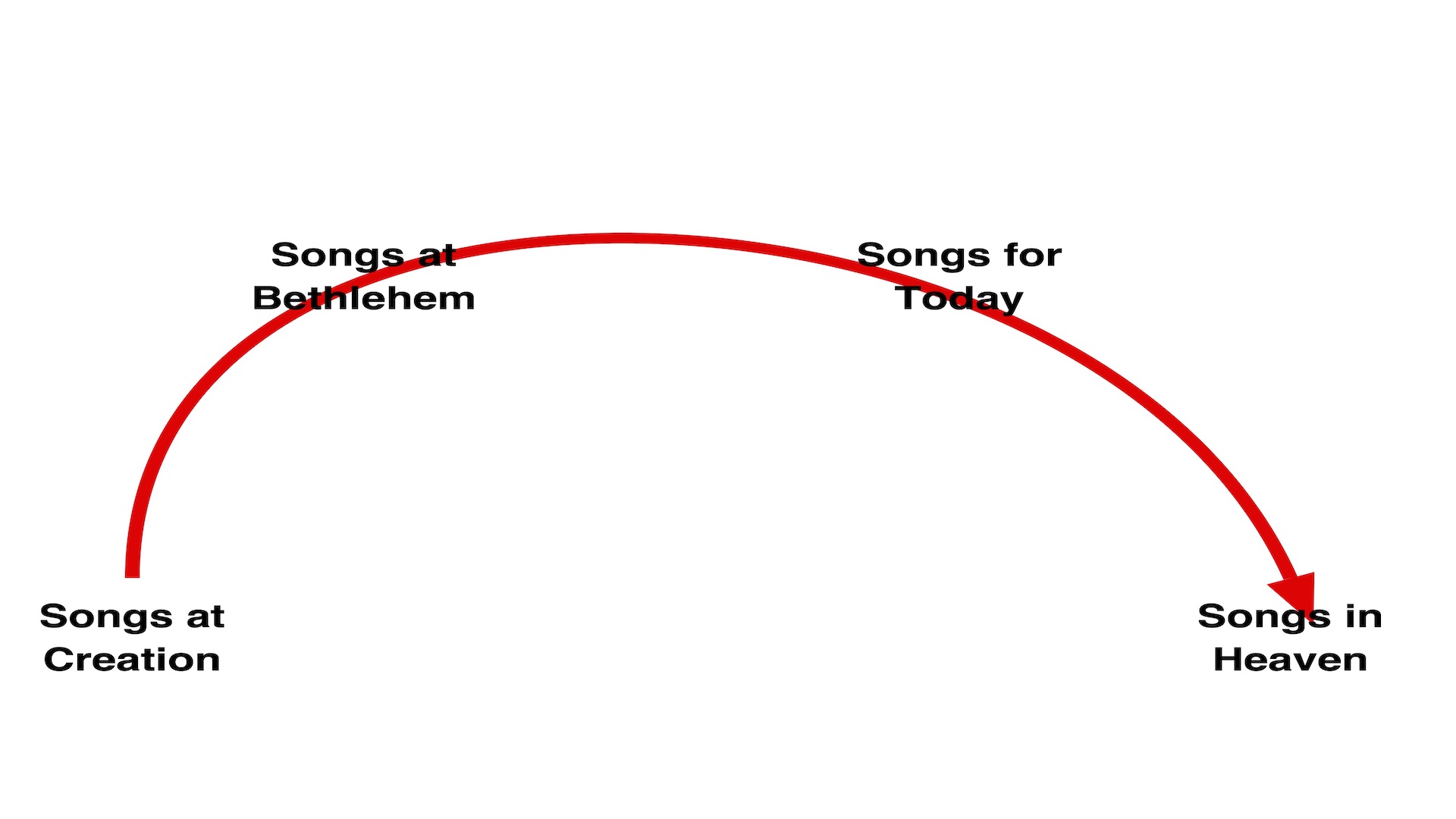
The Bible tells us that the angels were singing at Creation and that they are still singing in Heaven for all of eternity (Job 38:4-7; Revelation 5:9-13; 7:9-12; 15:2-4). Then we have this glimpse of the angels singing when Jesus was incarnated as a human baby in Bethlehem (Luke 2:14). Where did they get their song and their inspiration to sing it?

Their song comes from the Choir Leader who is the King of kings. Jesus is singing in Heaven, before the throne of His Father, about the salvation that He brought to mankind through His incarnation, sinless life, death on Calvary, and resurrection from the grave (see Hebrews 2:9-12). 

The song that Jesus sings tells the story of how He came to earth just like us—made a little lower than the angels—so that He might taste sin and death and conquer them for us. Now as our victorious Savior, He is not ashamed to call those who put their faith in Him His brothers and sisters.

Now perhaps you see why angels are also singing all the time! 

Even today there is a lot of singing around the Christmas season, but there is something missing in most of the songs: a focus on what Christmas really means. The world’s songs are about trees, and gifts, and Santa, and falling in love, but it’s a song that is out of tune with the angelic song. 

As Christians, we have a choice we can look around at this out-of-tune singing and lament what’s happening in our world, we can join in these meaningless songs, or we can look up at our Savior and sing the song He is singing. 

Christian, will you join with the angelic choir to let the world hear the unmistakable love song that Jesus is still singing today? 

If you’ve missed any of the message in this series, you can check them out by clicking here.

Humbug?!

In Longfellow’s classic I Heard The Bells On Christmas Day every stanza ends with the phrase “peace on earth, goodwill to men.” Unless you’ve been living someplace that doesn’t get the daily news, you might be saying, “Peace on earth? Really? I just don’t see it….” Or as Ebenezer Scrooge might say, “Peace on earth? Bah! Humbug!” 

A humbug is an imposter, or something empty of meaning. 

The third stanza of I Heard The Bells seems almost to slide into that Christmas humbug note: “And in despair I bowed my head: ‘There is no peace on earth,’ I said. ‘For hate is strong and mocks the song of peace on earth, goodwill to men.’” 

Indeed, even for those who call themselves a Christian, Christmas could become a humbug if…

  • … it’s all about busyness or just trying to “survive the holidays” 
  • … we get more excited about Santa Claus coming down the chimney to fill stockings than we do about Jesus coming down to Earth to be born in a manger 
  • … our main focus is on gifts—both what you’re giving and what you’re getting—and then we regret putting ourselves into debt 

Between Malachi (the last book of the Old Testament) and Matthew (the first book of the New Testament) is a time span of about 400 years that is called “the dark period.” God had promised through Jeremiah that He would restore the Israelites and rebuild Jerusalem. There were promises of the Messiah coming to set things right, but after 400 years of darkness, the mindset of most Israelites was probably, “Messiah? Peace? Bah! Humbug!!” 

What God really promised through Jeremiah was a peace that came about as a result of two things: (1) forgiveness of sins and (2) restoration of a perfect relationship with God. The Hebrew word for “peace” is shalom, which means one’s personal sense of wholeness and well-being, free from anxiety and fear, knowing that all is well between my soul and God. 

This is what God promises—I will cleanse them from ALL the sin they have committed against Me and will forgive ALL their sins of rebellion against Me (Jeremiah 33:8). 

This shalom is what comes through the First Advent of Jesus! As Longfellow observed, “Then pealed the bells more loud and deep: God is not dead nor doth He sleep; the wrong shall fail, the right prevail, with peace on earth, goodwill to men.” 

And this is what Jesus brought—

  • She will give birth to a Son, and you are to give Him the name Jesus, because He will save His people from their sins (Matthew 1:21 NIV). 
  • Now you have been united with Christ Jesus. Once you were far away from God, but now you have been brought near to Him through the blood of Christ. For Christ Himself has brought peace to us… (Ephesians 2:13-14 NLT) 
  • Therefore, since we are justified (acquitted, declared righteous, and given a right standing with God) through faith, let us grasp the fact that we have…peace with God through our Lord Jesus Christ (the Messiah, the Anointed One) (Romans 5:1 AMP). 

The bells and carols and remembrances of Christ’s First Advent should send our hearts soaring in anticipation of Christ’s Second Advent—when Christ shall return to take all of His own to be with Him forever, where He will wipe away every tear and where we live forever with Him in the New Jerusalem (see Jeremiah 33:9; John 14:3; Revelation 21:1-4). 

Let us guard against Christmas ever becoming a humbug—an imposter, something empty of meaning—but let’s make sure the rich meaning of Christ’s peace dwells richly in us! 

If you’ve missed any of the message in this series, you can check them out by clicking here.  

A Radical Change In Perspective

My friend Josh Schram shared a great message yesterday, wrapping up our series called Fading Gratitude. 

Josh was transparent about some of the struggles he overcame during his younger years, explaining how his decision to be grateful even for those roadblocks completely changed his perspective.

When we’re not intentional, our gratitude naturally begins to fade. It’s not that we’re intentionally ungrateful, but we just merely forget to be thankful. 

Our fading gratitude creates a domino effect. When gratitude fades we live with… 

Anxiety can keep us from even trying to pursue what God has planned for our lives. 

When a large group of people needed to be fed, a couple of Jesus’ disciples forgot about the miracles Jesus had already done in the past, and as a result, they became anxious about what to do next. 

Philip replied, “Even if we worked for months, we wouldn’t have enough money to feed them!” Then Andrew, Simon Peter’s brother, spoke up. “There’s a young boy here with five barley loaves and two fish. But what good is that with this huge crowd?” (John 6:7-9)

Yet Jesus multiplied more than enough for everyone to eat AND there were more leftovers than there was food that they originally started with! “So they picked up the pieces and filled twelve baskets with scraps left by the people who had eaten from the five barley loaves” (John 6:13).

That’s why Jesus tells us, So don’t worry about tomorrow, for tomorrow will bring its own worries. Today’s trouble is enough for today” (Matthew 6:34). When we’re grateful for what God provided yesterday, and we’re thankful for what He’s providing today, it will cut short any feelings of anxiety about what God will do again tomorrow!

“No amount of regret changes the past, no amount of anxiety changed the future, but any amount of gratitude changes the present.” —Ann Voskamp 

Gratitude can radically change our perspective! 

If I’m not choosing gratitude, then gratitude is fading. I can be grateful for things I originally thought were holding me back. I can give those things to Jesus—He is not only more than enough but He also gives back to me more than I gave to Him. 


Killing Discontentment

Fading gratitude is a terrible thing. Not being thinkful of our past not only keeps us from being thankful, but it also keeps us stuck in the past. And allowing gratitude to fade also sucks the life out of our every-day experiences.

Asaph told us about the manna that God provided for the Israelites to eat every single day that they were in the wilderness. He called it the bread of angels. But even this wasn’t enough for people who weren’t thinkful nor thankful. Instead, they craved more (Psalm 78:25-30). 

The dictionary defines forgetfulness as “ceasing to think about something.” Gratitude, then, is to continue to think about Someone—that “Someone” being God who daily provides for us.

Fading gratitude brings two ugly realities: 

(1) Discontentment. The dictionary calls this “a restless desire or craving for something one does not have.” In other words, it’s counting up what you don’t have instead of being grateful for what you do have. 

(2) Entitlement. This is discontentment’s sickly twin sister. Where discontentment counts up what it doesn’t have, entitlement says, “I deserve what I don’t have!” Jesus told a story about entitled people who had been given land, a vineyard, and everything they needed to be successful with their farm. Yet when the owner of the farmland asked for his rightful payment, the renters thought they were entitled to keep it all. 

There are serious—and potentially eternal—consequences for our unchecked discontented entitlement. Jesus said, “What then will the owner of the vineyard do? He will come and kill those tenants and give the vineyard to others” (Mark 12:9). And Asaph reported that for the discontented, entitled Israelites, “God’s anger rose against them; He put to death the sturdiest among them, cutting down the young men of Israel. … So He ended their days in futility and their years in terror” (Psalm 78:31, 33). 

One of two things is going to happen: either we kill discontentment, or discontentment will kill us! 

It’s not complicated to kill discontentment, but it is hard work. We kill discontentment with contentment. We learn to separate the dis from discontentment with the sword of gratitude! 

The apostle Paul wrote “…I have LEARNED to be content whatever the circumstances. I know what it is to be in need, and I know what it is to have plenty. I have LEARNED the secret of being content in any and every situation, whether well fed or hungry, whether living in plenty or in want. I can do all this through Him who gives me strength” (Philippians 4:11-13). 

One way to learn contentment is to keep reminders around you of all the things which with God has blessed you. Don’t let your gratitude fade for one moment! 

Next week we will be wrapping up this series by considering what can happen to our future outlook if we let gratitude fade from our hearts and minds. I hope you can join me! 

Forgetfulness Can Be Fatal

Have you ever noticed the up-and-down track record of the Israelites? We see them worshiping God, enjoying His abundance, with their enemies on the run in one chapter, only to see them worshiping idols, barely scraping by, with their enemies closing in on them.  

What led to the downturn from freedom and abundant blessing to slavery and scarcity? I think it’s summed up in two words: They forgot. 

Asaph captures this idea in the 78th Psalm. And if we’re honest with ourselves, Israel’s history is our history too. 

There is a peril in our forgetfulness!  

“When we have much of God’s providential mercies, it often happens that we have but little of God’s grace, and little gratitude for the bounties we have received. We are full and we forget God: satisfied with earth, we are content to do without Heaven. Rest assured it is harder to know how to be full than it is to know how to be hungry—so desperate is the tendency of human nature to pride and forgetfulness of God.” —Charles Spurgeon (emphasis added)

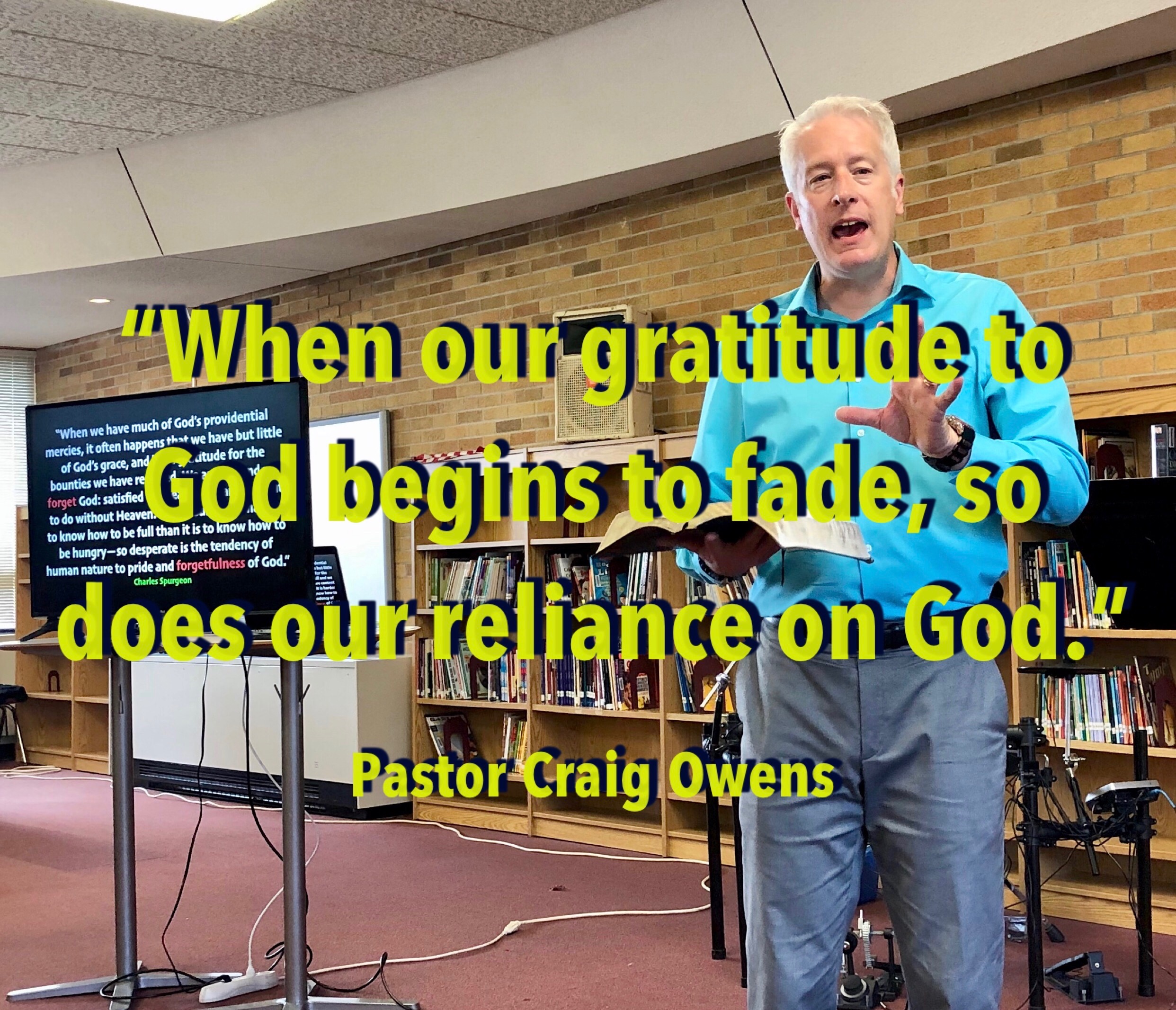
When our thoughts about God begin to fade, so does our gratitude to God. When our gratitude to God begins to fade, so does our reliance on Him. 

The dictionary defines some important terms:

  • Ungratefulness—not giving due return for benefits conferred
  • Unthankfulness—not repaying the blesser with thanks

I don’t think anyone consciously chooses to be ungrateful, but if we don’t choose to actively remember our blessings—and our Blesser—we will become ungrateful. So what if we began to think differently about the definition of gratitude? 

  • Forgetfulness—to cease to think of something
  • Gratitudeto continue to think of Someone (with that Someone being God!) 

When we are continually thankful—when we don’t let our gratitude fade—it keeps God’s blessings at the forefront of our minds. Gratitude—continuing to think of Someone—makes us completely God-reliant. 

Moses had a good idea to help us to continue to think of God’s blessings—

Impress them on your children. Talk about them when you sit at home and when you walk along the road, when you lie down and when you get up. Tie them as symbols on your hands and bind them on your foreheads. Write them on the doorframes of your houses and on your gates. (Deuteronomy 6:7-9) 

What if you posted reminders of God’s blessings all over the place? What if you made it almost impossible to forget God? What if you were constantly thinking of your blessings? 

Join us for our series called Fading Gratitude during the month of November.