Thursdays With Spurgeon—Unity Not Uniformity

This is a weekly series with things I’m reading and pondering from Charles Spurgeon. You can read the original seed thought here, or type “Thursdays With Spurgeon” in the search box to read more entries.

Listen to the podcast of this post by clicking on the player below, and you can also subscribe on iTunes or Spotify.

Unity Not Uniformity

And the glory that You gave Me I have given them, that they may be one just as We are One: I in them, and You in Me; that they may be made perfect in one, and that the world may know that You have sent Me, and have loved them as You have loved Me. (Jesus, in John 17:22-23)

     Beloved, those in whom Christ lives are not uniform, but one. …  

     As I have remarked, it is not uniformity. Of this our Lord says nothing. Though we are one body in Him, yet all the members have not the same office. The eye is very different from the ear, and the foot has not the same form as the hand. Neither does He speak of any formal organization by which unity is to be secured. How many have tried to create a mechanical union and have made confusion worse confusion! Their eagerness for unity has threatened to dash everything to shivers! The very first step toward a visible unity of the church is, with most men, that they will fix a standard of what the church ought to be and cut off everybody who will not conform to their idea! …  

     Christ lives in His people, and we are to act so, in the power of the Holy Spirit, that onlookers will say, ‘Surely Christ lives again in that man, for he acts out the precepts of Jesus. Did you notice how he bore the insult? Did you notice how he laid himself out to oblige and to serve? Did you observe how, without introducing religious talk, he gradually steered the conversation toward that which is to edification?’ …

     Brothers and sisters, if you and I are living for the same design that our Lord lived for, and if the very life that quickens us is the life of Jesus, then, since Jesus lives always for the same thing that God proposes and works out, surely there is a grand unity, the likes of which are not found in the universe! … 

     ‘That the world may know that You have sent Me.’ How will they know it? Why, when they see such characters as I have so feebly tried to paint! When they see men who are no longer selfish, hard, and ungenerous—when they see men no longer governed by their passions, no longer earthbound—when they see loving men, men who desire that which is holy, just, and good! When they see men living for God, the world will say, ‘Their Master must have been sent of God.’

From The Glory, Unity, And Triumph Of The Church

Several years ago I was meeting with a group of pastors from various denominations. Although the meeting was friendly, I still sensed some “walls” between us. At one point I asked, “By a quick show of a raised hand, how many of us believe that salvation from the penalty of our sin comes only through the work that Jesus did for us on the Cross?” Every pastor in the room raised a hand. “Great,” I said, “let’s just focus on that!” 

Some Christians are Calvinist, and some are Arminian; some take Communion one way, and some another way; some are charismatic, and some more liturgical; some baptize one way, and some baptize differently. Jesus wasn’t looking for uniformity, but He did pray for unity. 

We can all be unified around the love of Christ, and the unity of the family of Christ. 

If we will set aside the petty denominational differences and simply love each other as brothers and sisters in Christ, we will present a witness for Him that is unmistakable and irrefutable! We need each other to bring out the saintliness in all of us. When the world sees this vibrant saintliness—regardless of which church those saints attend on Sundays—it will capture their attention and draw them to Jesus. 

Charles Spurgeon concluded the sermon I just quoted from with a prayer, to which I sincerely hope all of us Christians can add our own Amen: “Oh, for grace so to live to God in Christ Jesus that the world will never be able to answer the argument of our lives! Help us, O Spirit of the Lord! Amen.”

►► Would you please prayerfully consider supporting this ministry? ◀︎◀︎
The Craig And Greg Show: Leaders Vs. Loneliness

On this episode of “The Craig And Greg Show” we talk about: 

  • the winner of last month’s winner of our drawing  
  • busyness can actually lead to loneliness 
  • how leaders can guard against loneliness  
  • insight from Josh McDowell on how coronavirus impacts feelings of loneliness  
  • some strategies to eliminate busyness  
  • how leaders can empower others to overcome isolation
  • the importance of a leader’s presence
  • the New Testament only uses “saints” in the plural because we need each other
  • Greg tries to get me to name names
  • leaders need to boldly initiate even with people who seem closed off
  • the new coaching page on our website
  • more ways to be entered into our January drawing

Check out this episode and subscribe on YouTube so you can watch all of the upcoming episodes. You can also listen to our podcast on Spotify and iTunes.

Words To Winners Of Souls (book review)

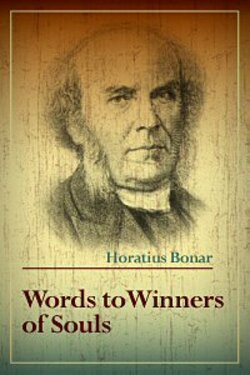
Horatius Bonar has given us a collection of sermons preached to pastors, which have been collated in a book under the title Words To Winners Of Souls. 

Although these were words by a pastor to pastors, this shouldn’t be a book exclusively read by pastors. Anyone who wants to successfully share their Christian testimony with unsaved friends and loved ones can find much to digest in these sermons. That being said, this is still a must-read (and I don’t say that very often) for those in pastoral ministry. 

Bonar was a no-pulled-punches preacher! He spoke candidly and forcefully, but he also spoke out of a love for the Body of Christ and its ministers. Early on in this book he says, “We take for granted that the object of the Christian ministry is to convert sinners and to edify the body of Christ. No faithful minister can possibly rest short of this. Applause, fame, popularity, honor, wealth—all these are vain. If souls are not won, if saints are not matured, our ministry itself is vain.” Wow: “our ministry itself is vain”—you cannot get more gut-level honest than that! 

In this collection of messages, Bonar helps us diagnose what may be hindering our soul-winning practices, and he also proposes the remedy for those shortcomings. These words are honest and often hard to hear, but they are so needed for everyone who desires, as Jesus does, “that none should perish but all should come to repentance” (2 Peter 3:9). 

Pastors, please read this book! 

Parishioners, please get a copy of this book for your pastor and then offer to prayerfully read through it with him or her. I promise you: this book will pay eternal dividends. 

UPDATE: I have shared some quotes from this book here.

The Closed Ear

“How much we lose by the closed ear! … Other speakers may win the ear of the multitude, but it is to God the Lord that the saint listens. His voice is powerful. Its tones are penetrating; its words attractive. God speaks as One entitled to be heard, expecting to be heard. He speaks with authority, waiting for our obedience to the heavenly voice. …

“A saint then is one who has listened to God; who has heard the words of peace from His lips; who has believed them; who has been reconciled; and who knows that he is so. Therefore he seeks to be holy. He hates his former folly. He does not return to it. He does not make his free pardon a reason for returning to it.

“Brethren, be consistent! Beware of sin, folly, unholiness of every kind. Be Christians out and out. Show that the peace you have received is a holy peace.” —Horatius Bonar, in Light & Truth—The Old Testament

A Praying Family

Not one word in Scripture is wasted: not one word is redundant or replaceable. When Jesus taught us to pray to a Heavenly Father, He taught us to say, “OUR Father.” That means we are all His children, with His Holy Spirit helping us to grasp this—The Spirit Himself testifies with our spirit that WE are God’s children. Now if WE are children, then WE are heirs—heirs of God and co-heirs with Christ… (Romans 8:16-17). 

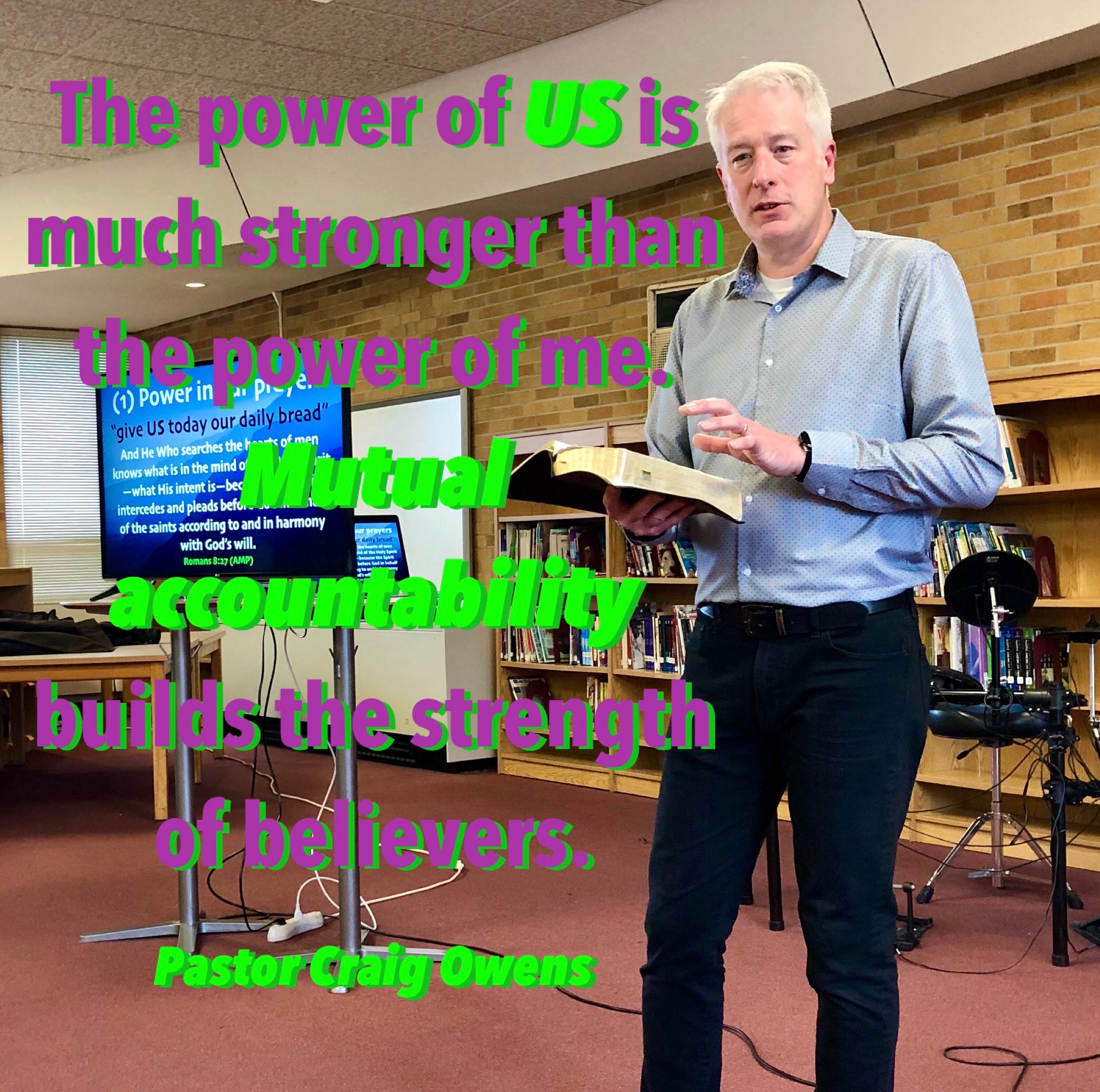
Did you know that the word saints never appears in the singular in Scripture? No one person is singled out for his or her saintliness. Because we are saintS, praying together to OUR Father, this means accountability. For some people, accountability is a bad word. It seems to them to feel like someone is looking over their shoulder or checking up on them. But Christians should never feel this way! I like how Ken Blanchard defines this: “Accountability means: We owe each other for something we’ve agreed upon.” 

What have the saints of God agreed upon? That God is our Father, that Jesus is His Son and our Brother, and that the Holy Spirit is our Helper. We’ve agreed that if we are brothers and sisters in God’s family, we are mutually accountable to one another. 

In the context of the prayer Jesus taught us to pray, being mutually accountable means: 

  1. Power in our prayers—give US today our daily bread. Jesus talks about the power in agreement, and the apostle Paul emphasizes how the Holy Spirit helps believers harmonize in prayer with each other and with God’s will (Matthew 18:19-20; Romans 8:27). 
  1. Strengthening of our character—forgive US our debts, as WE also have forgiven our debtors. Jack Hayford points out that, “The believer’s best defense against self-deception is through mutual accountability to one another.” In order for our character to be strengthened, we have to allow others to speak into our lives—even the lovingly painful words (Proverbs 27:17, 6). 
  1. Protection from falling to temptation—lead US not into temptation, but deliver US from the evil one. Samson became entangled with a prostitute when he was all by himself; Elijah became depressed when he sent his servant away; David fell into sin when he was alone; Peter denied Christ when all of the other disciples had run away. That’s why the writer of Hebrews counsels us to stick close to our Christian family members (Hebrews 10:21-25). 

In an earlier post, I noted that how we view God is going to determine what we pray and what we expect after we pray. Coming together and praying together will help us see God better. Just as the angels around the throne are always crying out to each other “Holy! Holy! Holy!”, when we come together we can show our fellow saints what we’ve learned about our holy Father’s love and power. This is both an encouragement to others and allows others to be an encouragement to us too. Then together we can pray more boldly and expect great things in response to our prayer. 

Being mutually accountable to the saints in prayer…

  • … hallows God as our Father

  • … glorifies Jesus as our Brother

  • … honors the Spirit as our Helper

God never intended that you would have to walk through life alone. He wants us to share the journey with fellow saints—His family made up of our brothers and sisters. This praying family truly honors God’s name! 

Join me on Sunday as we continue to learn more about prayer. 

Poetry Saturday—What Is Prayer?

Prayer is the soul’s sincere desire,
Unuttered or expressed;
The motion of a hidden fire,
That trembles in the breast.

Prayer is the burden of a sigh,
The falling of a tear;
The upward glancing of an eye,
When none but God is near.

Prayer is the simplest form of speech
That infant lips can try;
Prayer, the sublimest strains that reach 
The Majesty on high.

Prayer is the Christian’s vital breath,
The Christian’s native air;
His watchword at the gates of death—
He enters heaven with prayer.

Prayer is the contrite sinner’s voice,
Returning from his ways;
While angels in their songs rejoice
And cry, ‘Behold, he prays!’ 

The saints in prayer appear as one,
In word, in deed, and mind;
While with the Father and the Son,
Sweet fellowship they find.

No prayer is made by man alone
The Holy Spirit pleads;
And Jesus, on th’ eternal throne
For sinners intercedes.

O Thou! by Whom we come to God,
The Life, the Truth, the Way;
The path of prayer Thyself hast trod:
Lord, teach us how to pray. —James Montgomery

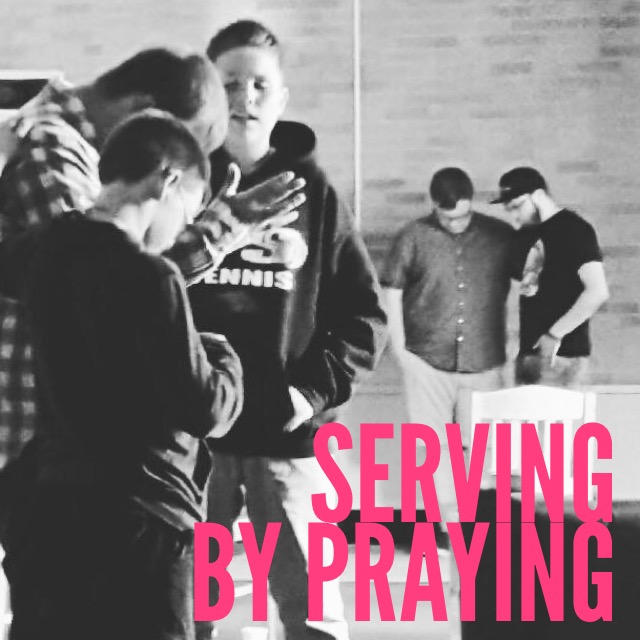
Serving By Praying

Paul and Timothy, bondservants of Jesus Christ, to all the saints in Christ Jesus who are in Philippi, with the bishops and deacons (Philippians 1:1). 

In just his opening line, Paul lists three types of servant-leaders: bondservants, bishops, deacons. 

The servant-leaders are all called to put the needs of the saints ahead of their own needs. They all serve so the saints can shine! And as the saints shine, they attract others to Jesus Christ. 

Jesus is our example of the Ultimate Servant (Philippians 2:5-8), and we are called to follow His example (John 13:12-17). 

One thing that clearly kept Paul, Timothy, and the other servant-leaders in Philippi in this servant’s posture was prayer. Even the physical posture of kneeling in prayer is a posture of a servant who is actively serving. 

  • Paul prayed for the Philippians frequently—In all my prayers for all of you, I always pray with joy (1:4). 
  • He prayed for them to grow in love and knowledge—I pray that your love will overflow more and more, and that you will keep on growing in knowledge and understanding (1:9). 
  • Paul was grateful for the prayers of the saints—I know that as you pray for me and the Spirit of Jesus Christ helps me, this will lead to my deliverance (1:19). 
  • And he closed his letter with a call for them to continue to pray about everything—Don’t worry about anything; instead, pray about everything. Tell God what you need, and thank Him for all he has done (4:6). 

Here are four powerful lessons for all Christians to live out…

(1) Leaders need to pray for the saints, and leaders need the saints to pray for them. 

(2) Leaders need to be prayerful to keep their posture right as servants. 

(3) Saints need to be prayerful for their leaders so that their leaders can continue to serve them in God-honoring ways. 

(4) We all serve best when we are diligent to keep our prayer life vibrant and healthy. 

Poetry Saturday—The Course Of Prayer

Even so, the course of prayer who knows?
   It springs in silence where it will,
      Springs out of sight, and flows
         At first a lonely rill
: 
But streams shall meet it by and by
   From thousand sympathetic hearts,
      Together swelling high
         Their chant of many parts. 
Unheard by all but angel ears
   The good Cornelius knelt alone,
      Nor dream’d his prayers and tears
         Would help a world undone. 
The while upon his terrac’d roof
   The lov’d Apostle to his Lord
      In silent thought aloof
         For Heavenly vision soar’d. 
Far o’er the glowing western main
   His wistful brow was upward rais’d,
      Where, like an angel’s train,
         The burnish’d water blaz’d. 
The saint beside the ocean pray’d,
   The soldier in his chosen bower
,
      Where all his eye survey’d
         Seem’d sacred in that hour. 
To each unknown his brother’s prayer,
   Yet brethren true in dearest love
      Were they—and now they share
         Fraternal joys above. —John Keble

Thursdays With Oswald—Christianity In The Actual And Real Life

This is a weekly series with things I’m reading and pondering from Oswald Chambers. You can read the original seed thought here, or type “Thursdays With Oswald” in the search box to read more entries.

Christianity In The Actual And Real Life

     A man cannot take in anything he has not begun to think about, consequently until a man is born again what Jesus says does not mean anything to him. The Bible is a universe of revelation facts have no meaning for us until we are born from above; when we are born again we see in it what we never saw before. We are lifted into the realm where Jesus lives and we begin to see what He sees (John 3:3). 

     By “Actual” is meant the things we come in contact with by our senses, and by “Real” that which lies behind, that which we cannot get at by our senses (cf. 2 Corinthians 4:18). The fanatic sees the real only and ignores the actual; the materialist looks at the actual only and ignores the real. The only sane Being whoever trod this earth was Jesus Christ, because in Him the actual and the real world one. …  

     When we are born from above we begin to see the actual things in the light of the real. …

     Deliverance from sin is not deliverance from conscious sin only, it is deliverance from sin in God’s sight, and He can see down into a region I know nothing about. By the marvelous Atonement of Jesus Christ applied to me by the Holy Spirit, God can purify the springs of my unconscious life until the temper of my mind is unblameable in His sight. …  

     Everything Jesus says is impossible unless He can put His Spirit into me and remake me from within…. When a man is born from above, he does not need to pretend to be a saint, he cannot help being one. …

     There is only one way in which as a disciple you will know that Jesus has altered your disposition, and that is by trying circumstances. … The proof that God has altered our disposition is not that we persuade ourselves He has, but that we prove He has when circumstances put us to the test.

From Studies In The Sermon On The Mount

The truths that the Bible declares are real truths, but they need to be lived out in the actual life of a Christian. Jesus is the only One who has ever done this, but by His Atonement applied to our actual lives by the Holy Spirit, we can begin to live this way as well. 

In order to live out real truths in actual life, we have to experience actual life—all of the ups and downs, the victories and defeats, the temptations succumbed to and the temptations overcome—in light of real truth. In every experience, the Holy Spirit can sanctify us. I like to think of that word sanctification like this: saint-ification. If I will allow Him, the Holy Spirit can bring out actual saintly qualities in my life. 

The more I allow Him to do this, the more saintliness is seen in my actual life. As Chambers reminds us, then we don’t have to pretend to be a saint, but we cannot help but be an actual one! 

11 Quotes On The Gospel Of Matthew

J.C. Ryle has given us a wonderful commentary on the Gospels in his Expository Thoughts On The Gospels. Check out my full book review here, and then enjoy a few quotes from Ryle’s insights on the Gospel of Matthew. 

“The rulers of this world have often call themselves Great, Conqueror, Bold, Magnificent, and the like. The Son of God is content to call Himself Savior. These souls which desire salvation may draw near to the Father with boldness, and have access with confidence through Christ. It is His office and His delight to show mercy. ‘For God didn’t send His Son into the world to judge the world, but that the world should be saved through Him’ (John 3:17).” 

“Trust Him at all times with all your sorrows. He will not despise you. Pour out all your heart before Him in prayer, and keep nothing back. He can sympathize with His people.” 

“Let us beware of resting satisfied with head-knowledge. It is an excellent thing, when rightly used. But a man may have much of it, and yet perish everlastingly. What is the state of our hearts? This is the great question. A little grace is better than many gifts. Gifts alone save no one. Grace leads on to glory.” 

“Here is one among many reasons why we ought to be diligent readers of our Bibles. The Word is the sword of the Spirit. We shall never fight a good fight, if we do not use it as our principal weapon. The Word is the lamp for our feet. We shall never keep the King’s highway to heaven, if we do not journey by its light. … Knowledge of the Bible never comes by intuition, it can only be obtained by diligent, regular, daily, attentive, wakeful reading.” 

“Aim at letting men see that we find Christianity makes us happy. Never let us forget that there is no religion in looking melancholy and gloomy. Are we dissatisfied with Christ’s wages and Christ’s service? Surely not! Then let us not look as if we were.” 

“Let the prayer ‘Lord, increase our faith,’ always form part of our daily petitions. We never perhaps know the weakness of our faith until we are placed in the furnace of trial and anxiety. Blessed and happy is that person who finds by experience that his faith can stand the fire, and that he can say with Job, ‘though He slays me yet will I trust in Him’ (Job 13:15).” 

“The more clearly we see Christ’s power, the more likely we are to realize Gospel peace. Our position may be trying. Our hearts may be weak. The world may be difficult to journey through. Our faith may seem too small to carry us home. But let us take courage when we think on Jesus, and not be cast down. Greater is He that is for us than all those who are against us. Our Savior can raise the dead. Our Savior is Almighty.” 

“Great grace and common sense are perhaps one of the rarest combinations. … Our Lord Jesus Christ Himself is our most perfect example. None were ever so faithful as He. But none were ever so truly wise. Let us make Him our pattern, and walk in His steps.” 

“Let us not be ashamed to say that we expect a literal fulfillment of unfulfilled prophecy. Let us frankly allow that there are many things we do not understand, but still hold our ground tenaciously, believe much, wait long, and not doubt that all will one day be made clear.” 

“Are we ever mocked and persecuted and thought foolish because of our religion? Let us bear it patiently and pray for those who persecute us. They know not what they are doing. They will certainly alter their minds one day. We may yet hear them confessing that we were wise and they were foolish. The whole world shall one day acknowledge that the saints of God made a wise choice.” 

“We can never attach too much importance to the atoning death of Christ. It is the leading factor in the Word of God, on which the eyes of our soul are to be ever fixed. Without the shedding of His blood, there is no remission of sin. It is the cardinal truth on which the whole system of Christianity hinges. Without it the Gospel is an arch without a key stone, a fair building without a foundation, a solar system without a sun.” 

Quotes from Ryle’s comments on the Gospels of Mark, Luke, and John coming soon.