“Psychologists, since the beginning of the discipline, have argued about the essence of what it means to be human. Some, like [Sigmund] Freud, insist that we are motivated by physical pleasure, while others, like Victor Frankl or Abraham Maslow, believe that some higher purpose…. Human beings, made in the image and likeness of God, only realize their full potential and pleasure as they participate in the very being of God and know and experience the pleasure He takes in Himself and His glory.” —T.M. Moore
“If you are persevering in faith today, you owe it to the blood of Jesus. The Holy Spirit, who is working in you to preserve your faith, is honoring the purchase of Jesus. God the Spirit works in us what God the Son obtained for us. The Father planned it. Jesus bought it. The Spirit applies it—all of them infallibly.” —John Piper
“The Hebrew word Davar (דבר, pronounced ‘daw-var’) reveals something profound about God’s Word—it’s not merely information, but transformation. … Throughout Scripture, God’s Word consistently proves both living and active. It has the power to create worlds (Genesis 1), transform lives (Psalm 119:105), and accomplish God’s purposes (Isaiah 55:11).” —Dave Adamson
More fascinating archeology that supports the Bible’s historicity. This is a look at the library of letters found at Tell el-Amarna in Egypt. “The most obvious connection between the Amarna Letters and biblical history is that some of the letters appear to be describing, in real-time, the attacks of the Israelites during the period of the conquest. Remember, the initial conquest battles took a period of some 5–6 years, but the attempts by various tribes to conquer their allotted territories lasted into the period of the Judges. The letters from the rulers of some of the very cities named in the biblical conquest calling for help from the attacking ʿapîru/ḫa-bi-ru, provide a poignant backdrop to this period of biblical history.”
“Because I am your constant Companion, there should be a lightness to your step that is observable to others. Do not be weighed down with problems and unresolved issues, for I am your burden-bearer.” —Jesus in Sarah Young’s Jesus Calling, based on Psalm 31:19–20; John 16:33
Psychologists call it “projection” when I see so quickly in others what’s really in myself.
If I see sin in others, my first response would be to hit my knees and ask the Holy Spirit to search me to point out the same sin in myself.
It’s only after confessing my sin and receiving God’s complete forgiveness that I am equipped with the empathy and mercy to help someone else find the same freedom I have found.
Lord, may I be more sensitive to the sin in my life than I am aware of the sin in the world.
Listen to the podcast of this post by clicking on the player below, and you can also subscribe on Apple, Spotify, or Audible.
Sir Isaac Newton may have said for every action there was an equal and opposite reaction, but that’s not true for God-fearing leaders.
Check out this episode of The Podcast.
The story of Paul and Barnabas that I reference in this video is found in Acts 14:1-21.
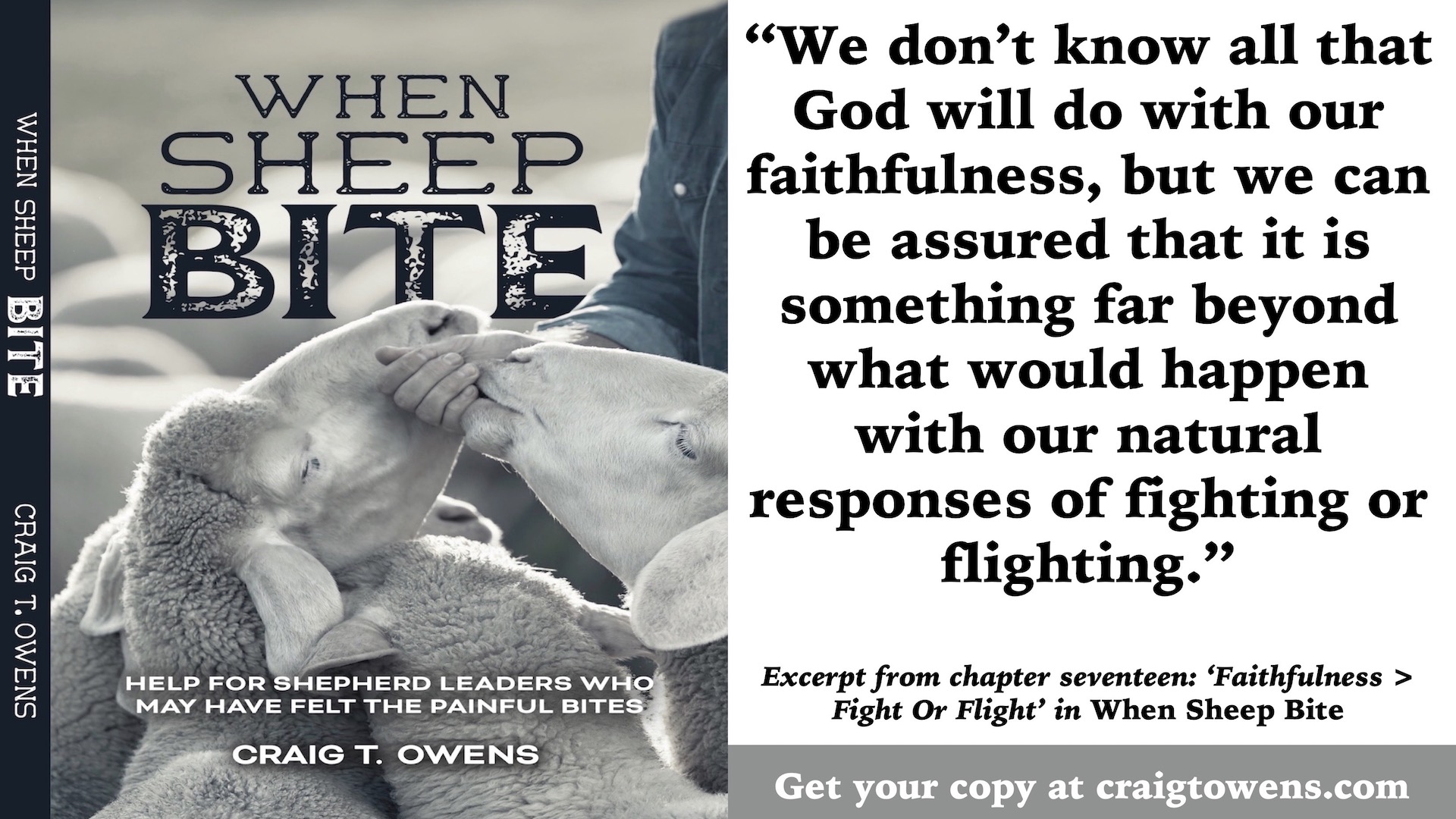
My book When Sheep Bite is divided into three section. In the first section I talk about a shepherd leader’s heart and section two diagnosis the sheep bites leaders endure. The final section is all about the faithfulness to finish well—not giving in to the natural responses of fight or flight.
I open that final section of the book like this—
Psychologists and medical doctors have all described what happens to our minds and bodies when we are under attack. They are universal responses that our loving Creator has implanted in all of us to be able to respond to threats that come at us. When confronted with a biting sheep, without consciously thinking about it our minds and bodies prepare for fight or flight.
But let’s consider those responses in the context of a shepherd pasturing his sheep. Is it an effective strategy for the shepherd to fight his sheep? No, of course not. Paul told Timothy that a shepherd is “not quarrelsome but forbearing and peaceable” (1 Timothy 3:3 AMPC).
Is it allowable for the shepherd to run away from the threat, leaving the flock without a shepherd? Again, no, as Jesus told us that one who resorts to flight isn’t worthy to be called a shepherd but is considered a mere “hired hand [who] cares nothing for the sheep” (John 10:12-13).
So if godly shepherds cannot give in to the natural responses of fight or flight, what are we to do? Since we serve an all-power, all-loving Chief Shepherd we must look to Him for the supernatural response of faithfulness.
Listen to the podcast of this post by clicking on the player below, and you can also subscribe on Apple, Spotify, or Audible.
As we learned last week, we are not the judge, nor the jury, nor the prosecution, nor even the sin police in deciding appropriate retribution. With that in mind, let’s consider Statement #15 in our series—Do not judge. Is that in the Bible?
Yes, those three words are there, spoken by Jesus, in Matthew 7:1. But then again, we need to say, no, because these words don’t mean we are not to make determination about the rightness or wrongness of something.
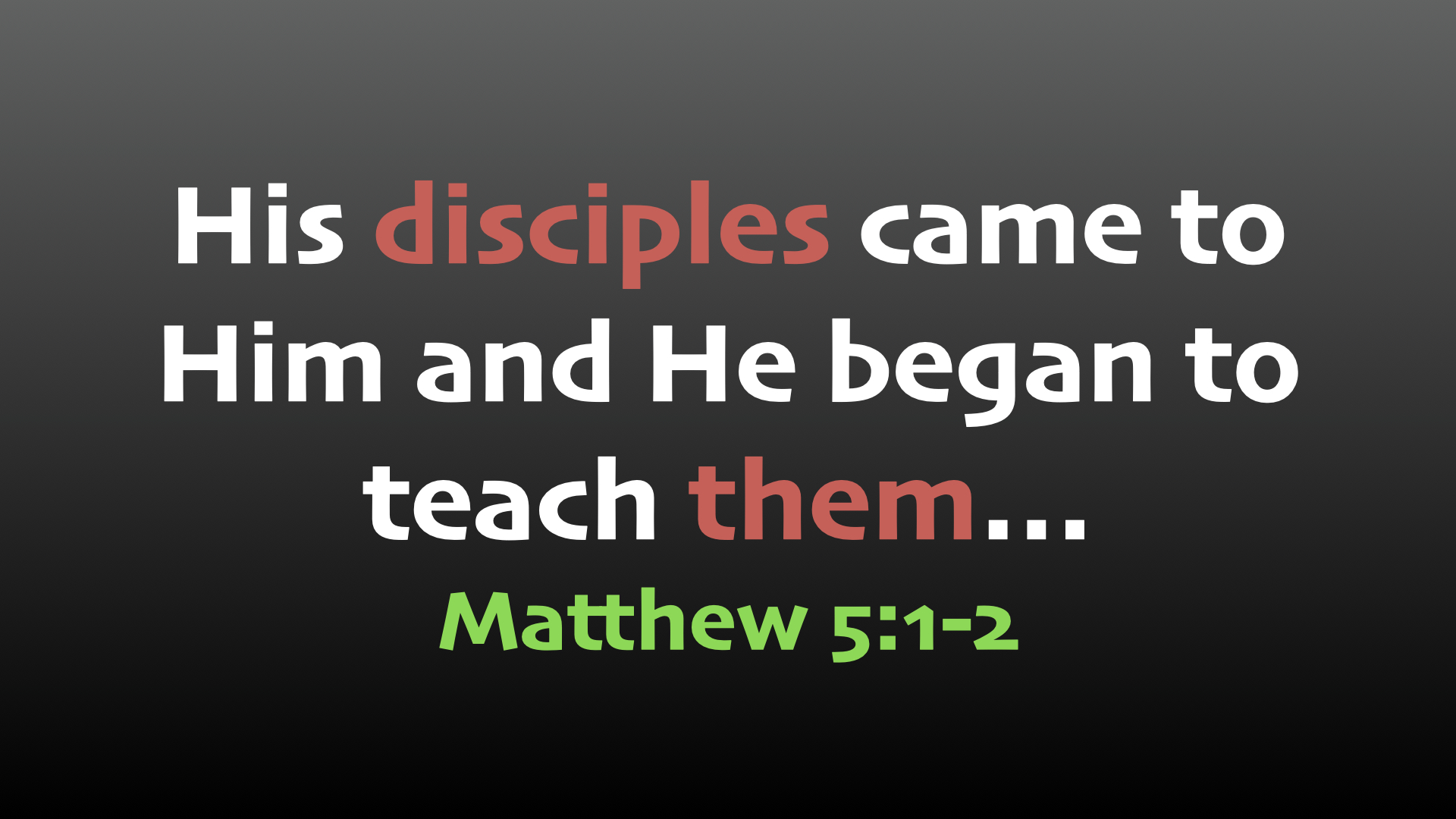
Let’s zoom-out a bit get the context of the words Jesus spoke. Who was His audience for these words? This is a part of the Sermon on the Mount (Matthew 5–7). Notice in the opening words, “His disciples came to Him, and He began to teach them” (5:1-2). So Jesus isn’t speaking to the world at-large, but He is talking with His disciples.
Jesus was very specific in His wording. In talking about the world, He uses words like people (5:11) or men (5:16; 6:1, 5). When talking about His disciples, He uses one word quite frequently: brother (3x in 5:22-24).
Matthew 7:1 is still in this sermon, and the word brother appears 3x in vv. 3-5. So these are instructions primarily for Christians to use with other Christian brothers and sisters.
The words judge here in the Greek means, “Those who judge severely (unfairly), finding fault with this or that in others.” To me, “this or that” sounds like a deliberate searching for something wrong, but Jesus assures us that this will boomerang on the judgmental person (v. 2; Luke 6:37).
In modern psychology, we find terms like:
mirroring = a psychological term the means quickly seeing what’s in others because it’s in me
projection = taking the negative things in me and projecting them onto others
Paul addresses both of these thoughts in Romans 2:1-3, where the word for judging here is the same Greek word Jesus uses in Matthew 7.
Paul concludes his remarks by reminding us that God treats us kindly (Romans 2:4). David echos this same thought in Psalm 103:8-10, 13-14.
When you read the whole passage in Matthew 7:1-5, please notice the words “brother,”“first,” and “then.”
Jesus does not mean that I am not to point out to my brothers and sisters any areas of concern. Jesus did this, as well as nearly every epistle writer. What it does mean is that correction needs to be gentle and never condemning. In other words, I want to lovingly help someone before they have to stand before The Judge.
That’s why I need to first humbly recognize that what I see in others may be apparent to me because I am afflicted with the same thing. That’s why Jesus says first deal with my own plank. Examine myselfbefore I try to correct a brother or sister (1 Corinthians 11:28; 2 Corinthians 13:5).
After I have allowed the Holy Spirit to deal with my plank, I will then have the empathy to help my brother or sister (2 Corinthians 1:3-4). Trying to get someone else to repent of something that still exists in my life is hypocritical.
If I see something wrong in someone else:
First ask the Holy Spirit to search me.
If necessary, confess it, repent from it, ask forgiveness, make things right.
Then lovingly and humbly share with your brother or sister (Ephesians 4:15).
If someone else sees something wrong in me, I should follow the exact same steps!
This is not easy, but it is vital for the Body of Christ to grow in a healthy way.
If you’ve missed any of the other messages in this installment of our series Is That In The Bible?, you can find them all here.
Listen to the podcast of this post by clicking on the player below, and you can also subscribe on Apple, Spotify, or Audible.
I’m not a fan of rollercoasters, but I know a lot of people who really like them. Some even travel all over the world to experience unique rollercoasters. The anticipation as the cars climb slowly up the big hill, knowing that there’s no stopping this thing now! Then the rush of emotions, a deep breath and a laugh at the end (usually laughing at our friends’ responses while on the ride), and then we just walk away. The moment of anticipation leading up to the big drop was usually longer and more intense than the ride itself.
Not only do people travel all over to find rollercoasters, some people seem to have their emotions perpetually on rollercoasters.
One of the telltale signs of someone with an immature mental health is the way every situation gets blown out of proportion before anything even happens. Then as an event unfolds, their exaggerations continue: the molehills are mountains, every valley is the valley of the shadow of death, the night is a nightmare, the “crisis” is lasting forever, no one has ever gone through what they’re going through, and the list goes on.
To break out of this habit requires us developing emotional capacity. John Maxwell describes it like this: “Emotional capacity is the ability to handle adversity, failure, criticism, change, and pressure in a positive way.” Just as athletes have to develop lung capacity or muscle capacity, developing emotional capacity takes time, patience, and diligence.
Increased emotional capacity is not escaping from our problems or even learning coping skill. Escapism never allows us to confront the things that are keeping our emotional capacity immature. On the other hand, maturing emotional capacity is learning to pause to get perspective so that we can avoid turning every mountain into a molehill, and every challenge into a do-or-die battle.
Let me illustrate this by looking at two emotions which seem to be the most rollercoaster-ish.
(1) The first rollercoaster emotion is anger
Out-of-proportion anger can either burn everyone around us when we explode, or it can eat away inside us if we hold it in. Neither of these are healthy emotional responses. Jesus got angry at the religious crowd that was keeping people away from God’s kingdom, but He didn’t ride the rollercoaster that led to a sinful expression of His anger.
God asked Jonah a very helpful question: Have you any right to be angry? (Jonah 4:4). When we feel the Holy Spirit asking us this question, our defiant first response is almost always, “Yes! I didn’t do anything wrong! It was all him!” Solomon would counsel us to cross-examine that thought (Proverbs 18:17).
Sometimes God will bring someone else across our path to help us pause to get perspective—to flatten the rollercoaster. For instance, God used Abigail to help David (see the story in 1 Samuel 25). However the Holy Spirit cross-examines us, we need to learn to truly listen. James told us:
My dear brothers and sisters, take note of this: Everyone should be quick to listen, slow to speak and slow to become angry, because human anger does not produce the righteousness that God desires. (James 1:19-20)
(2) The second rollercoaster emotion is fear
Fear usually causes us to fight or flight. Those are the natural responses, but the supernatural response is to pause to evaluate. I love the reminder that F.E.A.R. means false evidence appearing real.
As with anger, our first pause to get perspective on this potential rollercoaster that can plunge us into a deep, dark valley should be to cross-examine the false evidence of fear.
When the group of ladies came to the tomb of Jesus on the Sunday following His crucifixion, they were already battered and bruised in their emotions. Finding an empty tomb brought even more fear in their hearts. But there is a keyword in this account that will help us:
In their fright the women bowed down with their faces to the ground, but the men [angels] said to them, “Why do you look for the living among the dead? He is not here; He has risen! Remember how He told you, while He was still with you in Galilee: ‘The Son of Man must be delivered over to the hands of sinners, be crucified and on the third day be raised again.’” Then they remembered His words. (Luke 24:5-8)
The Holy Spirit can help us remember the truth in God’s Word to counteract the fear-inducing false evidence (2 Timothy 1:7; John 14:26), but we must pause to listen to this evidence before this rollercoaster emotion picks up speed.
The bottom line: Don’t try to escape your strong emotions. Pause. Cross-examine the evidence with the help of God’s Word, the Holy Spirit, and a friend to get a healthy perspective. This can help you flatten the rollercoaster before your emotions run away with you.
Listen to the podcast of this post by clicking on the player below, and you can also subscribe on Apple, Spotify, or Audible.
Without a doubt, Jesus had the most robust mental health of anyone who has ever walked planet Earth! Dr. Luke, a trained physician, captures this in just one verse (Luke 2:52) where he talks about how Jesus grew in a wholly healthy way, and Luke lists Christ’s mental health as the first priority.
I’m sure there have been plenty of times when someone asks you about something you like or dislike or why you do something the way you do, you probably don’t tell them the facts but you tell them a story. We have a story for everything we like, everything we do, and everything we avoid.
It’s good to rehearse these stories and to really listen to them. If we don’t really listen to them, we cannot learn from them; if we don’t learn from them, we rob ourselves of robust mental health.
From some of our stories, there is a regret that comes from three enemies. These enemies are all tied to our stories about our past and they are would’ve, could’ve, and should’ve—“If only I would’ve…” and “Things would be different today if I could’ve…” and “I should’ve known….”
One of the ways we need to talk back to those thoughts is like this, “I only know the would’ve, could’ve, and should’ve now because I’m older and more experienced. I didn’t know those things in the past so it was impossible for me to have done something differently.” Even the apostle Paul noted, “When I was a child, I talked like a child, I thought like a child, I reasoned like a child. When I became a man, I put the ways of childhood behind me” (1 Corinthians 13:11).
If we don’t talk back to those regrets of yesterday, we will have doubts about today: Will I make another mistake today? Do I have what it takes to meet today’s challenges? What will others think of me if I mess up? If we don’t address those doubts we have today, that will cause us worry and stress about tomorrow.
Regret … doubt … worry … stress. Those don’t really sound like words that contribute to positive mental health, do they?
Here’s the thing we need to remember—Learning from our yesterdays is healthy, but trying to relive our yesterdays is both unhealthy and unproductive!
Dr. William Osler said, “If the load of tomorrow is added to that of yesterday and carried today, it will make the strongest falter.”
Four times in just ten verses, Jesus told His followers not to worry about tomorrow (Matthew 6:25-34). He ties that worry about tomorrow to having little faith. That lack of faith comes from our doubts, and those doubts come from our past regrets.
T.G.I.F.—thank God it’s Friday!—is an escapism. It’s not wanting to deal with the regrets, doubts, and worry by trying to push them to some distant time. It doesn’t allow us to really concentrate on today. The Bible constantly brings us back to the present.
Today is used 203 times in the NIV Bible
Tomorrow is mentioned 56 times
Yesterday is only used 8 times
Jesus taught us to pray, “Give us today our daily bread” (Matthew 6:11) so that we won’t let past regrets spiral downward into daily doubts and then anxiety about tomorrow. Elizabeth Elliot wisely counseled, “One reason we are so harried and hurried is that we make yesterday and tomorrow our business, when all that legitimately concerns us is today.”
Christians that want to be mentally healthy should continually replace a T.G.I.F. mindset with T.G.I.T.—thank God it’s today!
Taking a line from Joshua who said, “Choose for yourselves this day whom you will serve” (Joshua 24:15), here are four things we need to choose to remember each day.
Choose to remember that God uses all things—even our would’ve, could’ve, and should’ves—for our good and for His glory (Romans 8:28).
Choose to forget those old, self-limiting, stress-causing stories (Philippians 3:13).
Choose to believe that God is doing something new—something I never could have planned (Isaiah 43:18-19).
Choose to believe that God can help you tell a new story about your past (Genesis 41:51).
You have to choose each day to say “Thank God it’s today! Thank God that I’m not who I was yesterday! Thank God that He is using my would’ve-could’ve-should’ve moments from yesterday to prepare me for today! Thank God that He is teaching me a new story!”
If you’ve missed any of the previous messages in our series on a Christian’s mental health, you can find them all here.
“If we thought we were building up a heaven on earth, if we looked for something that could turn the present world from a place of pilgrimage into a permanent city satisfying the soul of man, we are disillusioned, and not a moment too soon.” —C.S. Lewis, in a speech ‘Learning in War Time’
“Perhaps the character of Faramir, the Captain of Gondor in The Lord of the Rings, expresses it best. He possesses humility as well as great courage—a warrior with a ‘grave tenderness in his eyes’—who takes no delight in the prospect of battle. As such, he conveys a message that bears repeating at the present moment, in a world that is no stranger to the sorrows and ravages of war. ‘War must be, while we defend our lives against a destroyer who would devour all,’ he explains. ‘But I do not love the bright sword for its sharpness, nor the arrow for its swiftness, nor the warrior for his glory. I love only that which they defend.’” —Joseph Loconte
“Without an equal growth of Mercy, Pity, Peace, and Love, Science herself may destroy all that makes life majestic and tolerable. There never was a time when the inherent virtue of human beings required more strong and confident expression in daily life.” —Winston Churchill
“With God discredited, meaning must be found ‘in life itself, in the act of living, in the vitality of the moment.’ Thus, the new psychology legitimized a new hedonism. Within a decade, W.R. Matthews, the Dean of Exeter, complained of ‘the decay of institutional religion’ because of the ‘incoherence of the Christian message and its apparent contradiction with modern knowledge.’ All of this helped to produce the modern, secular zealot: the revolutionary who seeks to create heaven on earth. Science, psychology, politics, economics, education—any of these disciplines might be enlisted in the cause.“ —Joseph Loconte
“It will be a comfort to me all my life to know that the scientist and the materialist have not the last word, that Darwin and Spencer, undermining, ancestral beliefs, stand themselves on a foundation of sand.” —C.S. Lewis
The remaining quotes are for my Patreon supporters only. Become a supporter today for only $5 per month and get access to quotes, videos, sneak peaks, and so much more.
Listen to the podcast of this post by clicking on the player below, and you can also subscribe on Apple, Spotify, or Audible.
I don’t think there’s any arguing that Jesus must have been the healthiest Person to ever live. Dr. Luke records His growth in just one succinct verse: “And Jesus grew in wisdom and stature, and in favor with God and man” (Luke 2:52). Every word of Scripture is inspired, right down to the order the words are penned. So when Luke says first that “Jesus grew in wisdom,” that is our indication that a healthy mind is the foundation for every other aspect of health.
I recently received an email from a Christian brother asking for prayer and counseling in overcoming lust and pornography. I naturally agreed to pray with him, but I also said, “Before I offer you any strategies to try, let me ask you a quick question: What have you already tried to get victory over this?”
He replied, “I’ve tried praying, watching videos on it, and basically saying no to the devil. But the temptation comes when I am weak and I think, ‘I can just try again tomorrow!’ And then I fall into it. I am just tempted at times throughout the day, and sometimes I fight it with prayer, but other times I just fall right into it basically without even trying.”
What my friend is dealing with here is a natural, unconscious response. Our brains like well-worn paths because it’s very easy and comfortable for our minds to automatically respond as they have responded before. As in the case of my friend, it may be heading down a path of lust that leads to pornography. For others, it may be unhealthy choices made in response to certain triggers, or it may be the anger that flares up into biting words when a certain someone pushes your buttons.
We head down that well-worn path unconsciously and automatically. Our immediate response might bring some temporary relief, but usually, we’re not very happy with where we’ve ended up once again.
If we are going to make a new path—or a new, healthier response—we first need to become aware of the well-worn path we automatically go to. So my counsel to my friend who emailed me for help was to start keeping a journal. I wrote back:
Your willpower alone isn’t going to cut it (as you’ve probably realized). Here’s the first step I would suggest: keep a journal of every time you are tempted to lust or porn. Write down what you were feeling, was it day or evening, what was happening just before that, did you have time in prayer and Bible reading that day or not, how did you fight the temptation, were you successful or not? I think as you keep track of these things you will begin to see some triggers and some patterns. Maybe you were physically tired, or lonely, or hungry. Maybe it was a certain person you talked with or a show you watched. Maybe it was after checking your social medias or after a super-hard day at work. When you start to see patterns of what is causing you to go to porn for relief, you can recognize them earlier and head them off before they grip your mind so strongly.
Psychologists call it metacognition when we think about what we’re thinking about—when we think about why we are taking a certain well-worn path again.
We don’t think about our thinking very frequently. We keep thinking along those well-worn paths out of habit, not because we want to go down those paths. This is where the Holy Spirit is invaluable: He helps us see those well-worn paths, identify which paths are unhealthy or unproductive, and then help us begin to carve out a new path.
It’s not just thinking about right things, but thinking rightly about all things—even the painful things or the triggering things.
In Ephesians 4:22-25, Paul counsels us to take off the “old self” and “put on the new self, created to be like God in true righteousness and holiness. Therefore” (and this is an important conclusion) “each of you must put off falsehood and speak truthfully to his neighbor.”
Do you remember that Jesus taught us to love our neighbor as ourselves (Mark 12:28-31)? Paul says we are to speak truthfully to our neighbor, so doesn’t that mean that we have to first speak truthfully to ourselves? Yes, we do! If we are going to make new paths for our mind, we are going to have to talk to ourselves differently.
My cousin Dick Brogden wrote, “A primary theater of spiritual warfare is in our heads and thoughts. The primary weapon of the enemy is deceit. He starts with attractive little lies and half-truths, and works his way up to blatant, ridiculous, perverted nonsense. Winning the battle for truth in the mind is critical to winning the war. If we lose enough of the little skirmishes, we can believe and do any wicked thing. If we daily combat lies with light and truth, we will stand firm.”
The “little lies and half-truths” will keep us trapped on our old, well-worn paths. But identifying those lies, and speaking the truth to them, will help us travel down new paths that lead to health and freedom.
Let the Holy Spirit be your Counselor. Let the Holy Spirit help you think about what you’re thinking about when you’re triggered to unconsciously head down the unhealthy well-worn path. Let the Holy Spirit help you see a new path. And then let the Holy Spirit empower you to stick with it—to keep doing the hard work of blazing a new path.
I am going to build on this series of messages about a Christian’s mental health, but let’s start with this simple prayer:
Holy Spirit, help me make new paths.
As you pray this, listen to how the Holy Spirit will guide you away from the unhealthy, unconscious, well-worn paths, and will then lead you into the new, healthy path that brings you freedom.
I don’t think there is any arguing that Jesus was the healthiest individual who ever walked planet Earth. Some may want to push back with, “Of course He was because He didn’t have any problems to deal with!”
But the writer of Hebrews tells us that Jesus experienced everything you and I will ever experience (Hebrews 2:17), so His deity didn’t exclude Him from the stressors that His humanity would have to face. And yet, He handled all of these things successfully.
Luke the physician observed the growth of Jesus and tells us that it all began with Jesus having a robust mental health. From that foundation, everything else—physical, spiritual, relational—all could develop properly. We must learn from this example and pay careful attention to our own mental health.
This Sunday we will begin a series that we will be returning to once each month throughout this whole year called A Christian’s Mental Health. I would love to have you join us in person, but if you are unable to do that, we will make all of the messages available on Facebook and YouTube. If you’ve missed any of the messages, or simply want to review what we’ve already learned, you can find them all here:
There is a psychological term called “projection” where we see in others what is really in ourselves. This is something Christians MUST guard against doing. Instead of going to the other person first, let’s go to our knees in prayer first. This is a short clip from a full-length teaching video I provided exclusively for my Patreon supporters.
“Blessed are those who can give without remembering and can take without forgetting.” —Elizabeth Bibesco



 The armor of God is not for us to fight in but to shield us while we pray. Prayer is the weapon!

![Joshua 3.5 and Psalm 19.12 [commentary]](https://i0.wp.com/craigtowens.com/wp-content/uploads/2025/08/joshua-3.5-and-psalm-19.12-commentary.jpg?w=386&h=386&crop=1&ssl=1 "Joshua 3.5 and Psalm 19.12 [commentary]")







 Craig T. Owens