Thursdays With Oswald—Jesus Makes Joy Possible

Oswald ChambersThis is a weekly series with things I’m reading and pondering from Oswald Chambers. You can read the original seed thought here, or type “Thursdays With Oswald” in the search box to read more entries.

Jesus Makes Joy Possible

     “These things have I spoken unto you,” said Jesus, “that My joy may be in you.” What joy did Jesus have? He failed apparently in everything He came to do; all His disciples forsook Him, He was crucified, and yet He talked of His joy. The joy of Our Lord lay in doing what the Father sent Him to do. His purpose was not to succeed, but to fulfill the design of His coming—“For I am come down from heaven not to do Mine own will, but the will of Him that sent Me.” … 

     “God shall judge the righteous and the wicked.” But who is God? I have never seen God, or spoken to Him. An omnipresent, omniscient, omnipotent Being does not amount to anything to me; He is an abstract finding of man’s intellect. Can God take on hands and feet and man’s way of doing things, and manifest Himself on the plane on which we live? The Bible says that that is what God did do. Jesus Christ lived a human life on this earth…. What Jesus Christ exhibited was not omnipotence and omniscience and omnipresence, but absolute holiness in human flesh, and He said “he that hath seen Me hath seen the Father.” … 

     The essence of Christianity is not adherence to principles; but a personal relationship to God through Jesus Christ at work in the whole of my life. 

From Shade Of His Hand

Are you basing your “success” on what you are accomplishing? If so, prepare yourself for disappointment.

But if you define “success” as a growing relationship with Jesus Christ, be prepared for an eternity of limitless joy!

Thursdays With Oswald—Living In The Now

Oswald ChambersThis is a weekly series with things I’m reading and pondering from Oswald Chambers. You can read the original seed thought here, or type “Thursdays With Oswald” in the search box to read more entries.

Living In The Now

     Jesus did not use figurative language in talking about the Hereafter. He said: “Let not your heart be troubled”—“My Business is with the Hereafter.” Our business is to live a godly life in the present order of things, and not to push out beyond the durations God has placed as limits. … 

     I have no power to choose whether or not I will take the consequences of my choice; no power to say whether or not I will be born…but I have power to choose which way I will use the times as they come. … 

     Jesus Christ taught a reasonable life on the basis of faith in God—“Be carefully careless about everything saving your relationship to Me. Don’t be disturbed today by thoughts about tomorrow, leave tomorrow alone, and bank in confidence on God’s organization of what you do not see. Yesterday is past, there is no road back to it, tomorrow is not; live in the immediate present, and yours is the life of a child.” … 

     Jesus Christ deliberately chose “the long, long trail”; we choose “the short cut,” and continually go wrong until we understand the meaning of the 23rd Psalm, “The Lord is my Shepherd, He leads me in the right paths.” 

From Shade Of His Hand

In Shade Of His Hand, Oswald Chambers is taking an in-depth look at the book of Ecclesiastes. In chapter 3 of Ecclesiastes, Solomon says there is a time for everything.

Chambers reminds us that we don’t choose the time we will be born, and we don’t choose the time we will die—God alone chooses those. But everything between birth and death is our choice. Jesus taught us that our choices and our level of joy in the moment will be much better if we seek God’s wisdom for all of those choices we make.

Book Reviews From 2016

Thursdays With Oswald—Cynical Or Satisfied

Oswald ChambersThis is a weekly series with things I’m reading and pondering from Oswald Chambers. You can read the original seed thought here, or type “Thursdays With Oswald” in the search box to read more entries.

Cynical Or Satisfied

     It is no use trying to find true joy in being either a fool or a wise man. Solomon drives us back every time to the one thing, that a man’s chief end is to glorify God and enjoy Him for ever. … 

     The only way we can enjoy our “tree of life” is by fulfilling the purpose of our creation. Jesus Christ prayed “that they may have My joy fulfilled in themselves.” The thing that kept Jesus Christ all through was not that He held aloof from actual things, but that He had a kingdom within. … Our Lord’s whole life was rooted and grounded in God, consequently He was never wearied or cynical. 

From Shade Of His Hand

In this book, Oswald Chambers is commenting on Solomon’s words in Ecclesiastes. Solomon tried everything he could think of to try to make sense of life and to try to find lasting joy. But everything he tried left him flat.

That’s because we weren’t created to find ultimate fulfillment or purpose in the things of earth, but to find purpose, joy and contentment in a personal relationship to our Creator. Jesus lived His life on earth as a blazing example of a what a joy-filled, purpose-centered, God-glorifying life looks like. The wonder of the Incarnation is that He shows us the kind of eternal life we were meant to have.

So here’s the choice Solomon presents to us: Try to find fulfillment under the sun and end up cynical, or find fulfillment in the Son of God and know truly satisfying, eternal joy. Which will you choose this Advent season?

Thursdays With Oswald—A New Look At Some Old Bible Studies

This is a weekly series with things I’m reading and pondering from Oswald Chambers. You can read the original seed thought here, or type “Thursdays With Oswald” in the search box to read more entries.

A New Look At Some Old Bible Studies

     It is important to notice the difference between the Wisdom of the Hebrews and the Wisdom of the Greeks. The Wisdom of the Hebrews is based on an accepted belief in God; that is, it does not try to find out whether or not God exists, all its beliefs are based on God, and in the actual world of things as they are, all its mental energy is bent on practical living. The Wisdom of the Greeks, which is the wisdom of our day, is speculative; that is, it is concerned with the origin of things, with the riddle of the universe, etc., consequently the best of our wits is not given it to practical living.

     The value of the Book of Job is not in what it teaches, but that it expresses suffering, and the inscrutability of suffering. In the Book of Psalms, Wisdom is applied to things as they are and to prayer. The Book of Proverbs applies Wisdom to the practical relationships of life, and Ecclesiastes applies Wisdom to the enjoyment of things as they actually are; there is no phase of life missed out, and it is shown that enjoyment is only possible by being related to God. 

     The record of the whirl of things as they are is marvelously stated in these books of Wisdom: Job—how to suffer; Psalms—how to pray; Proverbs—how to act; Ecclesiastes—how to enjoy; Song of Solomon—how to love. … 

     Solomon sums up the whole thing as follows: If you try to find enjoyment in this order of things, you will end in vexation and disaster. If you try to find enjoyment in knowledge, you only increase your capacity for sorrow and agony and distress. The only way you can find relief and the right interpretation of things as they are it is by basing your faith in God, and by remembering that man’s chief end is to glorify God and enjoy Him forever. Jesus Christ is the One Who can transmute everything we come across.

From Shade Of His Hand

Sometimes the “wisdom” books of the Bible can be difficult to understand in our modern day, Western culture. But perhaps you may be able to read them differently with these insights that Oswald Chambers shares.

Why not try giving a new look at some old Bible studies, and then comment below on how it worked for you.

Thursdays With Oswald—Christ’s Incarnation Means Our Freedom

Oswald ChambersThis is a weekly series with things I’m reading and pondering from Oswald Chambers. You can read the original seed thought here, or type “Thursdays With Oswald” in the search box to read more entries.

Christ’s Incarnation Means Our Freedom

     Other religions deal with sins; the Bible alone deals with sin. The first thing Jesus Christ faced in man was this heredity of sin, and it is because we have ignored it in our presentation of the Gospel that the message of the Gospel has lost its sting, its blasting power; we have driveled it into insurance tickets for heaven, and made it deal only with the wastrel element of mankind. …  

     The revelation is not that Jesus Christ was punished for our sins, but that He was made to be sin. “Him who knew no sin” was made to be sin, that by His identification with it and removal of it, we might become what He was. … Jesus Christ went straight through identification with sin that every man and woman on earth might be freed from sin by His atonement. He went through the depths of damnation and came out more than conqueror; consequently everyone of us who is willing to be identified with Him is freed from the disposition of sin, freed from the connection with the body of sin, and can come out more than a conqueror too because of what Jesus Christ has done. … 

     The Holy Spirit will take my spirit, soul and body and bring them back into communion with God, and lead me into identification with the death of Jesus Christ, until I know experimentally that my old disposition, my right to myself, is crucified with Him, and my human nature is now free to obey the commands of God. 

From The Shadow Of An Agony

As we approach the time of year we celebrate the Incarnation of Jesus, it’s amazing to think that He didn’t come just to identify with our sin, but to be made sin! Without Jesus Christ’s death on a Cross in our place, there is no hope for us.

As we celebrate the First Advent, it’s a good idea to keep in the front our our minds what Christ’s Incarnation means for us. It means we can be freed from sin—free to obey God, and free to look forward to Christ’s Second Advent, where He will take away His saints to be with Him forever!

12 Quotes From “The Shadow Of An Agony”

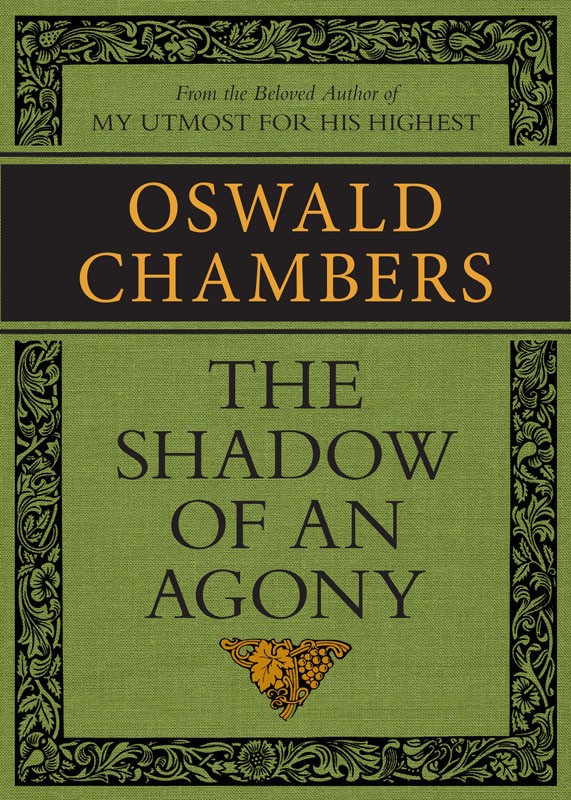
the-shadow-of-an-agonyIn The Shadow Of An Agony, Oswald Chambers explores how we should process the hard events of our lives which seem to totally rock our neat and orderly world. Check out my book review by clicking here, and then enjoy a few quotes from this book.

“If Jesus Christ were only a martyr, His Cross would be of no significance; but if the Cross of Jesus Christ is the expression of the secret heart of God, the lever by which God lifts back the human race to what it was designed to be, then there is a new attitude to things.”

“The agony of a man’s affliction is often necessary to put him into the right mood to face the fundamental things of life. The Psalmist says, ‘Before I was afflicted I went astray: but now I have kept Thy Word.’ The Bible is full of the fact that there has to be an approach to the holy ground. If I am not willing to be lifted up, it is no use talking about the higher heights. … No man can do wrong in his heart and see right afterwards. If I am going to approach the holy ground, I must get into the right frame of mind—the excellency of a broken heart.”

“Jesus Christ did not come to give us pretty ideas of God, or sympathy with ourselves; He came from a holy God to enable men, by the sheer power of His Redemption, to become holy.”

“No man is the same after an agony; he is either better or worse, and the agony of a man’s experience is nearly always the first thing that opens his mind to understand the need of Redemption worked out by Jesus Christ.”

“The attitude of the Bible to the human race is not a common-sense one. The Christian aspect deals with the a specimen of a human race which is a magnificent ruin of what it was designed to be. Supposing the view of the Bible to be right, to whom it is it ‘up to’ to right the wrong? The Creator. Has He done it? He has, and He has done it absolutely single-handed. The tremendous revelation of Christianity is not the Fatherhood of God, but the Babyhood of God—God became the weakest thing in His own creation, and in flesh and blood He levered it back to where it was intended to be. No one helped Him; it was done absolutely by God manifest in human flesh. God has undertaken not only to repair the damage, but in Jesus Christ the human race is put in a better condition than when it was originally designed.”

“We have been taken up with creeds and doctrines, and when a man is hit we do not know what to give him; we have no Jesus Christ, we have only theology. For one man who can introduce another to Jesus Christ by the way he lives and by the atmosphere of his life, there are a thousand who can only talk jargon about Him.”

“The New Testament view of a saint is a more rugged type. You and I are a mixture of dust and Deity, and God takes that sordid human stuff and turns it into a saint by Regeneration. A saint does not mean a man who has not enough sin to be bad, but a man who has received from Jesus Christ a new heredity that turns him into another man.”

“Our guide as to what emotions we are going to allow is this—What will be the logical outcome of this emotion? If it has to do with sin and satan, then grip it on the threshold of your mind and allow it no more way. You have no business to harbor an emotion the outcome of which you can see to be bad; if it is an emotion to be generous, then be generous, or the emotion will react and make you a selfish brute.”

“When I receive the Spirit of God, I am lifted not out of reason, but into touch with the infinite Reason of God.”

“Any fool will give up wrongdoing and the devil, if he knows how to do it; but it takes a man in love with Jesus Christ to give up the best he has for Him.”

“Churchianity is an organization; Christianity is an organism. Organization is an enormous benefit until it is mistaken for the life.” 

“The stupendous difference between the religion of Jesus Christ and every other religion under heaven is that His religion is one which brings help to the bottom of hell, not a religion that can deal only with what is fine and pure.”

Every Thursday I share a section of the current Oswald Chambers book I am reading, in a series called “Thursdays With Oswald.” If you would like to be notified when these posts go live, just enter your email address in the box on the right, and then click “Sign me up!”

The Shadow Of An Agony (book review)

the-shadow-of-an-agonyWhat happens when all of your perfect plans, all of your neat and tidy ideas, come crashing down around you because of a tragedy? This is the topic Oswald Chambers took on in his book The Shadow Of An Agony when The Great War (or what we now call World War I) was ravaging the nations.

Many people have had their worldviews rocked because a tragedy hit them out of nowhere. What then? Do you throw out all you have believed was true? Oswald Chambers explorers this topic in depth in this book, and comes to the conclusion that these shaking events should send us back to the foundation of the Bible.

For example, Chambers says, “In the past the error of the Christian faith was that it paid no attention to a man’s actual life; it simply used human beings and made them catspaws for a religious line of things. The present error is that humanity utilizes Christianity; if Jesus Christ does not coincide with our line of things, we toss Him overboard; Humanity is on the throne. In the New Testament the point of view is God and Man in union.”

Throughout this book you will see that Jesus Christ stepped into our agony to make a way for us to go through it as more than conquerors.

In commenting on The Shadow Of An Agony, Samuel M. Zwemer said, “Oswald Chambers points out that because Jesus Christ is so like unto His brethren we can face this turmoil and stress, and stand with Him in the shadow of a great agony, undiscouraged and unafraid.”

And Pastor Walter H. Armstrong noted, “This book deals with root or rock principles. It comes, not from the surface, but ‘out of the depths.’ It is the work of a great brain and a great heart. It does not shirk the problems of life, but it looks them straight in the face. Over against the tragedy of sin and suffering it brings us to the tragedy of the Cross of Christ.”

If you are walking through a difficult time in your life, the insights Oswald Chambers shares in this book may be just the lifeline you’re looking for. This is also an excellent book to read to prepare yourself for any tragedies which may be lurking around the corner. Don’t get caught unaware, but use these faith-building thoughts to prepare you to stand firm through the trials of life.

Thursdays With Oswald—Life-Altering Regeneration

Oswald ChambersThis is a weekly series with things I’m reading and pondering from Oswald Chambers. You can read the original seed thought here, or type “Thursdays With Oswald” in the search box to read more entries.
Life-Altering Regeneration 

     Personality merges, and you only get your real identity when you are merged with another person. A man has his individuality transfigured when he falls in love. When love or the Spirit of God strikes a man or woman, they are transformed, they no longer insist on their separate individuality. Christianity is personal, therefore it is un-individual. … Our Lord never spoke in terms of individuality…but in terms of personality, “that they all may be one.” … 

     We are much more than we are conscious of being. Our Lord said the Holy Spirit would bring back into our conscious mind the things He had said. We never forget anything although often we cannot recall it; we hear it and it goes into the unconscious mind. Things go on in our unconscious minds that we know nothing about, and at any second they may burst up into our conscious life and perturb us. The Spirit of God enters into a man below the threshold of his consciousness. When He will emerge into a man’s conscious mind no one can say; when He does, there is an earthquake, and the man has to readjust his life in every particular. The Spirit of God entering into the spirit of a man brings a totally new relationship to things. … 

     If all Jesus can do is to tell me that I must be holy, be what I never can be, present me with an ideal I cannot come anywhere near, His teaching plants despair; He is nothing more than a tantalizer and I wish He had never come. But if He is a Regenerator, One who first of all can put into me His own heredity, then I see what He is driving at in the Sermon on the Mount—that the disposition He puts in is like His own. … 

     The Spirit of Christ comes into me by regeneration, then I have to begin to form the mind of Christ, begin to look at things from a different standpoint.

From The Shadow Of An Agony

Our Heavenly Father will never force His love on us. Jesus Christ will never make us receive Him. The Holy Spirit will never change us against our will.

But our Heavenly Father will direct our lives to bring us to our wits’ end. Jesus Christ will constantly woo us with His love. And the Holy Spirit will continually bring to our conscious mind all that Jesus says to us.

The choice is mine—Will I continue to live my life my way, or will I yield to the life-altering regeneration that the the Father, Son and Spirit lovingly offer to me?

Thursdays With Oswald—Happiness Or Holiness?

Oswald ChambersThis is a weekly series with things I’m reading and pondering from Oswald Chambers. You can read the original seed thought here, or type “Thursdays With Oswald” in the search box to read more entries.

Happiness Or Holiness?

     “Beauty” means the perfectly ordered completeness of man’s whole nature. When once a man’s mind is upset, that beauty begins to go, the equilibrium is upset. This accounts for the characteristic tendency abroad today: ignore sin, deny it ever was; if you make mistakes, forget them, live the healthy minded, open-hearted, sunshiny life, don’t allow yourself to be convicted of sin. … 

     Happiness means we select only those things out of our circumstances that will keep us happy. It is the great basis of false Christianity. The Bible nowhere speaks about a “happy” Christian; it talks plentifully of joy. … Happiness would be alright if things were reasonable; it would be ideal if there were no self-interest, but everyone of us is cunning enough to take advantage somewhere, and after a while my inclination is to get my happiness at your cost. … 

     What kind of peace had Jesus Christ? A peace that kept Him for thirty years at home with brothers and sisters who did not believe in Him; a peace that kept Him through three years of popularity, hatred, and scandal; and He says, “My peace I give unto you”; “let not your heart be troubled,” i.e., “see that your heart does not get disturbed out of its relationship to Me.”

     But remember Jesus Christ has to upset the old equilibrium first. When a man is probed into by the Spirit of God, the waters of his conscious life get troubled and other ideas emerge. If I am going to follow the dictates of the Spirit of God and take up the attitude of Jesus Christ to things, it will produce an earthquake in my outlook. … “If you would be My disciple, says Jesus that is the cost.” …

     Take up any attitude of Jesus Christ’s and let it work, and the first thing that happens is that the old order and the old peace go. You cannot get back peace on the same level. If once you have allowed Jesus Christ to upset the equilibrium, holiness is the inevitable result, or no peace forever (Matthew 10:34). 

From The Shadow Of An Agony

Quite simply: I can live for my own happiness, or I can allow my “happiness” to be momentarily upset by allowing the holiness of God to reign in my heart.

Happiness eventually comes to an end, but holiness ultimately leads to the enjoyment of God forever!

The choice is yours: “IF you would be My disciple….”

