T.M. Moore On Considering Jesus

T.M. Moore“We cannot follow what we do not know. And if we do not know Jesus, if our vision and understanding of Him are vague or merely general, following Him, in any sense, will be an act of self-deception. …

“The writer of Hebrews understood this. Twice in his epistle he instructs us to ‘consider Jesus.’ We must consider Jesus if we have any hope of persisting in the faith, no matter the struggle or threat that comes our way (Hebrews 3:1). And we must consider Jesus if we are to run our own particular race as fully and swiftly as possible (Hebrews 12:3). Following Jesus, it seems, means considering Him carefully. The writer uses two different words which we translate by the term consider.

“The first, in Hebrews 3:1, is the same word Jesus used to instruct us to consider the lilies of the field. It seems to have an aesthetic sense to it, implying wonder, admiration, mystery, and awe. To consider Jesus in this way is to wonder at His beauty, majesty, mystery, and power, and to delight in meditating on Him and lingering in His presence.

“The second use of consider, in Hebrews 12:3, encourages a more analytical, logical, and even theological consideration of Jesus Christ. We must study Jesus, think about all the implications of His life, death, and resurrection, and apply our minds to taking every thought captive for obedience to Him (2 Corinthians 10:3-5).” —T.M. Moore

Thursdays With Oswald—Get Rid Of Jargon!

Oswald ChambersThis is a weekly series with things I’m reading and pondering from Oswald Chambers. You can read the original seed thought here, or type “Thursdays With Oswald” in the search box to read more entries.

Get Rid Of Jargon! 

     The New Testament is not written to prove that Jesus Christ is God Incarnate; the New Testament does not prove anything; it simply confirms the faith of those who believe beforehand. Christian evidences don’t amount to anything; you can’t convince a man against his will. … 

     Creeds are the effects of our belief, not the cause of it. I do not have to believe all that before I can be a Christian; but after I have become a Christian I begin to try and expound to myself Who Jesus Christ is, and to do that I must first of all take into consideration the New Testament explanation. “Blessed art thou, Simon bar Jonah: for flesh and blood hath not revealed it unto thee, but My Father which is in heaven.” … 

     Jesus Christ did not come primarily to teach; He came to make it possible for us to receive His heredity, to have put into us a new disposition whereby we can live totally new lives. … The Sermon on the Mount is impossible to a man, and yet it is what our Lord taught. Jesus Christ did not come to teach man to be what he cannot be, but to reveal that He can put into him a totally new heredity; and all He requires a man to say is—“I need it.” … Jesus Christ cannot begin to do anything for a man until he knows his need; but immediately he is at his wits’ end through sin or limitation or agony and cannot go any further, Jesus Christ says to him, “Blessed are you; if you ask God for the Holy Spirit, He will give Him to you.” God does not give us the Holy Spirit until we come to the place of seeing that we cannot do without Him (Luke 11:13). … 

     We have been taken up with creeds and doctrines, and when a man is hit we do not know what to give him; we have no Jesus Christ, we have only theology. For one man who can introduce another to Jesus Christ by the way he lives and by the atmosphere of his life, there are a thousand who can only talk jargon about Him.

From The Shadow Of An Agony

Oswald Chambers is reminding Christians that we only learn more about Jesus by confessing “I need You!” Then the Holy Spirit can begin to reveal real-life truths to us from God’s Word.

Peter reminded us that in order to be ready to give an answer to anyone who asks a Christian the reason for the hope they had, we must first make Jesus the Lord of our life (see 1 Peter 3:15). Creeds and doctrines and theories are of no help to a friend who is in trouble. Let’s not be one of the thousands “who can only talk jargon about Him,” but let’s really know Jesus as Lord, so that we have something real and tangible to pass on to our friends.

Get rid of the jargon! Go deeper in your personal relationship with Jesus Christ!

2 Life-Changing Words

whose-you-areThere’s an interesting story recorded in Acts. Seven sons of a priest named Sceva attempt to cast out a demon by saying, “In the name of Jesus whom Paul preaches, come out!” To which the demon replies, “Jesus I know and Paul I know, but who are you?”

Not only was the demon not exorcised, but the seven men came running out of the house bloodied and naked from the beating they received!

Think about it: If you spoke to the devil and said, “Get away from me!” would he be afraid of you? The simple answer is “No!” Why? Because you have no power in yourself.

It’s not about who you are, it’s about Whose you are.

john-14-20Jesus talked about our place in Him in John 14:20. Notice the word “in” in this verse:

  • Jesus is in the Father
  • The Christian is in Jesus
  • The Spirit of Christ is in the Christian

Here are the two life-changing words for any Christian to remember…

IN CHRIST

The devil wants to get you second-guessing your identity. He wants you to be uncertain if you are worthy of coming into God’s presence. He wants you doubting if you are truly forgiven and worthy of God’s attention. He wants you unsure if you can stand up against him in a spiritual fight.

This uncertainty and doubt is erased by faith in this: I am IN CHRIST!

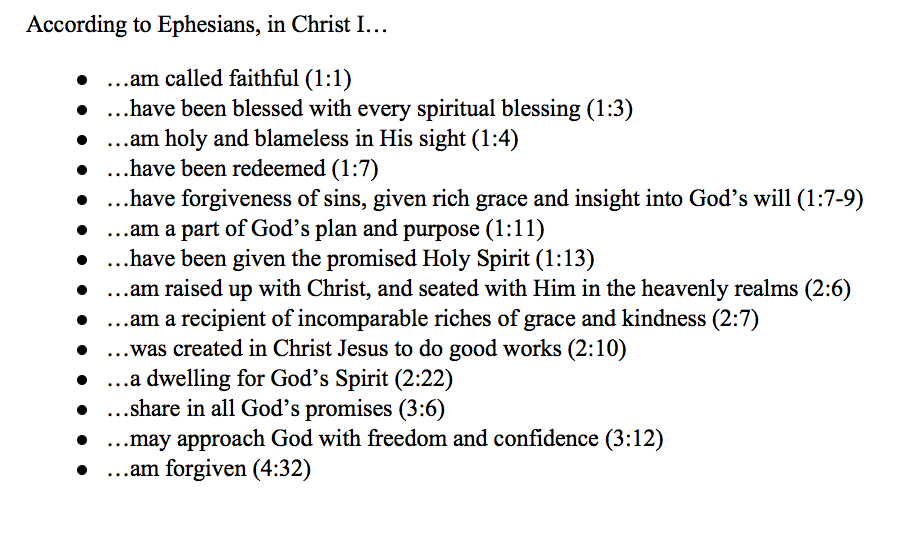
in-christ-i-amPlease print out this list from Ephesians of all the “in Christ” statements Paul shares with us. (You may download a PDF version by clicking here → in-christ-i-am)

Keep this list handy, and the next time satan whispers doubts in your ear like, “Jesus I know and Paul I know, but who are you?” say—

“It’s not who I am, but Whose I am! I am Christ’s. I am in Him and He is in me. I have been forgiven. I am a part of His family. I have a purpose. I am holy and blameless. I am the recipient of all God’s blessings. And you can never defeat me because I AM IN CHRIST!”

If you don’t have a home church, join us next week as we continue our series in the book of Ephesians called Sit Walk Stand.

Thursdays With Oswald—The Uncommon Attitude Of The Bible

Oswald ChambersThis is a weekly series with things I’m reading and pondering from Oswald Chambers. You can read the original seed thought here, or type “Thursdays With Oswald” in the search box to read more entries.

The Uncommon Attitude Of The Bible

     It is not necessary for a man to understand things before he can be a Christian. … Theology is the science of religion, an intellectual attempt to systematize the consciousness of God. Intellect systematizes things to a man’s mind, but we do not reach reality through intellect. Theology comes second, not first, and ought always to be open to dispute. … 

     The attitude of the Bible to the human race is not a common-sense one. The Christian aspect deals with the a specimen of a human race which is a magnificent ruin of what it was designed to be. Supposing the view of the Bible to be right, to whom it is it ‘up to’ to right the wrong? The Creator. Has He done it? He has, and He has done it absolutely single-handed. The tremendous revelation of Christianity is not the Fatherhood of God, but the Babyhood of God—God became the weakest thing in His own creation, and in flesh and blood He levered it back to where it was intended to be. No one helped Him; it was done absolutely by God manifest in human flesh. God has undertaken not only to repair the damage, but in Jesus Christ the human race is put in a better condition than when it was originally designed. … 

     The highest standard God has is Himself, and it is up to God to make a man as good as He is Himself; and it is up to me to let Him do it.

From The Shadow Of An Agony

It’s amazing how much we argue over theology! Especially because theology never saved a soul. Theology simply is a science that organizes our thoughts about God.

But God confounds those who merely want to analyze and systematize Him. I love Chambers’ thought: “The tremendous revelation of Christianity is not the Fatherhood of God, but the Babyhood of God.” Who would have ever conceived such a harebrained idea?!

Theology has value, but it comes second. First comes faith. Never let arguments over theology sway you from your childlike faith in a God Who loved you enough to single-handedly lift you back up to Him!

7 Quotes From “The Philosophy Of Sin”

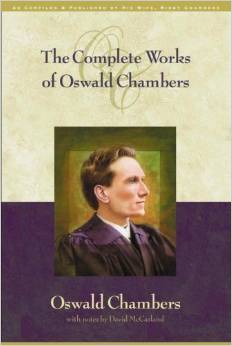
The Complete Works Of Oswald ChambersOswald Chambers always makes me think deeply, but The Philosophy Of Sin was a graduate-level, deep-thinking book on theology and philosophy for me! Check out my review of this book by clicking here. Below are some quotes I especially enjoyed.

“To people who are satisfied on too shallow a level the Bible is a book of impertinences, but whenever human nature is driven to the end of things, the Bible becomes the only Book and God the only Being in the world.”

“The life of nature is neither moral nor immoral; our bodies are neither moral nor immoral, we make them moral or immoral. Our Lord had a body, and we read that He hungered; it was not a sin for Him to be hungry, but it would have been a sin for Him to have eaten during the forty days in the wilderness, because His Father’s word at that time was that He should not eat. It is not a sin to have a body, to have natural appetites, it is a sin to refuse to sacrifice them at the word of God.”

“Lust simply means, ‘I must have this at once’; it may be a bodily appetite or a spiritual possession. The principal lust works on is, ‘I must have it at once, I cannot wait for God’s time, God is too indifferent,’ that is the way lust works.”

“If all Jesus Christ can do is to run a parallel counteraction with what satan can do, His right name is ‘Culture,’ not ‘Savior’; but His revealed nature was stated by the angel to Mary, and repeated over and over again, ‘Thou shalt call His name Jesus; for He shall save His people from their sins.’ The slight views of salvation, the sympathetic drifty views that all Jesus Christ can do is to put in us a principle that counteracts another principle, will cause anyone who is got to the last limit to blaspheme God for a thing like that. It all comes from a flimsy, wrong view of sin. If that is all He can do, what is the good of calling Him Savior? … It is sin that He came to cope with; He did not come to cope with the poor little mistakes of men, they cope with their own mistakes; He came to give them a totally new stock of heredity, that is, He came to implant into them His own nature, so that satan’s power in the soul is absolutely destroyed, not counteracted.”

“This aspect of the death of Jesus takes us into a spiritual domain beyond the threshold of the thinking of the majority of us. The cry of the Cross, ‘My God, My God, why hast Thou forsaken Me?’ is unfathomable to us. The only ones—and I want to say this very deliberately—the only ones who come near the threshold of understanding the cry of Jesus are not the martyrs, they knew that God had not forsaken them, His presence was so wonderful; not the lonely missionaries who are killed or forsaken, they experience exultant joy, for God is with them when men forsake them: the only ones who come near the threshold of understanding the experience of God-forsakenness are men like Cain—‘My punishment is greater than I can bear’; men like Esau, ‘…an exceedingly bitter cry’; men like Judas. Jesus Christ knew and tasted to a fuller depth than any man could ever taste what it is to be separated from God by sin.”

“How Jesus Christ does cleanse our conscience! It is freedom not only from sin and the damage sin has done, but emancipation from the impairing left by sin, from all the distortions left in mind and imagination.”

“The conscience formed in us by the Holy Spirit makes us amazingly sensitive to the things that tell against the honor of God.”

I’ll be sharing other quotes from this book in the near future, and I also share an extensive passage from the current Chambers’ book I am reading every Thursday. If you want to be notified when those quotes are posted, please enter your email address in the box to the right and click “Sign me up!”

I share quotes from Oswald Chambers and other inspirational authors daily on both Tumblr and Twitter.

Thursdays With Oswald—A New Perspective Of Calvary

Oswald ChambersThis is a weekly series with things I’m reading and pondering from Oswald Chambers. You can read the original seed thought here, or type “Thursdays With Oswald” in the search box to read more entries.

A New Perspective Of Calvary

     If Jesus Christ were only a martyr, His Cross would be of no significance; but if the Cross of Jesus Christ is the expression of the secret heart of God, the lever by which God lifts back the human race to what it was designed to be, then there is a new attitude to things. … 

     There are any number of amateur skeptics, and the men who are seeing the difference between “believing their beliefs,” and “believing God,” men, who, through the turmoil and the stress, are seeing that rationalism is not the basis of thing. According to the Bible, the basis of things is tragedy, and the way out is the way made by God in Redemption. The New Testament does not say that the human race is evolving, but that the human race is a magnificent ruin of what it was designed to be. …

     Paul says the fundamental revelation of the New Testament is that God redeemed the whole human race when they were spitting in His face, as it were. … 

     The majority of people who have never been touched by affliction see Jesus Christ’s death as a thing beside the mark. When a man gets to his wits’ end and things go hard with him, his thick hide is pierced and he is stabbed wide awake, then for the first time he begins to see something else—“At last I see; I thought that He was stricken, smitten of God and afflicted; but now I see He was wounded for my transgressions.” … 

     Jesus Christ did not come to give us pretty ideas of God, or sympathy with ourselves; He came from a holy God to enable men, by the sheer power of His Redemption, to become holy.

From The Shadow Of An Agony

Oswald Chambers wrote these words in the midst of The Great War (what we now refer to as World War I), when everyone’s belief in rationalism was shaken to the core. Tragedy has a tendency to do that to us.

Chambers says that trouble in this world should point us to the unshakable, inescapable truth that this world is “a magnificent ruin of what it was designed to be,” and the only security and hope we have is a new life with God though the Redemption Jesus paid for at Calvary.

May any pain, suffering, or confusion you feel in this world help you see the Cross of Christ in a whole new light.

11 More Quotes From “Culture”

cultureA.W. Tozer wrote almost 50 years ago, but his words to the church still ring true today. Check out my review of Culture, and then enjoy some additional quotes from this book.

“To preserve life the physician and the druggist use words of fixed meaning common to both. How much more should the pulpit and the pew have a clear understanding about the words of eternal life. The modern effort to popularize the Christian faith has been extremely damaging to that faith. The purpose has been to simplify truth for the masses by using the language of the masses instead of the language of the church. It has not succeeded, but has added to rather than diminished religious confusion.”

“The hope of the church yet lies in the purity of her theology, that is, her beliefs about God and man and the relation to each other. These beliefs have been revealed to her by the inspiration of the Holy Spirit in the sacred Scriptures. Everything there is clear-cut and accurate. We dare not be less than accurate in our treatment of anything so precious.”

“I think we make two mistakes in our attitude toward our Christian leaders, one is not being sufficiently grateful to them and the other in following them too slavishly.”

“Today we evangelicals are showing signs that we are becoming too rich and too prominent for our own good. With a curious disregard for the lessons of history we are busy fighting for recognition by the world and acceptance by society.”

“That terrible zone of confusion so evident in the whole life of the Christian community could be cleared up in one day if the followers of Christ would begin to follow Christ instead of each other.”

“The difficulty we modern Christians face is not misunderstanding the Bible, but persuading our untamed hearts to accept its plain instructions.”

“Our churches these days are filled (or one-quarter filled) with a soft breed of Christian that must be fed on a diet of harmless fun to keep them interested. About theology they know little. Scarcely any of them have read even one of the great Christian classics, but most of them are familiar with religious fiction and spine-tingling films. No wonder their moral and spiritual constitution is so frail.”

“To accept the call of Christ changes the returning sinner indeed, but it does not change the world. The wind still blows toward hell, and the man who is walking in the opposite direction will have the wind in his face. And we had better take this into account when we ponder on spiritual things.”

“Christianity’s scramble for popularity today is an unconscious acknowledgment of spiritual decline.”

“The desire to stand well with our fellow man is a natural one, and quite harmless up to a point, but when that desire becomes so all-consuming that we cannot be happy apart from the praises of man, it is no longer harmless, it is sinful in itself and injurious in its effects.”

“A Christian’s standing before God does not depend upon his standing before men. A high reputation does not make a man dearer to God, nor does the tongue of the slanderer influence God’s attitude toward His people in anyway.”

To read some additional quotes I shared from Culture, click here. You may also follow me on Twitter and Tumblr to read quotes which I share daily from Tozer and other notable thinkers.

Christlike Wives And Husbands

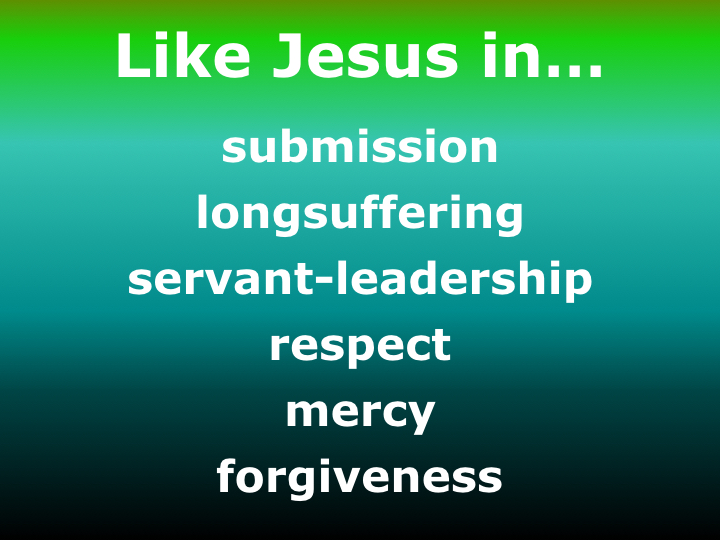
like-jesusTime after time Peter calls Christians to live a counter-cultural lifestyle. The most countercultural example we have ever seen is Jesus Christ.

Peter shows us how Jesus—in the most excruciating situation possible—lived. Heading into the torture of crucifixion

  • He was submissive to His Father’s will
  • He remained focused on the future glory, not just the immediate pain
  • He continued to be a servant-hearted leader
  • He spoke to those around Him respectfully
  • He extended mercy to His tormentors
  • He prayed for (and purchased with His blood) His tormentors’ forgiveness

Peter then tells Christian wives and husbands they are to behave in the same way as Jesus. Wow!

More specifically Peter challenges Christlike wives to be:

  1. Submissive to their husbands—I like how the Amplified Bible says this in verse 1: “subordinate, not as inferior, but out of respect for the responsibilities entrusted to husbands and their accountability to God, and so partnering with them.
  2. Christlike in their behavior.
  3. Distinctive by their purity.
  4. Reverent to God, by honoring the image of God in their husbands.
  5. Beautiful from the inside out.
  6. Consistently doing what is right
  7. Not swayed by fear—“do what is right without being frightened by any fear [that is, being respectful toward your husband but not giving in to intimidation, nor allowing yourself to be led into sin, nor to be harmed]” (v. 6 AMP).

Likewise Peter challenges Christlike husbands to be:

  1. Submissive to their wives—remember the in the same way phrase? That applies to the men too. Submit to one another out of reverence for Christ. … Husbands, love your wives, just as Christ loved the church and gave Himself up for her (Ephesians 5:21, 24).
  2. Considerate of her—the King James Version says, “dwell with them according to knowledge.” That word for knowledge means to study your wife and know what she likes and doesn’t like.
  3. Respectful in the way he treats his wife.
  4. Treating her as a partner and heir in your spiritual heritage.
  5. Understanding the part she plays in your spiritual development—“The same goes for you husbands: Be good husbands to your wives. Honor them, delight in them. As women they lack some of your advantages. But in the new life of God’s grace, you’re equals. Treat your wives, then, as equals so your prayers don’t run a ground” (v. 7 MSG).

Here are two questions I think Christian wives and husbands need to seriously consider: Are you thinking about your role as a husband or wife in biblical terms or cultural terms? If you are thinking in cultural terms, are you willing to try it God’s way?

Our Christian marriages should be “alien” to the way the world operates; they should be counter-cultural. That kind of marriage is what points people to a relationship with Jesus!

If you’ve missed any messages in this series, you may find the complete list by clicking here.

10 More Quotes From “The Beauty Of Intolerance”

Beauty Of IntoleranceI found Josh and Sean McDowell’s book The Beauty Of Intolerance to be such a timely book! Parents, teachers, pastors, and anyone who works with youth should definitely read this book to help navigate through the tolerance-saturated world we live in. You can check out my review of this book by clicking here.

“God gave Moses pages and pages of highly specific rules to govern the relationships and morality of His people. Each of those rules, which we call precepts, applies to a specific situation. But each is important because it is grounded in a principle, which is a fundamental, primary law from which other laws—the precepts—are derived. Each principle, in turn, is grounded in a Person—in the very character of God Himself. … God is not behind the principles and precepts simply to validate the rules; He is there as a Person for the purpose of relationship.”

“When moral truth becomes a matter of opinion, personal preference, or the individual’s views and feelings, then practically anything goes. … In a culture of tolerance where the individual decides morality, morality has no bounds.”

“An entire generation tends to go to the Bible not to discover the truth and bend their lives to it accordingly but to use it as sort of a self-help book to help them form their own version of what’s true and false, good and evil, right and wrong.”

“When you discuss the Bible, do not refer to it simply as a spiritual book that teaches us how to live, but as a road map leading one toward the discovery of true reality. … The one true God’s communication to humanity and the whole of Christianity as a religion is based on three primary realities supported by evidences: (1) The historic reliability of Scripture; (2) The deity of Christ; and (3) Christ’s bodily resurrection.”

“While we all may have a sense of what is evil and what is good, under the philosophy of cultural tolerance, evil and good can only be relative ideals. Without an objective truth—a set of universal moral values—good and evil are defined by the individual, community, or society. Therefore we have no moral basis by which to judge another person, community, or nation for what they do or don’t do.”

“Unless justice is rooted in a moral authority beyond those with the most power or even with the most votes, there cannot be true justice for all. … Justice, charity, and human rights are grounded in the fact that we are created in God’s image with value, dignity, and worth. … God’s mercy and justice as our model has fostered societal justice and provided more positive contributions to society in general than any other force in history.”

“The intolerance of the early Christians was a beautiful thing. They believed that everyone—including the poor, the homeless, the handicapped, the sick—was made in the image of God with dignity and worth. They were utterly intolerant of injustice, and they did whatever they could to correct the injustices they saw in society.”

“Real love—biblical, Godlike love—exposes cultural tolerance as the counterfeit of love because cultural tolerance fails to point people to a universal standard of morality designed to save them from serious harm. Cultural tolerance does not address what is in the best interest of a person—it possesses no moral standard that aligns to what is universally right and good. Real love, on the other hand, looks out for the best interest of others.”

“Every truth, every rule, and every guideline coming from God’s Word is issued from the loving heart and character of God for our own good.”

“Love is making the security, happiness, and welfare of another person as important as your own. Biblical love is not merely focused on another but on the good of another, even if the other does not recognize or accept the reality of the good.”

To read the first set of quotes I shared from The Beauty Of Intolerance, please click here. And be sure to follow me on Twitter and Tumblr to read more quotes from this book, and from lots of other profound thinkers, that I share daily.

Thursdays With Oswald—The Harmony Of Health

Oswald ChambersThis is a weekly series with things I’m reading and pondering from Oswald Chambers. You can read the original seed thought here, or type “Thursdays With Oswald” in the search box to read more entries.

The Harmony Of Health

     Health, or physical harmony, is a perfect balance between our organism and the outer world. … The great error of the healthy-minded cult is that it ignores a man’s moral and spiritual life. … The attitude to sickness in the Bible is totally different from the attitude of people who believe in faith-healing. The Bible attitude is not that God sends sickness or that sickness is of the devil, but that sickness is a fact usable by both God and the devil. 

   Happiness or moral harmony is a perfect balance between our inclination and our environment. … The Bible reveals that a man can have physical health at the cost of his moral welfare, and happiness at the cost of spiritual welfare. 

   Holiness, or spiritual harmony, is a perfect balance between our disposition and the law of God. … 

   The devil tries to make us think that when we have entered into the sanctified life, all is done; it is only begun. We have entered into Jesus Christ’s finished work, but remember, says Paul, you have attained to nothing yet; everything is perfectly adjusted, now began to attain and to “grow up into him in all things. These three things develop slowly together: first, the basis of spiritual holiness; second, the building of moral happiness; and third, the decoration of physical health. A full-grown man in Christ Jesus is one who has become exactly like Christ Jesus. “Till we all come…unto the measure of the stature of the fullness of Christ” (Ephesians 4:13). 

From The Philosophy Of Sin

Quite simply Oswald Chambers identifies health as a perfect balance:

  • Physical health balances outside germs against inside defenses.
  • Emotional health balances outside circumstances with inside coping mechanisms.
  • Spiritual health balances God’s law (outside) with our obedience to that law (inside).

Furthermore, Chambers says that Jesus Christ is our measuring stick. We must study God’s Word, and watch Jesus closely to see how He lived out the perfect balance of the Scriptural principles so that we can attain “unto the measure of the stature of the fullness of Christ.”