Thursdays With Oswald—Conscience

Oswald ChambersThis is a weekly series with things I’m reading and pondering from Oswald Chambers. You can read the original seed thought here, or type “Thursdays With Oswald” in the search box to read more entries.

Conscience 

     Conscience is that innate faculty in a man’s spirit that attaches itself to the highest the man knows, whether he be an atheist or a Christian. The highest the Christian knows is God: the highest the atheist knows is his principles. … 

     When conscience begins to be awakened by God, we either become subtle hypocrites or saints, that is, either we let God’s law working through conscience bring us to the place where we can be put right, or we begin to hoodwink ourselves, to affect a religious pose, not before other people, but before ourselves, in order to appease conscience—anything to be kept out of the real presence of God because where ever He comes, He disturbs. … 

     The majority of us have caught on the jargon of holiness without the tremendous panging pain that follows the awakening to holiness. The Spirit of God brings us to face ourselves steadily in the light of God until sin is seen in its true nature. If you want to know what sin is, don’t ask the convicted sinner, ask the saint, the one who has been awakened to the holiness of God through the Atonement; he is the one who can begin to tell you what sin is. … It is only as we walk in the light as God is in the light that we begin to understand the unfathomable depths of cleansing to which the blood of Jesus Christ goes (1 John 1:7). … 

     When a man begins his life with God there are great tracts of his life that he never bothers his head about, but slowly and surely the Spirit of God educates him down to the tiny little scruple. Every crook and cranny of the physical life, every imagination and emotion is perfectly known to God, and He demands that all these be blameless. … The marvel of the Atonement is just this very thing, that the perfect Savior imparts His perfections to me, and as I walk in the light as God is in the light, every part of bodily life, of affectionate life and of spirit life are kept unblameable in holiness; my duty is to keep in the light, God does all the rest.

From The Philosophy Of Sin

Quick question: What are you going to do the next time the Holy Spirit disturbs your conscience?

7 Quotes From “The Beauty Of Intolerance”

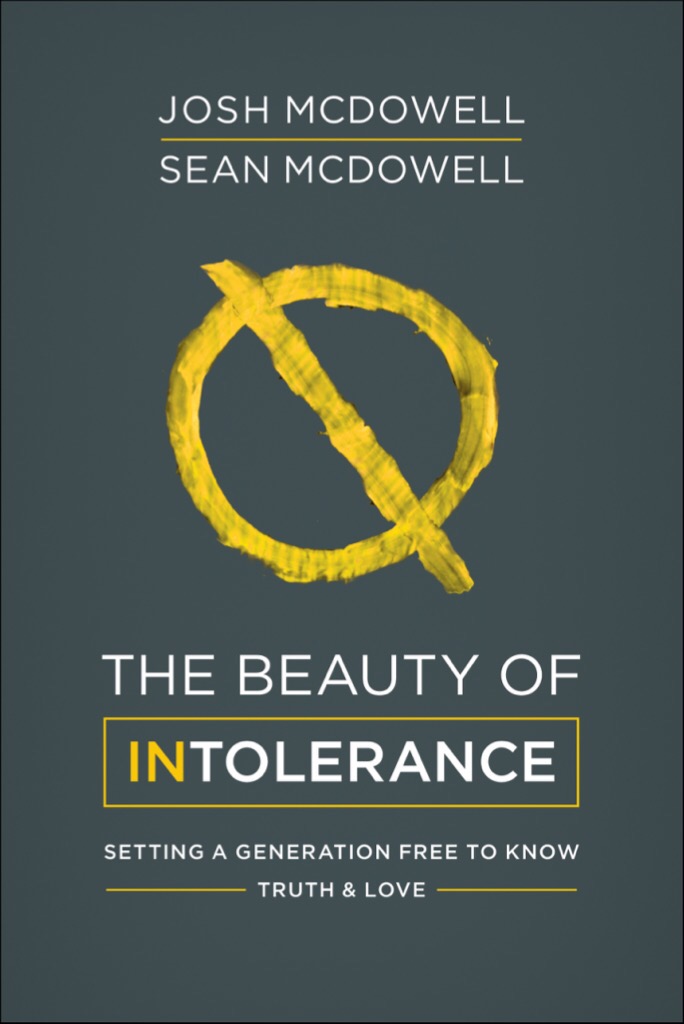
Beauty Of IntoleranceTolerance and intolerance are definitely the buzzwords of today’s culture. But depending upon whom you’re asking, the definition of these words may be dramatically different. This is where Josh McDowell and Sean McDowell’s book The Beauty Of Intolerance can help. Please be sure to check out my book review here, and then check out some of the quotes from this very important book below.

“It’s natural—and if done properly, even healthy—for the people of each new generation to establish a unique identity apart from their parents. Yet what we are experiencing today is far from the typical generation gap. We are seeing a cultural shift that is separating Christian parents from their children perhaps unlike anything seen before.”

“Your narrative about truth is probably based on your understanding of the Bible. Whether they realize it or not, our young people today largely derive their narrative about truth from a culture that says moral truth is found within the individual. These two narratives can be expressed in terms of the biblical narrative about truth and the cultural narrative about truth. When our young people accept the cultural narrative, it becomes the lens by which they interpret relationships and much of the world around them.”

“If each person is a valid, independent source of applied truth, then there can be no basis for external disapproval. There is no overarching standard by which to apply judgment. That means tolerance as the culture defines it is the only appropriate response to each individual’s moral choices. That kind of tolerance—what we will call cultural tolerance—propagates the notion that all moral truth is equal. From that perspective it only seems right to respect, accept, and approve of diverse views and the behavior of others, since doing otherwise would be intolerant and judgmental. … But what many of today’s young people don’t understand is that they have unwittingly bought into cultural tolerance, which is a faulty narrative about moral truth that fundamentally changes the traditional meaning of words like tolerance, acceptance, respect, and the like. They tend to think that they have the right to determine what is right and wrong for themselves.”

“God is not only the standard of what is true—He is truth—but He is also the perfect standard for tolerance. That is, He is the standard for tolerance in the original and traditional meaning of the word—a tolerance that loves us without approving of our sinful condition. Both truth and traditional tolerance reside in the character of God, and they are inseparable.”

“While the Incarnation is the personification of love and acceptance, God’s disdain for sin reflects His holy intolerance. What sin did to humans broke His heart. Separated from God, the human race wallowed in greed, lust, jealousy, hatred, and conflict. Human sin has rippled down from one generation to another with the same tragic results: pain and suffering, heartache and ruin, destruction and death. God’s hatred of evil and injustice—of everything that hurts us—prompted Him to be radically intolerant of sin and its devastating effects on His creation. His amazing love for us prompted Him to do something to save us from it. That something cost Him the death of His only Son, but He considered you and me worth it. God’s intolerance is an amazing and beautiful thing.”

“Moral truth isn’t simply an abstract concept; it originates in a Person who is the original and standard for morality. Jesus said, ‘I am the way, the truth, and the life’ (John 14:6). Moral truth ultimately finds its source in a ‘Who,’ not merely in a ‘what.’ In other words, moral claims are true if they correspond to the character of God—Who is the objective source for morality. God is the source of all moral truth.”

“The reason we think there are such concepts as ‘fair’ and ‘unfair’ is because our Maker is a just God and we have been made in His image (Genesis 1:27). The reason love is a virtue and hatred a vice is because the God of relationships who formed us is a God of love. The reason honesty is right and deceit is wrong is because God is true. The reason fidelity in marriage is honorable and infidelity is not is because God is faithful. The reason chastity is moral and promiscuity is immoral is because God is pure. … All truth claims cannot be equal because Jesus didn’t claim to be ‘a’ truth—one among viable others. His claim was exclusive.”

I will be posting more quotes from The Beauty Of Intolerance in the near future. If you would like to be notified when these quotes appear, please enter your email address in the form on the right to subscribe.

Also check out quotes from this and other books that I share daily on Twitter and Tumblr.

5 Ways To Be A Christlike Employee

Work like JesusHave you ever had a bad boss? One who was harsh, unreasonable, overly demanding, or just a plain meany? Do you think working for a “bad boss” means that you get to lower your standards?

Not if you are a Christian!

Christians are on Earth to represent Jesus. We are aliens and strangers here for a short time, but here to also point people toward Heaven. One place we have tremendous opportunity to do this is on our jobs.

Think about it: most people will work 30-40 hours per week, and probably work 40-50 years of their life. That’s a lot of hours in which to show that living for Jesus makes all the difference in the world. 

Peter addresses our work situation in his first epistle. In essence he says, “You may not be able to control your boss’s actions, but you can control your reactions. A Christian has a different attitude about workplace employers than Earthlings do.”

The two things that set Christian employees apart is their submission and their respect.

Submission means understanding the proper order. This isn’t just showing up on time, wearing the right uniform and checking off the right things on your job description. All of those things can be done with a lousy attitude, with an attitude that’s nothing like Christ’s attitude.

Submission means viewing our employers differently—

  • Obeying them like we would obey Jesus (Ephesians 6:5).
  • Being sincere when we say, “Yes, I’d be happy to do that” (Ephesians 6:5).
  • Working hard even when our employer isn’t watching us (Ephesians 6:6).

With that in mind, here are five ways to be an “alien employee.” That is, someone who honors God on-the-job…

  1. Work for God.
  2. Trust God to be your Provider, not your employer.
  3. Trust God to keep perfect records of your faithful service.
  4. Pray for God’s blessing on your employer.
  5. Pray for your employer to see Jesus in your work ethic.

Here’s a great question to ask yourself: If Jesus were filling out my employee evaluation, what would He say about my work ethic? 

If you’ve missed any messages in this series, you may find the complete list by clicking here.

Thursdays With Oswald—The Value Of Temptation

Oswald ChambersThis is a weekly series with things I’m reading and pondering from Oswald Chambers. You can read the original seed thought here, or type “Thursdays With Oswald” in the search box to read more entries.

The Value Of Temptation

     Temptation is not sin…. Temptation is something that exactly fits the nature of the one tempted, and is therefore a great revealer of the possibilities of the nature. … A good illustration of temptation is the way steel is tested. Steel can be “tired” in the process of testing, and in this way its strength is measured. … Temptation trains innocence into character or else into corruption. … 

     If the power to disobey were removed, our obedience would be of no value, for we should cease to be morally responsible. It is gloriously possible not to sin, but never impossible to sin, because we are moral agents. Morality must be militant in this order of things, but we can be “more than conquerors” every time. …

     Spiritual life is attained…by moral choices, whereby we test the thing that presents itself to us as being good. … Health is the balance between my physical life and external nature. If the fighting force on the inside begins to dwindle or is impaired, I get diseased, things outside begin to disintegrate my vital force. … The same is true spiritually; if I have enough spiritual fighting capacity, I will produce a character like Jesus Christ’s. Character must be attained, it is never given to us.

From The Philosophy Of Sin

It is interesting to think that what tempts us is a revealer of what’s really inside of us. We need to watch carefully what is enticing us toward sin, because that will help us see the areas of weakness in our lives.

God allows temptation to occur as a means of helping us submit that area of revealed weakness to His control. Lust is wanting something my way, and sin is when I give in to that lust. What I should do instead of giving in is submit that area of weakness to Christ’s Lordship.

I can develop the same character that Jesus Christ exhibited on earth, IF I will allow the Holy Spirit to develop that “vital force” in me. The Holy Spirit doesn’t give me character, but He gives me strength to overcome temptation and thus develop that Christ-like character.

Don’t confuse temptation with sin. But don’t treat temptation lightly either. See temptation for what it really is: (1) a revealer of an area of weakness in your heart, and (2) an opportunity for you to develop Christ-like character.

9 More Quotes From “Today’s Moment Of Truth”

Today's Moment Of TruthToday’s Moment Of Truth by Lee Strobel and Mark Mittelberg is so chockfull of helpful truths that I couldn’t possibly have shared all of the passages I highlighted. Here are a few more quotes I wanted to share with you:

“Jesus said, ‘Do not believe Me unless I do the works of My father. But if I do them, even though you do not believe Me, believe the works, that you may know and understand that the Father is in Me, and I in the Father’ (John 10:37-38). And Jesus did the miraculous works He referred to. Even the Pharisee Nicodemus conceded, ‘Rabbi, we know that You are a teacher who has come from God. For no one could perform the signs You are doing if God were not with Him’ (John 3:2).

“We can see such confirmation repeatedly in the lives of Jesus and the biblical prophets. But it never happened in the life of Mohammad, the founder of Islam. Mohammad believed Jesus was a prophet who performed miracles, including raising the dead. Muslims also believe Moses and Elijah performed miracles.

“However, according to the Qur’an, when unbelievers challenged Mohammad to perform a miracle, he refused. He merely said they should read a chapter in the Qur’an (Surah 2:118; 3:181-184; 4:153; 6:8, nine, 37).

“So, unlike Jesus, Mohammad never did miracles. It wasn’t until approximately 150 to 200 years after Mohammad’s death that some of his followers begin to come up with stories of miracles and ascribe them to him.” —Lee Strobel & Mark Mittelberg 

“There are two major competing worldviews to Christian theism—atheism and pantheism…. The problem with atheism is that, with its denial of God’s existence, there’s a loss of any ultimate moral basis by which to declare something good or evil. So atheists are left without any objective standard by which to judge something as being right or wrong. Instead, they’re left with mere preferences. I have mine. You have yours. Rape and murder may not be my cup of tea, but they maybe somebody else’s. And who are we to say that what others choose to do is wrong? [We are] not saying an atheist cannot live a moral life; we are saying that an atheist cannot define what morality is. ….

“If everything is part of god [as in pantheism], then what we call evil is actually part of that god as well. … This is the very god, or ultimate reality, that Eastern philosophy says we’re supposed to strive to become more like and eventually to become one with. This presents a tremendous problem: we’re supposed to join with the very entity that contains evil within itself!” —Lee Strobel & Mark Mittelberg

“Revering Christ as Lord and being prepared to defend our faith are ongoing processes in the Christian life. … It’s interesting that in the original Greek, the word Peter used for answer is apologia [1 Peter 3:15], from which we get our word apologetics. It literally means we are to be ready to give a speech of defense—a well-thought-out account of why our faith in Christ makes sense. … With God’s help we can present information that will remove intellectual barriers, helping people move one step closer to faith in Christ.” —Lee Strobel & Mark Mittelberg

“In 2 Chronicles 7, God says if Israel’s sin reaches a certain level, He’ll destroy the temple, exile the people, and leave them in a state of judgment. Sure enough, this comes to pass. The prophet Daniel prays in Daniel 9 that God would have mercy. God gives him a revelation about the temple being rebuilt. Before this new temple is destroyed, Daniel is told, several things are going to take place, including the bringing of everlasting atonement—the final dealing with sin.

“The prophet Haggai says the glory of the second temple will be greater than the glory of the first temple. God will fill the second temple with His glory. Then the prophet Malachi says the Lord will come to His temple. He uses a Hebrew term that always refers to God Himself: the Lord—He will come to that temple.

“Keep in mind the second temple was destroyed in AD 70. Atonement for sin had to be made and the divine visitation had to take place before the second temple was destroyed.

“So … if it’s not Yeshua, the Jewish name for Jesus, then throw out the Bible, because nobody except Him accomplished what needed to be done prior to AD 70. What divine visitation did take place if not for Yeshua? When else did God visit the second temple in a personal way? How else was the glory of the second temple greater than the first?

“Either the Messiah came two thousand years ago, or the prophets were wrong and we can discard the Bible. But they weren’t wrong. Yeshua is the Messiah—or nobody is.” —Michael Brown, a messianic Jew

“Even nonreligious people live in the trust that their nonreligious beliefs are accurate and that they won’t someday face a thoroughly religious Maker who actually did issue a list of guidelines and requirements that they failed to pay attention to.” —Mark Mittelberg 

“There can be no doubt that archaeology has confirmed the substantial historicity of Old Testament tradition.” —William F. Albright

“The noted Roman historian Collin J. Hemer, in The Book Of Acts In The Setting Of Hellenistic History, shows how archaeology has confirmed not dozens, but hundreds and hundreds of details from the biblical account of the early church. Even small details have been corroborated, like which way the wind blows, how deep the water is a certain distance from the shore, what kind of disease a particular island had, the names of local officials, and so forth.

“Now, Acts was authored by the historian Luke. Hemer gives more than a dozen reasons why Acts had to have been written before AD 62, or about thirty years after Jesus’ crucifixion. Even earlier, Luke wrote the Gospel of Luke, which is substantially the same as the other biblical accounts of Jesus’ life.

“So here you have an impeccable historian, who has been proven right in hundreds of details and never proven wrong, and it’s written within one generation while eyewitnesses were still alive and could have disputed it if it were exaggerated or false.” —Norman Geisler 

“No Book of Mormon cities have ever been located, no Book of Mormon person, place, nation, or name has ever been found, no Book of Mormon artifacts, no Book of Mormon scriptures, no Book of Mormon inscriptions,…nothing which demonstrates the Book of Mormon is anything other than myth or invention has ever been found.” —John Ankernerg and John Weldon

“Jesus did exist, whether we like it or not.” —Bart Ehrman, an agnostic

If you would like to read the first set or quotes from this book, please click here.

You can check out my review of Today’s Moment Of Truth here.

And to read some of the other quotes I’ll be sharing from this book, be sure to follow me on Tumblr and Twitter.

The Gospels Side-By-Side (book review)

Gospels Side By SideI love reading. But hands-down, without a doubt, my favorite book to read is the Bible. So I’m always intrigued by any resource that can help me get more out of my time in the Scriptures. In The Gospels Side-By-Side by Rose Publishing, I found a goldmine.

This short pamphlet is chockfull of graphics, charts, maps and historical background information  that helped me see the bigger picture of the story of Jesus that the Gospel writers were conveying to us. It begins with the unique perspective of each Gospel writer, and launches us deeper into the Bible from there.

In this book you will see things like:

  • The events of Christ’s life, and which Gospel tells particular events
  • The miracles of Jesus
  • The parables of Jesus
  • The chronological movements of Jesus
  • How Jesus celebrated Passovers during His public ministry
  • How these biblical biographies compare to other biographies of the era
  • Even the historical harmony of the Gospel message in the post-apostolic age

This should bring new life to any Bible student’s reading time! I highly recommend you check out not only this pamphlet, but many of the other resources available at Rose Publishing.

Here are a couple of screenshots from the book…


Screen Shot -Christ's movesScreenshot - gospel writers

Poetry Saturday—Joy And Sorrow

I know this technically isn’t a “poem” but I found this allegory poetically beautiful. I hope you enjoy it as I did!

FullSizeRender“…sorrowful, yet always rejoicing…” (2 Corinthians 6:10)

Sorrow was beautiful, but her beauty was the beauty of the moonlight shining through the leafy branches of the trees in the wood, and making little pools of silver here and there on the soft green moss below. When Sorrow sang, her notes were like the low sweet call of the nightingale, and in her eyes was the unexpectant gaze of one who has ceased to look for coming gladness. She could weep in tender sympathy with those who weep, but to rejoice with those who rejoice was unknown to her.

Joy was beautiful, too, but his was the radiant beauty of the summer morning. His eyes still held the glad laughter of childhood, and his hair had the glint of the sunshine’s kiss. When Joy sang his voice soared upward as the lark’s, and his step was the step of a conqueror who has never known defeat. He could rejoice with all who rejoice, but to weep with those who weep was unknown to him.

“But we can never be united,” said Sorrow wistfully.

“No, never.” And Joy’s eyes shadowed as he spoke. “My path lies through the sunlit meadows, the sweetest roses bloom for my gathering, and the blackbirds and thrushes await my coming to pour forth their most joyous lays.”

“My path,” said Sorrow, turning slowly away, “leads through the darkening woods, with moon-flowers only shall my hands be filled. Yet the sweetest of all earth-songs—the love song of the night—shall be mine; farewell, Joy, farewell.”

Even as she spoke they became conscious of a form standing beside them; dimly seen, but of a Kingly Presence, and a great and holy awe stole over them as they sank on their knees before Him.

“I see Him as the King of Joy,” whispered Sorrow, “for on His Head are many crowns, and the nail prints in His hands and feet are the scars of a great victory. Before Him all my sorrow is melting away into deathless love and gladness, and I give myself to Him forever.”

“Nay, Sorrow,” said Joy softly, “but I see Him as the King of Sorrow, and the crown on His head is a crown of thorns, and the nail prints in His hands and feet are the scars of a great agony. I, too, give myself to Him forever, for sorrow with Him must be sweeter than any joy that I have known.”

“Then we are one in Him,” they cried in gladness, “for none but He could unite Joy and Sorrow.”

Hand in hand they passed out into the world to follow Him through storm and sunshine, in the bleakness of winter cold and the warmth of summer gladness, “as sorrowful yet always rejoicing.” —Lettie Cowman

Trust The Bridge

From Corrie ten Boom’s book I Stand At The Door And Knock

John 14.6“Once I was waiting at a very primitive bridge in New Zealand. We were traveling by car, but we didn’t dare to cross. First, one of the men in the car went to investigate if the bridge was strong enough. It appeared to be strong enough, even though it was very primitive, and we crossed without a problem.

This man was not investigating our trust in the bridge. Very often, we tend to look at our faith, and we know our faith is big and strong, or weak and small. But we shouldn’t investigate our faith; we should investigate the Bridge. We should not rely on ourselves, but on Him. And when we look to Jesus, we know that He is strong.” —Corrie ten Boom (emphasis added)

Thursdays With Oswald—Backsliding

Oswald ChambersThis is a weekly series with things I’m reading and pondering from Oswald Chambers. You can read the original seed thought here, or type “Thursdays With Oswald” in the search box to read more entries.

Backsliding

     The tendency to rest in any of the blessings which are the natural outcome of union with God is the beginning of backsliding. … 

     If God were to remove from us as saints the possibility of disobedience there would be no value in our obedience, it would be a mechanical business. … The possibility of disobedience in a child of God makes his obedience of amazing value. … 

     If we have received the life of Jesus, it is unconscious blasphemy in God’s sight to stop short of attaining anything He reveals as possible for us. … If once we deliberately stop short and refuse to let God’s life has its way with us, we shall revile the truth because it has not been reached.

From The Philosophy Of Sin

Oswald Chambers is reminding us that there is no standing still for the saint. We cannot say, “That’s good enough, I don’t want any more,” or “It’s so wonderful here, I don’t want to move on.” Either of those attitudes sets us up to begin to slide backward from our relationship with God.

“But,” someone might say, “the next level God is calling me to seems so difficult. Staying where I am seems safer than attempting something where I might fall flat on my face spiritually!” Chambers reminds us that obedience to what God calls us to do is “of amazing value” to Him. Also, a littler later on, Oswald Chambers encourages us with these words: “All God’s commands are enablings.” In other words, what God calls us to do, His Spirit enables us to do.

Don’t stay where you are and risk backsliding away from Him. Press on! Press forward! Keep obeying what God is revealing to you!

Rethinking Addiction

AddictionThis is a fascinating video that may just revolutionize the way you think about addictions and addicts.

Near the 4:45 mark of the video the statement is made about a new way of interacting with others. This, I believe, is what the Christian church should be doing. If we aren’t, I doubt we are living out the good news that Jesus taught. If you want to do an interesting study, check out how many times the phrase “let us” is used in the New Testament. Also note that the word saint never appears in the New Testament in the singular, but it is always saintS. This tells me that we were designed to be together.

“Human beings have a deep need to bond and form connections. It’s how we get our satisfaction. If we can’t connect with each other, we will connect with anything we can find—the whirr of a roulette wheel or the prick of a syringe…. We should stop talking about ‘addiction’ altogether, and instead call it ‘bonding.’ A heroin addict has bonded with heroin because she couldn’t bond as fully with anything else.” —Johann Hari

What do you think? Please share your thoughts in the comment below?