Jesus Is Everlasting Father

Listen to the podcast of this post by clicking on the player below, and you can also subscribe on AppleSpotify, or Audible. 

Last week we talked about how the title “God” can mean different things to different people. When we are talking about the One True God as He is revealed to us in the Person of Jesus, there is no doubt of Whom we are speaking. The opponents of Christianity knew this too, which is why they tried to get the early saints to not use the name Jesus.  

Isaiah 9:6 says that a Child is born and a Son is given, but this Son is given the unusual title of Everlasting Father. Jesus acknowledged this unusualness in this exchange with the Pharisees in Matthew 22:41-45. 

(Check out all of the Scriptures in this post by clicking here.) 

Everlasting” means continuous existence; existing in perpetuity; the Chief by which all other things are ordered and aligned. We see this in Genesis 1:1, where “In the beginning” signifies God started Time but He existed before that moment. 

In John 1:1, similar words are used,  but here “in the beginning” means if you stand at the moment Time began and were able to look back into the immeasurable eternity that existed before that, God was there. More specifically, the Word of God (Jesus) was there as God. Jesus Himself affirmed this in Revelation 1:8 and 3:14. 

Then in 1 John 1:1, the phrase “from the beginning” means that after Time ends, you can look into the infinite eternity that still exists and God is there. Again, Jesus Himself affirms this in Revelation 22:13. 

Father” this is the first word in our biblical Hebrew dictionary. It means father, the head or founder of a family, the protector of the family. Paul says that Jesus fulfills all of these definitions (Colossians 2:9-10, 1:15-22), and the writer of Hebrew opens his epistle with the same thought (Hebrews 1:1-3). 

No one on earth has seen God the Father. This makes it difficult to follow Him. Which is why Jesus made His appearing among us (John 1:1, 14, 18). 

Paul wanted people to know the mystery of God, namely, Christ” (Colossians 2:2), and he said that Jesus is the Key that unlocks the treasure-trove of God’s rich love for us. Notice Paul’s progression: teaching the Word (1:25-27) so that we mature (1:28), so that we have the full riches of complete understanding, in order that we may know the mystery of God, namely, Christ (2:2-4). 

When Jesus was born, Simeon gave us the same assurance when he saw Jesus and announced that Jesus was the Christ that had been prophesied (Luke 2:25-32), and Jesus Himself told His disciples the exact same thing (John 14:8-9). 

Let people see God’s love through your life, all year-round but especially at Christmas. As we said last week, when we talk about Jesus and live for Jesus, we invite others to God, through Jesus, by the Spirit’s illumination. 

If you have missed any of the other messages in our series Jesus Is…, you can find them all here.

►► Would you please prayerfully consider supporting this ministry? My Patreon supporters get behind-the-scenes access to exclusive materials. ◀︎◀︎

Using The Bible To Pray

Listen to the podcast of this post by clicking on the player below, and you can also subscribe on AppleSpotify, or Audible.

During the first year of [Darius’] reign, I, Daniel, learned from reading the Word of the Lord, as revealed to Jeremiah the prophet, that Jerusalem must lie desolate for seventy years. So I turned to the Lord God and pleaded with Him in prayer and fasting. I also wore rough burlap and sprinkled myself with ashes. (Daniel 9:2-3 NLT) 

Reading the Word of God prompted Daniel to pray to the God that is revealed in the Word, and the prayer he offered to God was grounded in biblical promises—in God’s own promises (vv. 4-19). 

It’s like when children are speaking to their earthly fathers and say, “Dad, you promised,” it gets the attention of that father’s heart because he wants to keep his word. 

God hasn’t forgotten His promises; in fact, He is always at work to fulfill what He has said. But when we pray, “Father, according to Your promise to me,” we are praying words that resonate with His heart. He delights for His children to see Him at work. And He is glorified when we praise Him for fulfilling what He has promised. 

When we end our prayer with “in the name of Jesus, Amen,” that is not just some magical phrase that we tag on, but it is a reminder that we can come boldly before God’s throne with our petition. And prayers that are aligned with the heart of God—prayers that are grounded in the Word of God—have the “Amen” of Jesus added to them (Hebrews 10:19-22; 2 Corinthians 1:20). 

We never need to be at a loss for words when we go to our Heavenly Father in prayer. Read His Word, see the Holy Spirit illuminate and apply the Word to your circumstances, and then pray confidently in the name of Jesus.

For pastors and shepherd leaders, my book Amen Indeed contains over 100 biblically-based prayers for many of the situations we face in our ministries. My prayer for you is that this book will help you learn how to use the Bible as your Prayer Book.

►► Would you please prayerfully consider supporting this ministry? My Patreon supporters get behind-the-scenes access to exclusive materials. ◀︎◀︎

Jesus Is Mighty God

Listen to the podcast of this post by clicking on the player below, and you can also subscribe on AppleSpotify, or Audible. 

Have you ever heard the phrase “in name only”? For instance, someone might say, “He’s the boss around here in name only, but the one who really calls the shots is someone else.” We might give the title “boss” to someone just for convenience because “The guy who thinks he’s in charge” is probably too awkward to keep saying! We know the true boss by what he or she says or does, and how people respond to him or her. 

I think this is true when someone says, “God,” you might wonder just what they mean by that. Sennacherib’s field commander appeared to be confused by this, as he uses both “God” and “god” interchangeably in 2 Kings 18:19-22, 32-35. But the foretelling of the Advent of the Christ makes it perfectly clear to Whom the prophets were pointing (Isaiah 9:6-7). 

(Check out all of the Scriptures in this post by clicking here.) 

Let’s consider the title Mighty God. The word God is the Hebrew word el. It is translated many ways, but let’s find out which definition is correct in this foretelling of Jesus. 

  1. A god-like person  
  2. A mighty hero  
  3. An angel  
  4. A manmade god  
  5. The One True God 

We can eliminate “a god-like person” from Exodus 15:11.
We can eliminate “a mighty hero” from Psalm 82:1.
We can eliminate “an angel” from Psalm 29:1 and Isaiah 6:1-3.
We can eliminate “a manmade god” from Isaiah 14:12-15.

So it must mean He is The One True God! One of Isaiah’s favorite phrases is “the Lord Almighty” which he uses 61 times (e.g. Isaiah 47:4)! 

Isaiah 40 is one of the most descriptive chapters of the Lord Almighty. In here we see that…

  • He forgives sin (vv. 1-2) 
  • He is beyond description (v. 12)—holding the world’s 326 quintillion gallons of water in the hollow of His hand, fitting the 10 septillion stars of the cosmos across the breadth of His hand, and carrying the weight of the Earth (1.3 octillion pounds) easily in His basket! 
  • He is distinguished from manmade gods (vv. 18-20, 25) 
  • His strength is absolutely unrivaled (vv. 26, 28) 

How do we know these descriptive words in Isaiah point to Jesus? Look at these First Testament Scriptures compared to Christ’s First Advent: 

  • Isaiah 40:3-5 foretells the messenger who would herald Christ’s arrival. Zechariah is inspired by the Holy Spirit to make this connection to his son John (Luke 1:76-77), and then John lives this out (Mark 1:1-3).  
  • Remember that 40:1-2 says that The One True God forgives sins, which is what John the Baptizer sees in Jesus (John 1:29).  
  • In 41:10, 13-14 we read of God shining His light into darkness to set people free, which is another thing that Zechariah connects to Jesus (Luke 1:67-75). 

Jesus wasn’t God in name only, but His words and action—and the response of those who saw and heard Him—affirmed that He is the Mighty God that was foretold (John 8:48-59; Mark 14:60-64). 

Notice also how the early New Testament saints proclaimed Christ’s unique deity, stating clearly that He is the fulfillment of all of the prophetic words that point to Him as The One True God (Acts 4:8-10, 12, 18; 5:27-32). 

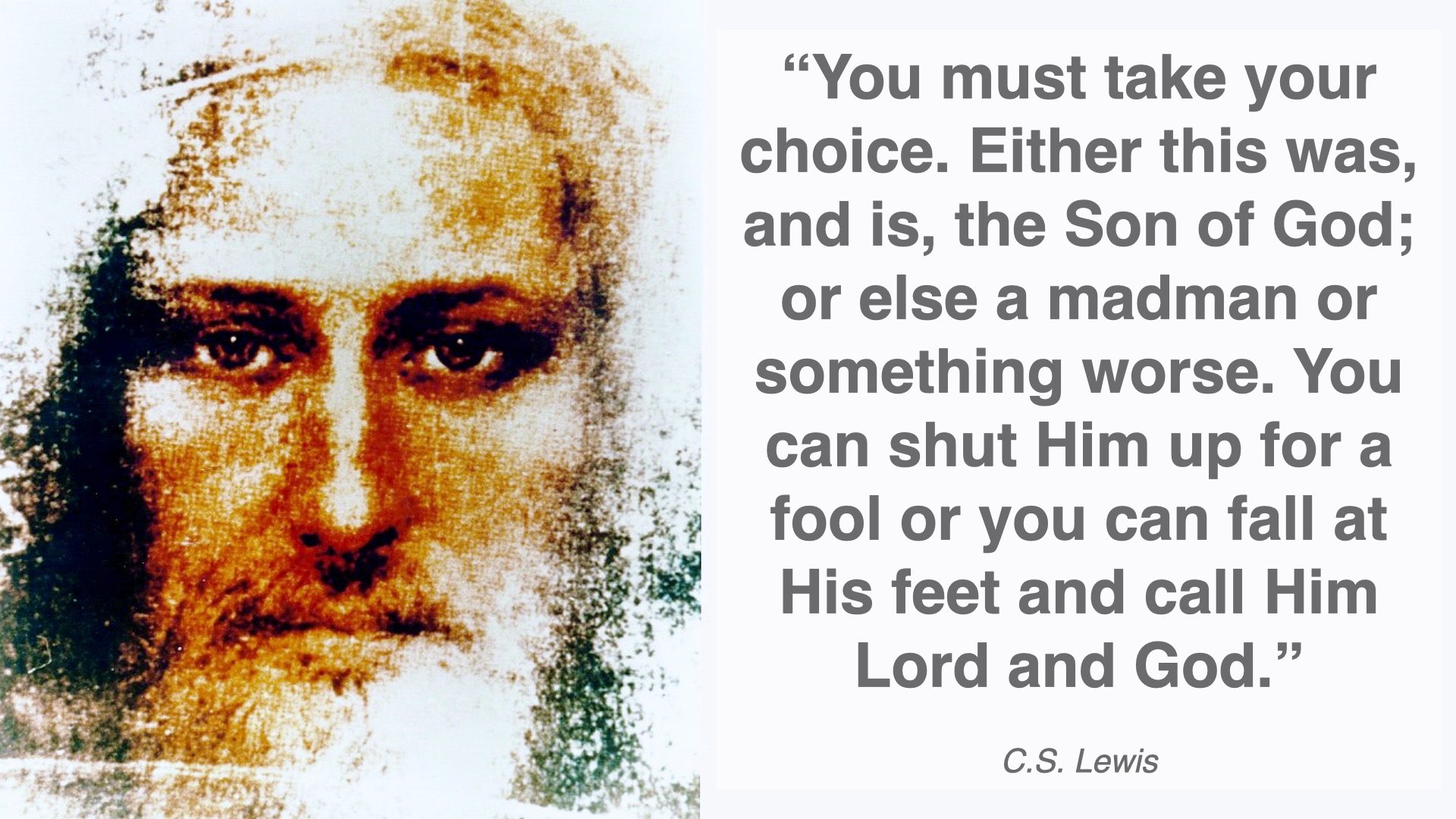
Peter and John said, “We are witnesses of this.” We too are witnesses of this if we have accepted Jesus as our Lord and Savior. We get to proclaim His Lordship by our verbal testimony and our lifestyle. As C.S. Lewis said, “A man who was merely a man and said the sort of things Jesus said would not be a great man or a moral teacher. He would either be a lunatic—on the level with the man who says he is a poached egg—or else he would be the devil of hell. You must take your choice. Either this was, and is, the Son of God; or else a madman or something worse. You can shut Him up for a fool…or you can fall at His feet and call Him Lord and God.” 

In Philippians 2:9-11, Paul points out that Jesus has the name above every name and that every knee must bow to Him and every tongue confess that He is Mighty God! Today, let us bow our knee to Him and lift our voices proclaiming that He is Lord and God until our One True God takes us home or returns at His Second Advent. 

If you’ve missed any of the other message in our Advent series called Jesus Is…, you can find them all here. 

►► Would you please prayerfully consider supporting this ministry? My Patreon supporters get behind-the-scenes access to exclusive materials. ◀︎◀︎

Links & Quotes

When the Holy Spirit shines His light on a biblical promise, and you turn that into a prayer, write it down! You may need to go back to this again and again. When God answers your prayer, write it down again! This can become a testimony journal that you and others can use to recall God’s provision. 

I have a lot of new video content on my YouTube channel every week. Please check it out and subscribe so you don’t miss anything.

“The pathway to maturity and to solid biblical food is not first becoming an intelligent person, but becoming an obedient person.” —John Piper 

“Somehow or other an extraordinary idea has arisen that the disbelievers in miracles consider them coldly and fairly, while believers in miracles accept them only in connection with some dogma. The fact is quite the other way. The believers in miracles accept them (rightly or wrongly) because they have evidence for them. The disbelievers in miracles deny them (rightly or wrongly) because they have a doctrine against them.” —G.K. Chesterton 

“At every moment, we always have a choice, even if it feels as if we don’t. Sometimes that choice may simply be to think a more positive thought.” —Tina Turner 

Every day should be a day of thanksgiving!

“We are strangers on Earth; our homeland is in Heaven. Our walk is here; our hearts are there.” —Dr. Henry Halley

Did Jesus “confess” He was God? J. Warner Wallace says He did, but not as some people define the word “confession.” 

I have already shared the first two posts in the latest archeological research on the biblical city of Jericho. Here is part three.

“Success is no accident. It is hard work, perseverance, learning, studying, sacrifice, and most of all, love of what you are doing or learning to do.” —Pelé 

“The greatest leader is not necessarily the one who does the greatest things. He is the one who gets people to do the greatest things.” —Ronald Reagan 

7 Images Of The Church

Husbands, love your wives, just as Christ loved the church and gave Himself up for her to make her holy, cleansing her by the washing with water through the Word. (Ephesians 5:25-26)

Dr. Henry Halley points to seven images the Bible portrays of how Jesus interacts with His saints.

“1. The Shepherd and the sheep emphasizes both the warm leadership and protection of Christ and the helplessness and dependency of believers (John 10:1-18). 

2. The vine and the branches points out the necessity for Christians to depend on Christ’s sustaining strength for growth (John 15:1-8).

3. Christ as high priest and the church as a kingdom of priests stress the joyful worship, fellowship, and service which the church can render to God through Christ (Hebrews 5:1-10; 7:1; 8:6; 1 Peter 2:5-9). 

4. The cornerstone and building stones (Matthew 21:42) accents the foundational value of Christ to everything the church is and does, as well as Christ’s value to the unity of believers. Love is to be the mortar which solidly holds the living stones together (1 Corinthians 3:9; 13:1-13; Ephesians 2:19-22; 1 Peter 2:5). 

5. The head and many-membered body, the church, is a vibrant organism, not merely an organization; it draws its vitality and direction from Christ, the Head, and each believer has a unique and necessary place in its growth (1 Corinthians 12:12-13, 27; Ephesians 4:4). 

6. The last Adam and new creation presents Christ as the initiator of a new creation of believers as Adam was of the old creation (1 Corinthians 15:22, 45; 2 Corinthians 5:17). 

7. The bridegroom and bride beautifully emphasizes the intimate fellowship and co-ownership existing between Christ and the church (Ephesians 5:25-33; Revelation 19:7-8; 21:9).

You can read all of the Bible verses listed in this post by clicking here. 

Links & Quotes

Christian saints have the joyful privilege of being able to step up for fellow saints. It’s hard work at times, but if we remember who those saints really are, it’s never heavy work! 

I have a lot of new video content on my YouTube channel every week. Please check it out and subscribe so you don’t miss anything.

“A people that values its privileges above its principles soon loses both.” —Dwight D. Eisenhower 

“[Jesus] draws us to Himself daily, to seek His beauty in Scripture, dwell before the beauty of His glorious face, bask in the beauty of His heavenly throne room, and become, increasingly, His beauty in and to the world. No matter how long we’ve known Him or how careful and earnest our study of Him has been, His fresh beauty remains fresher still.” —T.M. Moore

“Christianity is always out of fashion because it is always sane; and all fashions are mild insanities.” —G.K. Chesterton 

Replace the “sandwich method” of feedback with this: (1) Tell the person why you are giving them feedback, (2) Give them the feedback, and (3) End with a belief statement.

“Were” To “Are”

Listen to the podcast of this post by clicking on the player below, and you can also subscribe on AppleSpotify, or Audible. 

In the first ten verses of Ephesians 2 Paul talks about the amazing transformation from who we WERE before we met Jesus to who we ARE now with Jesus as our Lord and Savior. 

Before Jesus we…

  • were dead
  • used to live in sin
  • used to follow the world
  • were living to gratify fleshly cravings 
  • were following only earthly desires 

The result of this lifestyle is quite clear: We WERE deserving of God’s wrath (see vv. 1-3). 

Verse 4 opens with an amazing word: “But” here is what our new life looks like. We are…

  • made alive with Christ 
  • rescued from death
  • raised up with Christ
  • seated with Jesus in heavenly realms 
  • benefitting from God’s kindness

The bottom line: We ARE saved by God’s grace from God’s wrath (vv. 4-8)! 

It’s only now that we can realize that we ARE God’s handiwork, created to be in Jesus, to do good works, and to bring God glory. Our lives now ARE a display of the “incomparable riches of His grace” (v. 7)—we ARE a living testimony of His love for lost people. 

Being transformed from what we WERE to who we ARE allows us to echo the words of the psalmist—Come and see what our God has done, what awesome miracles He performs for people! (Psalm 66:5 NLT). 

►► Would you please prayerfully consider supporting this ministry? My Patreon supporters get behind-the-scenes access to exclusive materials. ◀︎◀︎

Training For The Fight

Listen to the podcast of this post by clicking on the player below, and you can also subscribe on AppleSpotify, or Audible. 

Last week I challenged all of us to ask the Holy Spirit to check our attitude to ensure we indeed have the attitude of a secure servant. This is especially true when we remember that we are in the midst of a spiritual battle and that Jude writes this letter to us to encourage us to “contend for the faith.” 

When Jesus told His parable about the sower, here’s what He said about the seed that fell on the hard path (Mark 4:15 AMPC). Jesus said the forces of evil want to try to bring down the Kingdom of God (Matthew 11:12).

(All the Scriptures I use in this post may be viewed here.)  

Are we willing to engage in this intense battle? Will we strive with the forces of darkness for the sake of seeing lost people saved? God told Isaiah that it was so easy to give in—to throw our hands up (Isaiah 64:5-7). Paul extolled a Christian brother named Epaphras for his willingness to wrestle in prayer for the saints (Colossians 4:12). 

Indeed wrestling for the saints is what Jude had in mind. 

I like the phrase “contend for the faith” in the Message paraphrase: “Fight with everything you have in you.” 

The Greek word Jude uses here is the only time it’s used in the New Testament. It means:

  1. To enter a contest—1 Corinthians 9:24-26 
  2. Contend with adversaries—Colossians 4:12; Ephesians 6:12 
  3. Struggle through difficulties—Colossians 1:28-29 
  4. Endeavor with strenuous zeal to obtain victory—1 Timothy 6:12; 2 Timothy 4:7 

The root word is agonizimai which sounds a lot like our English word “agonize.” This is an all-in mentality. Sitting on the sidelines, casually interacting, dabbling in it every once in a while won’t lead to victory. 

The stakes are too high, our enemy is cunning and desperate, so nothing less than agonizing training that will not quit no-matter-what will do! 

What exactly are we training to do? 

Too many view salvation as just saved from Hell. That’s part of it, but not all of it. We’re also saved to display the glory of God. The first part is accepting Jesus as Savior; the second part is accepting Jesus as Lord. The salvation we share is not either-or, but it is both-and: Jesus is both our Savior and Lord. 

We need to strive to obtain the fullness of Christ’s nature in us. People should be able to see and feel a difference in our lives without us even opening our mouths. Francis of Assisi said, “Preach always; if necessary, use words.” To that end, he offered this prayer—

“Lord, make me a channel of Thy peace, that
where there is hatred, I may bring love;
where there is wrong, I may bring the spirit of forgiveness;
where there is discord, I may bring harmony;
where there is error, I may bring truth;
where there is doubt, I may bring faith;
where there is despair, I may bring hope;
where there are shadows, I may bring light;
where there is sadness, I may bring joy.”

Will you be all-in?
Will you wrestle in prayer?
Will you let go of earthly things so you can cling to Jesus?
Will you display His light through your life?
Will you be ready to use words, if necessary?

Let’s make sure we are ready to contend for the faith the right way! 

P.S. Speaking of prayer, my new book Amen Indeed is a prayer guide for pastors. Please consider giving a copy of this book to your pastor! 

If you’ve missed any of the other messages in our series Earnestly Contend, you can find them all here. 

►► Would you please prayerfully consider supporting this ministry? My Patreon supporters get behind-the-scenes access to exclusive materials. ◀︎◀︎

Links & Quotes

Greg and I shared some insights for leaders interacting with people from different generations. Check out this clip about Gen Y.

I have a lot of new video content on my YouTube channel every week. Please check it out and subscribe so you don’t miss anything.

G.K. Chesterton penned these words over a century ago. If they were true then, imagine how much more so they are now: “These are the days when the Christian is expected to praise every creed except his own.”

“The only way to do great work is to love what you do. If you haven’t found it yet, keep looking. Don’t settle.” —Steve Jobs 

Epaphras literally put his life on the line to tell others about Jesus (Colossians 1:7; Philemon 23) and then tenaciously wrestled in prayer for the saints he led to the Lord (Colossians 4:12). That is a life worth emulating!

Sarah Young uses passages of Scripture and writes in the first-person voice as though Jesus Himself was speaking to us. “When you bring Me prayer requests, lay out your concerns before Me. Speak to Me candidly; pour out your heart. Then thank Me for the answers that I have set into motion long before you can discern results. When your requests come to mind again, continue to thank Me for the answers that are on the way. If you keep on stating your concerns to Me, you will live in a state of tension. When you thank Me for how I am answering your prayers, your mind-set becomes much more positive. Thankful prayers keep your focus on My Presence and My promises.”

The Servant Stands Strong

Listen to the podcast of this post by clicking on the player below, and you can also subscribe on AppleSpotify, or Audible. 

The second-to-last book of the New Testament is a short letter to the Church in which Jude felt urged by the Holy Spirit to challenge Christians to “contend for the faith that was once for all entrusted to the saints.” Does contend mean Christians are supposed to be combative about sharing their faith? We can learn a lot from the way Jude opens this letter. 

First, let’s look at who wrote this book. 

The names of the brothers of Jesus are listed twice (Mark 6:3; Matthew 13:55), and Jude is either the youngest or second youngest of these male siblings. He was a part of the family delegation that went to bring Jesus home because they thought He was out of His mind (Mark 3:21, 31). Later on, Jude would also mockingly taunt Jesus (John 7:5). 

(Check out all of the Scriptures in this post by clicking here.)

James is the oldest brother after Jesus. When Paul writes that Jesus appeared to James after the resurrection (1 Corinthians 15:7), it’s possible that it means Jesus appeared to all of his brothers, because Paul also mentions that the brothers of Jesus had become evangelists (9:5). It’s not surprising that Jude calls himself a brother of James, but it is quite shocking that he calls himself a servant of Jesus Christ. 

In fact, he calls Jesus:

  • our only Sovereign and Lord (v. 4) 
  • the One who gives us eternal life (v. 21) 
  • the only One who is our entrance into Heaven (vv. 24- 25) 

We need to adopt this servant’s mindset as we interact with others. 

Second, let’s notice who Jude’s audience is. 

Jude writes to people who are called, sanctified, preserved (NKJV). 

  • called = invited to the banquet 
  • sanctified = hagiazo = holy ones or saints 
  • preserved / kept = carefully attended to  

Finally, let’s consider how Jude expects saints to be living each day. 

Jude says in verse 2 that we are to live…

  • mercifully = not wanting people to get the punishment they deserve 
  • peacefully = having our soul so secure that we fear nothing from God 
  • lovingly = agape love like Jesus (John 3:16, 13:1) and like us (13:35, 15:9) 

And all of these things are to be in abundance—ever multiplying! 

After all of this, we are now in a place to consider how to live contending for the faith (v. 3). 

We are servants of Jesus, called to His banquet, set apart and preserved for His glory; we are intimately aware of His mercy, peace, and love, which we want others to know for themselves. 

Before we learn how to contend, let’s ask the Holy Spirit to check our attitude to ensure we indeed have the attitude of a secure servant. 

Follow along with all of the sermons in this series called Earnestly Contend. 

►► Would you please prayerfully consider supporting this ministry? My Patreon supporters get behind-the-scenes access to exclusive materials. ◀︎◀︎