Imagine being close enough to hear God’s voice—Your ears will hear a word behind you, “This is the way, walk in it,” whenever you turn to the right or to the left. (Isaiah 30:21)
Here’s a great question I recently heard: “What if God doesn’t want to give us answers, because He wants to give us His presence?”
Perhaps if God showed me my whole path, I might just take off down the path as fast as I could. Maybe I’d even say something like, “Thanks, God, I’ll take it from here!”
But God wants me close to Him. He wants me to hear His voice at every single step saying, “This is the way, walk in it.”
And forgive us our debts, as we also have forgiven our debtors [close enough to know His forgiving love for me and for others].
Lead us not into temptation, but deliver us from the evil one [close enough to His strength to say “no” to temptations that would entice me off of His path].
For Yours is the kingdom, and the glory, and the power forever [close enough to bask perpetually in His glory and His power].
God wants us THAT close to Him—to rely on Him, to lean into Him, to be empowered by Him, to be protected in Him.
A good question for all of us to ponder: How close to God am I?
Finally, be strong in the Lord and in His mighty power (Ephesians 6:10).
Not…
be strong in my own ability
be strong in the company of another warrior
But…
be strong in the Lord
be strong in the power of His might
The armor I wear has been battle-tested by the undefeated Champion. It’s armor emblazoned with the crimson red blood of Calvary. It’s armor gleaming brightly with the glow of Resurrection victory.
I wear Christ’s armor!
The belt of truth—it’s the righteousness of Jesus (Isaiah 11:1-5)
The breastplate of righteousness—worn by the Messiah who defeated evil (Isaiah 59:15-17)
The helmet of salvation—worn by Jesus as He won salvation for us (Isaiah 59:16-17)
The shoes of the gospel of peace—worn by our Lord as He defeated our enemies (Isaiah 52:5-7)
The shield of faith—God says, “I am your shield” (Genesis 15:1)
The sword of the Spirit—what Jesus used to strike down satan’s temptations (Isaiah 49:1-2; Luke 4:4, 8, 12)
I must continually clothe myself in God’s armor. Then I keep the armor bright by prayer—
Restraining prayer, we cease to fight
Prayer makes the Christian’s armor bright
And satan trembles when he sees
The weakest saint upon his knees. (William Cowper)
Holy God, may I be dressed in YOU at every moment. May I daily use YOUR battle-tested armor and weapons to strike a blow against satan!
This is part 3 in our series looking at phrases that sound biblical and then asking, “Is that in the Bible?”
Statement #3—This is how you should take Communion.… Is that in the Bible? Quite simply: No, it’s not.
Every church seems to celebrate Communion with its own unique style, typically following an age-old tradition. There’s nothing wrong with traditions per se. The only thing we have to watch out for is when traditions become the focal point, instead of the thing the tradition is pointing us to. Almost as if we are celebrating the celebration (see Isaiah 1:11-14; Mark 7:1-8).
In 1054 AD the Great Schism occurred between the Roman church (in West) and the Byzantine church (in East). One issue that led to this schism was Communion. The West used unleavened bread, saying that sin was removed. The East said that sounded like they were adopting Judaism, so they used leavened bread, saying that the “rising” symbolized new life.
Even today there are differences and disagreements—only administered by a priest … only certain church officials can “bless” the elements … a common cup … individual cups … unfermented juice … fermented wine … unleavened wafers … pieces torn off a full loaf of bread. The Bible never says about Communion, “Do it this way.” All of these are man’s traditions.
Passover was first instituted in Exodus 13. This is before the Law is given through Moses (Exodus 20) and before the instructions for the tabernacle are given (Exodus 25). In the first version, the sacrifice of the lamb was in individual homes, the lamb’s blood was shed on the doorposts of that home, and the family ate the lamb, unleavened bread, and bitter herbs together at home.
After the tabernacle was operational, there was a change (Deuteronomy 16). Now the sacrifice of the lamb was in the tabernacle, the lamb’s blood was sprinkled on the altar, but the family still ate the lamb, unleavened bread, and bitter herbs together at home.
By the time of Jesus, there were newer traditions which weren’t prescribed in the Bible that involved as many as five cups of wine, a very specific order that the meal was presented, and the singing of Psalm 113-118 (sometimes people sang all the way through Psalm 138).
I want to specifically focus on the second cup of wine Jesus used in this supper. Paul calls this cup the cup of thanksgiving and the cup of the Lord (1 Corinthians 10:16, 21). Why? Because Jesus switched cups with us!
The Bible tells us that we have all sinned, and therefore we are supposed to drink the cup of God’s wrath—For in the hand of the Lord there is a cup of His wrath, and the wine foams and is red, well mixed; and He pours out from it, and all the wicked of the earth must drain it and drink its dregs (Psalm 75:8 AMP).
But Jesus switched cups with us. He took the full wrath of God upon Himself, and then gave us God’s new covenant of forgiveness—“The days are coming,” declares the Lord, “when I will make a new covenant with the people of Israel and with the people of Judah. It will not be like the covenant I made with their ancestors when I took them by the hand to lead them out of Egypt, because they broke My covenant…. This is the covenant I will make with the people of Israel after that time,” declares the Lord. “I will put My law in their minds and write it on their hearts. I will be their God, and they will be My people. … For I will forgive their wickednessand will remember their sins no more.” (Jeremiah 33:31-34).
Jesus said, “When you drink this, do this in remembrance of Me.” THIS is what we’re called remember and celebrate!
It’s not HOW we celebrate Communion but WHO we remember when we do celebrate.
Let’s not celebrate the celebration, but let’s celebrate the Savior who paid the price so that we could celebrate the forgiveness of our sins under God’s new covenant!
This is part 1 in our series looking at phrases that sound biblical and then asking, “Is that in the Bible?”
Statement #1—God helps those who help themselves. Is that in the Bible? No, it is not!
The reason why I think people have accepted this as biblical is an incorrect view of God.
Humanism says God is us, which makes us believe, “If it’s going to be, it’s up to me.”
Fatalism says there is no God and therefore no meaning to life, which makes us believe, “The outcome is what it is and no one has any say in the matter.”
Deism says there is a God, but it’s hard to get His attention, which makes us believe “He is either disinterested in me or unapproachable. He’s only available for the ‘big’ things.”
The Bible flat-out rejects all three of these isms.
Instead, we see a loving, approachable God. One who is both all-powerful and all-loving. He says things like…
I made you and know everything about you, and I remain infinitely interested and intimately involved in your life
Not only is “God helps those who help themselves” untrue, but the exact opposite is also true—God helps those who cannot help themselves!
In Isaiah 40:28-29, we read that God gives strength to the weary and increases the power of the weak.
“Yes, it is our strength, not our weakness, that is our hindrance and stumbling block.” —Horatius Bonar
God gives power to the weak. He gives strength to those with no might of their own. God does NOT help those who think they can help themselves! God helps those who cannot help themselves! This is what Jesus came to do, and why we should rejoice in the fact that He does indeed help those who could never rescue themselves (Isaiah 53:4-5; 2 Corinthians 12:9)!
It is our can’ts that God uses as His opportunities to show how limitless He is. Our limitations magnify His love and His power.
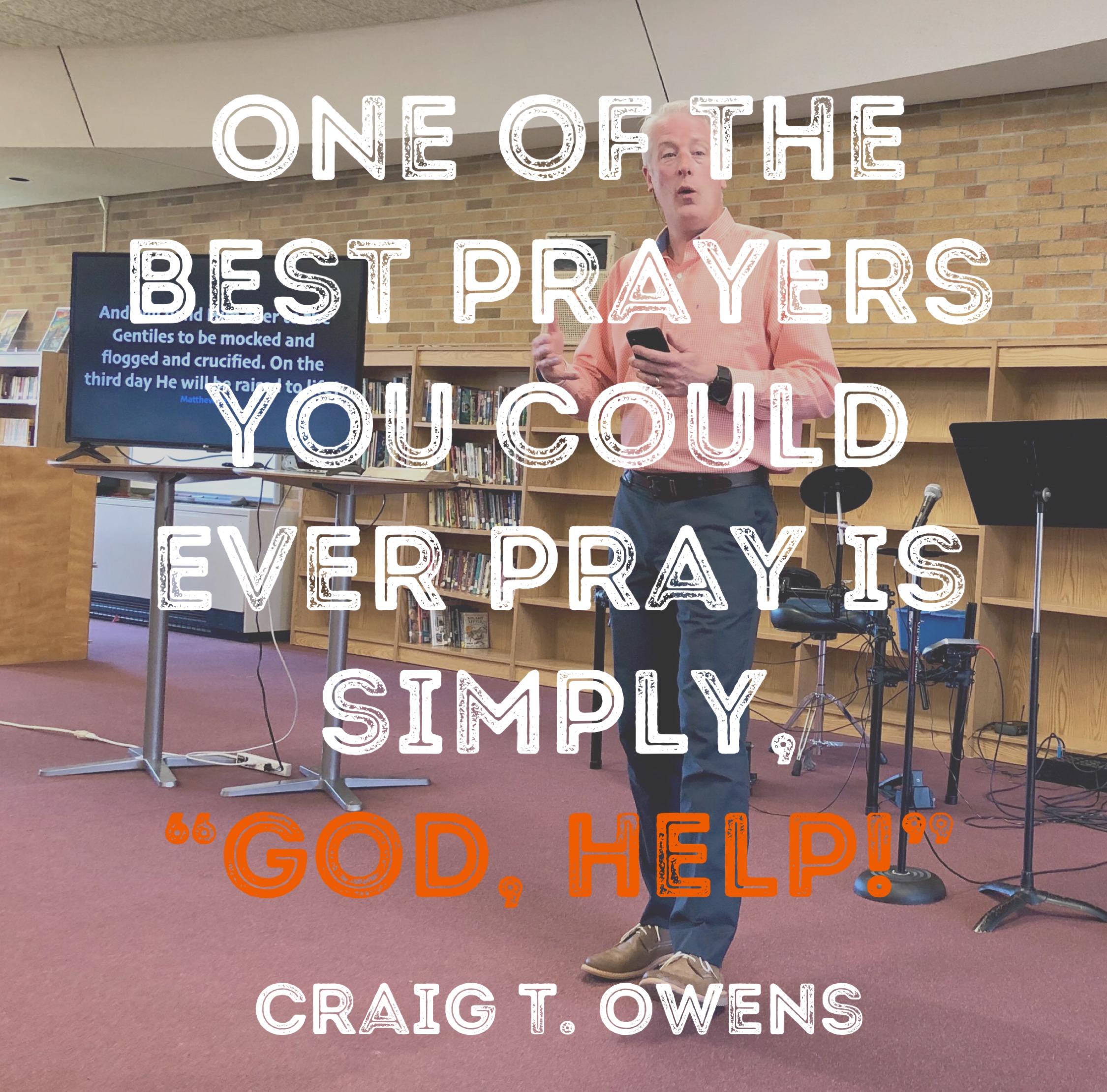
One of the best prayers you could ever pray is simply, “God, help!” This simple prayer acknowledges in just two words that you can’t but He most assuredly can!
But those who wait for the Lord—who expect, look for, and hope in Him—shall change and renew their strength and power; they shall lift their wings and mount up close to God as eagles mount up to the sun; they shall run and not be weary, they shall walk and not faint or become tired. (Isaiah 40:31 AMP)
Join me next week as we continue to explore various statements and ask, “Is that in the Bible?”
But you said in your heart, “I will ascend to heaven; I will raise my throne above the stars of God, and I will sit on the mount of assembly In the recesses of the north. I will ascend above the heights of the clouds; I will make myself like the Most High.” —what God said about satan (Isaiah 14:13-14)
“For God knows that in the day you eat from it your eyes will be opened, and you will be like God, knowing good and evil.” —satan (Genesis 3:5)
No wonder, for even satan disguises himself like an angel of light. —what the Apostle Paul said about satan (2 Corinthians 11:14)
Be of sober spirit, be on the alert. Your adversary, the devil, prowls around like a roaring lion, seeking someone to devour. —what the Apostle Peter said about satan (1 Peter 5:8)
Jesus is all reality. He is the All-Sufficient I AM. He knew the end from before the beginning. He is THE King of kings. The devil is only like a king, or like an angel, or like a lion.
The devil can only pretend to have answers. Everything he produces is a counterfeit. No wonder Jesus called him the “father of lies,” since lies are all he has to offer.
The devil tries to look like God, he tries to lure us to disobey God, he pretends to be what he’s not. So don’t fear his pretend roar. Instead, give yourself completely to God’s care, then you can stand firm against the devil’s attempts to seduce you, and he will be forced to flee from you (James 4:7)!
The Holy Spirit is vital in everything concerning a Christian’s life.Dr. Donald Stamps emphatically said it this way:
“It is essential that believers recognize the importance of the Holy Spirit in God’s redemptive purpose. Many Christians have no idea what difference it would make if there were no Holy Spirit in this world. Without the Holy Spirit there would be no creation, no universe, no human race (Genesis 1:2; Job 33:4). Without the Holy Spirit there would be no Bible (2 Peter 1:21), no New Testament (John 14:26; 15:26-27; 1 Corinthians 2:10-14), no power to proclaim the gospel (Acts 1:8). Without the Holy Spirit there would be no faith, no new birth, no holiness, no Christians at all in the world.”
Sometimes I think we have in our mind that the “old” in Old Testament somehow means outdated or no longer applicable to our lives, and the “new” in New Testament should be our sole focus. But Jesus affirmed again and again that all of the Scriptures—what we now refer to as the Old Testament—all point to Him.
The outpouring of the Holy Spirit on that Pentecost Sunday was not something new to the New Testament Christians. He was always a part of a believer’s life. Even 1000 years before Christ’s public ministry, David knew the importance of the Holy Spirit in both salvation, and in living a consistently holy lifestyle (Psalm 51:10-12, 143:10).
If Jesus needed the baptism in the Spirit to empower Him, direct Him, and give Him success, how much more do we need this?! That’s why Jesus imparted the Holy Spirit to His followers at their moment of salvation, but then admonished them to eagerly expect the baptism in the Holy Spirit as well (John 20:22; Luke 24:49; Acts 1:8).
Quite simply Jesus is saying—DON’T STOP AT SALVATION
Jesus didn’t, the apostles didn’t, Paul didn’t, Apollos didn’t, the Ephesian Christians didn’t, I didn’t, and you shouldn’t either!
Max Lucado takes us in for a closer look at the Cross and all that Jesus did there for us. Please check out my full book review and then read this book—you will be glad you did!
“Maybe you’ve never spit on anyone, but have you gossiped? Slandered? Have you ever raised your hand in anger or rolled your eyes in arrogance, have you ever blasted your high beams in someone’s rearview mirror? Ever made someone feel bad so you would feel good? That’s what the soldiers did to Jesus. When you and I do the same, we do it to Jesus too. ‘I assure you, when you did it to one of the least of these My brothers and sisters, you were doing it to Me!’ (Matthew 25:40 NLT). How we treat others is how we treat Jesus. …
“Allow the spit of the soldiers to symbolize the filth in our hearts. And then observe what Jesus does with our filth. He carries it to the Cross. Through the prophet He said, ‘I did not hide My face from mocking and spitting’ (Isaiah 50:6). Mingled with His blood and sweat was the essence of our sin.”
“‘He canceled the record that contained the charges against us. He took it and destroyed it by nailing it to Christ’s Cross’ (Colossians 2:14 NLT). Between His hands and the wood there was a list. A long list. A list of our mistakes: our lusts and lies and greedy moments and prodigal years. A list of our sins. Dangling from the Cross is an itemized catalog of your sins. The bad decisions from last year. The bad attitudes from last week. There, in broad daylight for all of heaven to see, is a list of your mistakes. … The list God has made, however, cannot be read. The words can’t be deciphered. The mistakes are covered. The sins are hidden. Those at the top are hidden by His hand; those down the list are covered by His blood. Your sins are ‘blotted out’ by Jesus (KJV). ‘He has forgiven you all your sins: He has utterly wiped out the written evidence of broken commandments which always hung over our heads, and has completely annulled it by nailing it to the Cross’ (Colossians 2:14 Phillips).”
“Seats at God’s table are not available to the sloppy. But who among us is anything but. Unkempt morality. Untidy with truth. Careless with people. Our moral clothing is in disarray. Yes, the standard for sitting at God’s table is high, but the love of God for His children is higher. So He offers a gift.… a seamless robe… a robe worn by His Son, Jesus.”
“What appeared to be the cruelty of man was actually the sovereignty of God. Matthew tells us: ‘And when Jesus had cried out again in a loud voice, He gave up His spirit. At that moment the curtain of the temple was torn into from top to bottom’ (27:50-51). It’s as if the hands of heaven had been gripping the veil, waiting for this moment.”
“Why is the Cross the symbol of our faith? To find the answer look no farther than the Cross itself. Its design couldn’t be simpler. One beam horizontal—the other vertical. One reaches out—like God‘s love. The other reaches up—as does God’s holiness. One represents the width of His love; the other reflects the height of His holiness. The Cross is the intersection. The Cross is where God forgave His children without lowering His standards.”
“‘Just look what they did to me!’ we defy and point to our hurts. ‘Just look what I did for you,’ Jesus reminds and points to the Cross. Paul said it this way: ‘If someone does wrong to you, forgive that person because the Lord forgave you’ (Colossians 3:13). You and I are commanded—not urged, commanded—to keep no list of wrongs.”
“Knowing His last deeds would be forever pondered, don’t you think Jesus chose them carefully? Deliberately? Of course He did. There were no accidents that day. Jesus’ last moments were not left up to chance. God chose the path; He selected the nails. Our Lord planted the trio of crosses and painted the sign. God was never more sovereign than in the details of the death of His Son. … The message: ‘I did it for you. I did it all for you.’”
On what we now refer to as Palm Sunday, Jesus arrived in Jerusalem with the crowd shouting, “Hosanna” because they thought Jesus was going to set things right. In this, they were disappointed. Jesus knew that His time for reigning in Jerusalem hadn’t come yet, and Christ’s passionate journey meant He would not cut any corners!
Before Jesus left Jerusalem that Sunday evening, Mark noted that “He looked around at everything.” He didn’t respond right away to what He saw. This is very important to note because we shouldn’t think that His response on Monday was something spontaneous. No, it was planned out in specific detail.
On Monday morning, Jesus prepared to make the 2-mile trip from Bethany to Jerusalem. The Gospels note quite frequently the amount of time Jesus spent in prayer, including beginning His day in conversation with His Father (see Mark 1:35). On this morning, He must have talked with His Father about everything He had seen in Jerusalem the day before.
En route to Jerusalem, Jesus encounters a fig tree that gives every appearance of life and vitality. It looks like it’s ready to serve people, but upon closer inspection, Jesus discovers that there is no fruit on it. He curses the tree for its deceptive outward appearance. This is definite foreshadowing for what’s about to happen!
Jesus enters the temple and begins to drive out merchants, and moneychangers, and dove sellers. He roars at them, “God says this is to be a place of prayer for all nations, but you have turned it into a den of robbers!” (see Matthew 21:12-17; Mark 11:15-19; and Luke 19:45-48).
The phrases house of prayer and den of robbers are direct quotations from Isaiah and Jeremiah, respectively (Isaiah 56:3-7; Jeremiah 7:1-11), but what do they mean?
The temple had specific courts available—
The Court of the Gentiles was open to all people, foreigners included.
The Women’s Court was open to all Jews and, their “uncontaminated” wives.
The Court of Israel was limited to male Jews who were clean and purified.
The fourth court was the Holy Place limited to priests robed in their priestly vestments.
This buying and selling was undoubtedly happening in the Court of the Gentiles. As the Passover was approaching, people from all over the world were here—some purchasing animals to use as sacrifices, and some exchanging their foreign money for Israelite money for the temple tax.
There was a lot of hustle and bustle, but very little worship. This is what angered Jesus. The activity in the temple was like the fig tree He cursed—it looked like it was fruitful, but that was merely outward deception.
Were the merchants exploiting people? Perhaps. But they were certainly occupying the only space where non-Jews could worship. They were certainly becoming a distraction to any true worship activities. They were clearly becoming the main attraction.
There are two important lessons in this outburst that Jesus gives to all His disciples:
As our Christlikeness increases, our intolerance of religious showmanship should increase.
As our Christlikeness increases, our intolerance of unrighteousness should increase—both a greater hate for sin and a greater love for sinners!
“Let the zeal of the house of the Lord ever eat you up. For example: do you see a brother running [toward sin]? Stop him, warn him, be grieved for him, if the zeal of God’s house has now eaten you up. Do you see others running and wanting to drink themselves drunk? Stop whom you can, hold whom you can, frighten whom you can; win in gentleness whom you can: do not in any way sit still and do nothing.” —Augustine
Christ’s passionate journey was out of love for us. Which means He hates anything that keeps us from His Father.
If you know God’s love, be zealous about those things that keep others from coming in to know God’s love for themselves. Not angry at people, but angry at practices and “religious shows” that hinder people from knowing God’s love like you know God’s love.
The Sunday before Christ’s crucifixion is typically called “The Triumphal Entry.” But was it really? One thing’s for sure—Jesus didn’t come to Jerusalem the way the people expected!
To fully get the picture of what’s happening we need to turn back the calendar several hundred years. Ever since Jerusalem fell to invading armies, the Jews hung on to the promise that God would restore their king and their kingdom. They were awaiting a descendant from the line of King David who would drive out their overlords and restore Jerusalem to its rightful place.
They clung to a promise in Psalm 118 that included these words—“Lord, save us! Lord, grant us success! Blessed is He who comes in the name of the Lord. From the house of the Lord we bless you.The Lord is God, and He has made His light shine on us. With boughs in hand, join in the festal procession upto the horns of the altar” (vv. 25-27).
But Jesus was prophesied to come as the Prince of Peace, gentle and unassuming, the Servant of all people (Isaiah 9:6; 42:1-3). Jesus simply didn’t do things the way the crowds expected! He was born in a manger in Bethlehem (not as a king in Jerusalem), and hailing from Nazareth caused people to mock, “Nazareth? Can anything good come from Nazareth?!”
So on that Sunday as Jesus approached Jerusalem, it wasn’t as a conquering King but as a humble servant. As He came near, He wept a sobbing lament over Jerusalem (Matthew 23:37).
The crowd took palm branches (as Psalm 118 suggested) and shouted, “Hosanna!” That word means “Save us,” but what they really meant was, “Save us NOW!” Jesus came riding a mule—a lowly work animal, not a war horse—to remove any fear people may have, and to show them His servant’s heart.
Even His disciples didn’t get this. But the Pharisees sure did: They wanted Jesus to rebuke the crowd for their insolence and blasphemy! Many of the worshippers were eyewitnesses to the resurrection of Lazarus, so Jesus said to the Pharisees, “They have to give praise to God for this!”
Jesus made His way to the temple but there were no sacrifices, no anointing, no coronation. Mark tells us Jesus simply “looked around at everything and then left.”
Have you ever noticed that Jesus never rushes? He’s never early. He’s never late. He’s never confused. He’s never trying to catch up.
This is because Jesus was in complete sync with His Father. Jesus said that everything He did was directed by His Father, and every word He spoke was given to Him by His Father.
We, too, should be able to move in that same unrushed pace. Because of what Jesus did for us on Calvary, we may have the same “oneness” with our Father as Jesus did (John 14:20).
Worry creeps into our lives when—like those cheering crowds in Jerusalem—we try to make our agenda happen on our timetable with our own resources. But when we look to Jesus, we see such a perfect peace as He relied on His Father.
Christ’s passionate journey was out of love for us, so that we could know peace with God as we journey through life with Jesus.
Join me this Sunday as we take a closer look at the Monday of Christ’s Passion Week.
Six days before His crucifixion and burial, Jesus was prepared for His burial by the most unlikely of people. This story takes place in Bethany, where Jesus spends a lot of time during His earthly ministry.
As was customary, the most influential men in the village would try to entice visiting guests to join them for dinner. Simon—a Pharisee and a former leper—was the one who extended the invitation to Jesus. Simon is a former leper because one who still had active leprosy wouldn’t have been allowed in his own home, let alone allowed to host guests. I think (as you will see in a moment) that Simon had been healed of his leprosy by Jesus.
Although it was customary for someone like Simon to host visiting guests, in this case, the religious leaders were scheming to arrest Jesus. In other words, there was an ulterior motive for Simon to have Jesus in his home.
Which is probably why Simon neglected his host’s duties: No welcoming kiss, no foot-washing, no anointing. All normal hospitality is ignored. Jesus appears to ignore the snub and simply recline at the table. But another guest takes Simon’s incredible rudeness personally.
Mary was standing or sitting along the wall in Simon’s house, as many common villagers would in that day. Luke tells us that Mary hadlived a sinful life. But while sitting at Jesus’ feet earlier she heard the good news that Jesus could forgive sins, she placed her faith in Him, and her lifestyle changed 180-degrees
Mary is overcome by emotion at the inhospitable—rude!—way Jesus is being treated and tears began to well up in her eyes. Since Jesus is reclining at the table, His feet would have been pointed in her direction, and she began to use her tears to wash His feet. Then—horror of horrors—she uncovers and lets down her hair in public(!) and begins to dry His feet.
Simon the Pharisee judges Mary by her past. Simon twice says, “Does Jesus even know what kind of woman she is? Does He know she is a sinner?” Mary is in big trouble: she is publicly pointing out the rudeness of the host, she is touching a man that is not her husband, and she has uncovered and let down her hair in public.
Jesus responds not to Mary, but to Simon: “Simon, I have something to tell you,” He says and then shares a short but powerful parable of a creditor who had two debtors. One owed him the equivalent of a year-and-a-half’s wages, and the other owed about two months’ wages. Since neither could pay, the creditor forgave both of them.
Jesus asked Simon, “Which of the two forgiven debtors do you think would be most grateful?” Simon correctly responds, “The one who was forgiven more.”
Jesus points out that Mary’s acts didn’t bring her forgiveness, but that her acts were a loving response to the forgiveness she had already received. Jesus said things like, “You have been forgiven,” and “Your sins are forgiven,” and “Your faith has saved you.”
Jesus took the anger that was focused on Mary and redirected it to Himself, as Isaiah prophesied the Messiah would do (see 53:4-5).
At the same time He is also challenging Simon, “Don’t you have something to be grateful for? Weren’t you once a physical leper? Mary was a spiritual leper, but she has been forgiven and is now overwhelmingly grateful. What about you?”
Mary was forgiven. She gave all she had in worship. Her anointing oil was lavishly poured out. It was worth a year’s wages, but she spent it all on Jesus. She anointed Him for His burial. The aroma of the oil remained on Jesus throughout His Passion Week and through His crucifixion. The aroma remained on Mary’s hands and hair. The aroma remained in Simon’s house. The memory was fixed in the memories of everyone in that room.
What about Simon? Did he ever acknowledge his gratitude? Or was he more concerned with receiving praise from men?
Have you received the forgiveness Jesus offers you? Can people tell you’ve been forgiven by your willingness to stand up for Him? Can people tell you’ve been forgiven by your willingness to give up everything for Him?
I hope you can join me this Sunday as we continue our slow, deliberate walk alongside Jesus on His passionate journey to the Cross and the resurrection.



 Imagine being close enough to hear God’s voice—Your ears will hear a word behind you, “This is the way, walk in it,” whenever you turn to the right or to the left. (Isaiah 30:21)







Dressed For Victory
July 30, 2019 — Craig T. OwensNot…
But…
The armor I wear has been battle-tested by the undefeated Champion. It’s armor emblazoned with the crimson red blood of Calvary. It’s armor gleaming brightly with the glow of Resurrection victory.
I wear Christ’s armor!
I must continually clothe myself in God’s armor. Then I keep the armor bright by prayer—
Holy God, may I be dressed in YOU at every moment. May I daily use YOUR battle-tested armor and weapons to strike a blow against satan!
(Check out all the Scripture references above by clicking here.)
Share this: