How Long Will This Last?

Chaos is all around us! There’s infighting both politically and religiously. Government officials are imposing new laws and regulations and restrictions. Lots of rival voices are clamoring to be heard. Loss of personal freedoms, civil liberties, and even the freedom of worship. Uncertainty about the future. Fear in the present. 

Although this may sound like current conditions in the USA, I’m actually describing life in Israel around 31 BC. 

The people of Israel were frustrated beyond words with the restrictions they faced. They thought they were living in their land and that they should be able to govern themselves as they saw best. 

Have you ever been in that place of utter frustration? Are you there now? “What’s happening? Why is this not going according to plan? Isn’t there anything I can do? How long is this going to last? God, where are You in all of this?! 

We humans like to think we are in control. Or at least we like to think that we know God’s timetable. Throughout the Bible—and still today—the questions persist: 

  • How long will this last? 
  • When will this take place? 
  • What about him? 
  • Is this the right time? 

(see Psalm 13:1-2; Matthew 24:3; John 21:21; Acts 1:6; Revelation 6:9-10) 

When we ask God, “How long?” He never answers us by pointing to the calendar or the clock, but He points us to principles in His Word.

Here are four principles that we need to ask the Holy Spirit to help us grasp: 

  1. God’s timing was determined before Time even started. 
  2. God is using this “How long?” time to perfect us for His service.
  3. God is using this “How long?” time to empower us to point others to Him.
  4. God is calling us to trust Him alone during our “How long?” times. 

(see Psalm 90:2; Isaiah 46:10; Psalm 13:5-6; Romans 5:3-4; Matthew 24:13-14; Acts 1:7-8; John 21:21) 

Those Israelites I described earlier were so frustrated with asking “How long?” and apparently getting no answer, that they frequently took matters into their own hands. This never turned out well for them. But God’s perfect timing was heading toward His perfect fulfillment.  

We may not perceive it, but God IS doing more than we will ever know during our “How long?” times. 

God’s perfect timing for His people couldn’t be until Caesar Augustus came on the scene and brought an end to the political uncertainty that kept everything in chaos. Nearly 30 years before Jesus was to be born in Bethlehem, Augustus was launching the pax Romana—the peace of Rome—all over the world. Pax Romana was creating the perfect environment in which Jesus could be born and minister, as well in which His followers could then take the Good News all over the world. 

Jesus was born “in the fullness of time” (Galatians 4:4), around 5 BC, in a land where a Jordanian king (Herod the Great) served an Italian emperor (Caesar Augustus) to a people frustrated with waiting. But God knew exactly when and where and how to send His Son to be our Savior!

So, my friends—Trust God in the “How long?” times! 

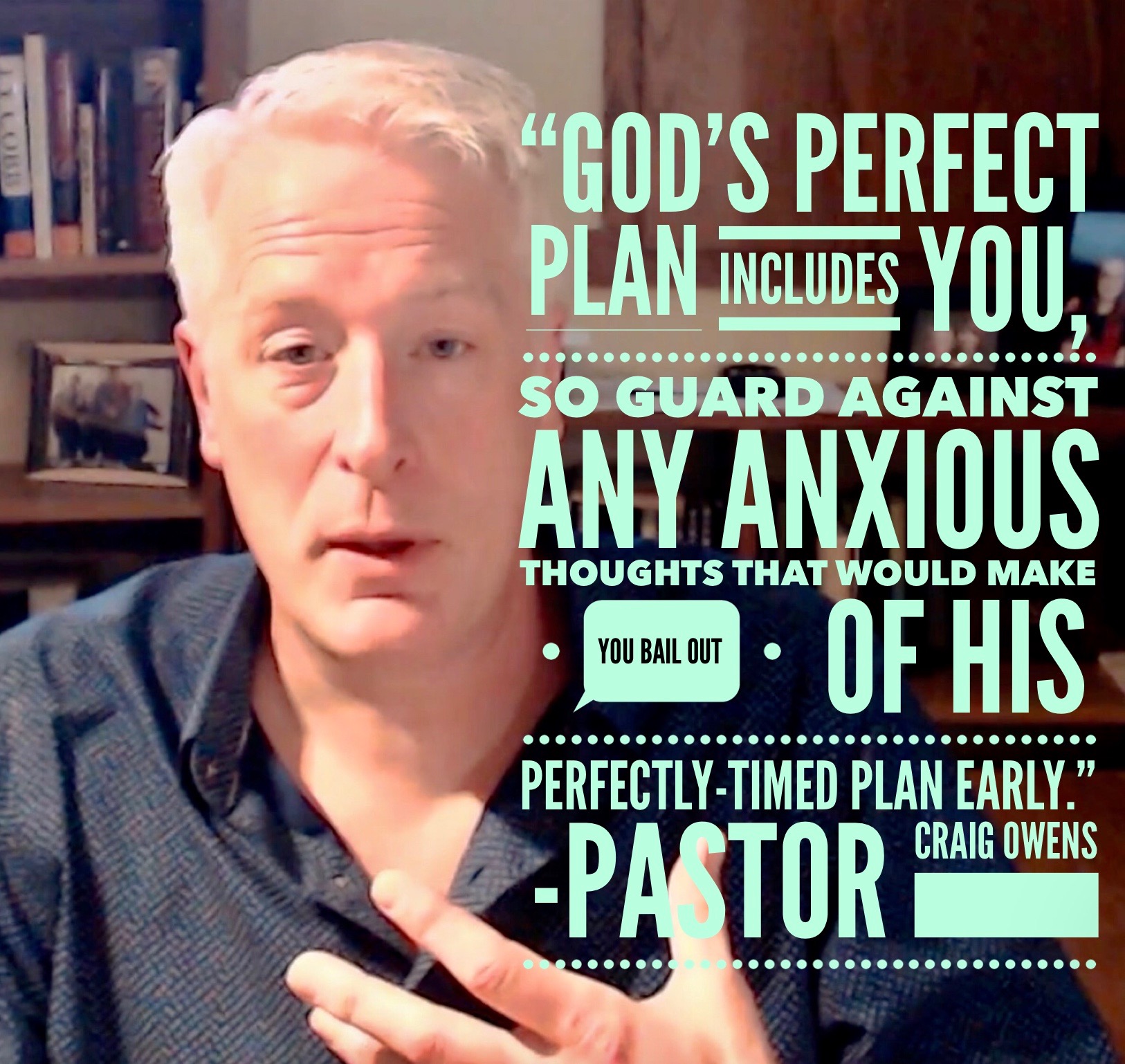
God’s perfect plan includes YOU, so guard against any anxious thoughts that would make you bail out of His perfectly-timed plan early. (see Psalm 139:16, 23-24)

Join me this Sunday as we continue our series called Where’s God? 

Thursdays With Spurgeon—God With Us

This is a weekly series with things I’m reading and pondering from Charles Spurgeon. You can read the original seed thought here, or type “Thursdays With Spurgeon” in the search box to read more entries.

God With Us

     ‘And you shall call His name Immanuel.’ …

     This is His name, ‘God with us.’ … He has not lost that name. Jesus had that name on earth, and He has it now in heaven! He is now ‘God with us.’ Believer, He is God with you to protect you! You are not alone, because the Savior is with you! … 

     But if you would know this name most sweetly, you must know it by the teaching of the Holy Spirit. … Unless the Holy Spirit takes the things of Christ and applies them to our heart, it is not ‘God with us.’ Otherwise, God is a consuming fire. …

     Immanuel—it is wisdom’s mystery, ‘God with us.’ Just look at it and wonder. Angels desire to see it. The plumb line of reason cannot reach halfway into its depth. The eagle wings of science cannot fly so high, and the piercing eyes of the vulture of research cannot see it! ‘God with us.’  It is hell’s terror! satan trembles at the sound of it. His legions fly apace; the black-winged dragon of the pit quails before it! Let satan come to you suddenly and do you but whisper that word, ‘God with us,’ and back he falls, confounded and confused! satan trembles when he hears that name, ‘God with us.’ It is the laborer’s strength. How could he preach the gospel, how could he bend his knees in prayer, how could the missionary go into foreign lands, how could the martyr stand at the stake, how could the confessor acknowledge his Master, how could men labor if that one word were taken away? ‘God with us’ is the sufferer’s comfort, it is the balm of his woe, it is the alleviation of his misery, it is the sleep that God gives to His beloved, it is the rest after exertion and toil.

     Ah, and to finish, ‘God with us’ is eternity’s sonnet, it is heaven’s hallelujah, it is the shout of the glorified, it is the song of the redeemed, it is the chorus of angels, and it is the everlasting oratorio of the great orchestra of the sky! ‘God with us!’

From The Birth Of Christ

Jesus is—always was and always will be—God with us! 

Do you know Jesus personally? He wants you to know Him. He came to earth so that you could know Him. His heart’s desire is to be with you today and have you with Him forever! 

If you have questions about this, please send me a message and let’s chat.


Thursdays With Spurgeon—Comments On Commentaries

This is a weekly series with things I’m reading and pondering from Charles Spurgeon. You can read the original seed thought here, or type “Thursdays With Spurgeon” in the search box to read more entries.

Comments On Commentaries

     It has been said that the passage I have taken for my text [Isaiah 7:1-17] is one of the most difficult in all the Word of God. It may be so. I certainly did not think it was until I saw what the commentators had to say about it, and I rose up from reading them perfectly confused! One said one thing, and another denied what the other had said. And if there was anything that I liked, it was self-evident that it had been copied from one to the other and handed through the whole of them! 

     One set of commentators tells us that this passage refers entirely to some person who was to be born within a few months after this prophecy….

     Well, that seems a strange frittering away of a wonderful passage, full of meaning, and I cannot see how they can substantiate their view when we find the evangelist Matthew quoting this very passage in reference to the birth of Christ [Matthew 1:22-23]….

     I find, moreover, that many of the commentators divide the sixteenth verse from the fourteenth and fifteenth verses, and they read the fourteenth and fifteenth verses exclusively of Christ, and the sixteenth verse of Shear-Jashub….

     Then another view, which is the most popular of all, is to refer the passage, first of all, to some child who was then to be born, and afterward, in the highest sense, to our blessed Lord Jesus Christ. … 

     But I think that if I had never read those books at all, but had simply come to the Bible without knowing what any man had written upon it, I would have said, ‘There is Christ here as plainly as possible! Never could His name had been written more legibly than I see it here.’ 

From The Birth Of Christ

Spurgeon was not advocating that we never consult commentaries because elsewhere he said about the use of commentaries: “I find it odd that he who thinks so highly of what the Holy Spirit teaches him speaks so little of what the Holy Spirit teaches others also.” 

But what I believe Spurgeon is advocating here is this important principle—The best commentary on a passage of Scripture is another passage of Scripture. Which is why he used the passage in Matthew to help him understand the passage in Isaiah.

God makes Himself clear in His Word. The same Holy Spirit that inspired the pen of those who wrote the words in the Bible is the same Holy Spirit in you that can illuminate those words to your heart and mind. 

Commentators have their place. I believe that place is after you have prayed through and wrestled with a passage of Scripture for yourself. Think of commentators as the answers in the back of your math book. After you have worked through the equations for yourself, go to the answer key to verify your answers. If you simply look up the answer before you wrestle with the problem, how have you benefitted yourself? 

And always remember that God’s Word is infallible, but men are fallible. Commentators may provide an insight that helps you see something more clearly, but they are never a substitute for God’s very own word on a matter. 

Should you use commentaries? Sure! Find a good one, but consult it only after you have asked the Holy Spirit to help illuminate the passage, and after you have allowed the commentary of Scripture itself to shine its light on the difficult verse or passage.


Prayer Expectations

Many of our prayers could be much bolder and much more specific than they are. Why is that? Because how we view God is going to determine what we pray and what we expect after we pray.

When we pray, we approach an All-Loving Father, and we approach an All-Powerful God. I have found that typically people get warmed by the idea of Father and get scared by the idea of God. They say things like: “What if my prayers don’t hallow God’s name? What if He’s mad at me? What if I pray an improper prayer?” 

God wants us to come to Him in prayer, so He makes Himself very accessible! The Father is both Father and God; the Son is both Friend and King; the Spirit is both Comforter and Convictor. We get ALL of this in One God. 

Charles Spurgeon had this word of encouragement: “If You are my Father, then You love me. If I am Your child, then You will regard me, and poor though my language is, You will not despise it.” Jesus came to earth fully God and fully man, making Him our perfect intermediary (see Job 9:32-35; 1 Timothy 2:5; Hebrews 7:25). And the Holy Spirit helps interpret our groaning prayers (Romans 8:26-27). 

Have you ever noticed that neither the prophets of the Old Testament, nor Jesus in the Gospels, nor the apostles in the New Testament ever prayed, “God, if this is Your will please do such-and-such”? They simply prayed. Or more accurately, they prayed so boldly and specifically it almost sounded like a command: “Stand up” or “Be clean” or “Go, your prayer has been answered.” 

When you and I are praying to an All-Loving and All-Powerful Father, with Jesus interceding for us, and the Spirit helping us, we too can pray these bold and highly specific prayers. 

After all, if you don’t pray specifically and expectantly, how will you know when your prayer is answered? 

I find John Piper’s acrostic very helpful in praying these bold and expectant prayers. He calls it APTAT: 

  • A—Admit I can’t do anything without Christ. This hallows His Name. 
  • P—Pray for help to do it. 
  • T—Trust a specific promise of God to help me (two general promises are found in Isaiah 41:10 and Romans 8:32). 
  • A—Act. Do the things I need to do: apply for the job, ask forgiveness, schedule a meeting. 
  • T—Thank Him when I’m done. 

Two final thoughts—

  1. Make prayer more of a listening relationship than a talking relationship. 
  2. Give yourself some grace as you are maturing; don’t expect immediate perfection. Start praying and then let the Father, the Son, and the Spirit help you mature in your prayer life. 

I hope you can join me this Sunday as we continue to work on our plans to pray.

Ingratitude Can Mess Us Up

Fading gratitude can negatively impact our past, present, and future. Because when our gratitude to God begins to fade, so does our understanding of what God has already done for us, our appreciation of what He is still doing for us today, and our hope for what He will provide for us tomorrow. But we can flip the script—Our continual gratitude can begin to positively impact our past, present, and future! 

“Gratitude is from the same root word as ‘grace,’ which signifies the free and boundless mercy of God. Thanksgiving is from the same root word as ‘think,’ so that to think is to thank.” —Willis P. King 

The more we THINK about God’s grace in our lives, the more we can give THANKS for all He has done. Or said another way…

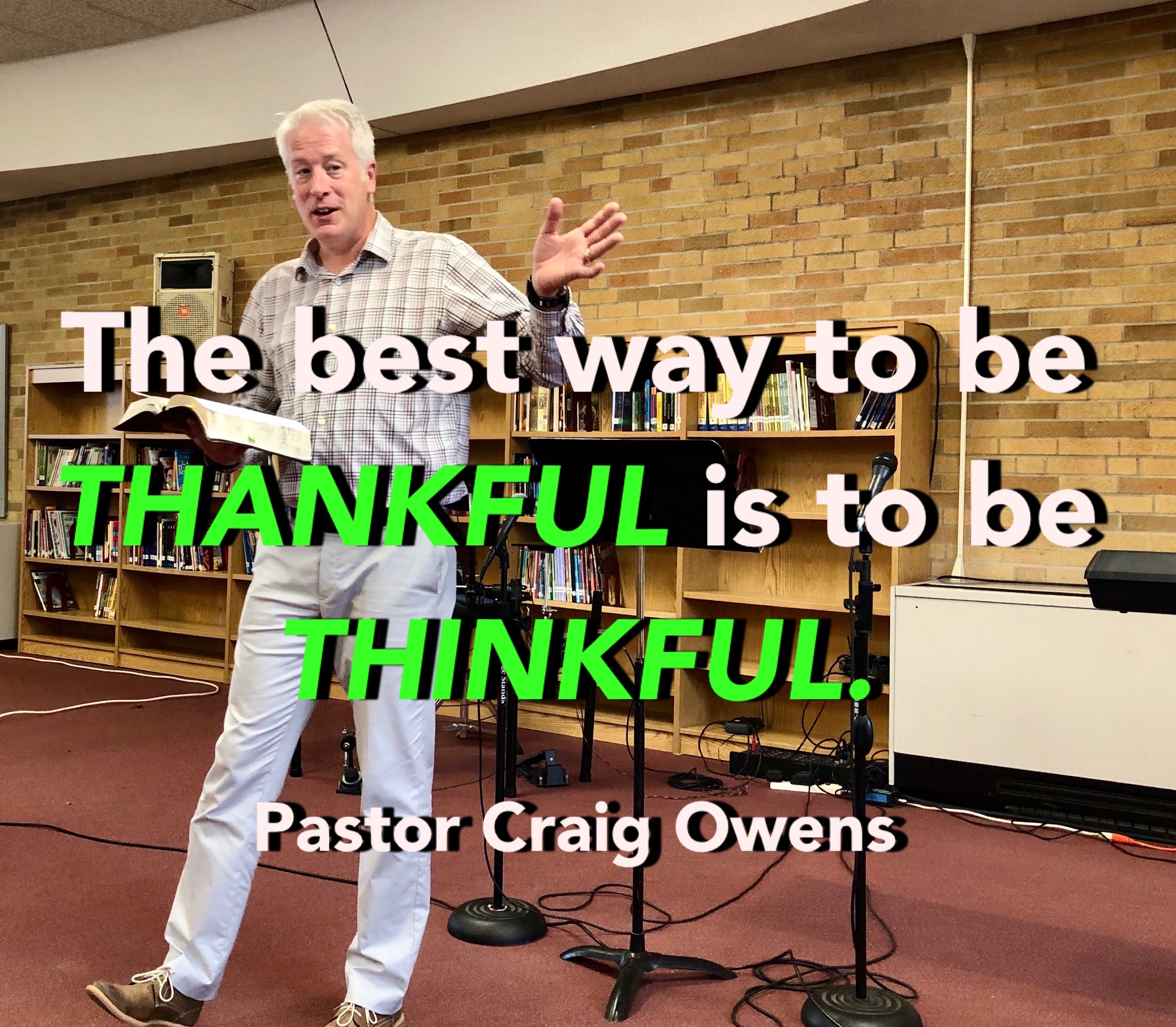
The best way to be THANKFUL is to be THINKFUL!

In Psalm 78, Asaph gives us a two-word reason for the up-and-down history of the Israelites: they forgot. The Israelites’ forgetfulness led to their lack of gratitude, which then caused yet another downward turn away from God. One of the examples he gives us is very informative: the daily provision of manna while the Israelites were in the wilderness (see Psalm 78:11-25; Exodus 16:4, 14-18). 

Every day God’s people had their food needs miraculously supplied for them, yet they begin to take this gift of God for granted. They stopped thinking about His provision, and then they began to ungratefully grumble (Numbers 11:4-6). Their grumbling actually caused them to want to return to slavery in Egypt! 

With fading gratitude, we can get stuck in the past. We even end up looking back at slavery and scarcity and call it “the good old days”! With fading gratitude for the past, sometimes we beat ourselves up. We say things like, “If I would have known then what I know now….” But you couldn’t know then what you know now. You only know now because of what you went through then, which makes another reason to be grateful. After all, God is using everything we have gone through to work out His plan (see Isaiah 46:9-10; Romans 8:28). 

We need to be thinkful about our past so that we can be thankful for what God is doing with it today.

Manna provided food every single day the whole time the Israelites were in the wilderness. It stopped immediately after they entered the Promised Land. For that daily provision, they should have been thankful but it was when they forgot to be thankful that they longed for the past and tried to do things on their own. 

The manna is a picture of Jesus. Not only is He our daily bread for today, but He is also our hope for eternity with God in Heaven. And for that, we should be daily thinkful AND thankful. 

If you’d like a fun idea of how to stay thinkful AND thankful, check this out.

Join us this Sunday as we learn more about the dangers of our fading gratitude. 

Thursdays With Spurgeon—God Will Not Acquit The Wicked

This is a weekly series with things I’m reading and pondering from Charles Spurgeon. You can read the original seed thought here, or type “Thursdays With Spurgeon” in the search box to read more entries.

God Will Not Acquit The Wicked

     The Lord is slow to anger and great in power, and will not at all acquit the wicked [Nahum 1:3]. The Lord is slow to anger because He is great in power. ‘How say you so?’ says one. I answer: He who is great in power has power over himself. And he who can keep his own temper down and subdue himself is greater than he who rules the city, or can conquer nations. … When God’s power does restrain Himself, then it is power indeed—the power to curb power. The power that binds omnipotence is omnipotence surpassed. God is great in power, and therefore does He keep in His anger. … We bless God that the greatness of His power is just our protection! He is slow to anger because He is great in power. …  

     I have blotted out like a thick cloud your transgressions, and like a cloud your sins [Isaiah 44:22]. Not of one of all those sins that have been pardoned was pardoned without punishment. Do you ask me why and how such a thing as that can be the truth? I point you to yonder dreadful sight on Calvary. The punishment that fell not on the forgiven sinner fell there. … Sin is still punished, though the sinner is delivered. … 

     And now we trace this terrible attribute to its source. Why is this? We reply, God will not acquit the wicked, because He is good. What? Does goodness demand that sinners will be punished? It does. The judge must condemn the murderer because he loves his nation. …  

     Mercy, with her weeping eyes (for she has wept for sinners), when she finds they will not repent, looks more terribly stern in her loveliness than justice in all his majesty. She drops the white flag from her hand and says, “No. I called and they refused. I stretched out my hand and no man regarded. Let them die, let them die” and that terrible word from the lip of mercy’s self is harsher thunder then the very damnation of justice. Oh yes, the goodness of God demands that men should perish if they will sin. …  

     Can you by humble faith look to Jesus and say, “My substitute, my refuge, and my shield; You are my rock, my trust, in You I do confide”? Then, beloved, to you I have nothing to say except never be afraid when you see God’s power. For now that you are forgiven and accepted, now that by faith you have fled to Christ for refuge, the power of God need no more terrify you than the shield and sword of the warrior need terrify his wife or his child.

From Mercy, Omnipotence, And Justice

Have you looked in faith to the work Jesus did on Calvary so that your sins could be forgiven? If so, wonderful! You have nothing to fear from God’s justice. 

If not, I plead with you—look again. God’s mercy has been extended to you at least long enough for you to read this, but His justice must fall. Don’t procrastinate another moment: Allow the acquittal of your sins that Jesus purchased with His blood to be yours this very moment!


Thursdays With Spurgeon—God Is Slow To Anger

This is a weekly series with things I’m reading and pondering from Charles Spurgeon. You can read the original seed thought here, or type “Thursdays With Spurgeon” in the search box to read more entries.

God Is Slow To Anger

     God is “slow to anger” [Nahum 1:3]. When mercy comes into the world, she drives winged steeds. The axles of her chariot wheels are glowing hot with speed. But when wrath comes, she walks with tardy footsteps. She is not in haste to slay; she is not swift to condemn. God’s rod of mercy is ever in His hands outstretched. God’s sword of justice is in its scabbard, not rusted in it. It can be easily withdrawn, but is held there by that hand that presses it back into its sheath, crying, “Sleep, O sword, sleep. For I will have mercy upon sinners and will forgive their transgressions.” … 

     God will not at once slay the man whose character is the vilest until He has first hewn him by the prophets. He will not hew him by judgments. He will warn the sinner before He condemns him. He will send His prophets, “rising up early” and late (Jeremiah 7:13, 25; 26:5; 29:19; 32:33; 33:15), giving him ‘precept upon precept, line upon line, here a little, there a little’ (Isaiah 28:13). … 

     God does not in grace, as in nature, send lightning first and thunder afterward, but He sends the thunder of His law first and the lightning of His execution follows it. … But best of all, when God threatens, how slow He is to sentence the criminal! When He has told them that He will punish unless they repent, how long a space He gives them in which to turn to Himself! …

     Although God is slow to anger, He is sure in it.

From Mercy, Omnipotence, And Justice

But do not forget this one thing, dear friends: With the Lord a day is like a thousand years, and a thousand years are like a day. The Lord is not slow in keeping His promise, as some understand slowness. Instead He is patient with you, not wanting anyone to perish, but everyone to come to repentance. But the day of the Lord will come like a thief. The heavens will disappear with a roar; the elements will be destroyed by fire, and the earth and everything done in it will be laid bare. Since everything will be destroyed in this way, what kind of people ought you to be? You ought to live holy and godly lives…. So then, dear friends, since you are looking forward to this, make every effort to be found spotless, blameless and at peace with Him. Bear in mind that our Lord’s patience means salvation… (2 Peter 3:8-11, 14-15).

Close To God

Imagine being close enough to hear God’s voice—Your ears will hear a word behind you, “This is the way, walk in it,” whenever you turn to the right or to the left. (Isaiah 30:21)

Here’s a great question I recently heard: “What if God doesn’t want to give us answers, because He wants to give us His presence?” 

Perhaps if God showed me my whole path, I might just take off down the path as fast as I could. Maybe I’d even say something like, “Thanks, God, I’ll take it from here!”

But God wants me close to Him. He wants me to hear His voice at every single step saying, “This is the way, walk in it.” 

The model prayer that Jesus taught us is all about that closeness and total reliance on God’s close presence: 

  • Our Father in heaven, hallowed be Your name [close enough to worship Him intimately],
  • Your kingdom come, Your will be done on earth as it is in heaven [close enough to know His heart].
  • Give us today our daily bread [close enough to rely on Him for all of my daily needs].
  • And forgive us our debts, as we also have forgiven our debtors [close enough to know His forgiving love for me and for others].
  • Lead us not into temptation, but deliver us from the evil one [close enough to His strength to say “no” to temptations that would entice me off of His path].
  • For Yours is the kingdom, and the glory, and the power forever [close enough to bask perpetually in His glory and His power].

God wants us THAT close to Him—to rely on Him, to lean into Him, to be empowered by Him, to be protected in Him. 

A good question for all of us to ponder: How close to God am I?

Dressed For Victory

Finally, be strong in the Lord and in His mighty power (Ephesians 6:10).

Not…

  • be strong in my own ability
  • be strong in the company of another warrior

But…

  • be strong in the Lord
  • be strong in the power of His might

The armor I wear has been battle-tested by the undefeated Champion. It’s armor emblazoned with the crimson red blood of Calvary. It’s armor gleaming brightly with the glow of Resurrection victory.

I wear Christ’s armor! 

  • The belt of truth—it’s the righteousness of Jesus (Isaiah 11:1-5)
  • The breastplate of righteousness—worn by the Messiah who defeated evil (Isaiah 59:15-17)
  • The helmet of salvation—worn by Jesus as He won salvation for us (Isaiah 59:16-17)
  • The shoes of the gospel of peace—worn by our Lord as He defeated our enemies (Isaiah 52:5-7)
  • The shield of faith—God says, “I am your shield” (Genesis 15:1)
  • The sword of the Spirit—what Jesus used to strike down satan’s temptations (Isaiah 49:1-2; Luke 4:4, 8, 12)

I must continually clothe myself in God’s armor. Then I keep the armor bright by prayer—

Restraining prayer, we cease to fight 
Prayer makes the Christian’s armor bright 
And satan trembles when he sees 
The weakest saint upon his knees. (William Cowper)

Holy God, may I be dressed in YOU at every moment. May I daily use YOUR battle-tested armor and weapons to strike a blow against satan! 

(Check out all the Scripture references above by clicking here.)

Not How But Who

This is part 3 in our series looking at phrases that sound biblical and then asking, “Is that in the Bible?

Statement #3—This is how you should take Communion.… Is that in the Bible? Quite simply: No, it’s not. 

Every church seems to celebrate Communion with its own unique style, typically following an age-old tradition. There’s nothing wrong with traditions per se. The only thing we have to watch out for is when traditions become the focal point, instead of the thing the tradition is pointing us to. Almost as if we are celebrating the celebration (see Isaiah 1:11-14; Mark 7:1-8). 

In 1054 AD the Great Schism occurred between the Roman church (in West) and the Byzantine church (in East). One issue that led to this schism was Communion. The West used unleavened bread, saying that sin was removed. The East said that sounded like they were adopting Judaism, so they used leavened bread, saying that the “rising” symbolized new life. 

Even today there are differences and disagreements—only administered by a priest … only certain church officials can “bless” the elements … a common cup … individual cups … unfermented juice … fermented wine … unleavened wafers … pieces torn off a full loaf of bread. The Bible never says about Communion, “Do it this way.” All of these are man’s traditions. 

Passover was first instituted in Exodus 13. This is before the Law is given through Moses (Exodus 20) and before the instructions for the tabernacle are given (Exodus 25). In the first version, the sacrifice of the lamb was in individual homes, the lamb’s blood was shed on the doorposts of that home, and the family ate the lamb, unleavened bread, and bitter herbs together at home. 

After the tabernacle was operational, there was a change (Deuteronomy 16). Now the sacrifice of the lamb was in the tabernacle, the lamb’s blood was sprinkled on the altar, but the family still ate the lamb, unleavened bread, and bitter herbs together at home. 

By the time of Jesus, there were newer traditions which weren’t prescribed in the Bible that involved as many as five cups of wine, a very specific order that the meal was presented, and the singing of Psalm 113-118 (sometimes people sang all the way through Psalm 138). 

In the last supper Jesus shares with His disciples, we see some of these later elements. We read about the different cups of wine, the unleavened bread, the supper of lamb, and the singing of a hymn (Luke 22:14-20; Matthew 26:26-30; Mark 14:22-26; 1 Corinthians 11:23-26). 

I want to specifically focus on the second cup of wine Jesus used in this supper. Paul calls this cup the cup of thanksgiving and the cup of the Lord (1 Corinthians 10:16, 21). Why? Because Jesus switched cups with us! 

The Bible tells us that we have all sinned, and therefore we are supposed to drink the cup of God’s wrath—For in the hand of the Lord there is a cup of His wrath, and the wine foams and is red, well mixed; and He pours out from it, and all the wicked of the earth must drain it and drink its dregs (Psalm 75:8 AMP). 

But Jesus switched cups with us. He took the full wrath of God upon Himself, and then gave us God’s new covenant of forgiveness—“The days are coming,” declares the Lord, “when I will make a new covenant with the people of Israel and with the people of Judah. It will not be like the covenant I made with their ancestors when I took them by the hand to lead them out of Egypt, because they broke My covenant…. This is the covenant I will make with the people of Israel after that time,” declares the Lord. “I will put My law in their minds and write it on their hearts. I will be their God, and they will be My people. … For I will forgive their wickedness and will remember their sins no more.” (Jeremiah 33:31-34). 

Jesus said, “When you drink this, do this in remembrance of Me.” THIS is what we’re called remember and celebrate! 

It’s not HOW we celebrate Communion but WHO we remember when we do celebrate. 

Let’s not celebrate the celebration, but let’s celebrate the Savior who paid the price so that we could celebrate the forgiveness of our sins under God’s new covenant!