He turned to God and the people put away their idols <or>
He turned from God and the people turned to their idols
It’s true: As goes the leader, so go the people.
In my life, I’ve experienced that the good things that I do over-the-top are only moderately emulated by those around me. But the unhealthy things that I even slightly indulge in are adopted quickly by everyone else.
Godly leaders must be so aware of how their example impacts everyone around them, and they must fight to maintain biblical standards. When we miss the mark, we must be quick to admit our shortcoming, repent, and get back on track.
In Hosea 4:9, God warns that the people will follow the ungodly example of their leaders, which is why God’s punishment is often more severe for those leaders.
On the positive side, in Leviticus 9, Moses and Aaron demonstrate the leadership example of spending time in God’s presence and fully obeying everything God had revealed to them there. Then verse 23 it says that after they came out of His presence, God’s glory appeared to all the people. The positive example of the leaders led to huge blessings for all the people!
A mark of a godly leader is one who increasingly aware of the power of his example.
Leaders, let’s be first to go first in…
…being in God’s presence
…obeying God’s commands
…repenting when we fall short
…asking forgiveness of those who have seen our poor example
…asking God to bless His people because of our good example
This is part 77 in my series on godly leadership. You can check out all of my posts in this series by clicking here.
Listen to the podcast of this post by clicking on the player below, and you can also subscribe on Apple, Spotify, or Audible.
If we are wise, we can learn invaluable leadership lessons even from those who fell short in their attempts. For example, consider Lot, the nephew of Abraham.
Lot was found “sitting at the gate” in Sodom. This was a place of leadership, the place where legal and business matters were discussed. That means Lot appeared to be accepted by the townsfolk (see Genesis 19:1-14).
But that also means Lot had compromised his values.
Lot didn’t walk right into this leadership role. The Bible tells us how Lot first lived in the vicinity of Sodom and Gomorrah, but then steadily moved closer and closer to the city, until eventually he compromised his values enough to be accepted into a civic leadership position.
Lot obviously did not live or speak according to God’s righteous standards because when he attempted to appeal to a depraved mob of Sodomites, they ridiculed him, reminding him that he was not one of them. And then when Lot tried to warn his future sons-in-law (men who were also Sodomites) about God’s impending judgment on the city, they only laughed at him.
Jesus warned us, “Woe to you when all men speak well of you, for so did their fathers to the false prophets” (Luke 6:26).
The Sodomites spoke well of Lot when he was in the city gate, going along with them, not standing up for righteousness.
So too for us: People of the world will appear to be your friend as long as you don’t make them uncomfortable by standing up and speaking up for the truth. As soon as Lot tried to stand for God, the Sodomites showed him their true colors.
On the other hand, look at the examples of Joseph, Mordecai, Esther, Daniel, and Nehemiah to see righteous people who didn’t compromise their commitment to God’s ways in order to achieve a leadership position in earthly governments. Instead, their righteousness was blessed by God, and He gave them favor.
Ironically, Lot compromised God-honoring values to try to earn favor with men, and in the end, lost favor with them. Those other godly leaders resolutely stood for God regardless of what anyone may have said about them and God gave those leaders favor with men.
A mark of an ungodly leader is one who compromises godly values to gain a leadership status in the world’s eyes.
This is part 76 in my series on godly leadership. You can check out all of my posts in this series by clicking here.
Listen to the podcast of this post by clicking on the player below, and you can also subscribe on Apple, Spotify, or Audible.
There’s an interesting verb used with both Enoch and Noah that denotes intimate fellowship—the word is “walked.”
Enoch walked with God; and he was not, for God took him. (Genesis 5:24)
These are the records of the generations of Noah. Noah was a righteous man, blameless in his generation. Noah walked with God. (Genesis 6:9)
David uses this same verb when he prays, “Vindicate me, Lord, for I have walked in my integrity, and I have trusted in the Lord without wavering. Examine me, Lord, and put me to the test; refine my mind and my heart. For Your goodness is before my eyes, and I have walked in Your truth” (Psalm 26:1-3).
And Solomon uses the same verb to say that anyone who walks in righteous integrity leaves a legacy of righteousness for his family: “A righteous person who walks in his integrity—how blessed are his sons after him” (Proverbs 20:7).
There is something important that is implied in this walking. God tells us what it is in this question: How can two walk together unless they agree to do so? (Amos 3:3).
But make no mistake, God doesn’t agree with whatever path I choose to walk, but I must agree to walk God’s path.
I must agree that God’s path is best, despite what everyone else is doing—“Then the Lord saw that the wickedness of mankind was great on the earth, and that every intent of the thoughts of their hearts was only evil continually” (Genesis 6:5). Yet Noah didn’t walk with the wicked, but he was commended because he walked with God.
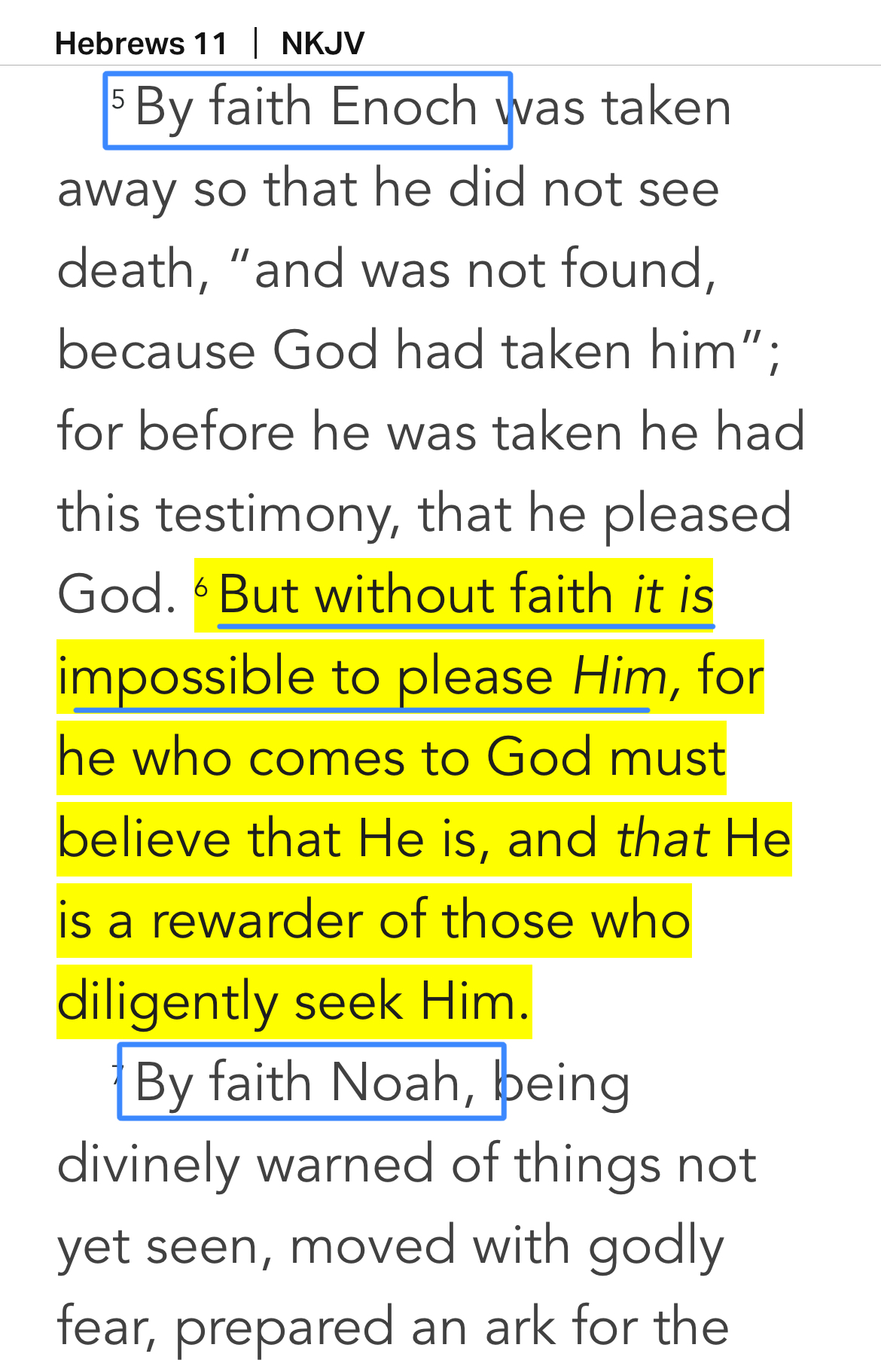
In the New Testament, Enoch and Noah are listed as back-to-back examples of faith (Hebrews 11:5, 7). The verse that connects these two men speaks of the faith-filled integrity that kept them walking with God—
And without faith it is impossible to please Him, for the one who comes to God must believe that He exists, and that He proves to be One who rewards those who seek Him. (Hebrews 11:6)
That word “seek” means to diligently crave. Enoch and Noah and David show us examples of men who diligently craved walking with God above all else. Their faithful, diligent walking made them stand out from all those around them.
What about us? Hebrews 11:6 says we can follow their example. We can choose to walk with God by faith. We can diligently crave Him above all else. When we walk righteously with God, He “rewards those” who do—for ever and ever!
Listen to the podcast of this post by clicking on the player below, and you can also subscribe on Apple, Spotify, or Audible.
Staying power is something special. It especially stands out to us when someone holds their position for years and continues to remain one of the go-to people in the organization. For Christians, the key to staying power may not be as difficult to obtain as you may think.
The timeline between Nebuchadnezzar and Belshazzar:
Nebuchadnezzar died in 562 and was succeeded by his son Amel-Marduk.
Amel-Marduk was assassinated by his brother-in-law, Nergal-Sharezer, two years later (560 BC), who then assumed the throne.
Four years later (556 BC) Nergal-Sharezer died, and he was succeeded by his son, Labashi-Marduk.
Before a year had passed, Labashi-Marduk was assassinated by a group of malcontents headed up by Nabonidus, who then assumed the throne.
Five years later (550 BC), Nabonidus died and was succeeded by his son, Belshazzar.
Darius—a common name for Medo-Persian rulers. “Darius the Mede” (Daniel 5:31) is a more mysterious figure who, so far, appears only in the Bible. Historians think he may have been Gubaru, an officer in Cyrus’ army who became governor of the Persian province of northern Babylon. In this case, he’s the military leader who invaded Babylon, killed Belshazzar, and effectively ended the reign of Babylon. Persia was now the new world power.
Darius I, called the Great, reorganized the government into satraps and extended the boundaries of the empire (Daniel 6:1-3). Daniel was appointed as one of three presidents over the 120 satraps but was being considered as the chief of the three.
Cyrus the Great was king of Persia from 550-529 BC. When Cyrus became ruler of the Persian district of Anshan, the district was subject to the Medes; five years later he led a rebellion against the Medes that resulted in the capture of King Astyages and the overthrow of the Median Empire. Thereafter Cyrus called himself king of Persia. In 539 BC the kingdom of Babylon fell to Cyrus.
Listen to the audio-only version of this podcast by clicking on the player below, or scroll down to watch the video.
Accepting a new position is a very exciting experience! Whether it’s a promotion in your current organization or an opportunity elsewhere, it’s very tempting to want to immediately throw your full attention into the next project. In this episode, Greg and I discuss the necessity of maintaining a balance between that excitement and recognizing that the people on your team now still need your leadership. This might create more work for you in the short term, but the long-term benefits of transitioning well will be huge for you!
[0:33] Any fresh starts for leaders have to be handled thoughtfully.
[2:44] Leaders of integrity give their best effort all the way to the end.
[4:08] How can we maintain a humble attitude when we have been selected to be promoted to a new position?
[6:08] There are different things to keep in mind when moving to a new position in the same organization vs. moving to a new organization.
[8:02] Both of us share stories about friends who benefitted by leaving their old organizations well, and they identify what the true litmus test for leaving well is.
[10:14] Greg also has a negative example to share.
[11:03] How do senior leaders handle coworkers who leave poorly?
[13:06] How do we keep ourselves from being distracted by our new position while we attempt to finish well in our old position?
[16:15] How do we arrive well in our new position?
[18:35] We need to always keep in mind that we are leaving or joining a team of many—we aren’t a team of one.
[22:57] Finishing well is a compliment to the organization you are leaving, and beginning well is a compliment to the organization you are joining.
Check out this episode and subscribe on YouTube so you can watch all of the upcoming episodes. You can also listen to our podcast on Spotify and Apple.
Jesus said we are hypocrites when we give, pray, or fast only outwardly. He called our prayers “pagan” when we try to pray unnaturally. Jesus desires for our giving, praying, and fasting to be natural parts of who we are.This is a short clip of a full-length teaching called “Keepin’ it real” that I shared exclusively with my Patreon supporters. If you would like to sponsor me too for just $5/month, check out the details here.
“Nothing is impossible, the word itself says ‘I’m possible’!” —Audrey Hepburn
“Astronomers are thrilled by the extraordinary images provided by the new James Webb Space Telescope (JWST)—but some of the data already contradict Big Bang expectations. … Creationists have long noted that the Big Bang suffers from the mature distant galaxy problem. Big Bang theorists assume that light from the most distant galaxies took more than 13 billion years to reach Earth. By Big Bang reckoning, we should be seeing these very distant galaxies, not as they are today, but as they were more than 13 billion years ago. Hence, these galaxies should look ‘unevolved’ and ‘immature.’ Yet this expectation is routinely contradicted, and preliminary data from Webb continues the trend.” Check out more from this ICR article.
“Our leadership will always be second to our followership of Jesus.” —Pastor Ben Stoffel
Have you ever been cursed out? Here’s how Jesus wants Christians to respond. It’s pretty easy to say something nice to someone who has done something nice for you. But Jesus tells us to say nice things to people regardlessof how they have treated us.
“The battles that count aren’t the ones for gold medals. The struggles within yourself—that’s where it’s at.” —Jesse Owens
“Your walk walks, and your talk talks, but your walk talks more than your talk talks.” —Anonymous
Listen to the podcast of this post by clicking on the player below, and you can also subscribe on Apple, Spotify, or Audible.
I once knew a businessman who was one of the most silver-tongued talkers I have ever met! He could persuade just about anyone to join him in one of his “can’t miss” business ventures.
And even after they did miss (which was all of them that I was aware of) he could still convince many of his backers to continue. I never knew him to fulfill what he had promised.
Eventually, this caught up with him. And so did the law, and he ended up serving a prison term.
It has always been intriguing to me how much value we put on the words of leaders. It seems as if they can “talk a good game,” we feel a need to exalt them to a higher level. It’s not the one who gets things done, or the one who has the best ideas, or the one who can bring increased efficiency or effectiveness, but the one who can talk the most convincingly.
I think about in my own profession as a pastor. Churches will select a pastor based on how he sounds from the platform. And yet the sermon is only a tiny fraction of a pastor’s work each week.
The danger comes when the leader thinks that his highest value to the organization is the words he speaks. Inevitably, then, he will put more effort into what he says than into what he does. He will spend a lot of time figuring out the right words to say, and how to move people’s hearts.
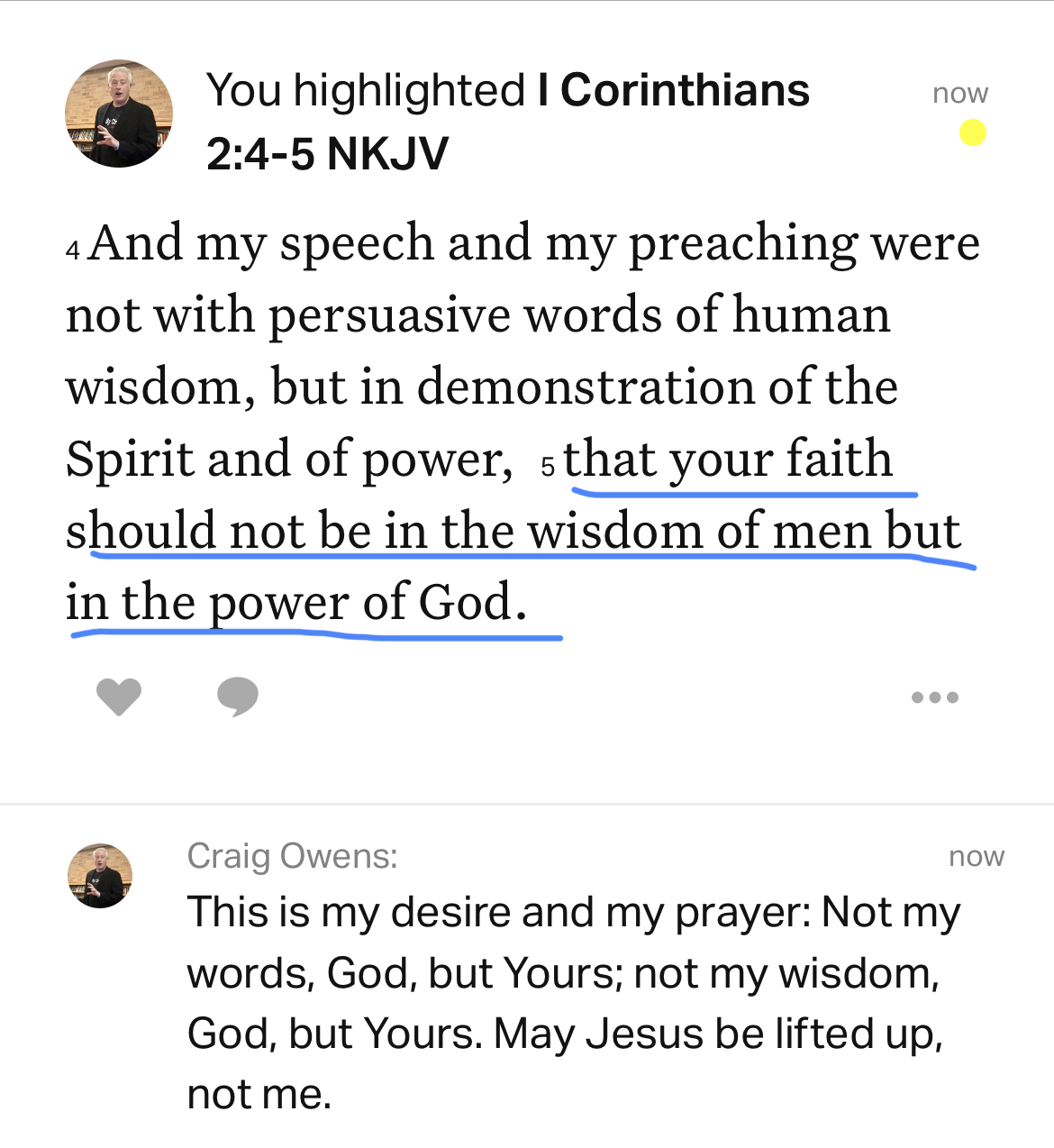
The apostle Paul told the Christians at Corinth, “My speech and my preaching were not with persuasive words of human wisdom” (1 Corinthians 2:4). And he told the Christians at Thessalonica, “For you remember what we taught you by the authority of the Lord Jesus” (1 Thessalonians 4:2), not Paul’s own authority.
I don’t want people to be impressed with me. I don’t want my authority to come from my vocabulary. I simply want to be known for speaking the Word of God, and then living a life that matches the Word of God.
As King Solomon said, “A truly wise person usesfew words” (Proverbs 17:27). The wisest words are not mine but God’s. Then “your faith [is] not in the wisdom of men but in the power of God” (1 Corinthians 2:5).
Words do have their place. But let’s always make sure that that place isn’t in place of God’s Word.
This is a weekly series with things I’m reading and pondering from Charles Spurgeon. You can read the original seed thought here, or type “Thursdays With Spurgeon” in the search box to read more entries.
Listen to the podcast of this post by clicking on the player below, and you can also subscribe on iTunes or Spotify.
Walking Preachers
For we walk by faith, not by sight. (2 Corinthians 5:7)
Walking is a position that…signifies activity. You would suppose from the way some Christians deport themselves, that their whole life was spent in meditation. It is a blessed thing to sit ‘with Mary at the Master’s feet.’ But we walk as well as sit. We do not merely learn, but we practice what we know. We are not simply scholars, but, having been taught as scholars, we go on to show our scholarship by working in the vineyard or wherever else the Master may be pleased to place us. …
You would gather indeed from what others say, that the whole life of a Christian is to be spent in prayer. Prayer, it is true, is the vitality of the secret parts of Christian life, but we are not always on our knees! We are not constantly engaged in seeking blessings from heaven. We do continue in prayer, but we are also engaged and showing forth to others the blessings that we have received and in exhibiting in our daily actions the fruits that we have gathered on the mountaintop of communion with God. We walk, and this implies activity. …
‘We walk.’ This is more than some can say. They can affirm, ‘We talk. We think. We experience. We feel.’ But true Christians can say with the apostle Paul, ‘We walk.’ Oh, that we may ever be able to say it too! Here, then, is the activity of the Christian life.
From Faith Versus Sight
Edgar A. Guest captured this idea well in his poem “Sermons We See.” The first stanza says,
I’d rather see a sermon than hear one any day;
I’d rather one should walk with me than merely show the way.
The eye’s a better pupil and more willing than the ear;
Fine counsel is confusing, but example’s always clear.
And the best of all preachers are the men who live their creeds.
For to see the good in action is what everybody needs.
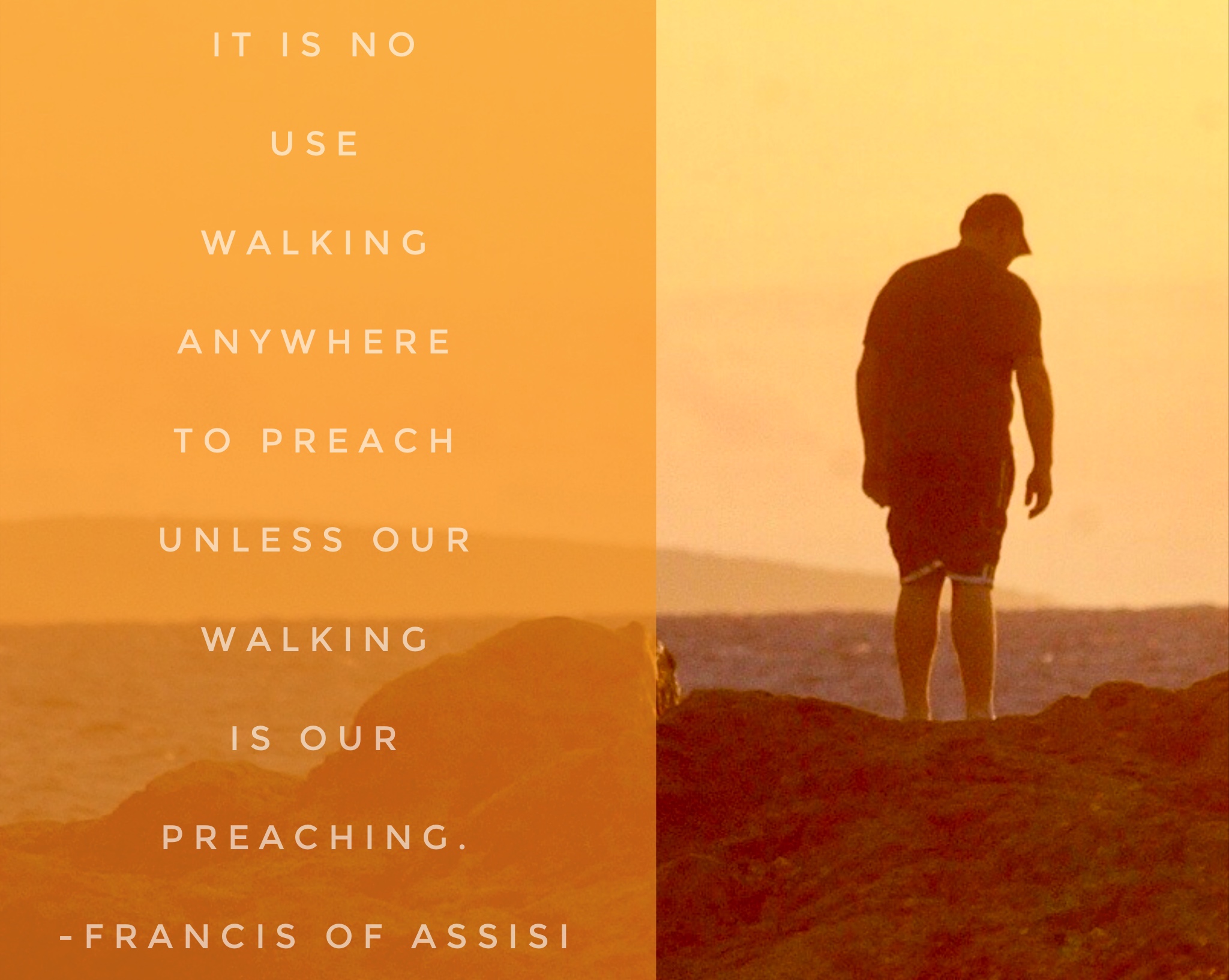
Or as Francis of Assisi noted, “It is no use walking anywhere to preach unless our walking is our preaching.”
So a fantastic question for every Christian to ask themselves is this: Do people know that I’m walking with Jesus even if I never open my mouth to tell them?
Listen to the podcast of this post by clicking on the player below, and you can also subscribe on Apple, Spotify, or Audible.
My cousin Dick Brogden wrote in his book Missionary God, Missionary Bible, “Since good news must often indeed rectify bad news, the gospel message is both warning and invitation.” This is so appropriate when reading the prophet Zephaniah: He wanted to share some really, really good news, but first, he must make us confront the really bad news.
Zephaniah prophesied near the end of Judah’s decline toward exile. He saw the great revival in King Josiah’s day, and then watched his fellow Israelites once again turn their backs on God. If Jeremiah spoke to faithless Israelites, and Habakkuk spoke to faithful Israelites, then Zephaniah spoke to fake Israelites—those who appeared to be religious, but whose hearts were not actually devoted to God.
This whole book looks backward in history and forward to soon-to-be-fulfilled prophecy. Most of the time when God speaks, He is asking us to look forward to what is unavoidably coming. Zephaniah then takes God’s words as a call for us to apply them to our lives today.
In the first chapter, God’s forward-look is a warning of the judgment that most assuredly is coming. Built into His warning are two backward looks to the law of Deuteronomy (vv. 13 and 15 look back to Deuteronomy 28:29-30).
Zephaniah uses this warning as a wake-up call for us, telling us to “seek the Lord” and “seek righteousness, seek humility” before the day of God’s judgment comes (2:1-3).
The fact that God’s judgment would fall on godless people shouldn’t surprise anyone (2:4-15), but when Zephaniah says, “Woe to the city of oppressors” (3:1), he’s talking to the people of Judah! Zephaniah addresses his warning to the fake Israelites, the hypocritical people—those claiming God’s name but not God’s nature.
The apostle Paul sounds a similar warning to New Testament Christians:
Now these things occurred as examples to keep us from setting our hearts on evil things as they did. Do not be idolaters, as some of them were; as it is written: ‘The people sat down to eat and drink and got up to indulge in revelry.’ We should not commit sexual immorality, as some of them did—and in one day twenty-three thousand of them died. We should not test Christ,as some of them did—and were killed by snakes. And do not grumble, as some of them did—and were killed by the destroying angel. These things happened to them as examples and were written down as warnings for us, on whom the culmination of the ages has come. So, if you think you are standing firm, be careful that you don’t fall! (1 Corinthians 10:6-14)
The really bad news is ALL of us have sinned and we have ALL fallen short of God’s righteous standard. As a result, ALL of us would stand guilty before God on Judgment Day.
But the really, really good news is that Jesus allowed our penalty to fall on Him instead! So if we put our faith in Jesus, God’s judgment will be appeased in Christ instead of on us!
Christians, then, take the name of Jesus Christ, but we need to make sure we also take His nature.Fake—hypocritical—Christians are those who are “Christian” in name only.
I like the way Eugene Peterson paraphrased part of the 1 Corinthians passage above—These are all warning markers—danger!—in our history books, written down so that we don’t repeat their mistakes. Our positions in the story are parallel—they at the beginning, we at the end—and we are just as capable of messing it up as they were. Don’t be so naive and self-confident. You’re not exempt. You could fall flat on your face as easily as anyone else. Forget about self-confidence; it’s useless. Cultivate God-confidence. (The Message)
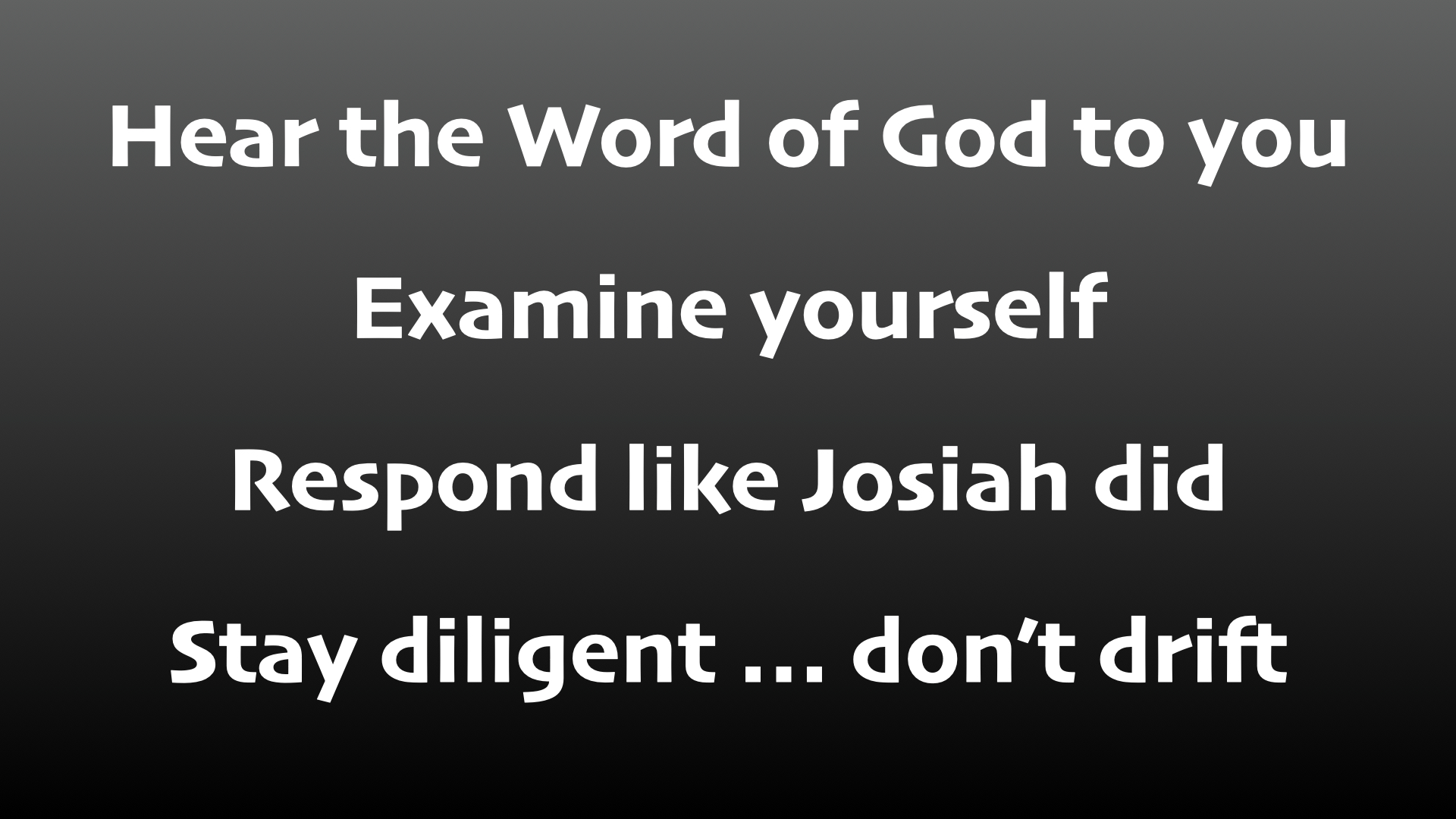
As we read those words, “So if you think you are standing firm, be careful that you don’t fall,” I’d like to suggest four action steps:
Hear the Word of God to YOU—not your neighbor—but you personally.
After you hear the Word, examine yourself to see if you are truly living in God’s nature and not just using His name.
Respond like King Josiah did when he heard God’s Word: He made a public commitment “to follow the Lord and keep His commands, statutes and decrees with ALL his heart and ALL his soul” (2 Kings 23:3).
Stay diligent—Hebrews 2:1 tells us, “We must pay the most careful attention, therefore, to what we have heard, so that we do not drift away.”
Don’t delay—the Day of the Lord is closer today than it’s ever been before! Pay attention to the really bad news that Judgment Day is coming, but then make certain you are standing in the nature of Jesus Christ on that day so that God’s judgment will pass over you.
Listen to the podcast of this post by clicking on the player below, and you can also subscribe on Apple, Spotify, or Audible.
When the righteous thrive, the people rejoice… (Proverbs 29:2).
I have read hundreds of leadership books and biographies of history’s most influential leaders. But no book even comes close to the leadership principles I discover on an almost daily basis in my Bible. Without a doubt, my Bible is my go-to leadership Book!
A great place to start mining leadership principles is the book of Proverbs. Take time to study just one of the 31 chapters each day, and you will be astounded at the leadership insights you will have gleaned by the end of the month.
Take Proverbs 29 as an example. Reading through this chapter, I’m reminded that:
righteous leadership causes people to rejoice
a leader builds stability through consistent justice, but bribes or showing favoritism undermines a leader’s foundation
leaders who speak up for those without a voice of their own will continue to exert influence long after their tenure is over
wise leaders energize people when they share a compelling vision
justice comes through a righteous leader, but ultimate justice come from God
I even read an important warning for leaders who make it their goal to lead righteously: Bloodthirsty men hate a man of integrity and seek to kill the upright (v. 10).
But even on the heels of that warning I read this assurance to continue to lead righteously: Fear of man will prove to be a snare, but whoever trusts in the Lord is kept safe (v. 25).
A mark of a godly leader is one who is continually finding new leadership principles in the Bible.
Try it for yourself and see how applying God’s wisdom will increase your influence as a leader.
This is part 58 in my series on godly leadership. You can check out all of my posts in this series by clicking here.



 When you read through the history of the kings of Israel and Judah, there are two consistently recurring themes for these leaders—