Listen to the podcast of this post by clicking on the player below, and you can also subscribe on Apple, Spotify, or Audible.
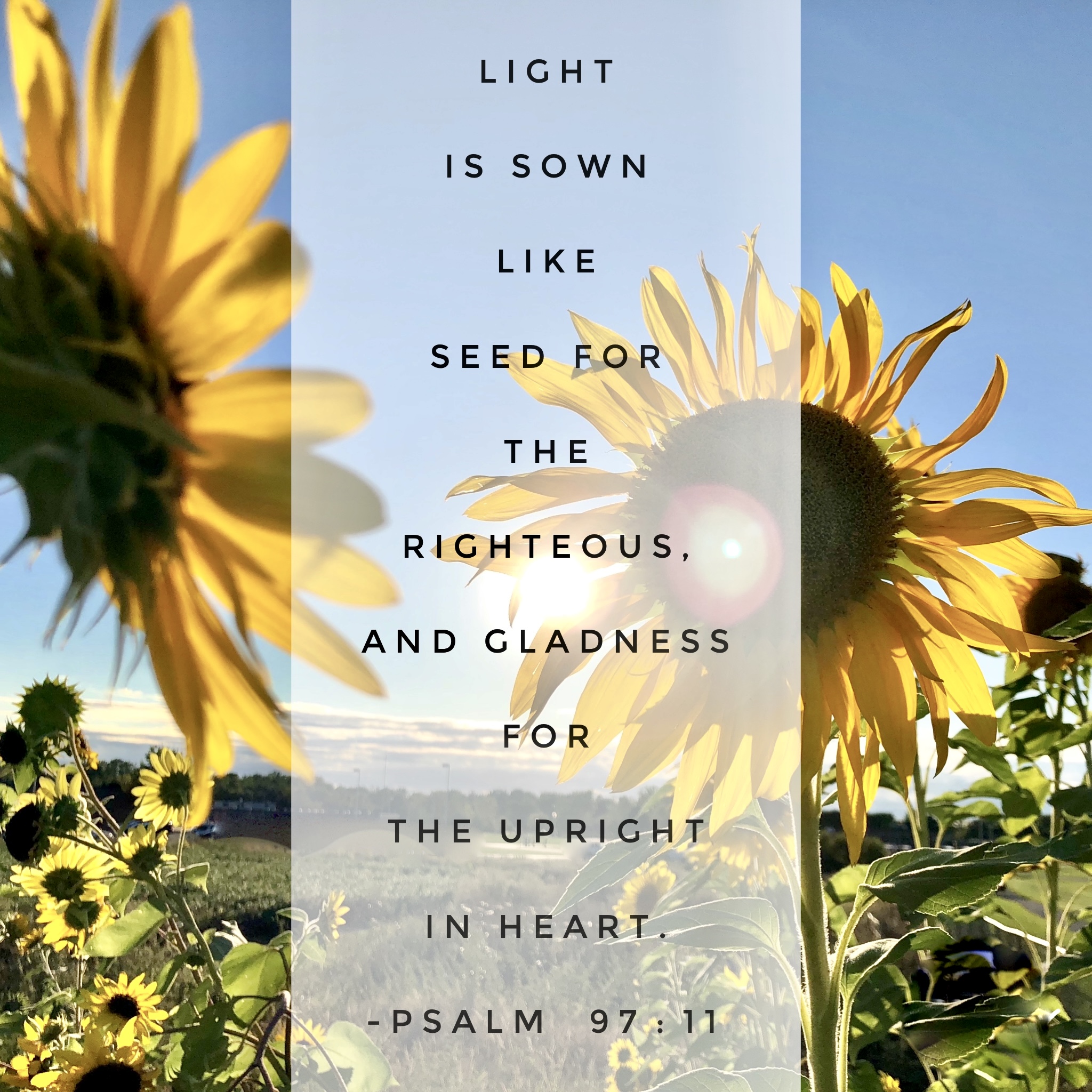
Light is sown like seed for the righteous, and gladness for the upright in heart. (Psalm 97:11)
Jesus used the parable of a farmer sowing seed as a picture of the seed God wants to sow in our hearts. The psalmist says that God’s seeds are light—driving out the shadows of darkness, and producing an abundant harvest of gladness in our hearts.
I like how the Amplified Bible renders this verse in Psalm 97—Light is sown for the uncompromisingly righteous and strewn along their pathway, and joy for the upright in heart—the irrepressible joy which comes from consciousness of His favor and protection.
Let’s live in a such a God-honoring way that His seeds of light bring forth an abundant harvest that gives Him all the glory and points others to Jesus the Savior.
Listen to the podcast of this post by clicking on the player below, and you can also subscribe on Apple, Spotify, or Audible.
The phrase “Jesus knew” specifically appears twice in John chapter 13 (vv. 1, 3), but the idea appears in multiple places. Jesus was continually and intimately aware of His Father’s plan and the Holy Spirit’s empowerment to help Him live out that plan.
Check out some of the things Jesus knew:
He knew His mission—I have come into the world as a light, so that no one who believes in Me should stay in darkness (John 12:46)
He knew His role in fulfilling that mission—For I did not come to judge the world, but to save the world (12:47)
He knew His Father’s voice directing Him in His mission—For I did not speak on My own, but the Father who sent Me commanded Me to say all that I have spoken.I know that His command leads to eternal life. So whatever I say is just what the Father has told Me to say(12:49–50)
He knew His Father’s timing for His mission—Jesus knew that the hour had come for Him to leave this world and go to the Father (13:1)
He knew His Father’s empowerment to complete the mission—Jesus knew that the Father had put all things under His power (13:3)
He knew what He must do to bring glory to His Father as He fulfilled His mission—Having loved His own who were in the world, He loved them to the end. … So He got up from the meal, took off His outer clothing, and wrapped a towel around His waist. After that, He poured water into a basin and began to wash His disciples’ feet, drying them with the towel that was wrapped around Him(13:1, 4-5)
Jesus said that He was in His believer’s lives, just as He was in the Father (John 14:20). That means He takes us into His Father, and He also told us that He would impart His Holy Spirit to us.
That means you and I have all that we need to know all that Jesus knew and to live like Jesus lived.
My question is: Why don’t I live this way?
Why am I not living up to this potential every day?
The simple conclusion must be that I am not operating in the full resources that are mine as a child of God.
I must make sure that I am abiding more and more intimately with my Savior, that I am tuning into the prompting of the Holy Spirit more and more consistently, and that I am increasingly aware of my Father’s will for my life.
If we strive for this, we can know what Jesus knew and we can live like Jesus lived. This is how we bring glory to God, just as Jesus did!
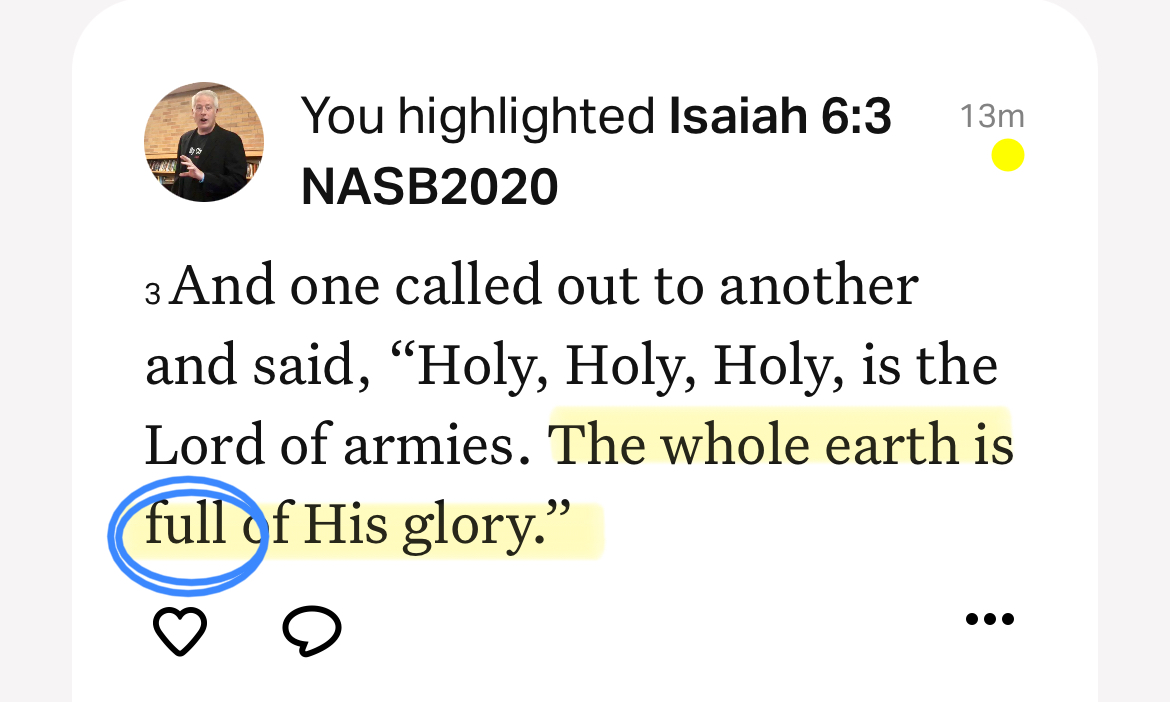
And one [angel] called out to another and said, “Holy, Holy, Holy, is the Lord of armies. The whole earth is full of His glory.” And the foundations of the thresholds trembled at the voice of him who called out, while the temple was filling with smoke. Then I said, “Woe to me, for I am ruined! Because I am a man of unclean lips, and I live among a people of unclean lips; for my eyes have seen the King, the Lord of armies.” (Isaiah 6:3-5)
The literal translation of the phrase “the whole part is full of His glory” is, “The fullness of the whole earth IS His glory.”
Paul says it this way, “All things have been created through Him [Jesus] and for Him. He is before all things, and in Him all things hold together” (Colossians 1:16-17). God spoke all things into existence—we literally live today in His breath, we breathe His breath, we eat His breath. All that exists is the fullness of His glory.
Isaiah got a small glimpse of this glory, and the weightiness of God’s awesome glory brought him to his knees (Isaiah 6:4-5).
How many trivial things would fall to the side when we realize how unimportant they are in comparison to the eternal importance of God’s glory!
How differently we would live each day if we were aware of God’s presence in and around us!
How fearful we would be to even contemplate sinning in His presence!
How quick we would be to repent of sin when we are aware of just how present He is!
How unafraid we would be to boldly stand for God and proclaim His love and power if we were aware of His ever-present Spirit equipping and supporting us!
Oh, that “the Father of glory may give you a spirit of wisdom and revelation in the knowledge of Him” (Ephesians 1:17)!
Listen to the podcast of this post by clicking on the player below, and you can also subscribe on Apple, Spotify, or Audible.
How exactly should we pray for those who have so badly mistreated us? There’s a natural response, and then there’s a supernatural response that Jesus calls us to.
In the New Testament, the Greek word for “bless” is eulogeo. The prefix eu- means “good” and the root logos is “word.” So, in the New Testament context in which we now live, to bless someone literally means to say good words both to them and about them. So when Jesus tells us, “Bless those who curse you and pray for those who mistreat you,” He is telling us to say good words to them, and to say good words about them in prayer to our Heavenly Father. …
Commenting on Psalm 109:4, my friend Kevin Berry said, “While they accuse me like satan, I will pray for them like Jesus.” This is the highest level of Christian maturity: To pray like Jesus did for those who insulted Him, slandered Him, and crucified Him, “Father, forgive them for they don’t understand what they are doing” (Luke 23:34).
I truly believe that When Sheep Bite will be a healing resource for shepherd leaders who are still feeling the pain of their latest sheep bite. Please pick up a copy today!
Listen to the podcast of this post by clicking on the player below, and you can also subscribe on Apple, Spotify, or Audible.
I’ve noticed how quick some people are to give up when things don’t get them the results they thought they should get, or the results don’t come as soon as they expected.
Anytime we try something new, there is always the potential for failure. Even later on, those who appear to be an expert at something rarely do it perfectly. But in either case, there are three things we need to do if we don’t get the results we expected: (1) reflect, (2) evaluate possible improvements, (3) re-engage.
Even before Jesus commissioned us to take His message of Good News to every street everywhere, He told us not to expect perfect results. In one of His best-known parables, Jesus talked about the farmer sowing seed (see Luke 8:5-8).
Jesus didn’t say, “All of your efforts at sharing the Gospel will be successful.” In fact, He said some efforts would totally fail (falling on the hard path), and some would have only temporary success (falling on the weedy and stony ground). But we keep on sowing the seed because some will fall on good soil and yield a harvest a hundred times more than was sown!
So, as John Wesley said, “Do all the good you can, by all the means you can, in all the ways you can, in all the places you can, at all the times you can, to all the people you can, as long as ever you can.”
The baptism of the Holy Spirit brings dynamic, life-changing power (Acts 1:8). The life that is changed first is our own. Everything about us begins to change.
When people heard Jesus speak, they said, “How did this Man get such learning without having been taught?” (John 7:15). The same Holy Spirit who empowered Jesus to speak is the same Holy Spirit who will empower our words.
When our words are Spirit-empowered words, people can feel it. When our words are matched by our lifestyle, people can’t ignore it (John 7:46; Acts 2:37, 4:13, 6:10)!
Just like salt that influences effortlessly, silently, and irreversibly, we never know what part the salt of our lives is playing in someone else’s life, even if it appears that nothing substantial is happening at all. But God said His word always accomplishes its purpose (Isaiah 55:10-11), which is why we keep on living and speaking as Spirit-empowered witnesses.
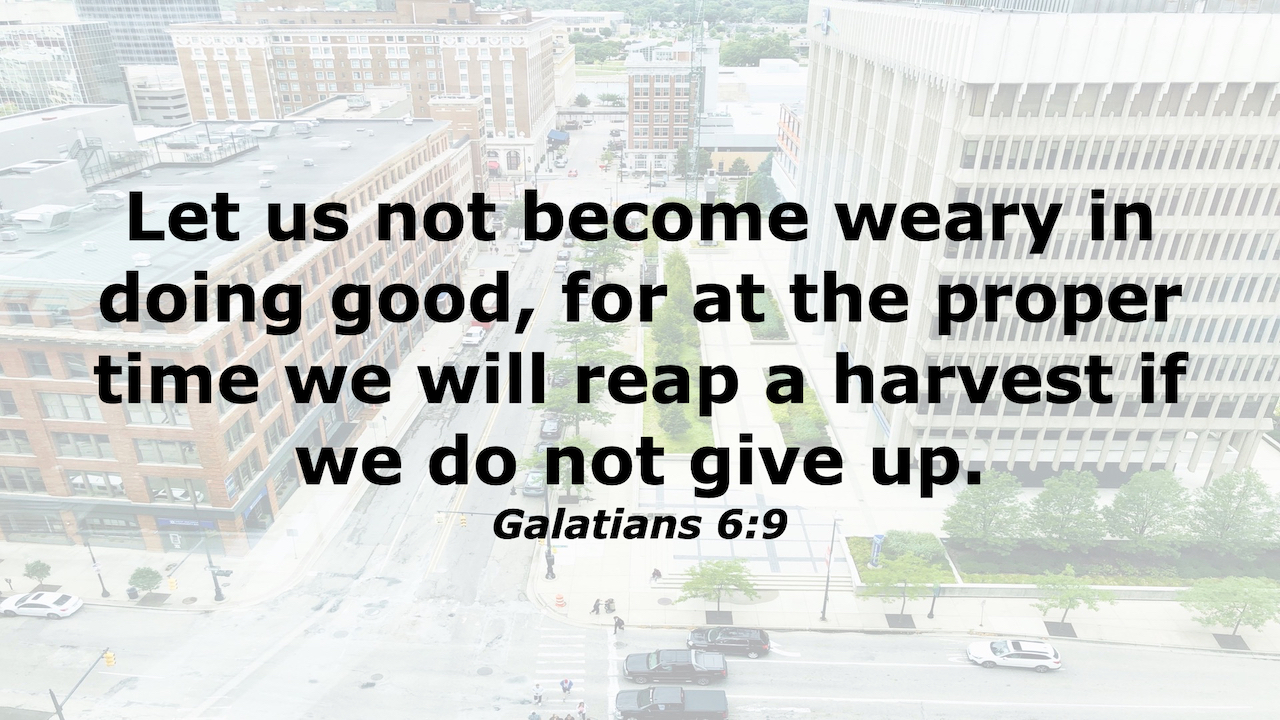
And we live expecting that something is happening—Let us not become weary in doing good, for at the proper time we will reap a harvest if we do not give up (Galatians 6:9).
How do we take this message of Jesus to every street?
Stay yielded to the influence of the Holy Spirit
Regularly and consistently read and apply God’s Word to your own life
Keep sowing in expectation
If your efforts appear to fail: reflect, evaluate, re-engage in expectation
We can be salt without being salty; we can be light without being annoying.
We have been empowered to take the Good News to every street, so let us not become weary in doing this.
Listen to the podcast of this post by clicking on the player below, and you can also subscribe on Apple, Spotify, or Audible.
Jesus sent us and the Holy Spirit empowers us to take the Good News to all nations—all the streets (Luke 24:47-49; Acts 1:8)—even the streets of Samaria where we will have more differences than similarities.
There is one street that has infiltrated and affected every other street more profoundly than any other: Hollywood Boulevard. The constant bombardment of messages through movies, television programs, music, literature, and the arts is almost immeasurable.
I think Christians rarely stop to ponder how much of the culture on Main Street is influenced by the content from Hollywood Boulevard. Probably because so few Christians are involved in the artistic or creative communities.
Here’s what we need to remember: All of this creativity is God-given. The opening words in the Bible say, “In the beginning God created…” (Genesis 1:1).
We specific examples of God-given creative skills in:
Bezalel—Exodus 31:1-5
Oholiab—Exodus 31:6, 35:34
craftsmen and craftswomen—Exodus 31:6; 35:10, 22, 25
In more modern times, we see notable creative people giving credit to God for their abilities.
William Shakespeare’s use of biblical themes—and even exact phrases—throughout his work is easy to spot. In the opening line of his last will and testament, he wrote, “I commend my soul into the hands of God my Creator, believing through the merits of Jesus Christ, my Savior, to be made a partaker of life everlasting.”
Johan Sebastian Bach, considered by many to be the greatest composer to ever live, placed “S.D.G.” on every one of his musical compositions, which stands for Sola Deo Gloria: only for the glory of God.
The apostle James tells us that every good and beautiful gift has come to us from God our Creator (James 1:17). And then this is my paraphrase of a similar thought the apostle Peter—
Each of you should use whatever gift you have received to serve others, as faithful stewards of God’s grace in its various forms. If anyone speaks [writes, paints, composes, sculpts], they should do so as one who speaks [writes, paints, composes, sculpts] the very words of God. (1 Peter 4:10-11)
So, here are four thoughts about how we can take the Good News of Jesus to Hollywood Boulevard.
Create a beautiful culture in your home, your Main Street, your workplace, your school. Ask the Holy Spirit to help you answer the question, “What can I do so that the love and beauty of Jesus will be felt here?”
Use your creative skills—write poems, compose music, paint a picture, sew clothing, bring innovation to your job.
Support beautiful authors, musicians, moviemakers, painters, etc. Hollywood produces what they think will make money, so if you are supporting creators of beautiful things, they will produce more of those things.
Leverage Hollywood’s culture to talk to others about heavenly culture. Point out biblical themes, challenge the rationale behind unbiblical lyrics, etc.
“Christians need to ask themselves a few key questions to help us respond to the society around us. First, what is good in our culture that we can promote, protect, and celebrate? Second, what’s missing in our culture that we can creatively contribute? Third, what’s evil in our culture that we can stop? And fourth, what’s broken in our culture that we can restore?” —John Stonestreet
Don’t complain—create something better.
Don’t compromise—promote what is beautiful and edifying.
The Holy Spirit can empower us to take the Good News of Jesus even to Hollywood Boulevard!
If you’ve missed any of the other messages in our series Takin’ Him to the Streets, you can find them all here.
Listen to the podcast of this post by clicking on the player below, and you can also subscribe on Apple, Spotify, or Audible.
I would like to take you behind the scenes to the origin of my second book. In this video, you will hear how I first came up with the idea for When Sheep Bite, and how the Holy Spirit redirected my original book design.
Check out this episode of The Podcast.
I wrote this in the Introduction to Section One of When Sheep Bite—
I know that when you are in distress you are looking for immediate relief. You may be tempted to jump right to Section 2 of this book where I outline specific thoughts and strategies for handling the ways your sheep are biting and kicking, but I invite you to hold off. … It may appear from your perspective that the fault lies entirely with the attacking sheep—and that you feel that you haven’t done anything to provoke them. But these attacks can open our eyes to things we haven’t noticed before and teach us invaluable lessons, if we are willing to quiet ourselves before the Holy Spirit’s counsel. …
If we don’t have the heart of a shepherd leader, we will not only treat every bite and kick as if it is completely their fault, but we will never be looking for ways to bring healthy correction and restoration to that wayward sheep. Let me remind you that all of us were those wayward sheep—biting God’s hand, running away from Him—when Jesus put His very life on the line to bring us into the sheepfold (Romans 5:6-8). This kind of shepherding doesn’t come just because we outwardly try to do the right thing, but because we have a right heart attitude (Philippians 2:5).
I truly believe that When Sheep Bite will be a healing resource for shepherd leaders who are still feeling the pain of their latest sheep bite. If you are a pastor—or if you love your pastor—please pick up a copy today!
Listen to the podcast of this post by clicking on the player below, and you can also subscribe on Apple, Spotify, or Audible.
Jesus sent us and the Holy Spirit empowers us to take the Good News to all nations—all the streets (Luke 24:47-49; Acts 1:8). As we move away from Jerusalem and into Judea, we should expect to see more differences with our audience. And then as we move into Samaria, there will probably be more differences than similarities. Regardless of how little we may have in common with those on other streets, the Holy Spirit still empowers us to witness there.
When we don’t live on someone else’s street, we tend to make some pretty big assumptions about them. For example, until I married a school teacher, I thought, “How nice it must be to be done with work by 3:00 every afternoon and have three months off in the summer!”
Mistakenly, we think we can so easily fix the problems people on other streets have—we think we can show them how simple it is to correct anything out of balance on their street. These are natural thought patterns when so little of our circles overlap.
If you live on Main Street, two streets which are quite different from you are Easy Street and Skid Row. When it comes to finances, there tends to be extremes in our thoughts about the Samaritans that live on those streets—
Those on Easy Street only cares about themselves
Those on Skid Row should work harder
Those on Easy Street have too much—it’s not fair!
Those on Skip Row don’t have enough—it’s not fair!
But here’s the thing: It’s really not about the money but it’s about our attitude about the money.
In Luke 21:1-6, Jesus saw both rich people from Easy Street placing their tithe in the temple treasury, and a poor widow from Skid Row doing the same. Jesus said this widow put in more than anyone else. He was talking in terms of quality, not quantity.
While they were still in the temple, the disciples pointed out how beautifully embellished the temple was. These decorations came from the money those on Easy Street had contributed. Jesus told them not to focus on the temporal temple but on the eternal Kingdom of God.
As I said, Jesus doesn’t have a problem with money, but He does warn us about our ungodly attitude toward money (Luke 8:1-3; Matthew 27:57; Acts 4:32-5:4; Exodus 20:17; Luke 12:13-22).
Even though Easy Street and Skid Row seem to be at opposite ends of the spectrum, I think we are effective witnesses for Jesus on these streets in exactly the same way.
(1) Guard your attitude about money. Remember that Gad often provides for us by giving us a skill, and then making a job available that can use our skill. So let’s be thankful for our God-given jobs. Then we guard our attitude about money by tithing regularly, and making sure that when we bless others financially, we do it without expecting any fanfare (Colossians 3:23; Malachi 3:10; Matthew 6:2-3).
(2) Let God be unique as unique with these folks on Easy Street and Skid Row as He is with you on Main Street. Don’t try to be someone else, and don’t expect others to be you—simply obey what God has spoken to your heart, just as you allow others to obey what God has spoken to their hearts.
(3) Don’t tell, but show how you use the resources God has given to you. It’s not our place to “preach” to others about how they should or shouldn’t be handling their finances, but simply live out the biblical principles outlined above, and let your life show your godly attitude.
(4) Always turn the focus to the eternal. Just as Jesus did with His disciples in the temple, He always reminded people that this world with its perks or tragedies is only temporary. What ultimately matters is where we will spend eternity (Luke 13:1-5).
Money is always a touchy subject with people, so let’s make sure we have our own attitude aligned with Scripture before we try to bring the subject up with others.
If you’ve missed any of the other messages in our Takin’ Him To The Street series, you can find them all here.
Listen to the podcast of this post by clicking on the player below, and you can also subscribe on Apple, Spotify, or Audible.
Jesus sent us to all nations—to all the streets in all the world (Luke 24:47-49; Acts 1:8). We are to begin in Jerusalem and move outward. As we have seen, Jerusalem is like out Main Street, where there are more similarities than differences between us and the people to whom we are taking the Good News of Jesus. Judea is our Lombard Street & Rodeo Drive, where we are starting to see more differences.
Then we move to Samaria where there are now way more differences than similarities. But still, let’s never forget that Jesus sent us and the Holy Spirit empowers us to be effective in our witness on every street—even those with whom we have very little in common.
Jesus was baptizing in the Judean countryside (John 3:22) and now He is heading back to Galilee. “The shortest route from Judea in the south to Galilee in the north went through Samaria. The journey took three days if one wanted to travel the direct route. The Jews often avoided Samaria by going around it along the Jordan River. The hatred between the Jews and Samaritans went back to the days of the exile” (Dr. Henry Halley).
There were wide differences between Jesus and this woman of Sychar:
Cultural differences—The Jews considered the Samaritans to be no longer “pure” Jews, but half-breeds and traitors (vv. 5-9).
Personal differences—She was female, Jesus was male; she was a divorcée, Jesus was single (vv. 9, 16-18).
Religious differences—The Samaritans only recognized the Pentateuch; the Jews recognized the entire Old Testament Scripture. And the Samaritans saw Mt. Gerizim as the center of worship and the place the Messiah would reign; the Jews believed Jerusalem to be the center of worship (vv. 19-20).
Our first task is to find common ground with whoever we can. Jesus used the word “whoever” three times in John 3:16, 18, 36, saying that whoever believed in Him would have eternal life. We need to have this same mindset. It’s not His desire that any should perish—not even the Samaritans!—but that all should come to know Him as Savior.
In his book Winning With People, John Maxwell presents The 101% Principle: Find the 1% we can agree upon and give that 100% of your effort.
Jesus found the 1% and gave 100% to it. For He and this Samaritan woman their common connection was water and worship (John 4:9-15, 21-26). Jesus used both of those things to open a conversation about eternal matters.
Who are the Samaritans in my life? They are people…
…I have very little in common with
…I go out of my way to avoid talking to
…I think are never going to “get it”
…who make me angry, defensive, or combative
But they are also people…
…for whom Jesus died
…who are dearly loved by our Heavenly Father
…who need to hear the Gospel
…to whom I have been sent
Our prayer should be this:
Holy Spirit, help me to notice the people to whom I have been blind or whom I have been avoiding. Help me to find the 1% on which we can agree, and then empower me to give 100% of my effort to that 1%. I want my heart to beat with the heart of my Savior: Whoever believes on Him will not perish but will have eternal life.
Christians do a disservice to the Gospel when we’re known more for what we’re against than what we’re for.Check out this full message here. I have lots of new content every week, which you can check out on my YouTube channel.
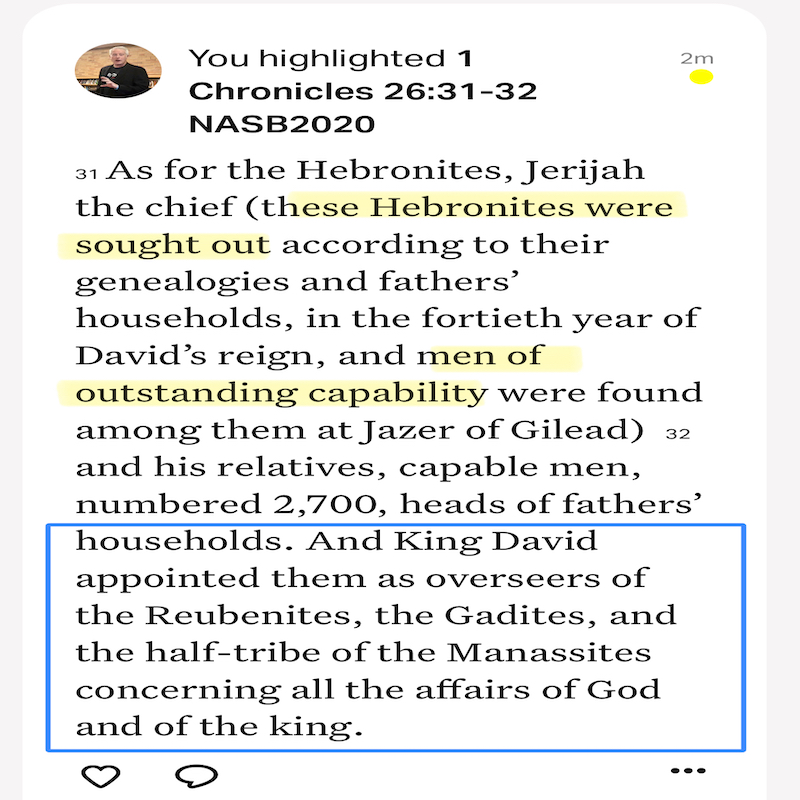
The Hebronites faithfully served God and King David without any fanfare or recognition. God shined His light on these “men of outstanding capability” so that they were finally recognized publicly. Note that they didn’t try to promote themselves. They faithfully served and God promoted these humble men in His timing.
I always appreciate the straightforward leadership insights that Ken Blanchard shares. He wrote, “Leadership is not something you do to people, but something you do with people.” And in this post he discusses some strategies when one of your direct reports is struggling.
“If I find 10,000 ways something won’t work, I haven’t failed.” —Thomas Edison
“We are a Christian people, according to one another the equal right of religious freedom, and acknowledging with reverence the duty of obedience to the will of God.” —1931 Supreme Court ruling
The Holy Spirit reminds us of God’s Word. But in order for Him to remind us, we have to study it first! Check out this full message.
“Your real, new self…will not come as long as you are looking for it. It will come when you are looking for God.” —C.S. Lewis, in Mere Christianity
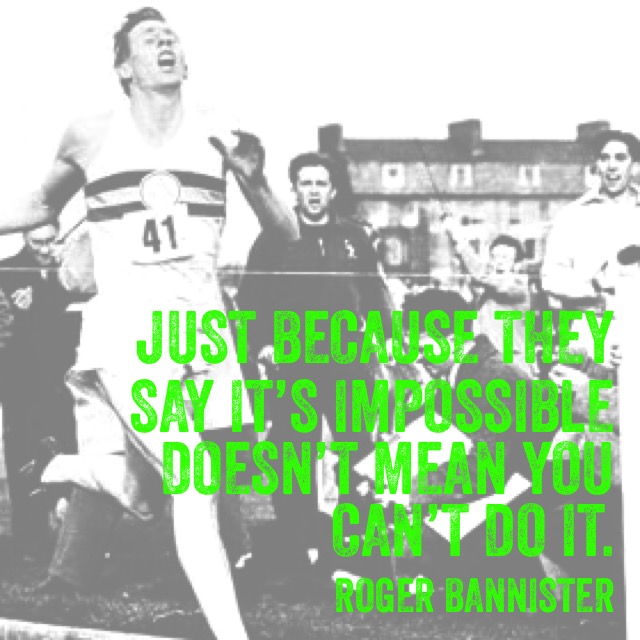
“Just because they say it’s impossible doesn’t mean you can’t do it.” —Roger Bannister, who broke the “impossible” barrier of running less than a 4-minute mile on May 6, 1954



 Light is sown like seed for the righteous, and gladness for the upright in heart. (Psalm 97:11)





 Craig T. Owens