Thursdays With Spurgeon—Blessed Assurance

This is a weekly series with things I’m reading and pondering from Charles Spurgeon. You can read the original seed thought here, or type “Thursdays With Spurgeon” in the search box to read more entries.

Blessed Assurance

     The Holy Spirit, who enabled me to believe, gave me peace through believing. I felt as sure that I was forgiven as before I felt sure of condemnation. I had been certain of my condemnation because the Word of God declared it, and my conscience bore witness to it; but when the Lord Jesus justified me, the same witnesses made me equally certain. The Word of the Lord in the Scripture says, “He who believes in Him is not condemned” (John 3:18), and my conscience bore witness that I believed, and that God in pardoning me was just. Thus I had the witness of the Holy Spirit and also of my own conscience, and these two agreed in one. …  

     I find the apostle Paul speaking by the Holy Spirit and saying, “Having been justified by faith, we have peace with God” (Romans 5:1). If I know that my trust is fixed on Jesus only, and that I have faith in Him, were it not ten thousand times more absurd for me not to be at peace than for me to be filled with joy unspeakable? It is but taking God at His Word, when the soul knows as a necessary consequence of its faith that it is saved. …  

     Has Jesus saved me? I dare not speak with any hesitation here; I know He has. His word is true; therefore I am saved. My evidence that I am saved does not lie in the fact that I preach, or that I do this or that. All my hope lies in this, that Jesus Christ came to save sinners. I am a sinner, I trust Him, then He came to save me, and I am saved. I live habitually in the enjoyment of this blessed fact, and it is long since I have doubted the truth of it, for I have His own Word to sustain my faith.

From The Autobiography Of Charles Spurgeon

The joy that Spurgeon recounts in his conversion is the same joy that is available to all who call on Jesus in faith. As Spurgeon was prone to quoting passages of hymns in his sermons and books, these words of his remind me of a favorite hymn as well—

Blessed assurance, Jesus is mine;
Oh, what a foretaste of glory divine! 
Heir of salvation, purchase of God,
Born of His Spirit, washed in His blood. 
This is my story, this is my song,
Praising my Savior all the day long!

5 Lessons From An Amazing Mother

There is a Pentecostal Christian woman that we first meet in the Book of Acts, and then we see her name scattered throughout Paul’s letters. She may be the most prominent woman among all of the Apostle Paul’s companions and probably is responsible for spreading the Gospel more and farther than any other woman recorded in the Bible. 

Scripture doesn’t tell us if she had children of her own but she is certainly the spiritual mother of more Christians than we will ever be able to count!

Prisca is her birth name. She is a Jew, and most likely a freeborn Roman (just as Paul was). She is from the prominent Acilius family, so combined with Prisca her name is called Priscilla. She married Aquila and they both worked as leather makers (also known as tentmakers). 

Let’s take a look at Priscilla’s travel itinerary—

Pricilla left Rome because of Emperor Claudius’ decree in 49 AD and traveled to Corinth, where she met Paul (Acts 18:1-3, 11, 18-19). 

After spending almost 2 years with Paul in Corinth, they traveled to Ephesus with Paul, where she met and mentored Apollos (Acts 18:24-26). Apollos became a trusted friend to Paul; in fact, Paul calls him a synergos (where we get our English word for synergy). In other words, Paul thought his ministry was more effective because of his partnership with Apollos, but that is all thanks to Priscilla’s involvement! 

Priscilla returned to Rome sometime after Claudius’ death in 54 AD. She probably returned home to prepare the way for Paul’s visit there (Romans 1:10-11; 15:23-24; 16:3). 

And at some point she returned to Ephesus, probably to help Timothy as he pastored the church there (2 Timothy 4:19). 

Here are 5 lessons we can learn from Priscilla’s life—

  1. Be baptized in the Holy Spirit. This is what she taught to others, so it is undoubtedly how she lived as well. 
  1. Use the gifting God has given you. Except for one place, Priscilla is always listed first ahead of her husband. This is unprecedented anywhere else in the New Testament. That tells us that despite what the Greco-roman culture tried to enforce, Priscilla was the predominant teacher/preacher in her family.
  1. Work hard. Priscilla had to be fairly well-to-do to be able to travel to at least three major cities and to host churches in her home, and yet we see her working with her hands to provide for her family and for the church. 
  1. Be bold. Jesus said the baptism in the Holy Spirit would give us boldness, and Priscilla demonstrated that powerfully (Romans 16:4). 
  1. Be synergistic. Paul also called Priscilla a synergos. Paul used this word sparingly for people who had put everything on the line for the sake of the Gospel. He used synergos for people like Apollos, Timothy, Titus, and Luke. Priscilla is the only woman who gets this invaluable term.  

We don’t know if Priscilla was a biological mom, but she was definitely a spiritual mom. She was empowered by the Holy Spirit, and probably is responsible for spreading the Gospel more than any other woman recorded in the Bible. You can follow in her footsteps! 

If you missed any of the messages in this series, you can access the full list of messages by clicking here. 

Don’t Stop At Salvation

The Holy Spirit is vital in everything concerning a Christian’s life. Dr. Donald Stamps emphatically said it this way: 

“It is essential that believers recognize the importance of the Holy Spirit in God’s redemptive purpose. Many Christians have no idea what difference it would make if there were no Holy Spirit in this world. Without the Holy Spirit there would be no creation, no universe, no human race (Genesis 1:2; Job 33:4). Without the Holy Spirit there would be no Bible (2 Peter 1:21), no New Testament (John 14:26; 15:26-27; 1 Corinthians 2:10-14), no power to proclaim the gospel (Acts 1:8). Without the Holy Spirit there would be no faith, no new birth, no holiness, no Christians at all in the world.” 

Sometimes I think we have in our mind that the “old” in Old Testament somehow means outdated or no longer applicable to our lives, and the “new” in New Testament should be our sole focus. But Jesus affirmed again and again that all of the Scriptures—what we now refer to as the Old Testament—all point to Him. 

The outpouring of the Holy Spirit on that Pentecost Sunday was not something new to the New Testament Christians. He was always a part of a believer’s life. Even 1000 years before Christ’s public ministry, David knew the importance of the Holy Spirit in both salvation, and in living a consistently holy lifestyle (Psalm 51:10-12, 143:10). 

The role of the Holy Spirit in Christ’s public ministry was foretold in the Old Testament Scriptures and then fulfilled in the New Testament era (see Isaiah 11:1-2; Luke 3:21-22; Isaiah 61:1-2; Luke 4:18-21). 

If Jesus needed the baptism in the Spirit to empower Him, direct Him, and give Him success, how much more do we need this?! That’s why Jesus imparted the Holy Spirit to His followers at their moment of salvation, but then admonished them to eagerly expect the baptism in the Holy Spirit as well (John 20:22; Luke 24:49; Acts 1:8). 

Quite simply Jesus is sayingDON’T STOP AT SALVATION

Jesus didn’t, the apostles didn’t, Paul didn’t, Apollos didn’t, the Ephesian Christians didn’t, I didn’t, and you shouldn’t either! 

Keep on going…

  1. Ask Jesus to forgive you of your sins
  2. Eagerly desire the baptism in the Spirit 
  3. Ask God to baptize you in His Spirit
  4. Expect that He will answer that prayer (Acts 2:38; Isaiah 44:3; John 7:37-39; Luke 11:13; Mark 11:24)

Join me again this Sunday as we continue to learn what it means for Christians today to be Pentecostal. 

If you missed any of the messages in this series, you can access the full list of messages by clicking here.

Growth Problems

…the number of disciples was increasing… (Acts 6:1).

Growth is a nice problem to have. But it is still a problem that needs to be addressed, or else the growth can implode an organization. 

In this instance, the early Christian church was growing rapidly and attempting to address the need for getting food to widows. Apparently, some of the widows were being overlooked in that food distribution. 

To start the ball rolling on solving this growth problem, the apostles gave some simple parameters: We will focus on preaching, the rest of you should select administrators to oversee the food ministry (vv. 2-4). The job description was pretty simple too—they must have a good reputation, be full of the Holy Spirit, be wise, and (this is implied) be willing to serve.

Notice the trust the church leaders placed in that congregation: 

  • seek out from among you
  • they chose
  • they set them [the candidates] before the apostles

The congregation was pleased by both the apostles’ plan and the level of trust that was conferred on them. It appears that seven men were the unanimous selection of both the congregation and the church leaders. 

After these men were installed in their new administrative roles, look at the results:

  • more preaching
  • more salvations
  • more inroads into the Jewish religious leadership sect
  • more people fed
  • more miracles performed
  • and more persecution from those threatened by the church’s rapid growth

It’s interesting to note that Luke uses the word added to talk about the church’s growth in chapters 1-5, but after this growth problem is successfully resolved, Luke stops using added and only uses multiplication terminology. 

When handled the right way, growth problems—or any problems, for that matter—lead to more growth. 

A mark of a godly leader is one who handles growth problems correctly. 

This is part 36 in my series on godly leadership. You can check out all of my posts in this series by clicking here.

The Empowerment Of Pentecost

The Feast of Pentecost was an annual celebration for Jewish people for a long time, with nothing really noteworthy happening. Until…

…on the Day of Pentecost that took place just 10 days after Jesus ascended into heaven, a new breed of Christian was unleashed on the world. Those followers of Jesus who were baptized in the Holy Spirit on that day begin living a lifestyle that we now refer to as Pentecostal. 

Most people were familiar with water baptism is an outward sign of an inward commitment. It’s not something that was new to Christianity: Greek philosophy teachers and Jewish rabbis baptized their followers. So did John the baptizer (or the Baptist). 

But John, as the forerunner of Jesus, promised that there would be something more—a baptism in the Holy Spirit that Jesus would bring. Jesus Himself said this baptism was so important that He didn’t want His followers to even attempt to begin to evangelize the world until they received this baptism (Luke 3:3, 16; 24:44-49; Acts 1:4-8). 

What is important about this Holy Spirit baptism? What are its origins? To answer these questions, we have to go back to the very beginning of Time itself. When God created humans, the Holy Spirit was breathed into us, giving us a living soul (Genesis 1:26, 2:7). This Spirit-breath set us apart from all other living creatures (Job 33:4, 32:8; Proverbs 20:27).

We were created to be intimately connected with God, but our sin severed that. Our hearts became sin-calloused and selfish and stone-hard toward God. 

The Cross of Jesus allowed us to be reconciled to God. By placing our faith in what Jesus did for us on the Cross, we could receive forgiveness of our sins. We were now saved from the penalty of our sins, but Jesus wanted more for us—He wanted us also to be saved to a new life that was as intimately connected to God’s heart as His life was. 

So Jesus told His followers to wait and pray for the promised baptism in the Holy Spirit. 

They prayed. And on that Day of Pentecost, they were indeed baptized in the Holy Spirit (Acts 2:1-4). Actually, the word filled literally means “fulfilled”—the baptism in the Holy Spirit fulfilled what Jesus had promised. 

From that day forward, those who are baptized in the Holy Spirit are called Pentecostal people. I know there are some who would argue that was only for “back then,” but let me tell you from personal experience that there is no other way that I would try to live the Christian life than by being an unashamed Pentecostal! 

Jesus wants us to not only be water baptized to announce our faith in Him for forgiveness of sins, but also to be baptized in the Holy Spirit to empower us to live holy, extraordinary, fulfilling lives. If you haven’t been baptized in the Holy Spirit, you can be simply by asking God (Luke 11:13).

Join me next Sunday as we continue to explore what it means to live the Pentecostal lifestyle.

If you missed any of the messages in this series, you can access the full list of messages by clicking here.

Thursdays With Oswald—Hear And Do

Oswald ChambersThis is a weekly series with things I’m reading and pondering from Oswald Chambers. You can read the original seed thought here, or type “Thursdays With Oswald” in the search box to read more entries.

Hear And Do

     The emphasis in these verses [Matthew 7:24-29] is laid by our Lord on hearing and doing. … We hear only what we listen for. Have we listened to what Jesus has to say? Have we paid any attention to finding out what He did say? Most of us do not know what He said. If we have only a smattering of religion, we talk a lot about the devil; but what hinders us spiritually is not the devil nearly so much as inattention. We may hear the sayings of Jesus Christ, but our wills are left untouched, we never do them. … 

     Pay attention to His words, and give time to doing it. Try five minutes a day with your Bible. The thing that influences us most is not the thing that we give most time to, but the thing that springs from our own personal relationship, that is the prime motive that dominates us. … 

     “Build up your character bit by bit by attention to My words,” says Jesus, then when the supreme crisis comes, you will stand like a rock. … If a man has built himself up in private by listening to the words of Jesus and obeying them, when the crisis comes it is not his strength of will that keeps him, but the tremendous power of God. … All you build will end in disaster unless it is built on the sayings of Jesus Christ; but if you are doing what Jesus told you to do, nourishing your soul on His word, you need not fear the crisis whatever it is. … 

     There is a tendency in all of us to appreciate the sayings of Jesus Christ with our intellects while we refuse to do them. … 

     The Holy Spirit’s voice is as gentle as a zephyr, the merest check; when you hear it do you say, “But that is only a tiny detail, the Holy Spirit cannot mean that, it is much too trivial a thing”? The Holy Spirit does mean that, and at the risk of being thought fanatical you must obey. … What does it matter what anyone thinks of us as long as Jesus Christ thinks we are doing the right thing, as long as we can hear Him say, “Well done, good and faithful servant”?” 

From Studies In The Sermon On The Mount

Hear/read God’s Word → Listen to how the Holy Spirit tells me to apply it to my life → Then apply it to my life → Repeat this process again tomorrow… 

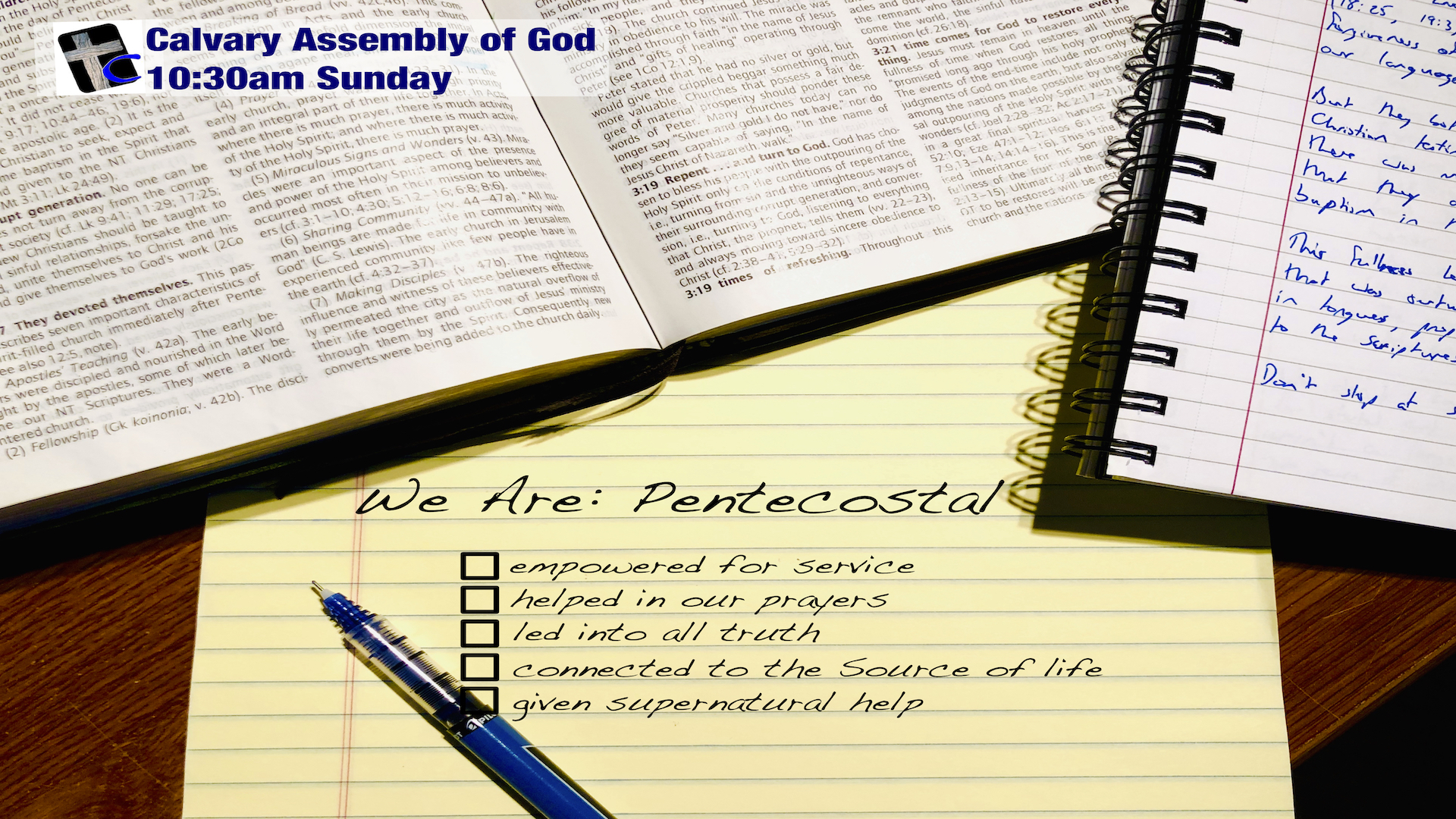
We Are: Pentecostal

Pentecost for over 1500 years was a celebration in Jerusalem that brought in Jews from all over the world. But on the Day of Pentecost that came just ten days after Jesus ascended back into heaven, the meaning of Pentecost was forever changed! 

Followers of Jesus—now empowered by an infilling of the Holy Spirit—began to take the good news of Jesus all over the world. These Spirit-filled Christians preached the Gospel and won converts to Christ even among hostile crowds, performed miracles and wonders, stood up to pagan priests and persecuting governmental leaders, and established a whole new way of living as Christ-followers. 

We, too, can be Pentecostal followers of Jesus Christ today. We can experience an anointing and an empowering in our lives that turns ordinary Christianity into extraordinary Christianity! 

Please join me this Sunday as we begin a series of messages called We Are: Pentecostal. You can find a map here, or if you live too far away to join us in person, be sure to check out our Facebook Live broadcasts every Sunday morning.

Here are the topics we covered in this series:

**We rejoined this series again in 2020. You can find a list of those topics by clicking here.

14 Quotes From “Studies In The Sermon On The Mount”

Oswald Chambers has unlocked the Sermon on the Mount for me like no other Bible commentator has before—deeply and practically. Check out my full book review by clicking here. I have already shared numerous passages from this book in my weekly “Thursdays With Oswald” series, but here are some other quotes that caught my eye as well. 

“Beware of placing our Lord as a Teacher first instead of Savior. That tendency is prevalent today, and it is a dangerous tendency. We must know him first as Savior before His teaching can have any meaning for us, or before it can have any meaning other than that of an ideal which leads to despair. … If Jesus is a Teacher only, then all He could do is to tantalize us by erecting a standard we cannot come anywhere near. But if by being born again from above we know Him first as Savior, we know that He did not come to teach us only: He came to make us what He teaches we should be. The Sermon on the Mount is a statement of the life we will live when the Holy Spirit is having His way with us.” 

“The disadvantage of a saint in the present order of things is that his confession of Jesus Christ is not to be in secret, but glaringly public. It would doubtless be to our advantage from the standpoint of self-realization to keep quiet, and nowadays the tendency to say—‘Be a Christian, live a holy life, but don’t talk about it’—is growing stronger. Our Lord uses in illustration the most conspicuous things known to men—salt, light, and a city set on a hill—and He says, ‘Be like that in your home, in your business, in your church; be conspicuously a Christian for ridicule or respect according to the mood of the people you are with.’” 

“Our Lord goes to the root of the matter every time with no apology. Sordid? Frantically sordid, but sin is frantically sordid, and there is no excuse in false modesty, or in refusing to face the music of the devil’s work in this life. Jesus Christ faced it and He makes us face it too. Our natural idea of purity is that it means according to obedience to certain laws and regulations, but that is apt to be prudery. There is nothing prudish in the Bible. The Bible insists on purity, not prudery.” 

“All our righteousness is ‘as filthy rags’ unless it is the blazing holiness of Jesus in uniting us with Him until we see nothing but Jesus first, Jesus second, and Jesus third. Then when men take knowledge of us, they will not say that we are good men, that we have a wonderful whiteness, but that Jesus Christ has done something wonderful in us.” 

“The Spirit of God comes through the different writers with the one steady insistence to stir up our minds (Philippians 2:5; 2 Peter 1:12-13). … Unless we learn to think in obedience to the Holy Spirit’s teaching, we will drift in our spiritual experience without thinking at all. The confusion arises when we try to think and to reason things out without the Spirit of God.” 

“Jesus does not use the illustration of the birds and the flowers by accident, He uses it purposely in order to show the utter unreasonableness from His standpoint of being so anxious about the means of living. Imagine the sparrows and blackbirds and thrushes worrying about their feathers! Jesus says they do not trouble about themselves at all, the thing that makes them what they are is not their thought for themselves, but the thought of the Father in heaven. A bird is a hard-working little creature, but it does not work for its feathers, it obeys the law of its life and becomes what it is. Jesus Christ’s argument is that if we concentrate on the life He gives us, we will be perfectly free for all other things because our Father is watching the inner life. We have to maintain obedience to the Holy Spirit, Who is the real principle of our life, and God will supply the ‘feathers,’ for are we not ‘much better than they’?” 

“We enthrone common sense as Almighty God and treat Jesus Christ as a spiritual appendage to it.” 

“At the bar of common sense Jesus Christ’s statements are those of a fool; but bring them to the bar of faith and the Word of God, and you begin to find with awestruck spirit that they are the words of God.” 

“No man is born with character; we make our own character. When the man is born from above a new disposition is given to him, but not a new character; neither naturally nor supernaturally are we born with character. Character is what a man makes out of his disposition as it comes in contact with external things. A man’s character cannot be summed up by what he does in spots, but only by what he is in the main trend of his existence.” 

“The Holy Spirit does reveal what is wrong in others, but His discernment is never for purposes of criticism, but for purposes of intercession.” 

“Prayer is not only asking, it is an attitude of heart that produces an atmosphere in which asking is perfectly natural, and Jesus says, ‘everyone who asks receives.’” 

“Fasting is much more than doing without food, that is the least part, it is fasting from everything that manifests itself-indulgence.” 

“When we are saved by God’s grace, God puts into us the possibility of not sinning, and our character from that moment is of value to God. Before we were saved we had not the power to obey, but now He has planted in us on the ground of Redemption the heredity of the Son of God, we have the power to obey, and consequently the power to disobey. The walk of a disciple is gloriously difficult, but gloriously certain. On the ground of the perfect Redemption of Jesus Christ, we find that we can begin now to walk worthily.” 

“Never trust the best man or woman you ever met; trust the Lord Jesus only. … We are never told to follow in all the footsteps of the saints, but only in so far as they have obeyed God.” 

Thursdays With Oswald—Do You Have The Goods Or Just The Label?

This is a weekly series with things I’m reading and pondering from Oswald Chambers. You can read the original seed thought here, or type “Thursdays With Oswald” in the search box to read more entries.

Do You Have The Goods Or Just The Label? 

     Our Lord makes the test of goodness not only goodness in intention, but the active carrying out of God’s will. Beware of confounding appearance and reality, of judging only by external evidence. …  

     The baptism of the Holy Ghost turns men into the incarnation of what they preach until the appearance and the reality are one and the same. … He does in us what Jesus did for us. … 

     Human nature is fond of labels, but a label may be the counterfeit of confession. It is so easy to be branded with labels, much easier in certain stages to wear a ribbon or a badge than to confess. Jesus never used the word testify; He used a much more searching word—confess. ‘Whosoever therefore shall confess Me before men…’ [Matthew 10:32-33]. The test of goodness is confession by doing the will of God. ‘If you do not confess Me before men,’ says Jesus, ‘neither will your Heavenly Father confess you.’ Immediately we confess, we must have a badge, if we do not put one on, other people will. Our Lord is warning that it is possible to wear the label without having the goods; possible for a man to wear the badge of being His disciple when he is not. Labels are all right, but if we mistake the label for the goods we get confused.

From Studies In The Sermon On The Mount

Some people only wear the labels—they use the name “Christian” without ever surrendering to the lordship of Jesus. Oswald Chambers reminds us that these are the people to whom Jesus will say, “I never knew you” (Matthew 7:21-23). 

Listen to the Holy Spirit. He can make sure that your preaching your living are one and the same. You and I don’t want to just testify that we are disciples of Jesus, but we want to be the living incarnation of all that Jesus did and taught.

Labels are fine (if other people put them there), but just make sure you have the goods! I’ll say it again: Listen to the Holy Spirit and immediately obey what He points out to you.

Undeniableness

…we cannot deny it (Acts 4:16)

The healing of a 40-year-old man who has been lame from birth is truly undeniable! But the Sadducees (the truly religious elite) took issue with the fact that Peter and John were then telling people about God’s resurrection power (which they did not believe).

It was undeniable that…

  • … the lame man was healed
  • … Peter spoke boldly with the help of the Holy Spirit
  • … Peter and John’s eloquence in spiritual matters was not bookish learning but divine illumination
  • … Peter and John had been with Jesus
  • … Peter and John could not be silenced by threats
  • … the admiration of the crowd following the healing and Peter’s sermon
  • … God was glorified

So what did the church do? They prayed for more “undeniableness” to be demonstrated by God through their lives!

They knew none of these threats took God by surprise, but they all happened as God had “determined before to be done” (v. 28). So they said, “We are Your servants in this—do more undeniable things through us. Enable us to speak Your Word boldly, and empower us to do signs and wonders in the name of Jesus” (vv. 29, 30).

And God answered that prayer!

What about us? Are we willing to pray that prayer today? Will we allow God to do undeniable things through us? Persecution may follow, but so will God’s glory, and saved souls, and healed people!

For more evidence of the unmistakable evidence that follows Spirit-baptized Christians, check out this post.