8 Prayers From “Dangerous Prayers”

Dangerous Prayers give a brief biography of 50 culture-shifting people, and the world-changing prayers they prayed. Check out my full book review by clicking here, and then enjoy just a few of the prayers from this excellent book. 

“Listen to my supplication, Master, so that my soul doesn’t stagger under Your instruction, so that I don’t stumble in testifying to Your mercies, by which You tore me away from all my ruinous pathways. Thus You’ll grow sweet to me beyond all that led me wrong, in my willingness to follow it. Thus I’ll love You most mightily, and grasp Your hand with all the strength of my inmost being. Thus You’ll tear me away from every trial, clear to the end.” —Augustine 

“Restore me to liberty, and enable me so to live now that I may answer before Thee and before the world. Lord, whatever this day may bring, may Thy name be praised. Amen.” —Dietrich Bonhoeffer, while awaiting execution in a Nazi concentration camp 

“Give us grace, O God, to dare to do the deed which we well know cries to be done. Let us not hesitate because of ease, or the words of men’s mouths, or our own lives. Mighty causes are calling us—the freeing of women, the training of children, the putting down of hate and murder and poverty—all these and more. But they call with voices that mean work and sacrifice and death. Mercifully grant us, O God, the spirit of Esther, that we may say: ‘I will go unto the king and if I perish, I perish.’” —W.E.B. DuBois 

“Because we have need continually to crave many things at Your hands, we humbly beg You, O heavenly Father, to grant us Your Holy Spirit to direct our petitions, that they may proceed from such a fervent mind as may be agreeable to Your holy will.” —John Knox 

“O keep us, we beseech Thee, Lord, for without Thy keeping we cannot keep ourselves.” —Charles Spurgeon 

“Oh Jesus, You who suffer, grant that today and every day I may be able to see You in the person of Your sick ones and that, by offering them my care, I may serve You. Grant that, even if You are hidden under the unattractive disguise of anger, of crime, or of madness, I may recognize You and say, ‘Jesus, You who suffer, how sweet it is to serve You.’” —Mother Teresa 

“I now make it my earnest prayer, that God would have you, and the State over which you preside, in His holy protection, that He would incline the hearts of the Citizens to cultivate a spirit of subordination and obedience to Government, to entertain a brotherly affection and love for one another, for their fellow Citizens of the United States at large, and particularly for their brethren who have served in the Field, and finally, that He would most graciously be pleased to dispose us all, to do Justice, to love mercy, and to demean ourselves with that charity, humility, and pacific temper of mind, which were the Characteristics of the Divine Author of our blessed Religion, and without an humble invitation of whose example in these things, we can never hope to be a happy Nation.” —George Washington 

“God give me a deep humility, a well-guided zeal, a burning love, and a single eye, and then let men or devils do their worst.” —George Whitefield 
Overcoming Unbelief Before It’s Too Late

Unbelief can shut down the “Shalom Cycle” that God intends for our lives. Even worse, unbelief can put us on a slippery slope that could be disastrous for our future! So it is vital that we understand what unbelief is, how we can recognize it in our own lives, and the steps we can take to recover from unbelief. 

First of all, let me remind you of what the Shalom Cycle looks like—

Quite simply, when we are grateful for what God has already done for us it fuels our trust in God’s future grace to meet our needs. 

But when we forget to be grateful and gratitude turns to grumbling, unbelief displaces trust.

A good way to remember how unbelief works is thinking of it as an un-complete faith. An un-complete faith is lacking power to trust God because of one of two reasons:

  • Either we don’t know there is a promise available to us,
  • Or we know of a promise but don’t think it applies to our circumstance. 

J.C. Ryle pointed out that, “Unbelief has a power to rob man of highest blessings.” 

Hebrews 3 shows us that left unchecked and uncorrected, unbelief can turn into disbelief. You can remember this word by defining it as a complete disintegration of faith. Notice in Hebrews 3 how quickly the word unbelieving becomes turns away from God, and how closely associated are the words unbelief and disobeyed (Hebrews 3:12, 19-20). 

We need to correct and reverse unbelief as quickly as possible. We do this through capturing our thoughts—or thinking about what we’re thinking about—and identifying three warning signs: 

  1. Worrying all the time—God wants you to enter His rest, not wallow in worry (Hebrews 3:11) 
  2. Making contingency plans—the Israelites forgot to be grateful and they grumbled instead. The next step (since they didn’t trust that God’s future grace would take them into the Promised Land) was to disobey by concocting a Plan B: “Let’s go back to Egypt.” 
  3. An inward focus on self-preservation—we no longer encourage others but think only of ourselves (Hebrews 3:13). 

If you detect any of these warning signs, quickly repent (Revelation 3:2-3) and then run to Jesus for help. One of the most honest prayers you can pray—and one of the prayers Jesus answers the quickest—is “Lord, I believe; help me overcome my unbelief!” (Mark 9:22-24). 

“Lord, I believe; help me overcome my unbelief!” 

Take control of grumbling by gratitude
Take control of unbelief by repentance and running to Jesus for help
Then help others take control of their unbelief by encouraging one another daily

Join me next Sunday for the final message in our 4-part series on God’s Shalom. 

19 Quotes From Other Authors In “Love Like That”

As Dr. Les Parrott presented the five ways Jesus showed His love to us, he supported his thoughts with some insightful quotes from other authors. Check out my full book review of Love Like That by clicking here.

“If you stop to be kind, you must swerve often from your path.” —Mary Webb 

“We may ignore, but we can nowhere evade, the presence of God. The world is crowded with Him. He walks everywhere incognito.” —C.S. Lewis 

“Pride is our greatest enemy and humility our greatest friend.” —John R.W. Stott 

“Jesus was the Man for others.” —Dietrich Bonhoeffer 

“Jesus was able to love because He loved right through the layer of mud.” —Helmut Thielicke 

“They that know God will be humble; they that know themselves cannot be proud.” —John Flavel 

“Those who judge will never understand, and those who understand will never judge.” —Wilson Kanadi 

“Mercy gave the Prodigal Son a second chance. Grace gave him a feast.” —Max Lucado 

“Christ accepts us as we are, but when He accepts us, we cannot remain as we are.” —Walter Trobisch 

“Jesus did not identify the person that with his sin, but rather saw in this sin something alien, something that really did not belong to him, something…from which He would free him and bring him back to his real self.” —Helmut Thielicke 

“While every other religion offers a way to earn approval, only Christianity dares to make God’s love unconditional.” —Philip Yancey 

“Judgmentalism finds its identity in what is not. … Rare is the person who can weigh the faults of others without putting his thumb on the scale.” —Byron Langenfeld 

“To love a person means to see him as God intended him to be.” —Fyodor Dostoevsky 

“I do not at all understand the mystery of grace—only that it meets us where we are but does not leave us where it found us.” —Anne Lamott 

“All human nature vigorously resists grace because grace changes us and the change is painful.” —Flannery O’Connor 

“Those who make peaceful revolution impossible will make violent revolution inevitable.” —John F. Kennedy 

“We often err not because we find it hard to perceive the truth (it is often right there, at the surface), but because it is easier and more pleasant to be guided by our feelings, especially if self-centered.” —Alexander Solzhenitsyn 

“A ‘no’ uttered from deepest conviction is better and greater than a ‘yes’ merely uttered to please, or what is worse, to avoid trouble.” —Mahatma Gandhi 

“Every time you listen with great attentiveness to the voice that calls you the Beloved, you will discover within yourself a desire to hear that voice longer and more deeply.” —Henri Nouwen 

Check out some of Dr. Parrott’s quotes from Love Like That which I shared here. 

11 Quotes On The Gospel Of Matthew

J.C. Ryle has given us a wonderful commentary on the Gospels in his Expository Thoughts On The Gospels. Check out my full book review here, and then enjoy a few quotes from Ryle’s insights on the Gospel of Matthew. 

“The rulers of this world have often call themselves Great, Conqueror, Bold, Magnificent, and the like. The Son of God is content to call Himself Savior. These souls which desire salvation may draw near to the Father with boldness, and have access with confidence through Christ. It is His office and His delight to show mercy. ‘For God didn’t send His Son into the world to judge the world, but that the world should be saved through Him’ (John 3:17).” 

“Trust Him at all times with all your sorrows. He will not despise you. Pour out all your heart before Him in prayer, and keep nothing back. He can sympathize with His people.” 

“Let us beware of resting satisfied with head-knowledge. It is an excellent thing, when rightly used. But a man may have much of it, and yet perish everlastingly. What is the state of our hearts? This is the great question. A little grace is better than many gifts. Gifts alone save no one. Grace leads on to glory.” 

“Here is one among many reasons why we ought to be diligent readers of our Bibles. The Word is the sword of the Spirit. We shall never fight a good fight, if we do not use it as our principal weapon. The Word is the lamp for our feet. We shall never keep the King’s highway to heaven, if we do not journey by its light. … Knowledge of the Bible never comes by intuition, it can only be obtained by diligent, regular, daily, attentive, wakeful reading.” 

“Aim at letting men see that we find Christianity makes us happy. Never let us forget that there is no religion in looking melancholy and gloomy. Are we dissatisfied with Christ’s wages and Christ’s service? Surely not! Then let us not look as if we were.” 

“Let the prayer ‘Lord, increase our faith,’ always form part of our daily petitions. We never perhaps know the weakness of our faith until we are placed in the furnace of trial and anxiety. Blessed and happy is that person who finds by experience that his faith can stand the fire, and that he can say with Job, ‘though He slays me yet will I trust in Him’ (Job 13:15).” 

“The more clearly we see Christ’s power, the more likely we are to realize Gospel peace. Our position may be trying. Our hearts may be weak. The world may be difficult to journey through. Our faith may seem too small to carry us home. But let us take courage when we think on Jesus, and not be cast down. Greater is He that is for us than all those who are against us. Our Savior can raise the dead. Our Savior is Almighty.” 

“Great grace and common sense are perhaps one of the rarest combinations. … Our Lord Jesus Christ Himself is our most perfect example. None were ever so faithful as He. But none were ever so truly wise. Let us make Him our pattern, and walk in His steps.” 

“Let us not be ashamed to say that we expect a literal fulfillment of unfulfilled prophecy. Let us frankly allow that there are many things we do not understand, but still hold our ground tenaciously, believe much, wait long, and not doubt that all will one day be made clear.” 

“Are we ever mocked and persecuted and thought foolish because of our religion? Let us bear it patiently and pray for those who persecute us. They know not what they are doing. They will certainly alter their minds one day. We may yet hear them confessing that we were wise and they were foolish. The whole world shall one day acknowledge that the saints of God made a wise choice.” 

“We can never attach too much importance to the atoning death of Christ. It is the leading factor in the Word of God, on which the eyes of our soul are to be ever fixed. Without the shedding of His blood, there is no remission of sin. It is the cardinal truth on which the whole system of Christianity hinges. Without it the Gospel is an arch without a key stone, a fair building without a foundation, a solar system without a sun.” 

Quotes from Ryle’s comments on the Gospels of Mark, Luke, and John coming soon. 

11 Quotes From “Notes On Jeremiah”

Oswald Chambers gives us some unparalleled insights into the Book of Jeremiah. This is a must-read for serious students of the Bible. Check out my full book review of Notes On Jeremiah by clicking here.

“Very few of us understand why clouds of darkness come. It is God trying to get us into line with the prophets and apostles. It is the Holy Spirit seeking to bring us into the place of vicarious intercession, and we nearly always misunderstand it and say, ‘I must have sinned,’ or ‘I must get out of this, I have got the blues.’” 

“We do not need a new Gospel; what we need is the old truth re-stated to hit the things that are wrong today.” 

“Few of us realize the power God has given us to grip on the threshold of the mind as in a vice the things that ought not to be there.” 

“The Cross of Jesus Christ is not a martyrdom, it does not procure salvation; it is the only salvation.” 

“Beware of ever saying to yourself, ‘God’s law is not exactly binding to me, I am under grace.’ To be under grace should mean that we can fulfill the law of God gracefully.” 

“Prosperity that does not spring from a godly motive is the external sign of having forsaken God.” 

“We cannot answer God’s call collectively (John 6:68-70). Never get disturbed out of hearing God’s voice by saying other people have not heard it.” 

“Human nature hates God’s message that there is a bad tendency inside that has to be plucked out, and unless it is it will damn us.” 

“Jesus Christ’s salvation is the destruction of the sinner in the man, not of the man.” 

“The measure of my misery when I turn from God is proportioned to my knowledge of Him when I walked with Him.” 

“Our Lord Jesus Christ and the Old Testament prophets are inseparable from one another, for in the Person and the teaching of our Lord all that the prophets taught is in part fulfilled, and will be completely fulfilled.” 

Every week I post longer passages from Oswald Chambers’ books in my “Thursdays With Oswald” feature. 

12 Quotes From “Love Like That”

Dr. Les Parrott dives into the loving life of Jesus and takes us with him to discover the five was Jesus loved. Check out my full book review by clicking here, and then enjoy some of the quotes I especially liked. 

“The great hindrance to true enjoyment is our willingness to settle for pitiful pleasures.” 

“What keeps us from being mindful? I can answer this question with one word: agendas. … Every one of us has the capacity to set aside our self-interest, temporarily. We have the ability at any time to press the pause button on what we want. … That’s the moment we become mindful.” 

“Loving like Jesus is not efficient. It takes time away from our own agenda-driven pace.” 

“Jesus was shockingly accessible to anyone who felt undesirable or unwanted—lepers, Gentiles, tax collectors, the poor and persecuted, pagans and sinners. He wasn’t like other ‘holy men’ in Judea. His fellow rabbis operated on the principles of exclusion and isolation.” 

“If you want to love like Jesus, you can’t limit your love to people who deserve it.” 

“God is happy to give unconditional acceptance and unmerited grace to all who will receive it.” 

“We can’t give grace to others when we are aren’t receiving it ourselves. When we’re busy earning acceptance from God, we start to think everyone else should earn it too. Judgmentalism creeps in. Self-righteousness appears. … When we aren’t cognizant of God’s unconditional acceptance in our own lives, we can’t give it to others.” 

“If you want to love like Jesus, you can’t shy away from what you know is right and true. You can’t remain silent just to go unnoticed. Loving like Jesus is not for the chickenhearted. It requires a fierce commitment to being authentic. It requires a bold commitment to being a truth-teller. … No one accused Jesus of being a pushover—or winsome.” 

“Self-giving is selfishness in reverse. It is not concerned with benefits, and it expects nothing in return. … It comes down to motive. You can be a giver and still expect something in return. … True self-giving is offering the best of who you are to others, and it comes with no strings attached.” 

“The long and short of it is that we love like Jesus when we allow Jesus to love through us. It’s not about our effort. We are not trying to imitate Jesus. It’s an inside job. It’s about being a channel for His love.” 

“Loving like Jesus isn’t achieved as much as it is received.” 

“The word intuition comes from the Latin word intueri, which is roughly translated as meaning ‘to contemplate.’ You see, our intuition stems from what we are considering, what we are sensitive to or attuned to do. … So, if you want to hear from God, you’ve got to slow down enough to clear your head and be attuned to His Spirit. That’s when the sacred gift of God’s whisper is heard—when you become accustomed to His voice.” 

I’ll be sharing more quotes from Love Like That soon, so stay tuned! Updatenew quotes are posted here.

A Leader’s Broken Heart

My heart will cry out for Moab … Therefore my heart shall resound like a harp for Moab, and my inner being for Kir Heres (Isaiah 15:5; 16:11). 

Judgment from God falls on Israel’s enemy and Moab is inconsolable (Isaiah 15:2-4, 5-9; 16:7-8, 10). And yet Isaiah weeps for them!

No gloating.

No “I told you so.”

No smug self-righteousness.

A mark of a godly leader is one whose heart is broken by what breaks God’s heart.

“Do not gloat when your enemy falls; when he stumbles, do not let your heart rejoice” (Proverbs 24:17).

Remember—there, but for the grace of God, go I. 

It is actually God’s mercy that His throne is established and judgment can bring an end to the suffering of punishment (Isaiah 16:5). But in the meantime, we should rescue those careening toward God’s punishment, watering our testimony with our tears.

This is part 27 in my series on godly leadership. You can check out all of my posts in this series by clicking here.

God’s Gift To The World

You are a gift. You are God’s grace gift to the world. 

Max Lucado said it this way: “You are you-nique. 

God made you on purpose and for a purpose.

God implanted unique abilities in you from conception (see Psalm 139:13). And check out what God said to Jeremiah, “Before I formed you in the womb I knew and approved of you…” (Jeremiah 1:5). Before you were even conceived, God already knew all about you AND He approved of you! 

Why did God implant these unique abilities in you? Because He knew of the unique opportunities you would face during your lifetime (see Psalm 139:16). Because God is for you, He gave you all that you would need to successfully face every opportunity that came your way. 

Every one of us has been given these grace gifts of unique talents and opportunities. The Bible says, “to each one of us grace has been given as Christ apportioned it” (Ephesians 4:7). If God is for you, and God is for me, then that means that you have been gifted to be a blessing to me and I have been gifted to be a blessing to you (Romans 12:3-6; 1 Corinthians 12:4-7).

Let me state it again: every one of us has been entrusted by God with unique talents in order to successfully face the unique opportunities that He knew we would face. Jon Bloom reminds us, “Some are given more, some are given less, but all are given much.” 

So what do we do with what we’ve been entrusted? There are two possibilities: (1) We can invest our talents and abilities in a way that glorifies God, or (2) We can squander the talents God has given us. 

How do you squander the grace gift of your life? 

  1. Not discovering it—I have a gift?
  2. Devaluing it—I’m nothing special.
  3. Overvaluing it—I’m super-important. I don’t need anyone else.
  4. Laziness—I don’t want to mess it up, so there’s no need for me to invest my gift.
  5. Short-sightedness—My gift is just for me, so it doesn’t matter what I do with it.

I hope we can all say what Erma Bombeck wrote: “When I stand before God at the end of my life, I would hope that I would not have a single bit of talent left but could say, ‘I used everything You gave me.’”

How do you honor God with your you-niqueness? I can tell you in just three simple words—You be you! 

If you will just be who God made you—not downplaying your talents, not wishing you had someone else’s talents—that’s when you will feel fulfilled, and God will be glorified, and the rest of the world will be blessed! So…

YOU BE YOU! 

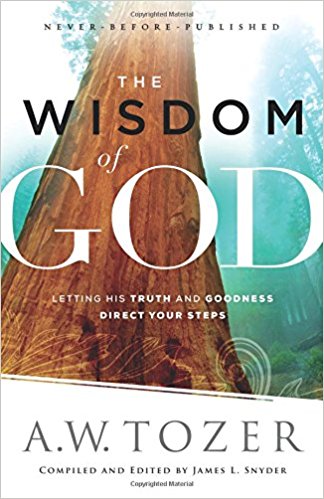
10 Prayers From A.W. Tozer In “The Wisdom Of God”

A.W. Tozer’s book The Wisdom Of God is a call to see Wisdom as a Person, not as a quality. As such, Tozer opens each chapter with a short prayer that we would bolster our relationship with Wisdom. Here are a few phrases from those prayers. 

“Let me not succumb to the limitations of my own reasoning and knowledge but leap beyond that and stepped into the reality of Thy Holy presence. Amen.” 

“Pour into my soul that which will enable me to see Thee as Thou wouldst have me to see Thee.” 

“O Wisdom, the incarnate Christ, fill my heart with desires that please Thee and show to the world around me Thy amazing grace.” 

“O God, Thou Eternal Wisdom, may I embrace that which You have created me for, and may out of my life flow the thanks and praise You so desire. Let me live my life by the wisdom of Thy Son, the Lord Jesus Christ.” 

“May Thy wisdom flow into me and out to the world around me, creating in me a vessel for Thy glory.” 

“O Holy Spirit, I praise Thee through the divine wisdom that Thou hast poured into my life, enabling me to understand who I am and who Thou art and how we come together.” 

“Let me not stay my heart till I have discovered Thee in all Thy fullness.” 

“Manifest Thy grace and wisdom in my life today as a witness to those around me.” 

“O Lord God, Thy wisdom has been poured into my heart, creating such a longing for Thee that nothing in this world can satisfy.” 

“Heavenly Father, open my eyes to recognize Thy hand in my life. … May I be aware of my surroundings in light of what Thou art doing.” 

You can check out my full book review of The Wisdom Of God by clicking here. And be sure to read some of the quotes I shared from this book by clicking here.

Is It Really The 11th Hour?

When we’re down to the last minutes before a crucial deadline, we often refer to it as “the eleventh hour.” 

Have you been there? You’re sweating it out, wondering if God is going to come through for you. Or perhaps thinking about what you might need to handle yourself in order to meet the deadline. And then God comes through for us, and we let out a deep sigh of relief and gratitude. 

But why a sigh? Were we worried that God wouldn’t come through? Did we think God’s supply was limited? And what made us think that it was “the eleventh hour” anyhow? 

What we often think is the eleventh hour is really God’s first hour! God is never late. He’s never scrambling to come up with what we need. We might be the ones “scrambling,” but God never is. He always has the perfect resources at the perfect moment. 

We should know this because the Bible tells us: God who did not spare His own Son, but gave Him up for us all—how will He not also, along with Him, graciously give us all things? (Romans 8:32) 

Jesus tells a story about an eleventh-hour situation in Matthew’s Gospel. Men were waiting around to work for the day when a landowner came along to hire them. He hired some guys first thing in the morning and agreed to pay them a full day’s pay. He hired some other workers at 9:00 AM and promised to pay them fairly, and then he hired even more workers at noon and at 3:00 PM, also promising to pay them what was fair. Finally, he hired some workers at 5:00 PM—literally at the eleventh hour—without any mention of pay. 

At the end of the day, every single worker was paid a full day’s wage. Every single one of them. Jerry Bridges notes why this is significant: 

“Each worker, regardless of how long he had worked, received a day’s wages. He received not what he had earned on an hourly basis, but what he needed to sustain his family for a day. … Those eleventh-hour workers were hired because they needed to receive a day’s wages. They had been standing all day waiting for someone to hire them so they could earn money to support their families. They needed to work more than the landowner needed their work. He hired them, not because of his need, but because of their need.” (emphasis added)

You see, God knows what you NEED and He generously supplies that NEED right on time.

Jesus taught us to pray, “Give us this day our daily bread.” The problem comes when we start looking down the road wondering what’s going to happen tomorrow, and the next day, and the next day (see Matthew 6:11, 31-34). 

God’s favor toward us is out of all proportion to our work or sacrifice. He gives exactly what we need, exactly when we need it. 

If you’re feeling anxious—like the clock is ticking down to the eleventh hour—perhaps you should recall how God has provided for you in the past. Then discipline your thoughts from running ahead to tomorrow as you pray, “Give me this day what I need.” 

Here’s a prayer I’m praying—

“God, I remember the wonderful deeds You have done for me. They are constantly in my thoughts. I cannot stop thinking about Your mighty works in the past. Therefore, I ask you today for my daily bread. Let my heart be on guard against scrambling as though I were in an eleventh-hour situation. You are my all-loving, all-gracious Father. You know what I have need of even before I ask. May my attitude be one of assured contentment in your abundant, right-on-time supply. May you be glorified as others see this confidence in my attitude.”