7 Quotes From “The Dawning Of Indestructible Joy”

the-dawning-of-indestructible-joyThe Dawning Of Indestructible Joy is a wonderful book from John Piper to prepare your heart for celebrating Christ’s First Advent! It’s arranged as a 25-day countdown until Christmas morning. Check out my review of this book here, and then enjoy a few quotes that caught my attention.

“The coming of Jesus was a search-and-save mission. ‘The Son of Man came to seek and save the lost’ [Luke 19:10]. So Advent is a season for thinking about the mission of God to seek and to save lost people from the wrath to come. … ‘As the Father has sent Me, even so I am sending you’ (John 20:21). It’s the story of how the vertical advent of God in the mission of Jesus bends out and becomes the horizontal advent of Jesus in the mission of the church. In us.”

“If there is a longing in your heart this Advent for something that the world has not been able to satisfy, might not this longing be God’s Christmas gift preparing you to see Christ as consolation and redemption and to receive Him for who He really is?”

“Christmas is about the coming of the Son of Man who ‘came not to be served but to serve, and to give His life as a ransom for many.’ These words in Mark 10:45, as a brief expression of Christmas, are what I hope God will fix in your mind and heart this Advent. Open your heart to receive the best present imaginable: Jesus giving Himself to die for you and to serve you all the rest of eternity.”

“Take the very personal words of the Apostle Paul and make them your own. ‘The life I now live in the flesh I live by faith in the Son of God, who loved me and gave Himself for me’ (Galatians 2:20). This is how Jesus destroyed the works of the devil and rescued us from our sin. Don’t leave Christmas in the abstract. Your sin. Your conflict with the devil. Your victory. He came for this.”

“The point is that when Jesus comes, He confirms the truth of all God’s promises. He shows that God is trustworthy; He keeps His word. … Christ came to prove that God tells the truth, that God keeps His promises. Christmas means that God can be trusted.” 

“It is God’s message of hope this Advent that what is good need never be lost and what is bad can be changed. The devil works to take the good and bring the bad. And Jesus came to destroy the works of the devil [1 John 3:8].”

“This is what God does again and again. He may be doing it for you this Advent season—graciously and tenderly frustrating you with life that is not centered on Christ and filling you with longings and desires that can’t find their satisfaction in what this world offers, but only in the God-man. What a Christmas gift that might be! Let all your frustrations with this world throw you onto the Word of God. It will become sweet—like walking into paradise.”

The First Noël

romans-3-22When I worked in the business field, I was invited to be a teacher for a program called GROW (Grand Rapids Opportunities for Women), where I taught a class on marketing. Then later on, I served as a reviewer as the students turned in their marketing plans.

One of the main points I tried to drive home to my students is a basic Marketing 101 principle which says—you can’t be all things to all people. You have to pick a niche market and then try to dominate that market. There are two general ideas here: (1) Make your product or service pricey and therefore exclusive to a select group, or (2) Make your product or service affordable and accessible for the mass market.

The Incarnation of Jesus totally violates this Marketing 101 principle. (Which goes to show you that God knows more than all the world’s so-called “experts”!)

First, there was a marketing message to shepherds (see Luke 2:8-11). This would have been the “mass market” as shepherds represented the every-day, working-class man. The first two verses of The First Noël carol addresses these “certain poor shepherds in fields where they lay.”

But then there is this appearance of a very exclusive group of Magi (see Matthew 2:1-2, 11). These men were highly educated and had gained great influence and affluence. Verse 3 of The First Noël references these “wise men…from country far” who could present such lavish gifts to Jesus.

God did exactly what I told my GROW students they shouldn’t do if they wanted to be successful!

The Incarnation of Jesus is one of those rarest of rare things that actually can be all things to all people! Why? Because ALL people need what the Incarnation of Jesus brings. That’s why the final verse of The First Noël calls for ALL of us to join in singing our praise to God because of the salvation Jesus had purchased for ALL mankind.

Here’s the reason—

  • ALL we like sheep have gone astray (Isaiah 53:6)…
  •    …and the penalty for that straying from God is death for ALL sinners (Romans 6:23).
  • But Jesus came to ransom ALL from that penalty (Mark 10:45)…
  •    …so that ALL who believe in Him will be saved (Romans 3:22)!

“The coming of Jesus was a search-and-save mission. ‘The Son of Man came to seek and save the lost.’ So Advent is a season for thinking about the mission of God to seek and to save lost people from the wrath to come. … ‘As the Father has sent Me, even so I am sending you’ (John 20:21). It’s the story of how the vertical Advent of God in the mission of Jesus bends out and becomes the horizontal Advent of Jesus in the mission of the church. In us.” —John Piper

You have been rescued, now go be a rescuer. Take this Noël message to ALL … young/old, rich/poor, Black/white, educated/illiterate, healthy/sick, friend/enemy…. the message in the First Noël and every Noël is for everyone! 

If you’ve missed any of the messages in our series The Carols Of Christmas, you can find the full list here.

F.B. Meyer On The Access God Gives Us

F.B. Meyer“Think how often Jesus, during His earthly ministry, put others in a position to command Him. ‘As Jesus and His disciples were leaving Jericho,’ Jesus stopped and responded to two blind men who had called out to Him. ‘What do you want Me to do for you?’ (Matthew 20:29, 32). It was as though He said, ‘I am yours to command.’ Could we ever forget how Jesus yielded the keys to His resources to the Greek woman from Syrian Phoenicia because of her reply to Him? In effect, He told her to help herself to all that she needed (see Mark 7:24-30). What human mind can fully realize the total significance of the lofty position to which God lovingly raises His little children? He seems to be saying, ‘All My resources are at your command.’ And I will do whatever you ask in My name (John 14:13).” —F.B. Meyer

Thursdays With Oswald—Christ’s Temptations And Ours

Oswald ChambersThis is a weekly series with things I’m reading and pondering from Oswald Chambers. You can read the original seed thought here, or type “Thursdays With Oswald” in the search box to read more entries.

Christ’s Temptations And Ours

     The first temptation of Our Lord comes to us on this line—“Be sensible, You are here for the service of men, and surely it is the most practical thing to feed them and satisfy their needs.” The clamor abroad today is all on this line, “Put man’s needs first; never mind about the first commandment, the second commandment is the all-important one” (see Mark 12:29-31). … The insistent demand in the world today to put men’s needs before God’s will is the outcome of the reasoning of human wits and wisdom…. So long as our wits and human solutions are on the throne, to satisfy the needs of men is ostensibly the grandest thing to do. … 

     Our Lord was then asked to compromise: “You will become the King of men and the Savior of the world by judicious compromise; build Your kingdom on broad-minded lines; be judicious, You know there is evil in the world; then use it wisely, and don’t be so intense against sin; don’t talk about the devil and hell; don’t be so extreme and say a man needs to be born from above. Tolerate my rule of the world, call things ‘necessary evils’; tell man sin is not anarchy, but a disease; fall down and worship me and my way of looking at things, and I will withdraw and the whole world will be Yours.” … Will the Church that bows down and compromises succeed? Of course it will; it is the very thing that the natural man wants. … 

     satan tried to put Jesus Christ on the way to becoming King of the world and Savior of men in a way other than that pre-determined by God. The devil does not tempt us to do wrong things; he tries to make us lose what God has put into us by regeneration, the possibility of being of value to God. When we are born from above the central citadel of the devil’s attack is the same in us as it was in Our Lord—to do God’s will in our own way. … 

     Every temptation of satan will certainly seem right to us unless we have the Spirit of God. Fellowship with our Lord is the only way to detect them as being wrong. 

From The Psychology Of Redemption

Wow! Lots to contemplate here!

What do you think about the temptation of Jesus? Have you seen the same sort of temptations come your way?

One more thought from Chambers: “Temptation must come, and we do not know what it is until we meet it. When we do meet it, we must not debate with God, but stand absolutely true to Him no matter what it costs us personally, and we will find that the onslaught will leave us with higher and purer affinities than before.

4 Ways To Share The Good News With Everyone

Everybody EveryoneJesus told His followers that their ministry assignment was to take His message of salvation throughout the entire world. One requirement to do this, is to be able to communicate with lots of people. Actually to be able to communicate with everyone.

Be careful to do what is right in the eyes of everybody. If it is possible, as far as it depends on you, live at peace with everyone. (Romans 12:17-18)

Really? Everybody and everyone?!

Yes!

Jesus said our Helper would be the Holy Spirit. He would come to empower us to be witnesses to everyone, everybody, everywhere (Acts 1:8).

We have been learning how to communicate with others better, but noticing their communication style “accent.” Check out this post to get some more insight into this. In a nutshell…

  • Doers are action-oriented
  • Planners like to work out all the details
  • People want to make sure everyone is connected
  • Visions are imagining a better future

So if you are a Doer, and you’re trying to share the Good News about Jesus with a Planner, you can probably see a potential problem. The Doer is speaking in bullet points, but the Planner is wanting a lot more facts and figures.

This is where the Holy Spirit can help us. He has the insight that we don’t, and He can direct our words, just as He directed Christ’s words (see John 12:49-50).

Here’s how to talk their talk when you’re sharing the Good News:

(1) Doer

  • Keep it brief
  • Share more facts than stories
  • Stress now/today
  • Rely on the Gospel of Mark (action oriented)

(2) Planner

  • Tell them the who, what, where, when, why, and how
  • Be ready for lots of questions
  • Give them time to process your information
  • Rely on the Gospel of Matthew (lots of background, lots of Old Testament references to answer the who, what, where, when, why and how)

(3) People

  • Develop a friendship first
  • Share more stories than facts
  • Don’t tell them, show them your personal life
  • Rely on the Gospel of Luke (lots of personal stories about changed lives)

(4) Vision

  • Share both the facts and the stories
  • Encourage them to “Imagine what would happen …”
  • Give them time to ask questions
  • Rely on the Gospel of John (very poetic and image-rich)

You can connect with everyone, everybody, everywhere and share the Gospel with them in an effective way. Allow the Holy Spirit to give you the insight you need.

Check out how I describe this in more detail here…

9 Quotes From “Your Joy Will Turn To Sorrow”

Your Sorrow Will Turn To JoyAlthough Your Joy Will Turn To Sorrow is intended to be read each morning and evening of Holy Week (check out my book review here), the content is so good that it will benefit you anytime you decide to read it! Here are some quotes that especially caught my attention.

“The only Savior who truly saves, only saves through suffering. The Cross was the only means of making us sinners right before a holy God. Our salvation was purchased with suffering, and it will be sealed and preserved with suffering (James 1:2-4), not comfort. We are promised comfort in the Christian life (2 Corinthians 1:4), but not the cheap, temporal imitation we’ve grown accustomed to in our modern world.” —Marshall Segal

“Jesus did not come to purchase the approval of others. No, He ‘was despised and rejected by men; a Man of sorrows, and acquainted with grief; and as One from whom men hide their faces He was despised’ (Isaiah 53:3). Why? Because it is God’s approval we desperately need. And God’s approval doesn’t come by popular opinion, but by divine intervention—the substitution of His own Son in our place.” —Marshall Segal

“The irony of Mark 14 is that Judas could see the value of the ointment rolling down Jesus’ head, but he couldn’t see the value of Jesus. He was a pawnbroker with cataracts. That’s why he took such offense at the woman. The woman, on the other hand, could see both the value of the ointment and the value of Jesus. That’s why she broke the flask.” —Jonathan Bowers

“No one understands better than God how difficult it can be for a human to embrace the will of God. And no human has suffered more in embracing the will of God the Father than God the Son. When Jesus calls us to follow Him, whatever the cost, He is not calling us to do something He is either unwilling to do or is never done Himself.” —Jon Bloom

“So, now, we say with an entirely different meaning, let His blood be on us, not defiantly as the crowds that crucified Him, but desperately—with gratitude and hope and adoration—as those who depend wholly on His sacrifice. Jesus, let Your blood be on us. Let it cover us. Let the blood that flows from Your head, Your hands, Your feet wash over us and cleanse us from all our iniquity. We proclaim Jesus’ death. We rejoice in his death, not because we believe He was a fraud or a lunatic, but because it is by His death, by His wounds, by His blood that we are healed.” —Marshall Segal

“Jesus spoke of this joy as He faced the torture of Good Friday. He faced denial, faced betrayal, faced beatings, faced splinters and nails and spears—He could not stop talking about joy! Only joy would keep Him going. Joy was on His mind, joy was on His tongue, and joy was drawing Him, not away from suffering, but into it (Hebrews 12:2). Jesus went to the Cross for joy: to buy joy, create joy, and offer joy. As the world celebrated the savage killing of God, out of this sea of foaming rebel hostility emerged a blood-bought, inextinguishable joy.

“If the killing of the Author of life could not extinguish this joy Jesus speaks about, nothing can—and nothing ever will. No opposition from the world, no opposition to the gospel, and no cultural despising of Christ will overcome the resurrection joy of Jesus.” —Tony Reinke

“If Christ is still dead, death reigns, and all our joys our vain. So hoard every plastic Easter egg you find, because whatever you find inside is all the joy you have to grab. Or, as Paul says, ‘If the dead are not raised, let us eat and drink, for tomorrow we die’ (1 Corinthians 15:32). But if death is dead, and if the dead are raised—if Christ is risen from the dead!—brothers and sisters, let us feast and celebrate, for the daunting light of our inextinguishable and inexhaustible eternal pleasures have broken into the darkness, offering us a life of joy in Christ that cannot fade or rust or be stolen away!” —Tony Reinke

“Easter has now become our annual dress rehearsal for that great coming Day. When our perishable bodies will put on the imperishable. When the mortal finally puts on immortality. When we join in the triumph song with the prophets and the apostles, ‘O death, where is your victory? O death, where is your sting?’ (Hosea 13:14; 1 Corinthians 15:55).” —David Mathis

“Indeed, even agony will turn to glory, but Easter doesn’t suppress our pain. It doesn’t minimize our loss. It bids our burdens stand as they are, in all their weight, with all their threats. And this risen Christ, with the brilliance of the indestructible life in His eyes, says, ‘These too I will claim in the victory. These too will serve your joy. These too, even these, I can make an occasion for rejoicing. I have overcome, and you will more than conquer.’ 

“Easter is not an occasion to repress whatever ails you and put on a happy face. Rather, the joy of Easter speaks tenderly to the pains that plague you. Whatever loss you lament, whatever burden weighs you down, Easter says, ‘It will not always be this way for you. The new age has begun. Jesus has risen, and the Kingdom of the Messiah is here. He has conquered death and sin and hell. He is alive and on His throne. And He is putting your enemies, all your enemies, under His feet.’” —David Mathis

3 Possibilities For An Empty Tomb

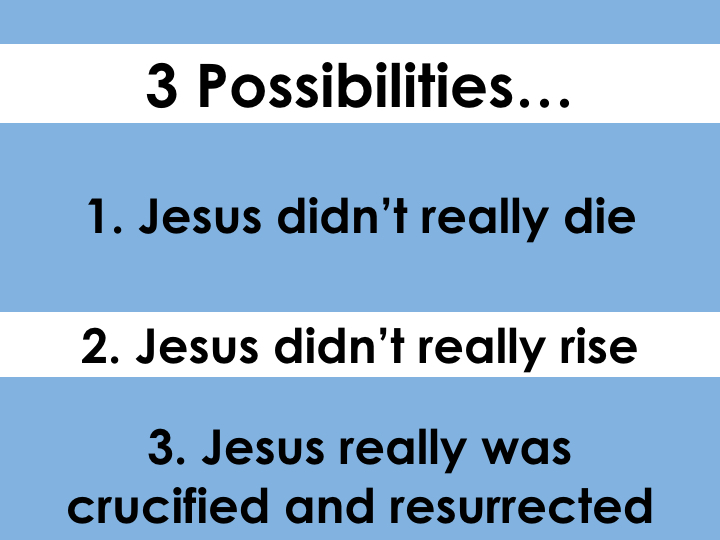
3 possibilitiesLast week we explored the validity of the evidence for the accuracy of the biblical accounts for the life of Jesus (you can check that out here). You might be one who says, “Okay, I think Jesus was a good Man, but I think it’s a bit of a stretch to believe that anyone could be raised from the dead after three days.” I think that’s a reasonable thing to explore…

If the tomb where Jesus was placed is really empty, then there are only three possibilities for us to consider.

(1) Jesus didn’t really die.

  • It’s hard to imagine anyone could go through the intense torture Jesus did prior to His crucifixion unscathed.
  • The crucifixion process itself is one of the most gruesome forms of execution man has ever invented.
  • As a result, forensic science shows that Jesus most likely died of a heart attack. The mention in John 19:34 of the blood and water that flowed from Christ’s body is an indication of the cardiac distress His body experienced.
  • Men who were followers of Jesus handled His dead body, and undoubtedly would have checked for any signs life (John 19:38-40).
  • A Roman centurion reported to the Roman governor Pilate that Jesus had in fact died (Mark 15:43-45).
  • Extra-biblical historians, many of whom were unfriendly to Jews and Christians, reported Christ’s death as an historical fact.

(2) Jesus didn’t really rise.

  • Some have claimed that Christ’s followers “saw” Jesus only in a grief-induced hallucination. The problem is, Jesus appeared to individuals, small groups, and large groups multiple times and in multiple settings over the course of 40 days (1 Corinthians 15:3-8).
  • At least one of Christ’s closest followers said he wouldn’t be convinced by verbal testimony alone, but needed to touch Christ’s body for Himself (John 20:24-28).
  • The disciples were afraid and lacked any military training that would have allowed them to get past the trained soldiers guarding the tomb (Matthew 27:62-66; 28:11-15).

(3) Jesus really did die on a Cross and was raised back to life.

Arthur Conan Doyle’s Sherlock Holmes rightly said, “When you have eliminated the impossible, whatever remains, however improbable, must be the truth.”

Real-life cold-case detective J. Warner Wallace explains how detectives use abductive reasoning to examine all of the evidence and infer to the most reasonable explanation from that. As a result, Detective Wallace says about this third explanation:

“The last explanation (although it is a miraculous, supernatural explanation) suffers from the least number of liabilities and deficiencies. If we simply enter into the investigation without a pre-existing bias against anything supernatural, the final explanation accounts for all of the evidence without any difficulty. The final explanation accounts for the evidence most simply and most exhaustively, and it is logically consistent…. The final explanation is also superior to all other accounts (given that it does not suffer from all the problems we see with the other explanations).” —J. Warner Wallace, Alive

The truth is Jesus loved you so much that He had to die for you. He had to pay the penalty for your sins. And God loved His Son so much, that He raised Him back to life. Jesus can live in you now, and you can live with Him forever, if you will simply believe what He did for you on Calvary.

Jesus left an empty tomb behind to show how powerful His love and life is!

4 Ways To Evaluate Biblical Evidence

Reliability of the GospelsTo be honest, if someone hasn’t heard the biblical account of the life of Jesus Christ before, it can sound quite fantastic! Jesus was born of a virgin, lived a sinless life, performed miracles no one had seen before, died a horrific martyr’s death, was raised back to life three days later, and then ascended back into heaven until He returns to Earth again.

But as fantastic as this sounds, there is still enough evidence to reasonably believe it’s all true. An unreasonable faith believes in something in spite of the evidence; a blind faith believes in something without any evidence; and reasonable faith believes in something because of the evidence.

The Bible gives us eyewitness testimony about the life of Jesus which we can matter-of-factly evaluate. 

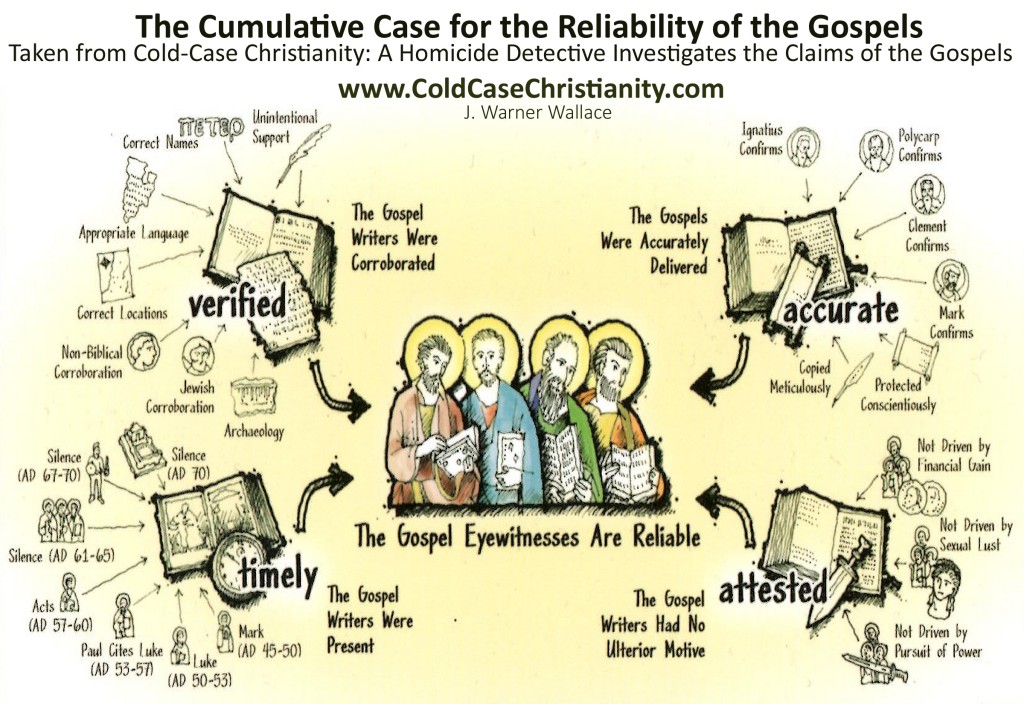
In a modern-day court of law, eyewitness testimony is evaluated on…

  • …the determination that the witnesses were actually present.
  • …the ability to corroborate their testimony.
  • …the consistency of their testimony over time.
  • …any biases they have that would cause them to exaggerate or misrepresent their testimony.

Let’s consider the testimony of the four Gospel writers: Matthew, Mark, Luke and John.

(1) Were The Eyewitnesses Present?

  • Luke is considered a credible historian, even by modern standards. He wrote the book of Acts following the ascension of Jesus into Heaven. Because he did not mention three major events in Jewish history (the Jewish uprising, the Roman siege of Jerusalem in response to that uprising, and the Roman destruction of the temple), we can determine that Acts was written before 61 AD.
  • Luke wrote the Gospel that bears his name before he wrote Acts. The Apostle Paul referenced portions of Luke’s Gospel in letters we can date by Paul’s Roman imprisonment, which means Luke was written prior to 53-57 AD.
  • Luke uses the Gospel of Mark as one of his references, which means Mark was probably written in 45-50 AD, just 10-15 years after the events of Christ’s life.
  • Mark was closely associated with the Apostle Peter, who was most assuredly Mark’s “source” in writing his Gospel, and Peter was one of the original twelve apostles called by Jesus.
  • Matthew and John were both apostles of Jesus, living and working closely with Jesus for over three years.

(2) Is Their Testimony Corroborated?

  • Archeological finds continually demonstrate the accuracy of the people, titles, places and details the Gospel writers mention.
  • Outside—or extra-biblical—sources like Josephus (a Jewish historian who wanted to preserve the purity of Judaism), Tacitus (a Roman historian), and Mara Bar-Serapion (a Syrian historian)—all who wrote between 40-70 AD—affirm things like where Jesus lived, the miracles He performed, the manner of His death, His resurrection, and the changed lives of people who believed in Jesus Christ.
  • In addition, Paul wrote of the “five hundred of the brothers” who were also eyewitnesses to the resurrected Christ (1 Corinthians 15:3-8).

(3) Has Their Testimony Remain Unchanged Over Time?

  • The history and accuracy of the scribes had already been demonstrated in the preservation and transmission of the Old Testament over a period of 1400 years.
  • These same scribal techniques were not only used in the transmission of the New Testament, but in subsequent years the Masoretic scribes became even more meticulous in the techniques they used.
  • The “chain of custody” of evidence can be absolutely traced from the Gospel authors, to their students, and to the writings of the Church Fathers.
  • In fact into the third-century AD, the writings of the Church Fathers contain so many direct quotations from the New Testament, that we can almost completely reconstruct the New Testament from their writings.

(4) Is Their Testimony Unbiased?

  • These eyewitnesses didn’t gain anything financially by their testimony. In fact, many of them lost or gave up all their possessions to tell others about Jesus.
  • They didn’t gain political power or influence that could save their own lives. All of the original apostles (except John) died a gruesome martyrs’ death.
  • In short, they had nothing to gain by making up and reporting a false story about Jesus.

All of these points make it reasonable to believe the evidence presented in the Bible about Jesus Christ is true. Check out this video where I elaborate a little more on each of these points—

If you live in the Cedar Springs area and don’t have a home church, I would love for you to visit with us Easter Sunday morning at 10:30am. We’ll be examining the evidence for Christ’s resurrection from the dead. Click here to get more details.

4 Terrible Ways & 4 Great Ways To Study Your Bible

Isaac Newton Bible study.001There are two Greek words in the New Testament that have to do with trying to figure things out. One of them leads to less knowledge, and one opens the way for greater learning. Not surprisingly, Jesus never used the first way, but He confronts people who try to.

The first Greek word is defined as learning through self-calculation. In other words, I try to get at the right answer by either teaching myself, or by talking with people who don’t know any more than I do. This way leaves me in the dark.

For example, notice the phrase “discussed among themselves” in Matthew 16:7 and Mark 11:31. These are people who wanted to try to get answers without going to someone who could teach them. So that leads to four terrible ways to study your Bible—

  1. Approach your Bible with a know-it-all attitude.
  2. Try to figure out what the Bible is saying all on your own.
  3. Try to be your own Bible teacher.
  4. Grade your own tests as to your answers being right or wrong.

These are not only terrible ways to learn, but they are the exact opposite of what God desires. God says things like, “Come, let us reason together” (Isaiah 1:18), and “Call to Me and I will tell you things you do not know” (Jeremiah 33:3).

There is another Greek word which means to learn by having a conversation with someone more knowledgable than myself. So that means four great ways to study your Bible are—

  1. Ask the Holy Spirit to illuminate Scripture to you (John 16:13).
  2. Study the Bible in a daily systematic way (Acts 19:9).
  3. Don’t take anyone else’s word for what the Word says (Acts 17:11).
  4. If you’re confused, ask God to make it clear to you (Jeremiah 33:3).

Luke records an important story for us that took place on the day Jesus was raised from the dead. Two men were walking along “discussing these things with each other,” but not consulting the Scriptures. The result: they were sad and confused. Jesus join them on their journey (although they didn’t recognize Him at first), and took them to the Scriptures that showed them the answers for which they were yearning. They even said, “When He talked to us from the Scriptures, that’s when our hearts burned within us!” (see Luke 24:13-32).

You can try to figure life out on your own, and you will probably end up stymied like the religious leaders in Mark 11, or downcast like the disciples in Luke 24. Or you can ask the Holy Spirit to show you truths from the Scriptures, and have your eyes opened, like the two disciples after Jesus met with them. I think the choice is obvious!

Join me next week as we continue our series How To Study Your Bible.

Asyougo

Listen to the podcast of this post by clicking on the player below, and you can also subscribe on AppleSpotify, or Audible.

A little habit started for me as a kid. I’d put things on the bottom steps of the stairway, so I’d be sure to see them and grab them as I went upstairs to my bedroom. After a while, everyone in our family had his or her own “step.” I called these asyougos: as you go upstairs, please take these with you. The principle was pretty simple, as I would naturally see these things going about my regular route.

Jesus had a similar idea for His followers: Go into all the world and preach the Good News to all creation (Mark 16:15). The verb tense and definition of the word go literally means that Jesus said, “Asyougo into all the world, preach the Good News.

In fact, this is exactly how Jesus lived His life. As He went about His normal life, His life intersected with people who needed Good News (check out Mark 10:17, 46; Luke 8:4, 42; 17:11; and John 9:1 as examples).

Peter summed up all of Christ’s life like this: God anointed Jesus of Nazareth with the Holy Spirit and power, and how He went around doing good and healing all who were under the power of the devil, because God was with Him (Acts 10:38).

Jesus lived an asyougo lifestyle, He called us to do the same, and He empowered us to live our asyougo lifestyle with the same power He had (Matthew 28:18-19; Acts 1:8).

Here’s the big idea—We don’t need to go anywhere special to find people who need Good News…

  • asyougo to school, you will attend class with them
  • asyougo to work, you will work alongside them
  • asyougo to the grocery store, you will interact with them
  • asyougo to do yard work, you will talk over the backyard fence with them
  • asyougo out to eat, you will sit next to them

People who need the life-changing, disease-healing, sin-forgiving power of Jesus are all around you. ASYOUGO share the Good News of Jesus Christ with them!

►► Would you please prayerfully consider supporting this ministry? My Patreon supporters get behind-the-scenes access to exclusive materials. ◀︎◀︎