I’ve been thinking, writing, and speaking about God’s favor quite a bit lately. You can check out some thoughts here, here, and here.
This topic isn’t complete without considering God’s grace. After all, grace literally means God’s unmerited favor.
So what do you think disgrace means?
The prefix dis- means separation. When something is disassembled, it’s not whole as it used to be. If someone is feeling discouraged, they are separated from what used to give them courage. So disgrace could mean that we are separated from God’s grace.
But are we really?
Listen carefully to this, and then take a look at this 4-minute video—satan cannot stop God’s grace, but he can stop you from recognizing God’s grace. In other words, disgrace doesn’t mean that God’s grace has been withdrawn from you, but rather disgrace is when you are having difficulty seeing, hearing, or feeling God’s grace.
Elizabeth was feeling disgrace, but then check out what God did for her…
You can read the story for yourself in Luke 1:5-25. This video clip is a small snippet from a longer message. If you would like to listen to the whole message, please click here.
I have been trumpeting this truth: God is for you! He’s not looking for opportunities to blast you, but to bless you. God wants you to know that you have found His favor.
But what happens if we sin? Do we lose God’s favor? In a word—NO!
Here’s what happens instead: God becomes our Prodigal Father.
Let me show you from both the Old Testament and the New Testament what I mean, but first, let’s define prodigal: it means recklessly extravagant or lavishly abundant. This is always how God treats His children.
In Isaiah 59, the prophet reminds us that nothing about God’s strength or ability to respond to our pleas has been diminished. Instead: your sins have separated you from your God—we can leave God, but He never leaves us!
Isaiah catalogs all our sins that have become a quicksand trap for us. God looks to see who can help us, and finding no one, here’s what He does: so His own arm worked salvation for Him, and His own righteousness sustained Him.
God did what was underserved. God did what no one else could do: HE HIMSELF BECAME OUR SALVATION!
If ever there was a definition of recklessly extravagant, lavishly abundant love… this is it!!
In Luke 15, Jesus tells a story that people often call the story of the prodigal son, but it’s really the father who is prodigal. The son squanders all his father’s blessings on wild living and finds himself bankrupt, starving, and completely disgraced. But the moment the son came to his senses and began to move toward his father by confessing his sin, his prodigal father ran to him!
Jesus tells us this father was overflowing with compassion. There wasn’t anything his son could have done to diminish the father’s love, nor was there anything the son could have done to make his father love him more. The father was all-loving all the time. He was recklessly extravagant and lavishly abundant in his love.
The father RAN to his son and covered his son’s disheveled, stinking rags with his royal robe.
This is exactly what Isaiah said God would do for us…
instead of ashes, we get a crown
instead of rags of mourning, we get an anointing of gladness
instead of a spirit of despair, we get a garment of praise
instead of shame, we get a double portion of God’s riches
instead of disgrace, we get God’s inheritance
How does all this happen? Our Prodigal Father abundantly, lavishly “clothes me with garments of salvation and arrays me in a robe of righteousness”!!
Don’t ever buy into satan’s lies that God loves you less, or that you’ve used up your changes, or that your sins are too many or too big. If we confess our sins, He is faithful and just and will forgive us our sins and purify us from ALL unrighteousness (1 John 1:9).
Join me this coming Sunday either in person or on Facebook Live as we learn more about God’s favor toward us.
“It was because of His grace that God the Father sent His only Son to die in our place. To say it another way, Christ’s death was the result of God’s grace; grace is not the result of Christ’s death.” —Jerry Bridges
God had been showing us His love throughout the Old Testament period, but the Advent of Jesus made it abundantly and unmistakably clear that God is for us!
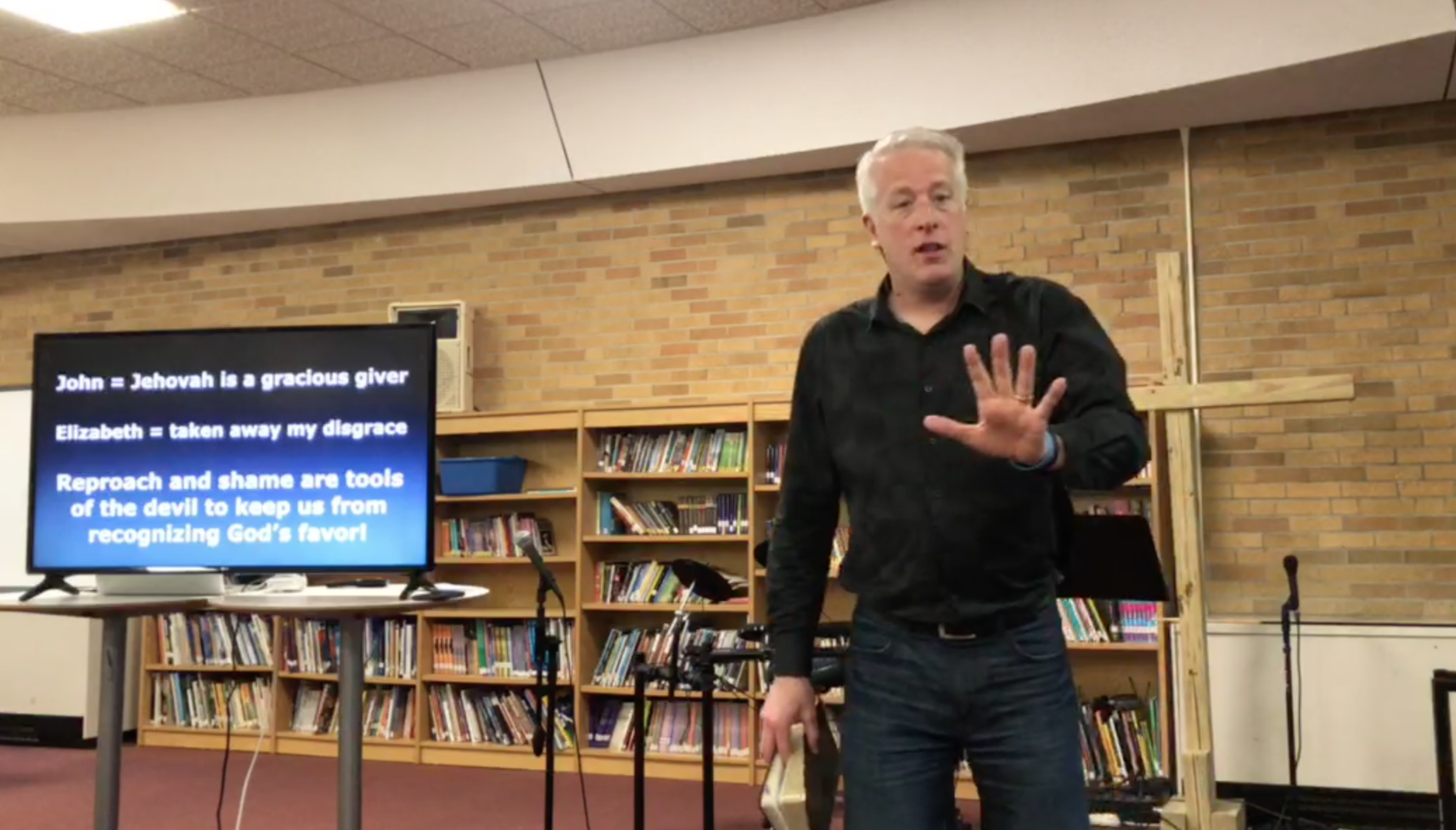
John (the one who would announce the arrival of Jesus) means Jehovah is a gracious Giver.
Elizabeth (John’s mother) said that God had not only shown His favor to her by making her pregnant, but she also said God had removed her disgrace.
Mary (the mother of Jesus) was greeted by the angel with the phrases “You are highly favored” and “You have found favor with God.”
On the night of Christ’s birth, the angels sang, “Glory to God in the highest heaven, and on earth peace to those on whom His favor rests.”
Jesus, in His first public sermon, quoted Isaiah’s words, saying He had come to proclaim God’s favor.
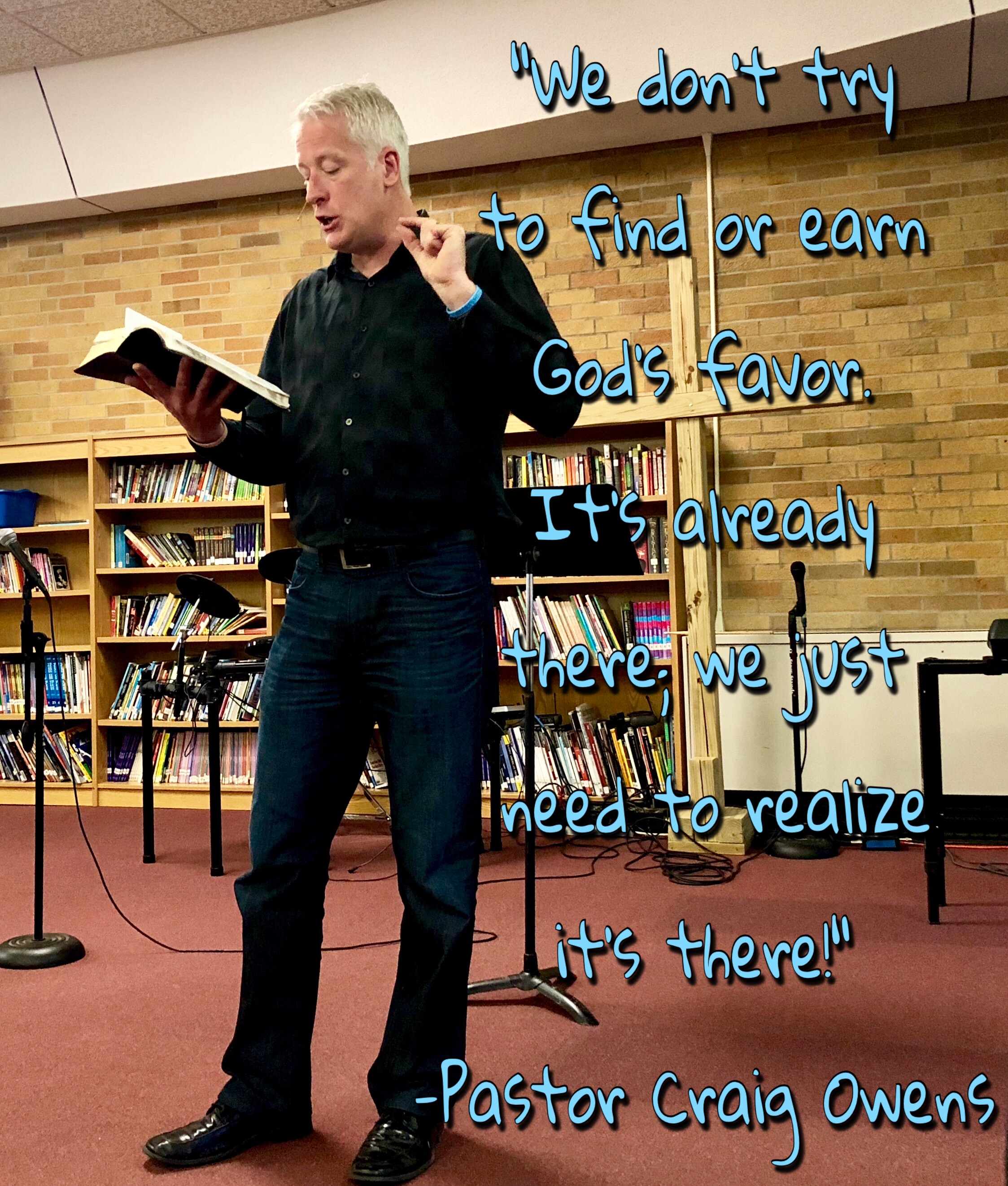
But please notice this truth—We don’t try to find or earn God’s favor. It’s already there; we just need to realize it’s there!
You see, we don’t grow in God’s favor, nor do we get more favor, but we progressively become more deeply and intimately acquainted with God’s favor that is already there. Check out what Moses said:
If I have found favor in Your sight, show me now Your way, that I may know You progressively become more deeply and intimately acquainted with You, perceiving and recognizing and understanding more strongly and clearly and that I may find favor in Your sight (Exodus 33:13)
The angel said to Mary, “You are HIGHLY FAVORED” (Luke 1:28). God uses the same word when He says to us: God made us ACCEPTED in the Beloved (Ephesians 1:6).
How can this be??Because on the Cross, Jesus switched places with us. He took all our sin and DISgrace, and gave us all of His righteousness. Now when God the Father looks at us, all He sees is the righteousness of His Son. Now all praise to God for His wonderful kindness to us and His favor that He has poured out upon us because we belong to His dearly loved Son(TLB).
God’s grace is undiminished. It is as full today as it ever has been. God could never love you more than He already does. God could never love you less because of anything you do. Keep your eyes on Him and you will find just how much favor He has for you!
Join me this Sunday either in person or on Facebook Live as we continue to learn more about God’s favor.
This is part 4 in my 5-part series, “I can know Jesus is A.L.I.V.E. because of ….” I have already addressed A—Apologetics, L—Lives changed, and I—It is finished. Today I want to consider the prophecies that the life, death, and resurrection of Jesus supposedly fulfilled.
We have all heard about “copycat” crimes. Could the life and death of Jesus fit that? Since Jesus was born from the family line of King David, and His family really wanted the promised Messiah to finally appear, perhaps He was pushed that way. Perhaps He lived in a certain way to make it look like He was fulfilling prophecy.
Detective J. Warner Wallace wrote, “Homicide detectives are perhaps the least trusting people in the world. My own experience investigating murders has taught me to consider everyone a liar—until, at least, I have good reason to believe otherwise.”
So was Jesus a liar? Was He following some copycat script to make it merely look like He was the Messiah? Or do we have good reasons to believe He was telling the truth? Consider three points—
How could David describe a crucifixion scene in 1000 BC, since the Persians didn’t invent it until around 400 BC (see Psalm 22:12-18)?
How could Jesus control others’ actions (i.e. Judas’ betrayal; being killed by crucifixion, not by stoning; soldiers gambling for His clothes)?
Even His own followers—whom He would need to perpetrate the hoax—didn’t understand what He was doing (John 12:16).
Prosecutors have to present enough evidence to convince a jury that they have arrested and brought to trial the right man. One of the key terms is beyond a reasonable doubt—“a part of jury instructions in all criminal trials, in which the jurors are told that they can only find the defendant guilty if they are convinced ‘beyond a reasonable doubt’ of his or her guilt.”
Let’s consider a hypothetical case that a prosecutor might present:
multiple eyewitnesses saw a man fleeing the scene, and all of them identified the suspect in a police line-up
the shoe prints at the crime scene were the same size and design that of the suspect was wearing when he was arrested
prosecutors presented text messages in which the suspect threatened to do to the victim exactly what was done to the victim
the wounds made by the weapon which was used on the victim correspond with the weapon the police found in the suspect’s car
the blood on that weapon matched the blood of the victim
the fingerprints on that weapon are the suspect’s fingerprints
That is the evidence. From that evidence, the jury is asked to draw inferences about the reasonableness of that suspect being the one who committed the crime.
I have listed just six pieces of evidence. How strong do you think the prosecutor’s case is? What if the jurors were presented with 50 pieces of evidence? What about 100? 200? How about 300 pieces of evidence?
Jesus fulfilled at least 300 prophecies—which were made before He was born!—in His life, death, and resurrection!
Math professor Peter Stoner calculated that the odds for just one man in history to fulfill only 8 prophecies is 1-in-1×10¹⁷. How amazing is that!? To give us a little perspective, Stoner says that 1×10¹⁷ silver dollars would cover the entire state of Texas in silver dollars two-feet thick. If just one of those silver dollars was marked, and a blindfolded man could select that one marked coin on his very first attempt, that would be about the same odds of Jesus fulfilling only 8 prophecies.
As a juror, if you weighed this evidence, do you find enough proof to “convict” Jesus?
But ultimately Jesus didn’t come just to fulfill prophecy; He came to rescue you and me from the penalty of our sin (Luke 4:16-21), and that is the best news of all!
Join me either in person or on Facebook Live this Sunday for the final message in this 5-part series.
Throughout history, lots of martyrs have died for what they believe. But only One had been resurrected from the dead to prove that what He believed and taught was true.
Jesus, however, is not a martyr. His life and His work weren’t cut short. Calvary didn’t happen to Jesus, but He came specifically to die on a Cross. He knew what was going to happen to Him. Check this out…
Jesus predicted not only His death but His resurrection too (John 10:7-18)
Jesus knew exactly how He would die, which was not by stoning at the hands of the Jews, but by crucifixion at the hands of the Romans (John 10:22-33; Mark 8:31; Matthew 26:2)
Later, knowing that everything had now been finished, and so that Scripture would be fulfilled, Jesus said, “I am thirsty.” … When He had received the drink, Jesus said,“It is finished.”
Actually His “It is finished” wasn’t just a statement, it was a yell that reverberated throughout the countryside. The Greek words Mark uses are megas phōnē, which sounds a lot like our word megaphone. Jesus wanted to make sure everyone heard Him, and then look at the result:
Then Jesus uttered another loud cry and breathed His last. And the curtain in the sanctuary of the Temple was torn in two, from top to bottom.
The curtain that separated God’s presence from mankind was torn in two. The writer of Hebrews notes, “Our High Priest offered Himself to God as a single sacrifice for sins, good for all time. Then He sat down in the place of honor at God’s right hand.”
What do you conclude from all this? C.S. Lewis offered this challenge:
“A man who was merely a man and said the sort of things Jesus said would not be a great man or a moral teacher. He would either be a lunatic—on the level with the man who says he is a poached egg—or else he would be the devil of hell. You must take your choice. Either this was, and is, the Son of God; or else a madman or something worse. You can shut Him up for a fool… or you can fall at His feet and call Him Lord and God. But let us not come with any patronizing nonsense about His being a great human teacher. He has not left that open to us.”
Jesus told us that He would die, how He would die, when He would die, why He would die, and that He would be resurrected. If you heard all of these claims before His crucifixion, you might think He was a lunatic or a braggart. But after His It Is Finished! declaration, we have only one logical conclusion: Jesus is exactly who He said He was. It was out of love for you that Jesus laid down His life and picked it up again. Will you put your faith in Him today?
We are working our way through 5-parts of this series: “I can know Jesus is A.L.I.V.E. because of….” We’ve already covered:
The sea saw it and fled; Jordan turned back, the mountains skipped like rams … rocks turned into a pool of water… (Psalm 114:3, 4, 8).
What would cause a sea to shrink?
Or a river to stop flowing? Or mountains and hills to quake in fear?
What could turn flint rocks into puddles?
God’s presence!
Creation recognizes its Creator!
Do we?
Waters and mountains and rocks cannot think or feel or appreciate majesty and beauty—but they can and do recognize their majestic Creator and bow in His presence.
How much more so we who can think and feel and appreciate—how much more so should we bow before our Majesty, the Creator of all!
Jesus may have had this Psalm 114 in mind when He said that rocks would cry out in praise if we humans did not [Luke 19:37-40]. I, for one, am not going to let rocks or waters praise on my behalf!
This is a weekly series with things I’m reading and pondering from Oswald Chambers. You can read the original seed thought here, or type “Thursdays With Oswald” in the search box to read more entries.
An Aroma From God’s Garden
[Oswald Chambers is speaking about how the prodigal son returned home.]
Did the father send any message to the far country after the younger boy? There is no record of any message being sent. What did the younger boy have to do? He had to do exactly what is recorded in Hosea long before that picture was painted by Our Lord—he had to return. Drawn by God? It does not say so. Read the fourteenth chapter of Hosea: “I will heal their backsliding” [Hosea 14:4]; but the backslider has to get up first, leave the pigs and what pigs eat, and go back to where he came from. Help granted him? None whatever. Messages from the home country? Not one. Tender touches of God’s grace on his life? No. Can you picture that prodigal son returning, a degraded, sunken, sin-stained man, going back in all the cruel, bald daylight? Oh, it is a hard way to go back out of the backslider’s hell; a hard, hard way! Every step of it is cruel, every moment is torture. But what happened? Before that younger son had gotten very far, the father saw him “and ran to his son, threw his arms around him and kissed him”!
Worker for God among backslidden souls, remember God’s way, put the sting, if you can, into the backslider’s soul that he may get up and come back to God, and what has he to do? Take with him words and say, “Forgive all my sins and receive me graciously” [Hosea 14:2]. Did the prodigal son take with him words? He did, he rehearsed them over and over again where he was amongst the pigs—“I will say to my father this and that,” he had it all by heart. Does Hosea say the same? He does: “My sins have been my downfall” [Hosea 14:1]. …
I just said now that no message was sent to the far country; God sends none, but, worker for God, will you be a message from the Father? Will you so bathe your life in the atmosphere of prayer that when you come in contact with a backslidden soul, it will awaken a remembrance of the Father, awaken a remembrance of what that soul once was? Will you let your life be like a bunch of flowers from the Father’s home garden, just awakening for one moment a remembrance of what life once was, and then pass on, and pray and watch, and you will be mightily rewarded by God when you see that poor backslidden soul get up and go back to God, taking with him words and saying, “My sins have been my downfall.”
From Workmen Of God
What about you, my friend? Do you love the prodigals enough to be the Father’s message from home to them?
This is a weekly series with things I’m reading and pondering from Oswald Chambers. You can read the original seed thought here, or type “Thursdays With Oswald” in the search box to read more entries.
The Hardy Annuals
By “hardy annuals” I mean the healthy-minded sinners. … How are we to get these irreligious people who are quite happy and healthy-minded to the place where they want Jesus? …
I want us to look at three types of pagans—Gallio, Herod and Pilate. ….
“And Gallio cared for none of those things” [Acts 18:12-15]. He said in effect, “I have nothing whatever to do with your religious quarrels, I am not here to decide questions of your law for you.” The opponents of Christianity are not weak, they are opponents who are able to ignore us; so the first thing to do is to examine and see what kind of Gospel we are preaching. … Have I a pet doctrine I am lifting up? If I have, then these healthy-minded folk will simply heap ridicule on me; but immediately I preach Christ, something happens—the Spirit of God begins to work where I cannot. …
Herod is a rare type of pagan, he is obscene; he was bad, unmentionably bad, and you will find that when he saw Jesus Christ face to face he was not the slightest bit troubled. Why? He had heard the voice of God before through John the Baptist, and he had ordered that voice to be silent [Mark 6:17-18]. Herod is the presentation of the awful possibility of a fixed character, absolutely fixed in immorality. Jesus Christ did not awaken one tremor of conscience in him…. Did you ever notice what is recorded? “Now when Herod saw Jesus, he was exceeding glad” [Luke 23:8-9]—why? For the same reason that people go to a picture show, they want to see things. We read that Herod questioned Jesus in many words; “but He answered him nothing.” …
Pilate represents the type of pagan who always seeks his own interests; that type is known to us all today. People belong to certain churches because it is better for their business; or they shift their membership to other churches because it is more convenient for business. A once-born man, who acts from this point of view is an opportunist. “If it is Jesus Christ’s Gospel that is in the ascendancy, then I will use it to serve my own ends.” You have to bring that man face to face with Christ, not with your experience, but with Jesus Christ Himself. …
Rely on the Holy Ghost as the most practical Being you ever knew, and live among the facts of God’s Word and among human facts, and people will recognize Jesus Christ through you. … The next time you come across a ‘hardy annual,’ see that you lay hold of God for that one until Jesus Christ is presented by the power of the Holy Ghost, and then you will see the altered face, the altered attitude, and the altered life.
There’s a time when David was fainting and had no one to help him—my spirit was overwhelmed and fainted, throwing all its weight on me. I look for someone to come and help me, but no one gives me a passing thought! No one will help me; no one cares a bit what happens to me (Psalm 142:3-4).
Here’s the backdrop to this prayer. King Saul has tried to kill David twice, not including the time Saul sent assassins to David’s house to kill him there. Even Jonathan, Saul’s son, was embarrassed and grieved at his father’s shameful treatment of David.
David runs away from Saul so quickly that he doesn’t take any food or even a weapon. He literally only has the clothes on his back and the sandals on his feet. He’s able to get some day-old bread from Ahimelech the priest, and he also takes Goliath’s sword from the temple.
David is clearly not thinking clearly. He is wearing Goliath’s sword on his side. Remember that David killed Goliath. Goliath is from Gath. And where does David run? To Gath!! He has to pretend he’s gone insane in order to escape from Gath, and he flees to the cave of Adullam.
It’s here that he prays an intense prayer. How intense? David literally shouts this prayer. He uses phrases like:
I cry aloud to the Lord
I lift up a thundering voice to God to plead for mercy
I let my complaint gush out in front of God, not holding anything back
He cries to God, “You are all I really want in life” and “You’re my last chance, my only hope for life”
After he did all that, he still says, “God, listen to my even louder cry!
Just how desperate is your situation? Just how heavy is your burden? Have you come to the realization that God is your ONLY help? Then, like David, cry out louder and louder to Him until He answers you!
A blind man got the attention of Jesus by yelling at the top of his lungs, “Jesus, Son of David, have mercy on me!!” Jesus said that this man’s faith healed him. What was the demonstration of his faith? It was the persistent calling out to the only One who could help him.
Earlier in this chapter, Jesus says this: So what makes you think God won’t step in and work justice for His chosen people, who continue to cry out for help? Won’t He stick up for them? I assure you, He will. He will not drag His feet. But how much of that kind of persistent faith will the Son of Man find on the earth when He returns? (Luke 18:7-8).
Once again Jesus links a continual cry for help to the definition of persistent faith.
So I’ll ask again: just how desperate are you for God to answer you? If you will cry out loud to Him, God will see your persistent faith and will step in and work for you.
This is a weekly series with things I’m reading and pondering from Oswald Chambers. You can read the original seed thought here, or type “Thursdays With Oswald” in the search box to read more entries.
Thawing Those ‘Frozen’ Toward God
The “lost” from the Bible standpoint are not doomed. The lost, Jesus Christ is seeking for… To Jesus Christ, all men are lost, and the worker who is going to work for the cure of souls must have the same outlook. …
In Luke 19 we find a specimen of a lost man. “The Son of Man is come to seek and to save that which was lost.” Notice the setting of this statement. Zacchaeus was a chief publican and as such he would be possessed of many ill-gotten gains; he was a man of wealth and position, a dishonorable man, but perfectly content with his dishonor. … This man Zacchaeus was frozen towards God, his conscience did not bother him, he was “lost,” quite contented, quite happy, and quite curious. When Jesus Christ came his way, the man’s nature unfroze, something began to work at once. …
Look what happened to Zacchaeus—“Zacchaeus stood up and said to the Lord, ‘Look, Lord! Here and now I give half of my possession to the poor; and if I have cheated anybody out of anything, I will pay back four times the amount.’” Who had been talking to him about his doings? Not a soul. Jesus had never said a word about his evil doings. What awakened him? What suddenly made him know where he was? The presence of Jesus!
Wherever a worker for God goes, the same thing will happen if the Spirit of God is getting His way through that man or woman. … The Holy Spirit’s presence through you has brought the atmosphere that Jesus Christ’s presence always brought, and has thawed the ice around their mind in their conscience and they are beginning to be convicted. …
Oh, do let us get back to this tremendous confidence in the Lord Jesus Christ’s power! Back to reliance on the Holy Spirit, and to remembering that Jesus came to seek the lost.
From Workmen Of God
Is this an amazing thought?!
If Christians will just approach their “frozen” friends and loved ones with the knowledge that Jesus Christ loves them and wants to save them—and with the expectation that Jesus can save them—then the Holy Spirit can work through our presence to begin the thaw around their heart.
“Oh, do let us get back to this tremendous confidence in the Lord Jesus Christ’s power! Back to reliance on the Holy Spirit, and to remembering that Jesus came to seek the lost.” Amen!



 I’ve been thinking, writing, and speaking about God’s favor quite a bit lately. You can check out some thoughts here, here, and here.