Four Kings Of Kings

When C.S. Lewis first introduces us to the land of Narnia in The Lion, The Witch and The Wardrobe, we discover that the White Witch has Narnia seemingly under her iron fist, and has made it so that it’s always winter but never Christmas. 

“Come on!” cried Mr. Beaver, who was almost dancing with delight. “Come and see! This is a nasty knock for the Witch! It looks as if her power is already crumbling. … Didn’t I tell you, that she’d made it always winter and never Christmas? Didn’t I tell you? Well, just come and see!” 

And then they were all at the top and did see.

It was a sledge, and it was reindeer with bells on their harness. But they were far bigger than the Witch’s reindeer, and they were not white but brown. And on the sledge set a person whom everyone knew the moment they set eyes on him. He was a huge man in a bright red robe (bright as holly-berries) with a hood that had fur inside it and a great white beard that fell like a foamy waterfall over his chest. … Some of the pictures of Father Christmas in our world make him look only funny and jolly. But now that the children actually stood looking at him they didn’t find it quite like that. He was so big, and so glad, and so real, that they all became quite still. They felt very glad, but also solemn.

“I’ve come at last,” said he. “She has kept me out for a long time, but I have got in at last. Aslan is on the move. The Witch’s magic is weakening.” 

I think the Israelites waiting for their Messiah must have felt a little like the Narnians: always winter, but never Christmas; trapped under the iron-fisted rule of Babylon, and Persia, and Rome. 

But as they approached what we now call the year 1 AD, winter is about to end and the Advent of CHRISTmas is about to occur at long last! 

You might think that the birth of Jesus brought us the King of Kings. But actually, there were three other “king of kings” that preceded Jesus, who all helped to fulfill God’s ultimate plan. 

Nebuchadnezzar was the king of Babylon. God called him “My servant” and also gave him the title king of kings (Jeremiah 27:6; Ezekiel 26:7). It was he who defeated Judah and took captives with him to Babylon. Among those captives was a young man named Daniel. 

God gave Daniel the ability to interpret Nebuchadnezzar’s dream which foretold of three other kingdoms which would follow Babylon, with the fourth kingdom being called a kingdom of iron. History shows us that Babylon was defeated by the Medes, who were in turn defeated by the Persians, who were themselves defeated by the Greco-Romans. 

Artaxerxes was king of the Persians, and he called himself king of kings (Ezra 7:12). He helps to facilitate the Jews’ return back to Jerusalem, and even helped fund their efforts to rebuild the temple of Solomon and reestablish worship there. 

In 44 BC, Julius Caesar was assassinated, and Octavius was named in Caesar’s will as his adopted son and heir. Eventually, Octavius quelled a 20-year-long civil war and established himself as the unquestioned ruler of the Roman Empire. He changed his name to Caesar Augustus, which means the exalted one. But all throughout the Mediterranean world archeologists have discovered numerous other titles for Caesar Augustus—Divine, Son of God, God Incarnate, God from God, Lord, Redeemer, Liberator, Savior of the World, and King of Kings. 

Historian Luke records these words, “In those days Caesar Augustus issued a decree” (Luke 2:1). This decree called everyone to return to his hometown to be registered in Rome’s census. This decree meant that Joseph was obligated to return to Bethlehem. He took his pregnant wife with him to arrive just in time for Jesus to be born. 

JesusTHE eternal and ultimate King of Kings—was born in Bethlehem just as had been prophesied 700 years earlier in the winter of Israel’s captivity: 

But you, Bethlehem Ephratah, you are little to be among the clans of Judah; yet out of you shall One come forth for Me Who is to be Ruler in Israel, Whose goings forth have been from of old, from ancient days (eternity). (Micah 5:2) 

The coming of THE King of Kings is proof that God sees you too. God brought the king of kings named Nebuchadnezzar, and Artaxerxes, and Caesar Augustus to power just to move two “average Joes” 70 miles from Nazareth to Bethlehem so that THE King of Kings could be born there to fulfill the prophesy. 

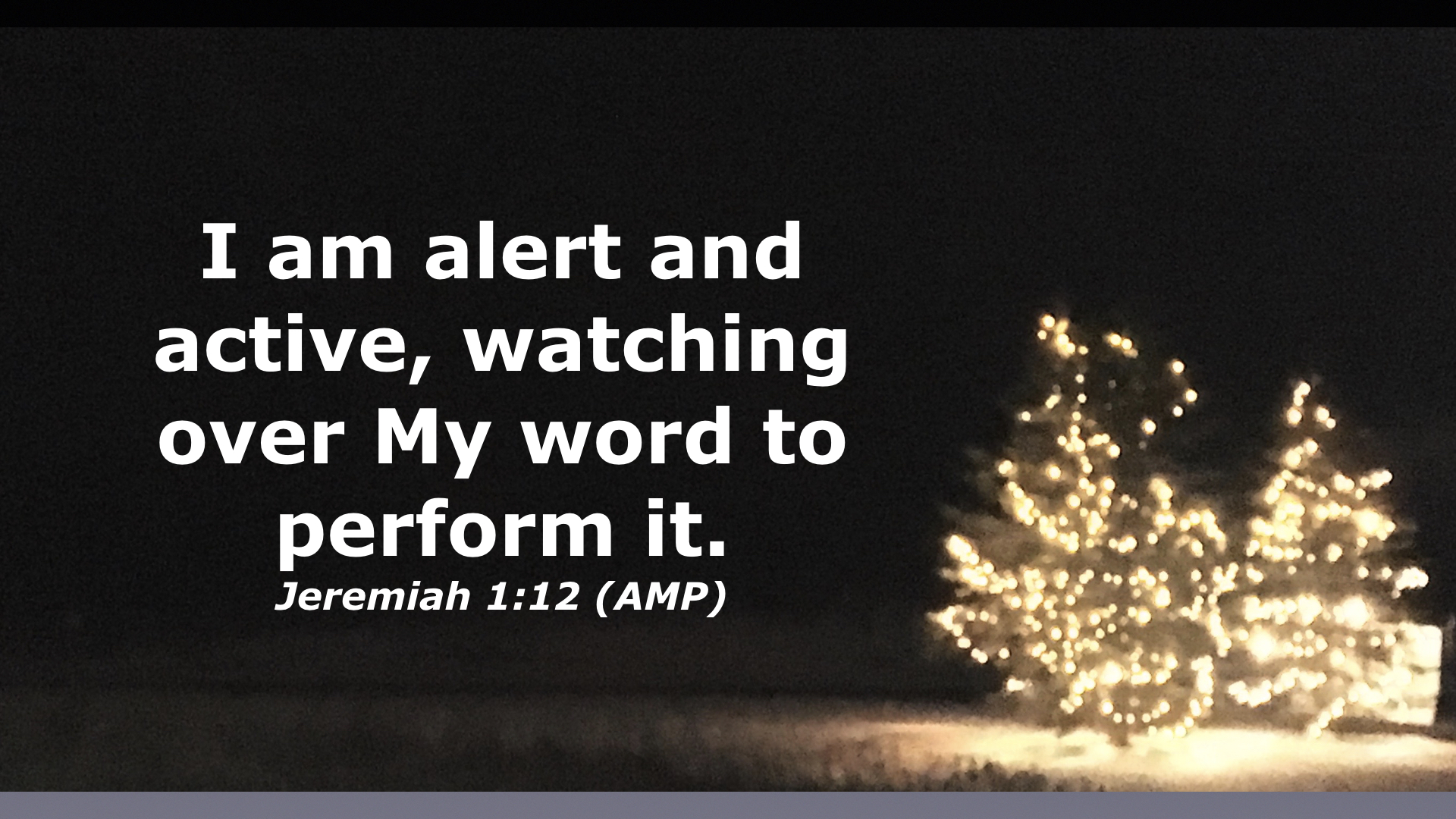
God has a plan for your life. His plan for you was in place before you were even conceived in your mother’s womb. And—even this very moment—He is watching over world events to make sure that every detail of His plan is fulfilled (see Ephesians 2:10; Psalm 139:16; Jeremiah 1:12)! 

If you ever feel like you are in a “winter” season of your life—always winter and never Christmas—just remember that God sees you, He has a plan for you, and He will bring an end to your winter just in time to bring you CHRISTmas!

How Is Your Heart Hearing?

Therefore take heed how you hear… (Luke 8:18).

Therefore—when I see this word, I need to ask, “What came before?” Jesus has just shared the parable of the sower and given its fuller explanation to His disciples. Now Jesus is speaking privately to His disciples and telling them, “Be very attentive to how you are hearing My words.”  

Why would Jesus tell them that? He says that the way we pay attention to His words can either bring more blessing to our lives, or cause us to miss out on His blessings: “For whoever has, to him more will be given; and whoever does not have, even what he seems to have will be taken away from him” (v. 18). 

In other words, every single one of us has the capacity to have hearts like all four types of soil Jesus talked about in His parable: hard, rocky, thorny, productive. 

I must be attentive to how I’m listening to Christ’s words…

  • …with a prepared (plowed) heart 
  • …not preoccupied with worldly things
  • …ready to obey what He says
  • …ready to share the blessings of what I hear with others

Lord, my heart is ready. Speak to me. I am ready to hear, ready to obey, and ready to share. Give me more insight into what You are saying to me.

The Powerful Name Of Jesus

As we approach Christmas Day and we think about the First Advent, many times our thoughts go to the scene of a lowly manger, tired parents, and a newborn baby wrapped in cloths. We tend to focus on the Baby. 

And rightly so! 

It is fascinating to think that before He was even born an angel appeared to both Joseph and Mary to tell them that this Baby should be named Jesus (Matthew 1:21 and Luke 1:31). But have you also noticed all of the other names and titles given to the Baby at His birth? 

  • a Savior who is Christ the Lord
  • Immanuel which means “God with us” 
  • Son of the Most High 
  • King of the Jews
  • Ruler of God’s people
  • Son of the Most High God
  • God Himself

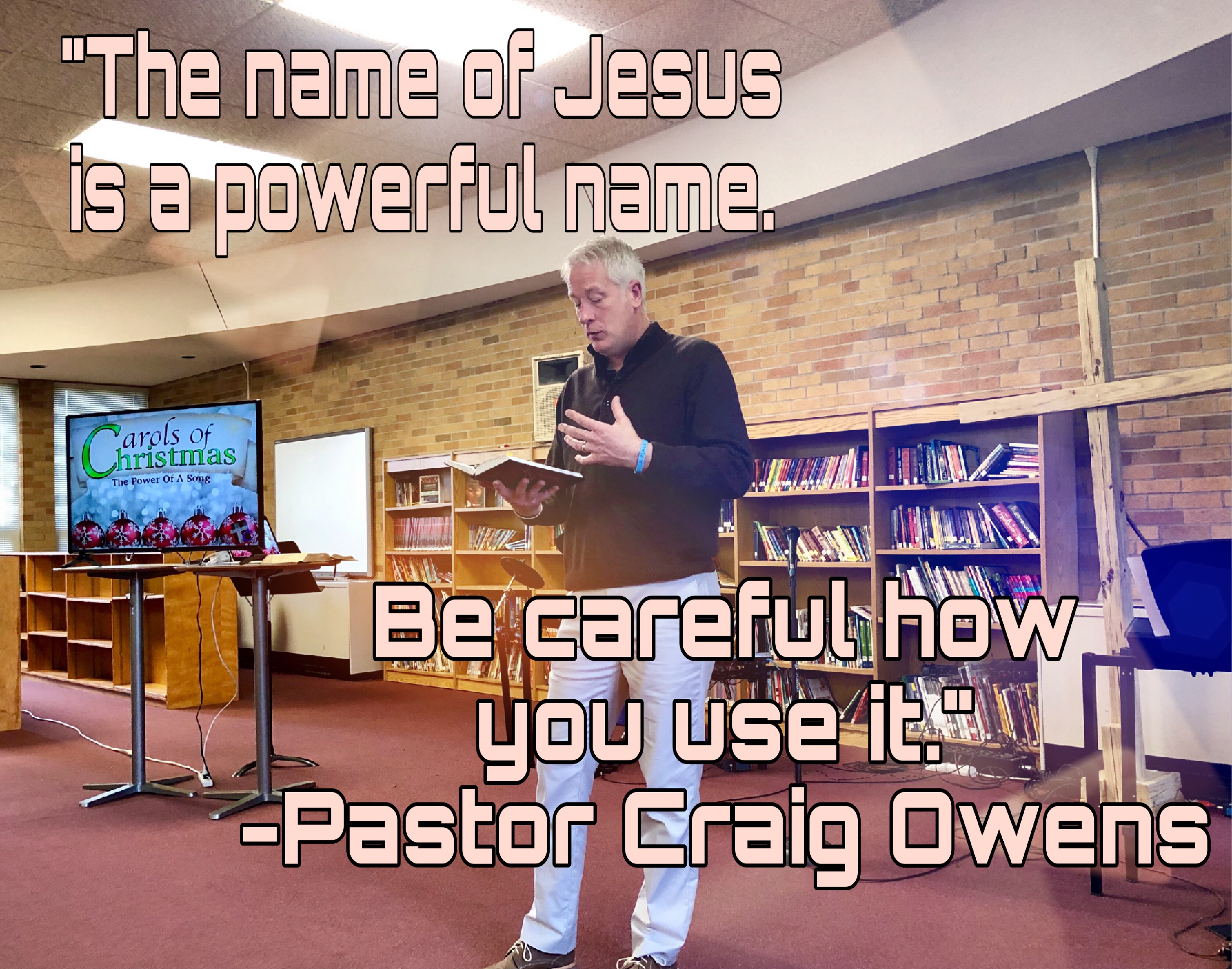
What do we do with the name of the Lord? 

When I say “the name of the Lord” I’m not talking about the five letters that spell J-E-S-U-S or even C-H-R-I-S-T. The name of the Lord means all of God’s character, His majesty, His personality, His magnificence, everything that makes God God. 

The Bible clearly tells us how to use God’s name properly. We are to use the name of the Lord for

  • salvation
  • protection
  • batting the enemy
  • preaching
  • praying
  • casting out demons
  • healing the sick

The use of the name of the Lord should distinguish us. CHRISTians bear the name of Christ, so they should represent the character of God accurately, and in a way that causes others to glorify Him and want to approach Him. 

If there is a proper way of using the name of the Lord, that also means there are ways we can misuse the name of the Lord, something God expressly forbids in the third of the Ten Commandments (Exodus 20:7). 

We misuse the name of the Lord when we… 

There is a holy balance—Jesus is both King of kings and a Friend of sinners. God paid an incredibly high price so that we could be reconciled to Him, but not so that you could treat Him ignorantly or carelessly. This calls for some serious searching by the Holy Spirit! Perhaps you could pray a prayer that David penned: Search me, God, and know my heart; test me and know my anxious thoughts. See if there is any offensive way in me, and lead me in the way everlasting.

To take a look at the other stanzas of this Christmas carol, please click here.

Blessings And Woes

… blessed are you … woe to you … (Luke 6:20-27). 

Blessings and woes: the positives and negatives of the Christian life. Jesus listed these back-to-back to remind us that we need to keep both of them in mind, sort of like two rails that keep us on track. 

It’s interesting to note how many of these blessings and woes are opposites of each other. It comes down to this—

there are blessings for seeking the Kingdom of God, AND there are woes for seeking our own immediate pleasure.

Notice the contrasts Jesus lists:

  • You are blessed when you seek heavenly rewards; you experience woe when your focus is earthly treasure (vv. 20, 24). 
  • You are blessed when you are driven by a hunger for God; you experience woe when your god becomes your selfish appetites (vv. 21, 25). 
  • You are blessed when you acknowledge your sin, weep over it, and repent from it; you experience woe when sin is laughed at (vv. 21, 25). 
  • You are blessed when you are hated by the world for loving God; you experience woe when you are loved by the world for loving sinful pleasures (vv. 22, 26). 

I think C.S. Lewis captured these thoughts well when he wrote in Mere Christianity, “Give yourself up and you will find your real self. Lose your life and you will save it. … Look for Christ and you will find Him, and with Him everything else thrown in.” 

Blessings for seeking Jesus and His kingdom; woes for seeking only your own kingdom. 

So how do we live blessed? Here’s what Jesus taught us (vv. 27-49)—

Love your enemies
Always do good, even (especially!) to your haters
Bless those who curse you 
Don’t fight for your rights
Be an impartial, liberal giver
Treat others the way you want to be treated 
Love and give to others without expecting a return
Be merciful
Don’t be judgmental
Give, give, and give some more
Look in the mirror at yourself first before looking out the window at others
Serve others
Check what sort of fruit your life is bearing
Build everything in your life on God’s Word

Avoid the woes AND enjoy the blessings of God! 

Putting CHRIST In Christmas

Does it seem like many people substitute “Happy holidays” for “Merry Christmas”? Or that more and more people prefer spelling it “X-mas” instead of Christmas? 

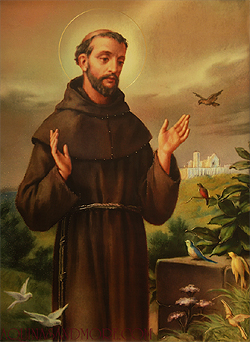
This isn’t something new in our culture. Francis of Assisi dealt with this same situation in the 12th century. 

“Many people spell Christmas without Christ, the glory of a Holy Day being supplanted by the glitz of a holiday—a problem that reaches back to the days of St. Francis of Assisi. 

“Francis was born in 1182 in central Italy, son of a rich merchant. After a scanty education, he joined the army and was captured in war. He came to Christ shortly after his release, and soon he began traveling around the countryside, preaching the gospel. At a February 1209 Mass, Francis was gripped by words being read from Matthew 10: As you go, preach this message: ‘The kingdom of heaven is near.’ Heal the sick, raise the dead, cleanse those who have leprosy, drive out demons. Freely you have received, freely give. Do not take along any gold or silver or copper in your belts; take no bag for the journey, or extra tunic, or sandals or a staff … (NIV). 

“Francis felt that Christ Himself was speaking directly to him. He decided to obey those words as literally as possible, preaching the kingdom and possessing nothing. It is as though a 1,200-year bridge were crossed, putting Francis in the shoes of the original wayfaring apostles themselves. 

“He spent his remaining days making Christ real to everyone he met—a passion leading to history’s first living nativity scene. On December 24, 1223, Francis found a cave near Greccio, Italy, and brought in animals traditionally associated with the birth of Christ. (Francis loved animals and sometimes even preached to them.) He built the crib, arranged the hay, and finished the scene. Crowds gathered full of curiosity and wonder; and there on Christmas Eve Francis preached the wonder of God made man, born a naked infant and laid in the manger. ‘Behold your God,’ he said, ‘a poor and helpless Child, the ox and donkey beside Him. Your God is of your flesh.’ 

“Glitz gave way to glory that evening as the people of Greccio learned afresh how to spell the word Christmas.” —From On This Day 

This Advent season, let us remember that there is no Christmas without Christ! 

Joining The Angel Choir

The angels are highly visible around the birth of Jesus Christ in Bethlehem, but here’s the amazing thing—we are invited to join the angelic choir singing praise to Jesus! 

Nowhere else do we see such a concentration of angels as during Christ’s time on earth, and especially at His birth. In the Old Testament prior to Christ’s birth, and in the New Testament following Christ’s ascension, we don’t see as many angels clustered together on Earth— 

  • Gabriel brings a birth announcement to Zechariah 
  • Gabriel brings a birth announcement to Mary
  • an angel talks to Joseph in a dream (three times!) 
  • an angel gives instructions to the wise men in a dream
  • angels minister to Jesus in the wilderness after His battle with the devil 
  • angels are poised for action in case Jesus calls on them prior to His crucifixion
  • angels are present at Christ’s tomb after His resurrection
  • and a massive angel choir sings at Christ’s birth (Luke 2:8-14) 

Charles Wesley wrote a Christmas carol called Hark! The Herald Angels Sing. In the first stanza, we’re invited to “join the triumph in the skies.” But how can someone sing a song grand enough, majestic enough, or worthy enough to honor Almighty God?! That would be like me being asked to compose a song or play something on the piano to honor Mozart—how could I play anything worthy of his musical talent? 

In a similar way, when the Israelites thought about coming into God’s presence, they were gripped with knee-knocking, gut-churning fear (Exodus 19:16-19; 20:18-19)! 

But notice that the angels didn’t sing, “God is born in Bethlehem.” They sang, “Christ is born in Bethlehem.” Christ: the Messiah; the One who sets things right. No wonder this is such good news of great joy that brings peace and God’s favor (Luke 2:10, 14). 

The simple fact is that we couldn’t approach God and join in their angelic song. Instead, Jesus approached us as our Messiah, our Deliverer. How could this happen? Wesley’s carol reminds us that Jesus came so that God and sinners are reconciled! 

The First Advent is God approaching us. If we allow Jesus to reconcile us to our Holy Heavenly Father, then we have no fear of Christ’s Second Advent. His Second Advent will be attended to by angels just like His First Advent (Matthew 25:31-32; Mark 8:38; Jude 1:14-15). Those who haven’t had their sins forgiven will hear a song that is soul-crushing to them, while those who have accepted the reconciling work of Jesus will join with the angelic host in a victorious song bringing glory to God forever and ever (Revelation 14:9-11; 15:1-4). 

We don’t have to wait until we get to Heaven to join the triumph of the skies. We can join the angelic choir right now in singing our praise to God today. And every day! 

To take a look at the other stanzas of this Christmas carol, please click here.

Thursdays With Oswald—How To Understand And Apply The Scriptures

This is a weekly series with things I’m reading and pondering from Oswald Chambers. You can read the original seed thought here, or type “Thursdays With Oswald” in the search box to read more entries.

How To Understand And Apply The Scriptures

     In order to understand the Sermon on the Mount, it is necessary to have the mind of the Preacher, and this knowledge can be gained by anyone who will receive the Holy Spirit (see Luke 11:13; John 20:22; Acts 19:2). The Holy Ghost alone can expound the teachings of Jesus Christ. The one abiding method of interpretation of the teachings of Jesus is the Spirit of Jesus in the heart of the believer applying His principles to the particular circumstances in which he is placed. “Be transformed by the renewing of your mind,” says Paul, “that you may prove,” i.e. make out, “what is that good, and acceptable, and perfect will of God” [Romans 12:2]. …

     Every mind has two compartments—conscious and subconscious. We say that the things we hear and read slip away from memory; they do not really, they pass into the subconscious mind. It is the work of the Holy Spirit to bring back into the conscious mind the things that are stored in the subconscious. In studying the Bible never think that because you do not understand it, therefore it is of no use. A truth may be of no use to you just now, but when the circumstances arise in which that truth is needed, the Holy Spirit will bring it back to your remembrance [John 14:26]. … 

     We do not hunt through the Bible for some precept to obey…but we live so in touch with God that the Holy Spirit can continually bring some word of His and apply it to the circumstances we are in. … The teaching of Jesus Christ comes with astonishing discomfort to begin with, because it is out of all proportion to our natural way of looking at things; but Jesus puts in a new sense of proportion, and slowly we form our way of walking and our conversation on the line of His precepts: Remember that our Lord’s teaching applies only to those who are His disciples.

From Studies On The Sermon On The Mount

What Chambers says about the Sermon on the Mount is true of any biblical passage we read: we need to have the Holy Spirit’s help to understand it and apply it to our unique life setting. 

Think of this—the same Holy Spirit who inspired the biblical writers is the exact same Spirit who will assist you in understanding that Word! Before I read the Bible I often pray: May the Spirit who inspired this Word now illuminate my mind to understand it and obey it. 

Try that prayer yourself and see how God’s Word is opened up to you. 

Alien Anxiety

“A recent survey of primary care physicians in the United States revealed that at least one-third of office visits were prompted by some form of anxiety.” —Lanny Hunter & Victor Hunter 

The Greek word for anxiety means to be pulled in different directions. In the context of “Aliens and Strangers,” it means being pulled between Earth’s way and Heaven’s way. Other biblical definitions for anxiety that the Amplified Bible brings out include—

  • being perpetually uneasy…about your life (Matthew 6:25) 
  • a troubled mind unsettled, excited, worried, and in suspense (Luke 12:29) 
  • drawn in diverging directions, his interests are divided and he is distracted from his devotion to God (1 Corinthians 7:34) 

Unchecked anxiety can negatively impact our physical, emotional, mental, and even spiritual health, so it’s imperative—if we are going to live differently than Earthlings—that Christians handle their anxiety in an alien way. 

Peter gives us an alien response to our feelings of worry and anxiety—

Cast all your anxiety on [Jesus] because He cares for you. (1 Peter 5:7)

Notice that Peter doesn’t say, “Don’t be anxious,” but he does say, “Here’s what to do with your anxiety.” Being anxious is not a sin, but hanging on to your anxiety may cause you to behave in a sinful way. 

So what do we do with our anxiety? In a word cast it off—throw it somewhere else! The verse tense here means it’s something we must keep on doing, so Peter is really saying keep on casting your anxiety on Jesus. 

Why can we keep on casting our anxieties on Jesus? Because He cares for you. Jesus has taken charge of your care; He’s made it His goal that you aren’t missing out on the abundant life He paid for! This verb is in what’s called the indicative mood. That means it is something that has happened in the past, and it is happening now, and it will continue to happen forever and ever! 

Even if you cast an anxiety on Jesus 30 seconds earlier, you can do it again right now because that’s how much He cares for you! 

At the risk of oversimplifying it, here is the prescription for anxiety in four steps: 

  1. Recognize that you are anxious—admit it to yourself and to God. 
  2. Remind yourself that Jesus cares for you. 
  3. Reject your anxieties by counteracting your worry with God’s truth—I like to read something like Psalm 23.
  4. Repeat steps 1-3. 

“Your natural tendency when you’re feeling anxious is to focus on yourself and your problems. The more you do this, the more you forget about Me and all the help I can supply. This worldly focus only increases your anxiety! Let the discomfort you feel at such times alert you to your neglect of Me. Whisper My Name, and invite Me into your difficulties. … A problem-preoccupation makes you anxious. So I urge you to cast all your anxiety on Me—trusting that I care for you. You may have to do this thousands of times daily, but don’t give up! Each time you cast your worries and concerns on Me, you are redirecting your attention from problems to My loving presence.” —Sarah Young, in Jesus Always 

Join me next week as we continue our series called Aliens and Strangers. If you’ve missed any messages in this series, you may find the complete list by clicking here.

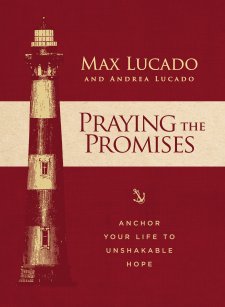
7 More Prayers From “Praying The Promises”

In his book Praying The Promises, Max Lucado shows us how simply we can turn passages of Scripture into intimate and powerful prayers. Here are a few more prayers (the references in brackets are passages that formed the prayer).

Lord, in the midst of my storms, I may doubt Your presence. I may wonder if You are there and if You care. Don’t let me lose hope or lose heart. Deepen my belief in You, even during the storms. Don’t allow doubt to take over. Help me release control of my circumstances and surrender them to You. Jesus is interceding on my behalf, and I am so comforted by this truth. [Luke 22:32; Hebrews 7:25; Matthew 14:23-24]

God, teach me how to live free from condemnation. Teach me how to trust and believe in this promise: in Christ, I am no longer a slave to sin. Free me from guilt and shame. [Romans 3:23-25; Romans 6:6-7; Romans 8:1] 

Lord, thank You for the promise of a temporary tomb. Your power has no limits. You have conquered death. You have promised to make all things new. You are the God of restoration and redemption and regeneration. You are the God of resurrection. In my day-to-day life it can be difficult for me to maintain an eternal perspective. Sometimes I may get bogged down in the worries of today and forget that the best is yet to come. Restore in me the joy of my salvation, God. Renew my mind and my heart so that I will have an eternal perspective of all the worries of my day. They are nothing compared to spending eternity with You. And because of Your promise of resurrection, I do not have to fear death. I will live in faith, knowing that in Jesus, death has been swallowed up in victory. Amen. [Matthew 28:5-6; 2 Corinthians 4:16-18] 

Guide me today, Holy Spirit. Show me where You want me to go, whom You want me to talk to, what decision You want me to make. Help me discern Your voice over my own and others’. Walk closely with me and whisper truth to me. Forgive me when I listen to my own desires and ignore what You are telling me. [John 16:13-15; Galatians 5:25] 

You know all of my needs before I can even ask for them. Sometimes it’s tempting for me to believe I can rely on myself for what I need. Instead of trusting You to provide, I think I can look out for myself. I fear not having enough. And when I do have enough, it never feels like it. But You have promised to meet my needs out of Your glorious riches. Remind me of Your kind and generous provision. Thank You for taking care of me and meeting all of my needs. [Psalm 34:10; Matthew 6:8; Matthew 10:29-31]

Help me to keep eternity in mind, making the most of my days and showing others Your renewing love. [2 Corinthians 4:16-18; 2 Peter 3:13] 

Dear God, You are my unshakable hope. Your promises are unbreakable. You never waiver. You are faithful to the end. My hope cannot be anchored to anything less than Your promises. … Forgive me for those times when I don’t put my hope in You. May I rest in Your promises once again. May any fear, anxiety, or confusion I feel subside in light of You as my anchor. [Isaiah 40:31; Romans 15:13] 

You can check out my review of Praying The Promises by clicking here. I also shared some other prayers here and some quotes from this book here. 

Fight Like Jesus

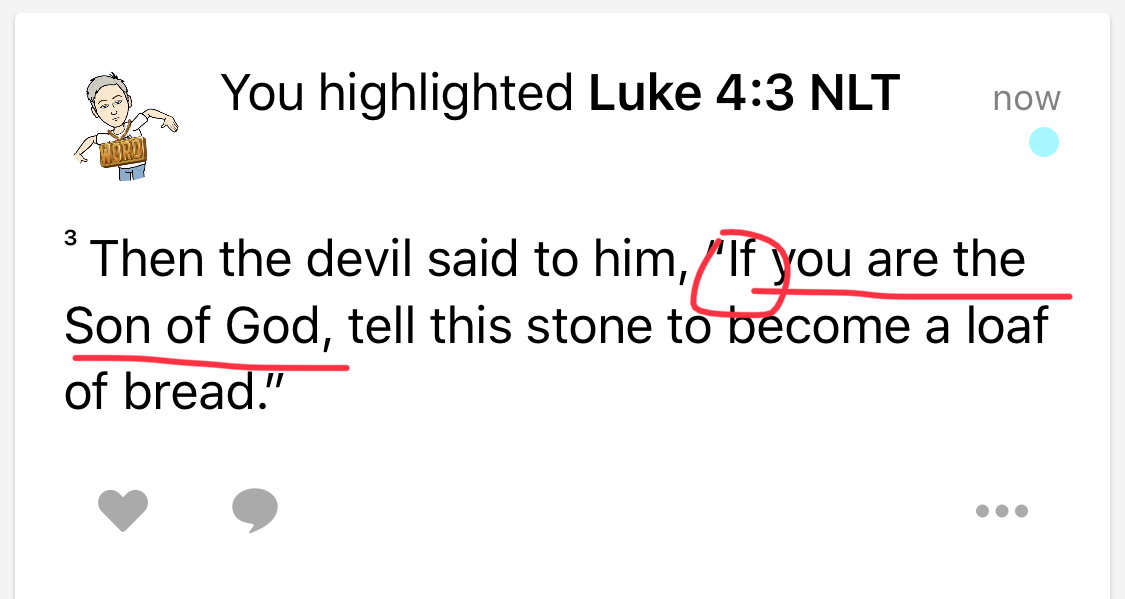
God announces to the world that Jesus is His Son, but as soon as the devil has an opportunity to tempt Jesus he begins with, “IF You are the Son of God….

“This is the bedrock of EVERY temptation. If satan can cause us to reject, doubt, or forget our original identity as beloved sons and daughters of the King, he can get us to fall for any number of tricks and non-satisfying pleasures.” —Honoring Christ In Human Rights (a YouVersion reading plan)

The devil has always been a slanderer and a prosecutor—always leveling charges against God’s children, trying to get them to feel unworthy of God’s love. He still does this today. 

Don’t let him. It’s time to fight back!

How?

We read in Revelation: “For the accuser of our brothers and sisters, who accuses them before our God day and night, has been hurled down. They triumphed over him by the blood of the Lamb and by the word of their testimony” (Revelation 12:10-11).

Jesus—the Lamb of God—shed His blood for you. You have been purchased with an amount that is incalculable. You have so much worth to your Heavenly Father! You did nothing to earn this payment of blood, you just receive it by faith. 

But we also need “the Word.” Notice that every time the devil attacked Jesus, He responded by saying, “It is written,” and then He quoted the Word (see Luke 4:1-12). We must do the same. 

When the devil says you’re unworthy of God’s love, you say, “It is written, ‘There is no condemnation for me because I am covered by the blood of Jesus’” (Romans 8:1).

When the devil says God can’t or won’t help you, you say, “It is written, ‘If God did not spare His own Son, but gave Him up for me—how will He not also graciously give me everything I need?’” (Romans 8:32). 

When the devil says you can’t resist his temptations for very much longer, you say, “It is written, ‘Greater is He that is in me than anything you’ve got. I have submitted myself to God and I will not give in to you, so you must flee from me!’” (1 John 4:4; James 4:7).

When the devil says you’re all alone in this world, you say, “It is written, ‘God said He would never leave me, and His Spirit is inside me right now and forever’” (Hebrews 13:5; John 14:16-18).

Dear friend, the blood of the Lamb covers you. Now use His Word to refute every single charge the devil tries to use to slander you.