Listen to the podcast of this post by clicking on the player below, and you can also subscribe on Apple, Spotify, or Audible.
And they were not able to resist the wisdom and the Spirit by which [Stephen] spoke. (Acts 6:10)
Luke the historian doesn’t give us very many details about Stephen, but one common thread is the obvious help the Holy Spirit gave him:
Stephen, full of faith and power, did great wonders and signs among the people
they were not able to resist the wisdom and the Spirit by which he spoke
all who sat in the council…saw his face as the face of an angel
when they heard these things they were cut to the heart
being full of the Holy Spirit, [Stephen] gazed into heaven and saw the glory of God, and Jesus standing at the right hand of God
Jesus lived this way too. Near the end of His public ministry He said,
“I have never spoken on My own authority or of My own accord or as self-appointed, but the Father Who sent Me has Himself given Me orders concerning what to say and what to tell. And I know that His commandment means eternal life. So whatever I speak, I am saying exactly what My Father has told Me to say and in accordance with His instructions.” (John 12:49-50 AMP)
Jesus said this same Holy Spirit who directed His vocabulary, and Who gave Stephen his irresistible words, would do the same thing for us too. The apostle Paul asked for the Ephesian Christians to pray for him like this, “Pray also for me, that whenever I speak, words may be given me so that I will fearlessly make known the mystery of the gospel” (Ephesians 6:19).
When we are yielded to the Holy Spirit we can say with assurance…
A mark of a godly leader is his irresistible, Spirit-led vocabulary.
This is part 60 in my series on godly leadership. You can check out all of my posts in this series by clicking here.
“Love of the Word appears preeminently in our Lord and Savior Jesus Christ. He read it publicly. He quoted it continually. He expounded it frequently. He advised the Jews to search it. He used it as His weapon to resist the devil. He repeatedly said, ‘The Scripture must be fulfilled.’ Almost the last thing He did was to ‘open their minds so they could understand the Scriptures’ (Luke 24:45). I am afraid that man cannot be a true servant of Christ, who has not something of his Master’s mind and feeling towards the Bible.” —J.C. Ryle, Bible Reading
“The character of our praying will determine the character of our preaching. Light praying will make light preaching. …The preacher must be preeminently a man of prayer. His heart must graduate in the school of prayer. In the school of prayer only can the heart learn to preach.” —E.M. Bounds, Power Through Prayer
“Some pastors and preachers are lazy and no good. They do not pray; they do not read; they do not search the Scripture. … The call is: watch, study, attend to reading. In truth you cannot read too much in Scripture; and what you read you cannot read too carefully, and what you read carefully you cannot understand too well, and what you understand well you cannot teach too well, and what you teach well you cannot live too well. … The devil … the world … and our flesh are raging and raving against us. Therefore, dear sirs and brothers, pastors and preachers, pray, read, study, be diligent.” —Martin Luther
I wrote Shepherd Leadership: The Metrics That Really Matter to encourage pastors who are tired and struggling with feelings of failure. One of the most powerful sources of encouragement is more leaders surrounding a tired pastor.
I have a chapter dedicated to this called “Going Farther.” Here’s a short excerpt—
You will not only extend your leadership by having other servant-hearted shepherds around you, but you will also have a guard against the aloneness that led to such ugly warts on the biography of otherwise powerful leaders such as David, Elijah, and Peter.
Jesus told us to pray to the Lord of the Harvest to send out more workers into the field (Luke 10:2). In a similar attitude, I believe we can pray to the Chief Shepherd to send out more under-shepherds into the pastures; specifically, we can pray for those under-shepherds to be sent into the pasture where we labor. The early church showed us the example of prayer being the priority when new shepherds were needed (Acts 1:21-26, 6:3-6, 13:1-3; 2 Timothy 1:3-6). We would do well to make it a priority to pray for God to send us godly leaders that can serve alongside us.
If you are a pastor, please pick up a copy of this book, as I truly believe it will encourage you. If you love your pastor, please give him or her a copy as a gift. I promise you that this book will bring such a fresh perspective to their ministry.
And whether you are a pastor or a lay leader in your church, please continue to pray for God to send more laborers into your harvest field.
Listen to the podcast of this post by clicking on the player below, and you can also subscribe on Apple, Spotify, or Audible.
Isaiah 49 has an interesting phrase that appears twice: “But I said…” (vv. 4, 14).
Notice that first word: But. That conjunction means that “I” am saying something in contradiction to what someone else has said. Sadly, in this case the Someone Else that is speaking in this chapter is God Himself!
The phrase “this is what the LORD says” is used three times in this same chapter (vv. 8, 22, 25). Look at what God is saying to you and me:
I made you
I called you
you are My servant
I reward you
you have My favor
you have My comfort
I never forget you
I will never disappoint you
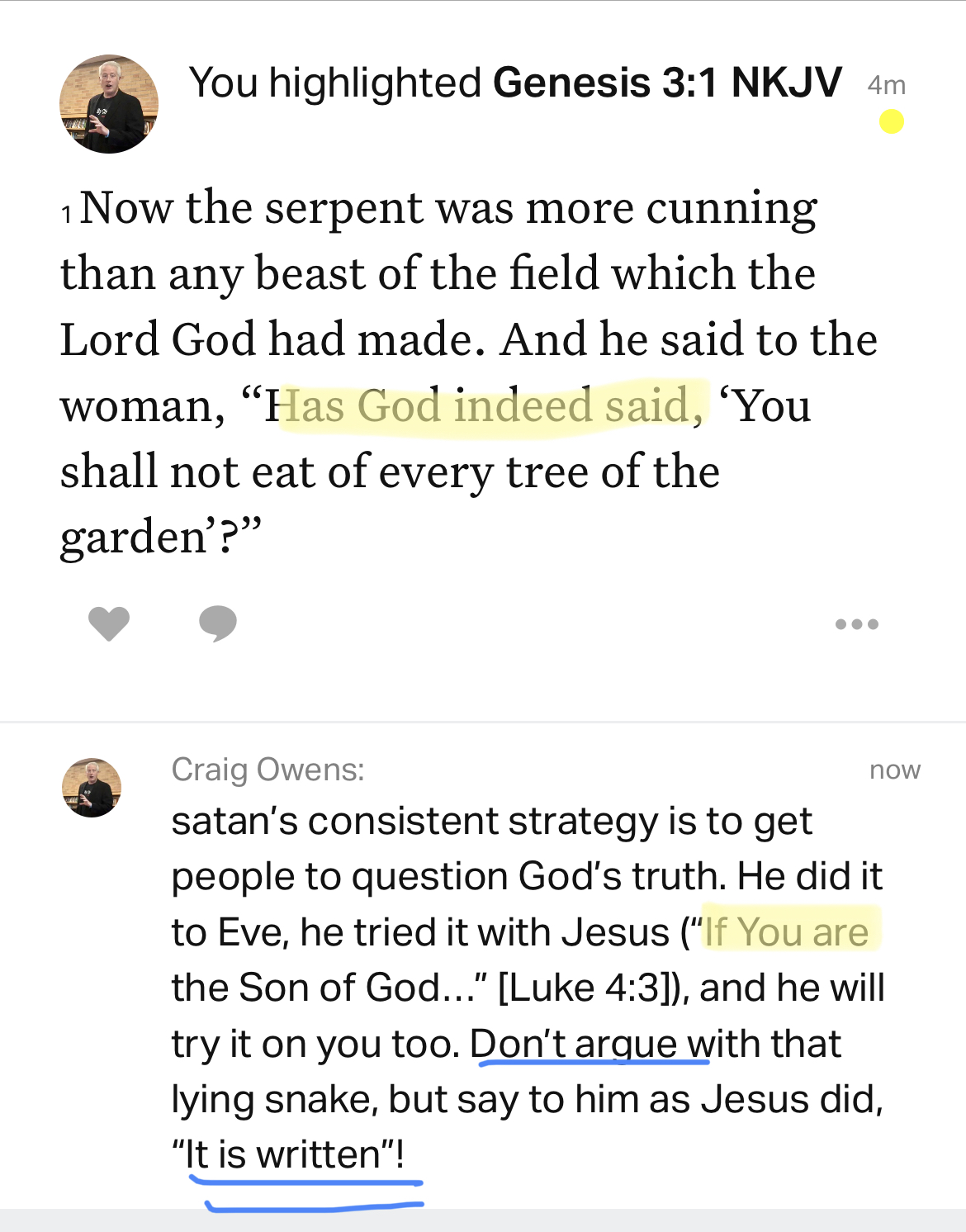
A consistent strategy of the devil is try to get us second-guessing or doubting God’s promises. He did this to Eve—“Did God really say that?”—and he tried it with Jesus—“Are You really the Son of God?”—and he’s still trying it today.
Jesus said the devil’s native tongue is lying. He lies and he slanders you. He wants you to simply listen to those lies without questioning them.
Someone once asked Smith Wigglesworth, “Smith, how do you feel?” He replied, “I never ask Smith how I feel. I tell him how he feels!”
That’s good counsel for us today!
Don’t listen to yourself, especially when you’re tired or lonely or anxious or scared, but talk to yourself. Remind yourself what God says to you and what He says about you. Remind those negative thoughts that God never lies, that He is all-loving, that He is all-powerful, and that He has a unique plan and purpose your life.
Whenever you feel like saying, “But I said,” change those thoughts around to, “But this is what God says!”
I’ve shared a couple of other posts that expand on this idea which you may want to read here and here.
Listen to the podcast of this post by clicking on the player below, and you can also subscribe on Apple, Spotify, or Audible.
The Lord is angry with all nations… (Isaiah 34:2).
Perhaps that verse surprises you in light of the title of this post, “Everlasting, Unshakable Joy,” but stick with me.
These phrases from Isaiah 34 do sound like terrible news:
God is angry with all nations
His wrath is on all their armies
God will totally destroy them
Even all the starry host will fall
God Himself says, “My sword has drunk its fill”
All the world’s princes will vanish away
But please keep in mind that this is only bad news for those who don’t have their sins forgiven through a personal relationship with Jesus Christ. “For the Lord has a day of vengeance, a year of retribution, to uphold Zion’s cause” (v. 8). And, “He will come with vengeance; with divine retribution He will come to save you” (35:4).
So God’s anger is not at those whose sins have been forgiven, but at those who are not only unforgiven but hell-bent on attacking those who are forgiven.
These words are intended to “strengthen feeble hands, steady the knees that give away,” and to bring strength “to those with fearful hearts” (35:3-4).
The righteous have nothing to fear when the world is quaking in fear! “They will enter Zion with singing; everlasting joy will crowned their heads. Gladness and joy will overtake them, and sorrow and sighing will flee away” (v. 10)!
This is why Jesus told us, “I tell you, My friends, do not be afraid of those who kill the body and after that can do no more” (Luke 12:4 NIV), and, “Save your fear for God, who holds your entire life—body and soul—in His hands” (Luke 12:5 MSG). And also the apostle Peter reminds us that we do not fear what the world fears (1 Peter 3:14).
If your sins are forgiven, if you are walking in God’s paths, if you are seeking to savor the glory of God, and desirous that His glory be seen on earth as it is in heaven, there is not only nothing to fear, but you will have an everlasting, unshakable joy!
Get your eyes off the world’s bad news, and keep your eyes firmly on the Good News that only Jesus has made a reality!
Listen to the podcast of this post by clicking on the player below, and you can also subscribe on Apple, Spotify, or Audible.
Our Advent series this year has been called “People Will Talk,” but we have one more person to learn from who says nothing. We have none of her words inside quotation marks, and yet Luke was inspired by the Holy Spirit to share her story with us. Her wordless message speaks volumes, if we’re willing to listen.
Anna, like Simeon, was one of the “Quiet in the Land.” Luke describes her as “very old.” The Greek phrase can either mean that she was a widow for 84 years after seven years of marriage, or simply that she was 84 years old. In either case, we don’t see her sitting withdrawn and inactive because of her old age, but we see her taking the initiative. She is the one who comes up to Joseph, Mary, and Jesus.
Luke also calls her a “prophetess.” Not someone bitter about her widowhood, but someone who truthfully and lovingly spoke God’s Words. Throughout the Bible, we see that a prophet or prophetess is less foretelling the future than they are forth-telling the promises of God. Of course the “-ess” at then end of “prophet” reminds us that Anna is a woman. As a woman she was excluded from certain parts of the temple, but instead of picketing or making a scene Luke says she spends her time worshipping, fasting, praying, and waiting for the fulfillment of God’s promised Messiah.
I imagine that her mere presence must have changed the atmosphere wherever she went!
I’m not sure if Charles Dickens had Anna in mind when he wrote A Christmas Carol, but the way the Ghost of Christmas Present added his blessing to busy people is what I imagine Anna’s role being in the temple—
“But soon the steeples called good people all, to church and chapel, and away they came, flocking through the streets in their best clothes, and with their gayest faces. And at the same time there emerged from scores of bye-streets, lanes, and nameless turnings, innumerable people, carrying their dinners to the bakers’ shops. The sight of these poor revelers appeared to interest the Spirit very much, for he stood with Scrooge beside him in a baker’s doorway, and taking off the covers as their bearers passed, sprinkled incense on their dinners from his torch. And it was a very uncommon kind of torch, for once or twice when there were angry words between some dinner-carriers who had jostled each other, he shed a few drops of water on them from it, and their good humor was restored directly. For they said, it was a shame to quarrel upon Christmas Day. And so it was! God love it, so it was!”
Both Anna in the New Testament and Hannah in the Old Testament mean graceful. Or as I like to remember that word: someone full of grace. When she approaches Joseph, Mary, and Jesus, Luke says she “gave thanks.” This comes from a unique Greek word in the New Testament. The root word is usually translated confession, which means saying the same words as others. But the prefix Luke adds means “in place of.” This means that Anna was speaking thankful words in place of the other words being spoken around her.
Anna spoke counter-culturally. Instead of being a cultural thermometer, she was serving as a thermostat to change the culture around her. This is the same kind of lifestyle that Jesus calls us to live. And it’s a lifestyle that Paul sums up in one succinct verse: “Let your gentleness [or we could say ‘grace-fullness’] be evident to all. The Lord is near” (Philippians 4:5).
After Ebenezer Scrooge’s encounter with the three spirits, his life was transformed—
“Scrooge was better than his word. He did it all, and infinitely more.… He became as good a friend, as good a master, and as good a man, as the good old city knew, or any other good old city, town, or borough, in the good old world.
“Some people laughed to see the alteration in him, but he let them laugh, and little heeded them; for he was wise enough to know that nothing ever happened on this globe, for good, at which some people did not have their fill of laughter in the outset; and knowing that such as these would be blind anyway, he thought it quite as well that they should wrinkle up their eyes in grins, as have the malady in less attractive forms. His own heart laughed: and that was quite enough for him.
“…And it was always said of him, that he knew how to keep Christmas well, if any man alive possessed the knowledge. May that be truly said of us, and all of us! And so, as Tiny Tim observed, God bless Us, Every One!”
As Christians, may both our actions and our reactions be so grace-filled, and may our gentleness be so evident to everyone all year long, and may we live so counter-culturally that people cannot help but see that we are grace-filled by the Spirit of Jesus Christ!
Listen to the podcast of this post by clicking on the player below, and you can also subscribe on Apple, Spotify, or Audible.
Christmas time finds me sampling a whole lot of delicious treats, and I’m not complaining at all! But I’m a pretty simple guy, so one of my favorite treats is just plain old peanut butter. I love it! Sometimes I stick my spoon right in the jar and eat a big spoonful.
But then there’s the age-old problem: How do you get peanut butter off the roof of your mouth? You can use your tongue or try blowing on it. Or you can use your finger!
But then there’s another problem: How do you get peanut butter off your finger? Blow it? Shake it? Or eat it!
Hmm, now I seem to be back to the original problem: How do you get peanut butter off the roof of your mouth?
Maybe you’ve tried to solve one problem, only to create another problem. And then when you solve that problem you find yourself right back where you started! Round and round it goes!
The Israelites were facing much the same situation. They sinned, God punished them through King Nebuchadnezzar, they tried to rebel, they were taken into captivity, and then they were finally allowed to return to Jerusalem after 70 years. But they still weren’t in charge of their own fate. First it was the Babylonians calling the shots, then the Medians, then the Persians, and then the Romans. Luke begins the birth story of Jesus with the words “in the days of Caesar Augustus” (Luke 2:1).
The Israelites were waiting for God to restore their Promised Land to them. Some people believed a miraculous champion was going to come on the scene (much like Samson of old), and some thought a new anointed king from King David’s line would appear and rally an army to himself.
We can understand this because of one of the prophecies from Isaiah 9 that talks about a warrior and God’s zeal.
That word “warrior” got people pumped up! As did the promise that “the zeal of the LORD Almighty will accomplish this”! For many, this was their proof that God wanted His people to rule this Promised Land for themselves
We’ve been going through a series called People Will Talk, and these voices of a miraculous champion or a new king from David’s line were loud voices to be sure. But interestingly, the Bible doesn’t record much of what these loud voices were saying.
Also among the people of this time there was another group that were called “the Quiet in the Land.” These were people who didn’t talk very much, but instead they clung to the promise spoken by God Himself of the Messiah. One of these quiet ones was a man named Simeon.
He was called “righteous and devout” and someone “waiting for the consolation of Israel.” Which meant he carefully attended to the prophecies of Scripture. The Amplified Bible says that Simeon “lived in prayerful expectancy [of] the Lord’s Christ.”
I left out an important part of that prophecy in Isaiah 9—something that I think the loud ones overlooked or downplayed too. In between those words about “warrior” and “God’s zeal” we read this: “For to us a Child is born, to us a Son is given. The government will be upon His shoulders. And He will be called Wonderful Counselor, Mighty God, Everlasting Father, Prince of Peace” (Isaiah 9:6).
What does the “Prince of Peace” have to do with a warrior? Quite simply, when Jesus the Messiah came, the struggle was over. Jesus was the Warrior King who defeated the enemy of sin that kept us out of God’s presence.
The loud Israelites believed God wanted His people to rule their Promised Land for themselves. But God wanted a people exclusively for Himself. ALL people—Jews and Gentiles alike—regardless of where or when they lived!
Jesus is the way into God’s presence. He told us, “I am the way, the truth, and the life” (John 14:6).
You can try to solve your own problems, but only Jesus can bring the ultimate salvation. In the Christmas carol Come, Thou Long-Expected Jesus, check out the lyrics of the second stanza:
Born Thy people to deliver,
Born a child and yet a King,
Born to reign in us for ever,
Now Thy gracious kingdom bring.
By Thine own eternal Spirit,
Rule in all our hearts alone;
By Thine all sufficient merit,
Raise us to Thy glorious throne.
A relationship with Jesus means there is no more struggle of trying to solve our own problems, or figure out how things are supposed to work, or pushing down one problem only to have another one pop up. We come to the One and Only One who can raise us to His glorious throne forever and ever!
Advent is a celebration of the end of our struggle because Jesus has made the way for us to have peace with God.
Listen to the podcast of this post by clicking on the player below, and you can also subscribe on Apple, Spotify, or Audible.
What people were saying about Jesus from His birth—before He preached a sermon, performed a miracle, or stepped on the toes of religious or political leaders—was revealing the truth. I’ve already discussed the words of the Magi and King Herod the Great, but all of these men also interact with another group (Matthew 2:1-6). Matthew calls them “all the people’s chief priests and teachers of the law.”
This group was commonly called the Sanhedrin. It was an influential body of 70 + 1 leaders (Numbers 11:16), whose influence was felt in the temple in Jerusalem, in the synagogues in small villages, in King Herod’s throne room, and in the palace of the Roman governors.
Notice that Matthew says “chief priests” in the plural. At the time of the birth of Jesus, Caiaphas was high priest and Annas his father-in-law was the former high priest. In the time of the early church, Annas is again called the high priest (Luke 3:2; John 18:13; Acts 4:6)
Even under the Roman government the Sanhedrin held tremendous power…
they were experts in the Mosaic law and its application (Matthew 22:35)
Jesus said, “the teachers of religious law and the Pharisees are the official interpreters of the law of Moses” (Matthew 23:2 NLT)
Jesus also said they had storehouses of helpful knowledge (Matthew 13:52)
they decided who would get to use their authority (Mark 11:27-28; 1:22)
they were keepers of the traditions and became “indignant” when those traditions weren’t followed (Mark 7:5; Matthew 21:15)
they were exorcists (Mark 9:14-17; Acts 19:13-14)
Jesus said these leaders would be instrumental in His death (Matthew 16:21)
they had their own armed guards and prisons (Mark 14:43; Acts 4:1; 5:18)
yet they were afraid of the opinions of the people (Luke 22:1-2; Mark 11:31-32)
Jesus said they were “the official interpreters of the law,” yet they oftentimes interpreted the law to benefit themselves.
When Herod asks them where the Messiah is to be born, they quote Micah 5:2 as saying, “a Ruler who will be the Shepherd of My people Israel.” But the word they use for “Ruler” means a leader with authority, or a governor (the same word is used for Joseph in Acts 7:10). Remember Herod’s violent temper and his insane suspicion? The word these religious leaders used gave them an “out.” They were almost saying to Herod, “When the Messiah does come, He will be a governor, which means there’s a good chance that He would report to you.” This “tame” interpretation was an attempt to keep them in the good graces of King Herod the Great
But Micah himself uses the word for “Ruler” that means one with absolute dominion. Jesus will be THE Sovereign King.
After hearing that this long awaited Messiah had finally been born in fulfillment of the prophecies, take a look at their response—
they said .
they did . (even though Bethlehem was only 6 miles away!)
How sad!
But I think this is because they believed themselves to be “in” with Jehovah because they so carefully kept the rules. They didn’t need a Messiah to save them because—in their minds—they believed they were already saved from God’s punishment.
Keeping religious rules doesn’t save anyone.
Honoring age-old traditions doesn’t save anyone.
Only coming to Jesus saves anyone!
A key prophecy about Jesus in Isaiah 9:2 says that the Messiah will save us from darkness and shadows. What exactly are these?
The writer of Hebrews tells us that the law and rules are merely shadows of the True Substance. God said through Isaiah that relying on the rules keeps us trapped in meaningless religious traditions. But Jesus came as the Light and as the Substance that set us free. His death and resurrection made it possible for our sins to be forgiven (see Hebrews 10:1-7; Isaiah 1:11-14, 18).
Rules don’t take us into God’s presence, but Jesus does. Not just talking about Jesus, but coming to Jesus as our Savior and Lord.
People will talk about Jesus—even you may talk about Him. That doesn’t do anything. But when we do more than talk—when we come to Him to follow Him as our Ruler and Shepherd—then we find forgiveness and freedom.
Let’s not just talk about Jesus, but let’s be actively obedient!
When Faith Frodsham was teaching at the Peniel Bible Institute, she wrote home to tell her father Stanley about her frustration over the small size of her class. She wondered if she was really being successful with such a small class.
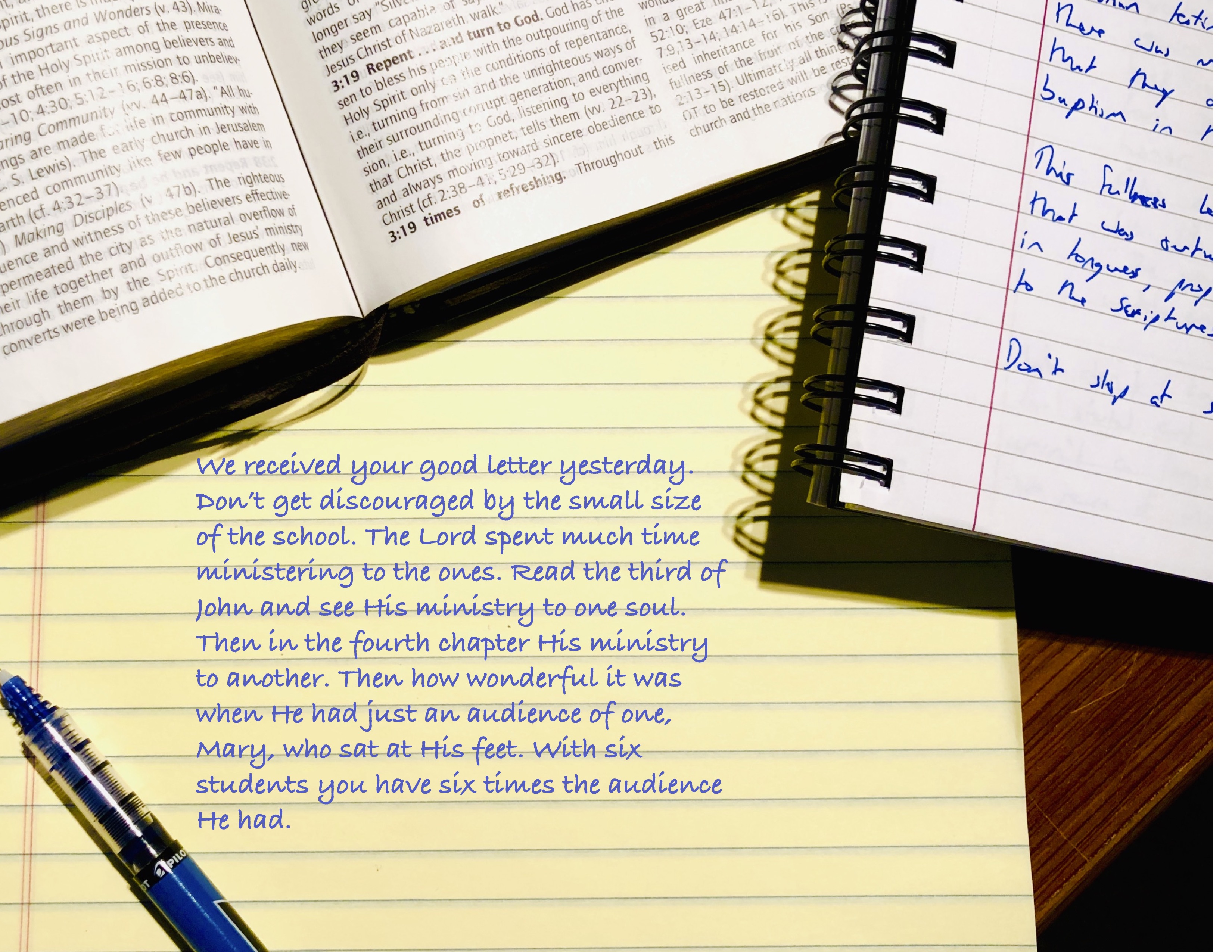
“We received your good letter yesterday. Don’t get discouraged by the small size of the school. The Lord spent much time ministering to the ones. Read the third of John and see His ministry to one soul. Then in the fourth chapter His ministry to another. Then how wonderful it was when He had just an audience of one, Mary, who sat at His feet. With six students you have six times the audience He had.”
Success is not about big numbers, but about quality time invested faithfully and for God’s glory.
I wrote my book Shepherd Leadership: The Metrics That Really Matterto address this misconception which discourages so many pastors and other ministry leaders. If you are involved in ministry, I truly believe this book will give you a new encouraging perspective.
But let’s look at this from another angle: Before there was an Old Testament and a New Testament, what did those who lived in the days of Jesus call what we now refer to as “the Old Testament”? They called it Scripture.
Here’s a clip from a recent sermon where I discuss more in-depth why our New Testament is really the best commentary we have on the Old Testament:
I invite you to check out a couple of other resources:



 And they were not able to resist the wisdom and the Spirit by which [Stephen] spoke. (Acts 6:10)










The Best Commentary On The Old Testament
December 8, 2021 — Craig T. OwensListen to the podcast of this post by clicking on the player below, and you can also subscribe on Apple, Spotify, or Audible.
But let’s look at this from another angle: Before there was an Old Testament and a New Testament, what did those who lived in the days of Jesus call what we now refer to as “the Old Testament”? They called it Scripture.
Here’s a clip from a recent sermon where I discuss more in-depth why our New Testament is really the best commentary we have on the Old Testament:
I invite you to check out a couple of other resources:
►► Would you please prayerfully consider supporting this ministry? ◀︎◀︎
Share this: