Listen to the podcast of this post by clicking on the player below, and you can also subscribe on Apple, Spotify, or Audible.
“Woe is me!” said the prophet (Isaiah 6:5).
The Hebrew word for “woe” here is the word “oy!” Although the word “woe” appears 20 times in the English translation of Isaiah, the Hebrew word “oy” is only used four times, and two of those times are Isaiah speaking of himself (6:5; 24:16). “Oy!” is a cry from a profound stab of pain from the realization that my sin has transgressed an All-Holy God.
Isaiah saw his own sin (6:5) as well a the sin of his people (3:9, 11), and it took his breath away. He stood trembling before a holy God pleading for mercy and cleansing before he could answer the call to be God’s messenger to the people of Israel (6:5-8).
The other Hebrew word that gets translated into the English word “woe” is “howy.” This is usually uttered from someone in pain because things aren’t going well. It’s a cry of, “Hey! Look! This is painful. This is not good at all.” But unlike “oy” which requires a profound heart change, “howy” can be said with the mouth without any change of the heart.
Isaiah cried, “Oy!” because his sin deserved the punishment of the Righteous Judge, but his heart posture called on God’s mercy for forgiveness and restoration. Because of his cleansed heart, Isaiah could now call, “Howy!” to the people: “Hey, sinful Israel, look at your sin. Look at how you’ve transgressed against God. Feel that pain, then don’t delay, but cry out ‘Oy!’ to Him now, while mercy may still be found.”
Isaiah’s “howy” had the impact of godly integrity because he had first cried “oy” in God’s presence. His “howy” was a call to others to do what he had done: see the holiness of God, see their sin, tremble in fear before an All-Holy God, and then cry “oy” to an All-Merciful God for forgiveness and restoration.
We should do the same thing. When the Holy Spirit convicts you of sin, don’t merely say, “Hey (howy), that hurts!” But say, “Oy! I have sinned, but God is a merciful Forgiver of sin.” Let that stab of pain from the conviction of your sin bring a change in your heart as well as a cry from your lips. God is merciful, and He does forgive.
This is a weekly series with things I’m reading and pondering from Charles Spurgeon. You can read the original seed thought here, or type “Thursdays With Spurgeon” in the search box to read more entries.
Listen to the podcast of this post by clicking on the player below, and you can also subscribe on iTunes or Spotify.
Always Follow The Example Of Jesus
The heathen moralists, when they wished to teach virtue, could not point to the example of their gods, for, according to their mythologists, the gods were a compound of every imaginable and, I had almost said, unimaginable vice! Many of the classic deities surpassed the worst of men in their crimes—they were as much greater in iniquity as they were supposed to be superior in power. It is an ill day for a people when their gods are worse than themselves! The blessed purity of our holy faith is conspicuous, not only in its precepts, but in the character of the God whom it reveals. There is no excellence that we can propose, but we can see it brightly shining in the Lord our God! There is no line of conduct in which a believer should excel, but we can point to Christ Jesus our Lord and Master as the pattern of it! In the highest places of the Christian faith, you have the highest virtue, and to God our Father and the Lord Jesus be the highest praise.
From Forgiveness Made Easy
If you’ve ever studied ancient mythologies, the gods and goddesses of those stories did not live a life worthy of emulation! But Jesus is an entirely different story. Even people who don’t want to acknowledge the deity of Jesus still find His lifestyle worthy of following.
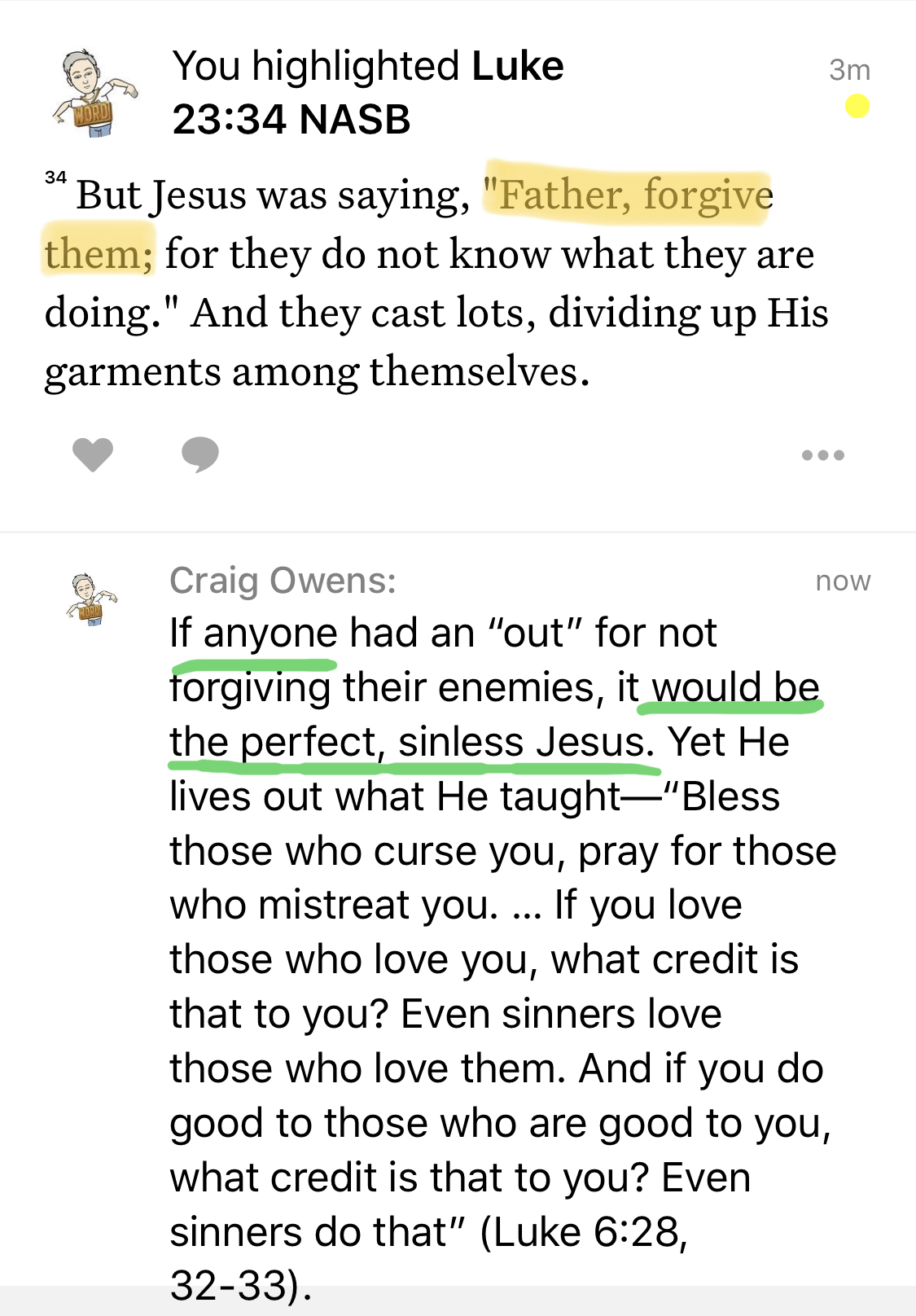
So not only did Jesus say, “Bless those who curse you, pray for those who mistreat you,” but He lived it out. “When they hurled their insults at Him, He did not retaliate; when He suffered, He made no threats. Instead, He entrusted Himself to Him who judges justly,” and said, “Father, forgive them, for they do not know what they are doing.” (See Luke 6:28; 1 Peter 2:21-23; Luke 23:34).
Don’t say, “That person really injured me. It was unfair! I cannot forgive them.” Instead, follow the example of Jesus, the only one who ever lived an absolutely perfect life and yet He was still shamefully mistreated. Peter reminds us that by forgiving His tormenters, Jesus was entrusting Himself to the Perfect Judge—He trusted God to take care of it.
It may seem impossible, but the same Holy Spirit that empowered Jesus to do these things is living in you and He will empower you too. Always, always, always follow the example of Jesus.
This is a weekly series with things I’m reading and pondering from Charles Spurgeon. You can read the original seed thought here, or type “Thursdays With Spurgeon” in the search box to read more entries.
Listen to the podcast of this post by clicking on the player below, and you can also subscribe on iTunes or Spotify.
Holy Familiarity
All these thirteen years, so far as Scripture informs us, Abram had not a single visit from his God. We do not find any record of his either doing anything memorable or having so much as a single audience with the Most High. Learn from this that if we once forsake the track of simple faith, once cease to walk according to the purity that faith approves, we strew our path with thorns, cause God to withhold the light of His countenance from us, and pierce ourselves through with many sorrows.
But mark, beloved, the exceeding grace of God: The way to recover Abram from his backsliding was that the Lord should appear to him…. This brings to my remembrance the words in the book of Revelation concerning the church in Laodicea: ‘You are neither cold nor hot. I could wish you were cold or hot. So then, because you are lukewarm, and neither cold nor hot, I will vomit you out of My mouth’ (Revelation 3:15-16)—a very solemn declaration. But what follows? ‘Behold, I stand at the door and knock. If anyone hears My voice and opens the door, I will come in to him and dine with him, and he with Me’ (Revelation 3:20). That means just this: For recovery out of a horrible state of languishing and lukewarmness there is no remedy but the coming of Jesus Christ to the soul in near and dear communion! …
Distance from God’s presence always means sin. Holy familiarity with God engenders holiness. The more you think of God, the more you meditate on His works, the more you praise Him, the more you pray to Him, the more constantly you talk with Him and He with you by the Holy Spirit, the more surely are you on the road to thorough consecration to His cause!
From Consecration To God
I’ve often said that one of the most powerful prayers we can pray is simply, “God, help!” In those two words we acknowledge our helplessness and His omnipotence, our sin and His forgiveness, our shortcomings and His desire to restore us.
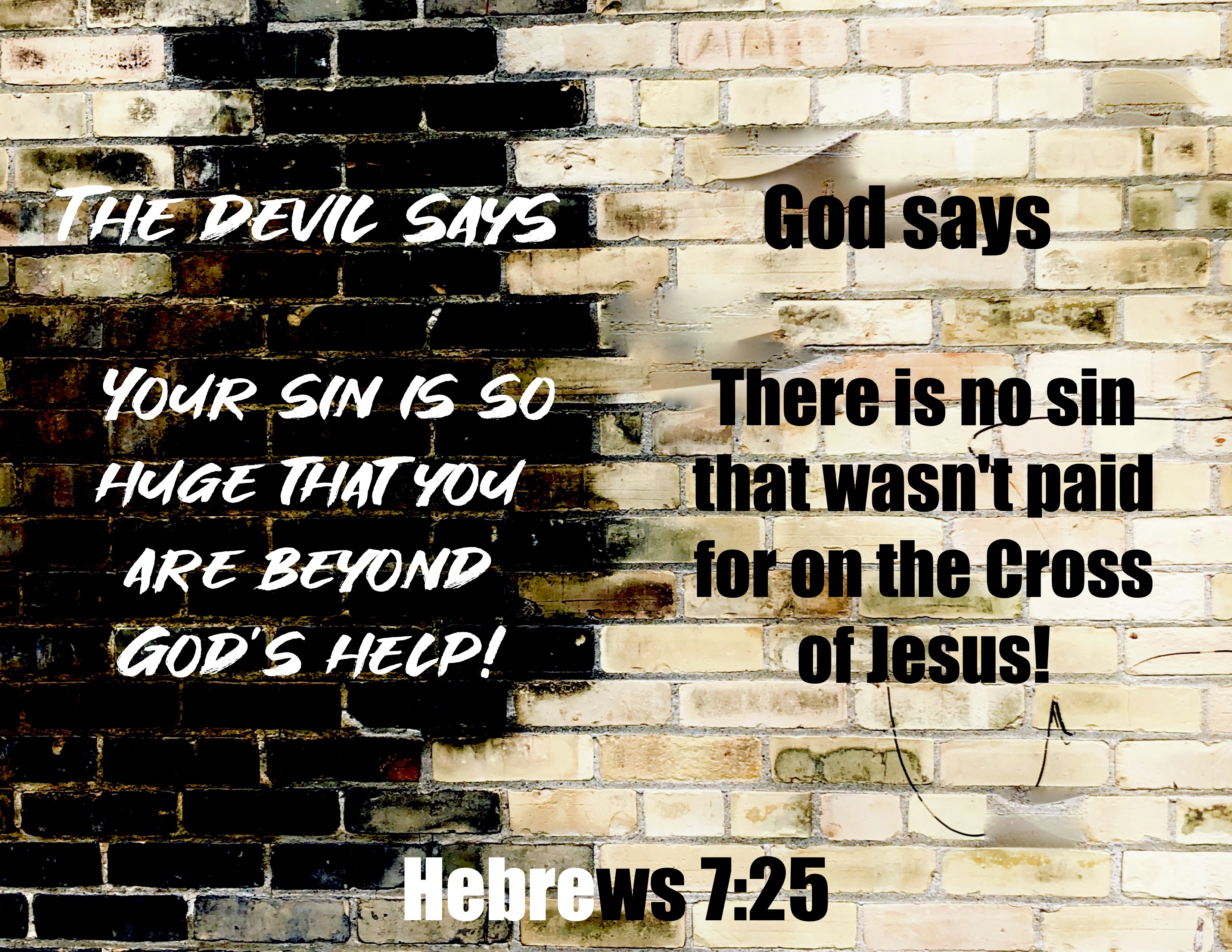
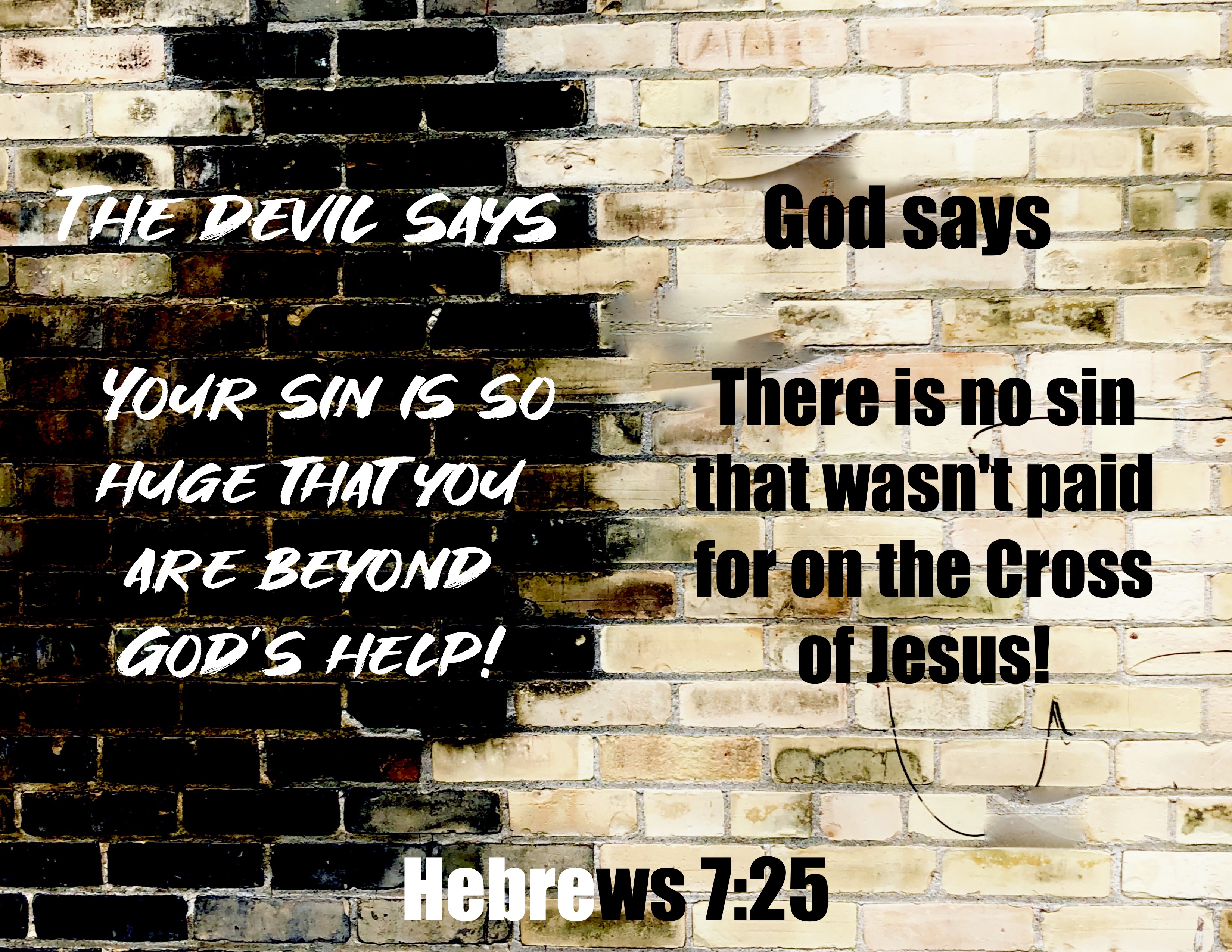
The devil lies! He loves to whisper the condemning words of, “You’ve messed up one too many times. You’re too far away for God to rescue you now. This time you exhausted God’s mercy.”
Once again, by simply crying out, “God, help!” you are calling out satan’s lies. Jesus paid too high of a price for Him to ever let you go. Near the end of this sermon, Charles Spurgeon spoke a powerful reminder: “The blessings of grace are not given today to be taken back tomorrow, but are eternal blessings [Genesis 17:7, 13, 19].” Amen!
My friend, cry out to God today—He loves you and He’s longing to restore you!
Listen to the podcast of this post by clicking on the player below, and you can also subscribe on Apple, Spotify, or Audible.
My cousin Dick Brogden wrote in his book Missionary God, Missionary Bible, “Since good news must often indeed rectify bad news, the gospel message is both warning and invitation.” This is so appropriate when reading the prophet Zephaniah: He wanted to share some really, really good news, but first, he must make us confront the really bad news.
Zephaniah prophesied near the end of Judah’s decline toward exile. He saw the great revival in King Josiah’s day, and then watched his fellow Israelites once again turn their backs on God. If Jeremiah spoke to faithless Israelites, and Habakkuk spoke to faithful Israelites, then Zephaniah spoke to fake Israelites—those who appeared to be religious, but whose hearts were not actually devoted to God.
This whole book looks backward in history and forward to soon-to-be-fulfilled prophecy. Most of the time when God speaks, He is asking us to look forward to what is unavoidably coming. Zephaniah then takes God’s words as a call for us to apply them to our lives today.
In the first chapter, God’s forward-look is a warning of the judgment that most assuredly is coming. Built into His warning are two backward looks to the law of Deuteronomy (vv. 13 and 15 look back to Deuteronomy 28:29-30).
Zephaniah uses this warning as a wake-up call for us, telling us to “seek the Lord” and “seek righteousness, seek humility” before the day of God’s judgment comes (2:1-3).
The fact that God’s judgment would fall on godless people shouldn’t surprise anyone (2:4-15), but when Zephaniah says, “Woe to the city of oppressors” (3:1), he’s talking to the people of Judah! Zephaniah addresses his warning to the fake Israelites, the hypocritical people—those claiming God’s name but not God’s nature.
The apostle Paul sounds a similar warning to New Testament Christians:
Now these things occurred as examples to keep us from setting our hearts on evil things as they did. Do not be idolaters, as some of them were; as it is written: ‘The people sat down to eat and drink and got up to indulge in revelry.’ We should not commit sexual immorality, as some of them did—and in one day twenty-three thousand of them died. We should not test Christ,as some of them did—and were killed by snakes. And do not grumble, as some of them did—and were killed by the destroying angel. These things happened to them as examples and were written down as warnings for us, on whom the culmination of the ages has come. So, if you think you are standing firm, be careful that you don’t fall! (1 Corinthians 10:6-14)
The really bad news is ALL of us have sinned and we have ALL fallen short of God’s righteous standard. As a result, ALL of us would stand guilty before God on Judgment Day.
But the really, really good news is that Jesus allowed our penalty to fall on Him instead! So if we put our faith in Jesus, God’s judgment will be appeased in Christ instead of on us!
Christians, then, take the name of Jesus Christ, but we need to make sure we also take His nature.Fake—hypocritical—Christians are those who are “Christian” in name only.
I like the way Eugene Peterson paraphrased part of the 1 Corinthians passage above—These are all warning markers—danger!—in our history books, written down so that we don’t repeat their mistakes. Our positions in the story are parallel—they at the beginning, we at the end—and we are just as capable of messing it up as they were. Don’t be so naive and self-confident. You’re not exempt. You could fall flat on your face as easily as anyone else. Forget about self-confidence; it’s useless. Cultivate God-confidence. (The Message)
As we read those words, “So if you think you are standing firm, be careful that you don’t fall,” I’d like to suggest four action steps:
Hear the Word of God to YOU—not your neighbor—but you personally.
After you hear the Word, examine yourself to see if you are truly living in God’s nature and not just using His name.
Respond like King Josiah did when he heard God’s Word: He made a public commitment “to follow the Lord and keep His commands, statutes and decrees with ALL his heart and ALL his soul” (2 Kings 23:3).
Stay diligent—Hebrews 2:1 tells us, “We must pay the most careful attention, therefore, to what we have heard, so that we do not drift away.”
Don’t delay—the Day of the Lord is closer today than it’s ever been before! Pay attention to the really bad news that Judgment Day is coming, but then make certain you are standing in the nature of Jesus Christ on that day so that God’s judgment will pass over you.
Listen to the podcast of this post by clicking on the player below, and you can also subscribe on Apple or Spotify.
You who answer prayer … You answer us with awesome and righteous deeds, God our Savior…. Shout for joy to God, all the earth! (Psalm 65:2, 5; 66:1).
Psalms 65 and 66 tell of God’s awesome involvement in our lives. He is both globally involved and personally involved. He’s not too big to care for my needs, and He’s not so preoccupied with me that He is unaware of global events.
Look at the grandeur of our Creator—
You answer us with awesome deeds of righteousness
You are the hope of all the ends of the earth
You formed the mountains by Your power
You stilled the roaring of the seas
You care for the land and water it; You enrich it abundantly
Your carts overflow with abundance
all of creation shouts for joy and sings praise to You
all the earth says, “How awesome are Your deeds!” and bows down to You in praise
You rule forever by Your power, Your eyes watch the nations
how awesome are Your works on man’s behalf!
And yet He is not just God of global events, but He is intimately involved with each and every person. He notices me!
The psalmist says, “Come and listen, all you who fear God; let me tell you what He has done for me.” Then he tells how God…
forgave my sin
listened to my prayer
honored my prayer
has not withheld His love from me
Oh, come and see! See how awesome God is that the earth trembles before Him. See how awesomely loving He is that He stoops to listen to me. He is indeed a global God but He is also an intimately personal God.
The more we know our God in both His majesty and His intimacy, the more we will praise Him.
This is a weekly series with things I’m reading and pondering from Charles Spurgeon. You can read the original seed thought here, or type “Thursdays With Spurgeon” in the search box to read more entries.
Listen to the podcast of this post by clicking on the player below, and you can also subscribe on iTunes or Spotify.
Never Give Up On Grace And Mercy
Therefore He is also able to save to the uttermost those who come to God through Him, since He always lives to make intercession for them. (Hebrews 7:25)
My friends, it is one thing to go to church or chapel. It is quite another thing to go to God. …
Coming to God is not what some of you suppose, that is, now and then sincerely performing an act of devotion but giving to the world the greater part of your life. You think that if sometimes you are sincere, if now and then you put up an earnest cry to heaven, God will accept you. And though your life may be still worldly and your desires still carnal, you suppose that for the sake of this occasional devotion God will be pleased, in His infinite mercy, to blot out your sins. I tell you, sinners, there is no such thing as bringing half of yourselves to God and leaving the other half away. …
If I should see a sinner staggering on his progress to hell, I would not give him up, even when he had advanced to the last stage of iniquity. Though his foot hung trembling over the very edge of perdition, I would not cease to pray for him. And though he should in his poor drunken wickedness go staggering on till one foot was over hell and he was ready to perish, I would not despair of him. Till the pit had shut its mouth upon him I would believe it is possible that divine grace might save him. See there! He is just upon the edge of the pit, ready to fall. But before he falls, free grace bids, ‘Stop that man!’ Down mercy comes, catches him on her broad wings, and he is saved—a trophy of redeeming love.
From Salvation To The Uttermost
My friend, if you don’t have a personal relationship with God through the forgiving work that Jesus accomplished on the Cross, I implore you to come to Him before another minute passes. When Jesus said from this Cross, “It is finished,” He told you that He paid in full your debt that would have kept you separated from God forever.
Now you just need to come to Him in faith. Simply pray something like this: “God, I acknowledge that I am a sinner separated from You. But I believe that Jesus paid the penalty for all of my sins when He died on the Cross. Because of that payment, I am asking You to forgive me and bring me into a full relationship with You. I pray this in the name of Jesus. Amen.”
And let me speak to you, my Christian brother or sister who has been praying earnestly for the salvation of someone dear to you. Let me encourage you to not give up! God’s mercy and God’s grace are so swift that even with the last breath they can swoop in to save. Never cease to pray for them and know that Jesus is interceding for them before God’s throne too!
Listen to the podcast of this post by clicking on the player below, and you can also subscribe on Apple or Spotify.
Just before Jesus said, “I am thirsty,” John tells us that Jesus knew everything written about Him in the law had been completed and all of the prophecies about Him had been fulfilled. Jesus knew this to be true but no one else standing there would have said “Aha!” because of that statement. But Jesus left no doubt for any of us when He next said, “It is finished!”
These three English words are just one word in Greek: tetelestai. It’s in the perfect tense, telling us that nothing more needs to be added to Christ’s work. It not only shares the same root word that John uses for completed and fulfilled, but it closes the circle of another dying declaration of Jesus when He quoted Psalm 22:1: “My God, My God, why have You forsaken Me?” His “It is finished” statement is also the last verse of Psalm 22.
The root word telos translated as completed, fulfilled, and finished has a very rich meaning. Here are three definitions we should consider:
(1) To complete or bring to a conclusion
Jesus told His Father that He had finished (telos) His mission (John 17:4). Q: How do we know His mission was completed? A: Jesus sat down! Think about this: There were no chairs in the Old Testament temple because a priest never rested, there was always more work to do. But when Jesus finished His work, He sat down (see Hebrews 10:1-4, 11-12).
(2) To discharge a debt
Since Jesus was the only One who could make the final “once for all” payment, that means that we were hopeless debtors prior to that. God foretold of His forgiveness using the picturesque language of a debt being “doubled up” when it was paid in full (see this video where I explain this concept more fully). Here’s what Jesus did:
Having cancelled and blotted out and wiped away the handwriting of the note with its legal decrees and demands which was in force and stood against us. This note with its regulations, decrees, and demands He set aside and cleared completely out of our way by nailing it to His cross. (Colossians 2:14 AMP)
In this case, Jesus took what was missing by switching cups with us. He drank the cup of God’s righteous wrath—which was justly ours—and gave us His cup of righteousness in its place! (see Isaiah 51:17-22; Matthew 26:39).
Q: How do we know we have a cup of righteousness in place of a cup of wrath? A: Dead saints of God were resurrected when Jesus died. “It is finished” was not Jesus giving up, but death giving up … it was not Jesus defeated, but death defeated!
Jesus paid it all! There is nothing I can do to add to His completed—tetelestai—work, so I can now do what formerly was impossible: I can live a holy life for God’s glory. I can now finish (telos) my race on earth and receive the rewards God has stored up for me (see 2 Timothy 4:7-8).
Christ’s tetelestai confession is our empowerment to live holy!



 “Woe is me!” said the prophet (Isaiah 6:5).