Listen to the podcast of this post by clicking on the player below, and you can also subscribe on Apple, Spotify, or Audible.
Have you ever seen kids tearing into a Christmas present and then being disappointed that what they got wasn’t what they wanted? They may say something like, “This isn’t what I put on my wish list!”
From the response of the religious leaders in the Gospels, it appears that the gift of Jesus on that original “Christmas morning” was very similar. It’s almost like they were saying, “This isn’t the type of Messiah we wanted!” They wanted someone to give them freedom from the Romans, but their Heavenly Father wanted them to have something far bigger and greater: Eternal freedom from the penalty of sin.
The first humans had the joy of being innocent in God’s presence, where they had everything they needed. But satan got Adam and Eve to focus on something they wanted, and thatsin of disobedience brought an immediate separation. They now feared the nearness of God.
There were immediate and painful consequences for their sin, but God wanted the heaviest of penalties to fall on Himself. To foreshadow this, God sacrificed an innocent animal to cover their nakedness, showing us what the gift of Jesus would do for us (Genesis 3:1-21).
In The Holy War, John Bunyan tells the story of the town of Mansoul enslaved to Diabolus. The crafty serpent plays on their fears by reminding them how terrible it would be if they allowed Holy God to come near them while they were in their sinful state:
“‘Gentlemen,’ quoth he, ‘and my faithful subjects, if it is true that this summoner hath said concerning the greatness of their King, by His terror you will always be kept in bondage, and so be made to sneak. Yea, how can you now, though He is at a distance, endure to think of such a Mighty One? And if not to think of Him while at a distance, how can you endure to be in His presence?’”
Diabolus even tried to make their slavery to sin look like freedom: “I, your prince, am familiar with you, and you may play with me as you would with a grasshopper. Consider, therefore, what is for your profit, and remember the immunities that I have granted you.’”
As John Piper reminds us, “Christmas is for freedom.” Indeed, that’s just what we see on the first “Christmas morning” in words like salvation, no fear, and great joy (Matthew 1:21; Luke 2:10-11).
Turning again to The Holy War, here’s what the Father said to His Son: “Wherefore the King called to Him Emmanuel, His Son, who said, ‘Here am I, My Father.’ Then said the King, ‘Thou knowest, as I do Myself, the condition of the town of Mansoul, and what We have purposed, and what Thou hast done to redeem it. Come now, therefore, My Son, and prepare Thyself.’”
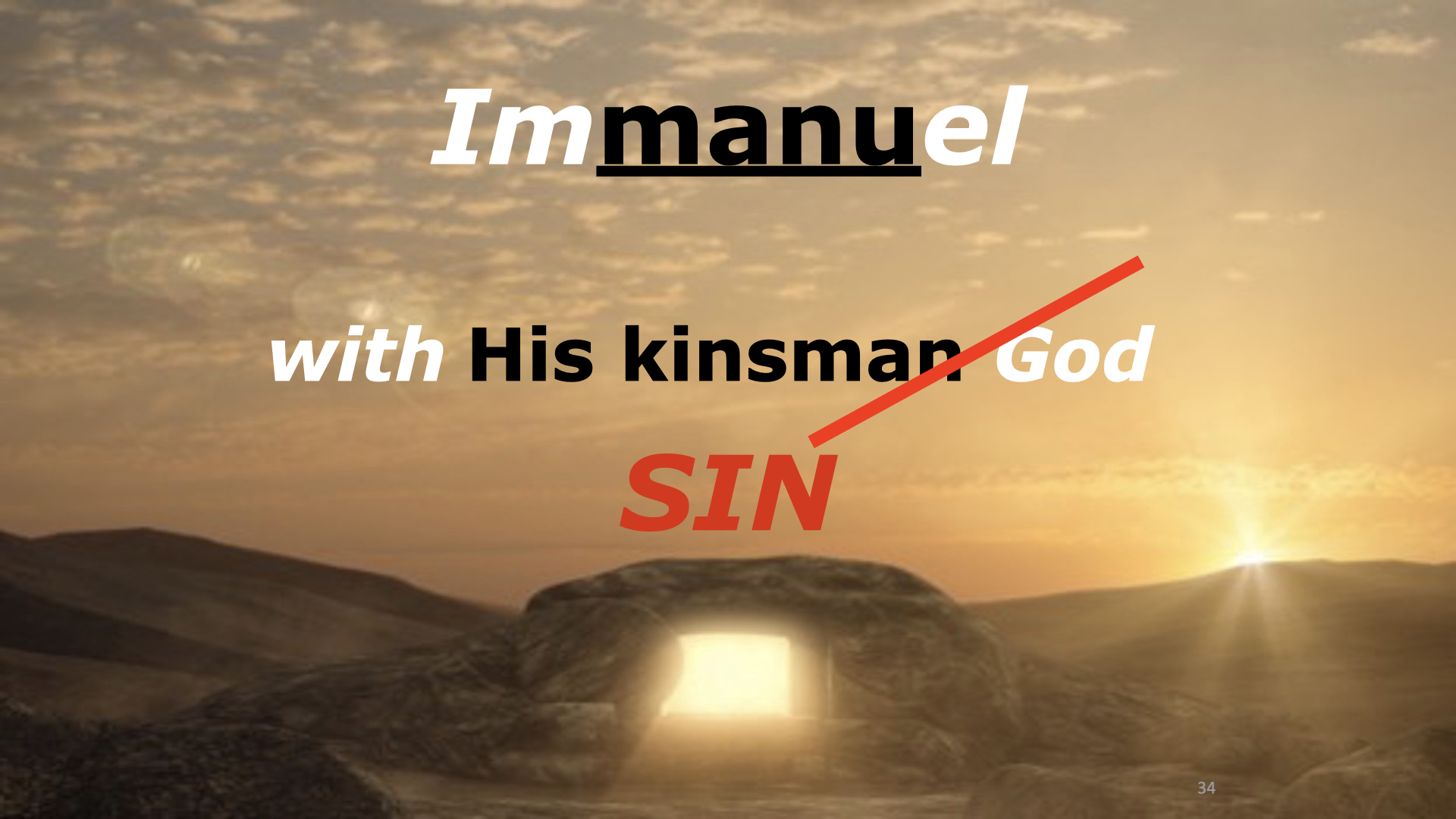
Immanuel (or the Romanized spelling Emmanuel) is the One who removes the separation caused by our sin, and rejoins us to God. That prefix “im” means with, and the suffix “El” means God. The root word means God’s kinsmen. Immanuel comes to repair what was severed by taking sin’s penalty on Himself, and allowing us to once again enjoy the closeness of kinship with our Heavenly Father (Matthew 1:22-23; Galatians 4:4-7).
When the people saw this Gift on Christmas morning, they said, “This isn’t what we wanted! We wanted a rich, powerful, conquering King. One who would send the Romans running in fear!” As a result, very few unwrapped this Heavenly Gift. But God reminded them, “That may be what you wanted, but I have given what you need. I want you to have not just temporary freedom from the Romans, but eternal freedom from your sin so that you can be forever in My presence!”
This is what Jesus rejoiced to do for us with the Gift of His life, death, and resurrection. One more passage from The Holy War tells us, “Then said the King’s Son, ‘Thy law is within My heart: I delight to do Thy will. This is the day that I have longed for, and the work that I have waited for all this while. … I will go and will deliver from Diabolus, and from his power, Thy perishing town of Mansoul. My heart has been often pained within Me for the miserable town of Mansoul; but now it is rejoiced, but now it is glad.’” (The timing for the Incarnation of Jesus and even these words of Immanuel Himself are found in Hebrews 2:14-15; 10:5-7).
God’s love is too great to be limited to just meeting our wants because in our immaturity and sinfulness we don’t know what we really need—but He does. So His love sent Immanuel to us.
The Gift was given to us at Christmas, but in our immaturity and shortsightedness, we didn’t realize the full impact of this Gift until Jesus rose victoriously from the grave! Now by placing our faith in His completed work, we can be rejoined to God and live in unshakable hope of an eternity with Him!
Listen to the podcast of this post by clicking on the player below, and you can also subscribe on Apple, Spotify, or Audible.
There’s a little song that makes me chuckle every time I hear it, and I may have even sung this song a couple of times myself. It goes like this, “I had a lot to do today, but you know what I did instead? I took a nap. It was a very good nap.”
We’ve all been there. There are things we know that we should do, but we simply don’t feel like doing them. We let our feelings drive our actions. There are several seemingly innocent things that we can handle this way, with no apparent problems created for ourselves.
The real problem comes in when our feelings continually drive our actions. Because the caboose which must follow that engine can easily become “my truth.” It goes like this:
I let my feelings take the lead
I act on my feelings
I now believe what I felt was truthful
This could be called pragmatism—allowing a positive outcome to determine what I believe to be truth.
But our feelings may lie to us. Our feelings can make us believe something is harmless, when in fact it may be putting us on a path from which it may be extremely difficult to recover.
Jesus taught us a different way. He prayed this way to His Father, “Your Word is truth” (John 17:17). He may have had in mind these words from the psalmist:
The sum of Your word is truth—the total of the full meaning of all Your individual precepts; and every one of Your righteous decrees endures forever. (Psalm 119:160 AMP)
When we let truth drive our actions, we are performing those actions in faith that good feelings will follow. Now the progression goes like this:
I let what I know to be true take the lead
I act on that truth
I feel good for doing the right thing
I may not feel like exercising, but I know it’s good for me. So I do it and then I feel good for doing it, and my body is healthier for doing it.
I may not feel like forgiving the one who wronged me, but I know God says I should. So I do it and then I feel good for doing it, and my emotions are healthier for doing it.
I may not feel like speaking the tough word in love to my friend, but I know the Bible says I should. So I do it and then I feel good for doing it, and my relationship is healthier for doing it.
Letting God’s truth be the engine that drives our actions will result in healthiness and good feelings. But letting my emotions be the engine that drives my actions may sometimes result in temporary good feelings, but the longterm consequences may not be healthy or God-honoring.
We should not say, “God, please bless what I’m doing so that I can feel good about it,” but instead we should say, “God please help me to do what You say is right, and I know I will feel good because Your blessing will be on it.”
Listen to the podcast of this post by clicking on the player below, and you can also subscribe on Apple, Spotify, or Audible.
The Lord is angry with all nations… (Isaiah 34:2).
Perhaps that verse surprises you in light of the title of this post, “Everlasting, Unshakable Joy,” but stick with me.
These phrases from Isaiah 34 do sound like terrible news:
God is angry with all nations
His wrath is on all their armies
God will totally destroy them
Even all the starry host will fall
God Himself says, “My sword has drunk its fill”
All the world’s princes will vanish away
But please keep in mind that this is only bad news for those who don’t have their sins forgiven through a personal relationship with Jesus Christ. “For the Lord has a day of vengeance, a year of retribution, to uphold Zion’s cause” (v. 8). And, “He will come with vengeance; with divine retribution He will come to save you” (35:4).
So God’s anger is not at those whose sins have been forgiven, but at those who are not only unforgiven but hell-bent on attacking those who are forgiven.
These words are intended to “strengthen feeble hands, steady the knees that give away,” and to bring strength “to those with fearful hearts” (35:3-4).
The righteous have nothing to fear when the world is quaking in fear! “They will enter Zion with singing; everlasting joy will crowned their heads. Gladness and joy will overtake them, and sorrow and sighing will flee away” (v. 10)!
This is why Jesus told us, “I tell you, My friends, do not be afraid of those who kill the body and after that can do no more” (Luke 12:4 NIV), and, “Save your fear for God, who holds your entire life—body and soul—in His hands” (Luke 12:5 MSG). And also the apostle Peter reminds us that we do not fear what the world fears (1 Peter 3:14).
If your sins are forgiven, if you are walking in God’s paths, if you are seeking to savor the glory of God, and desirous that His glory be seen on earth as it is in heaven, there is not only nothing to fear, but you will have an everlasting, unshakable joy!
Get your eyes off the world’s bad news, and keep your eyes firmly on the Good News that only Jesus has made a reality!
This is a weekly series with things I’m reading and pondering from Charles Spurgeon. You can read the original seed thought here, or type “Thursdays With Spurgeon” in the search box to read more entries.
Listen to the podcast of this post by clicking on the player below, and you can also subscribe on Apple, Spotify, or Audible.
The Death Of The Christian
You shall come to the grave at full age, as a sheaf of grain ripens in its season. (Job 5:26)
Let me tell you a parable. Behold, two men sat together in the same house when Death came to each of them. He said to one, ‘You will die.’
That man looked at him. Tears suffused his eyes, and tremblingly he said, ‘O Death, I cannot! I will not die.’ He sought out a physician and said to him, ‘I am sick, for death has looked upon me. His eyes have paled my cheeks, and I fear I must depart. Physician, there is my wealth. Give me health and let me live.’ The physician took his wealth but gave him not his health with all his skill. The man changed his physician, tried another, and thought that perhaps he might spin out the thread of life a little longer.
But alas! Death came and said, ‘I have given you time to try your varied excuses. Come with me. You will die.’ And he bound him hand and foot and made him go to that dark land of Hades. As the man went, he clutched at every side post by the way, but Death, with iron hands, still pulled him on. … He did not come to his grave, but death fetched him to it; the grave came to him.
But death said to the other man, ‘I am come for you.’
He smilingly replied, ‘Ah, Death! I know you; I have seen you many a time. I have held communion with you. You are my Master’s servant. You have come to fetch me home. Go and tell my Master I am ready, whenever He pleases. Death, I am ready to go with you.’ And together they went along the road and held sweet company.
Death said to him, ‘I have worn these skeleton bones to frighten wicked men. But I am not frightful. I will let you see myself. The hand that wrote upon Belshazzar’s wall was terrible because no man saw anything but the hand. But,’ said Death, ‘I will show you my whole body. Men have only seen my bony hand and have been terrified.’
And as they went along, Death ungirded himself to let the Christian see his body, and he smiled, for it was the body of an angel. He had wings of cherubs and a body glorious as Gabriel. The Christian said to him, ‘You are not what I thought you were. I will cheerfully go with you.’ At last Death touched the believer with his hand. … So did Death put his finger on the man’s pulse and stopped it for a moment, and the Christian found himself by Death’s kind finger changed into a spirit. Yes, found himself brother to the angels. His body had been etherealized, his soul purified, and he himself was in heaven.
From The Death Of The Christian
I love God’s timing. In my ongoing series looking at the sermons of Charles Spurgeon, I simply turned the page to the next sermon for this week, and this parable was especially timed for me because my Mom just passed away on December 26.
What a godly woman she was!
What a thrill it is to know that Death did not take her to her grave, but that she came to her grave at full age, fully ripened in God’s timing. Our family is at peace because we know that my Mom is now at Home with her Savior Jesus—the home she has been longing for!
Our family loves the promise in 1 Thessalonians: And now, dear brothers and sisters, we want you to know what will happen to the believers who have diedso you will not grieve like people who have no hope (1 Thessalonians 4:13). We grieve because we will miss her, but we have such an unshakable hope of her eternal home! Paul goes on to tell us that we should “encourage each other with these words” (v. 18).
So let me encourage you, my friend, with this question: Will Death have to take you to the grave, or will you come willingly with him? If you have your sins forgiven because you have placed your faith in the sin-forgiving work Jesus Christ did upon His Cross, then Death will have no fear for you. If you are uncertain or fearful, don’t lose another moment! Pray to God: admit you are a sinner who is helplessly trapped in your sin, believe that Jesus paid the full penalty for your sin, and then ask God to forgive your sins because of your faith in Jesus. The moment you do that, you will be completely forgiven and the fear of Death will be removed.
This is a weekly series with things I’m reading and pondering from Charles Spurgeon. You can read the original seed thought here, or type “Thursdays With Spurgeon” in the search box to read more entries.
Listen to the podcast of this post by clicking on the player below, and you can also subscribe on iTunes or Spotify.
Forgiven And Forgiving
Forgiving one another, even as God for Christ’s sake has forgiven you. (Ephesians 4:32)
Now observe how the apostle puts it. Does he say, ‘forgiving another’? No, that is not the text. If you look at it, it is ‘forgiving one another.’ One another! Ah, then that means that if you have to forgive today, it is very likely that you will, yourself, need to be forgiven tomorrow, for it is ‘forgiving one another.’ … Let us begin our Christian career with the full assurance that we will have a great deal to forgive in other people, but that there will be a great deal more to be forgiven in ourselves! …
Note again: When we forgive, it is a poor and humble business compared with God’s forgiving us, because we are only forgiving one another—that is, forgiving fellow servants. But when God forgives us, the Judge of all the earth is forgiving, not His fellows, but His rebel subjects, guilty of treason against His majesty! For God to forgive is something great—for us to forgive, though some think it great—should be regarded as a very small matter. … What we owe to God is infinite, but what our fellow creature owes to us is a very small sum. …
If anyone here who is a Christian finds a difficulty in forgiveness, I am going to give him three words that will help him wonderfully… Here they are again: ‘For Christ’s sake.’ …
I do not know how to put this next word I am going to say. It is a paradox. You must forgive or you cannot be saved. But at the same time, you must not do it from compulsion, you must do it freely. … Remember, it is of no use for you to put your money into that offering box as you go out unless you remember, first, to forgive your brother. God will not accept the gifts, prayers, or praises of an unrelenting heart. … The very prayer that teaches you to ask for mercy bids you say, ‘And forgive us our debts, as we forgive our debtors’ (Matthew 6:12). Unless you have forgiven others, you read your own death warrant when you repeat the Lord’s Prayer!
From Forgiveness Made Easy
We honor the forgiveness that God has extended to us by liberally forgiving others. And our forgiveness of others shows them just how loving and forgiving our God is too!
I add my prayer to Charles Spurgeon’s that you would grasp the truth that we can forgive one another for Christ’s sake because God has forgiven us for Christ’s sake. Let’s all grow in this Christian maturity!
This is a weekly series with things I’m reading and pondering from Charles Spurgeon. You can read the original seed thought here, or type “Thursdays With Spurgeon” in the search box to read more entries.
Listen to the podcast of this post by clicking on the player below, and you can also subscribe on iTunes or Spotify.
“All” Means All
Forgiving one another, even as God for Christ’s sake has forgiven you. (Ephesians 4:32)
We pass on to observe what it is that we are told in the text has been done for us and to us, for Christ’s sake: ‘God for Christ’s sake has forgiven you.’ … Have you put your trust in the atoning sacrifice? Then God for Christ’s sake has forgiven you. You have not begun to be a Christian, I hope, with the idea that one day, at some future period, you may obtain forgiveness. No. ‘God for Christ’s sake has forgiven you.’ … Pardon is not a prize to be run for, but a blessing received at the first step of the race. If you have believed in Jesus, your sins are all gone—all gone. All your sins have been erased from the records of the past, never to be mentioned against you forever! …
I have sometimes heard it said that we were so forgiven when we first believed that there is no need to ask for further forgiveness. I will reply, we were so completely forgiven when we first believed that we ought continually to ask for the perpetuity of that one far-reaching act, that the Lord may continue to exert toward us that fullness of forgiving grace that absolved us perfectly at the first, that we may continue to walk before Him with a sense of that complete forgiveness, clear and unquestioned. …
O you believers, think of this, for the ‘all’ is no little thing. It includes sins against a holy God, sins against His loving Son, sins against gospel as well as against law, sins against man as well as against God, sins of the body as well as sins of the mind, sins as numerous as the sands of the seashore and as great as the sea itself, and all are removed from us as far as the east is from the west!
From Forgiveness Made Easy
Let me drive home Charles Spurgeon’s point with two passages of Scripture and a stanza from an old hymn.
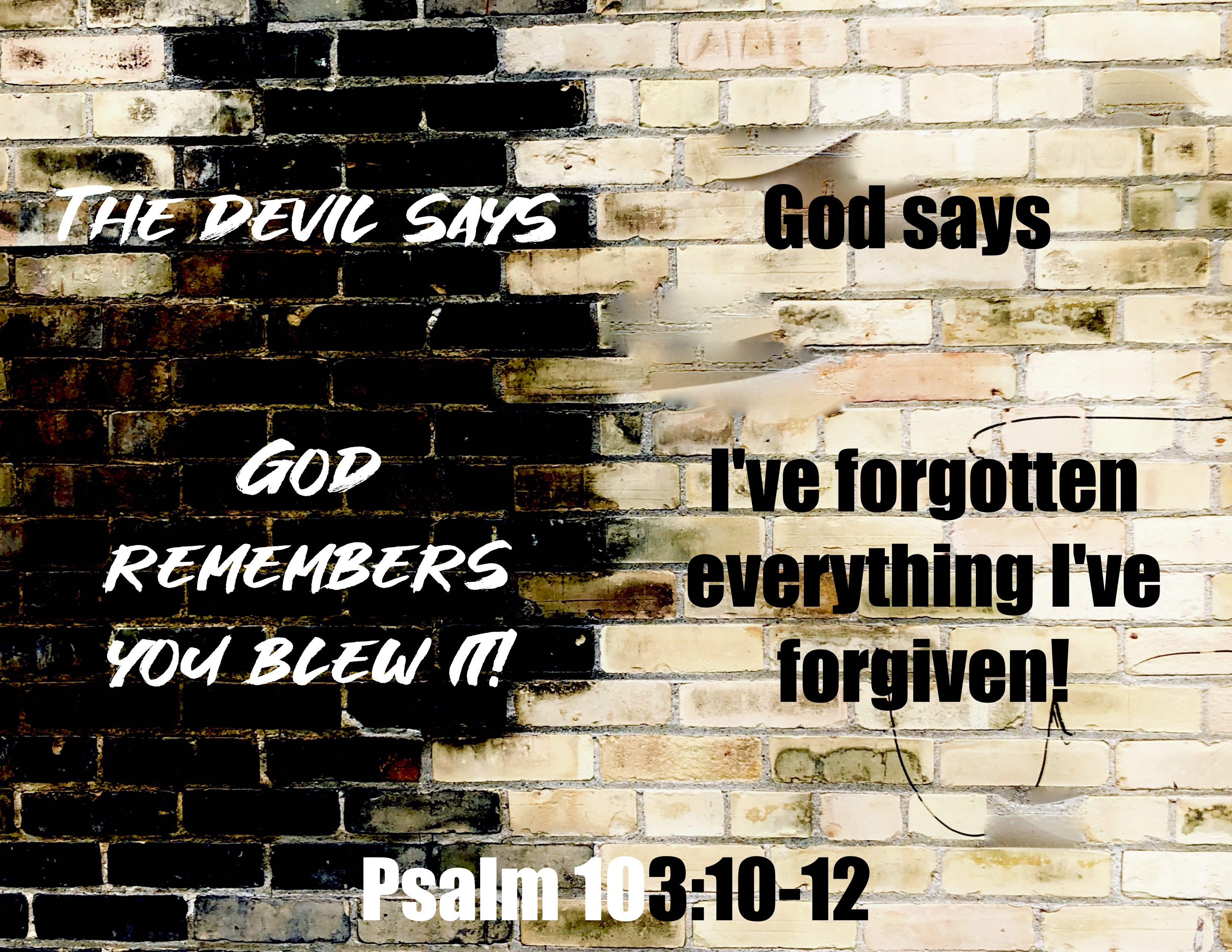
[God] does not treat us as our sins deserve or repay us according to our iniquities.For as high as the heavens are above the earth, so great is His love for those who fear Him; as far as the east is from the west, so far has He removed our transgressions from us. (Psalm 103:10-12)
For I will forgive their wickedness and will remember their sins no more. (Hebrews 8:12)
When satan tempts me to despair
And tells me of the guilt within,
Upward I look and see Him there
Who made an end of all my sin.
Because the sinless Savior died,
My sinful soul is counted free;
For God the Just is satisfied
To look on Him and pardon me,
To look on Him and pardon me. (Charitie Lees Bancroft)
So I think this is a good conclusion—In this freedom Christ has made us free and completely liberated us; stand fast then, and do not be hampered and held ensnared and submit again to a yoke of slavery which you have once put off. (Galatians 5:1 AMP)
This is a weekly series with things I’m reading and pondering from Charles Spurgeon. You can read the original seed thought here, or type “Thursdays With Spurgeon” in the search box to read more entries.
Listen to the podcast of this post by clicking on the player below, and you can also subscribe on iTunes or Spotify.
Love So Amazing
Forgiving one another, even as God for Christ’s sake has forgiven you. (Ephesians 4:32)
The first phrase to think about is ‘for Christ’s sake.’ We use these words very often, but probably we have never thought of their force. … All the good things that God has bestowed upon us have come to us ‘for Christ’s sake.’ But especially the forgiveness of our sins has come ‘for Christ sake.’ …
It is His very love as well as His holiness and His justice that, if I may use such a term, compels Him to severity of judgment so that sin cannot and must not be blotted out till atonement has been presented. There must, first of all, be a sacrifice for sin, that, mark you, the great Father, to show His love, supplies, for it is His own Son who is given to die! And so the Father Himself supplies the ransom through His Son, that Son is one with Himself by bonds of eternal unity, mysterious but most intense. If God demands the penalty in justice, He Himself supplies it in love. …
I want you to consider, for a moment, how readily God may now blot out sin since Christ has died. … God, for Christ’s sake, has accepted us in Him, has forgiven us in Him, and looks upon us with infinite love, changeless in Him. This is how all our blessings come to us, in and through Christ Jesus. And if we are indeed in Him, the Lord does not only forgive us our sins, but He bestows upon us the boundless riches of His grace in Him. In fact, He treats us as He would treat His Son. He deals with us as He would deal with Jesus! …
And you, big evil sinner, if you will go to God at this moment and say, ‘Lord, I cannot ask You to forgive me for my own sake, but do it out of love for Your dear Son,’ He will do it…. Christ took the shame that He might magnify His Father, and now His Father delights to magnify Him by blotting out the sin.
From Forgiveness Made Easy
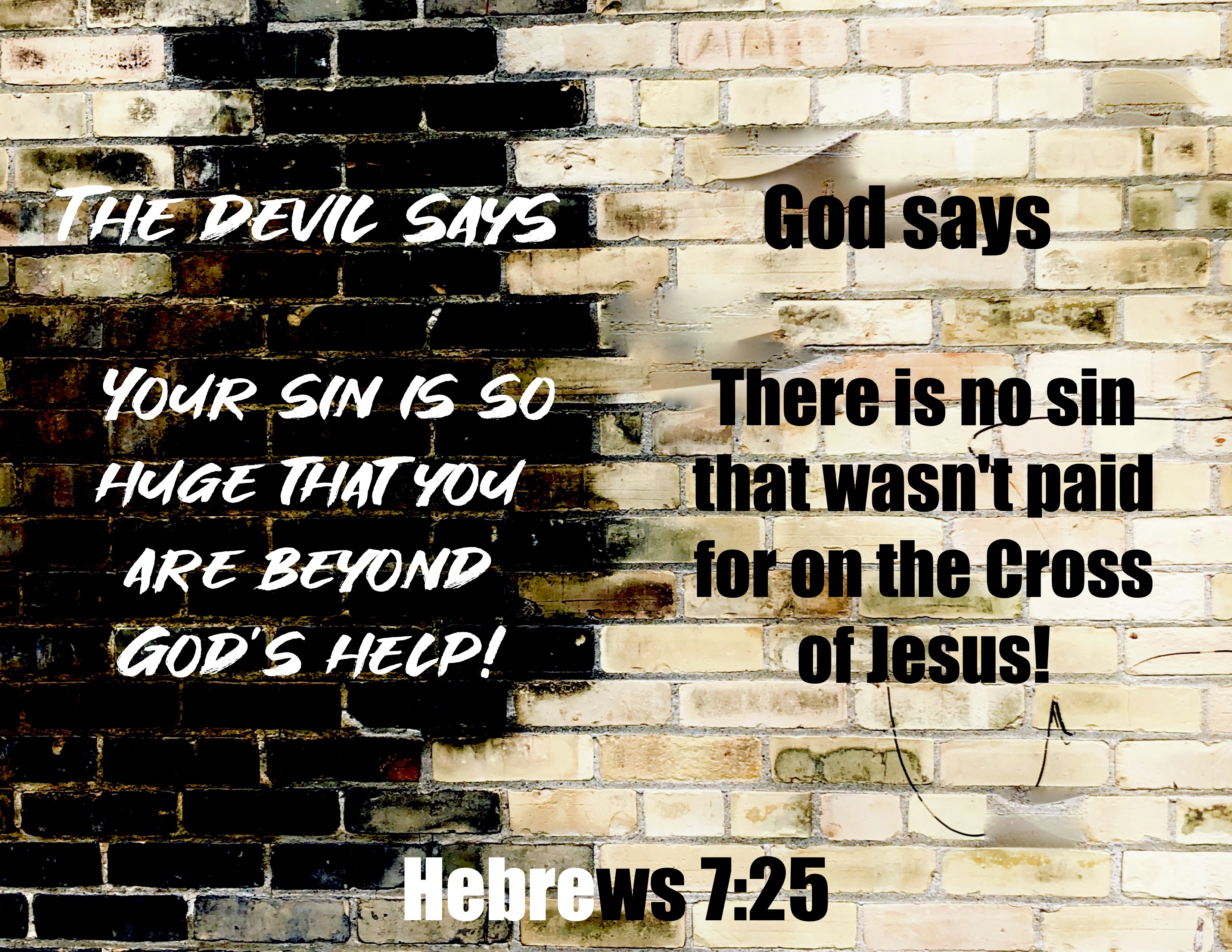
I’ve lost track of the number of times someone has told me, “I’ve messed up for so long—I’ve done such atrocious things—there is no way God could forgive me.” This is one of satan’s lies that keeps people from accepting God’s forgiveness.
Don’t wait another moment: If you haven’t asked God to forgive you “for Christ’s sake,” do it right this very minute! I’d love to chat with you about this, so reach out to me and let’s talk more about this amazing new relationship you now have with Almighty God because you are forgiven for Christ’s sake.
Listen to the podcast of this post by clicking on the player below, and you can also subscribe on Apple, Spotify, or Audible.
“Woe is me!” said the prophet (Isaiah 6:5).
The Hebrew word for “woe” here is the word “oy!” Although the word “woe” appears 20 times in the English translation of Isaiah, the Hebrew word “oy” is only used four times, and two of those times are Isaiah speaking of himself (6:5; 24:16). “Oy!” is a cry from a profound stab of pain from the realization that my sin has transgressed an All-Holy God.
Isaiah saw his own sin (6:5) as well a the sin of his people (3:9, 11), and it took his breath away. He stood trembling before a holy God pleading for mercy and cleansing before he could answer the call to be God’s messenger to the people of Israel (6:5-8).
The other Hebrew word that gets translated into the English word “woe” is “howy.” This is usually uttered from someone in pain because things aren’t going well. It’s a cry of, “Hey! Look! This is painful. This is not good at all.” But unlike “oy” which requires a profound heart change, “howy” can be said with the mouth without any change of the heart.
Isaiah cried, “Oy!” because his sin deserved the punishment of the Righteous Judge, but his heart posture called on God’s mercy for forgiveness and restoration. Because of his cleansed heart, Isaiah could now call, “Howy!” to the people: “Hey, sinful Israel, look at your sin. Look at how you’ve transgressed against God. Feel that pain, then don’t delay, but cry out ‘Oy!’ to Him now, while mercy may still be found.”
Isaiah’s “howy” had the impact of godly integrity because he had first cried “oy” in God’s presence. His “howy” was a call to others to do what he had done: see the holiness of God, see their sin, tremble in fear before an All-Holy God, and then cry “oy” to an All-Merciful God for forgiveness and restoration.
We should do the same thing. When the Holy Spirit convicts you of sin, don’t merely say, “Hey (howy), that hurts!” But say, “Oy! I have sinned, but God is a merciful Forgiver of sin.” Let that stab of pain from the conviction of your sin bring a change in your heart as well as a cry from your lips. God is merciful, and He does forgive.