Links & Quotes

Greg and I shared some insights for leaders interacting with people from different generations. Check out this clip about Gen Y.

I have a lot of new video content on my YouTube channel every week. Please check it out and subscribe so you don’t miss anything.

G.K. Chesterton penned these words over a century ago. If they were true then, imagine how much more so they are now: “These are the days when the Christian is expected to praise every creed except his own.”

“The only way to do great work is to love what you do. If you haven’t found it yet, keep looking. Don’t settle.” —Steve Jobs 

Epaphras literally put his life on the line to tell others about Jesus (Colossians 1:7; Philemon 23) and then tenaciously wrestled in prayer for the saints he led to the Lord (Colossians 4:12). That is a life worth emulating!

Sarah Young uses passages of Scripture and writes in the first-person voice as though Jesus Himself was speaking to us. “When you bring Me prayer requests, lay out your concerns before Me. Speak to Me candidly; pour out your heart. Then thank Me for the answers that I have set into motion long before you can discern results. When your requests come to mind again, continue to thank Me for the answers that are on the way. If you keep on stating your concerns to Me, you will live in a state of tension. When you thank Me for how I am answering your prayers, your mind-set becomes much more positive. Thankful prayers keep your focus on My Presence and My promises.”

Links & Quotes

A great mental health strategy: focus on what is happening today. Trying to fix yesterday or worrying about tomorrow robs you of the peace God wants you to have. Check out the full series of mental health strategies I shared here. I have lots of new content every week, which you can check out on my YouTube channel.

“Compromise and commitment cannot coincide. … Conviction leads to commitment, but the lack of commitment leads to compromise.” —Dr. Tony Evans

I love reading about the archeological finds that confirm the historicity of the Bible! Here is a post from The Bible Archeology Report on the top ten discoveries related to Christmas.

“Hard times create strong men. Strong men create good times. Good times create weak men. Weak men create hard times.” —G. Michael Hopf

“Luck is when an opportunity comes along and you’re prepared for it.” —Denzel Washington

“Ministers are set to be lights to the souls of men in this respect, as they are to be the means of imparting divine truth to them, and bringing into their view the most glorious and excellent objects, and of leading them to and assisting them in the contemplation of those things that angels desire to look into…by which they may know God and Jesus Christ, whom to know is life eternal.” —Jonathan Edwards

“Scripture the unus sermo Dei—the one sermon of God.” —Augustine

T.M. Moore is presenting another outstanding series of posts, this one about the dignity of work. In one post, he wrote, “A just society requires all members to contribute love for their neighbors, whether they are poor or wealthy. Those who will not work when they can do so should be left to the consequences of their sluggardliness (2 Thessalonians 3:10). It is incumbent on local community leaders to discover ways, analogous to the work of gleaning, of helping to meet the needs of local poor. These might include keeping part-time work available, identifying ‘community work’ opportunities and helping to fund them, offering job counseling and training, and so forth. Churches certainly could pioneer the way in this, creating opportunities for work on their campuses, on behalf of needy members, and for the community at large.”

“The Holy Spirit responds to our walking according to the Word, not merely talking about the Word.” —Dr. Tony Evans

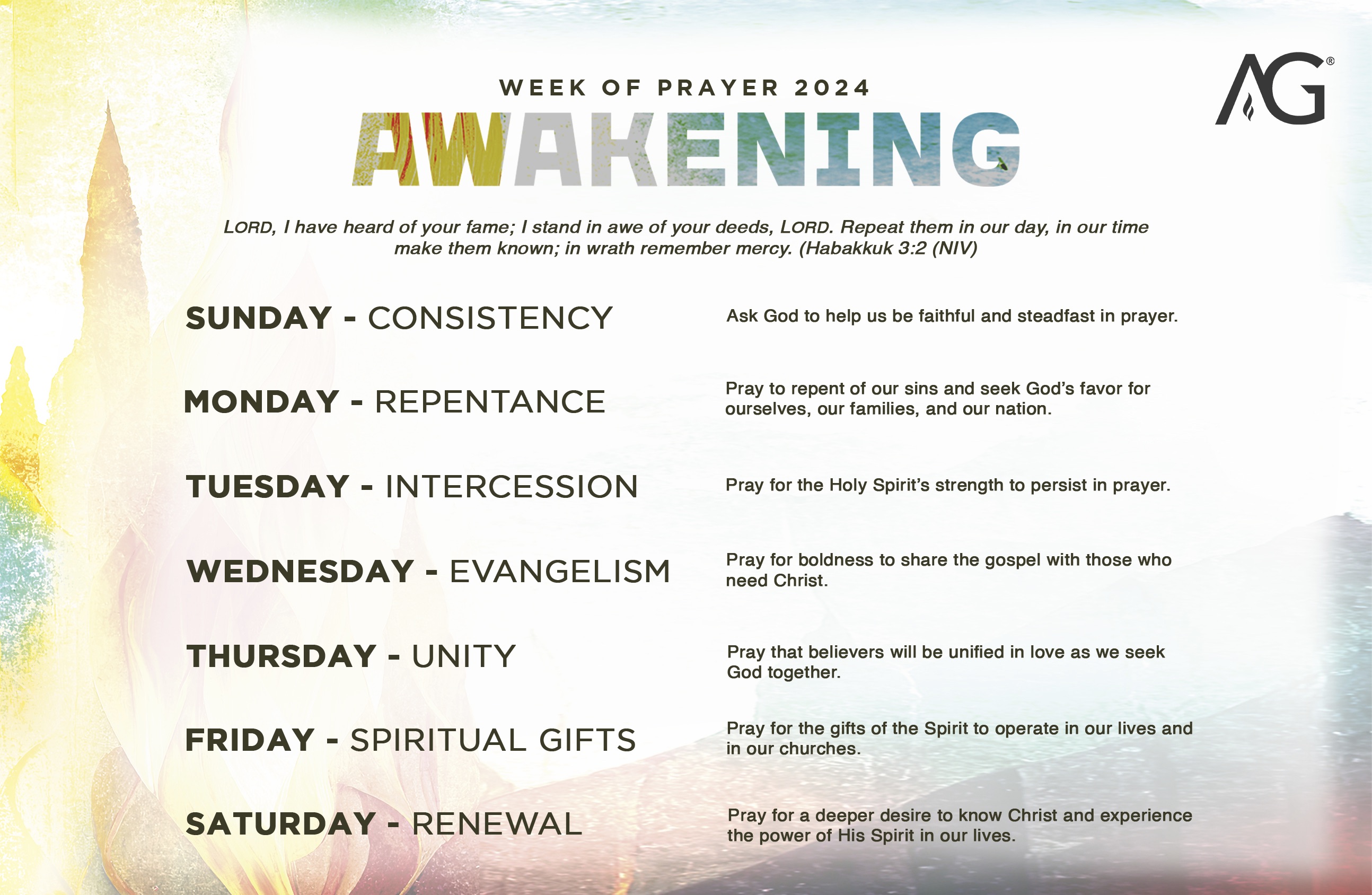
Week Of Prayer (2024)

I grew up with a phrase ringing in my ears, “The Church moves forward on its knees.”

I believe this is true! We cannot expect to be effective in any kingdom-building endeavor if we are not empowered by heavenly help. So we like to begin each new year with a dedicated week of prayer. I invite you to join us in kicking off the new year with a renewed passion for prayer.

Conquering Two Roadblocks To Sabbathing

Listen to the podcast of this post by clicking on the player below, and you can also subscribe on AppleSpotify, or Audible. 

I thought it was very appropriate that I got to be a guest on the Thriving In Ministry podcast with Kyle Willis while his podcast partner Dace Clifton was on sabbatical. It was appropriate because Kyle and I talked about the importance of pastors finding time to rest. 

Proper rest is absolutely vital for longevity and vitality. I hope you will listen to this short segment from this conversation. 

I shared with Kyle two main roadblocks to sabbathing. 

(1) Trying to be something you’re not. 

We are all wired differently. God wired us that way on purpose. So if you’re an early bird, guard those morning hours for your creative work and use the evenings for rest. If you’re a night owl, don’t try to copy the early birds, but rest early in the day and do your creative work when you are at your best. 

→ So the key concept to overcoming this roadblock is personalization. 

(2) Getting distracted by the non-essentials. 

Two things have really helped me with this one: Sticking to sustainable daily routines, while at the same time being sensitive to the Holy Spirit’s redirection (check out my post on the idea I call I.T.L.W.). 

→ The key concept here is flexible focus. 

I talk more about this concept of sabbathing and a leader’s overall healthiness in my book Shepherd Leadership. You can also check out some other posts about sabbathing by clicking here.

►► Would you please prayerfully consider supporting this ministry? My Patreon supporters get behind-the-scenes access to exclusive materials. ◀︎◀︎

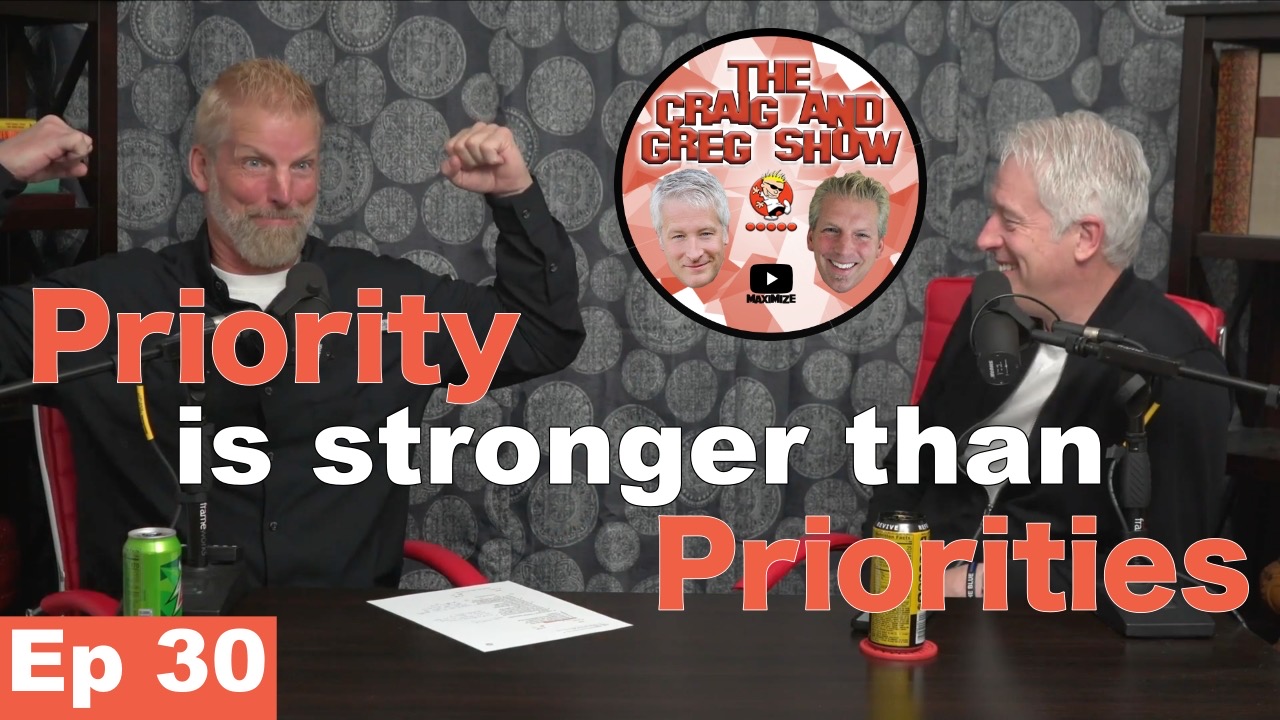
The Craig And Greg Show: A Leader’s Top Priority

Listen to the audio-only version of this podcast by clicking on the player below, or scroll down to watch the video.

On this episode of “The Craig And Greg Show” we talk about: 

  • [0:38] What are the origins of the word “priority” and why should priority be singular and not plural? 
  • [0:56] Is it true that multi-tasking increases efficiency? 
  • [2:52] Greg tells a story about shopping with his parents.
  • [3:55] Greg reminds us that the devil uses distraction as a tool.
  • [5:04] I talk about how leaders should set their first priority.
  • [6:32] Why is it so hard to invest in unavailable people?
  • [7:58] I explain how leaders can make time for their “have to” list.
  • [9:58] Greg loves “StrengthFinders” and how it helps leaders learn to work in their strength zone.
  • [10:52] We discuss the book No Is A Beautiful Word.
  • [12:42] How can leaders use the priority vs. priorities paradigm to create margin in their life?
  • [14:36] We throw out the “Not-To-Do List Challenge” for leaders.

Check out this episode and subscribe on YouTube so you can watch all of the upcoming episodes. You can also listen to our podcast on Spotify and Apple.

Poetry Saturday—A Man With An Aim

Give me a man with an aim,
   Whatever that aim may be,
Whether it’s wealth or whether it’s fame,
   It matters not to me.
Let him walk in the path of right,
   And keep his aim in sight,
And work and pray in faith alway,
   With his eyes on the glittering height.

Give me a man who says,
   “I will do something well,
And make the fleeing days
   A story of labor to tell.”
Though the aim he has be small,
   It is better than none at all;
With something to do the whole year through,
   He will not stumble and fall.

But satan weaves a snare
   For the feet of those who stray,
With never a thought or care
   Where the path may lead away.
The man who hath no aim
   Not only leaves no name
When life’s done, but ten to one
   He leaves a record of shame. 

Give me a man whose heart
   Is filled with ambition’s fire;
Who sets his mark in the start,
   And keeps moving it higher and higher.
Better to die in the strife,
   The hands with labor rife,
Than to glide with the stream in an idle dream
   And lead a purposeless life. 

Better to strive and climb
   And never reach the goal,
Than to drift along with time
   An aimless, worthless soul.
Ay, better to climb and fall,
   Or sow, though the yield be small,
Than to throw away day after day,
   And never to strive at all. —Anonymous

4 + 4 Strategies To Eliminate Distractions To Your Prayer Time

There’s a quote that has been the theme for this series on prayer: “Prayer pursues joy in fruitful fellowship with Jesus, knowing that God is glorified when we bear fruit in answer to prayer. Why do God’s children so often fail to have consistent habits of happy, fruitful prayer? Unless I’m badly mistaken, one of the reasons is not so much that we don’t want to, but that we don’t plan to.” —John Piper 

And unless I’m badly mistaken, the most obvious thing we need to plan to eliminate is distractions. 

Some people say they can juggle a lot of things at once. “I’m a really good multitasker,” they say. But science says differently. MIT neuroscientist Earl Miller concluded that our brains are “not wired to multitask well…. When people think they’re multitasking, they’re actually just switching from one task to another very rapidly. And every time they do, there’s a cognitive cost.” What is that cognitive cost? “Multitasking can drop IQ as much as 15 points, essentially turning you into the cognitive equivalent of an 8-year-old” (Inc. Magazine). 

If the devil can make you think you can multitask prayer with other things, he has seriously inhibited the effectiveness of your prayers. 

Jesus was not a multitasker—but He was singularly focused on His Father’s plan. And yet He accomplished more in His three years of public ministry than anyone else in history! 

Here are 4 strategies to help you get ready to pray:

  1. Try to have your prayer time in the same place and at the same time. Your brain likes routine and it will help you zero-in during your scheduled prayer times. 
  2. Silence your cell phone or other noisy distractions. 
  3. Keep a notepad handy for random thoughts that pop into your head. Writing them down will keep your brain from switching back-and-forth to them.
  4. Focus on listening, not on talking—Eugene Peterson said, “Prayer is first of all a means of listening. Prayer is an act of attention.” 

When we get right down to it, prayer is spiritual warfare (2 Corinthians 2:11; Ephesians 6:10-18). In the context of warfare, the word strategy means the maneuvering that takes place prior to the battle. The devil is a masterful tactician, and he will do everything he can to keep you distracted. 

That’s why three times Peter tells us to be clear-minded and singularly-focused in our thoughts SO THAT we can pray without the hindrances of distractions (1 Peter 1:13-14; 4:7; 5:8-9). And Paul tells us to take all our thoughts captive, so that no un-Christlike thoughts are inhibiting our prayer time (2 Corinthians 10:4-5). 

Here are 4 strategies to help you stay focused in prayer:

  1. A—adoration. Enter into God’s presence with a Psalm or worship music. 
  2. C—confession. Deal with unconfessed sin, unforgiveness, or relationship strife as quickly as possible (Psalm 66:18; Matthew 5:21-24). 
  3. T—thanksgiving. Paul counseled us, “Do not be anxious about anything, but in everything, by prayer and petition WITH thanksgiving, present your requests to God” (Philippians 4:6).  
  4. S—supplication. Intercede for your brothers and sisters in the battles they are facing (James 5:16; Job 42:10; Ephesians 6:18).  

Remember—

Prayer isn’t preparation for the battle; prayer IS the battle! Let’s not be distracted from that!

20 Facts & Tips About Your Body Clock

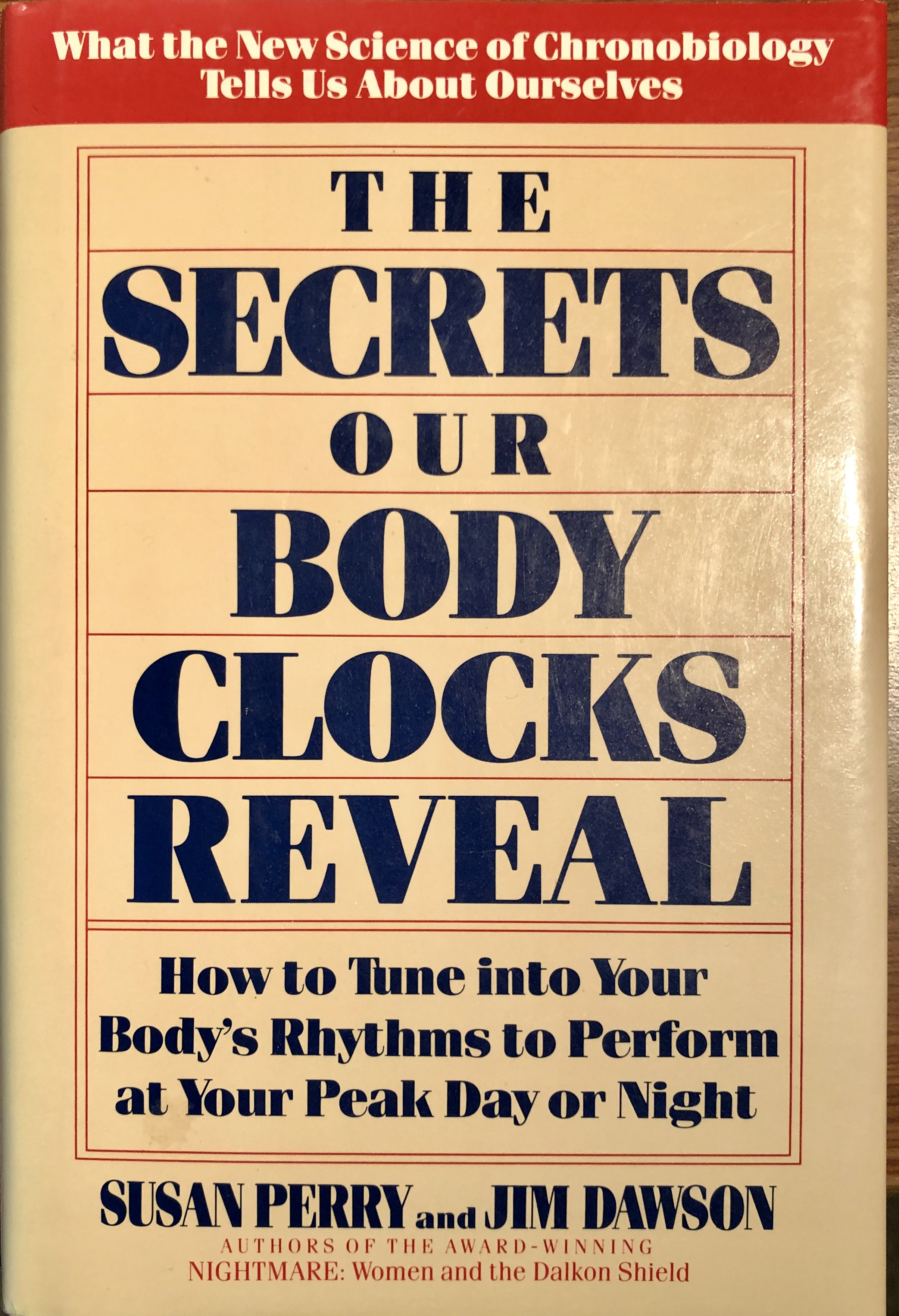
I really enjoyed reading The Secrets Our Body Clocks Reveal (you can read my full book review by clicking here). From this book, I’ve begun implementing a few of the tips I discovered. Here are a few of the facts and tips that I found interesting. 

  1. “Most of us reach our peak of alertness around noon. … We are least alert during the early morning hours—specifically, between 3:00 a.m. and 6:00 a.m.” 
  2. “Your immediate, or short-term, memory is best during the morning hours. … Your long-term memory is a different matter, however. Afternoon is the best time for learning material that you want to recall days, weeks, or even months later. … How well you remember things depends on when you learn them, not when you recall them.” 
  3. “On average, we tend to do best on cognitive tests—things that require the greatest mental effort—during the morning hours, particularly the late morning hours.” 
  4. “All of your senses—taste, sight, hearing, touch, and smell—are their keenest during the twilight hours of late afternoon and early evening.” 
  5. Tips for keeping your daily rhythms on beat: (1) get out in the sun for at least fifteen minutes each day, and (2) try to follow a regular daily routine.
  6. “Fortunately, there is another way to avoid the Monday morning blahs. Stay up as late as you like, but make sure you get up at your regular wake up time. In other words, don’t sleep in. And don’t take naps during the day. Then, when night rolls around again, you’ll find yourself able to fall asleep at or before your regular bedtime, and you’ll avoid pushing your cycle ahead.” 
  7. “Scientists have also discovered that short naps (twenty minutes or less) are just as revitalizing as long ones—and less disruptive to regular sleep rhythms. In addition, regular nappers wake up more refreshed than those who take only an occasional nap. When naps are part of the regular daily rhythm, they are less disruptive.” 
  8. “Generally, our moods peek around four hours after we awaken.” 
  9. “A regular exercise program can go along way toward easing the physical effects of stress. … The exercise program must be regular, however; sporadic physical activity, such as an occasional game of tennis or softball, or an activity that is not appropriate to your physical condition, can be a harmful stressor.” 
  10. “Melatonin’s daily rhythm is similar to that of legendary vampires: it appears at the onset of darkness and begins to disappear at the break of dawn. In other words, darkness triggers the chemical’s release; sunlight suppresses it. It should come as no surprise, therefore, that melatonin reaches its seasonal peak in the body during the dark winter months.” 
  11. “Beards tend to grow the most on Sunday and the least on Wednesday.” 
  12. “If you wake up in the morning with a temperature of 99° F, you are very likely coming down with a cold, the flu, or some other kind of illness. But if you have that same reading around dinner time, you may be in perfect health. The reason, of course, is that your temperature rises during the day. A high reading early in the day is a greater indication of illness than the same reading late in the day.” 
  13. “Take a commonplace drug like aspirin, for example. When swallowed at 7:00 a.m., aspirin stays in the body for up to twenty-two hours. When the same dose is taken at 7:00 p.m., it is completely out of the body within seventeen hours.” 
  14. “When you know your rhythms are out of sync, be aware that you are particularly vulnerable to illness. It is the time to be extra careful about keeping your distance from people with the flu or other viruses.” 
  15. “The best thing you can do for a tension headache is to learn how to relax. As soon as the headache begins, lie down, if possible, so you can take the strain off your neck, since this is the location of most of the muscles that tense up and cause a tension headache. Close your eyes and breathe deeply to return oxygen to your strained muscles. Better yet, ask a sympathetic friend or loved one to gently massage your neck and shoulders.”
  16. “Eat your biggest meal at breakfast, your next biggest at lunch, and your smallest at dinner.” 
  17. “About every ninety minutes, most people experience an urge to put something into their mouths. … Generally, it will pass in about fifteen minutes.” 
  18. “According to recent studies conducted at Northwestern University, both morning and night people perform simple mental tasks better during the morning hours after consuming the caffeine equivalent of one to three cups of coffee. But when the tasks become more complex, only night people do better under the influence of caffeine. For morning people, the higher dose of caffeine, the more mistakes they make.” 
  19. “Carbohydrates help calm and focus your mind.” 
  20. “Protein foods increase your alertness and help you feel more energetic. … Protein can be eaten either alone or with a carbohydrate food to energize the mind. For carbohydrates to have their calming effect, they must be eaten alone.” 

Susan Perry and Jim Dawson also shared what they uncovered about the importance of sleep. Click here to read about their research 

Self-made Or Spirit-led?

“And behold, two men were conversing with Him—Moses and Elijah, who appeared in splendor and majesty and brightness and were speaking of His exit from life, which He was about to bring to realization at Jerusalem.” (Luke 9:30-31)

Jesus was constantly making decisions that kept Him on the path straight toward Calvary’s Cross. He would let nothing deter Him from God’s appointed mission. Even when His own friends and family urged Him to find another route. 

It was at a moment like this—when Jesus had yet another choice to make about what path He would follow—that Moses and Elijah talked to Him, reminding Him of the ultimate outcome of His obedient and correct choices. 

At every crossroads—at every decision point—Jesus chose correctly. He chose to do God’s will for His life. He could have decided to do things His own way, but He leaned into the unmistakable voice of the Holy Spirit pointing Him toward the right path.

What does that mean for us today?

I have failed to make the right choice.
That means that I could have chosen correctly.
Jesus was human just like me.
Which means He had choices too.
He always chose correctly, even though the other possibility was there.
So the question is: Will I try to be a self-made man or a Spirit-led man?
I cannot be both.

Notes From The Global Leadership Summit

I had an amazing time last week at the Willow Creek Global Leadership Summit. Every year I came away with some many thoughts, and a brand new passion for the various leadership roles in which I get to serve.

Below are just a few of my notes that I jotted down during an intense two days.

Hybels - everybody winsBill Hybels—The Lens Of Leadership

“Everybody wins when a leader gets better.”

“Armed with enough humility, leaders can learn from anyone.”

Hybels discussed four leadership lenses:

1.   Passionate leader (depicted by vibrant bright red frames)

  • They understand unbridled passion in leadership.
  • “Passion is like protein for the team.”
  • A motivated worked will outperform an unmotivated worker by 40%.
  • People are more motivated by working for a passion-filled leader than they are by compensation or perks.
  • Passion comes from a mountain-top dream, or a valley-deep frustration of current settings.

2.   People leader (cool frames, but cracked lenses)

  • An organization will only be as healthy as the top leader wants it to be.
  • This world needs more pastors of businesses, factories, medical offices, military units, etc.

3.   Performance leader (self-adjusting glasses)

  • Leaders ask: what progress should be made? how do we measure this? what doesn’t need to be measured?
  • Every worker wants to know how they are doing. For the leader, it’s cruel to hire someone and never let them know how they’re doing. Every staff member should get an update at least every six months.

4.   Legacy leader (sunglasses with a rearview mirror [cyclist])

  • Every once in awhile we need to look behind to see what legacy we’re leaving behind.
  • Leaders should reflect on this annually.
  • If my leadership assignment were to end today, what legacy would I leave?

Mulally - overcommunicateAlan Mulally—CEO Boeing and Ford Motor Company

An average commercial airline has 4 million parts!

  • People first
  • Include everyone
  • Create a compelling vision
  • Present a workable strategy
  • Set clear performance goals
  • Relentless implementation
  • Share lots of data
  • “Over-communicate the plan and the current status against the plan.”
  • Instill a positive can-do attitude
  • Keep your emotional resilience
  • Have fun


Melinda Gates - hear the criesMelinda Gates—Gates Foundation

Melinda says of herself, “I am an impatient optimist. We are changing the world, but we need to change it faster.”


“At the end of the day, you have to hear the cries of those in need, let your heart break and act in courage.”

Jossy Chacko—Empart

“All of us have been entrusted with something. What are we doing to leverage it?”

In thinking about the parable of the talents … “To Jesus, faithfulness is not just sitting with what you have been given, but multiplying what you have been given. God’s mission is not maintaining.”

“Playing it safe is not enough for a follower of Jesus Christ.”

Three principles for expanding our leadership reach:

Jossy Chacko - faithfulness1. Enlarge your vision

  • “When people hear my vision, they should know the size of my God.”
  • “An enlarged vision should keep us driven.”
  • “Do not be confused about what people say about your vision; trust what God has said to you.”

2. Empower your people

  • “Leadership is about taking wise chances and giving people opportunities.”
  • “Your leadership reach will be determined by your empowerment choices.”
  • Three things to keep in mind: (1) Focus on building their character before empowering them; (2) Empowerment has to be through relationship; and (3) Make sure we have agreed on the right outcomes, and have the right way to measure them.

3. Embrace risk

  • Faith = risk. Without faith it is impossible to please God = without taking risks it is impossible to please God.
  • Paradigms to be changed: (1) See risk as your friend to love, not as your enemy to be feared; (2) See comfort and safety as your enemies; and (3) Increase your pain threshold.
  • “Your leadership capacity is in direct relationship to your pain threshold.”
  • “Don’t allow the fear of losing what we have to lose what God has in store for you.”
  • “By me not taking risks, who is missing out?”

Bradberry - EQDr. Travis Bradberry—TalentSmart

All inputs into the brain travel through the limbic system first (emotional center) before the inputs travel to the frontal cortex. The EI (emotional intelligence) center is in the front of the brain, just above the left eye.

Only 36% of people are able to accurately identify their emotions as they happen.

EQ (the Emotional Quotient that measures emotional intelligence) is not IQ.

EQ can be improved all throughout life.

Four components of emotional intelligence:

 1. Self-awareness: knowing my emotions, and knowing my tendencies. I need to lean into my discomfort if I want to improve.

   2. Self-management: what I do with this increased self-awareness. This is not “stuffing” my feelings. The biggest mistake is only trying to manage negative emotions; positive emotions need to be managed too.

   3. Social awareness: focusing more on others than on myself.

   4. Relationship management: using the first three skills in concert. Seeing how my behavior is affecting the other person, and then adjusting accordingly.


How to increase my EQ:

  1. Control stress—stress under control is healthy; chronic stress is unhealthy. Gratitude reduces the stress hormone cortisol.
  2. Clean up my sleep hygiene—sleep cleans up toxic hormones in the brain. To get better sleep: (1) Don’t take any kind of sleeping pill; and (2) Reduce “blue lights” in the evening.
  3. Reduce my caffeine input—especially after noon.

Ideal team playerPatrick Lencioni—Author

Three qualities of an ideal team player:

1.   Humble

  • Lacking self-confidence is not humility.
  • “Denying skills and downplaying abilities is not humility.”

2.   Hungry

  • Strong work ethic
  • Driving hard

3.   Smart

  • Not intellectual smarts, but people smarts = EQ

“To develop people, we have to have the courage to humbly and constantly talk to people about their ‘stuff.’”

McChesney - execution disciplinesChris McChesney—Franklin Covey

Rahm Charan asked:

  • Q: Do leaders struggle more with strategy or execution? A: Execution.
  • Q: Are leaders more educated in strategy or execution? A. Strategy.

“The hardest thing a leader will ever do is drive a strategy that changes someone’s behavior.”

There are four disciplines for making changes in human behavior:

1.  Focus

  • “Focus on the wildly important.”
  • If a team focuses on 2-3 goals, they are likely to get them done. But if there are 4-10 goals, momentum is killed. At 11+ goals, the team is going backward.
  • We narrow the focus by coming up with a WIG: wildly important goal (this lives at the intersection of ‘really important’ and ‘not going to happen’).

2.  Leverage

  • “What are the fewest number of battles necessary to win the war?”
  • “When you want to go big, don’t think big, think narrow.”
  • One WIG per team at the same time. Everything else is in sustainment mode.
  • Make goals like this—“From x to y by when.”

3.  Engagement

  • “The biggest driver of engagement is when people feel like they’re winning.”
  • “Do the people who work for me feel like they’re playing a winnable game?”

4.  Accountability

  • Everyone needs to answer: “What are the things I do that have the biggest impact on the WIG?”
  • After sharing the scoreboard, allow people to determine what they need to do next. The people need to determine their own next moves, not the leader. The leader pulls this out of people.

Erin Meyer - contextErin Meyer—INSEAD

On The Culture Map communication is divided into Low vs. High Context:

  • Low = feel we don’t have the same context or relationship. We feel we need to explain things very simply and explicitly.
  • High = we assume we have a larger body of shared reference points. We feel communication is more implicit or nuanced.

Anglo-Saxon countries are typically low context.

Latin American are mid-low.

Asian countries are usually high context.

In low context we tend to nail things down in writing, where in high context we leave things more open to later interpretation.

“Context impacts communication. … We need to read both the messages ‘in the air’ as well as the explicitly stately messages.”

“In a high context culture, repeat things less, ask more questions, learn to ‘read the air.’”


Maxwell - 3 questionsJohn Maxwell—Author 

“Good leaders lift.”

“You have to find the people before you lead the people.”

“The one thing leaders have to get right—they must intentionally add value to people every day.”


Five things that intentionally adds value to people:

  1. Value people—“God values people I don’t know; He even value people I don’t like.” “Are we going to spend our lives connecting with people, or correcting them?”
  2. Think of ways to add value to people—“Intentional living is thinking upfront on how to help people.”
  3. Look for ways to add value to people.
  4. Do things that add value to people.
  5. Encourage others to add value to people.

If you attended the GLS, please share in the comments below something amazing / challenging / paradigm-busting that you learned. Let’s all keep on learning!