Links & Quotes

Let’s change our leadership mentoring perspective. It’s not whether you dropped the ball or not, it’s what you learned from the time you dropped the ball. This is how we help others move forward. Check out the full Craig and Greg Show episode where we talk more about “untraditional” performance reviews.

I have lots of new content every week, which you can check out on my YouTube channel.

If it hadn’t been for J.R.R. Tolkien’s influence, C.S. Lewis may have remained an atheist. And if it hadn’t been for C.S. Lewis’ encouragement, the world may never have been able to enjoy Tolkien’s Lord of the Rings series. This truly was a friendship that blessed the world! A book that explores this relationship further is A Hobbit, A Wardrobe, and A Great War.

“We don’t all have to be geniuses to innovate in the way we use culture. For example, what if we were to repudiate, once and for all, all gossip and all carping and complaining, and instead were to work hard day by day to redirect our tongues toward building others up (Ephesians 4:29)? We would have to innovate some new ways of engaging people in conversation, by getting to know people and taking a real interest in them, becoming better listeners, asking good questions, making sure all our words were seasoned with grace, and always speaking truth in love. Would that not be a radical and innovative improvement on much of what passes for conversation today? If every believer just worked a bit harder to innovate new forms of conversation, I’m persuaded the world would certainly notice the difference!” —T.M. Moore

I think anyone who has read the Bible has heard the amazing story that Jesus told about a wayward son, a loving father, and a struggling older brother (see Luke 15:11-32). Jon Bloom imagines a conversation that the brothers may have had with each other after the younger brother returned home.

J. Warner Wallace is a cold-case detective and a premier Christian apologist. Some Christians believe that we only need to use Scripture to form our trust in Scripture. In this video, Wallace explains from Scripture how even Jesus used evidence outside of Scripture to make His case that He was who Scripture said He was. 

It is interesting how many modern-day scientists will accept without fact that an asteroid impacted Earth “millions of years ago” to trigger massive changes that resulted in the extinction of dinosaurs, but will flatly disregard the Flood recorded in the Bible. As a result of their false assumptions, they reach conclusions (like believing they have refuted Bergmann’s Rule) that are quickly refuted. Check out this insightful post.

If you are doing all the calculating with your money, then Jesus says you’re not rich toward God. Check out this full sermon here.

“When God brings new opportunities the path forward is often unknown; it’s a risky journey to start. After all, if you can see the path to the finish line, you do not need to trust the Lord. Why would God give a golden opportunity to those unwilling to trust Him for the unknown?” —Roger Parrott, Opportunity Leadership 

(For security reasons, I cannot share a link to the following but I can verify its veracity). “Sam” is a Christian in an Arabic country who has been instrumental in starting and leading a church in his country for several years. He was arrested two months ago and held in prison for 55 days. He was interrogated the first 8 days, then left in solitary confinement for 47 days: the bright lights always on, Some Christians were able to meet with him after his release, listen to his story, share Scripture together, pray with and encourage him. Here is one of their main takeaways from their conversation with Sam. 

“So, Sam, how did you make it 55 days in prison?” 

Sam said, “The Holy Spirit was with me and was with my mouth. He gave me the words to say. But the devil also sat right next to me twisting Scripture.” Sam continued, “Tell those that will go to prison it is very important not only to know the Scripture but to be able to interpret it correctly as the accuser (I found out by experience) is so adept at twisting God’s Word to both tempt and discourage us.”

Takin’ Him To Easy Street And Skid Row

Listen to the podcast of this post by clicking on the player below, and you can also subscribe on AppleSpotify, or Audible. 

Jesus sent us and the Holy Spirit empowers us to take the Good News to all nations—all the streets (Luke 24:47-49; Acts 1:8). As we move away from Jerusalem and into Judea, we should expect to see more differences with our audience. And then as we move into Samaria, there will probably be more differences than similarities. Regardless of how little we may have in common with those on other streets, the Holy Spirit still empowers us to witness there. 

(You can find all of the Scriptures I reference in this post by clicking here.) 

When we don’t live on someone else’s street, we tend to make some pretty big assumptions about them. For example, until I married a school teacher, I thought, “How nice it must be to be done with work by 3:00 every afternoon and have three months off in the summer!” 

Mistakenly, we think we can so easily fix the problems people on other streets have—we think we can show them how simple it is to correct anything out of balance on their street. These are natural thought patterns when so little of our circles overlap.

If you live on Main Street, two streets which are quite different from you are Easy Street and Skid Row. When it comes to finances, there tends to be extremes in our thoughts about the Samaritans that live on those streets—

  • Those on Easy Street only cares about themselves
  • Those on Skid Row should work harder 
  • Those on Easy Street have too much—it’s not fair! 
  • Those on Skip Row don’t have enough—it’s not fair! 

But here’s the thing: It’s really not about the money but it’s about our attitude about the money. 

In Luke 21:1-6, Jesus saw both rich people from Easy Street placing their tithe in the temple treasury, and a poor widow from Skid Row doing the same. Jesus said this widow put in more than anyone else. He was talking in terms of quality, not quantity. 

While they were still in the temple, the disciples pointed out how beautifully embellished the temple was. These decorations came from the money those on Easy Street had contributed. Jesus told them not to focus on the temporal temple but on the eternal Kingdom of God.  

As I said, Jesus doesn’t have a problem with money, but He does warn us about our ungodly attitude toward money (Luke 8:1-3; Matthew 27:57; Acts 4:32-5:4; Exodus 20:17; Luke 12:13-22).  

Even though Easy Street and Skid Row seem to be at opposite ends of the spectrum, I think we are effective witnesses for Jesus on these streets in exactly the same way. 

(1) Guard your attitude about money. Remember that Gad often provides for us by giving us a skill, and then making a job available that can use our skill. So let’s be thankful for our God-given jobs. Then we guard our attitude about money by tithing regularly, and making sure that when we bless others financially, we do it without expecting any fanfare (Colossians 3:23; Malachi 3:10; Matthew 6:2-3). 

(2) Let God be unique as unique with these folks on Easy Street and Skid Row as He is with you on Main Street. Don’t try to be someone else, and don’t expect others to be you—simply obey what God has spoken to your heart, just as you allow others to obey what God has spoken to their hearts. 

(3) Don’t tell, but show how you use the resources God has given to you. It’s not our place to “preach” to others about how they should or shouldn’t be handling their finances, but simply live out the biblical principles outlined above, and let your life show your godly attitude. 

(4) Always turn the focus to the eternal. Just as Jesus did with His disciples in the temple, He always reminded people that this world with its perks or tragedies is only temporary. What ultimately matters is where we will spend eternity (Luke 13:1-5). 

Money is always a touchy subject with people, so let’s make sure we have our own attitude aligned with Scripture before we try to bring the subject up with others. 

If you’ve missed any of the other messages in our Takin’ Him To The Street series, you can find them all here. 

►► Would you please prayerfully consider supporting this ministry? My Patreon supporters get behind-the-scenes access to exclusive materials. ◀︎◀︎

Book Reviews From 2018

Saturday In The Proverbs—Knowing True & False Riches (Proverbs 22)

[Each chapter in the Book of Proverbs contains thoughts that fit into a theme; they are not just random thoughts gathered together. In this “Saturday In The Proverbs” series, I will share a theme that I see in each chapter. But the cool thing about God’s Word is that you may see an entirely different theme. That’s great! If you do, I would love for you to share it in the comments below.]

…riches… (Proverbs 22:1, 4, 16).

There are earthly riches and there are heavenly riches. There are temporary gains and there is eternal wealth. This Proverb helps direct us to true riches that last forever. 

Good character and a good reputation are better than money (v. 1)

God alone decides what is truly valuable (v. 2)

Prudence helps you avoid bankruptcy (v. 3)

Humbly fearing God is the path to eternal wealth (v. 4)

A perverse pursuit of wealth is a hard and painful path (v. 5)

Better godly children than gobs of money (vv. 6, 15)

Debt enslaves (v. 7)

Cutting corners to make a buck will come back to bite you (v. 8)

Generosity leads to more blessings (v. 9)

Don’t pay attention to those who scoff at God’s ways (vv. 10, 24, 25)

A grace-filled, pure lifestyle will get you noticed and rewarded (v. 11)

God rewards those who do things His way (vv. 12, 17-21)

A good work ethic brings rewards (vv. 13, 29)

Immoral pursuits end in a deep pit (v. 14)

Don’t treat people differently because of their ‘net worth’ (vv. 16, 22, 23; see also James 2:2-4)

Be careful to whom you make financial  commitments (vv. 26, 27)

Don’t encroach on others’ space (v. 28) 

10 Quotes From “Jesus’ Terrible Financial Advice”

I loved the financial insights that John Thornton presented in Jesus’ Terrible Financial Advice. The advice is “terrible” in that it flies in the face of conventional financial wisdom and puts it in the proper biblical light. Check out my full review of this book by clicking here.

“As God waits patiently to receive our all, wonder, and appreciation for all He is and does, an idol steps in to accept our applause. Like an insidious illusionist, the idol misdirects our attention to itself. … What does an idol do? Nothing. That’s all an idol can do. Nothing. Nothing but steal God’s glory.”

“Jesus is not trying to impoverish us when He tells us to store up treasures in heaven.”

“Here is where some people mistakenly make it about the money. They wrongly conclude that rich people can’t make it to heaven, but poor people can. This is a grave error. In truth, no one can enter the kingdom of heaven, rich or poor, without God.”

“If we are seeking heaven because our life here is so good that we don’t want it to end, or simply because we don’t want to go to hell, we’ve missed the point. We’ve made the same mistake this young man made [Mark 10]. So doing what Jesus always did, He redirected the young man to the right thing. The greatest good. He redirected the young man to God. Jesus clarifies that no one is good but God Himself. … What makes eternal life good isn’t the length. It’s the company. God Himself is what is good about heaven [John 17:3].”

“Regardless of how much of a blessing of wealth has the potential to be, it becomes a curse for us when it separates us from the love of God.”

“Don’t wrongfully conclude that rich people can’t make it, but poor people can. Or that poor people are godly, but rich people are not. If we do this, we miss the point entirely. We think that Jesus is just calling out rich people. We think He is talking about people’s financial position, when He’s really talking about our heart condition. … At the end of the day, answer to the question ‘Does Jesus want you rich or poor?’ is obvious. The answer is yes! Jesus wants you. And the answer is all about God’s goodness, not ours.”

“The number one theme related to wealth in the Bible is that it is a blessing from God.” 

“Whenever we conclude that the plans we have for our lives are better than the plans God has for us, or that the gifts we have for ourselves are better than His gifts, the false master Money steps up. Money promises to put us in charge. With it, we can smooth the way or save the day. Don’t worry. Be happy. But God has a better plan for our lives. We were made to live for so much more. And He is more. God wants us to understand and know Him, His ‘kindness, justice and righteousness,’ for in these He delights (Jeremiah 9:24). God’s plan is to complete us.”

“Wealth becomes a curse for us when we choose it over God.” 

“In a society where we have taken independence, individual freedom, and self-love to cult status, submission is taboo. We want to be our own master. Money offers us what we want, so we love it or fear it, trading in the true God for a false one. But Jesus shows us we have it all wrong. He shows us that submission to His Father is the only way to be truly free. Free to live life to the full. The only way to live a life that matters is to find our sole purpose in Him.”

Jesus’ Terrible Financial Advice (book review)

When a trained and certified financial advisor says you’re making a mistake with your finances, you will probably listen to him. But what if the one giving the terrible financial advice is Jesus? John Norton (a CPA with a Ph.D. in accounting) looks at the financial advice of Jesus in a whole new light in his book Jesus’ Terrible Financial Advice.

I’ll be honest with you: this book is not at all what I expected. When I hear someone say that Jesus gave “bad financial advice,” I just assume it’s a tongue-in-cheek lead in to a discussion on tithing or giving to missions. But as the subtitle of the book hints, John Norton flips the table on every financial concept that you’ve ever heard taught by the world’s financial experts.

Many people wrongly think that Jesus was anti-wealth, and that to be a truly “sold-out” follower of Jesus, Christians have to give up all semblance of nice things. But that’s not what Jesus taught or lived! Neither did Jesus say that Christians are to pursue wealth on earth. Does that sound like confusing double-talk? Far from it! It’s the truth that John unpacks in this very readable book. John tells us right up front, “I relied on just one rule while writing this book: ‘If my theology disagrees with God, one of us is wrong, and it’s not Him.’”

If you’ve ever struggled with how a Christian is supposed to handle the wealth and possessions of this world, this book will come as a welcome insight into what Jesus really wants for His children: freedom to glorify God!

“Like Jesus’ early followers, we are at a crossroads. He flips the tables on everything we thought we knew about peace, prosperity, and the pursuit of happiness. Jesus’ teachings about money and wealth hit us where we live, shake us free from a life that leads to death, and leave us immeasurably more blessed than we ever imagined. All with the single-minded purpose of bringing glory to His Father.” (John Thornton)

I believe you will be as pleasantly surprised at this book as I was.

I am a Moody Publishers book reviewer.

Money And The Church

Unfortunately, far too many financial scandals have tainted the church, and therefore any pastor who mentions tithes or offerings or missions support is usually viewed skeptically.

So sad! Especially because it should NEVER be this way!

The Apostle Paul gives an excellent teaching on financial gifts for church ministry in 2 Corinthians 8-9. I love this example he gives about the Christians in the impoverished area of Macedonia—

Out of the most severe trial, their overflowing joy and their extreme poverty welled up in rich generosity. (2 Corinthians 8:3)

Severe trial … extreme poverty rich generosity…. Want to see this in a modern-day setting? Check out this video:

Wow!! If the homeless can give like that, why can’t we?

Here are some principles Paul lists about giving:

  • Give because God compels you, not because a man compels you (2 Corinthians 8:3-4)
  • Give yourself to God before you give your income (8:5)
  • Give excellently (8:7)
  • Give sincerely (8:8)
  • Give like Jesus gave (8:9)
  • Give what you say you’re going to give, and do it quickly (8:10-15)
  • Give where there is proper accountability and proven credibility (8:16-24)
  • Give generously (9:1-6)
  • Give cheerfully (9:7)
  • Give where God is glorified (9:8-15)

Giving according to these principles removes the taint of anything shady, and puts the focus on God.

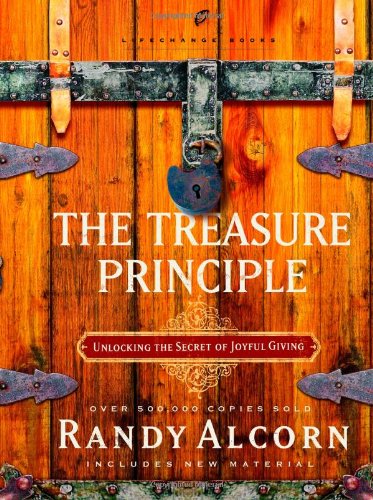
The Treasure Principle (book review)

One of the knocks I often hear about the church is that we talk too much about money. I don’t feel that’s an accurate assessment, especially considering that Jesus talked about money and possessions more than He did about Heaven and Hell. In The Treasure Principle: Unlocking The Secret Of Joyful Giving, Randy Alcorn shares the keys that Jesus taught about this important topic.

In just the first few pages, Randy sets the stage for this book by stating:

“Why did Jesus put such an emphasis on money and possessions? Because there’s a fundamental connection between our spiritual lives and how we think about and handle money. We may try to divorce our faith and our finances, but God sees them as inseparable.”

The Treasure Principle mixes biblical instruction on handling our money, Randy’s insights into those scriptures, as well as Randy’s own personal experiences with finances. These are all used to support six treasure principle keys.

One of my favorite parts of the book comes at the very end. Randy shares “31 Radical, Liberating Questions To Ask God About Your Giving.” This is where the rubber meets the road (or the principles meet the pocketbook!). This is setup for you to read one question daily for a month, to really allow God to speak to you through His Word and through this book about your financial perspectives and practices. I thoroughly enjoyed the book, and I’m looking forward to continuing my month-long journey through these radical questions.

I am a Multnomah book reviewer.

Trading A Can For A Kid

Trade off

As we wrapped up our Bigger Than Me series last night, I asked our youth group how we could know that we are putting what we believe into action. It’s easy to deceive ourselves and say, “I’m doing a pretty good job,” but now do we know we’re doing what God wants us to do.

In Bigger Than Me we talked about stepping out of our comfort zone into The UnZone. We looked at the importance of walking in empathy (or, as we said it, walking in someone else’s flip-flops) to know what they are really feeling. Using empathy as the starting point, we then looked at the importance of praying for other people’s needs as though they were our own. And then we talked about how one person doing the right thing—even though nobody else is—made it easier for others to make the choice to do the right thing too.

So here’s the big ask. How do we put this into action? How do we join faith with deeds?

Our youth group was challenged to take on the responsibilities of sponsoring two students in the Latin America Child Care program. For just $64 per month, we’re making sure that two students get a school uniform, eat a healthy breakfast and lunch, get a quality education, and—best of all—have an opportunity to meet Jesus as their personal Savior.

Just $64 per month. For our youth group that’s like each person giving up one can of Pepsi, Coke, Monster (or their other favorite beverage) each month. One drink per month so that two students can have a better future.

Think about it: are you willing to trade one can for one kid? Our youth group did. They responded to the big ask, they stepped up to the challenge, they are putting their faith into action. I’m so proud of them!

How can you step up to the challenge?

The Big Ask

Tonight in our Impact! Youth service we are wrapping up a great series called Bigger Than Me. We’ve been challenging our youth to look out from themselves and see the big world around them. This has been an amazing series and I’ve been so excited to see so many students step out in a big way. You can read more here and here.

But tonight is the big ask. Tonight I’m going to challenge our students to make a commitment that’s going to hit them in a really sensitive area—their wallets. We’re going to present the opportunity to confront a real need in a very practical way: by giving money. Not just once, but every month.

Here’s the way the apostle James laid it on the line:

Dear friends, do you think you’ll get anywhere in this if you learn all the right words but never do anything? Does merely talking about faith indicate that a person really has it? For instance, you come upon an old friend dressed in rags and half-starved and say, “Good morning, friend! Be clothed in Christ! Be filled with the Holy Spirit!” and walk off without providing so much as a coat or a cup of soup—where does that get you? Isn’t it obvious that God-talk without God-acts is outrageous nonsense?

Here’s how you can be involved:

  1. Pray for me that I can present the big ask in a compelling way.
  2. Pray for our students that they’ll be moved to respond.
  3. Check out my blog tomorrow for an update on tonight’s response, and to see how you can help too.

I can hardly wait!