Beware Of The Sneaky Bite

Listen to the podcast of this post by clicking on the player below, and you can also subscribe on AppleSpotify, or Audible. 

Check out a couple of ways I could greet you in this post:

  1. It’s great to see all of you today. I am really glad you stopped by my blog. 
  2. In fact, no one is as astute as you are. No one digs into the Scripture the way you do. There is no one else in the world that I would want visiting my blog today. 

What did I just do? I went from genuinely complimenting you to flattering you. I bit you. Flattery is a sneaky bite that we need to be aware of. 

A compliment is simply defined as an expression of praise or admiration. 

Flattery, on the other hand, crosses the line. It’s defined as trying to please someone by excessive or insincere praise. The reason why I call flattery a bite is because the flatterer is only thinking about himself, not about you. 

Flatterers are trying to get something for themselves. See how the rich young man tried to do this by flattering Jesus in Mark 10:17. The Amplified Bible brings out the man’s flattery more clearly: Teacher, You are essentially and perfectly morally good. 

(You can read all of the Scriptures I reference in this post by clicking here.)

This man was looking for the secret formula that would get him into Heaven, so he wasn’t complimenting Jesus but flattering Him to get a favorable answer. 

Jude described these pseudo-religious people as ones who “flatter others for their own advantage” (Jude 1:16). The NKJV says they use “great swelling words.” Peter describes these same kinds of people as speaking “great swelling words of emptiness” (2 Peter 2:18). 

Flatterers are trying to trip you up so they are recognized as your superior. Once again, we can see how tricksters tried this tactic on Jesus in Mark 12:14. We know they are insincere because of the background information Mark gives us in vv. 12-13. 

David described flatterers in Psalm 12:1-3. The AMPC says they talk “with flattering lips and double heart” and The Message paraphrases it, “Lies slide off their oily lips. They doubletalk with forked tongues” (v. 2). 

Solomon warns us of the net they are setting for us: Those who flatter their neighbors are spreading nets for their feet (Proverbs 29:5). 

Flatterers are trying to cover up their own sinfulness. David again diagnoses this in Psalm 36:1-4. This also means that sometimes we can flatter ourselves to avoid dealing with our own sin. 

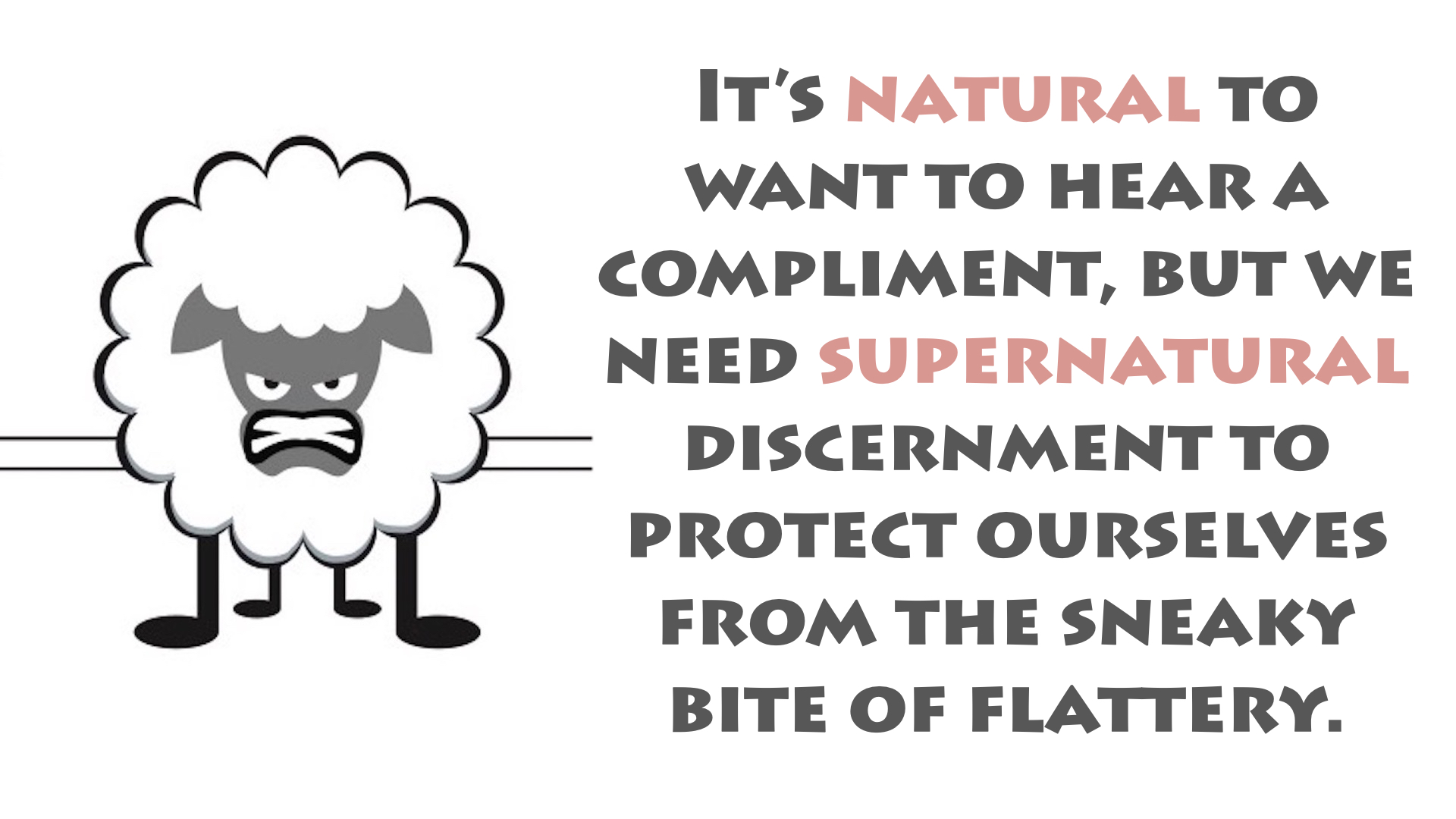
It’s natural to want to hear a compliment, but we need supernatural discernment to protect ourselves from the sneaky bite of flattery. 

Look how Jesus did this in Mark 10:17-18. Remember the Amplified Bible that laid it on so thick? Jesus responded correctly: “There is no one essentially and perfectly morally good—except God alone” (v. 18). If we are going to do any comparing at all, let’s compare ourselves to our perfect God and Savior. Remember, we have done a self-check (Psalm 26:2) so we know what’s really there! 

Swallowing this flattery only fuels the pride inside us. C.S. Lewis warned, “It was through Pride that the devil became the devil; it is the complete anti-God state of mind. … Pride is a spiritual cancer: it eats up the very possibility of love, or contentment, or even common sense.” 

Look at the other example from Jesus in Mark 12:12-15. When Jesus sensed their flattery, He called it what it was: hypocrisy! 

What we all need instead is God-fearing friends who speak the truth in love (Proverbs 27:6, 9). 

Flattery makes you feel like you’re on top of the world. Flattery makes you forget the things the Holy Spirit has revealed to you that needs work. But Jesus asked, “What do you benefit if you gain the whole world but lose your own soul?” (Mark 8:36 NLT). 

The sincerest compliment we should all be living to hear is, “Well done, good and faithful servant! Enter into your Master’s happiness forever and ever!” No other voice matters! 

Check out the other messages in this series called When Sheep Bite Sheep by clicking here. And if you are a pastor, check out my book When Sheep Bite. 

►► Would you please prayerfully consider supporting this ministry? My Patreon supporters get behind-the-scenes access to exclusive materials. ◀︎◀︎
When Shepherds And Sheep Talk

Listen to the podcast of this post by clicking on the player below, and you can also subscribe on AppleSpotify, or Audible. 

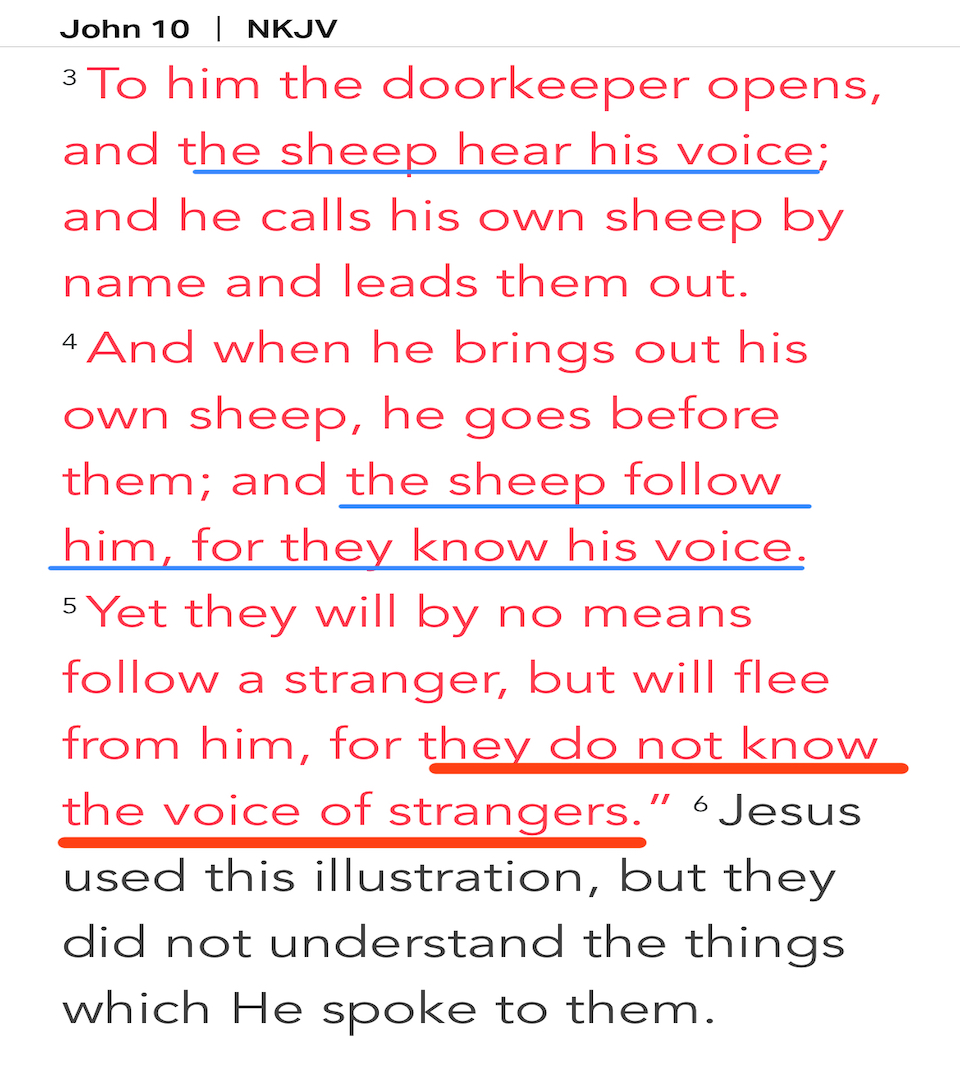
In John 10:1-18, Jesus calls Himself the Good Shepherd, and He refers to those who follow Him as His sheep. 

Anyone who has ever seen a shepherd interact with his sheep knows that the sheep are listening for their shepherd’s voice to give them direction, but they will ignore or run away from a stranger’s voice. 

(You may want to check out this video clip where I talk about how shepherds individualize their care for their sheep.)

This requires two-way communication. The shepherd must speak tenderly and convincingly, and the sheep must remain tuned in to their shepherd’s voice with an ear to follow. 

This requires proximity. The shepherd cannot speak from a distance without raising his voice, and sheep will never be attracted to someone who yells at them. 

This requires consistency. The shepherd needs to continually speak life-giving words, and the sheep need to consistently obey the shepherd’s words in order to reap the benefits. 

This requires discernment. The sheep have to be able to know the difference between their shepherd’s voice and a stranger’s voice. The shepherd needs to speak “words of eternal life” (see John 6:68-69). 

This requires patience. A shepherd’s directions really “get through” the first time, so the message needs to be patiently, lovingly, and creatively repeated. 

This requires abiding. The shepherd needs to show himself trustworthy, and the sheep need to show themselves faithful in their abiding with their shepherd. 

Jesus is the good and perfect Shepherd. There is no one else to whom I should be trusting, abiding with, listening to, and obeying. 

The Good Shepherd will call some of His sheep to serve as His under-shepherds for other sheep. Those under-shepherds bring the Good Shepherd glory by shepherding just as Jesus models for them. 

When shepherds and sheep remain in constant communication, there is a vitality and maturity that is readily apparent. And when the communication breaks down, the health of the sheep quickly deteriorates. 

If you have been called to be an under-shepherd, please check out my books Shepherd Leadership and When Sheep Bite that will give you practical, biblical guidelines for you to thrive in this beautiful ministry. 

►► Would you please prayerfully consider supporting this ministry? My Patreon supporters get behind-the-scenes access to exclusive materials. ◀︎◀︎

Go Deep—The Gifts Of Healing, Miracles, Prophecy, Discernment, Tongues, And Interpretation

According to 1 Corinthians 12-14, the Holy Spirit operates in nine different gifts to both evangelize the sinner and edify the saints. The apostle Paul says that these gifts are available to all Christians who will allow the Holy Spirit to operate through them.

You may download the participant’s notes for this lesson here → Go Deep – operational gifts of healing, miracles, prophecy, discernment, tongues, interpretation

If you have missed any of the lessons in this series, you can find the complete list by clicking here. You may also be interested in our Go Deep series on the motivational gifts listed in Romans 12, which you can check out here: Go Deep—An Introduction To The Motivational Gifts

If you would like to join us in person for this class, here is where you can find us.

Am I The Genuine Article?

Examine and test and evaluate your own selves to see whether you are holding to your faith and showing the proper fruits of it. Test and prove yourselves… (2 Corinthians 13:5). 

The root word for discern in the New Testament Greek is dokimazō. This word means to examine something—scrutinize it closely—to see if it is genuine. We’re instructed to take a close, scrutinizing look at…

  • …our beliefs about God (Romans 1:28)
  • …our understanding of God’s will for our lives (Romans 12:2)
  • …our relationship with God and others (1 Corinthians 11:28) 
  • …our faith (2 Corinthians 13:5)
  • …our motives (2 Thessalonians 2:4)
  • …the teaching we are listening to (1 John 4:1) 

In his book Romans: God’s Glory, Donald Grey Barnhouse discussed the root word for discern (the Greek word dokimos). He said, 

“In the ancient world there was no banking system as we know it today, and no paper money. All money was made from metal, heated until liquid, poured into moulds and allowed to cool. When the coins were cooled, it was necessary to smooth off the uneven edges. The coins were comparatively soft, and of course many people shaved them closely. In one century, more than eighty laws were passed in Athens to stop the practice of whittling down the coins then in circulation. But some money-changers were men of integrity, who would accept no counterfeit money; they were men of honour who put only genuine, full-weight money into circulation. Such men were called dokimos, and this word is used here for the Christian as he is to be seen by the world.” (emphasis mine)

This should be said of every Christian: “They are dokimos—men and women who are honorable and are the real deal. They don’t shave anything off; they don’t water anything down. They can be scrutinized closely and found to be the genuine article.” 

The Bible makes it clear that before the world can call us dokimos, the Holy Spirit first has to stamp that word on us. It’s only after we have allowed Him to scrutinize (and correct) our beliefs, relationships, faith, and motives that we can be labeled dokimos. When we are the real deal in His presence, the world cannot help but see the genuine article when they examine us. 

Let’s live this way! May both God and the watching world be able to call us dokimos! 

Thursdays With Oswald—Jeremiah 11

Oswald ChambersThis is a weekly series with things I’m reading and pondering from Oswald Chambers. You can read the original seed thought here, or type “Thursdays With Oswald” in the search box to read more entries.

Jeremiah 11 

[These are notes from Oswald Chambers’ lecture on Jeremiah 11.]

     Misapprehensions of God arise from not understanding that His way for us is obedience until we discern, not waiting to obey until we know. The only way to know God more fully is to obey what we have discerned, then we shall know something more. …  

     If we will obey, we are backed by Omnipotence; but if once we begin to be cunning and suspicious and to doubt, we are backed by diabolical inspiration as compelling on the wrong side as obedience is on the right. … 

     Unless we keep in touch with God by obedience it is possible to pray for a wrong thing. In this case [Jeremiah 11:9-11] the people have rebelled and do not intend to obey, they only pray because they are suffering, not because they want God’s will to be done in them. … 

     “My Lord and I” is a very beautiful sentiment, but before we know it as a living experience we have to fight our way through all the contradicting things to the un-afraid, simple life that trusts in God. 

From Notes On Jeremiah

Most of us have an attitude that says, “As soon as I understand, I will fully believe.” But Oswald Chambers points out that the Scriptures teach that we are to be fully obedient to what has already been revealed to us in order to receive more revelation. 

A loving God would not reveal things to us that we are not yet ready to obey. So if you want God to show you deeper things, obey what He’s already shown you. 

Saturday In The Proverbs—If … Then (Proverbs 2)

[Each chapter in the Book of Proverbs contains thoughts that fit into a theme; they are not just random thoughts gathered together. In this “Saturday In The Proverbs” series, I will share a theme that I see in each chapter. But the cool thing about God’s Word is that you may see an entirely different theme. That’s great! If you do, I would love for you to share it in the comments below.]

…if you will receive My words… (Proverbs 2:1).

Some people find this hard to fathom, but it’s an undeniable truth—God wants to bless you!

But His blessings will only come in His ways. You cannot do what you want to do and expect God to bless that behavior. Proverbs 2 tells us that IF we will do what God asks, THEN God will pour out His blessings.

IF

  • receive God’s Word
  • treasure His commands
  • incline your ear to His wisdom
  • apply God’s understanding to your life
  • cry out for God’s discernment
  • lift up your voice for God’s understanding
  • seek God’s wisdom
  • search for God like it’s treasure

THEN

  • you will understand the fear of the Lord
  • you will find God’s knowledge
  • you will gain God’s understanding
  • you will have God’s protection
  • you will understand God’s righteousness and justice
  • you will be preserved by discretion
  • you will be saved by understanding
  • you will be delivered from evil
  • you will be kept from immorality

If I will do what God says, then God opens His storehouse of invaluable treasures!

Tuning Out Enemies

“…they thought to do me harm”Nehemiah

Nehemiah had enemies on almost every side as he attempted to complete his work (the rebuilding of the wall around Jerusalem). Check out his enemies’ strategy and his response to them—

Enemy’s tactic #1—Get Nehemiah preoccupied with attending meaningless meetings.

Nehemiah’s response—“I’m doing a great work; I can’t come down. Why should the work come to a standstill just so I can come down to see you?”

Enemy’s tactic #2—Send out letters slandering Nehemiah.

Nehemiah’s response—“There is no truth in any part of your story. You are making up the whole thing.” Then he prayed, “God, give me strength.”

Enemy’s tactic #3—Try to scare Nehemiah into running away.

Nehemiah’s response—“Should someone in my position run from danger? I know that God wouldn’t like that.”

Nehemiah had a vision from God and he stayed focused on that.

  • It determined his priority
  • It set his daily agenda
  • It gave him discernment
  • It gave him courage

The result: “When all our enemies heard [that we had completed our project]…they were frightened and humiliated. They realized this work had been done with the help of our God.”

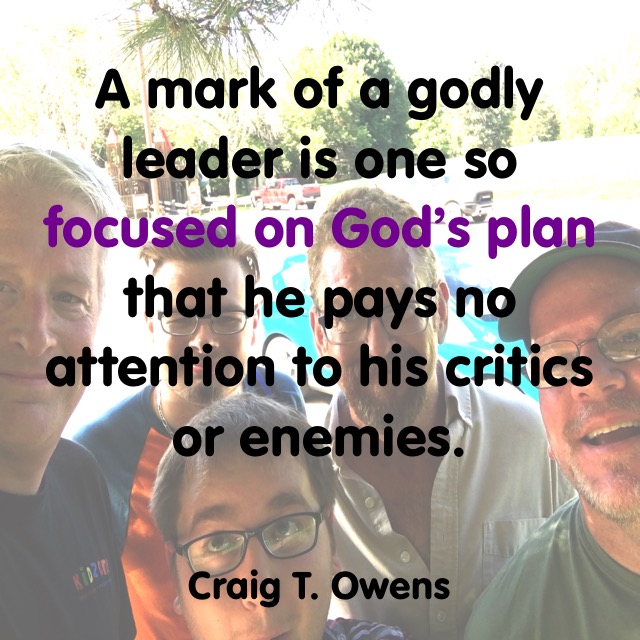
A mark of a godly leader is one so focused on God’s plan that he pays no attention to his critics or enemies.

This is Part 7 in my series on godly leadership. To read my other posts, please click here.

The Promised Power Of Pentecost

When the Israelites were delivered from Egypt on the night of Passover, fifty days later they arrived at Mount Sinai where God delivered the Ten Commandments to them. This became the birth of the Jewish nation. For millennia following this, not only did the Jewish people observe Passover but they also celebrated “The Feast of Weeks” (also known as Pentecost) fifty days following Passover.

But on the first Pentecost after Christ ascended to Heaven, something amazing happened which was a game-changer for the new Christians. An event which became the birth of the Christian nation.

On that Pentecost Sunday, the Holy Spirit was poured out on Christ’s followers in a way never before seen in history. Although this had never been seen before, it was the fulfillment of something God had promised thousands of years before.

  1. Promised

This blessing of the Holy Spirit had been hinted at when God first called Abraham, as He promised that from Abraham would come a blessing for all peoples on earth (Genesis 12:3). Jesus said that this blessing would be realized with the outpouring of the Holy Spirit, and then Peter tied the Day of Pentecost experience to the fulfillment of those promises (Acts 2:38-39).

  1. Commanded

Jesus had this empowerment of the Holy Spirit and He wanted all of His followers to have it too, so His directive to His follower is not a suggestion. Twice when Jesus tells His followers to receive the baptism in the Holy Spirit, the verbs He uses are commands (see Luke 24:49 and Acts 1:4).

  1. Normal Experience

For the first Christians, the baptism in the Holy Spirit was a normal experience for them following salvation. This baptism gave them power to…

  1. Initial Evidence

The baptism in the Holy Spirit is accompanied by an initial physical evidence of speaking in a language you’ve never studied. This is to be an unmistakable proof—primarily to you—of the Spirit’s outpouring. But the ongoing development of Christlike character is the continual evidence of the baptism in the Holy Spirit.

So what’s the controversy? Why do people spend so much time arguing this baptism isn’t for us, or for now? If we start down that path, what else are we going to say is outdated or exclusive for some?

Doesn’t it seem much more logical to simply accept what God promised all His people?!

So here’s the question I would ask you—Have you been baptized in the Holy Spirit? If not, why not?

10 Blessings From Obeying God’s Word

Listen to the podcast of this post by clicking on the player below, and you can also subscribe on AppleSpotify, or Audible. 

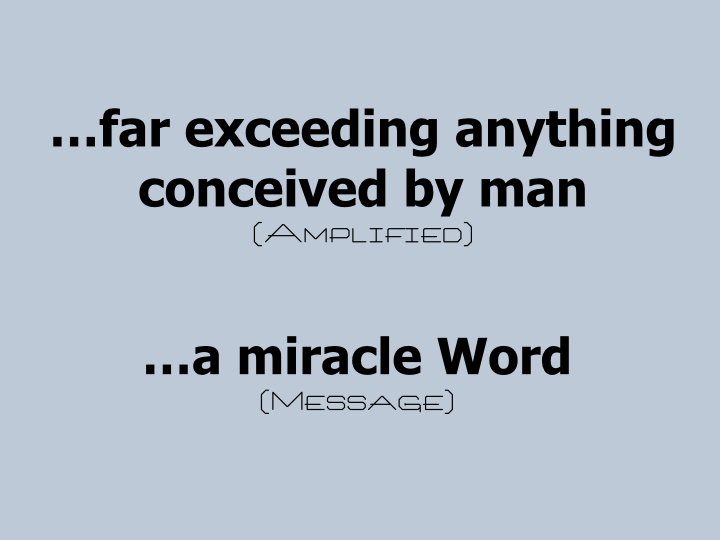
The entire 119th Psalm is a love song to God for His amazing Word. Quite simply it is “far exceeding anything conceived by man” (v. 129, AMP) and “a miracle Word” (v. 129, MSG).

In the 8-verse section called Pe, the psalmist says, “I can’t think of any better response to Your Word than to obey it!” In Pe, here are ten blessings that come with that obedience—

  1. Light … this is the discernment that allows for the “Aha!” revelations of the Holy Spirit.
  2. Understanding … the blessing of comprehending what God is saying to us.
  3. Longings fulfilled … nothing but God’s Word will ever satisfy like God’s Word!
  4. More clearly seeing God’s face as He shines upon us.
  5. God’s mercy and favor.
  6. A greater understanding of God’s love.
  7. Secure paths that keep us from sin’s snares.
  8. Freedom from satan’s extortions … this is literally what the phrase redeem me from the oppression means in verse 134.
  9. Greater obedience.
  10. Learning God’s Word so that I can teach it to others.

The psalmist also gives us good insight into how to respond to those who reject God’s Word: Rivers of tears gush from my eyes because people disobey Your instructions” (v. 136). With all the blessings that come from obeying God’s wonderful law, why would you ever want to try to live any other way?!

If you have missed any of the messages in our P119 series, you can access them all by clicking here.

►► Would you please prayerfully consider supporting this ministry? ◀︎◀︎

The Counselor

The CounselorThere are several people in the Bible that are called “a counselor.” But there is only One Who is called “the Counselor.” This is the title Jesus gave to the Holy Spirit, when He said One was coming Who would be of invaluable help to us.

This Sunday is Pentecost Sunday. On that first Pentecost after Christ’s ascension, something amazing happened to the followers of Jesus—they were baptized in the Holy Spirit. The Counselor saturated their lives with His wisdom.

From this moment the Christians operated in extraordinary wisdom, power, discernment, boldness, and effectiveness.

Josh McDowell points out, “By AD 100, the apostles had died, but the Christian Church was still in its infancy, with fewer than twenty-five thousand proclaimed followers of Christ. But within the next two hundred years, the fledgling church experienced explosive multiplication of growth, to include as many as twenty million people. This means the church of Jesus Christ quadrupled every generation for five consecutive generations!” (emphasis added)

This type of growth was only possible because of the counsel The Counselor imparted every day to these new Christians. And this same counsel and help and empowerment is available to all Christians today!

This Sunday at Calvary Assembly of God we begin a new series called “The Counselor.” If you are in the Cedar Springs area and don’t have a home church, I invite you to come join us to learn more about this power that is for you.