Let’s Grow Together

Listen to the podcast of this post by clicking on the player below, and you can also subscribe on AppleSpotify, or Audible. 

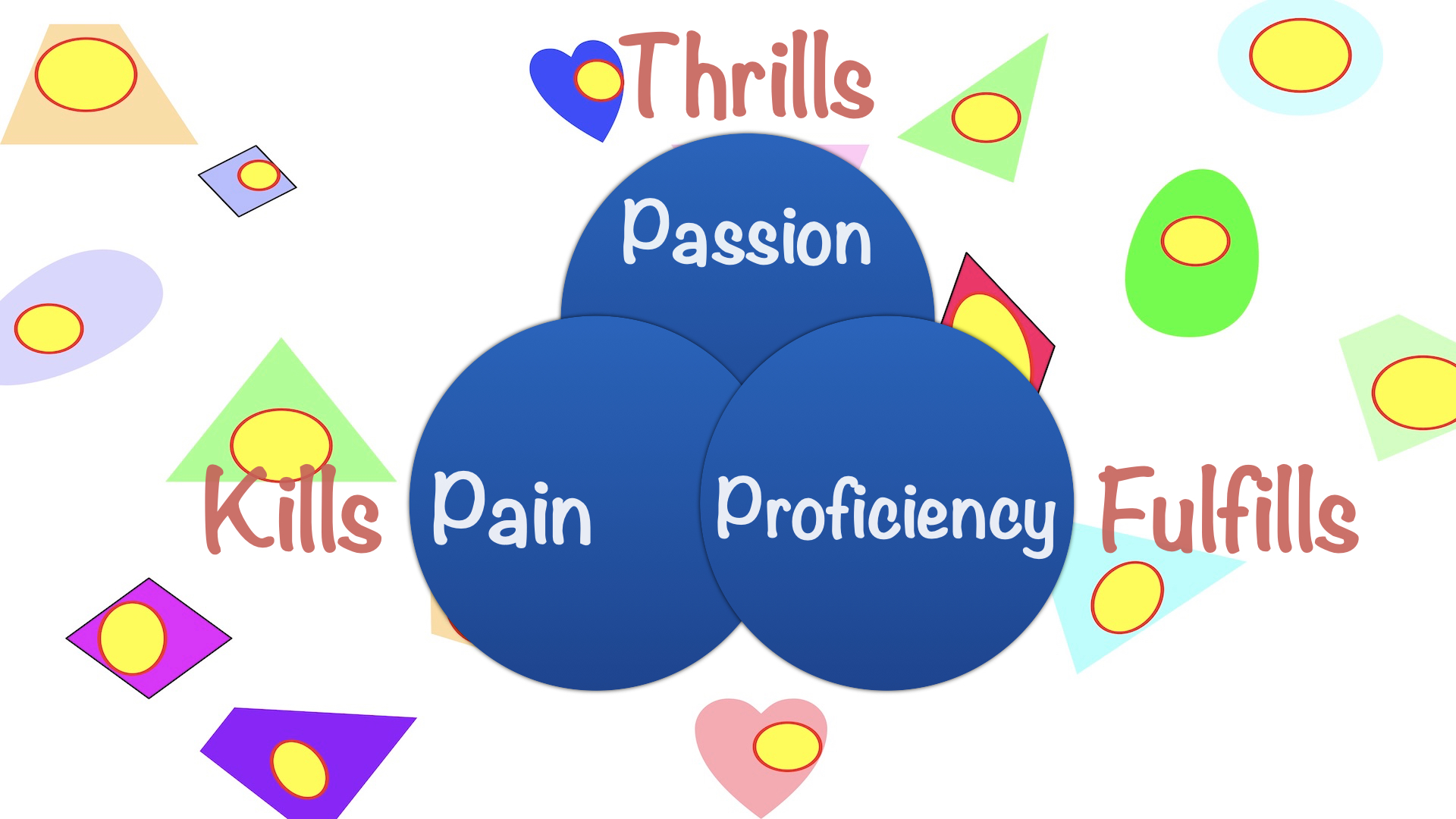
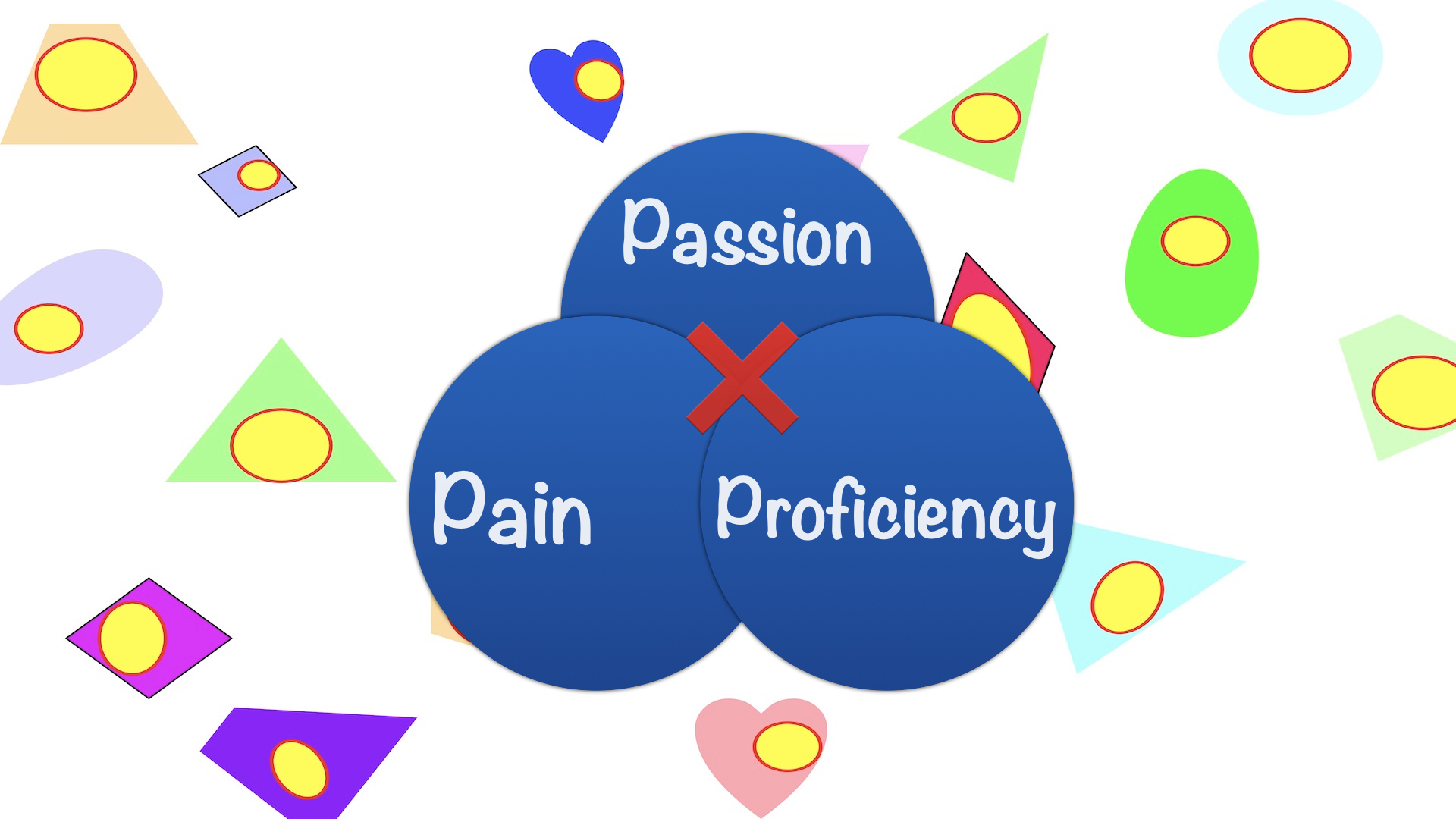
We’ve now learned about all three circles that help us discover our God-implanted gifts: 

  • Passion—what thrills you? 
  • Pain—what kills you? 
  • Proficiency—what fulfills you? 

What do you do with these gifts? What’s the whole purpose in learning about them? I think the goal as saints is to help the Body of Christ mature in ways that brings God glory (Ephesians 4:12-16). 

(Check out all of the Scriptures in this post by clicking here.) 

Solomon also gives a great word picture of friends using their gifts for each other—“As iron sharpens iron, so a friend sharpens a friend” (Proverbs 27:17 NLT). 

In an earlier message in this series, I talked about the thousands of enzymes in our human bodies. Each enzyme has just one task, and each task is indispensable to the health of the whole body. It is exactly the same in the Body of Christ—your gift-in-action is indispensable to the health of the whole Body.

How do you squander your grace gift? I think these are five basic ways:

  1. Not discovering it—“I have a gift?” 
  2. Devaluing it—“My gift is nothing special.” 
  3. Overvaluing it—“My gift is super-important.” 
  4. Laziness—“My gift is fine just the way it is.” 
  5. Selfishness—“My gift is just for me.” 

We need to discover our own gifts, but then we need to work on making the switch from “me” to “we.” I want to excel in using my gift so that I can help you excel in using your gift so that we can help another brother or sister excel in using their gift. 

Oswald Chambers said, “The Book of God is insistent on this: we cannot develop a holy life alone, it would be a selfish life, without God in it and wrong. … Beware of isolation; beware of the idea that you have to develop a holy life alone. It is impossible to develop a holy life alone, you will develop into an oddity and a peculiarism, into something utterly unlike what God wants you to be. The only way to develop spiritually is to go into the society of God’s own children, and you will soon find how God alters your set.” 

Frequently we need another brother or sister in Christ to help nudge us into discovering and using our gifts. For example, look how…

  • Mordecai assured Esther (Esther 4:13-14) 
  • Matthias was chosen by those in the upper room (Acts 1:21-26) 
  • The first deacons were unanimously chosen by the Church (Acts 6:3-6) 
  • Barnabas and Saul were chosen by the Holy Spirit and confirmed by other prophets and teachers in the church (Acts 13:1-3) 
  • Paul encouraged his proteges to appoint elders who were recognized by others in the church (Titus 1:5; 1 Timothy 3:1f) 

Consider this poem—

For want of a horseshoe nail the shoe was lost.
For want of a shoe the horse was lost.
For want of a horse the rider was lost.
For want of a rider the message was lost.
For want of a message the battle was lost.
For want of a battle the kingdom was lost.
And all for the want of a horseshoe nail.


Listen to the Holy Spirit. Listen to the confirming words from fellow saints—words like “You are gifted,” “You are so good at…,” and “How did you know how to do that?” Then step out of your comfort zone and soar into your gift zone! 

If you’ve missed any of the other messages in our Living in your gift zone series, you can check them all out here. 

►► Would you please prayerfully consider supporting this ministry? My Patreon supporters get behind-the-scenes access to exclusive materials. ◀︎◀︎
Stewarding Your Gifts Into Strengths

Listen to the podcast of this post by clicking on the player below, and you can also subscribe on AppleSpotify, or Audible. 

We have been learning about how God gifts us so that He can use us to build His kingdom. Discovering these gifts and then living in this gift zone is going to require us to stretch out of our comfort zone. So far, we’ve looked at two factors: 

  • Passion—what thrills you? 
  • Pain—what kills you? 

As you look back, the things that thrill you and kill you have probably remained consistent through your life. You may recall moments where implementing your gifts went very well and times when it didn’t go so well. The former makes us ready to try again and maybe expand a little further, but the latter tempts us to shrink back into our comfort zone. The key is to find out how we can be more consistent in using our gifts productively. 

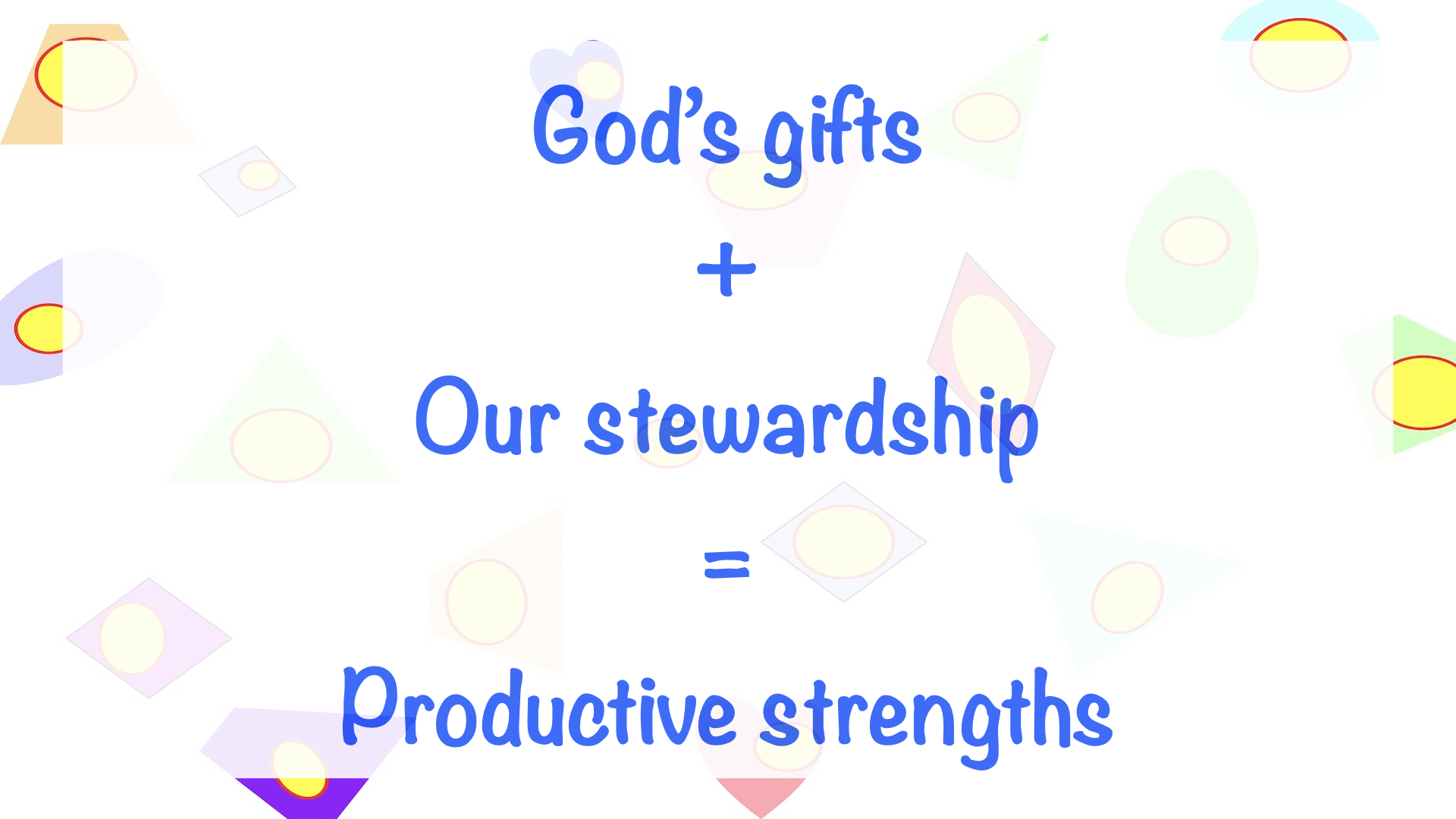
It looks like this: God’s gifts + Our stewardship = Productive strengths. 

God gives the gifts as only He knows best (Psalm 139:16; Romans 12:6; 1 Corinthians 12:11) and then we steward these gifts into productive strengths. 

(Check out all of the Scriptures in this post by clicking here.) 

What does stewardship mean? 

  • The dictionary defines it as the responsible overseeing and protection of something considered worth caring for and preserving. 
  • The Bible always portrays a steward as the one in charge of the precious things in a household—in our case, the Church. 

Jesus makes the role of a steward very clear in his parable found in Matthew 25:14-27. Notice three important things:  

  1. The master gave gifts to everyone of his servants, but he gave “each according to his ability” (vv. 14-15). 
  2. The wise servants stewarded the master’s gift by that way they “put his money to work” (vv. 16-18) 
  3. The master demanded accountability of all of his servants. Two servants acknowledged “you entrusted me” with these gifts (vv. 19-23), while one said, “I was afraid” (vv. 24-27). 

God created each of us on purpose and for a purpose. He gave us the gifts we need to accomplish that purpose. We will only find our fulfillment in life in stewarding those God-given gifts and opportunities in ways that glorify Him. Not only fulfillment here, but then eternal satisfaction when we hear our Savior say, “Well done, good and faithful servant! Enter into your Master’s happiness!” 

The only servants that heard the “well done” from their master were those who realized it was “your money…entrusted” to me. I like how Eugene Peterson brings this out in his paraphrase: 

Make a careful exploration of who you are and the work you have been given, and then sink yourself into that. Don’t be impressed with yourself. Don’t compare yourself with others. Each of you must take responsibility for doing the creative best you can with your own life. (Galatians 6:4-5 MSG) 

So let’s add one more circle to the passion and pain circles, and that is the circle of proficiency. This is what fulfills us because we can do it so well; it feels so natural for us to be doing this. Proficiency is what really brings together the passion and the pain, and it helps us find the sweet spot. 

Let me give you a couple of examples—one from the Old Testament and one from the New Testament. 

Nehemiah was killed that Jerusalem was in shambles and the people were disgraced (Nehemiah 1:3-4)—that’s what killed him. Nehemiah didn’t go to wall-building school, but he effortlessly strategized, cast vision, organized, planned, procured, and adapted—that’s his proficiency. The wall was built in 52 days, Israel’s enemies were disgraced, and the people had a place to worship again (Nehemiah 6:15-16, 9:1-3)—that’s what thrilled him. 

The apostles and the first deacons in the New Testament church saw that some of the widows were being overlooked in the food distribution (Acts 6:1)—this is what killed them. These new leaders didn’t go to food-distribution school, but they effectively strategized, cast vision, organized, planned, procured, and adapted (v. 3)—this is their proficiency. The widows were cared for, the Word of God spread, and more people became Christians (v. 7)—that’s what thrilled them. 

God gives gifts—we feel that in what thrills us and what kills us. We steward those gifts into productive strengths—we stick with what we fulfilled in doing. Our productive strengths then glorify God as we strengthen and grow the Body of Christ. 

Let me give you four things to consider about your area of proficiency:

  1. What comes easily to me? 
  2. Where do I see both the steps and the completion before others do? 
  3. Where do I experience the greatest ROI of my time and efforts? 
  4. What do I do that thrills me because I ran to because it was killing me, and now it fulfills me to keep doing it? 

With all three of these circles, please take some time to ponder what your sweet spot is. And if you’ve missed any of the messages in this series, you can find them all here. 

►► Would you please prayerfully consider supporting this ministry? My Patreon supporters get behind-the-scenes access to exclusive materials. ◀︎◀︎
What’s Your Passion?

Listen to the podcast of this post by clicking on the player below, and you can also subscribe on AppleSpotify, or Audible. 

A quick recap: We are all gifted by God, but we typically restrict ourselves to a comfort zone which is much smaller than our God-given gift zone. In order to maximize our impact for the Kingdom of God, we are going to have to get uncomfortable with staying comfortable—we are going to have to trust God as we push out further into our gifts. 

Last week I gave you a homework assignment to think about the things you love to do. Why do we need to know this? Because it is one of the indicators of our areas of giftedness. 

In the whole carrot-versus-stick discussion, you will find that most people are motivated by reward way more than they are by the fear of punishment. Look at how these God-fearing men were motivated by the God’s rewards:

  • David—1 Samuel 17:26-27, 29-30 
  • Paul—1 Corinthians 9:24; 2 Timothy 4:8 
  • Jesus—Hebrews 12:2; Philippians 2:9-11 

(Check out all of the Scriptures in this post by clicking here.)

Who’s more likely to get the reward: the one who loves what they are doing or the one who hates what they are doing? We are more likely to stick with what we love doing, and you are going to love doing what you are gifted by God to do. 

Why we do what we do is much more important that what we do (Isaiah 1:11, 13, 15; Matthew 7:22-23). 

We have been gifted by God to do great things. When we do those great things, we are rewarded and it brings God glory. That realization should answer the question of why we do what we do (Ephesians 2:10). 

The way we see the world, what motivates us, and how we act are all determined by our gifts. We are working on the same Great Commission, but how we live that out will be different because of our different gifts. 

In the Old Testament, the saints wanted Zion to be strong and God-glorifying: 

  • David fought battles and wrote worship songs 
  • Solomon gave wise proverbs 
  • Josiah brought about reforms 
  • Ezra encouraged the Israelite governor and high priest 
  • Daniel encouraged the Babylonian rulers 
  • Nehemiah built the wall

In the New Testament era, the saints should all want the Body of Christ to be strong and God-glorifying. Toward that goal, we still need warriors, worshipers, wisemen, reformers, teachers, counselors, workers. 

Toward that goal, we all have a part to play (Ephesians 4:12). Check out the example of Paul in…

  • …Thessalonica: Paul was in the synagogue on three Sabbaths (Acts 17:1-2; 2 Thessalonians 3:8)  
  • …Corinth: Paul was synagogue on the Sabbath days, but after Silas and Timothy arrived, Paul was able to be preaching every day for 18 months (Acts 18:1-5, 11) 

What’s the difference? Silas and Timothy used their gifts so that Paul could use his. Without the “enzyme” of Silas and Timothy’s gifting, the whole Body of Christ would have been impoverished. 

One of the things that will help your spot your areas of giftedness is noticing what you are passionate about—What do you love to do? 

Let me give you three things to consider:

  1. When can I do this again? vs. When will this be over? 
  2. When I do this, I’m tired but fulfilled vs. When I do this, I’m tired. 
  3. I would do this without pay vs. I would rather find something else to do. 

Our prayer should echo what Paul prayed:

For this reason, since the day we heard about you, we have not stopped praying for you. We continually ask God to fill you with the knowledge of His will through all the wisdom and understanding that the Spirit gives, so that you may live a life worthy of the Lord and please Him in every way: bearing fruit in every good work, growing in the knowledge of God. (Colossians 1:9-12)

If you’ve missed any of the messages in our series Living in Your Gift Zone, you can find them all here. 

►► Would you please prayerfully consider supporting this ministry? My Patreon supporters get behind-the-scenes access to exclusive materials. ◀︎◀︎
We Are All Gifted

Listen to the podcast of this post by clicking on the player below, and you can also subscribe on AppleSpotify, or Audible. 

Last week I concluded by saying I wanted to help all of us discover our God-given gifts so that we could stretch outside of our comfort zone. Remember that your comfort zone is much smaller than your gift zone. 

I’m concerned that some people might be confused about what I mean by “gifts.” Some people look at someone who can preach, or write, or sing, or compose music, or paint, and say, “They are so gifted! I could never do anything like that.” Yes, those are very visible gifts, but let’s not limit “gifts” to just those kinds of things. 

God has designed our physical bodies to do some astounding things! We see some people using their bodies to run fast, jump high, lift heavy things, or catch a ball, and we may marvel at their talents. These amazing feats are only possible because of a thousand other gifts. Even the simplest of tasks is far from simplistic. Isaac Newton noted, “In the absence of any other proof, the thumb alone would convince me of God’s existence.” 

Something that is invisible to the human eye but indispensable to absolutely everything that happens in our physical bodies is the vital functions of enzymes. 

Enzymes are proteins that help facilitate metabolism, or coordinate a chemical reaction. Some enzymes build things up and some break things down. Enzymes help with things like… 

  • turning the food we eat into energy 
  • breathing 
  • building muscle 
  • nerve function 
  • ridding our bodies of toxins 

There are thousands of individual enzymes in the body. Each type of enzyme only has one job. 

For example, consider the enzyme sucrase. If it is deficient in the body, sucrose from food isn’t broken down to glucose and fructose. As a result we would experience dehydration, malnutrition, and developmental delay. 

Every enzyme is vital. It’s not coincidental at all the the New Testament uses the analogy of our physical bodies to portray the Body of Christ (Romans 12:3-6; 1 Corinthians 12:6, 18, 27). 

(Check out all of the verses in this post by clicking here.)

In the New Testament church it’s easy to spot the highly visible gifts like preaching, evangelism, and church leadership, just as it’s easy to spot physical accomplishments like a professional athlete or a world-class pianist. But let’s not overlook the thousands of indispensable “enzymes” in the Church that allow the Body of Christ to function in a healthy way. 

Read through the Book of Acts and you will see gifts in the form of people who…

  • agreed together in prayer 
  • affirmed God-honoring, biblical decisions 
  • organized feeding programs 
  • hosted people in their homes (house churches) 
  • prepared food for others 
  • handed out that food 
  • sewed clothes for those who needed them 
  • faithfully visited the sick and imprisoned 
  • earned a paycheck to pay for ministry expenses 
  • distributed funds to those in need 
  • used their official positions open doors or provide protection 
  • wrote important correspondence

Peter wrote, “God has given each of you a gift from His great variety of spiritual gifts. Use them well to serve one another” (1 Peter 4:10). 

What happens if an “enzyme” is missing? Quite simply: The Church cannot grow to our full potential (1 Corinthians 12:26 AMPC; Ephesians 4:12-13). 

Each of us needs all of us. All of us needs each of us. Jesus hasn’t just saved you from death, He has also saved you to life—an abundant life for you, for the Body of Christ, and for those who don’t know Him as their Lord and Savior yet. 

You are gifted. More precisely said: You ARE a gift! 

If you’ve missed any of the other messages in this series, you can check them all out here. 

►► Would you please prayerfully consider supporting this ministry? My Patreon supporters get behind-the-scenes access to exclusive materials. ◀︎◀︎

Links & Quotes

By it’s very definition, stepping out of your comfort zone is UNcomfortable and sometimes fearful. God promises to be close by while you’re in the Discomfort Zone!

I have lots of new content every week, which you can check out on my YouTube channel. 

Scientists have long endeavored to comprehend the transformations that take place in trees and plants throughout the autumn season. While lacking complete knowledge, they possess sufficient understanding to explain the fundamental aspects of these spectacular displays. Interestingly, the colorful leaves are not only aesthetically pleasing, they also serve a crucial role in the trees’ survival.

“Some believe it is only great power that can hold evil in check, but that is not what I have found. I have found it is the small everyday deeds of ordinary folk that keep the darkness at bay. Small acts of kindness and love.” —J.R.R Tolkien

“It cannot be exaggerated how much God hates our trying to do His work when it comes to vengeance or vindication. Whether it be vengeance or vindication, either is solely the Lord’s sovereign right. He does not like it when you or I try to punish someone, to vindicate ourselves, making ourselves look good or clearing our own names.” —R.T. Kendall

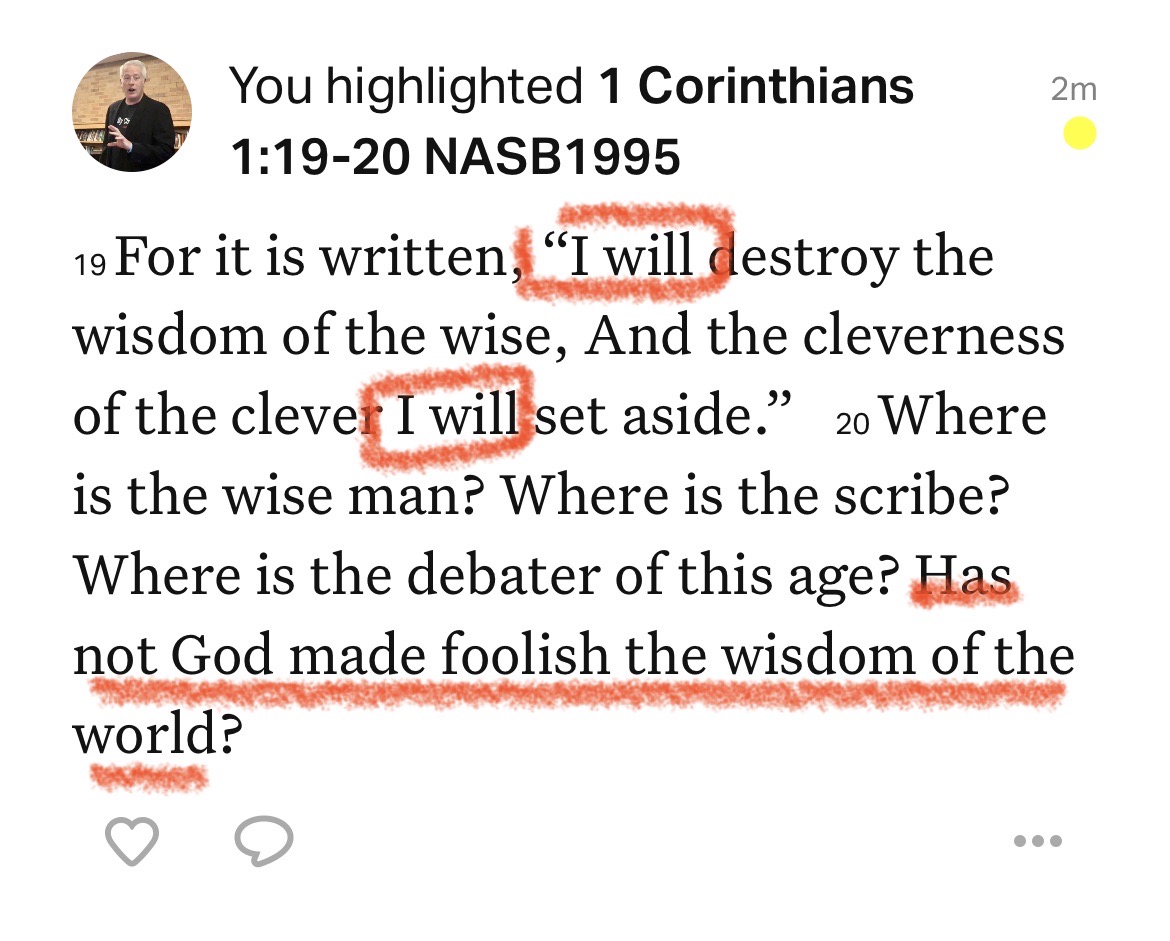
The world’s arguments are a lot of noise and very little substance. Don’t get into a shouting match, but quietly, gently, and respectfully keep returning to God’s Word. Charles Spurgeon was once asked how he could defend the Bible and he responded, “The Bible is like a lion: I let it out and it defends itself!”

Getting Uncomfortable With Staying Comfortable

Listen to the podcast of this post by clicking on the player below, and you can also subscribe on AppleSpotify, or Audible. 

We as a Church are underperforming. How do I know this? Look at the way the world treats Christians; specifically, look at what’s NOT happening. 

  • By this all will know that you are My disciples, if you have love for one another” (John 13:35). Jesus said this right after He served His disciples by washing their feet. Is this happening today: Do people know you are a Christian by the way you put your love into servant-hearted action, or do they just know what you are against? 
  • “Be prepared to give an answer to everyone who asks you to give the reason for the hope that you have” (1 Peter 3:15). When was the last time someone saw your hope-filled life in such contrast to everyone else’s response that they said, “How can I have what you have?” 

(Find all of the Scriptures I’ve used in this post by clicking here.)

Peter said our adversary prowls like a lion. He is perfectly willing to bide his time, picking the strategy that works best. One of his favorite strategies is lies—sometimes half-truths or out-of-context truths. 

…Woe to the earth and the sea, because the devil has gone down to you! He is filled with fury, because he knows that his time is short. … The dragon was enraged with the woman and went off to make war against the rest of her offspring—those who obey God’s commandments and hold to the testimony of Jesus (Revelation 12:12, 17). 

Lies are his native tongue. He lied to Adam and Eve right in the beginning (Genesis 3:1, 4-5), and he still lies now (Revelation 12:10). Jesus contrasted this with the truth that He came to proclaim (John 8:42-45). 

The devil has learned that with many people, outright attacks drive them TO God. We see this in the oldest book of the Bible (Job 1:6f, 20-22), and in modern times (churches were filled after the 9-11 terrorist attacks). 

What the devil would rather do is lie to you to keep you comfortable. In The Screwtape Letters, Screwtape implores Wormwood to keep his patient indifferent and comfortable. Indeed, we all have a comfort zone and we love to stay in it. 

King Saul went from 3000 men to 600 men, from a full armory to only two swords, from defeating the Ammonites to being hemmed in by the Philistines. King Saul was enjoying life as the king, hanging out with his friends, sitting under a pomegranate tree, far away from his enemies. Life was good for Saul, life was familiar and comfortable. Saul was living in his comfort zone. But the comfort zone is a lousy place to live. 

In the comfort zone you only tell stories, but never live an adventure. In the comfort zone, you only hear about what God has done for others, but you never experience Him move in miraculous ways for yourself. 

God has given us all gifts so that we can live as overcomers and bring Him glory, but we settle for living only in our comfort zone. Our comfort zones are always way smaller than our gift zones, and the devil is perfectly happy to see us stay there.

Moses was comfortable in the desert, but God sent him in His power (Exodus 3:11, 14). 

David was comfortable in the pasture, but God equipped him to lead a whole nation (2 Samuel 7:18; Psalm 78:70-71). 

Jeremiah was comfortable being an anonymous priest, but God gave him words to prophesy to a wayward nation (Jeremiah 1:4-8). 

Saul was comfortable as a Pharisee, but God sent him to tell the world the Jesus is the Messiah (Acts 8:3; 1 Timothy 1:16). 

What lies have kept you in your comfort zone? 

  • Maybe a parent said, “You’ll never amount to anything.” 
  • Maybe a teacher said, “You’re slow.” 
  • Maybe a classmate said, “You’re weird.” 
  • Maybe the devil said, “You cannot make a difference in the world.” 

You need to silence those lies with God’s truth: 

  • God created me on purpose and for a purpose—Psalm 139:13-17 
  • He has given me all the gifts I need to soar—2 Peter 1:3-4 
  • He wants to help me, if I will trust Him—Isaiah 41:10, 13-14 

Charles Spurgeon said, “The extent of power God can infuse into a person is immeasurable; when divine strength is granted, human weakness ceases to be a hindrance.” 

So, friends, it’s time to get uncomfortable with staying comfortable. It’s time to stretch and soar out of your comfort zone and into more of your gift zone! 

How do you discover your gifts? That’s what we are going to unpack in this series over the next few weeks, I hope you will continue to follow along. And you can catch up on anything you may have missed in our series called Living in Your Gift Zone by clicking here. 

►► Would you please prayerfully consider supporting this ministry? My Patreon supporters get behind-the-scenes access to exclusive materials. ◀︎◀︎
10 Quotes From “Shaken”

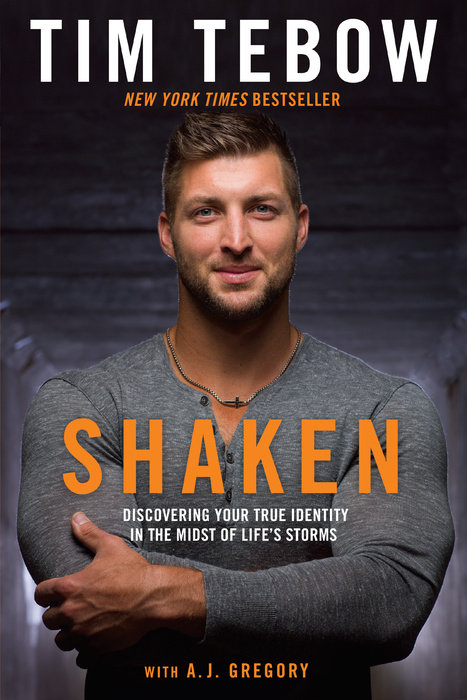
shakenTim Tebow explores what happens when your nice, neat world is shaken by the unexpected. It’s a phenomenally encouraging book! Check out my book review by clicking here. Then enjoy these quotes from Shaken.

“Sure, God loves the world, but He also loves each one of us individually. With billions of people on the planet, I know it can be hard to comprehend His love for us personally. God is infinite and focuses all of His love on you and me. He can’t spread Himself too thin. He cannot exhaust Himself. He cannot overextend Himself. And so every single person on the planet is the object of His love.”

“God can do a lot with what we think is a little. He can take something that can be described as ‘insignificant’ or ‘not enough’ or ‘small’ or ‘meaningless’ and use it to perform a miracle.”

“There will always be people in your life who will underestimate your potential, saying that you’ll never reach your dream or make that goal, or try to hold you back in some way. … Here’s the good news. What God knows about us is more important than what others think.”

“Being normal is safe. And easy. It doesn’t require much work or effort or change on our part. But it always leads to mediocrity. When we strive to be just like everyone else, we never have a chance to be special. When you start to embrace and even celebrate how special and different God made you, you can begin to do extraordinary things. You can begin to see yourself through His eyes. You can begin to live in the uniqueness with which you were created. You can be motivated and inspired to go against the grain. What does that mean? When everyone around you is picking on someone, stand up for that person. When everyone around you is using foul language, say kind things. When you see injustice and everyone else turns a blind eye, try to make it right.”

“Don’t get beat down by the stares, whispers, or obnoxious opinions of others who points out how different you are, look, or act. They don’t know God’s plan for your life. They don’t know how God can use what they may view as a weakness. If you focus on how much you hate those scars or those burns, you might missed the opportunity to encourage or inspire someone else who is going through a similar journey. … When you begin to accept how God purposely created you, you can begin to appreciate your uniqueness and allow Him to use those gifts.”

“While self-confidence is important and we should believe we can achieve great things, there must be a balance. We must be proud of our accomplishments without letting them define us.”

“When is the last time you did something different? Something beyond your comfort zone? Something that wasn’t familiar but could do a world of good in the life of another? When you stay put in your comfort zone, you don’t grow. You don’t stretch. You’re not challenged. You stay the same.”

“The stand you take may not be the biggest deal to the entire world, but it can be a big deal for one person. … A stand doesn’t always mean doing something radical. Sometimes God will use something you’ve always done in a way that’s bigger than you can imagine. Sometimes He’ll use something He puts on your heart, or maybe He’ll use your convictions, your search for the truth, your desire to do the right thing for a greater purpose.”

“We don’t have to feel led into full-time ministry before we can help the homeless or share a message of hope to someone who may need it. The only qualification necessary is willingness. I know not everyone has the opportunity to visit hospitals or prisons or make wishes come true. But there is always something you can do, even when you’re in a busy season in life. Give someone a hug. Send a text with an inspiring quote. Mail someone a heartfelt card. Donate blood. Tell someone how much you appreciate him or her. If we open our eyes, each day presents us with opportunities to do something kind or nice for someone else.”

“Don’t limit what God can do based on how you limit yourself. Be you, and let God be God.”

Thursdays With Oswald—God’s Plan For Building Spiritual Muscles

Oswald ChambersThis is a weekly series with things I’m reading and pondering from Oswald Chambers. You can read the original seed thought here, or type “Thursdays With Oswald” in the search box to read more entries.

God’s Plan For Building Spiritual Muscles

     If a man has used his arm only for writing, and then becomes a blacksmith, he will groan for days with the tremendous pain in the deltoid muscle until by practice the time comes when there is no more pain because the muscle has become rightly adjusted to its new work. 

     The same thing happens spiritually, God begins to teach us how to walk and over and over again we begin to howl and complain. May God save us from the continual whine of spiritual babes—“Teach us the same things over and over again, don’t give us the revelations of God which are painful, give us the ‘simple gospel,’ what we have always believed, don’t tell us of things we have never thought about before, because that causes pain” (Hebrews 5:12). Of course it does. 

     Thank God there is a pain attached to being saved, the pain of growing until we come to maturity where we can do the work of a son or daughter of God. … 

     Look back over your life in grace, whether long or short, and ask yourself which are the days that have furthered you most in the knowledge of God—the days of sunshine and peace and prosperity? Never! The days of adversity, the days of strain, the days of sudden surprises, the days when the earthly house of this tabernacle was strained to its last limit, those are the days when you learned the meaning of this passion of “Go.” 

From The Philosophy Of Sin

The only way to build physical muscles is to push them beyond their comfort level.

The only way to build physical stamina is to run farther than you have run before.

The only way God can build our spiritual muscles—and our spiritual stamina—is to push us beyond our comfort zone, to challenge us to go deeper and farther than we’ve gone before. Don’t push Him away. God loves you too much to leave you where you are!

11 Quotes From “Holy Fire”

Holy FireHoly Fire by R.T. Kendall is an excellent book for dyed-in-the-wool Pentecostals, and for those who believed the operational gifts of the Holy Spirit have ceased. You can read my book review by clicking here. Below are a few quotes I highlighted in this book.

“So if you feel threatened by the Holy Spirit, is it because you are happily in your comfort zone? Are you afraid of what the Holy Spirit might do to you? What He would require of you? What He might ask you to do? Do you think you will lose something if you make yourself vulnerable and totally open to Him? Are you afraid He will embarrass you? Do you think you will lose your identity? Do you think you might have to change?”

“The canon of Holy Scripture is closed. It is final. Absolute. Incontrovertible. It is God’s complete and final revelation. No word that will come in the future will be equal to the Bible in level of inspiration. This means that any leading, prophetic word, word of knowledge, or vision one may have today must cohere with Holy Scripture. If it doesn’t, it must be rejected.”

“The Holy Spirit is our best and only reliable Teacher. In fact, He is the only Teacher who matters. Whatever teaching you hear or read (including this book)—whoever the preacher or teacher, if the Spirit does not apply it and witness it to your heart (which He is most capable of doing), you should learn to hold that teaching in abeyance—if not dismiss it.” 

“The Spirit ‘guides’ us into truth—showing what is there but what cannot be seen without Him opening our eyes. It is humbling for prideful people to admit to the need of the Holy Spirit. The cost? Our pride being shattered. But once we are broken and enabled to see our stubbornness, the Spirit will show us amazing things—in Scripture.”

“The Holy Spirit leads us to praise the Lord Jesus as He deserves.” 

“Don’t come short of discovering how real God is because some well-meaning person says this kind of relationship with God is not possible today.”

“Unbelief is doubt that degenerates to a conscious act of the will. … But when we consciously decide that God did not say what He did—and we can do it better; or that He is not going to keep His word—or manifest Himself, and then put ourselves above His Word, we cross over a line. This is dangerous stuff.” 

“Do you know the context of Hebrews 13:8? Verses 7 and 9 point to one thing: sound teaching. … Whereas we have a perfect right to apply Hebrews 13:8 against cessationist teaching, the immediate context refers to doctrine. Sound theology. The writer wanted the teaching of Jesus to remain the same yesterday and today and forever. Knowing His Word and His ways.”

“What if God in some cases keeps some skeptics from seeing the miraculous even though it actually takes place? What if miracles are largely for those believers in God’s family who have accepted the stigma of being ‘outside the camp’ (Hebrews 13:13)? After all, why didn’t the resurrected Christ appear to everybody on Easter Sunday? One might choose to argue that this would have been a reasonable thing to do if God truly wanted everybody to believe on His Son. Why did Jesus reveal Himself only to a few? Why didn’t Jesus knock on Pontius Pilate’s door on Easter morning and say, ‘Surprise!’? Why didn’t Jesus go straight from the empty tomb to Herod’s palace and say, ‘Bet you weren’t expecting Me!’ He appeared only to a few—those who were His faithful followers. I also suspect that God sometimes allows just a little bit of doubt when it comes to the objective proof of the miraculous. This keeps us humbled. And sobered.” 

“The Holy Spirit can therefore be quenched by a doctrine that does not allow for Him to show up. … It also seems to me that one of the more serious fallouts of being a cessationist is that it can eliminate any expectancy for God to work powerfully in our hearts and lives. One may become too content with his or her sheer intellectual grasp of the gospel. The consequence is that we don’t even consider—much less expect—that God will manifest His power in our lives.”

“This to me is serious—and a very precarious position to take, namely, ruling out categorically the possibility of God manifesting His glory in signs and wonders today and deleting a great portion of the Bible for today. Consider how much the Bible has to say about God’s power. Healing. Signs and wonders. Revelation of truth by the Holy Spirit. Consider what is left in Holy Scripture when you rule out the miraculous or the gifts of the Holy Spirit.”

21 Quotes From “Sometimes You Win, Sometimes You Learn”

Sometimes You WinAs I mentioned in my book review (which you can read by clicking here), John Maxwell always expands my horizons with his writings. I appreciate his ability to use his own life experiences as well as historical and contemporary examples and writings. So some of my favorite quotes from Sometimes You Win, Sometimes You Learn are from Dr. Maxwell, and some are from others that he quotes. Enjoy!

“I sometimes react to making a mistake as if I have betrayed myself. My fear of making a mistake seems to be based on the hidden assumption that I am potentially perfect and that if I can just be very careful, I will not fall from heaven. But a mistake is a declaration of the way I am, a jolt to the way I intend, a reminder that I am not dealing with facts. When I have listened to my mistakes, I have grown.” —Hugh Prather

“Those who profit from adversity possess a spirit of humility and are therefore inclined to make the necessary changes needed to learn from their mistakes, failures, and losses. … When we are focused too much on ourselves, we lose perspective. Humility allows us to regain perspective and see the big picture. … Humility allows us to let go of perfection and keep trying.” —John Maxwell

“Most people spend their entire lives in a fantasy Island called ‘Someday I’ll.’” —Denis Waitley 

“An idealist believes the short-run doesn’t count. A cynic believes the long run doesn’t matter. A realist believes that what is done or left undone in the short-run determines the long run.” —Sydney J. Harris

“Those things that hurt, instruct.” —Benjamin Franklin

“You can’t grow and learn if your focus is on finding someone else to blame instead of looking at your own shortcomings.” —John Maxwell

“The highest reward for our toil is not what we get for it but what we become by it. … Mistakes are not failures. They are proof that we are making an effort. When we understand that, we can more easily move out of our comfort zone, try something new, and improve. … Improvement demands a commitment to grow long after the mood in which it was made has passed.” —John Maxwell 

“Success in most things comes not from some gigantic stroke of fate, but from simple, incremental progress.” —Andrew Wood

“The main trouble with despair is that it is self-fulfilling. People who fear the worst tend to invite it. Heads that are down can’t scan the horizon for new openings. Bursts of energy do not spring from a spirit of defeat. Ultimately, helplessness leads to hopelessness.” —Norman Cousins

“Positive thinking must be followed by positive doing.” —John Maxwell

“When you are influential and highly respected, people tend to tell you what you want to hear, not what you need to hear. They are seeking your approval, or they flatter you. Unfortunately, this creates a gap between what you hear and reality. If you find yourself in that situation, you will need to work extra hard to get the people close to you to speak honestly into your life. And you will have to become highly intentional in observing and listening.” —John Maxwell 

“Wisdom is the reward you get for a lifetime of listening when you would have preferred to talk.” —Doug Larson

“Circumstances are the rulers of the weak; but they are the instruments of the wise.” —Samuel Lover 

“Mistakes are painful when they happen, but years later a collection of mistakes is what is called experience.” —Denis Waitley

“Ninety percent of those who fail are not actually defeated; they simply quit. … As you face bad experiences, it’s important for you to remember that you can rarely see the benefits while you’re in the midst of them. You usually gain perspective on the other side of it.” —John Maxwell 

“Most people would rather change their circumstances to improve their lives when instead they need to change themselves to improve their circumstances. They put in just enough effort to distance themselves from their problems without ever trying to go after the root, which can often be found in themselves. Because they don’t try to change the source of their problems, their problems keep coming back at them.” —John Maxwell

“To grow, you must be willing to let your present and future be totally unlike your past. Your history is not your destiny.” —Alan Cohen

“If I had my life to live over again, I’d make the same mistakes, only sooner.” —Tallulah Bankhead

“Maturity is doing what you are supposed to be doing, when you’re supposed to be doing it, no matter how you feel.” —Dom Capers 

“Have you not succeeded? Continue! Have you succeeded? Continue!” —Fridtjof Nansen, Nobel Peace Prize winner

“How we think when we lose determines how long it will be until we win.” —G.K. Chesterton