How To Respond To Bad Pastors

God has ordained that His leaders oversee and administer His ministry. But problems arise in the church when humans change the “His” to “my.”

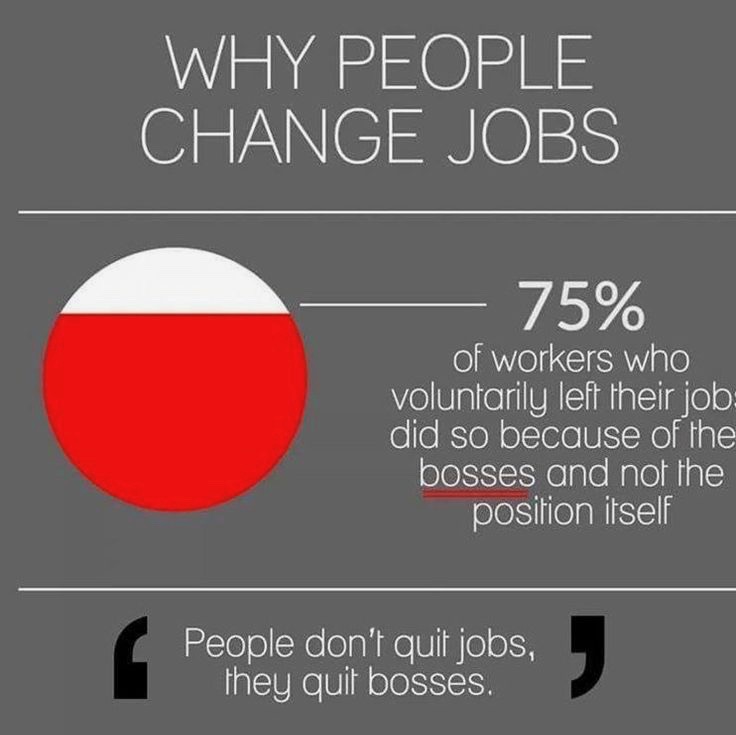
I read a statistic that 75% of people who voluntarily left their jobs did so because of a problem with their boss. In other words, 3-out-of-4 people didn’t quit their job, they quit their boss. In my personal experience this is equally as true in the church world—Most people don’t quit their church, they quit a bad pastor.

Sadly, those who do quit their church usually do so the wrong way. As a result they become either de-churched (they don’t attend anywhere), or cynical in the next church they do attend.

Who is a bad pastor?

  • One who is no longer effective because he is stuck in an old way of doing things
  • One who is theologically off
  • One who is unwilling to admit an error, ask forgiveness, and make amends
  • One who uses his position to build his kingdom instead of God’s kingdom

We have a great example of how to handle a bad spiritual leader in the story of David and Saul (see 1 Samuel 24). David had done nothing wrong, yet Saul was trying to kill him. At one point David’s men urged David to take matters into his own hands, and he almost did. He got close enough to Saul to cut off a corner of his robe, but quickly discovered that was too close. Immediately after doing so David was conscience-stricken!

Then look how David responded:

  • David rebuked his men as he reminded them that Saul was their “master” and “the Lord’s anointed.”
  • David “bowed down and prostrated himself” before Saul as he apologized.
  • David called him his “master,” “father,” and “the Lord’s anointed.”
  • David said he would leave the matter in God’s hands, allowing God to “judge between you and me.”
  • And twice David declared, “My hand will not touch you!”

This humble reply got Saul’s attention. Saul wept as he said, “You have treated me well, but I have treated you badly.” Saul then asked David to be kind to his descendants.

Then this conclusion—David gave Saul his oath, and then went away to a safe place.

The New Testament captures these same ideas for today’s Christians. We are told not to lightly entertain an accusation against spiritual leaders (1 Timothy 5:19), but to submit and obey to biblically-correct leaders (Hebrews 13:17).

The Bible gives us only two options for dealing with spiritual leaders…

SUBMIT & OBEY or WALK AWAY

Two wrongs don’t make a right. Responding in an unscriptural way to an unscriptural pastor’s way is just as wrong as what the pastor was doing wrong in the first place!

So give the bad pastor your oath that you will not lay a hand (or a word!) on them, and then remove yourself to a safe place. Submit and obey, or walk away and leave them in God’s capable hands.

If you’ve missed any messages in this series, you may find the complete list by clicking here.

What Does The Bible Say About Church Leaders?

God’s plan has always been for His leaders to organize and oversee His ministry.

The important thing for us to distinguish is “His.” It’s not a man or woman saying, “I will be a leader,” or even a God-appointed leader saying, “I am going to build up my ministry.”

The New Testament gives us a fourfold purpose for the Body of Christ:

  1. Mobilizing for evangelism
  2. Organizing for more meaningful ministry
  3. Making disciple-makers
  4. Caring for one another

We see God’s leaders involved in all of these aspects—

Mobilizing for evangelism—Peter pointed out the need for an apostle to be appointed to replace Judas, thus returning their ranks to the 12 apostles just as Jesus had originally said (Acts 1:15-22).

Organizing for more meaningful ministry—Everywhere Paul founded a church, he also appointed leaders to oversee and shepherd that church.

Making disciple-makers—Paul tells us that God appointed five offices of leaders in the church who had the specific task of preparing church members to do the ministry of building maturity in the church (Ephesians 4:11-16).

Caring for one another—The First Church set the pace for providing care for all who were in need, including organizing leaders to oversee specific care ministries (Acts 6:1-5).

What about a church congregation’s responsibility to their leaders? I see five areas:

  1. Hold them accountable to the Word (Acts 17:11). The Bible has to be THE standard to which leaders are held.
  2. Give them your confidence and submission after they have shown accountability to their biblical mandate (Hebrews 13:17).
  3. Pray for them (Ephesians 6:19).
  4. Pay them (1 Timothy 5:17).
  5. Be very careful about accusing them (1 Timothy 5:19).

A church and its leaders following this biblical pattern is a church that can effectively fulfill the Great Commission which Jesus gave us.

The Mystery & Meaning Of Marriage

John Piper’s insight of both the Old Testament and New Testament meaning of marriage is profound!

Here are the links to the Scriptures he references:

Piper’s conclusions:

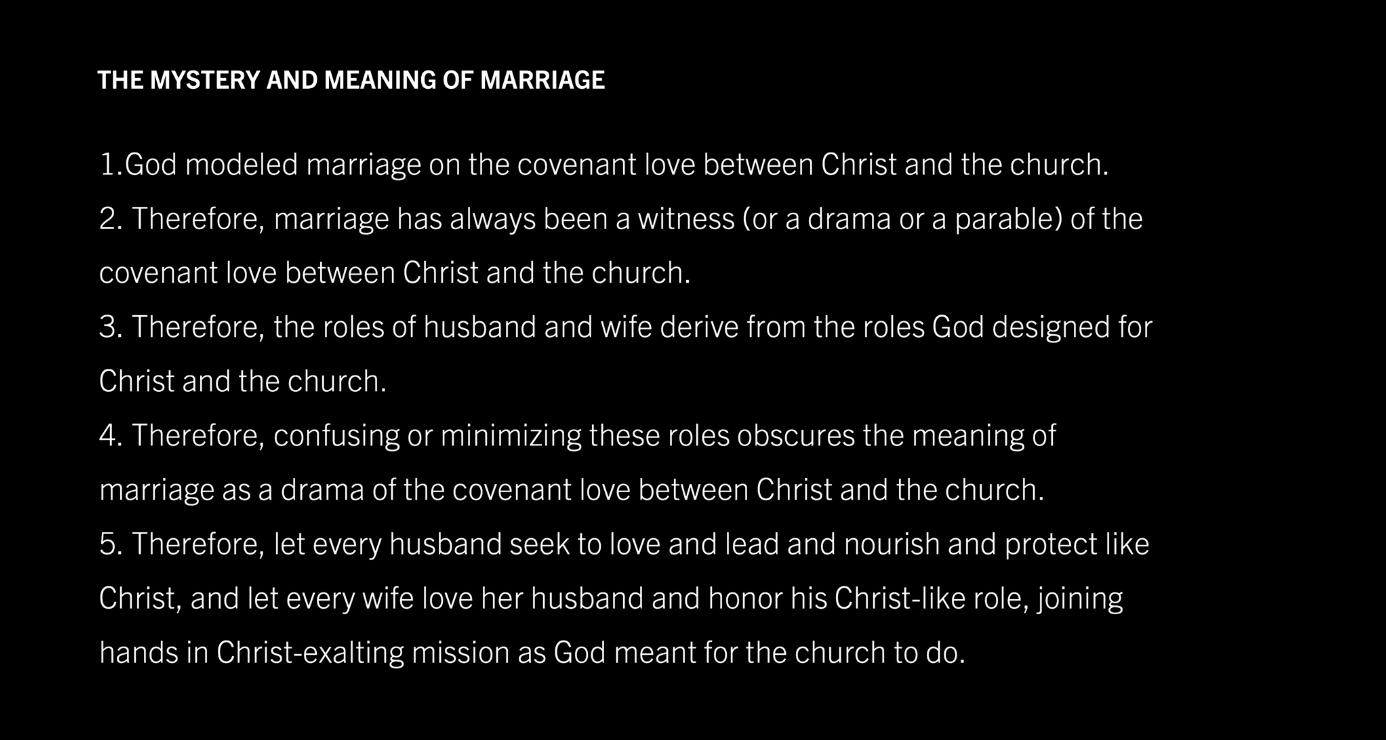
  1. God modeled marriage on the covenant love between Christ and the church.
  2. Therefore, marriage has always been a witness (or a drama or a parable) of covenant love between Christ and the church.
  3. Therefore, the roles of husband and wife derive from the roles God designed for Christ and the church.
  4. Therefore, confusing or minimizing these roles obscures the meaning of marriage as a drama of the covenant love between Christ and the church.
  5. Therefore, let every husband seek to love and lead and nourish and protect like Christ, and let every wife love her husband and honor his Christ-like role, joining hands in Christ-exalting mission as God meant for the church to do.

What Is The Church Supposed To Be Doing?

Listen to the podcast of this post by clicking on the player below, and you can also subscribe on AppleSpotify, or Audible.

Before ascending back to Heaven, Jesus commissioned His followers. He gave them a mission that Christians often refer to as The Great Commission.

Jesus said, “All authority in heaven and on earth has been given to Me. Therefore go and make disciples of all nations, baptizing them in the name of the Father and of the Son and of the Holy Spirit, and teaching them to obey everything I have commanded you. And surely I am with you always to the very end of the age.”

There are several pictures in the New Testament of how the Church could live out this Great Commission, but one of the pictures that I find the most helpful is that of a Body.

The human body is an amazing creation! Just to accomplish the simple task of picking up something between our thumb and forefinger is a miracle in itself. The structure of bones and ligaments and tendons, the interaction of nerves in the fingers coordinating with the optical nerve, not to mention the enzymes and blood vessels that are all doing their part.

Yet if any part is not functioning properly, that simple action becomes more difficult. Maybe it even becomes impossible.

The Church is the same way. Every part of the Church Body has to be functioning in healthy order for the whole Body to be effective.

Here are four aspects of a healthy Church Body that the Apostle Paul lists in Ephesians 4:

  1. Caring for one another
  2. Mobilizing for evangelism
  3. Making disciple-makers
  4. Helping organize for more meaningful ministry

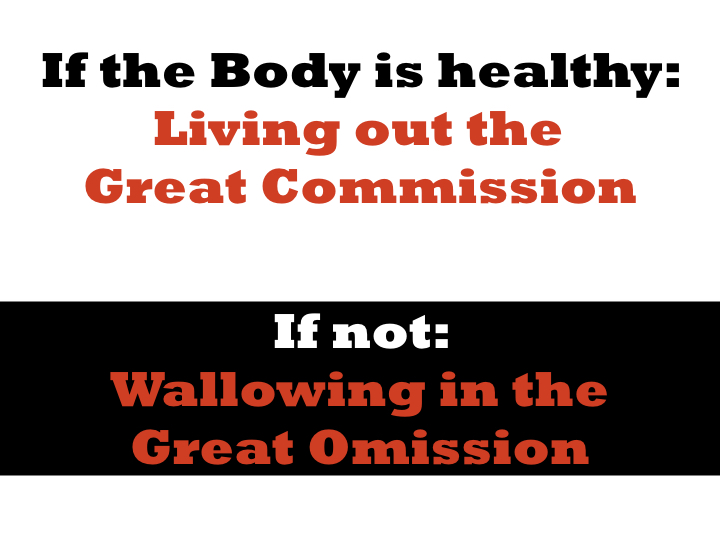
If every part of the Body is doing its part, we’re Living out the Great Commission.

If some parts are missing or unhealthy, we’re Wallowing in the Great Omission.

It’s not about your church (small “c”) or my church. It’s about all Christian disciples being a part of one Church—one Body—going into all the world and making disciples of all peoples. That’s what the Church is supposed to be doing!

►► Would you please prayerfully consider supporting this ministry? My Patreon supporters get behind-the-scenes access to exclusive materials. ◀︎◀︎

10 Great Reasons To Go To Church Regularly

Without exception, all human beings have exactly 168 hours in a week. No one gets any bonus time and no one has any hours taken away. We’re supposed to get 8 hours of sleep a night, and most of us work about 40 hours each week. So let’s do the math…

168 hours per week
– 56 hours for sleeping
– 40 hours for work
=72 discretionary hours

In those 72 hours there must be time for eating and taking care of chores. But what about going to church? The problem for many people is looking at church attendance as just another “chore” or item on their “To Do” list.

But instead of thinking of going to church as “I have to,” how about if you looked at all of the “I get to” benefits?

Here are 10 great reasons for going to church regularly. I get to…

  1. …draw closer to my Heavenly Father, just like Jesus did (Luke 2:49)
  2. …be an example to others (1 Timothy 4:12)
  3. …hang out with some really great people (Hebrews 10:24)
  4. …get to know Jesus and my brothers and sisters better (1 John 1:3)
  5. …reaffirm the priority that God is first in my life (Matthew 6:33)
  6. …learn to better understand Scripture (2 Timothy 2:15)
  7. …join with a choir of God worshipers (John 4:23-24)
  8. …grow spiritually (1 Peter 2:2-5)
  9. …complete the Body of Chris (1 Corinthians 12:12)
  10. …avoid becoming isolated and possibly lost (Proverbs 18:1)

“Sometimes we make it sound like we’re making a sacrifice to go to church, but think about the very real sacrifice Jesus made so that we could meet together as brothers and sisters!” —Scott Troost

How about it? Do you think you could invest an hour or two of your 72 discretionary hours in a local church this week?

My thanks to my brother, Scott Troost, for sharing such a timely message!

8 Quotes From “Paths To Power” by A.W. Tozer

As I said in my book review, A.W. Tozer’s words frequently make me say both “Ouch!” and “Amen!” Maybe you’ll feel the same thing in these few quotes.

“Left to herself the Church must have perished as a thousand abortive sects had done before her, and have left nothing for a future generation to remember. That the Church did not so perish was due entirely to the miraculous element within her. That element was supplied by the Holy Spirit who came at Pentecost to empower her for her task. For the Church was not an organization merely, not a movement, but a walking incarnation of spiritual energy. …

“In short, the Church began in power, moved in power, and moved just as long as she had power. When she no longer had power she dug in for safety and sought to conserve her gains. But her blessings were like manna: when they tried to keep it overnight it bred worms and stank. So we have had monasticism, scholasticism, institutionalism; and they have all been indicative of the same thing: absence of spiritual power.” 

“The weakness in our message today is our overemphasis on faith with a corresponding underemphasis on obedience. This has been carried so far that ‘believe’ has been made to double for ‘obey’ in the minds of millions of religious persons.”

“In every denomination, missionary society, local church, or individual Christian this law operates. God works as long as His people live daringly; He ceases when they no longer need His aid.” 

“To any casual observer of the religious scene today, two things will at once be evident: one, that there is very little sense of sin among the unsaved, and two, that the average professed Christian lives a life so worldly and careless that it is difficult to distinguish him from the unconverted man.”

“It is always dangerous to isolate a truth and then press it to its limit without regard to other truth.”

“It may be stated as an axiom of the Christian system that whatever makes sin permissible is a foe of God and an enemy of the souls of men.”

“Some time after Pentecost a group of believers met to pray for strength and power to meet the emergency then facing them, and to enlist the help of God on their behalf. ‘And when they had prayed, the place was shaken where they were assembled together; and they were all filled with the Holy Ghost, and they spake the Word of God with boldness’ (Acts 4:31). Some of these were of the original number filled at Pentecost. It is hardly conceivable that God acted contrary to His own will in filling them again after Pentecost. Still other outpourings are recorded in Acts 8, 10 and 19. All these occurred some years after the original act.

“In brief, the teaching of the New Testament is that the outpouring at Pentecost was the historic beginning of an era which was to be characterized by a continuous outpouring of the Holy Spirit.”

“This anti-emotionalism, though it is sponsored by some good people and travels in pretty orthodox company, is nevertheless an unwarranted inference, not a scriptural doctrine, and is in violent opposition to psychology and common sense. Where in the Bible are feeling and faith said to be at odds? The fact is that faith engenders feeling as certainly as life engenders motion. We can have feeling without faith, it is true, we can never have faith without feeling. Faith as a cold, unemotional light is wholly unknown in the Scriptures.”

Paths To Power (book review)

As I read A.W. Tozer’s words I find myself saying two things: (1) “Ouch!” and (2) “Amen!” Tozer’s Paths To Power is a continuation in those responses as he outlines what robs the Church and individual Christians of the power God wants them to have.

Right at the outset, Tozer identifies a key element robbing the Church of power: a lack of obedience in the things God has commanded us. “A knowledge of the truth is not enough,” he writes. “The truth must be followed if we would realize in actual experience the blessedness which is here described.”

Another power-blocker is an unwillingness to let God confront us and help us change. We get stuck in a this-is-how-it’s-always-been rut and then shut our eyes to the times of refreshing God wants to send to us. Other blockers include poor doctrine, putting the Holy Spirit in a box, justifying our sin, and not unleashing our faith, to name just a few.

Thankfully, Tozer also points us to the straightforward cures for all of the blockages to power. If we are willing to open our eyes, ears, and hearts to God’s voice, His unlimited blessings could flow uninterrupted into our lives and churches.

Paths To Power contains only seven short chapters, but the digestion, contemplation, and implementation of Tozer’s cures will be something that will involve a lifetime commitment for those ready for God’s fresh power to be poured into their lives.

I am a Moody Publishers book reviewer.

11 Quotes From “Man—The Dwelling Place Of God” by A.W. Tozer

A.W. Tozer’s 50-year-old publication Man—The Dwelling Place Of God still rings with timely truth for today. You can check out my full book review by clicking here.

“I long ago decided that I would rather know the truth than be happy in ignorance. If I cannot have both truth and happiness, give me truth. We’ll have a long time to be happy in heaven.”

“Shakespeare may be enjoyed without penitence; we may understand Plato without believing a word he says; but penitence and humility along with faith and obedience are necessary to a right understanding of the Scriptures.”

“Faith and morals are two sides of the same coin. Indeed the very essence of faith is moral. Any professed faith in Christ as personal Savior that does not bring the life under plenary obedience to Christ as Lord is inadequate and must betray its victim at the last. The man that believes will obey; failure to obey is convincing proof that there is not true faith present.”

“There are two kinds of love: the love of feeling and the love of willing. The one lies in the emotions, the other in the will. Over the one we may have little control. It comes and goes, rises and falls, flares up and disappears as it chooses, and changes from hot to warm to cool and back to warm again very much as does the weather. Such love was not in the mind of Christ when He told His people to love God and each other. … The love the Bible enjoins is not the love of feeling; it is the love of willing, the willed tendency of the heart.

“Let no one interpret the Scriptures for you in such a way as to rule out the Father’s gift of the Spirit. Every man is as full of the Spirit as he wants to be. Make your heart a vacuum and the Spirit will rush in to fill it.”

“I am among those who believe that our Western civilization is on its way to perishing. It has many commendable qualities, most of which it has borrowed from the Christian ethic, but it lacks the element of moral wisdom that would give it permanence. Future historians will record that we of the twentieth century had intelligence enough to create a great civilization but not the moral wisdom to preserve it.”

“The church today is suffering from the secularization of the sacred. By accepting the world’s values, thinking its thoughts and adopting its ways we have dimmed the glory that shines overhead. We have not been able to bring earth to the judgment of heaven so we have brought heaven to the judgment of the earth. Pity us, Lord, for we know not what we do!”

“David Brainerd once compared a man without the power of the Spirit trying to do spiritual work to a workman without fingers attempting to do manual labor. The figure is striking but it does not overstate the facts. The Holy Spirit is not a luxury meant to make deluxe Christians, as an illuminated frontispiece and a leather binding make a deluxe book. The Spirit is an imperative necessity.”

“I do not believe that it is the will of God that we should seek to be happy, but rather that we should seek to be holy and useful. The holy man will be the useful man and he’s likely to be a happy man too; but if he seeks happiness and forgets holiness and usefulness, he’s a carnal man.”

“That religion may be very precious to some persons is admitted, but never important enough to cause division or risk hurting anyone’s feelings. In all our discussions there must never be any trace of intolerance; but we obviously forget that the most fervent devotees of tolerance are invariably intolerant of everyone who speaks about God with certainty. And there must be no bigotry, which is the name given to spiritual assurance by those who do not enjoy it.”

“The truly spiritual man is indeed something of an oddity. He lives not for himself but to promote the interests of Another. He seeks to persuade people to give all to his Lord and asks no portion or share for himself. He delights not to be honored but to see his Savior glorified in the eyes of men. His joy is to see his Lord promoted and himself neglected.”

Viewing Abortion As Slavery

In our American history, we have many valuable lessons. Some of these lessons come from sad chapters that now we have the benefit of hindsight to see the error of our ways. But with this hindsight, there should come insight into the issues which currently face us.

Slavery was an abhorrent evil that plagued our country. Thankfully there were strong men who forcefully and persuasively spoke out against the horrors of slavery; men like Frederick Douglass. His address “What To The Slave Is The Fourth Of July?” is a masterpiece of statesmanship!

Those under the oppression of slavery had no choice. They weren’t allowed speak for themselves, so they depended upon free men and women to speak for them.

Much the same today, babies who are aborted in the womb have no choice, no voice. They cannot speak for themselves, so it is up to us to speak out for them against this abhorrent evil that plagues our country.

I would ask you to consider some of the words of Frederick Douglass where the terms for slavery are replaced with the terms for abortion.

“Standing with God and the crushed and bleeding [aborted baby] on this occasion, I will, in the name of humanity which is outraged, in the name of liberty which is fettered, in the name of the Constitution and the Bible, which are disregarded and trampled upon, dare to call in question and to denounce, with all the emphasis I can command, everything that serves to perpetuate [abortion]—the great sin and shame of America! … 

“The feeling of the nation must be quickened; the conscience of the nation must be roused; the propriety of the nation must be startled; the hypocrisy of the nation must be exposed; and its crimes against God and man must be proclaimed and denounced. … 

“Let it be thundered around the world, that, in tyrant-killing, king-hating, people-loving, democratic, Christian America, the seats of justice are filled with judges, who hold their offices under an open and palpable bribe, and are bound, in deciding in the case of [an unborn baby’s] liberty, hear only [the abortionist]! … 

“A religion which favors [‘choice’] against the [unborn baby]; which exalts the proud above the humble; which divides mankind into two classes, [pro-choice] and [pro-life]; which says to the [baby in the womb, you don’t matter]; and to the [abortionist, continue on]; it is a religion which may be professed and enjoyed by all the robbers and [killers] of mankind; it makes God a respecter of persons, denies His fatherhood of [all human life], and tramples in the dust the great truth of the brotherhood of man. … 

“The American church is guilty, when viewed in connection with what it is doing to uphold [abortion]; but it is superlatively guilty when viewed in connection with its ability to abolish [abortion]. The sin of which it is guilty is one of omission as well as of commission. … Let the religious press, the pulpit, the Sunday school, the conference meeting, the great ecclesiastical, missionary, Bible and tract associations of the land array their immense powers against [abortion]; and the whole system of crime and blood would be scattered to the winds….

“O! had I the ability, and could I reach the nation’s ear, I would, to-day, pour out a fiery stream of biting ridicule, blasting reproach, withering sarcasm, and stern rebuke. For it is not light that is needed, but fire; it is not the gentle shower, but thunder. We need the storm, the whirlwind, and the earthquake. The feeling of the nation must be quickened; the conscience of the nation must be roused; the propriety of the nation must be startled; the hypocrisy of the nation must be exposed; and its crimes against God and man must be proclaimed and denounced.”

I ❤️ My Church Family

We have so much fun together!

This slideshow requires JavaScript.

If you live near Cedar Springs and don’t have a church family, I would love for you to join us! Click here to get all the details, or leave me a comment if you have questions.