Strength In Unity

Listen to the podcast of this post by clicking on the player below, and you can also subscribe on AppleSpotify, or Audible. 

The 12th Song of Ascent (Psalm 131) was written by David to remind us to rely on God’s help even more as we progress on the journey (or mature in our faith). In the 13th Song (Psalm 132), the psalmist says, “Remember David” and his passion for God’s people to experience God’s righteousness and joy. In order for us to know that, we have to remember Jesus. 

Those who put this collection of Songs of Ascent together now include David’s fourth song (Psalm 133) in this collection which expresses his desire for unity among God’s people. 

(Check out all of the Scriptures in this post by clicking here.)

Can you imagine the pilgrims starting out from their individual villages? Maybe there’s not very many of them to begin with and traveling is pretty easy, but they do have to be vigilant against dangers on the road. 

As they progress, they begin to join with pilgrims from other villages. Maybe these are from the same tribe, perhaps even distant relatives. The journey may go a bit slower now that there are more people to keep track of, and some complications of personality may start to arise. But the level of safety and assistance also increases. 

Soon the group is getting larger as they now join with pilgrims from other tribes. These aren’t near relatives at this point, so there may be more complications, but there is even greater encouragement, safety, and potential. 

Aha! Potential. 

We’ve gone singing with a small ensemble to singing in a choir. And David is anticipating us singing in an even larger, majestic choir! There will undoubtedly be more problems, but there is also assuredly so much more potential, beauty, and strength in their combined worship. 

My friend Dan Chastain has over 20 years of experience in the United States Army. He points out that the Army did the same things in his day as we read in the Old Testament. 

The unity of a fighting force, Dan said, is a blessing. David was a professional soldier. Many people today join the military because of this professional, unity, and camaraderie. Maintaining this unity is the responsibility of everyone, because disunity leads to mistrust, chaos, and defeat. 

David says this choir paints a picture—“it is like” (v. 2) and “it is as if” (v. 3). He is saying that God desires overflowing blessings on His people (v. 2), and that God desires saturating blessings on His people (v. 3). Why? Because God wants to give us more than enough for our needs so that there is plenty left for those who aren’t brothers and sisters yet. He longs for our choir to include people from every tribe, race, and nation. 

Just as we said last week that a Christian’s joy is a testimony, a choir of Christians is an even more compelling testimony! 

David calls this unity “good” which really means so much better than the alternative. And he calls this unity “pleasant.” The Hebrew word literally means singing a sweet sound! 

The Hebrew word for “unity” here is also instructive. It means to be together in the same place—not just in spirit and desire—but in physical proximity. This is exactly the picture we see in the first Church (Acts 2:44, 46-47), as well as the picture of the choir from every nation, tribe, people, and language singing around God’s throne in Heaven (Revelation 7:9-10). 
In order to navigate all of the differences of personality that could keep us from this unity, we have to work at. We need the attitude of Jesus (Philippians 2:1-5). This requires a daily transformation of our minds (Romans 12:1-3), and this transformed mind is what helps us move from a small ensemble to a majestic choir (Romans 12:4-5, 16-18). 

Remember the word “saints” is always plural in the New Testament. You and I each have a vital part to play in helping other saints! 

If you’ve missed our look at any of the other Songs of Ascent, you can find them all listed here. 

►► Would you please prayerfully consider supporting this ministry? My Patreon supporters get behind-the-scenes access to exclusive materials. ◀︎◀︎

Living In Kingdom Power

Listen to the podcast of this post by clicking on the player below, and you can also subscribe on AppleSpotify, or Audible. 

Last week I shared a quote about this Kingdom Prayer from the YouVersion reading plan The Prayer That Turns The World Upside Down. Let me remind you of one phrase: “This prayer is dangerous, overturning the kingdom of the principalities and powers of this world.” 

We live on Earth but we are citizens of the Kingdom of God. This prayer is a desire for that eternal Kingdom to be seen by Earthlings so that they will also obtain citizenship. So we saw last week that the phrase “Hallowed be Your name” is both an acknowledgement of God’s greatness and a request that we would display His greatness in our lives. The next phrase—Your Kingdom come (Matthew 6:10)—has that same two-part motivation: acknowledgment and request. 

I wrote Shepherd Leadership to address the non-biblical practices in our churches that had taken on biblical weight. I think this is something that invades many Christian’s thinking about what “the Kingdom of God” actually is. 

Here’s two things I know for sure: (1) Kingdom power ≠ political power, and (2) Kingdom power ≠ religious power. 

A.W. Tozer wrote—

“In Christian circles today, the church that can show an impressive quantitative growth is frankly envied and imitated by other ambitious churches. Numbers, size and amounts seem to be very nearly all that matters…. The great goddess, Numbers, is worshiped with fervent devotion, and all things religious are brought before her for examination. Her Old Testament is the financial report, and her New Testament is the membership roll. To these she appeals as the test of spiritual growth and the proof of success or failure in most Christian endeavors. A little acquaintance with the Bible should show this up for the heresy it is.” 

Jesus was clearly focused on His Father’s Kingdom. The phrase “Kingdom of God” is used over 50 times in the Gospels, and Jesus uses words like “Heaven,” “Hell,” and “eternal life” over 120 times. 

In teaching us to pray, Jesus called us to focus on the eternal. We want people to see “Our Father in Heaven”—in all His hallowed majesty and glory—not merely in the ways we attempt to “Christianize” life on Earth. 

Alan Redpath said, “Before we can pray, ‘Lord, Thy Kingdom come,’ we must be willing to pray, ‘My Kingdom go.’” 

Jesus constantly taught like this, “The Kingdom of Heaven is like….” He said, “The coming of the Kingdom of God is not something that can be observed” (Luke 17:20). Or better stated: The Kingdom of God doesn’t arrive because I oversee something and announce it. 

Peter summed up the ministry of Jesus like this, “How God anointed Jesus of Nazareth with the Holy Spirit and power, and how He went around doing good and healing all who were under the power of the devil, because God was with him” (Acts 10:38).

Jesus told us to live the same way—“When Jesus had called the Twelve together, He gave them power and authority to drive out all demons and to cure diseases, and He sent them out to proclaim the kingdom of God and to heal the sick” (Luke 9:2). 

The early Church was known for living differently—cared for the poor, the young, the sick, the elderly; honored marriage; built hospitals. They were not known because they had political clout. 

Our living Kingdom-focused is the answer to our prayer for God’s Kingdom to come. 

For the kingdom of God is not a matter of talk but of power. (1 Corinthians 4:20) 

We hallow God’s name and we make His Kingdom visible when we seek Him as our only priority. Both of these phrases are acknowledgments of His absolute sovereignty and our desire to be empowered to be anointed by the Holy Spirit to go around doing good and delivering all who are under the power of the devil. 

I love this short verse from A.B. Simpson—

Help me to work and pray, 
help me to live each day, 
that all I do may say, 
‘Thy kingdom come.’

Check out the other messages in our series Kingdom Praying by clicking here. 

►► Would you please prayerfully consider supporting this ministry? My Patreon supporters get behind-the-scenes access to exclusive materials—like this recent Bible study insight from the Gospels. ◀︎◀︎

Saints Together

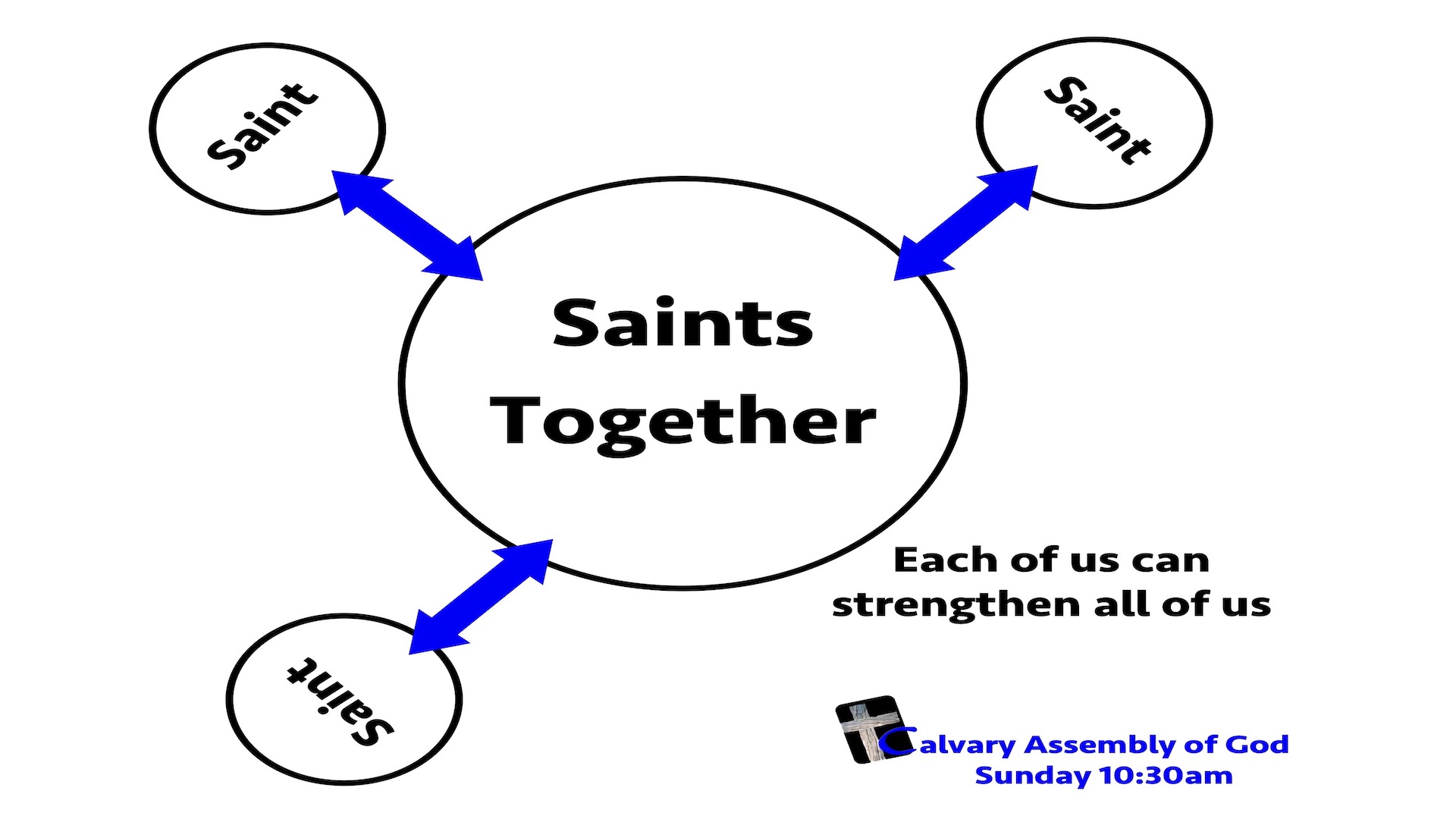
Throughout the New Testament the word “saints” is always in the plural form. This is a clear indication that none of us can develop into the full-fledged Christians we were meant to be on our own. 

We all need each other. More specifically, we all need the most mature version of each other. 

A key component of an individual saint’s development is the time spent alone being forged by the discipline of the Holy Spirit. Maturing saints then come together with each other to continue to strengthen and sharpen everyone in the church. Strong individual saints make a strong church, and a strong church makes strong individual saints! 

Join me for our new series called Saints Together. We will be studying the six spiritual disciplines that each individual saint must put into practice so that they can use their newly developed strengths to help other saints in their own development. 

Check out all of these messages here:

A Preservative To Moral Decay

Listen to the podcast of this post by clicking on the player below, and you can also subscribe on AppleSpotify, or Audible. 

Have you ever wondered why the Roman soldiers treated Jesus so cruelly? After all, these are professional soldiers so why are they acting in such an unsoldierly way (see Mark 15:16-20)? 

Perhaps they thought that Jesus was just another criminal that was in cahoots with Barabbas—a murderer and insurrectionist. But where would they get that idea? It must have come from the lies and slander that the Sanhedrin were spewing. 

Perhaps the soldiers had a low value of all human life. Where would this come from? First from their leadership: particularly the way history tells us that Pontius Pilate treated the Jews. But we can go a little broader because we also know from history the disregard the Romans had for the weak, the young, the sick, and the aged. 

The bottom line is this: Anytime there is a departure in even the slightest degree from the Great Commandment—love God, love yourself, and love your neighbor—the resulting society is dark and ugly, with people mistreating others in the most inhumane of ways. 

This is where Christians are called to be salt and light. 

We stand as a check against the decay in societal values. Our high view of God’s power and love, our proper understanding of each person’s worth in God’s sight, and the way we express genuine love for others—especially the weak and marginalized—is a preservative to the moral decay. 

It’s so easy to get caught up with the loud voices around us. Pontius Pilate did, the Roman soldiers did, the Sanhedrin did, and the crowds that listened to these leaders did too. 

If you are concerned about the moral decay you see in your neighborhood, the movies and music that are released, or the behavior of our elected officials, we must adhere all the more closely to the Great Commandment: Love God with all your being, maintain a healthy self-image in light of God’s love for you, and then love your neighbor—all of your neighbors—in the same way God loves you. 

This is the only way His Spirit can equip and empower us to be effective salt and light in these last days! 

►► Would you please prayerfully consider supporting this ministry? My Patreon supporters get behind-the-scenes access to exclusive materials. ◀︎◀︎
Quieting The Angry Rhetoric

Listen to the podcast of this post by clicking on the player below, and you can also subscribe on AppleSpotify, or Audible. 

When the culture becomes increasingly angry and loud, how are Christians to respond? 

Check out this episode of The Podcast. 

Resources I mentioned in this podcast:

►► Would you please prayerfully consider supporting this ministry? My Patreon supporters get behind-the-scenes access to exclusive materials. ◀︎◀︎

Unafraid Of End Times Events

Listen to the podcast of this post by clicking on the player below, and you can also subscribe on AppleSpotify, or Audible.

When people ask me about end times events, it is usually from a posture of hand-wringing worry. But when Jesus told His followers about what is to come, He repeatedly told them not to be afraid.

Some resources from this video:

►► Would you please prayerfully consider supporting this ministry? My Patreon supporters get behind-the-scenes access to exclusive materials. ◀︎◀︎
Unity Enhances Our Witness

Listen to the podcast of this post by clicking on the player below, and you can also subscribe on AppleSpotify, or Audible. 

Last week we mentioned that one of the things the Holy Spirit did after the Day of Pentecost was to unite individual Christians into the Church. In a world divided by religious and political factions, the unity of the Christians set them apart. Is our culture any different? Of course not! So the unity that the Holy Spirit brings is just as vital today. 

In Psalm 133, David longs for this unity among believers. This psalm is in the collection of “Songs of Ascent.” That means that pilgrims to Jerusalem sang these songs as they literally went up the hill to Jerusalem. Psalm 133 opens with David singing, “How good and pleasant it is when brothers and sisters live together in unity” (v. 1). 

Maybe David thought back to the time when people were joining him to give him support as king—David went out to meet them and said to them, “If you have come peaceably to me to help me, my heart shall be knit to you” (1 Chronicles 12:17 AMP). In the next two verses of Psalm 133, David explains how this unity from being knit together is seen as a blessing. 

Last week, we talked about the blessing of peace the priests pronounced on the people. That word for “peace” is shalom which could be defined as “nothing missing.” But couldn’t we also say that shalom is “no one missing”? Yes, because each and every part of the Body of Christ is vital and indispensable! 

We see this same unity when the followers of Jesus were baptized in the Holy Spirit on the Day of Pentecost. Acts 2:1 says these Christians were “all together” (or some translations say “one accord”). This is one word in Greek (homothumadon) which describes the beauty of unity. One Greek dictionary defines this word,  “The image is almost musical; a number of notes are sounded which, while different, harmonize in pitch and tone. As the instruments of a great concert under the direction of a concert master, so the Holy Spirit blends together the lives of members of Christ’s church.”

This picture of a majestic musical is further amplified in the next verses of Acts 2 where people from all over the world heard these Christians praising God in their own native tongues. Luke goes on to use homothumadon again and again throughout Acts to show what a powerful testimony their unity was to the watching world.  

Paul emphasized the need for unity in the Church when he wrote—

As a prisoner for the Lord, then, I urge you to live a life worthy of the calling you have received. Be completely humble and gentle; be patient, bearing with one another in love. Make every effort to keep the unity of the Spirit through the bond of peace. There is one body and one Spirit, just as you were called to one hope when you were called; one Lord, one faith, one baptism; one God and Father of all, who is over all and through all and in all. (Ephesians 4:1-6) 

How does the Holy Spirit help us handle our differences and keep this unity? We first need the Spirit’s help to distinguish whether it’s a biblical, unbiblical, or non-biblical issue. 

  • Biblical issues must send us back to the Bible to find the truth (2 Timothy 3:16-17). 
  • Unbiblical issues—where a brother or sister is living in a way contrary to Scripture—call on us to speak the truth in love and correct in love only after allowing the Holy Spirit to examine our own lives (Ephesians 4:15; Matthew 7:1-5; James 5:19-20). Notice that we are to do this with fellow brothers and sisters, not with those outside the Church.  
  • Non-biblical issues are the trickiest. These are issues over which we should immediately stop fighting as we defer to the weakest brother or sister (Romans 12:10, 14:19-21).  

(I wrote much more about biblical, unbiblical, and non-biblical issues here, and how to correctly apply the principle of confrontation here.)

The Church needs this unity today. We need to be in “one accord.” In a world divided by religious and political factions, our unity enhances our witness.

If you’ve missed any of the messages in our series We Are: Pentecostal, you can check them all out by clicking here. 

►► Would you please prayerfully consider supporting this ministry? My Patreon supporters get behind-the-scenes access to exclusive materials. ◀︎◀︎
The Compliance Of Silence

Listen to the podcast of this post by clicking on the player below, and you can also subscribe on AppleSpotify, or Audible.

A couple of weeks ago I shared a recap from my sermon called Eloquent Silence. Jesus serenely remained silent when He was being falsely accused by those who wanted Him out of the way. Yet, His silence was eloquent and convicting. 

We would do well to learn this lesson from our Savior. 

There is a flip side to this: Sometimes our silence can signal compliance or acceptance of those who are speaking or perpetrating evil. 

David wrote, “Do you indeed speak righteousness, you silent ones? Do you judge uprightly, you sons of men? No, in heart you work wickedness; you weigh out the violence of your hands in the earth” (Psalm 58:1-2 NKJV). 

Commenting on this psalm, Charles Spurgeon wrote, “It would be well, if people would sometimes pause and candidly consider this: ‘Do you indeed speak righteousness, you silent ones?’ Some of those who surrounded Saul were passive rather than active persecutors—they held their tongues when the object of royal hate was slandered. In the original, this first sentence appears to be addressed to them, and they are asked to justify their silence. Silence gives consent. People who refrain from defending the right are themselves accomplices in the wrong.”  

Silence does have its place. King Solomon wrote, “He who despises his neighbor lacks sense, but a man of understanding keeps silent. He who goes about as a talebearer reveals secrets, but he who is trustworthy conceals a matter” (Proverbs 11:12-13 NASB1995). But to remain silent in the face of evil or falsehood could also be a sin. 

Consider a few other wise words:

“No one wants to be thought of as holding to a ‘minority position’ on anything, so, rather than speak up in the face of many who are doing so, most will remain silent. This is where the Christian community finds itself at this time, trapped in a spiral of silence before a blustering but empty secular and unbelieving worldview. So it is very important that believers in Jesus Christ make the best use of every opportunity to talk about what is good and pleasing to God.” —T.M. Moore 

“Don’t be a bystander, be on stand by. I will not allow a bully to bully others. I will not laugh at his jokes, I will not remain silent. I will stand up and say ‘Enough is enough.’” —Nick Vujicic 

“As Christians we are tempted to make unnecessary concession to those outside the Faith. We give in too much. Now, I don’t mean that we should run the risk of making a nuisance of ourselves by witnessing at improper times, but there comes a time when we must show that we disagree. We must show our Christian colors, if we are to be true to Jesus Christ. We cannot remain silent or concede everything away.” —C.S. Lewis 

“Our lives begin to end the day we remain silent about things that really matter.” —Martin Luther King, Jr.

When to speak up and when to remain silent is a huge issue for Christians. This is why we need to be sensitive to the Holy Spirit telling us when to hold our tongues and when to speak out boldly.

►► Would you please prayerfully consider supporting this ministry? My Patreon supporters get behind-the-scenes access to exclusive materials. ◀︎◀︎

Come To God And Keep Walking With Him

Listen to the podcast of this post by clicking on the player below, and you can also subscribe on AppleSpotify, or Audible. 

I have been so grateful for the insights of Dr. Gary Chapman in his book The Five Love Languages. I have found this book to be of immense value in helping couple prepares for marriage, and in helping married couples get beyond a place where intimacy has become stuck. 

In short, the five love languages are words of affirmation, quality time, gifts, acts of service, and physical touch. The goal of learning the other person’s love language—and learning to speak it consistently and fluently—is an increased level of intimacy. In the book of Amos, God asks, “Can two people walk together without agreeing on the direction?” (Amos 3:3 NLT), and speaking the right love language definitely helps people agree! 

The whole reason we come to God in prayer as a Father, as a Brother, and as a Counselor is so that we can hear Him speaking our love language and we can continue to walk in deeper intimacy with Him. 

When my then-girlfriend Betsy and I first met, we spent hours and hours getting to know each other. We would ask questions, share stories, and tell things we did and didn’t enjoy. This is the epitome of intimate conversation: getting to know the other person’s heart as you open up your heart to them as well.

I’ve shared this analogy before, but intimacy grows stale and can eventually disappear altogether if those in a relationship are no longer walking together. It doesn’t work if I say, “Betsy, I’m looking forward to spending an hour with you each week,” or even if I say, “I’ll give you 15 minutes each morning.” Instead, our relationship needs to be one of continual walking. 

It’s the same thing for us as Christians: we cannot only give God an hour at a church service on Sunday mornings, nor is intimacy going to increase if I only walk and talk with my Savior for a few minutes in my morning devotions. 

Walking closely with Him is what God has desired right from the beginning. He walked with Adam and Eve each evening. This phrase “walking with God” is used consistently throughout the Bible of those who had an intimate relationship with their Father, Brother, and Counselor—Noah, Abraham, Isaac, the people of Israel (Genesis 3:8, 6:9, 17:1, 48:15; Leviticus 26:12). And even as the New Testament era dawns, we read, “And they [Zechariah and Elizabeth] were both righteous before God, walking in all the commandments and ordinances of the Lord blameless” (Luke 1:6 NKJV). 

But I’m especially intrigued by the story of Enoch in Genesis 5:21-24. Twice in four short verses, we read “Enoch walked with God.” Remember that verse in Amos—“Can two people walk together without agreeing on the direction?”—so Enoch and God had to be in agreement. In fact, that’s exactly what we read about Enoch in the Book of Hebrews: 

By faith Enoch was taken from this life, so that he did not experience death: “He could not be found, because God had taken him away.” For before he was taken, he was commended as one who pleased God. And without faith it is impossible to please God, because anyone who comes to Him must believe that He exists and that He rewards those who earnestly seek Him. (Hebrews 11:5-6)

If you’ve taken Dr. Chapman’s love language assessment, you probably found that you were pretty lopsided: maybe you scored very highly in one love language and then barely registered in another. We may be lopsided in our love language skill, but God speaks every language perfectly! 

  • Words of affirmation—Hosea 2:14; Isaiah 40:2 
  • Quality time—Deuteronomy 31:6; Psalm 23:3-4
  • Gifts—James 1:17; 2 Peter 1:3
  • Acts of service—Philippians 2:13; Romans 8:28
  • Physical touch—Psalm 139:13-15; Luke 24:39 

(Click here to check out all of those verses.) 

Dr. Chapman noted that when our love language is being spoken to us sincerely and consistently, our love tank is filled, and all of the love languages begin to become more meaningful. 

Just as God walked with Enoch until the day He brought him Home, so He wants to walk with us. 

  • Walk in obedience to all that the Lord your God has commanded you, so that you may live and prosper. (Deuteronomy 5:33) 
  • The Lord will establish you as His holy people, as He promised you on oath, if you keep the commands of the Lord your God and walk in obedience to Him. (Deuteronomy 28:9) 
  • May He turn our hearts to Him, to walk in obedience to Him and keep the commands. (1 Kings 8:58) 
  • Blessed are all who fear the Lord, who walk in obedience to Him. (Psalm 128:1) 
  • And this is love: that we walk in obedience to His commands. As you have heard from the beginning, His command is that you walk in love. (2 John 6) 

When we walk in loving intimacy with Him, our intimacy grows deeper and more mature. Sometimes they will say of couples who have been married for a long time and walk in increasingly deeper intimacy with each other, “They seem to know each other’s thoughts.” That’s because they know each other’s hearts—and that’s what God wants to do with us. He did it with Enoch, and He will do that with us too (Jude 14; Jeremiah 33:3; Habakkuk 3:19). 

Enoch walked intimately with God for 365 years. Let us walk intimately with God for 365 days a year, for as many years as He gives us until God takes us away with Him forever! 

If you’ve missed any of the messages in our prayer series called Intimate Conversation, you can find all of the messages by clicking here. 

►► Would you please prayerfully consider supporting this ministry? My Patreon supporters get behind-the-scenes access to exclusive materials. ◀︎◀︎

Links & Quotes

Don’t wait until you feel like doing the next good thing, just do the next good thing and the good feelings will follow. Not only that, but you will motivate others too!

“Excellence is to do a common thing in an uncommon way.” —Booker T. Washington

This is a cool mini-biography of Gottfried von Leibniz, a German polymath, committed Lutheran, and one of the most wide-ranging intellects in all of history.

“Forgiveness does not excuse the offending behavior. Forgiveness excuses the offender. The fact that God forgives us of sin, does not make sinning okay. The fact that we forgive someone of their sin towards us, does not make the sin okay.” —Kanayo Situ

“The happiness of a man in this life does not consist in the absence but in the mastery of his passions.” —Alfred Lord Tennyson

“In life you can take things one of two ways: you can take them for granted or you can take them with gratitude.” —G.K. Chesterton

T.M. Moore has an excellent post on how we can prepare for temptation before it even comes. Please check out this whole post which concludes with this thought, “Make up your mind, each day, that you’re going to resist temptation with prayer, preparation, and resting in the Word of God. Let the Spirit Who brings conviction and repentance be at work within you before you come upon the nets and snares of temptation, and you’ll be in a much better position to overcome the evil that threatens to engulf you, with the good choices and conduct that please the Lord and honor Him.”

More amazing evidence of the creativity of our Creator. Researchers have discovered how plant roots adapt based on the presence or lack of water.