The Carols Of Christmas

Carols Of ChristmasI heard the bells on Christmas Day
Their old familiar carols play,
And wild and sweet the words repeat
Of peace on earth, goodwill to men. (Henry Wadsworth Longfellow)

How many “old familiar carols” have you heard Christmas after Christmas until the words have almost lost their meaning? If we’re not careful, any song repeated too often can lose the richness of its original intent.

There are some amazing messages in many of our old familiar Christmas carols because many of those messages are saturated with the old familiar story of Redemption that the Bible tells over and over again.

Please join me this Sunday as we take a new look at the old familiar messages in our Christmas carols. These messages will bring a new appreciation of God’s love that was sung at Christ’s Advent, and reawaken the sweetness of meaning for this Christmas Day.

This has been an ongoing series for us. To take a look at the Christmas carols we’ve already talked about, check them out here, here, here, and here, and here. The Advent songs we looked at this year are:

Linger In Gratitude

I just finished a series of messages at Calvary Assembly of God called Fading Gratitude. It was intended to give some practical thoughts that would stimulate our continual gratitude—not just thankfulness on a day called Thanksgiving.

Sarah Young does a masterful job speaking the words of Scripture as though it were Jesus speaking first-person to us. This word is so appropriate on the heels of this series and on the eve of our Thanksgiving celebration.

“I want you to linger in gratitude. This is a most delightful place—where the joy of My presence shines warmly upon you. 

“You often and pray fervently for something until you receive the answer you desire. When I grant your request, you respond joyfully and thankfully. But your tendency is to move on rather quickly to the next matter. I want you to remain for a while in an attitude of grateful joy. Instead of experiencing only a short-lived burst of gratitude, let this pleasure flow freely into the future by training yourself to recall what I have done. One way is to tell others about it. This blesses both them and you, and it pleases Me. Another way is to write down the prayer-answer someplace where you will see it again and again.

“Keep bringing your gratitude to Me. This thankfulness will bless you doubly—with happy memories of answered prayer and with the delight of sharing enjoy it with Me.” —Jesus (in Sarah Young’s Jesus Always, emphasis mine)

A Radical Change In Perspective

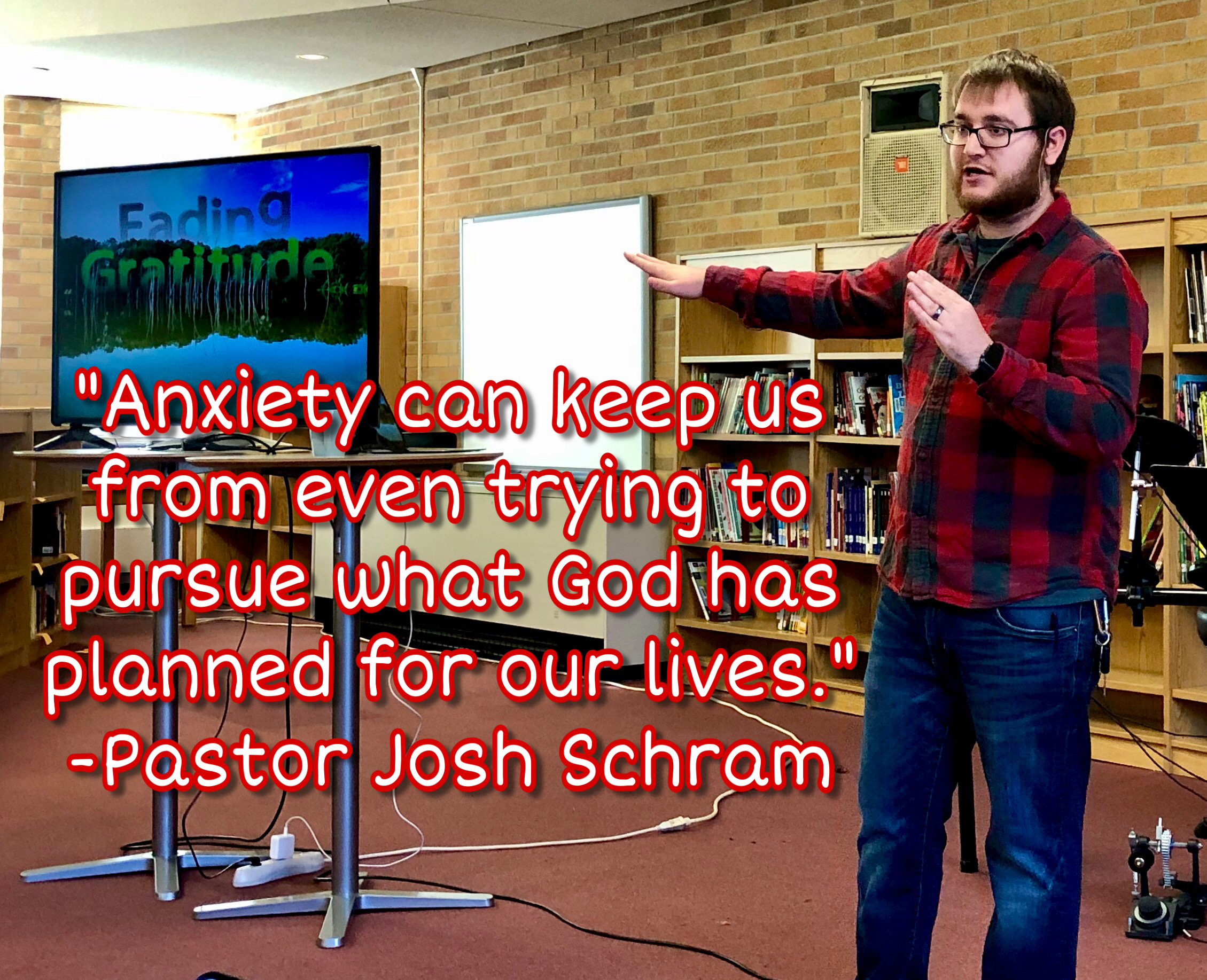
My friend Josh Schram shared a great message yesterday, wrapping up our series called Fading Gratitude. 

Josh was transparent about some of the struggles he overcame during his younger years, explaining how his decision to be grateful even for those roadblocks completely changed his perspective.

When we’re not intentional, our gratitude naturally begins to fade. It’s not that we’re intentionally ungrateful, but we just merely forget to be thankful. 

Our fading gratitude creates a domino effect. When gratitude fades we live with… 

Anxiety can keep us from even trying to pursue what God has planned for our lives. 

When a large group of people needed to be fed, a couple of Jesus’ disciples forgot about the miracles Jesus had already done in the past, and as a result, they became anxious about what to do next. 

Philip replied, “Even if we worked for months, we wouldn’t have enough money to feed them!” Then Andrew, Simon Peter’s brother, spoke up. “There’s a young boy here with five barley loaves and two fish. But what good is that with this huge crowd?” (John 6:7-9)

Yet Jesus multiplied more than enough for everyone to eat AND there were more leftovers than there was food that they originally started with! “So they picked up the pieces and filled twelve baskets with scraps left by the people who had eaten from the five barley loaves” (John 6:13).

That’s why Jesus tells us, So don’t worry about tomorrow, for tomorrow will bring its own worries. Today’s trouble is enough for today” (Matthew 6:34). When we’re grateful for what God provided yesterday, and we’re thankful for what He’s providing today, it will cut short any feelings of anxiety about what God will do again tomorrow!

“No amount of regret changes the past, no amount of anxiety changed the future, but any amount of gratitude changes the present.” —Ann Voskamp 

Gratitude can radically change our perspective! 

If I’m not choosing gratitude, then gratitude is fading. I can be grateful for things I originally thought were holding me back. I can give those things to Jesus—He is not only more than enough but He also gives back to me more than I gave to Him. 


Poetry Saturday—I Do It Unto Thee

Lord of all pots and pans and things,
since I’ve no time to be a great saint
by doing lovely things…
make me a saint by getting meals,
and washing up the plates.
Warm all the kitchen with Thy love,
and light it with Thy peace;
forgive me all my worrying,
and make my grumbling cease.
Thou Who didst love to give men food,
in room, or by the sea,
accept the service that I do,
I do it unto Thee.
Amen. —Brother Lawrence

Thursdays With Spurgeon—Instructor And Indweller

This is a weekly series with things I’m reading and pondering from Charles Spurgeon. You can read the original seed thought here, or type “Thursdays With Spurgeon” in the search box to read more entries.

Instructor And Indweller

O righteous Father! The world has not known You, but I have known You; and these have known that You sent Me. And I have declared to them Your name, and will declare it, that the love with which You loved Me may be in them, and I in them. (John 17:25-26) 

     John’s Gospel is always easy for the child to read, but it is always hard for the man to understand. And these two verses, which are almost entirely made up of words of one syllable, contain mysteries that baffle the most enlightened understanding. …  

     The twenty-sixth verse speaks of the wonderful discoveries of a love of infinite excellence: “That the love with which You loved Me may be in them, and I in them.” And you notice that in order to bring that love home to us, there is a divine Indweller who goes with it, and without whom it could not be! As a teacher is required to bring us the choice knowledge, so an indweller is necessary to infuse into us the infinite love: “And I in them.” Jesus must teach us or we will not know the Father. He must dwell in us or we will not rejoice in His love.

     Thus our first subject is divine knowledge and the divine Instructor. Our second subject is indwelling love and the indwelling Lord. The two are one! The blessed Person of our Lord Jesus is so connected with both and so unites both that the subject is one! To know God in Christ Jesus is to love Him, and to be loved of Him is the cause of our being made to know Him! When Jesus declares the Father’s name, we both know and love. And when we see the Father in the Son, we are filled with both instruction and affection. …  

     “Righteous Father”—I know of no other place in Scripture where God is called by that name. … He is righteous, having the attributes of a judge and ruler. He is just, impartial, by no means sparing the guilty. He is Father, near of kin, loving, tender, forgiving. In His character and in His dealings with His people, He blends the two as they were never combined before! How can the Judge and the Father be found in one? When guilty men are concerned, how can both characters be carried out to the fullest? How is it possible? There is but one answer, and that is found in the sacrifice of Jesus that has joined the two in one! In the atonement of our Lord Jesus, “mercy and truth have met together; righteousness and peace have kissed” (Psalm 85:10). 

From The Righteous Father Known And Loved

Jesus showed us the full extent of His love at Calvary. When He was ready to ascend to heaven, He promised to send the Holy Spirit to remind us of all that we had learned about this love and salvation of Jesus, and so much more! 

This should suggest to each of us a searching question: Do I know the Lord? 

If not, you can know Him today!


8 Quotes From “The Gospel Of The Kingdom”

T.M. Moore has written a book that I think is a must-read for those who want to “earnestly contend for the faith” (Jude 3)—the orthodox Christianity that is presented in the Scriptures. You can check out my full book review of The Gospel Of The Kingdom by clicking here. 

“We can only discern these wayward ‘winds of doctrine’ when we have a clear understanding of the Gospel of the Kingdom. The better we understand and the more wholeheartedly we embrace this Good News as Jesus and the Apostles taught it, the better able we will be to counsel and lead our fellow believers who may be ensnared in the thrall of a ‘different gospel’ and therefore in danger of having believed in vain.” 

“In the divine economy now established within the Kingdom of God, the Spirit of God works with the Word of God to build the church and further the reign of Christ. An ethic of love and hope prevails within that realm which serves as a platform for embodying and proclaiming the truth of God and Christ. Salvation comes to those who believe, bringing them into the community of the saints and dramatically affecting every aspect of their lives in relationships of mutual service and love.” 

“The Gospel of the Kingdom is not, in the first instance, about you and me going to heaven when we die. It is about the Kingdom of God, first and foremost—about a new reality that has broken into human experience with irresistible, transforming power, making all things new and bringing the knowledge of the glory of God to light in the sight of all men and nations.” 

“Apart from the saving mercy of Christ and liberation into His Kingdom, men can look forward only to lives of uncertainty, doubt, disappointment, false hopes, fear, and death.” 

“The Gospel of the Kingdom is the power of God for transformation, a transformation so complete and thorough that it finally makes all things new. Those who know this power are changed by the glory of God so that, increasingly, their lives actually begin to reflect the living reality of the risen Christ, their King. The fruits and virtues that flow from their lives, like rivers of living water, are precisely those most to be desired and least in supply in a fallen world.” 

“The Kingdom is Good News because it brings power exceeding and abundant to be and do more than we could ever ask or think [Ephesians 3:20]. Here is a power we can never exhaust and that springs up day by day in ever fresher, ever more abounding ways to make all things new in our lives.” 

“Joy, it appears, is not determined by what we can see in our immediate environment. Instead, Joy is a condition that attaches to knowing the Lord and being able to see past what is seen in order to engage what is not seen. …The ability to know joy—in spite of any untoward circumstances or conditions—is dependent on the extent to which one actually knows the Lord and is intimately engaged in a relationship with Him. … Your salvation is an experience of living in the Kingdom of God, where we know the hope of glory, experienced and expressed, as a daily reality, then our joy will be more constant and full because our relationship with the Lord will be as much for the ‘here and now’ as for the ‘then and there.’” 

“God is always ready to meet us with joy, and He has provided ample means whereby we may engage Him for the joy that is to be known in His presence. Only our slothfulness, distractiveness, or neglect of His salvation—or the idolatry of seeking our joy in places other than the presence of God—can keep us from living in joy now, and in anticipation of the fullness of joy yet to come.” 

The Gospel Of The Kingdom (book review)

In the 1940s, C.S. Lewis presented a series of radio talks which became the book Mere Christianity. It was in this book that Lewis went beyond any denominationalism to the basic tenants of Christianity as outlined in the Bible. T.M. Moore persuasively warns us today of the trend away from “mere” Christianity to what he terms “near Christianity.” The Gospel of the Kingdom is an important book for those who desire to “contend for the faith that was once for all entrusted to God’s holy people” (Jude 3). 

An increasing number of people who call themselves Christians—and even more alarmingly, those who are in positions of church leadership—aren’t living or preaching the full Gospel as presented in the Scriptures. Moore sounds the clarion call: “We are in danger, I believe, of having embraced, not the Gospel Jesus and the Apostles proclaimed, and for which our forbearers in the faith lived and died, but another gospel, a shallow, self-centered, merely sentimental gospel, which ‘assures’ us of heaven but does not equip us for the kingdom of God.” 

The followers of near Christianity tout how they have been saved from hell, but their profession and lifestyle don’t go beyond that. In other words, there is very little—if any—evidence that Jesus has become the Sovereign of their lives, and that they are living as citizens of God’s Kingdom. “Near Christianity, therefore, produces little in the way of kingdom evidence in the lives and churches of those who embrace it,” says Moore. 

In The Gospel of the Kingdom, Moore fully defines the imposter known as near Christianity, and then systematically details the characteristics of the Kingdom of God that should be evidenced in the lives of those who call themselves Christians. This isn’t just Moore’s opinion, but this short book is thoroughly cross-referenced with over 100 biblical passages.

All Christians—and especially those in the pastorate or other leadership roles—would do well to digest this book. If we aren’t vigilant, near Christianity may dominate the landscape of our churches, which really isn’t Christianity at all. 

I am a Wax Tablet Publications book reviewer. 

Killing Discontentment

Fading gratitude is a terrible thing. Not being thinkful of our past not only keeps us from being thankful, but it also keeps us stuck in the past. And allowing gratitude to fade also sucks the life out of our every-day experiences.

Asaph told us about the manna that God provided for the Israelites to eat every single day that they were in the wilderness. He called it the bread of angels. But even this wasn’t enough for people who weren’t thinkful nor thankful. Instead, they craved more (Psalm 78:25-30). 

The dictionary defines forgetfulness as “ceasing to think about something.” Gratitude, then, is to continue to think about Someone—that “Someone” being God who daily provides for us.

Fading gratitude brings two ugly realities: 

(1) Discontentment. The dictionary calls this “a restless desire or craving for something one does not have.” In other words, it’s counting up what you don’t have instead of being grateful for what you do have. 

(2) Entitlement. This is discontentment’s sickly twin sister. Where discontentment counts up what it doesn’t have, entitlement says, “I deserve what I don’t have!” Jesus told a story about entitled people who had been given land, a vineyard, and everything they needed to be successful with their farm. Yet when the owner of the farmland asked for his rightful payment, the renters thought they were entitled to keep it all. 

There are serious—and potentially eternal—consequences for our unchecked discontented entitlement. Jesus said, “What then will the owner of the vineyard do? He will come and kill those tenants and give the vineyard to others” (Mark 12:9). And Asaph reported that for the discontented, entitled Israelites, “God’s anger rose against them; He put to death the sturdiest among them, cutting down the young men of Israel. … So He ended their days in futility and their years in terror” (Psalm 78:31, 33). 

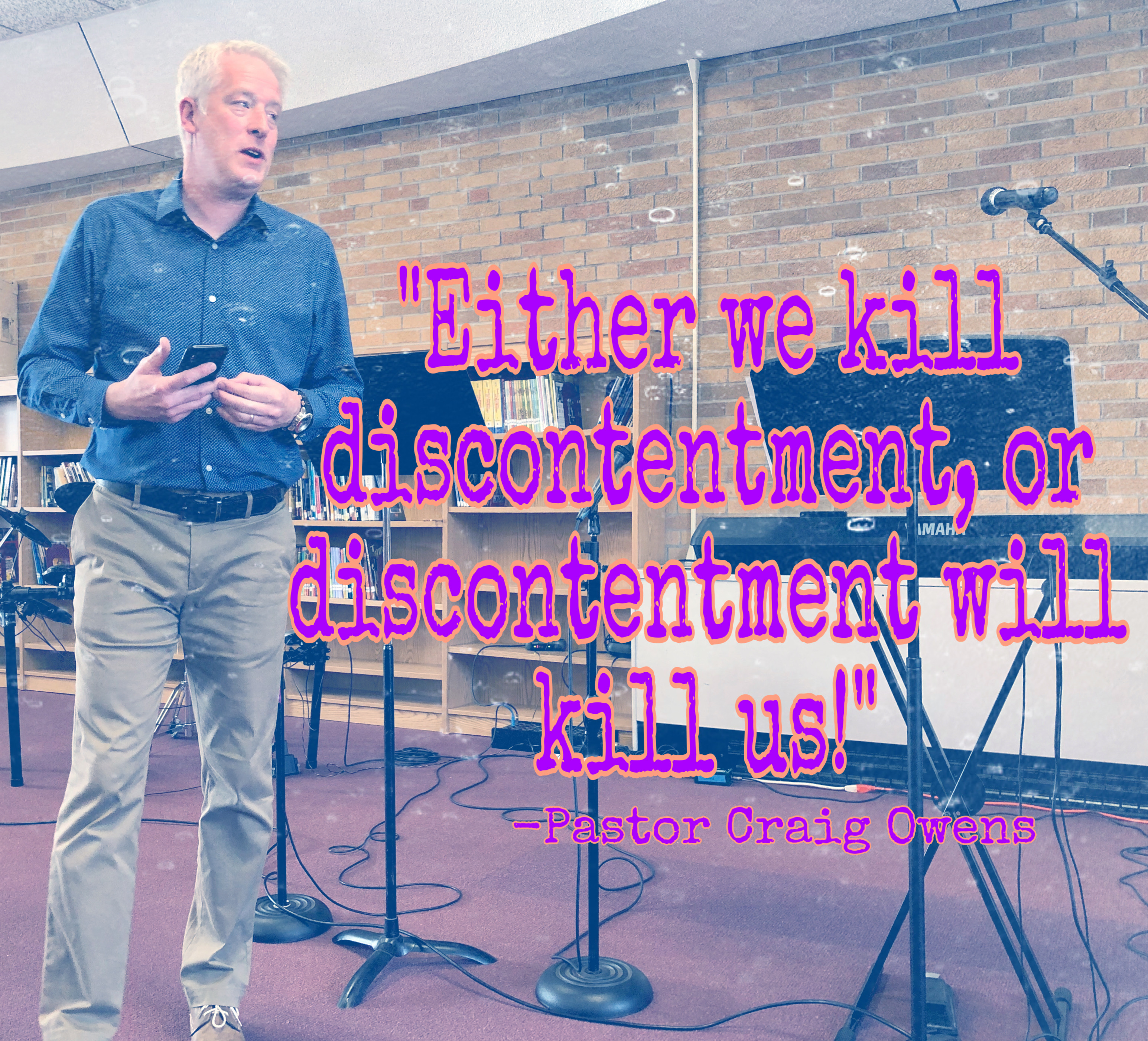
One of two things is going to happen: either we kill discontentment, or discontentment will kill us! 

It’s not complicated to kill discontentment, but it is hard work. We kill discontentment with contentment. We learn to separate the dis from discontentment with the sword of gratitude! 

The apostle Paul wrote “…I have LEARNED to be content whatever the circumstances. I know what it is to be in need, and I know what it is to have plenty. I have LEARNED the secret of being content in any and every situation, whether well fed or hungry, whether living in plenty or in want. I can do all this through Him who gives me strength” (Philippians 4:11-13). 

One way to learn contentment is to keep reminders around you of all the things which with God has blessed you. Don’t let your gratitude fade for one moment! 

Next week we will be wrapping up this series by considering what can happen to our future outlook if we let gratitude fade from our hearts and minds. I hope you can join me! 

Poetry Saturday—Come, Thou Fount

Come, Thou Fount of every blessing, tune my heart to sing Thy grace; 
streams of mercy, never ceasing, call for songs of loudest praise. 
Teach me some melodious sonnet, sung by flaming tongues above. 
Praise the mount! I’m fixed upon it, mount of Thy redeeming love. 

Here I raise mine Ebenezer; hither by Thy help I’m come; 
and I hope, by Thy good pleasure, safely to arrive at home. 
Jesus sought me when a stranger, wandering from the fold of God; 
He, to rescue me from danger, interposed His precious blood. 

O to grace how great a debtor daily I’m constrained to be! 
Let Thy goodness, like a fetter, bind my wandering heart to Thee. 
Prone to wander, Lord, I feel it, prone to leave the God I love;
here’s my heart, O take and seal it, seal it for Thy courts above. —Robert Robinson

Thursdays With Spurgeon—You Cannot Hide Your Heart From God

This is a weekly series with things I’m reading and pondering from Charles Spurgeon. You can read the original seed thought here, or type “Thursdays With Spurgeon” in the search box to read more entries.

You Cannot Hide Your Heart From God

Hell and destruction are before the Lord: how much more then the hearts of the children of men? (Proverbs 15:11 KJV) 

     God knows the burial places of all His people. He notes as well the resting place of the man who is buried tombless and alone as the man over home a mighty mausoleum has been raised. He saw the traveler who fell in the barren desert, whose body became the prey of vultures and whose bones were bleach in the sun. He saw the mariner, who was wrecked far out at sea and over whose corpse no dirge was ever wailed, except the howling of the winds and the murmuring of the wild waves. God knows the thousands who have perished in battle, unnumbered and unnoticed; the many who have died alone amid dreary forests, frozen seas, and devouring snowstorms; all these and the places of their sepulcher. God has marked that silent grotto within the sea, where pearls lie deep, where now the shipwrecked one is sleeping, as the death place of one of His redeemed. …

     Yes, hell, horrible as it is and veiled in many clouds and covered over with darkness, is naked before the vision of the Most High. There is the grand fact stated: “Hell and destruction are before the Lord.” After this the inference seems to be easy: “How much more, then, the hearts of the children of men?” … 

     God who sees death and hell sees our hearts, for they are far less extensive. … Scarcely have we time enough to tell the story before it comes to its end. Surely, then, God may easily understand the history of a man, when He knows the history of the monarchies of death and hell. [see Psalm 44:21; Jeremiah 23:24; Revelation 2:23] … 

     God does not judge by the appearance of a man’s great heart, or the outside appearance of a good heart. But He puts it in the scales and weighs it; puts His own Word in one scale and the heart in the other. He knows the exact weight. He knows whether we have grace in the heart, which makes us good weight, or only presence in the heart, which makes us weigh light when put into the scale. He searches the heart in every possible way. …

     Oh, you may endeavor as much as you can to hide your faults from God. But beyond a doubt, He will discover you.  

From God, The All-Seeing One

When—not if—God looks at your heart, what will He find? 

Yes, we should pray—Search me, O God, show me anything that is offensive to You [Psalm 139:23-24]—but then we must repent and ask forgiveness when the offense is revealed. No excuses, no covering up!