General George Patton gives us an insightful leadership look into how his army was able to accomplish so much during such a short time in World War II. Check out my full book review by clicking here.
“An ounce of sweat saves a gallon of blood.”
“This is another example of the many I’ve encountered in life where great disappointments have proven to be the road to future success.”
“Successful generals make plans to fit the circumstances, but do not try to create circumstances to fit plans.”
“The 8th of May, 1945, marked exactly two-and-a-half years since we had landed in Africa. During all that time we had been in practically continuous battle, and when not in battle had been under the strain of continuous criticism, which I believe is harder to bear.”
“It is unfortunate and to me a tragic fact, that in our attempts to prevent war we have taught our people to belittle the heroic qualities of the solider.”
“Wars are not won by defensive tactics. … The best armor and the best defense is a rapid and well-directed fire.”
“An army commander does what is necessary to accomplish his mission, and that nearly eighty percent of his mission is to arouse morale in his men.”
“Don’t delay. The best is the enemy of the good. By this, I mean that a good plan violently executed now is better than a perfect plan next week.”
I grew up reading the King James Version of the Bible. So naturally, this was the version I also memorized. Even to this day (all these many, many[!] years later), many of the verses I memorized still come back to my mind in that Olde English slant.
A few years ago we celebrated the 400th anniversary of the King James authorized translation of the Bible into English. It’s astounding to realize how many words, phrases, and concepts from this version have become mainstays in the English language. From Shakespeare’s plays right down to current writings, this “Book of books” infiltrates our thoughts and our vocabulary.
Here is an outstanding poem Glen Scrivener put together to honor the 400th anniversary of the KJV, where he attempts to share 100 phrases from this translation in 3 minutes. Enjoy!
Throughout my life, I’ve had the privilege of meeting World War II soldiers who fought in the Third Army in Europe. I’ve said to them, “Oh, so you were Patton’s man.” And the response is always the same, “Yes sir!” they proudly respond with a smile. General George Patton was a unique military leader, and his memoirs called War As I Knew It capture his uniqueness.
George Patton lived as if he were always in pursuit of something big. He always pushed himself, those under his command, and even those in leadership over him, to keep moving forward. His memoirs cover the final 2+ years of World War II, from the time he landed his troops in Africa until Germany surrendered.
Patton’s Third Army was an unstoppable force! They covered more ground, took more territory, captured or killed more enemy combatants, liberated more cities, and destroyed more enemy material than any other army in US history! This was because of Patton’s drive, and because of his strenuous personal preparation before the war even started.
These memoirs record Patton’s successes, but he also is transparent enough to list where he miscalculated and where he was simply a beneficiary of good fortune.
For students of leadership, US history, or military history, War As I Knew It is a very insightful book.
How did Nahum respond to this word of judgment God spoke through him? His opening words say, “The burden against Nineveh. The book of the vision of Nahum the Elkoshite” (NKJV). The Hebrew word for “burden” is almost always associated with a word God has spoken. It’s a realization of God’s weighty glory; it’s never, ever something we should trivialize!
Prophets don’t just prophesy future events, they also announce in the present tense where people have departed from a lifestyle that robs God of His glory and how they can be forgiven of sins.
“The prophets foretell (speak to what will happen in the future) and forth-tell (speak to what we should be doing in the present), both in the light of God’s heart for His own glory among all peoples of the world.” —Dick Brogden
God never makes idle threats nor empty promises. Truly His Word is His bond. Through Nahum, God foretold that Assyria would be utterly destroyed, twice saying, “I am against you” (Nahum 2:13-3:7).
The world may rejoice at God’s justice on evil (3:19), but how does God feel about carrying out His judgment? Ezekiel records God saying, “Do I take any pleasure in the death of the wicked,” declares the Sovereign Lord. “Rather, am I not pleased when they turn from their ways and live?” (Ezekiel 18:23)
And Jesus declared, “For God so loved the world that He gave His one and only Son, that whoever believes in Him shall not perish but have eternal life. For God did not send His Son into the world to condemn the world, but to save the world through Him.” (John 3:16-17)
The Bible shows that when I sin, God’s first response is not anger toward me but broken-hearted grief. This is the message that must be both foretold and forth-told by Christians.
“But what can I do,” you might ask. “I’m just one person. I’m not a big-time evangelist.” That sounds a lot like Nahum. He was just a guy from Elkosh—no special family lineage, no large city to claim as his home.
Foretelling God’s judgment is a burden. Forth-telling God’s forgiveness is a joy. All Christians have been given the joyful burden of this both-and ministry!
This is a weekly series with things I’m reading and pondering from Charles Spurgeon. You can read the original seed thought here, or type “Thursdays With Spurgeon” in the search box to read more entries.
Our Prayer Helper
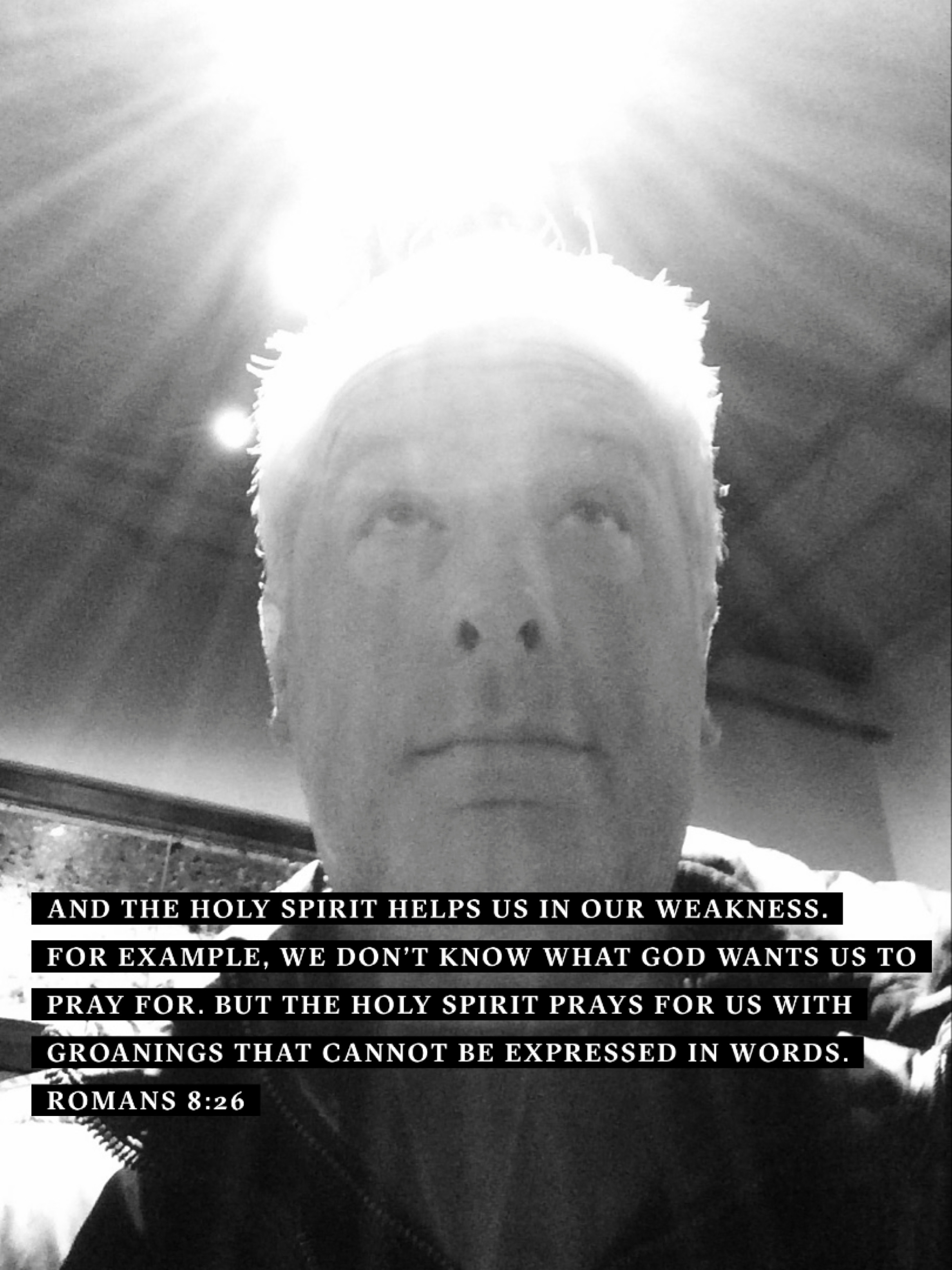
Likewise the Spirit also helps in our weaknesses. For we do not know what we should pray for as we ought, but the Spirit Himself makes intercession for us with groanings which cannot be uttered. Now He who searches the heart knows what the mind of the Spirit is, because He makes intercession for the saints according to the will of God. (Romans 8:26-27)
God helps our infirmity, and with a Helper so divinely strong, we need not fear the result! … We take our burden to our heavenly Father and tell Him in the accents of childlike confidence, and we come away quite content to better whatever His holy will may lay upon us. …
We bathe our wounds in the lotion of prayer and the pain is lulled; the fever is removed. But the worst of it is that in certain conditions of heart we cannot pray. We may be brought into such perturbation of mind and perplexity of heart that we do not know how to pray. … We fall into such heaviness of spirit and entanglement of thought that the one remedy of prayer, which we have always found to be unfailing, appears to be taken from us. Here, then, in the nick of time, as a very present help in time of trouble, comes in the Holy Spirit! He draws near to teach us how to pray, and in this way He helps our infirmity, relieves our suffering, and enables us to bear the heavy burden without fainting under the load. …
He will guide you both negatively and positively. Negatively, He will forbid you to pray for such and such a thing, even as Paul essayed to go into Bithynia, but the Spirit would not allow him. And, on the other hand, He will cause you to hear a cry within your soul that will guide your petitions, even as He made Paul hear the cry from Macedonia, saying, ‘Come over to Macedonia and help us’ (Acts 16:6-10). …
If I am a true believer, there dwells the Holy Spirit, and when I desire to pray, I may ask Him what I should pray for as I ought and He will help me! He will write the prayers that I ought to offer upon the tablets of my heart, and I will see them there and so I will be taught how to plead! It will be the Spirit’s own Self pleading in me and by me and through me before the throne of grace!
From The Holy Spirit’s Intercession
Oh, how many times I’ve been in desperate need but cannot find the right words to pray. The Holy Spirit understands even groans that come from my anguished heart and can help me turn those groans into perfect prayers.
“The question, therefore, which each of us has to answer to his own conscience is, ‘Has it been the end of my ministry, has it been the desire of my heart to save the lost and guide the saved? Is this my aim in every sermon I preach, in every visit I pay? Is it under the influence of this feeling that I continually live and walk and speak? Is it for this I pray and toil and fast and weep? Is it for this I spend and am spent, counting it, next to the salvation of my own soul, my chiefest joy to be the instrument of saving others? Is it for this that I exist?’”
“It is not opinions that man needs: it is truth. It is not theology: it is God. It is not religion: it is Christ. It is not literature and science; but the knowledge of the free love of God in the gift of His only-begotten Son.”
“Our power in drawing men to Christ springs chiefly from the fullness of our personal joy in Him, and the nearness of our personal communion with Him.”
“Why so many meetings with our fellow men, yet so few meetings with God?”
“Our life has not been a lying-in-wait for the voice of God. ‘Speak, Lord; for Thy servant heareth,’ has not been the attitude of our souls, the guiding principle of our lives. Nearness to God, fellowship with God, waiting upon God, resting in God, have been too little the characteristic either of our private or our ministerial walk. Hence our example has been so powerless, our labors so unsuccessful, our sermons so meager, our whole ministry so fruitless and feeble.”
“It is easier to speak or write about revival than to set about it. There is so much rubbish to be swept out, so many self-raised hindrances to be dealt with, so many old habits to be overcome, so much sloth and easy-mindedness to be contended with, so much of ministerial routine to be broken through, and so much crucifixion, both of self and of the world, to be undergone. As Christ said of the unclean spirit which the disciples could not cast out, so we may say of these: ‘This kind goeth not out but by prayer and fasting.’”
“These must be days of strenuous, ceaseless, persevering, and, if God bless us, successful toil. We shall labor till we are worn out and laid to rest.”
“It is unbelief that makes ministers handle eternal realities with such irreverence. It is unbelief that makes them ascend with so light a step ‘that awful place the pulpit,’ to deal with immortal beings about heaven and hell.”
…with Your mouth You have promised and with Your hand You have fulfilled it… (2 Chronicles 6:15).
I rest solely on what God says—He says it and He fulfills it.
I can live on “every Word” He speaks (Deuteronomy 8:3).
“Every Word” of God is flawless and is a protection for me (Proverbs 30:5).
None of God’s Word ever fail (Isaiah 55:11).
God gives us His Word to speak (Jeremiah 26:12; John 12:49; Luke 21:15).
We defeat our enemies by God’s Word in our mouth (Matthew 4:4, 7, 10; Revelation 12:11).
Every Word of God gives life because of the Holy Spirit’s anointing on it (John 6:63).
Every Word of God is a sword (Hebrews 4:12; Revelation 1:16; 2:12, 16; 19:15). Or as my friend Sasha reminds me God’s Word is our S(word)!
There isn’t a more effective shield against enemies, there isn’t a more deadly weapon against temptation, there isn’t a more sure foundation in storms than the Word spoken and fulfilled by God!
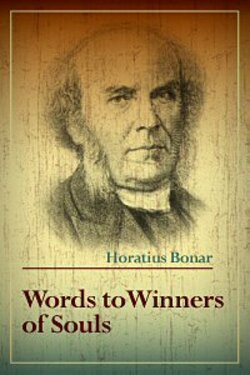
Horatius Bonar has given us a collection of sermons preached to pastors, which have been collated in a book under the title Words To Winners Of Souls.
Although these were words by a pastor to pastors, this shouldn’t be a book exclusively read by pastors. Anyone who wants to successfully share their Christian testimony with unsaved friends and loved ones can find much to digest in these sermons. That being said, this is still a must-read (and I don’t say that very often) for those in pastoral ministry.
Bonar was a no-pulled-punches preacher! He spoke candidly and forcefully, but he also spoke out of a love for the Body of Christ and its ministers. Early on in this book he says, “We take for granted that the object of the Christian ministry is to convert sinners and to edify the body of Christ. No faithful minister can possibly rest short of this. Applause, fame, popularity, honor, wealth—all these are vain. If souls are not won, if saints are not matured, our ministry itself is vain.” Wow: “our ministry itself is vain”—you cannot get more gut-level honest than that!
In this collection of messages, Bonar helps us diagnose what may be hindering our soul-winning practices, and he also proposes the remedy for those shortcomings. These words are honest and often hard to hear, but they are so needed for everyone who desires, as Jesus does, “that none should perish but all should come to repentance” (2 Peter 3:9).
Pastors, please read this book!
Parishioners, please get a copy of this book for your pastor and then offer to prayerfully read through it with him or her. I promise you: this book will pay eternal dividends.
Near the end of the movie The Princess Bride, the grandson learns that Wesley, the hero of the story, has apparently died. He asks his grandfather, “Who kills Prince Humperdink,” the arch-villain in the story.
His grandfather replies, “No one. He lives.”
“You mean he wins!?” blurts out the exasperated boy, “Grandpa, why did you read me this story??”
We love to see bad guys get what’s coming to them, don’t we? Some of the baddest bad guys—perhaps in all of history—are the kings of Assyria. When the Assyrians in Nineveh repented and God’s judgment didn’t fall on them, Jonah’s response was much like the grandson in The Princess Bride, “God, why did You send me here?!”
For Judah, this is a short-lived victory because the two kings which follow Sennacherib turn out to be two of the evilest and ruthless kings of Assyria. Yet Nahum’s prophecy still stands: an ultimate destruction is coming. In 605 BC Assyria was defeated by the Babylonians, and the destruction was so complete that Nineveh’s very existence was questioned until archeological discoveries were made in the 19th century.
Why is this prophecy given to us? What are we New Testament Christians supposed to do with this promise of judgment?
Nahum’s name means comfort, so it seems like God’s justice should comfort us. But, interestingly, the root word of his name means to regret or to feel sorry.
Why is this? Think about it: You cannot really know what peace is unless you have been through a period of turmoil. Likewise, you cannot truly understand the relief of being spared God’s judgment unless you fully understand the weight and totality of God’s judgment that should fall on you.
Assyria’s utter destruction is less than a drop in the bucket compared to eternal separation from God. As C.S. Lewis commented about the end of time:
“For this time it will be God without disguise; something so overwhelming that it will strike either irresistible love or irresistible horror into every creature. It will be too late then to choose your side. There is no use saying you choose to lie down when it has become impossible to stand up. That will not be the time for choosing: it will be the time when we discover which side we really have chosen, whether we realized it before or not. Now, today, this moment, is our chance to choose the right side. God is holding back to give us that chance. It will not last forever. We must take it or leave it.”
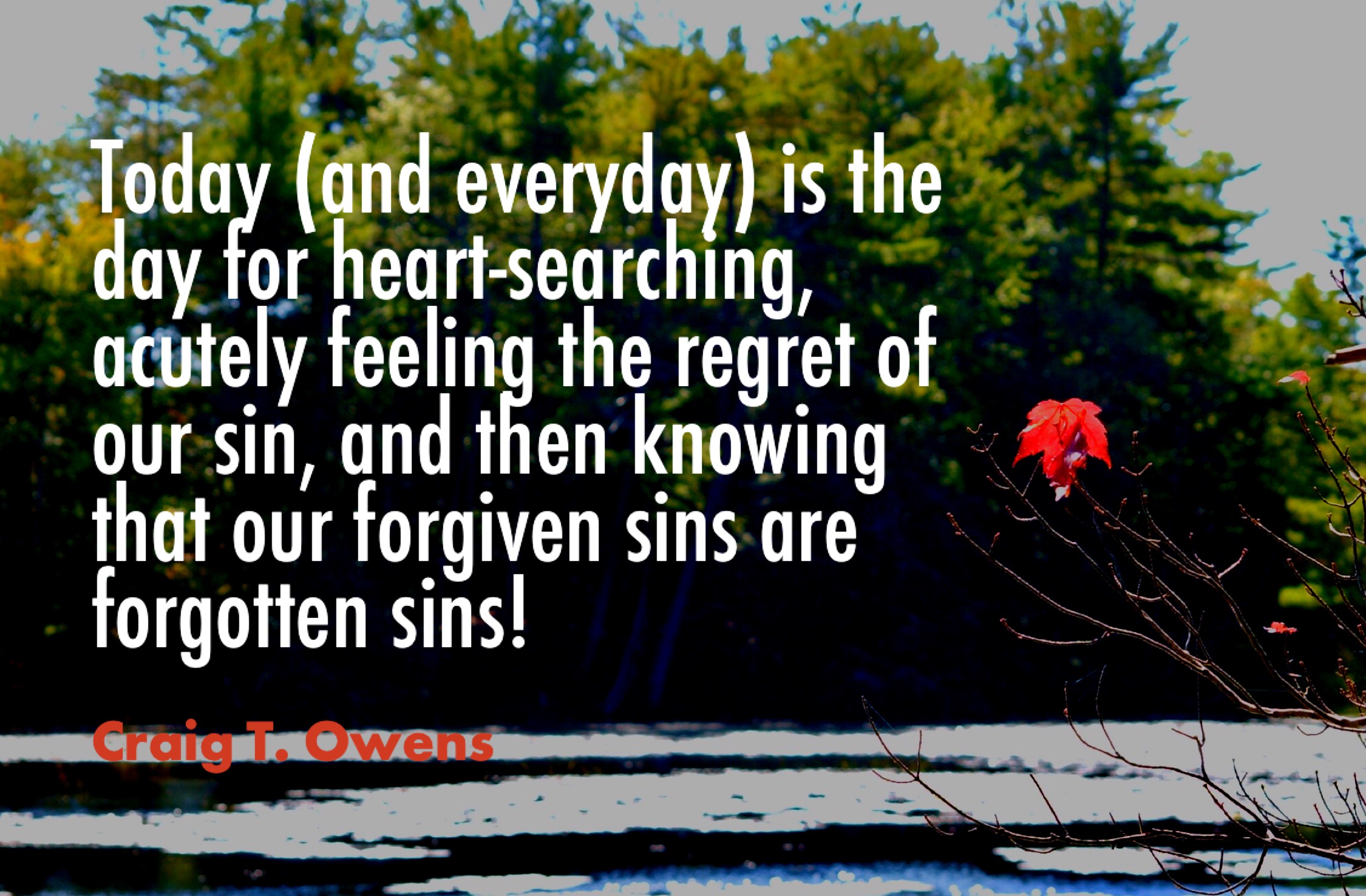
Today (and every day) is the day for heart-searching, acutely feeling the regret of our sin, and then knowing that our forgiven sins are forgotten sins!



 General George Patton gives us an insightful leadership look into how his army was able to accomplish so much during such a short time in World War II. Check out my full book review by clicking here.







 Craig T. Owens