The Gift Unmistakably Seen

Listen to the podcast of this post by clicking on the player below, and you can also subscribe on AppleSpotify, or Audible. 

We saw last week that John 3:16 tells us of God’s greatest Gift—Jesus! 

This Gift was not an after-thought. God didn’t say, “I’ve tried everything else and nothing has worked so I guess I have to send My Son.” NO! The Gift was foretold right from the very moment Adam and Eve sinned (Genesis 3:15, 21). In fact, we can even say it was planned before the beginning of Time, as John describes Jesus as “the Lamb who was slaughtered before the world was made” (Revelation 13:8). 

John also writes for us one of the most beautiful and succinct statements of God: God IS Love (1 John 4:8). 

Paul wrote an inspired definition of love. Check out what happens when we put “God” in place of “love” in 1 Corinthians 13:4-8

God is patient, God is kind. God does not envy, God does not boast, God is not proud. God does not dishonor others, God is not self-seeking, God is not easily angered, God keeps no record of wrongs. God does not delight in evil but rejoices with the truth. God always protects, God always trusts, God always hopes, God always perseveres. God’s love never fails. 

This description of God means that He wasn’t forced to send Jesus as the ransom for our sins, but rather that His love foreknew the perfect moment to send this Gift for us. 

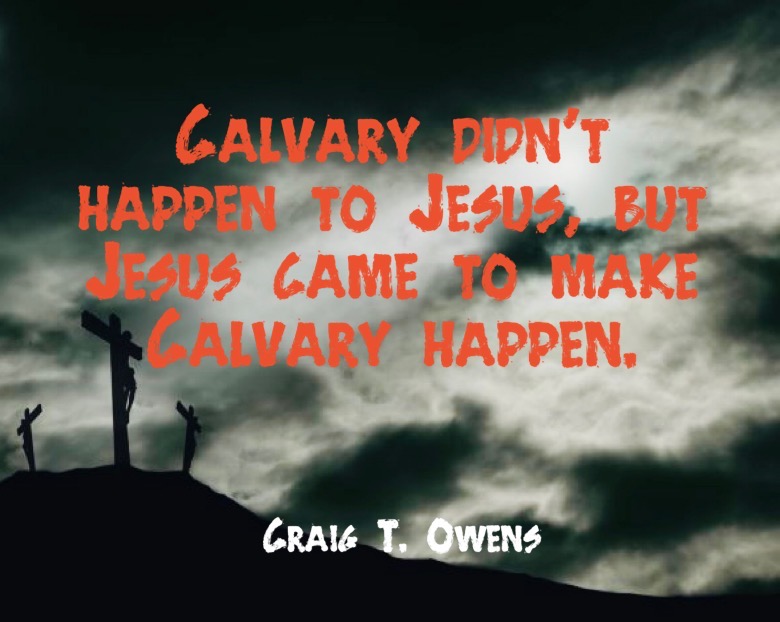
Neither did Jesus feel trapped by this plan His Father made. Calvary didn’t happen to Jesus, but Jesus came to make Calvary happen (John 17:24; Hebrews 12:2; John 10:17-18). 

Jesus made His Gift unmistakable:

  • He predicted the unmistakable events leading up to Calvary—Matthew 20:17-19, 26:2; Mark 10:32-34; Luke 18:31-33; John 13:19 
  • He predicted the unmistakable way He would die—John 3:14, 12:32-33 
  • And His Father unmistakably confirmed all of this—John 12:27-28

(check out all of the above verses by clicking here) 

Just before His crucifixion, Jesus gave His followers an unmistakable example of love to follow. He said that His love radiating out of His followers would show the world an unmistakable picture of His love (see John 13:3-5, 12-17, 34-35). 

I may say, “Thank you so much” when I open someone’s gift, but my true gratitude is seen in what I do with their gift after that. Do I put it on a shelf and forget about it? Or do I cherish it, use it, and tell others all about the one who gave the gift to me? This is just as true with how I treat the Love Gift that I was given in Jesus. 
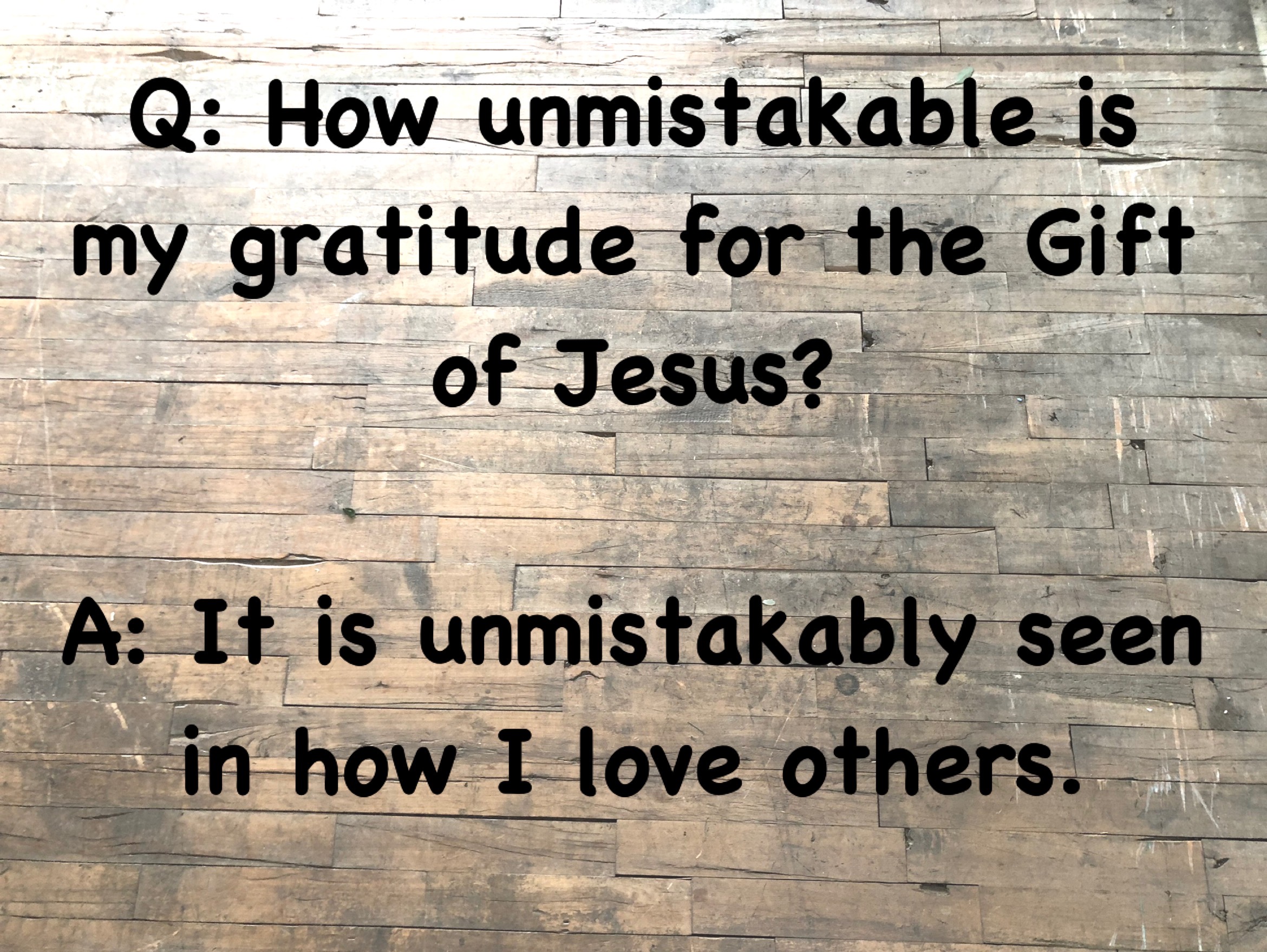
Q: How unmistakable is my gratitude for the Gift of Jesus? 

A: It is unmistakably seen in how I love others. 

Here’s the test: Can I put my name in 1 Corinthians 13:4-8—

Craig is patient, Craig is kind. Craig does not envy, Craig does not boast, Craig is not proud. Craig does not dishonor others, Craig is not self-seeking, Craig is not easily angered, Craig keeps no record of wrongs. Craig does not delight in evil but rejoices with the truth. Craig always protects, Craig always trusts, Craig always hopes, Craig always perseveres. Craig’s love never fails.

The Holy Spirit wants all Christians to be able to truthfully insert their names in that statement. He wants to help us make necessary changes that will allow the amazing Gift of Jesus to be unmistakably seen by everyone. 

God’s plan is unmistakable. The death of Jesus is unmistakable proof of God’s love. Now, let’s make sure that our love is also empowered by the love of God shining unmistakably out of everything we say and do. 

If you’ve missed any of the messages in our series Christmas Unwrapped At Easter, you can find the complete list by clicking here. 

►► Would you please prayerfully consider supporting this ministry? My Patreon supporters get behind-the-scenes access to exclusive materials. ◀︎◀︎

Poetry Saturday—Oh The Lamb

Listen to the podcast of this post by clicking on the player below, and you can also subscribe on AppleSpotify, or Audible.

In evil long I took delight,
Unawed by shame or fear,
Till a new object met my sight,
And stopp’d my wild career.

Oh, the Lamb, the bleeding Lamb,
The Lamb on Calvary,
The Lamb that was slain and liveth again
To intercede for me.

I saw One hanging on a Tree
In agonies and blood,
Who fixed His languid eyes on me,
As near the Cross I stood.

Sure never till my latest breath
Can I forget that look,
It seem’d to charge me with His death,
Tho’ not a word He spoke.

My conscience felt and owned my guilt,
And plung’d me in despair,
I saw my sins His blood had spilt,
And helped to nail Him there.

A second look He gave, which said,
“I freely all forgive,
This blood is for thy ransom paid,
I die, that thou may’st live.”

Thus, while His death my sins display
In all its blackest hue,
Such is the mystery of grace,
It seals my pardon too.

Oh, the Lamb, the bleeding Lamb,
The Lamb on Calvary,
The Lamb that was slain and liveth again
To intercede for me. —John Newton

►► Would you please prayerfully consider supporting this ministry? My Patreon supporters get behind-the-scenes access to exclusive materials. ◀︎◀︎

Thursdays With Spurgeon—Don’t Let Your ‘Well Begun’ Be Only ‘Half Done’

This is a weekly series with things I’m reading and pondering from Charles Spurgeon. You can read the original seed thought here, or type “Thursdays With Spurgeon” in the search box to read more entries.

Listen to the podcast of this post by clicking on the player below, and you can also subscribe on AppleSpotify, or Audible. 

Don’t Let Your ‘Well Begun’ Be Only ‘Half Done’

But our citizenship is in heaven. And we eagerly await a Savior from there, the Lord Jesus Christ, Who, by the power that enables Him to bring everything under His control, will transform our lowly bodies so that they will be like His glorious body. Therefore, my brothers and sisters, you whom I love and long for, my joy and crown, stand firm in the Lord in this way, dear friends! (Philippians 3:20—4:1). 

     The start is not everything, but it is a great deal. It has been said by the old proverb that ‘well begun is half done,’ and it is certainly so in the things of God. … See to it that you lay a good foundation. It is better to have no repentance than a repentance that needs to be repented of! It is better to have no faith than a false faith! It is better to make no profession of religion than to make an untruthful one! … We should learn early on the difference between grace and merit, between the purpose of God and the will of man, between trust in God and confidence in the flesh. If we do not start aright, the further we go, the further we will be from our desired end and the more thoroughly in the wrong we will find ourselves.

From The Watchword For Today: “Stand Fast”

Some people love wearing the label “Christian” but they never surrender to the lordship of Jesus. This is scary because Jesus says that these are the people to whom He will have to say, “I never knew you” (Matthew 7:21-23). 

In the biblical passage Spurgeon used as his text, we read some important words. First of all, we need to live as citizens of Heaven, not as citizens of Earth. That means we need to always follow God’s laws, not the passing fads of culture. 

Second, the apostle Paul calls Jesus both Savior and Lord. We don’t get to choose one and ignore the other. We cannot say, “Thank You, Jesus, for saving me, but I’ll take it from here.” 

Finally, we need to not only stand firm, but as Paul also says in another letter, “So, if you think you are standing firm, be careful that you don’t fall!” (1 Corinthians 10:12). No assumptions. No coasting. No merely going through the motions of Christianity, but keeping a humble heart that responds to the correcting word from the Holy Spirit. 

Let’s make sure that our walk with Jesus is never described as only “half done.” But instead, let’s begin well, walk well, and rejoice to hear our Savior say, “Well done, good and faithful servant!

►► Would you please prayerfully consider supporting this ministry? My Patreon supporters get behind-the-scenes access to exclusive materials. ◀︎◀︎

Crucifixion Events

Listen to the podcast of this post by clicking on the player below, and you can also subscribe on AppleSpotify, or Audible. 

The death of Jesus may be the most attested execution in all of history. It’s certainly the most meaningful execution, as the death of Jesus brought a fulfillment to prophecy that was made in the immediate aftermath of humanity’s first sin. 

I have frequently written about the historicity of the Bible. The crucifixion of Jesus is not a “once upon a time” or “in the make-believe land of Israel” story, but an actual event, which involved actual people, at an actual moment in history. Even the way the four Gospel writers record the crucifixion of Jesus attests to the historicity of this event.

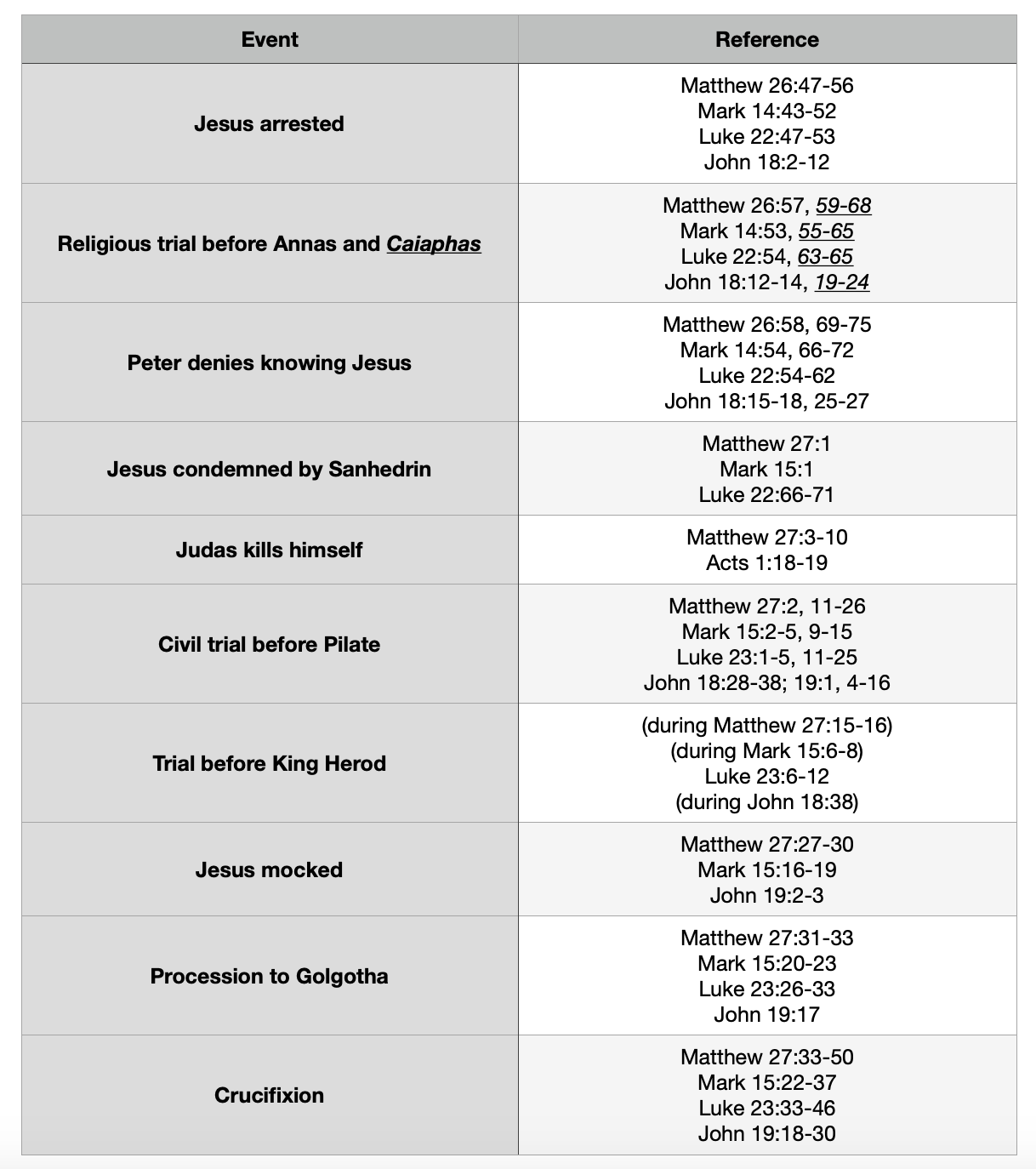
Check out this chart of the events that show how Matthew, Mark, Luke, and John record this historical moment. 

When did this moment in history occur? Consider this scholarly insight from The Archeological Study Bible

“In what year was Jesus born, and when was He crucified? These are long-standing historical questions. The seemingly obvious answer to the first—that He was born in A.D. 1 (there is no year 0)—is incorrect, however, since the calculations on which our modern calendar is based were faulty. …

“The chronology of Jesus’ life, though clear in outline, cannot be fixed with absolute precision. Matthew and Luke both inform us that Jesus was born before the death of Herod (4 B.C.), though it would appear that His birth occurred toward the final years of Herod’s reign, suggesting an approximate date of 6-4 B.C. The next chronological marker comes from Luke 3:1, where we learn that John the Baptist’s ministry began during the fifteenth year of the reign of the emperor Tiberius. Since A.D. 14 is the generally accepted date for Tiberius’ accession to the throne, John’s ministry would have commenced between August A.D. 28 and December of 29. Jesus began His own ministry shortly after John had embarked on his, at some point in A.D. 28 or 29, making Jesus about 32 or 33 years old at the time. This fits well with Luke’s statement that Jesus was ‘about 30 years old’ (Luke 3:23).

“The duration of Jesus’ public ministry was approximately three years. While the exact chronology of this period is difficult to ascertain, the final phase of His ministry allows for closer scrutiny. It is clear that Jesus was crucified under Pontius Pilate, who governed Judea from A.D. 26-36. …

“Taking Friday, Nisan 14, as the day of the crucifixion, astronomical data informs us that the only years from A.D. 29-36 that could have seen Nisan 14 on a Friday are A.D. 30, 33 and 36. A.D. 36 is easily dismissed as too late, while A.D. 30 seems too early (although some who begin Jesus’ ministry in A.D. 28 and shorten His public ministry find it acceptable). This leaves A.D. 33 as the most likely date for the year of Jesus’ death and resurrection.” 

As you celebrate the victory over sin and death that Jesus won by His sacrificial death on the Cross, rejoice also that this is an actual historical event that bought your freedom from your sin. It is indeed miraculous, but it is also historic. Let’s never lose sight of either of those facets. 

►► Would you please prayerfully consider supporting this ministry? My Patreon supporters get behind-the-scenes access to exclusive materials. ◀︎◀︎
The Craig And Greg Show: Mistake Your Way To Success

Listen to the audio-only version of this podcast by clicking on the player below, or scroll down to watch the video.

On this episode of “The Craig And Greg Show” we talk about: 

  • [0:20] Craig shares an insightful quote from John Maxwell 
  • [0:45] The guys claim to have never made a mistake, and we definitely believe them…
  • [1:12] Mistakes help both individuals and teams grow 
  • [2:12] Craig shares a lesson from his wife’s classroom about it being a safe place to make mistakes 
  • [3:06] Leaders need to distinguish between success and perfection 
  • [3:50] What do our faces show when others make mistakes? 
  • [4:40] Greg explains how grace and humility from the leader will help other teammates deal with their mistakes 
  • [6:16] Sports show us how mistakes can lead to excellence 
  • [7:24] Greg’s football mistakes led to his high level of success 
  • [11:06] Leaders have to remind everyone that mistakes aren’t fatal 
  • [13:30] Thomas Edison gave us a good example about success coming from failure 
  • [15:31] When leaders share their mistakes, it’s freeing for the rest of the team
  • [17:26] Leaders need to take initiative—as the leader goes, so goes the team

Check out this episode and subscribe on YouTube so you can watch all of the upcoming episodes. You can also listen to our podcast on Spotify and Apple.

Creating A Peaceful Environment

Listen to the podcast of this post by clicking on the player below, and you can also subscribe on AppleSpotify, or Audible. 

The Israelites fought constantly with the Philistines throughout Saul’s lifetime… (1 Samuel 14:52). 

Have you ever worked in a hostile environment? I was involved with one organization where all of the staff members called the weekly meeting the “staff beating” instead of the staff meeting. This was largely because the senior leader started off every meeting by asking for problems that needed to be addressed, but then he “addressed” the problem by attacking the person who shared the problem. 

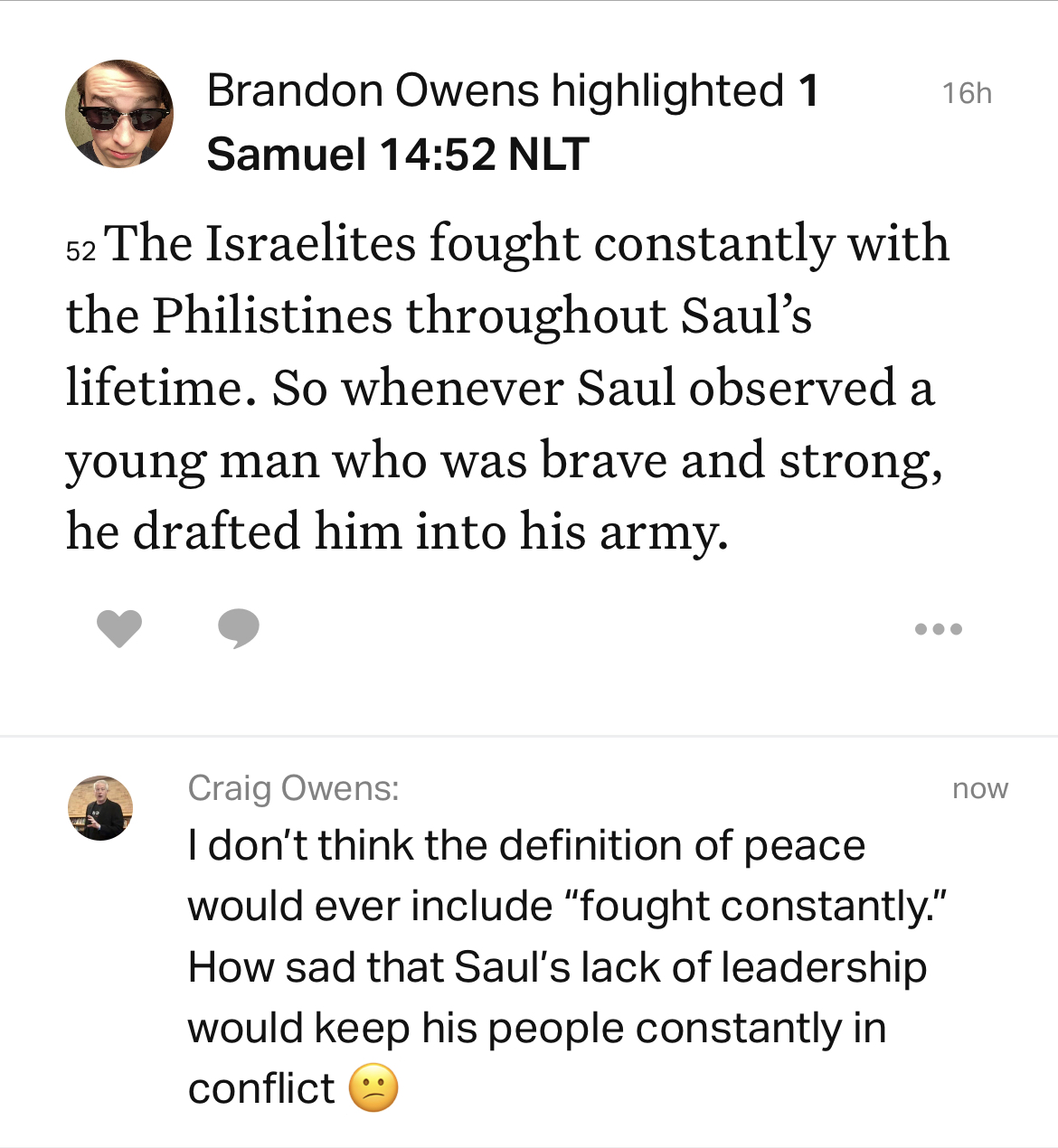
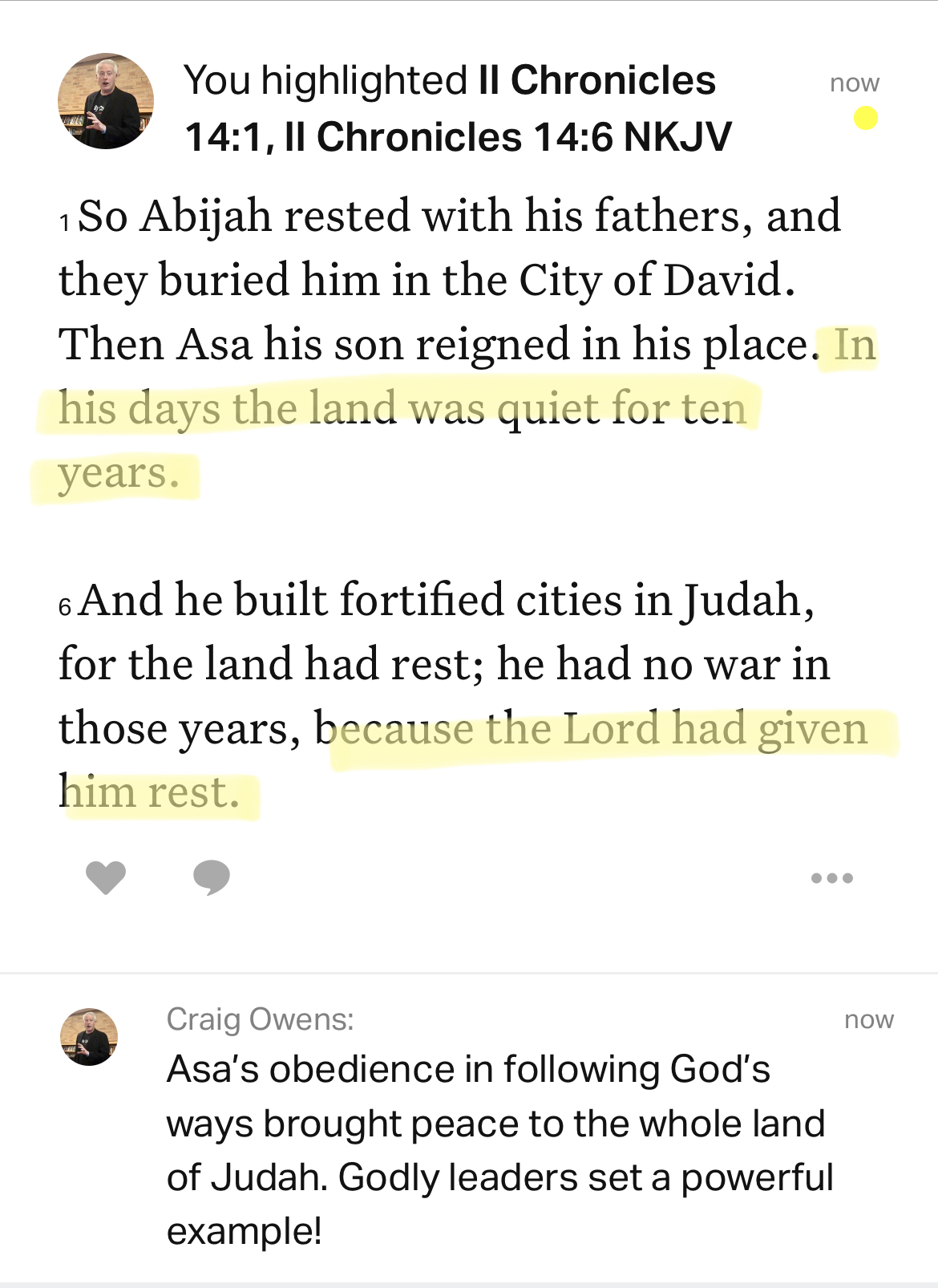
I was reminded of this recently when I was scrolling through YouVersion and saw that my son had highlighted 1 Samuel 14:52 that said that Saul’s reign as king was noted for the constant fighting. I added the comment, “I don’t think the definition of peace would ever include ‘fought constantly.’ How sad that Saul’s lack of leadership would keep his people constantly in conflict.” 

Make no mistake about it: It was his poor leadership that created this environment. We often read of his jealousy of anyone else who was successful, and we see that although he had a loyal army, he kept them bottled up. 

On the other hand, consider this statement about the reign of king Asa: “In his days the land was quiet for ten years. … He had no war in those years, because the Lord had given him rest” (2 Chronicles 14:1, 6). This peace and quiet and rest is directly tied to Asa’s obedience to God’s laws. 

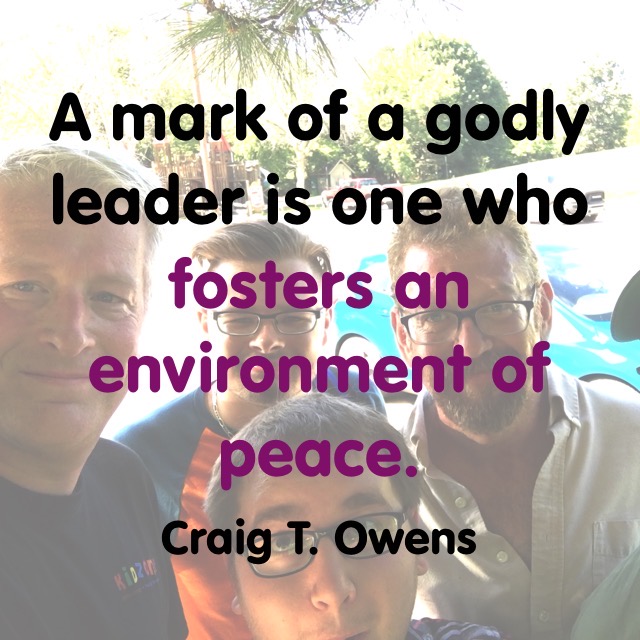
A mark of a godly leader is one whose obedience to God fosters an environment of peace for his people. 

This is part 62 in my series on godly leadership. You can check out all of my posts in this series by clicking here. And I would also encourage you to check out my book Shepherd Leadership: The Metrics That Really Matter, where I outline in more detail the characteristics of godly leadership. 

►► Would you please prayerfully consider supporting this ministry? My Patreon supporters get behind-the-scenes access to exclusive materials. ◀︎◀︎

The Gift Promised

Listen to the podcast of this post by clicking on the player below, and you can also subscribe on AppleSpotify, or Audible.

Have you ever seen kids tearing into a Christmas present and then being disappointed that what they got wasn’t what they wanted? They may say something like, “This isn’t what I put on my wish list!” 

From the response of the religious leaders in the Gospels, it appears that the gift of Jesus on that original “Christmas morning” was very similar. It’s almost like they were saying, “This isn’t the type of Messiah we wanted!” They wanted someone to give them freedom from the Romans, but their Heavenly Father wanted them to have something far bigger and greater: Eternal freedom from the penalty of sin. 

The first humans had the joy of being innocent in God’s presence, where they had everything they needed. But satan got Adam and Eve to focus on something they wanted, and that sin of disobedience brought an immediate separation. They now feared the nearness of God. 

There were immediate and painful consequences for their sin, but God wanted the heaviest of penalties to fall on Himself. To foreshadow this, God sacrificed an innocent animal to cover their nakedness, showing us what the gift of Jesus would do for us (Genesis 3:1-21). 

In The Holy War, John Bunyan tells the story of the town of Mansoul enslaved to Diabolus. The crafty serpent plays on their fears by reminding them how terrible it would be if they allowed Holy God to come near them while they were in their sinful state: 

“‘Gentlemen,’ quoth he, ‘and my faithful subjects, if it is true that this summoner hath said concerning the greatness of their King, by His terror you will always be kept in bondage, and so be made to sneak. Yea, how can you now, though He is at a distance, endure to think of such a Mighty One? And if not to think of Him while at a distance, how can you endure to be in His presence?’” 

Diabolus even tried to make their slavery to sin look like freedom: “I, your prince, am familiar with you, and you may play with me as you would with a grasshopper. Consider, therefore, what is for your profit, and remember the immunities that I have granted you.’”  

As John Piper reminds us, “Christmas is for freedom.” Indeed, that’s just what we see on the first “Christmas morning” in words like salvation, no fear, and great joy (Matthew 1:21; Luke 2:10-11). 

Turning again to The Holy War, here’s what the Father said to His Son: “Wherefore the King called to Him Emmanuel, His Son, who said, ‘Here am I, My Father.’ Then said the King, ‘Thou knowest, as I do Myself, the condition of the town of Mansoul, and what We have purposed, and what Thou hast done to redeem it. Come now, therefore, My Son, and prepare Thyself.’”  

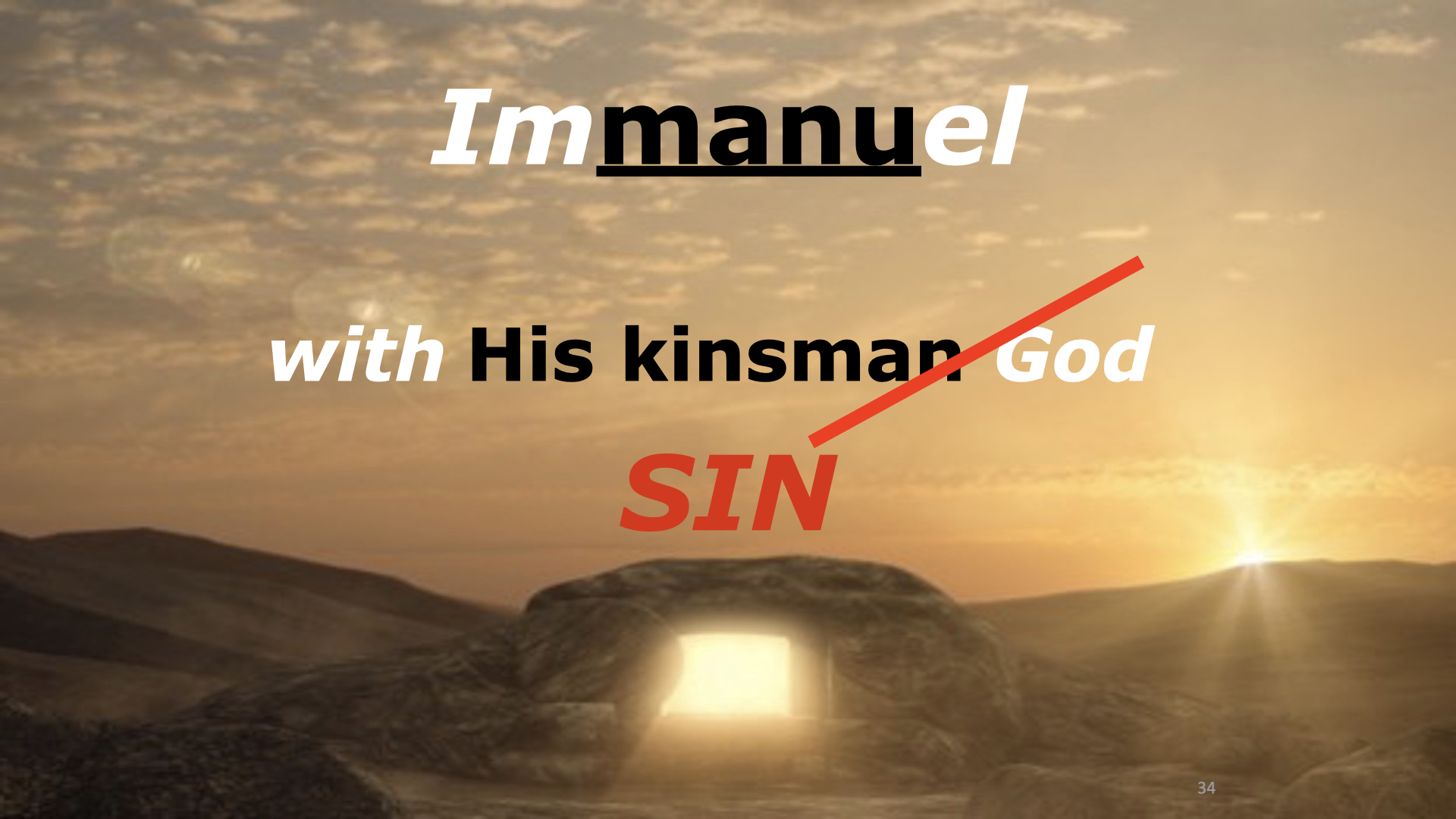
Immanuel (or the Romanized spelling Emmanuel) is the One who removes the separation caused by our sin, and rejoins us to God. That prefix “im” means with, and the suffix “El” means God. The root word means God’s kinsmen. Immanuel comes to repair what was severed by taking sin’s penalty on Himself, and allowing us to once again enjoy the closeness of kinship with our Heavenly Father (Matthew 1:22-23; Galatians 4:4-7). 

When the people saw this Gift on Christmas morning, they said, “This isn’t what we wanted! We wanted a rich, powerful, conquering King. One who would send the Romans running in fear!” As a result, very few unwrapped this Heavenly Gift. But God reminded them, “That may be what you wanted, but I have given what you need. I want you to have not just temporary freedom from the Romans, but eternal freedom from your sin so that you can be forever in My presence!” 

This is what Jesus rejoiced to do for us with the Gift of His life, death, and resurrection. One more passage from The Holy War tells us, “Then said the King’s Son, ‘Thy law is within My heart: I delight to do Thy will. This is the day that I have longed for, and the work that I have waited for all this while. … I will go and will deliver from Diabolus, and from his power, Thy perishing town of Mansoul. My heart has been often pained within Me for the miserable town of Mansoul; but now it is rejoiced, but now it is glad.’” (The timing for the Incarnation of Jesus and even these words of Immanuel Himself are found in Hebrews 2:14-15; 10:5-7). 

God’s love is too great to be limited to just meeting our wants because in our immaturity and sinfulness we don’t know what we really need—but He does. So His love sent Immanuel to us. 

The Gift was given to us at Christmas, but in our immaturity and shortsightedness, we didn’t realize the full impact of this Gift until Jesus rose victoriously from the grave! Now by placing our faith in His completed work, we can be rejoined to God and live in unshakable hope of an eternity with Him! 

If you would like to follow along with all of the messages in this series called Christmas Unwrapped At Easter, please check out the links I’ve shared here.

►► Would you please prayerfully consider supporting this ministry? My Patreon supporters get behind-the-scenes access to exclusive materials. ◀︎◀︎
Poetry Saturday—The Bag

Listen to the podcast of this post by clicking on the player below, and you can also subscribe on AppleSpotify, or Audible.

Away despair! my gracious Lord doth heare.
         Though windes and waves assault my keel,
         He doth preserve it: He doth steer,
         Ev’n when the boat seems most to reel.
         Storms are the triumph of His art:
Well may He close His eyes, but not His heart.

Hast thou not heard, that my Lord Jesus di’d?
         Then let me tell thee a strange storie.
         The God of power, as He did ride
         In His majestic robes of glorie,
         Reserv’d to light; and so one day
He did descend, undressing all the way.

The starres His tire of light and rings obtain’d,
         The cloud His bow, the fire His spear,
         The sky His azure mantle gain’d.
         And when they ask’d, what He would wear;
         He smil’d and said as He did go,
He had new clothes a making here below.

When He was come, as travellers are wont,
         He did repair unto an inne.
         Both then, and after, many a brunt
         He did endure to cancell sinne:
         And having giv’n the rest before,
Here He gave up His life to pay our score.

But as He was returning, there came one
         That ran upon Him with a spear.
         He, who came hither all alone,
         Bringing nor man, nor arms, nor fear,
         Receiv’d the blow upon His side,
And straight He turn’d, and to His brethren cry’d,

If ye have any thing to send or write,
         I have no bag, but here is room:
         Unto my Father’s hands and sight,
         Beleeve Me, it shall safely come.
         That I shall minde, what you impart;
Look, you may put it very neare My heart.

Or if hereafter any of My friends
         Will use Me in this kinde, the doore
         Shall still be open; what he sends
         I will present, and somewhat more,
         Not to his hurt. Sighs will convey
Any thing to Me. Harke, Despair away. —George Herbert (**spelling is 1663 English**)

►► Would you please prayerfully consider supporting this ministry? My Patreon supporters get behind-the-scenes access to exclusive materials. ◀︎◀︎
Heathy Sheep Need A Healthy Shepherd

Listen to the podcast of this post by clicking on the player below, and you can also subscribe on AppleSpotify, or Audible. 

I had a great time on the Thriving In Ministry podcast with Kyle Willis and Dace Clifton. 

Their podcast is all about helping pastors avoid burnout. That’s definitely a message that resonates with my heart too! Long before I stepped into the pastorate, I was actively involved in encouraging pastors and helping protect them from the many slings and arrows that get thrown at them. 

Pastors, we need to remain healthy. Only healthy shepherds can create a healthy environment for the sheep under their care. Jesus not only gave us the example for mental, physical, spiritual, and relational health, but the Holy Spirit wants to help us today to be that kind of wholly healthy leader. 

If you’re a pastor, I believe you will be energized by reading or listening to my book. Shepherd Leadership: The Metrics That Really Matter is available in print or ebook, and in audiobook through either Audible or Apple. 

If you love your pastor, get a copy to give as a gift. If you believe that your pastor would benefit from reading my book, but you don’t have the funds available to purchase it at this time, please leave me a comment below and I’ll make sure I get a copy to you. 

It takes everyone in the Body of Christ being actively involved for both the shepherd and sheep to remain healthy! 

If you’ve missed any of the other clips I’ve shared from this interview, please check them out here:

►► Would you please prayerfully consider supporting this ministry? My Patreon supporters get behind-the-scenes access to exclusive materials. ◀︎◀︎