People Of The Word

Listen to the podcast of this post by clicking on the player below, and you can also subscribe on AppleSpotify, or Audible.

Haggai appears on the historical scene for just five months, but what a bright light he shines! He is the first of three post-exilic prophets to encourage the Israelites who have returned to Jerusalem.

Before we talk about Haggai’s ministry, we need a brief grammar lesson. Specifically, let’s look at two prefixes: un- and non-. Both of them ultimately mean “not,” but there is a distinction that we need to consider when it comes to the Bible: 

    • unbiblical would mean something contrary to the teaching of the Bible 
    • non-biblical is something that may or may not be correct, but it’s not specifically mentioned in the Bible 

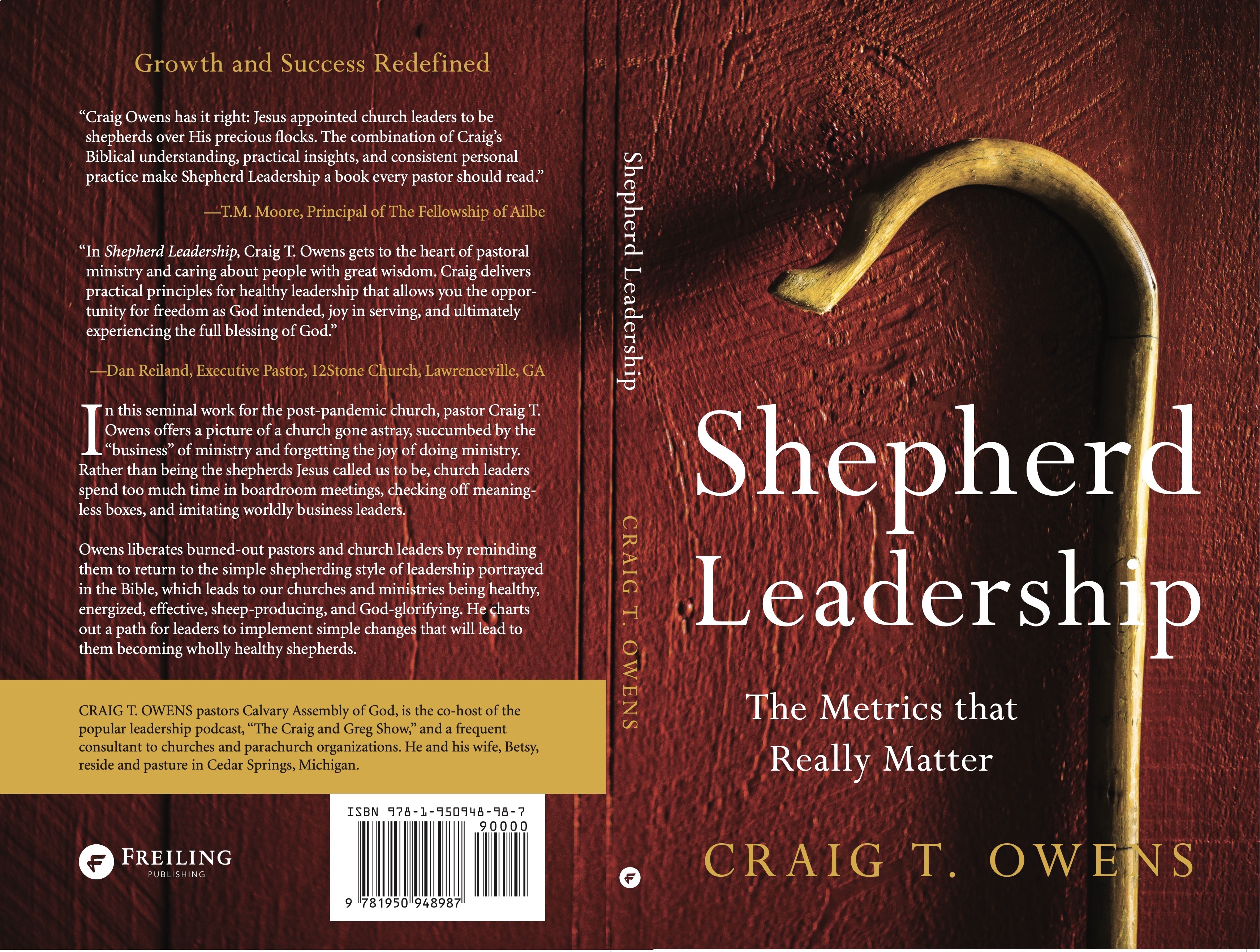
Let me give you an example from my book Shepherd Leadership: The Metrics That Really Matter. Chris asked me whether I preferred the title senior pastor or lead pastor. This is a non-biblical issue; that is, it doesn’t really matter to me because neither of those titles are found in the Bible. Technically, the word pastor isn’t in the Bible either. The word that is usually translated “pastor” is really a herdsman or a shepherd. 

The problem is that if we put too much focus on non-biblical things, those things can end up becoming unbiblical pursuits. Like when Jesus took the Pharisees to task for their focus on traditions over Scripture (see Matthew 15:1-6). I wrote Shepherd Leadership mainly to get pastors and church leaders to spot non-biblical metrics which may have sneakily turned into unbiblical pursuits, so that they could return to pure biblical principles. In the Preface of my book, I wrote—

“My larger concern is that churches, parachurch organizations, and nonprofit ministries that are largely founded to fulfill a biblical mandate are straying from the simple, freeing truths found in the Bible. Or maybe I should say that they are adding things to their ministries that aren’t in the pages of Scripture. Whichever way you want to say it, the result is the same: We are using the wrong metrics to define ‘success’ for our ministries. I fear that in our focus on unbiblical practices, we are missing the joy of really doing ministry.”

Haggai calls God’s people to return to God’s Word. This is the second-shortest book in the Old Testament (at just 38 verses long), yet Haggai says something like “this is what God says” 28 times in these 38 verses! 
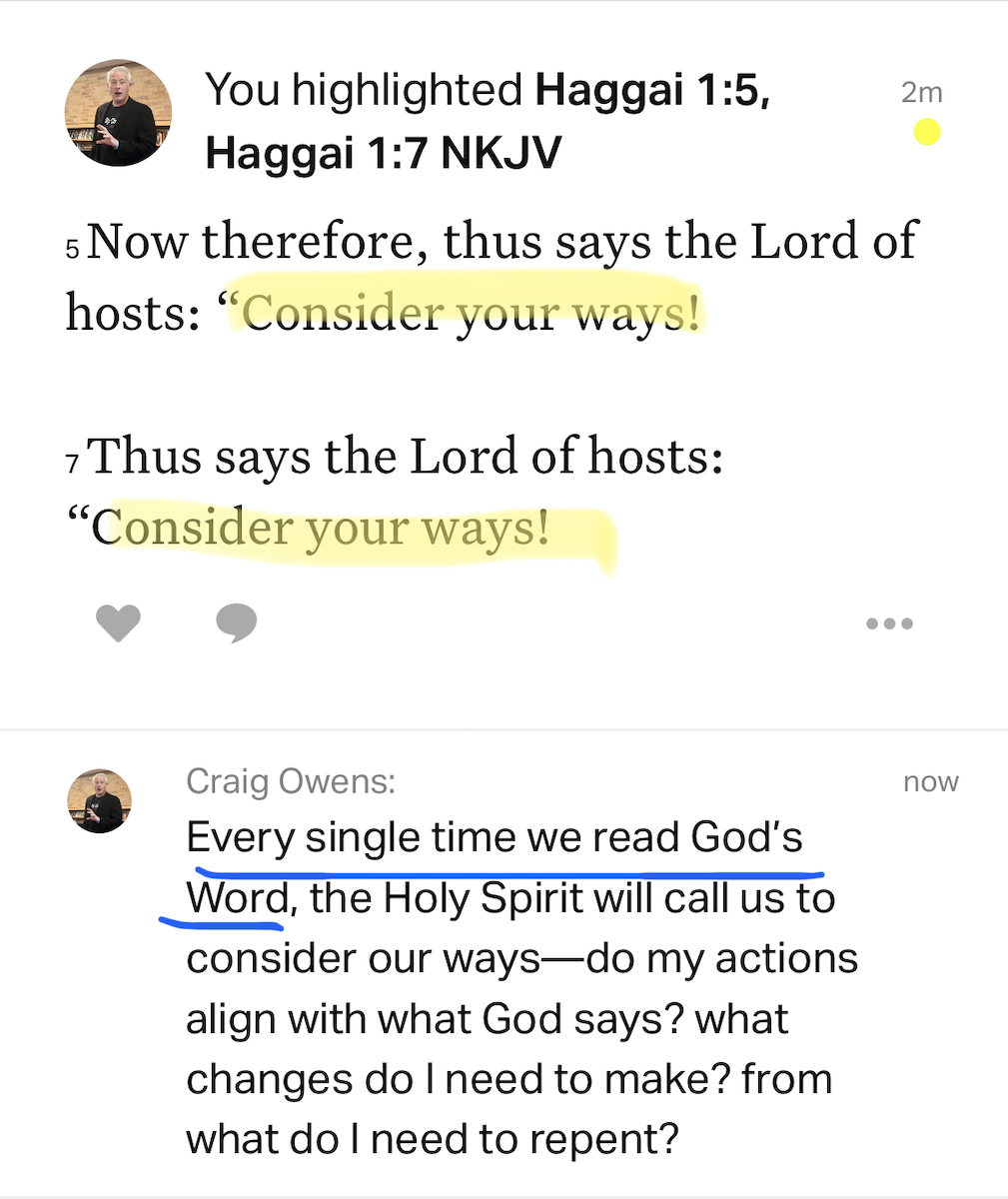
Haggai also records five times that God says, “Give careful thought to your ways.” This phrase literally means to take a strong hold on each thought and examine it intensely. This idea is always connected to a phrase like, “This is what the Lord Almighty says” (1:5, 7; 2:14-15, 17-18). In other words, we are to thoughtfully examine our lifestyle with God’s Word being THE standard of measurement. 

Paul made a similar connection in the New Testament: We demolish arguments and every pretension that sets itself up against the knowledge of God, and we take captive every thought to make it obedient to Christ (2 Corinthians 10:5). 

Jesus did this too. When speaking to the religious leaders, He said, “You are wrong because you know neither the Scriptures nor God’s power” (Matthew 22:29). And even with His own disciples, He had to open their minds to see how the Scriptures pointed to Him and were fulfilled in Him (Luke 24:25-27, 44-45). 

Indeed, the phrase “it is written” is used 75 times in the New Testament! 

That’s why Haggai’s words still ring true to us today: “Give careful thought” to how you live in light of how God says you should be living. Christians need to…

  1. Hear the Word of God every day 
  2. Consider their lives in light of the Word of God
  3. Obey what the Word of God is saying to us 

(check out Acts 17:11; Psalm 139:23-24; 1 Samuel 15:22) 

We must become people of the Word of God or else we run the very real risk of letting our non-biblical decisions spiral downward into a sinful, unbiblical lifestyle that grieves the heart of God. 

If you’ve missed any of the messages in our series Major Lessons From Minor Prophets, you can access the full list by clicking here. 

►► Would you please prayerfully consider supporting this ministry? ◀︎◀︎

Don’t Quit

Easy roads teach us very few valuable lessons. In my book Shepherd Leadership: The Metrics That Really Matter, I talk about how the Holy Spirit uses our challenging times to develop the leadership qualities that are necessary for us to grow. 

My friend, let me encourage you with two words: Don’t quit. If God has called you to your position of leadership, He will also train you to be successful. I really believe the principles I share in my book will help you, and I hope you will pick up a copy soon.

The Craig And Greg Show: Greed Vs. Contentment

On this episode of “The Craig And Greg Show” we talk about: 

  • most people don’t think this leadership killer impacts them [0:30] 
  • we share our personal experiences of leaders placing “me” in front of “we” [2:06] 
  • here’s what this killer does to our teammates [2:58] 
  • sharing is better than taking—this is a key part of an abundance mindset [3:53] 
  • discontentment and low self-esteem lead to feelings of greed [5:14] 
  • what squashes greed? what is our leadership builder? [5:20] 
  • discontentment is the path of least resistance, so we have to choose to be contented leaders [6:43] 
  • Greg shares a contentment lesson he learned while on a missions trip [9:11]
  • how the senior leader should address discontentment or greed in other team members [10:56] 
  • leaders are the thermostat for their team [13:20] 
  • where does work fit into the overall scheme of life? [14:14] 
  • Greg gives us a leadership challenge to help us win the battle against greed [15:40]

Check out this episode and subscribe on YouTube so you can watch all of the upcoming episodes. You can also listen to our podcast on Spotify and Apple.

Really Bad News And Really, Really Good News

Listen to the podcast of this post by clicking on the player below, and you can also subscribe on AppleSpotify, or Audible. 

My cousin Dick Brogden wrote in his book Missionary God, Missionary Bible, “Since good news must often indeed rectify bad news, the gospel message is both warning and invitation.” This is so appropriate when reading the prophet Zephaniah: He wanted to share some really, really good news, but first, he must make us confront the really bad news. 

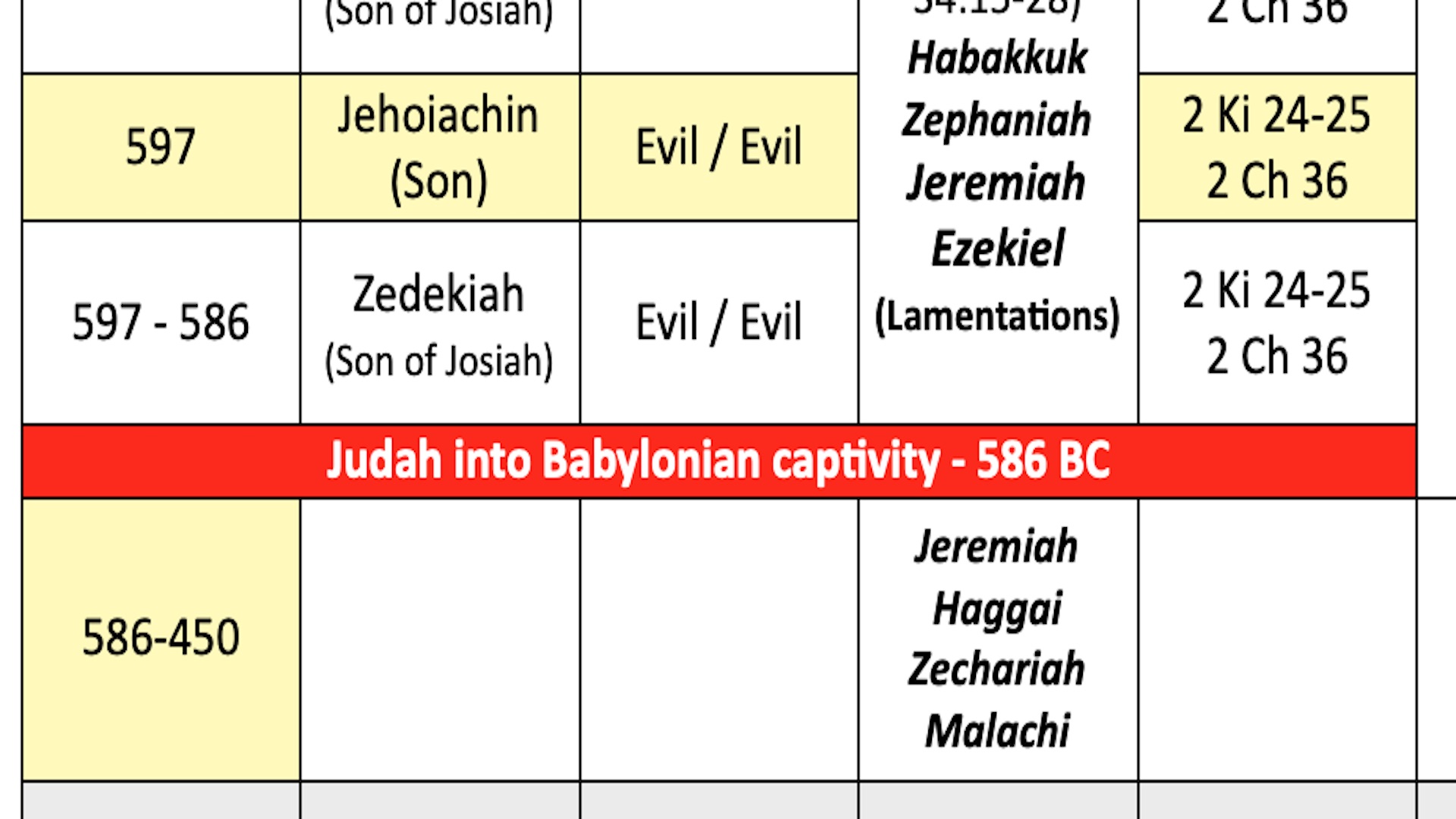
Zephaniah prophesied near the end of Judah’s decline toward exile. He saw the great revival in King Josiah’s day, and then watched his fellow Israelites once again turn their backs on God. If Jeremiah spoke to faithless Israelites, and Habakkuk spoke to faithful Israelites, then Zephaniah spoke to fake Israelites—those who appeared to be religious, but whose hearts were not actually devoted to God. 

This whole book looks backward in history and forward to soon-to-be-fulfilled prophecy. Most of the time when God speaks, He is asking us to look forward to what is unavoidably coming. Zephaniah then takes God’s words as a call for us to apply them to our lives today. 

In the first chapter, God’s forward-look is a warning of the judgment that most assuredly is coming. Built into His warning are two backward looks to the law of Deuteronomy (vv. 13 and 15 look back to Deuteronomy 28:29-30). 

Zephaniah uses this warning as a wake-up call for us, telling us to “seek the Lord” and “seek righteousness, seek humility” before the day of God’s judgment comes (2:1-3). 

The fact that God’s judgment would fall on godless people shouldn’t surprise anyone (2:4-15), but when Zephaniah says, “Woe to the city of oppressors” (3:1), he’s talking to the people of Judah! Zephaniah addresses his warning to the fake Israelites, the hypocritical people—those claiming God’s name but not God’s nature. 

The apostle Paul sounds a similar warning to New Testament Christians: 

Now these things occurred as examples to keep us from setting our hearts on evil things as they did. Do not be idolaters, as some of them were; as it is written: ‘The people sat down to eat and drink and got up to indulge in revelry.’ We should not commit sexual immorality, as some of them did—and in one day twenty-three thousand of them died. We should not test Christ, as some of them did—and were killed by snakes. And do not grumble, as some of them did—and were killed by the destroying angel. These things happened to them as examples and were written down as warnings for us, on whom the culmination of the ages has come. So, if you think you are standing firm, be careful that you don’t fall! (1 Corinthians 10:6-14) 

The really bad news is ALL of us have sinned and we have ALL fallen short of God’s righteous standard. As a result, ALL of us would stand guilty before God on Judgment Day. 

But the really, really good news is that Jesus allowed our penalty to fall on Him instead! So if we put our faith in Jesus, God’s judgment will be appeased in Christ instead of on us! 

Christians, then, take the name of Jesus Christ, but we need to make sure we also take His nature.  Fake—hypocritical—Christians are those who are “Christian” in name only. 

I like the way Eugene Peterson paraphrased part of the 1 Corinthians passage above—These are all warning markers—danger!—in our history books, written down so that we don’t repeat their mistakes. Our positions in the story are parallel—they at the beginning, we at the end—and we are just as capable of messing it up as they were. Don’t be so naive and self-confident. You’re not exempt. You could fall flat on your face as easily as anyone else. Forget about self-confidence; it’s useless. Cultivate God-confidence. (The Message) 

As we read those words, “So if you think you are standing firm, be careful that you don’t fall,” I’d like to suggest four action steps:

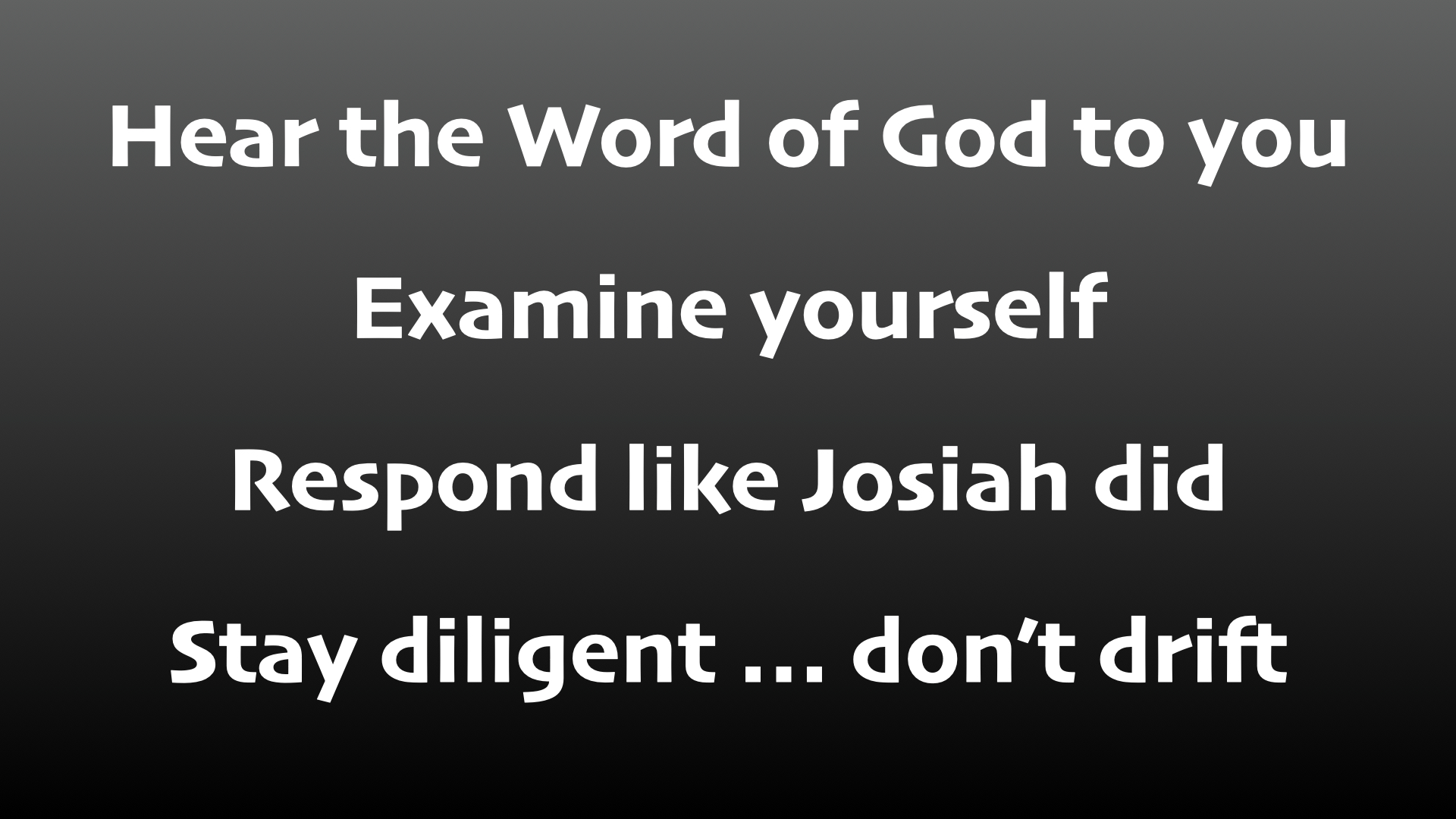
  1. Hear the Word of God to YOU—not your neighbor—but you personally. 
  2. After you hear the Word, examine yourself to see if you are truly living in God’s nature and not just using His name. 
  3. Respond like King Josiah did when he heard God’s Word: He made a public commitment “to follow the Lord and keep His commands, statutes and decrees with ALL his heart and ALL his soul” (2 Kings 23:3). 
  4. Stay diligent—Hebrews 2:1 tells us, “We must pay the most careful attention, therefore, to what we have heard, so that we do not drift away.” 

Don’t delay—the Day of the Lord is closer today than it’s ever been before! Pay attention to the really bad news that Judgment Day is coming, but then make certain you are standing in the nature of Jesus Christ on that day so that God’s judgment will pass over you. 

If you’ve missed any of the messages in our series looking at the major lessons in the minor prophets, you can find the full list of messages by clicking here. 

►► Would you please prayerfully consider supporting this ministry? ◀︎◀︎

Healthy Leaders = Healthy Teammates

“Only healthy shepherds can lead a flock of sheep to places where they too can be at their optimal health.” —excerpt from Shepherd Leadership: The Metrics That Really Matter

I have five chapters in my book to help ministry leaders get mentally, physically, spiritually, and relationally healthy. In this short clip, from “The Craig And Greg Show” leadership podcast, Greg Heeres and I talk about how important it is for leaders to self-care. To see the full episode, please click here. 

Do Our Ministries Need “Glittering Tinsel”?

Listen to the podcast of this post by clicking on the player below, and you can also subscribe on AppleSpotify, or Audible. 

Former Assembly of God General Superintendent W.T. Gaston wrote an article of warning in 1953 that pastors and ministry leaders would do well to heed again today. This part especially caught my attention—

Gaston suggested, “If we are to have a future that is better or even comparable and worthy of our past, we will need to learn over again some of the lessons of yesterday.” One of the important lessons to rediscover, he wrote, was the importance of promoting “pure, undefiled” religion. 

He recalled that many early 20th-century Pentecostal pioneers were bivocational ministers, that often met in homes or rented buildings, and that most were not very impressive by the standards of the surrounding culture. However, they did not need worldly goods and accolades in order for the Holy Spirit to accomplish great things through their lives and ministries.

Gaston wrote that he witnessed an “utter disregard for poverty or wealth or station in life” in the early Pentecostal movement. Yet “those rugged pioneers,” he noted, “had something that made them attractive and convincing.” The contrast between the attitudes of the world and the early Pentecostals was striking. According to Gaston, early believers were “completely satisfied without the world’s glittering tinsel, and content to be the objects of its scornful hatred.”

In the Preface to my book Shepherd Leadership: The Metrics That Really Matter, I sound a similar note of warning and encouragement: 

My larger concern is that churches, parachurch organizations, and nonprofit ministries that are largely founded to fulfill a biblical mandate are straying from the simple, freeing truths found in the Bible. Or maybe I should say that they are adding things to their ministries that aren’t in the pages of Scripture. Whichever way you want to say it, the result is the same: We are using the wrong metrics to define “success” for our ministries. I fear that in our focus on unbiblical practices, we are missing the joy of really doing ministry. 

All of these titles, flowcharts, and non-essential things that we are discussing, revamping, implementing, and measuring aren’t doing anything to liberate us, but they are keeping us focused on checking off meaningless boxes. We’re spending far too much valuable time and resources on keeping the machinery running, but we’re not correctly evaluating the outputs. We need to recalibrate our understanding of leadership: God’s leaders are servants. … 

I believe that leaders of churches and nonprofit ministries will find the greatest freedom and enjoyment—and ultimately experience the full blessing of God—when they learn to view themselves as shepherd leaders. Jesus is our ultimate example: Our Good Shepherd showed us how to live out the lifestyle that pleases Him and glorifies our Heavenly Father. 

I hope you will buy a copy of this book. And I invite you to also check out this video where I explain a little more what I hope this book will accomplish in all of our ministries. 

►► Would you please prayerfully consider supporting this ministry? ◀︎◀︎

Avoiding Leadership Warts

The Craig And Greg Show: Leaders Need To Refresh

On this episode of “The Craig And Greg Show” we talk about: 

  • “burning the midnight oil” is not healthy for a leader  [0:45] 
  • September is Mental Health Awareness Month—what makes this a challenge for leaders [1:20] 
  • I share three attitudes that can hinder a leader’s ability to self-care [1:37]
  • leaders cannot give to others what they do not possess themselves [2:43]
  • Greg addresses the stigma that some people have about mental health [3:55]
  • leaders should think “seasons” over “balance” [5:12]
  • healthy leaders apply boundaries to their lives and understand the tension between work and rest [6:00]
  • Greg shares a different way to think about “balance” [7:22]
  • I remind leaders that self-care is not selfish [8:07]
  • Greg says that boundaries and margin protect leaders and let them handle balance more effectively [10:03]
  • I share how I created margin in my life based on Stephen Covey’s Urgent/Important grid [12:10]
  • in our coaching huddles, we ask the questions that help our clients self-discover their boundaries and margins [14:41]
  • there are some unique hurdles to self-care that non-profit leaders face [16:03]
  • leaders need to assess if they’re ready and equipped to help others [18:40]
  • my leadership challenge [19:40]
  • leaders need to continue to replenish themselves [17:22]
  • we are here to encourage you—check out information on our leadership huddles

Check out this episode and subscribe on YouTube so you can watch all of the upcoming episodes. You can also listen to our podcast on Spotify and Apple.

4 Ministries Of Healthy Churches

Listen to the podcast of this post by clicking on the player below, and you can also subscribe on AppleSpotify, or Audible.

In the Foreword to my book Shepherd Leadership: The Metrics That Really Matter, Dick Brogden observes, “God plucked David from the sheepfold. God chose a sheep to be a shepherd. And though we all are stupid sheep, when God plucks us out of obscurity to serve others, we can have the humble confidence for as long as we are asked to lead that God has chosen us. That confidence both faithfully drives us to our knees and fearlessly propels us against our giants. It is good to be a sheep; it is good to be an under-shepherd. Just remember you are stupid, chosen by the Wise One, and as long as you serve as a shepherd, you and your flock will be safe.” 

How true it is that all of us are sheep. The role of the shepherd is to care for the sheep and create a healthy environment for them. The role of healthy sheep is to reproduce more sheep. In this, both shepherds and sheep are ministers—we all minister to those God has placed around us. 

God calls all Christians to be ministers. The Church is the sheepfold that equips us, but then we must go out to minister in a way that will bring lost sheep to a personal relationship with Jesus. 

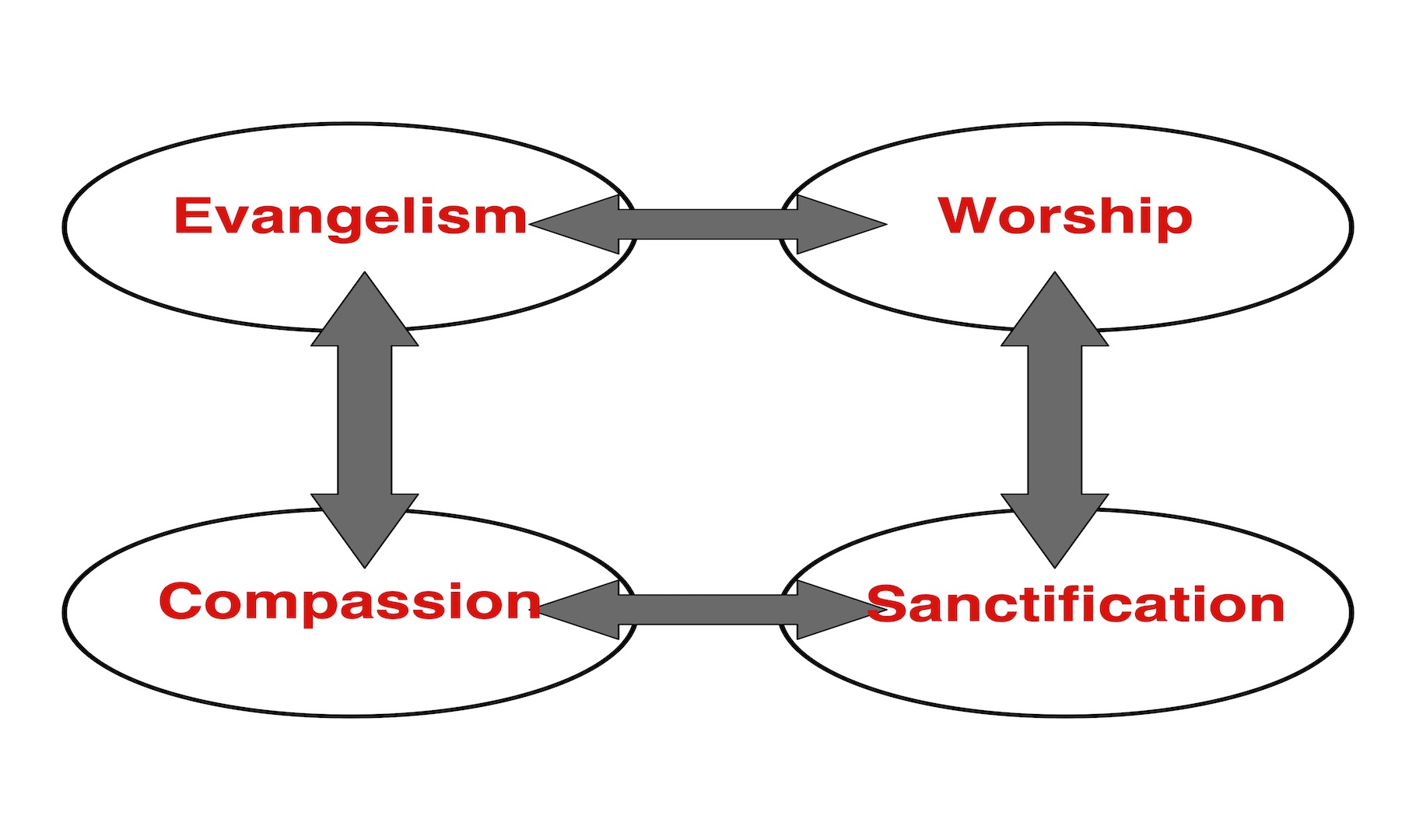
Our foundational truth statement about church ministry says: A divinely called and scripturally ordained ministry has been provided by our Lord for the fourfold purpose of leading the Church in evangelism, worship, sanctification, and compassion. 

(1) Evangelism. When we looked at the foundational belief about the Church, we noted that it’s not either-or—evangelism or discipleship—but it’s both-and. Christians are being the Church when they are intentionally living in a way that makes Jesus known (Matthew 10:1, 7-8; 28:18-20). 

(2) Worship. We shouldn’t have the mindset of, “Let’s go to church to meet with God.” Instead, we need to live in a way where we are always abiding in God’s omnipresence. This worship-centric lifestyle empowers our evangelism, changes our hearts, and fuels our compassion (John 4:23-24; Romans 12:1; Acts 2:46-47). 

(3) Sanctification. Remember that we are all in-process of becoming saints (I like to remember this by calling it saint-ification). We need each other to do this, which is why God gives gifts to bring out Christ-like maturity in us (Ephesians 4:1-7, 11-16). 

(4) Compassion. Compassion is feeling turned into action. This opens the door for evangelism, creates more opportunities for worship, and matures Christians (Mark 6:34-37; Luke 10:33; Acts 2:45).  

Notice that each of these ministries are interdependent with all the other ministries. 

In a blog post nearly 10 years ago, I questioned: “How do we know if our church is successful?  The apostle Paul uses two words to help answer these questions: Quality and Faithfulness (1 Corinthians 3:13, 4:2). 

So here are two important questions we need to ask ourselves: (1) Am I doing quality work? (2) Am I faithfully doing my work? 

To help answer those questions, I like this thought from Leonard Sweet’s book I Am A Follower: “The most important metrics we must rely on, the crucial ‘deliverables’ we can present, must focus on the newly formed lives of the disciples we are making, the followers who are following Christ into a place of serving Him by serving others. The most important measure of our faithfulness to Christ must be the extent of transformation into the living image of Christ Himself. … The quantifiable fruit of our church is not found in the number of people we can gather on a weekly basis. What counts is what is happening in the lives of those who have gathered. 

These are questions we should all ask the Holy Spirit to reveal to us: 

  • What is happening in my life? 
  • Am I telling others about Jesus? 
  • Am I worshipping God so consistently that everyone can see it? 
  • Am I maturating as a saint and am I helping other saints mature? 
  • Is my faith seen in my compassionate actions? 

Our individual answers to those questions will determine the success of our individual churches, which will ultimately determine the effectiveness of the global Church of Jesus Christ. I hope you will take some time to consider these questions for yourself. 

If you’ve missed any of the other messages in our series exploring our foundational beliefs, you can access the full list by clicking here.

►► Would you please prayerfully consider supporting this ministry? ◀︎◀︎

Thursdays With Spurgeon—Present Communion With Jesus

This is a weekly series with things I’m reading and pondering from Charles Spurgeon. You can read the original seed thought here, or type “Thursdays With Spurgeon” in the search box to read more entries.

Listen to the podcast of this post by clicking on the player below, and you can also subscribe on iTunes or Spotify.

Present Communion With Jesus

     The desire of a renewed soul is to find Christ and to be with Him. … Past communion with Christ is very well: ‘Therefore I will remember Thee from the land of Jordan…’ (Psalm 42:6). But these are only stale meats, and a loving soul wants fresh food every day from the table of Christ. … 

     A true loving soul, then, wants present communion with Christ. So the question is, ‘Tell me where You feed. Where do You get Your comfort from, O Jesus? I will go there. … Where do You feed Your flock? In Your house? I will go there, if I may find You there. In private prayer? Then I will not be slack in that. In the Word? Then I will read it night and day. Tell me where You feed; wherever You stand as the Shepherd, there will I be, for I want You. I cannot be satisfied to be apart from You. My soul hungers and thirsts to be with You.’

From The Church’s Love To Her Loving Lord

There are so many pictures in the Bible about our continual reliance on God’s presence—from the manna that was only good for each day, to Jesus teaching us to pray for “our daily bread,” to the vivid example of Christians being as dependent on Jesus as a branch is dependent on the vine (see Exodus 16:4-5, 14-17; Matthew 6:11; John 15:1-8).  

All of these mean that we need to constantly abide with our Savior. 

In my book Shepherd Leadership: The Metrics That Really Matter, I spend two chapters talking to leaders about the need to rest—or sabbath. In fact, I call it sabbathing to give it the emphasis on the ongoing nature of this activity. I wrote—

“Without building in sabbath breaks, we run down emotionally, spiritually, mentally, and physically, which means loving God becomes a chore, not a delight (Mark 12:30). This then means loving your neighbor becomes nearly impossible (Mark 12:31). Ultimately, this means that we aren’t able to be the compassionate, wise, strong shepherds that the sheep under our care need us to be. … 

“The goal of sabbathing is to infuse more vitality into the shepherd leader for the purpose of pasturing the sheep under that leader’s care. You cannot give hope to others unless you are hope-filled; you cannot give health to others unless you are healthy; you cannot consistently speak wisdom to others unless you are growing in wisdom. All of this healthy growth for the shepherd leader takes place while sabbathing….” 

To reiterate what Pastor Spurgeon said: “A true loving soul, then, wants present communion with Christ.” I hope you will always seek that for yourself.

►► Would you please prayerfully consider supporting this ministry? ◀︎◀︎