Go Deep—An Introduction To The Motivational Gifts

According to Romans 12, all Christians have been given a unique gift package by God. We are to use these motivational gifts to make God’s Kingdom more visible and more desirable. 

This is the introductory lesson in this series. You may download the participant’s notes and the gifts assessment I use in this lesson:

If you would like to join us in person for this class, here is where you can find us. If you have missed any of the classes in this series, check them out here:

The Craig And Greg Show: Playtime Can Be A Leadership Tool

Listen to the audio-only version of this podcast by clicking on the player below, or scroll down to watch the video.

On this episode of “The Craig And Greg Show” we talk about: 

  • [0:30] Summertime is a good time to review our work vs. leisure balance
  • [1:21] I share how a leader can realize the organization needs some downtime
  • [2:51] Leaders need to recharge themselves
  • [4:13] Self-care is not selfish; self-care needs to be built into a leader’s schedule
  • [5:40] Greg reminds leaders that there isn’t an award for not taking a vacation
  • [6:46] Greg has seen the fallout from overly-tired leaders, and I share some ideas for leaders to help themselves and their teammates de-stress
  • [9:31] How do leaders build playtime into their regular work schedule?
  • [11:10] Share your ideas with us!
  • [11:34] Greg shared some playtime activities he used in his organizations
  • [12:27] Why do leaders think they have to be so serious?
  • [15:15] Some thoughts for leaders to help their teams
  • [16:51] Greg emphasizes again the importance of self-care and they guys talk about how we can help other leaders practice self-care
  • [19:03] Our coaching huddles can help you grow your leadership
  • [20:02] Is it possible to find work-life balance?

Check out this episode and subscribe on YouTube so you can watch all of the upcoming episodes. You can also listen to our podcast on Spotify and Apple.

Spirit-Filled Dads 

Listen to the podcast of this post by clicking on the player below, and you can also subscribe on AppleSpotify, or Audible. 

Last week I mentioned that there are numerous people who only appear in the Bible once. They come on the scene—many of them nameless to us—to play their part and then we never hear about them again. 

But we still hear from them because their lives are still teaching us. 

Remember that each of you is God’s gift to the world IF you are using God’s gift in you to glorify God in the world. We meet one of those gifts in the Book of Luke that can teach us Dads some valuable lessons. 

There are several “one-timers” listed by Luke in the Advent story. Luke was a first-rate historian, researching his subject and talking to eyewitnesses to the events. Some of these one-timers have a few details Luke shared with us: 

  • Zechariah and Elizabeth—we know their family lineage (priestly), Zechariah’s role in the temple, and the fact that Elizabeth was barren 
  • Shepherds—we know where they came from (the fields surrounding Bethlehem) and their occupation. 
  • Anna—we know her tribe (Asher), her father (Phanuel), and role (prophetess), and that she had been married and is now widowed. 

But all Luke can say of Simeon is, “There was a man called Simeon…” (Luke 2:25-35). 

Although, even that short introduction is packed with meaning. 

Simeon in Greek means harkening while Simeon in Hebrew means heard. So he was both one who heard God and one who was heard by God. This speaks to me of an intimacy of relationship. Simeon didn’t view his conversation with God as a monologue but as a dialogue. I think that far too often we view our Bible reading time as God simply speaking to us, and our prayer time as us speaking to God. But both of these activities should be a two-way dialogue.

A.W. Tozer has a great definition of a godly leader that I believe accurately portrays Simeon: “A true and safe leader is likely to be one who has no desire to lead but is forced into a position of leadership by the inward pressure of the Holy Spirit and the press of the external situation.” 

I think this means that a safe, godly leader is one who sees what is happening in a Christ-less culture, who then cries out in pain to God, and then who hears the Holy Spirit telling him how to live a holy life in that Christ-less culture.

We could call this external pressure grief over unrighteousness. Simeon so stood out in his culture that Luke calls him “righteous.” This is one whose way of thinking, feeling, and acting is wholly conformed to the will of God. 

He also calls Simeon “devout.” This is a compound Greek word that only Luke uses in the New Testament which means to catch good things and make them your own. Simeon took hold of the things of God, made them his own, and then observed them carefully.

Finally, Luke tells us that Simeon was “waiting for the consolation.” He was living expectantly to see God’s Word come to its fulfillment. He could do all of this because the Holy Spirit was upon him and the Holy Spirit had revealed truth to him. 

That phrase “revealed to him by the Holy Spirit” again speaks to the intimate relationship Simeon had with God. 

Simeon knew that what God promises, He fulfills. He knew the consolation God had promised through Isaiah (Isaiah 40:1-2), and then Simeon saw its fulfillment in Jesus the Christ—

“Sovereign Lord, as You have promised, You may now dismiss Your servant in peace. For my eyes have seen Your salvation, which You have prepared in the sight of all nations: a light for revelation to the Gentiles, and the glory of Your people Israel.” (Luke 2:29-32)

In today’s darkening, Christ-less culture, godly men like Simeon are needed again. 

Dads, do you feel the external pressure of today’s culture? If so, I pray that you will also feel the inward strengthening of the Holy Spirit drawing you into a more intimate relationship with Himself.

God gives His Word to men that will wait expectantly and pray fervently for its fulfillment. God is looking for men—for Dads—that will not cave in to cultural pressure. 

Guys, let the Holy Spirit’s inward pressure strengthen you to stand strong. As you see the external downward spiral away from God, don’t collapse, don’t complain, but hear God’s Word and remain a righteous and devout man for your family and your community. 

In our series We Are: Pentecostal, we talked much more in-depth about how the Holy Spirit wants to help us. You can check out all of those messages by clicking here.

►► Would you please prayerfully consider supporting this ministry? My Patreon supporters get behind-the-scenes access to exclusive materials. ◀︎◀︎

Quality Over Quantity

Listen to the podcast of this post by clicking on the player below, and you can also subscribe on AppleSpotify, or Audible. 

I had a great time on the Ailbe Podcast with Rusty Rabon. 

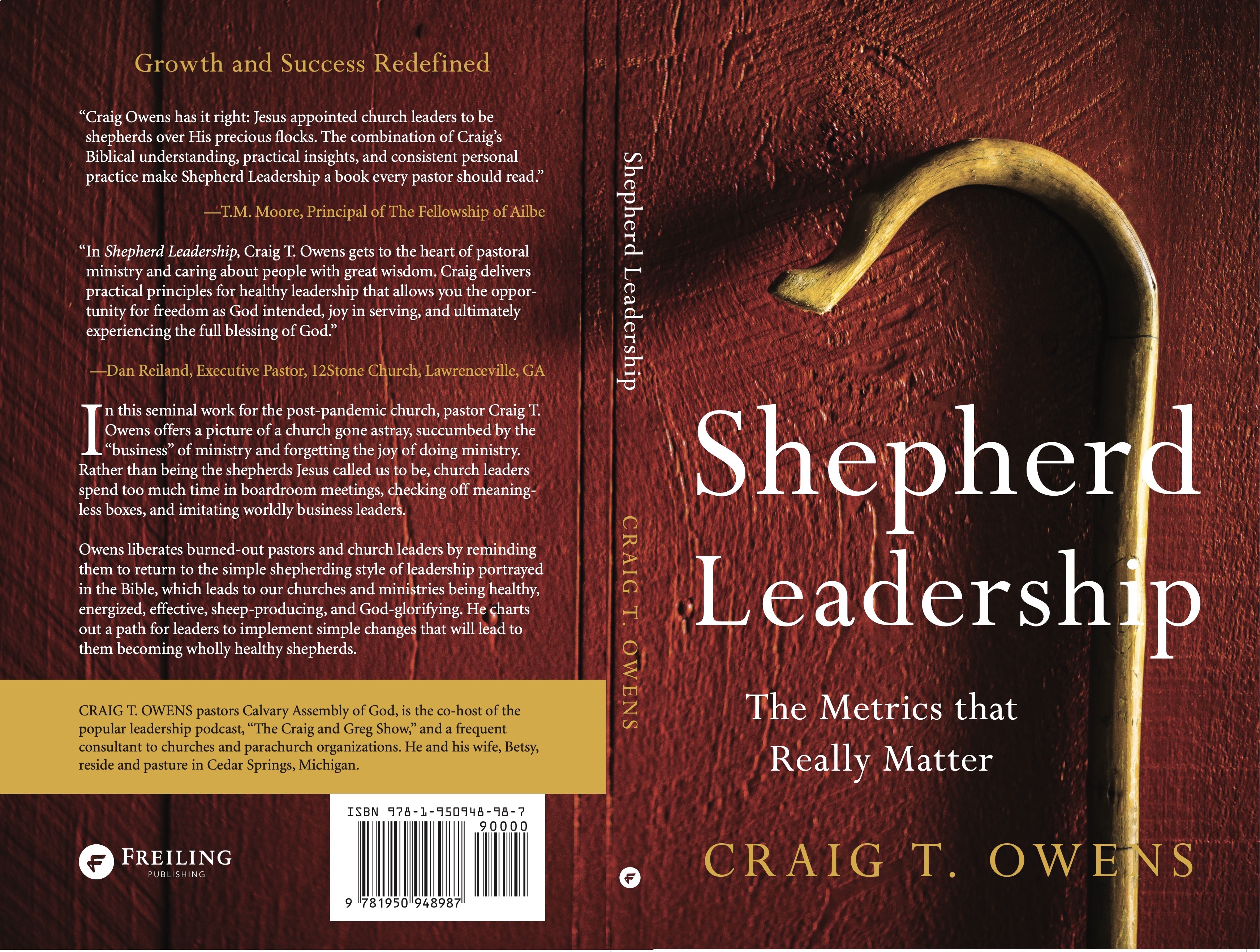
Rusty referred to the opening chapter of my book Shepherd Leadership: The Metrics That Really Matter where I talk about how many of our churches and church leaders are attempting to climb the wrong ladder of success. Rusty noted how many people become frustrated because they are not seeing the success the way that so many people define it.

Before addressing frustrated pastors, I first spoke to the board members that are supporting that pastor. 

In Shepherd Leadership I wrote,

“Businesses think in terms of quantitative gains—things they can count—but churches and nonprofits should be thinking in terms of qualitative gains—a quality improvement that isn’t as easily counted. I think we all know this, and yet we still persist in wanting to define success in a church or a nonprofit by those quantitative standards such as attendance growth, donations, and the like. When we think qualitative over quantitative, suddenly what seemed “small” is so significant and so valuable that it cannot be calculated!”

I’ll be sharing more clips from this interview soon, so please stay tuned. If you would like to check out the other clips I have already shared from this podcast, please check them out here. Shepherd Leadership: The Metrics That Really Matter is available in print or ebook, and in audiobook through either Audible or Apple. 

►► Would you please prayerfully consider supporting this ministry? My Patreon supporters get behind-the-scenes access to exclusive materials. ◀︎◀︎

Completing The Body

Listen to the podcast of this post by clicking on the player below, and you can also subscribe on AppleSpotify, or Audible. 

One of the miracles we talked about last week was the Holy Spirit giving gifts to people that evangelize the sinner and edify the saint. Let me be more specific: YOU are God’s gift to the world if you are using God’s gift to glorify God in the world. 

You are a one-of-a-kind creation. God is infinitely creative so He never has to duplicate any of His creative works. He saw your life and implanted in you what you need to glorify Him (Psalm 139:13-18). But we need to think about this uniqueness the right way. 

Lucifer, an archangel, became satan, the Christian’s archenemy, because of his oversized pride. Pride is what turned Lucifer into satan, and it’s a tactic he still uses today on God’s creations. His other tactic is slander: attempting to get us to think we are insignificant and have no real purpose in the world. 

Just like Jesus did, we overcome satan’s lies with the truth in God’s Word.  

In Romans 12, Paul talks about our lives being used as a living, breathing, God-honoring sacrifice. But Romans 12:1 begins with the word “therefore,” so we need to back up a few verses. The final four verses of chapter 11 are a beautiful doxology that is praising God for His wisdom and sovereignty. Paul then offers this conclusion: Therefore we need to think correctly about our place in the world, allowing the Holy Spirit to transform our thoughts. 

Paul uses the word “think” twice in this passage. The root word is the same in each place (phroneo in Greek), but the prefix is what sets them apart from each other. The first has the prefix hyper-. That means it’s overly-analyzed thinking, overly self-concerned thinking, or self-focused.

The second time the prefix is soph- (which means “wise”). This is sound thinking, big-picture thinking, or others-focused. The Holy Spirit wants to give us sophroneo thinking to reveal our God-implanted gifts and talents that are to be used to benefit others—in fact, to benefit the whole Body of Christ.

In Romans 12, Paul uses the phrase “one body” twice as he talks about our spiritual gifts. He uses the same “one body” praise three times in 1 Corinthians 12 as he again talks about spiritual gifts (1 Corinthians 12:12-13, 20). 

All of our spiritual gifts are to be used in love and to build up others (1 Corinthians 12:31—13:3; 14:1, 12, 26, 40). 

The Holy Spirit gives gifts to individuals so that individuals can edify the whole Body of Christ. It’s not competing with one another but completing one another. 

Remember: Saints is always plural in the New Testament! I need you to bring out the saintly qualities in my life, as much as you need me to bring out the saintly qualities in your life. 

This summer I will be offering an in-depth teaching on the spiritual gifts listed in the New Testament. We’ll take some assessments and discuss how these gifts can best be invested in the Body of Christ. I hope you can join me for an hour of learning on Wednesdays. 

If you’ve missed any of the messages in our series exploring our Pentecostal roots, you can find all of those messages by clicking here.

►► Would you please prayerfully consider supporting this ministry? My Patreon supporters get behind-the-scenes access to exclusive materials. ◀︎◀︎

Visionary Leaders

I believe God gives a vision to His leaders.

God doesn’t give a vision to a leader so that a leader can have a better life, but so that the leader can help the people get to a better place. Vision is always through the leader to the people.  

Daniel exhibits this in his life.

This video is a short clip from a longer video that is exclusive content for my Patreon supporters. 

My Patreon supporters are helping me be able to continue to provide all of the free content on my blog and my YouTube channel. Will you please prayerfully consider supporting this ministry at just $5/month?

Thursdays With Spurgeon—Encouragement For Preachers

This is a weekly series with things I’m reading and pondering from Charles Spurgeon. You can read the original seed thought here, or type “Thursdays With Spurgeon” in the search box to read more entries.

Listen to the podcast of this post by clicking on the player below, and you can also subscribe on AppleSpotify, or Audible. 

Encouragement For Preachers

…For the mouth of the Lord has spoken (Isaiah 1:20).

     We preach because ‘the mouth of the Lord has spoken.’ It would not be worth our while to speak what Isaiah had spoken if in it there was nothing more than Isaiah’s thought—neither should we care to meditate hour after hour upon the writings of Paul, if there was nothing more than Paul in them. … The true preacher, the man whom God has commissioned, delivers his message with awe and trembling because ‘the mouth of the Lord has spoken.’ … 

     Woe unto us if we dare to speak the Word of the Lord with less than our whole heart and soul and strength! Woe unto us if we handle the Word as if it were an occasion for display! If it were our own word, we might be studious of the graces of oratory. But if it is God’s Word, we cannot afford to think of ourselves. … Because the mouth of the Lord has spoken the truth of God, we therefore endeavor to preach it with absolute fidelity. …  

     Believing that ‘the mouth of the Lord has spoken,’ it is my duty to repeat God’s Word to you as correctly as I can after having heard it and felt it in my own soul. It is not mine to amend or adapt the gospel. …  Again, dear friends, as ‘the mouth of the Lord has spoken,’ we speak the divine truth with courage and full assurance. Modesty is a virtue, but hesitancy when we are speaking for the Lord is a great fault. …  

     We preach not the gospel by your leave. We do not ask tolerance nor court applause. We preach Christ crucified, and we preach boldly as we ought to speak because it is God’s Word not our own. … We cannot use ‘ifs’ and ‘buts,’ for we are dealing with God’s ‘shalls’ and ‘wills.’ If He says it is so, it is so. And there is the end of it. Controversy ceases when Jehovah speaks [Jeremiah 1:17-19].

From The Infallibility Of Scripture

Preaching God’s Word is not for the faint of heart. It takes one who is confidently humbled—confident that God has spoken and humbled that He would choose someone like me to speak His Word to His people. 

In my book Shepherd Leadership: The Metrics That Really Matter I wrote: 

Check this out: “Now Moses was a very humble man, more humble than anyone else on the face of the earth” (Numbers 12:3). Who wrote the book of Numbers? If you answered “Moses,” you are correct. Doesn’t that sound a bit brash to declare that you are more humble than anyone else on the earth? Yet, God allowed Moses to pen those words, making that a Holy Spirit-inspired statement of fact. Humility is a double-edged sword: it can serve a leader well when it is balanced with appropriate confidence, but it is a detriment to an organization’s health if it is self-de-basing humility that undercuts a leader’s credibility. 

The God-honoring preacher gets his message from the mouth of the Lord, and then confidently endeavors “to preach it with absolute fidelity.” Whether others praise of criticize, the humble leader says, “I am only God’s servant speaking God’s Word.” 

Preachers, let’s make sure that everything we confidently and humbly share from our pulpits is the whole counsel of what has been spoken by the mouth of the Lord.

►► Would you please prayerfully consider supporting this ministry? My Patreon supporters get behind-the-scenes access to exclusive materials. ◀︎◀︎

The Craig And Greg Show: Generous Leaders Unleash Potential

Listen to the audio-only version of this podcast by clicking on the player below, or scroll down to watch the video.

On this episode of “The Craig And Greg Show” we talk about: 

  • [0:15] I adapt a verse from the Bible to talk about generosity and Greg agrees with me. 
  • [1:00] Generosity is so much more than donating money.
  • [2:15] Generous leaders are proactive, and have appropriate boundaries.
  • [2:48] Leaders cannot fake generosity.
  • [3:42] Generosity isn’t in the big things, but the everyday things.
  • [4:25] Time, talent, treasure are all important components in generosity.
  • [6:00] Greg shares a telling statistic about how Americans give to charities.
  • [6:45] Greg says giving your network can be one of the most generous things a leader does. 
  • [7:37] Generosity requires an abundance mindset.
  • [8:52] What holds us back from being generous?
  • [10:00] Comparisons kill generosity.
  • [10:27] Being generous expands our influence, but stinginess strangles it.
  • [12:55] Our teammates are looking for places to be generous.
  • [13:53] Generosity opens doors for new opportunities.
  • [14:51] Greg shares an insightful quote from Anne Frank 
  • [15:17] I make a connection to the change in Ebenezer Scrooge’s life.
  • [16:11] How we define a generous leader.
  • [17:38] Our leadership challenge: how can you view generosity differently?

Check out this episode and subscribe on YouTube so you can watch all of the upcoming episodes. You can also listen to our podcast on Spotify and Apple.

Expecting Miracles

Listen to the podcast of this post by clicking on the player below, and you can also subscribe on AppleSpotify, or Audible. 

Last week we saw the in-ness of the Holy Spirit guiding us, teaching us, and empowering us to overcome evil. For what purpose? Why does the Holy Spirit lead us this way? Because the Spirit desires to draw everyone into this in-ness. His work in and through our lives is always unmistakable and irrefutable. 

A good word to describe the unmistakable and irrefutable work of the Spirit is: Miracles. 

Miraculous signs characterized the earthly ministry of Jesus, and they also should to the hallmark of Spirit-baptized Christians today who are sharing the Gospel with others (Acts 10:38; 2:43; Mark 16:20). 

Some may ask, “Why don’t we see as many miracles today?” And some skeptics even point to a decrease in miracles as proof of their cessationist paradigm. But consider this: Has God’s power been diminished? Have all needs been met? Are there no more sickness or unsolvable problems of human suffering? Is everyone free of the power of the devil? 

No, of course not! 

So that would mean if there is any diminishment in miracles, the diminishment would seem to be in us! Particularly I think it is that we no longer expect miracles to happen.

Not only should we expect miracles, but we should also expect to be the vessel through which the Holy Spirit demonstrates the miracle. 

Here are 8 miracles that we should be expecting:

  1. Minds opened that were blinded to the Gospel message—2 Corinthians 4:4-6 
  2. Thoughts transformed—Romans 12:2-3; Philippians 2:5 
  3. Invincible words spoken by us to others—Acts 6:10 
  4. Love tangibly expressed through our spiritual gifts—John 13:34-35; 1 Corinthians 12:1, 31—13:3 
  5. Gifts of the Spirit used constructively in the church to both evangelize the sinner and edify the saint—1 Corinthians 14
  6. Compassionate actions constantly initiated to address areas of human suffering—Philemon 4-7, 17
  7. Powerful prayers prayed and answered—Acts 3:6, 4:31, 13:2-3 
  8. Miracles consistently seen as authenticating the Gospel message—Acts 10:38, 19:11-12 

(Check out all of the above scripture verses by clicking here.) 

Don’t limit the Supernatural power of the Holy Spirit in you to only natural expressions. Constantly expect miracles! 

If you’ve missed any of the messages in our series We Are: Pentecostal, you can find them all by clicking here.

►► Would you please prayerfully consider supporting this ministry? My Patreon supporters get behind-the-scenes access to exclusive materials. ◀︎◀︎

“Doing” Church

Listen to the podcast of this post by clicking on the player below, and you can also subscribe on AppleSpotify, or Audible. 

I had a great time on the 200churches podcast with Jeff Keady. 

Jeff and I talked about some of the changes pastors and churches were forced to confront during the COVID shutdowns. For me, this was a time for my leadership team to examine why we “do church” the way we do. These shutdowns helped us identify the things that were biblical and non-biblical. 

One of the reasons I gave the subtitle “The Metrics That Really Matter” to my book was because of the frustration I saw in so many pastors who were feeling unsuccessful. I discovered that their frustration was largely due to trying to live up to metrics that simply aren’t found in the pages of Scripture. As I wrote in the preface of my book—

My larger concern is that churches, parachurch organizations, and nonprofit ministries that are largely founded to fulfill a biblical mandate are straying from the simple, freeing truths found in the Bible. Or maybe I should say that they are adding things to their ministries that aren’t in the pages of Scripture. Whichever way you want to say it, the result is the same: We are using the wrong metrics to define “success” for our ministries. I fear that in our focus on unbiblical practices, we are missing the joy of really doing ministry. 

Our ministry should be joyful to us as leaders and joy-giving to those to whom we are ministering. If it’s draining instead of fulfilling, that may be an indication that we are trying to gauge success by monitoring non-biblical metrics. 

If you want to dig into this a bit more, check out two previous posts I wrote: 

I’ll be sharing more clips from this 200churches interview soon, so please stay tuned. Shepherd Leadership: The Metrics That Really Matter is available in print or ebook, and in audiobook through either Audible or Apple. 

►► Would you please prayerfully consider supporting this ministry? My Patreon supporters get behind-the-scenes access to exclusive materials. ◀︎◀︎