Jesus said we are hypocrites when we give, pray, or fast only outwardly. He called our prayers “pagan” when we try to pray unnaturally. Jesus desires for our giving, praying, and fasting to be natural parts of who we are.This is a short clip of a full-length teaching called “Keepin’ it real” that I shared exclusively with my Patreon supporters. If you would like to sponsor me too for just $5/month, check out the details here.
“Nothing is impossible, the word itself says ‘I’m possible’!” —Audrey Hepburn
“Astronomers are thrilled by the extraordinary images provided by the new James Webb Space Telescope (JWST)—but some of the data already contradict Big Bang expectations. … Creationists have long noted that the Big Bang suffers from the mature distant galaxy problem. Big Bang theorists assume that light from the most distant galaxies took more than 13 billion years to reach Earth. By Big Bang reckoning, we should be seeing these very distant galaxies, not as they are today, but as they were more than 13 billion years ago. Hence, these galaxies should look ‘unevolved’ and ‘immature.’ Yet this expectation is routinely contradicted, and preliminary data from Webb continues the trend.” Check out more from this ICR article.
“Our leadership will always be second to our followership of Jesus.” —Pastor Ben Stoffel
Have you ever been cursed out? Here’s how Jesus wants Christians to respond. It’s pretty easy to say something nice to someone who has done something nice for you. But Jesus tells us to say nice things to people regardlessof how they have treated us.
“The battles that count aren’t the ones for gold medals. The struggles within yourself—that’s where it’s at.” —Jesse Owens
“Your walk walks, and your talk talks, but your walk talks more than your talk talks.” —Anonymous
John uses the word “fellowship” four times in 1 John 1:3, 6-7. This is the Greek word koinonia,which means intimacy of relationship. The whole purpose of the motivational gifts, the operational gifts, and the leadership gifts is to bring maturity and unity to the Body of Christ. This maturity brings out the fruit of the Spirit.
All of these gifts of the Holy Spirit are intended to help us demonstrate the fruit of the Spirit in ways that make the Kingdom of God visible and desirable. A key component is our koinonia that draws us together as one Body. Two key phrases that appear generously throughout the New Testament Church are one another and each other.
Patiently bearing with one another—Ephesians 4:2; Ephesians 4:3 TLB
Speaking the truth in love to one another—Ephesians 4:15; Colossians 3:9
Forgiving one another—Ephesians 4:32; Colossians 3:13
Submitting to one another—Ephesians 5:21
Acting like Jesus toward each other—Philippians 2:5
Doing what is good for one another—1 Thessalonians 5:15
Spurring one another on—Hebrews 10:24
Regularly meeting with one another—Acts 2:46; Hebrews 10:25
Looking after each other—Hebrews 12:15 AMP
Confessing sins to one another—James 5:16
Showing hospitality to each other—1 Peter 4:9
Doing the hard work of getting along with each other—James 3:17-18 MSG
Those things lead to #26, which starts the cycle over again at #1.
Increasing our love for one another—1 Thessalonians 3:12; 2 Thessalonians 1:3; Hebrews 13:1; 1 Peter 4:8
Our koinoniain the church is encouraging for the saints and it is a blessing for the unsaved because of all of the good things a unified, strong, loving church can do. Koinonia ultimately becomes one of the greatest witnessing tools. Jesus prayed—
My prayer is not for them alone. I pray also for those who will believe in Me through their message, that all of them may be one, Father, just as You are in Me and I am in You. May they also be in Us so that the world may believe that You have sent Me. (John 17:20-21)
After I had shared a little of my background about how God directed me into the pastorate, John asked us our thoughts about pastors working some sort of vocational job before stepping into the role as a pastor.
I thought this exchange of ideas was pretty solid. Check this out…
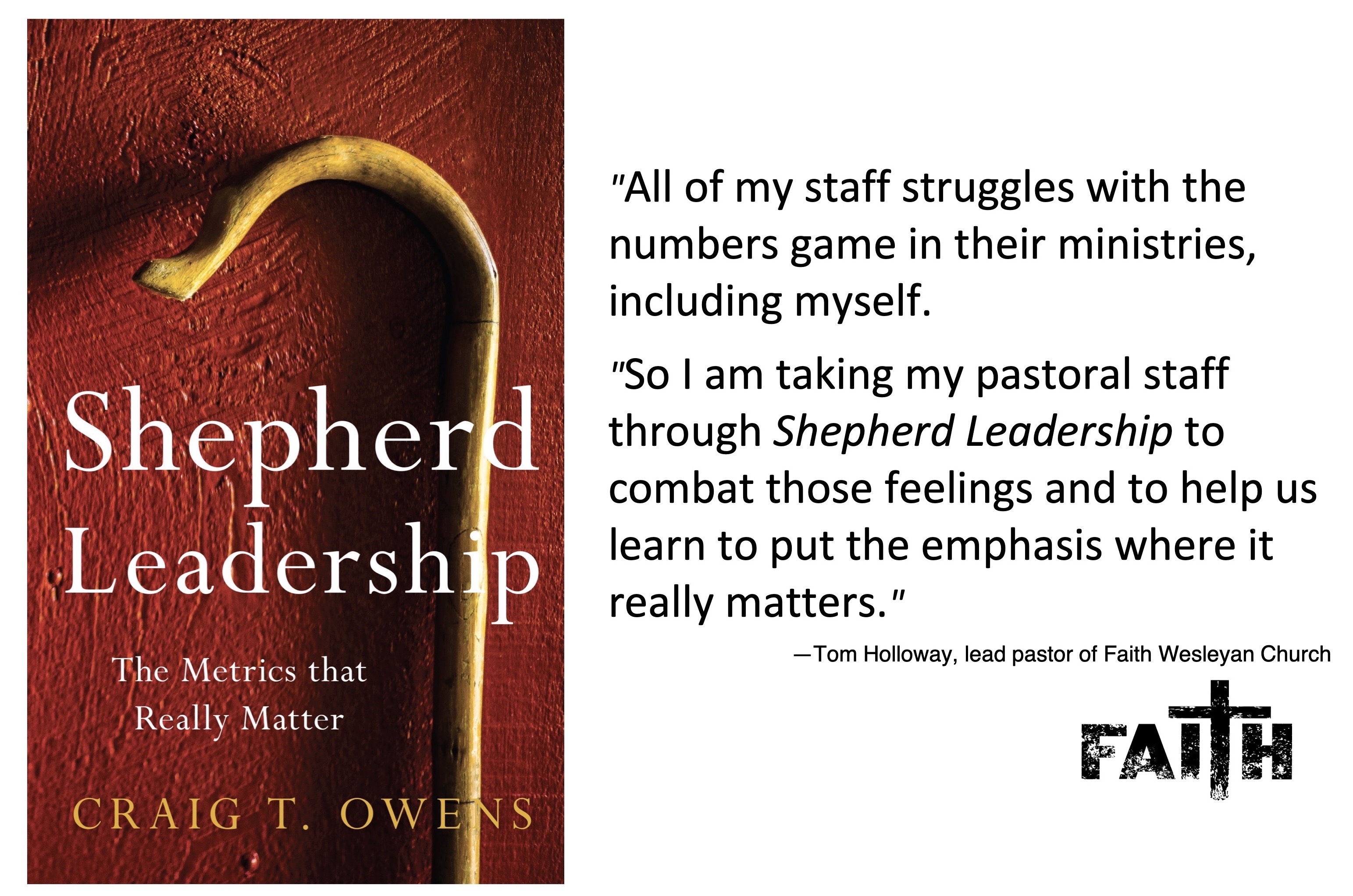
One of the things I highlight in my book Shepherd Leadership is the danger of business metrics creeping into our churches. I think a pastor who has both vocational and ministry training is better equipped at spotting this shift of metrics and then making the necessary adjustments. If you are a pastor, I highly recommend that you pick up a copy of my book.
I’ll be sharing more clips from this Leading From Alignment interview soon, so please stay tuned. Shepherd Leadership: The Metrics That Really Matter is available in print or ebook, and in audiobook through either Audible or Apple.
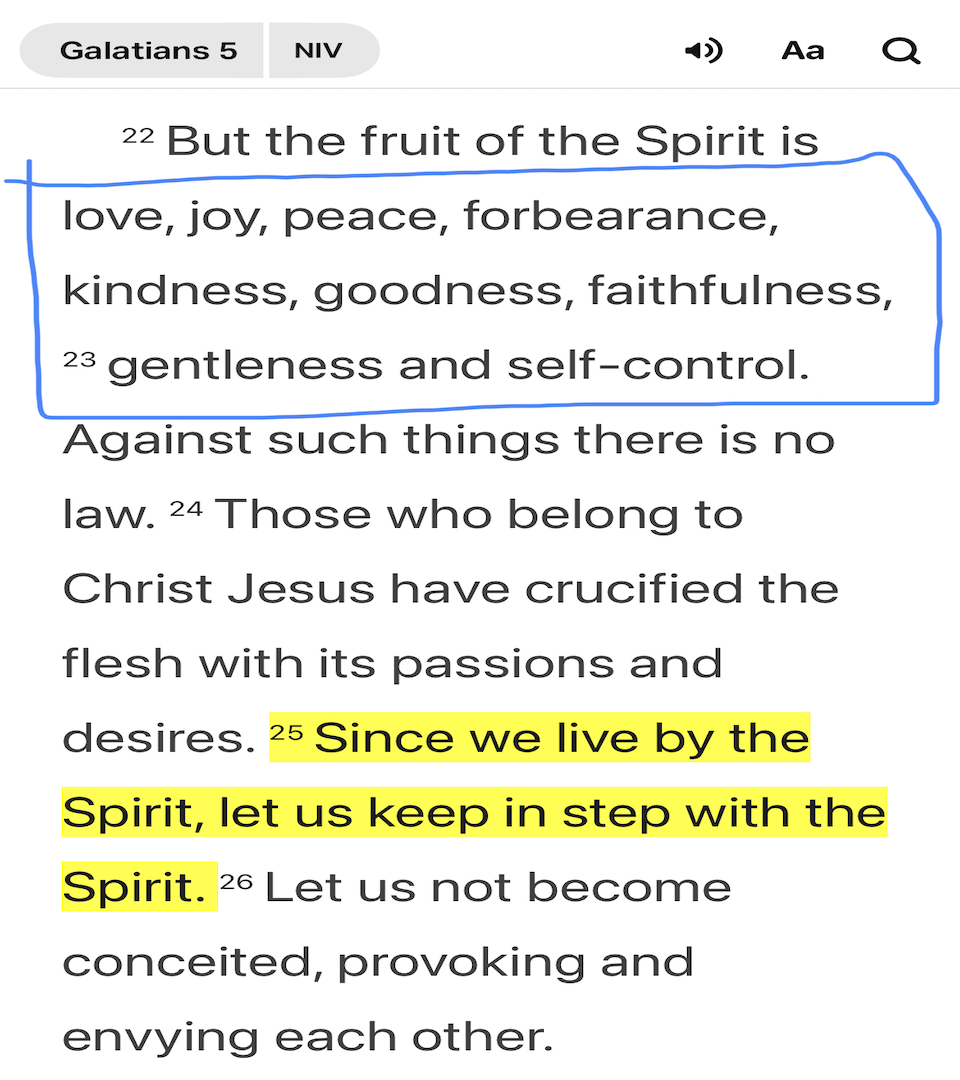
In our most recent Go Deep Bible study, I was teaching about the fruit of the Spirit found in Galatians 5:22-23—But the fruit of the Spirit is love, joy, peace, forbearance, kindness, goodness, faithfulness, gentleness and self-control.
There are four things that are notable to me in this passage:
(1) This whole section (Galatians 5:16-25) is circular. It begins with the phrase, “Walk by the Spirit,” and it concludes with, “Since we live by the Spirit, let us keep in step with the Spirit.” This tells me that our walk is never done—we never “arrive” but we must continue to walk with the Holy Spirit every day.
(2) The fruit of the Spirit is singular—it’s not “fruits” but “fruit.” That means that the Holy Spirit is working to bring out all of these nine fruit, not just one or two of them.
(3) The list of the fruit of the Spirit is also a circular list—
LOVE for God fill us with love for others → there is JOY in knowing His nearness → PEACE comes in the face of anxiety-causing tribulations → which gives me PATIENCE with others who are anxious without God → then I can have KINDNESS to draw them to God → and GOODNESS that is expressed in kind deeds → and my FAITHFULNESS that creates a sense of stick-to-it-iveness → and GENTLENESS that gives me courage to stand up for what’s right → my SELF-CONTROL keeps the fruit of the flesh in-check → which gives me greater LOVE for God and others…
(4) This whole process of producing more visible fruit in the life of a Christian is called sanctification. I like to remember this word by saying it “saint-ification.” As long as we are still on this earth, there is still work for the Spirit to do in us, so don’t ever become discouraged by this ongoing process of love.
Listen to the podcast of this post by clicking on the player below, and you can also subscribe on Apple, Spotify, or Audible.
I was playing golf with a pastor and a missionary when the starter asked if a single player could join us to make a foursome. We happily agreed. About 4-5 holes into our game, our guest asked what we did. My pastor friend started out, “I’m a pastor, and this guy is a missionary, and—”
Our guest interrupted and blurted out, “You guys are Christians?! I’ve never had so much fun! I always heard Christians were boring.”
When did it come about that people thought of Christians as boring—or even worse, as sourpusses and killjoys? Sadly, too many Christians have helped cement this idea in people’s minds. I think this is largely because those Christians are misinformed and frustrated. This frustration, I believe, comes from the mistaken idea that Christians are supposed to squelch any urges or cravings that we have.
But check out this Q&A from the Westminster Catechism—
Q: What is the chief end of man?
A: To glorify God and to enjoy Him forever.
Glorifying God is supposed to result in enjoyment—enjoying both God’s presence and the life He has given us. We are created to crave the fuel of His Spirit that satisfies and energizes us.
Just as your car would at best under-perform if you attempted to run it with anything else but gasoline, so our lives will under-perform and feel like drudgery if we are trying to fuel our cravings with anything other than God.
The dictionary defines “craving” as a great or eager desire, or a yearning. But I believe the Bible defines God-honoring craving as the longing for an intimate relationship with God that is implanted by God Himself.
The people of Judah had gone astray from God and were trying to satisfy their urges with foreign gods and pagan idolatry. When King Asa called these backsliders back to God, here’s how he did it—
[Asa] commanded Judah to seek the Lord, the God of their fathers—to inquire of and for Him and crave Him as a vital necessity—and to obey the law and the commandment. (2 Chronicles 14:4 AMP)
Contrast this with the temporary cravings of earth—
But those who crave to be rich fall into temptation and a snare and into many foolish, useless, godless, and hurtful desires… (1 Timothy 6:9 AMP)
This world is fading away, along with everything that people crave. But anyone who does what pleases God will live forever (1 John 2:17 NLT).
Nowhere are godly cravings and earthly cravings better contrasted than in James 4:1-6.
In this passage, the Greek word for desires (v. 1) and pleasures (v. 3) is hedone. This is where we get our English word “hedonism.” There is nothing wrong with pleasure—for God Himself takes pleasure—but it’s what pleasures we are craving that can make them ungodly. James rightly points out that the wrong hedonism is a craving to fulfill “your desires,” “your pleasures,” and to desire “friendship with the world” (v. 1, 3, 4)
Jesus talked about worldly cravings—using the same word hedone—when He said, “The seed that fell among thorns stands for those who hear, but as they go on their way they are choked by life’s worries, riches and pleasures [hedone], and they do not mature” (Luke 8:14).
Notice the same thing in Isaiah 58:2 where God declares that people “seem eager” to delight in God, but it’s only a show for them to satisfy fleshly cravings. John Piper noted, “God means they are delighting in their business and not in the beauty of their God. He does not rebuke their hedonism. He rebukes the weakness of it. They have settled for secular interests and thus honor them above the Lord.”
Instead, notice the fulfilled cravings when we seek God: “If you keep your feet from breaking the Sabbath and from doing as you please on My holy day, if you call the Sabbath a delight and the Lord’s holy day honorable, and if you honor it by notgoing your own way and notdoing as you please or speaking idle words, then you will find your joy in the Lord, and I will cause you to ride in triumph on the heights of the land and to feast on the inheritance of your father Jacob. For the mouth of the Lord has spoken” (Isaiah 58:13-14).
I like that reminder that “the mouth of the Lord has spoken.” The origin of the word craving is the Old Norse word krefja, which means to lay claim on something because of a promise. God has promised, and so we can claim it.
James assures us that the spirit God implanted in us envies intensely (James 4:5). We were made to crave God’s presence, we were made to find ultimate satisfaction in His presence, we were made to find eternal delight in knowing Him more intimately!
The proud person says, “God, I know what I want. Give it to me.” The humble person says, “God, I know Your presence is the only thing that will satisfy me. Give it to me.”
The craving in our spirit can be redirected from earthly yearnings to God-honoring yearnings by yielding to the Holy Spirit. I would humbly suggest that our prayer should be something like this—
“Father, grant that my cravings are for Your name to be hallowed, Your kingdom to be made visible, and Your will to be done. Let the enjoyment I have in Your presence shine out of me in a way that invites others to be dissatisfied with their earthly cravings and find their ultimate satisfaction in a personal relationship with You through Jesus Christ. Holy Spirit, continue to refine and redirect all of my cravings away from earthly things to eternal pleasures. In Jesus’ name I pray, Amen.”
I co-host a leadership podcast with my good friend of 30+ years Greg Heeres. In an episode that came out last week, we were discussing the importance of friendships for leaders. All of us need friends that are investing in our lives. You may check out the rest of the conversation Greg and I had by clicking here.
Jonathan Woodward writes, “The right use of authority or power can make people glad. In our age, however, power is often immediately viewed with skepticism or outright disdain.” He also talks about our responsibility to the incorrect use of leadership authority: “It’s absolutely necessary to identify, challenge, and rebuke sinful leadership. It ensures that people are cared for and God is honored.” Check out The Power to Bless: Six Dimensions of Good Leadership.
More and more scientists are dissatisfied with the lack of evidence supporting the theory of evolution. ICR reports, “Indiana University Biologist Armin Moczek told The Guardian, ‘We still do not have a good answer. This classic idea of gradual change, one happy accident at a time, has so far fallen flat.’”
The churches in my hometown of Cedar Springs, MI, have partnered together to make sure students who are food insecure on the weekend are supplied with nutritious food to carry them through the weekend. If you would like to know more, or if you would like to help us, please check out the Cedar Springs Ministerial Association website.
“Because we love something else other than this world, we love even this world better than those who know no other.” —C.S. Lewis
This is one of the best interviews I have done. I so enjoyed this! And the good news is this is only part 1. We had such a good conversation that the hosts asked me to stick around to record another episode with them. Here is the first session…
We have been studying the different sets of gifts listed in the New Testament. These gifts are to bring maturity and health to the church. Previously we have looked at:
Near the end of this lesson, I shared something that I hadn’t included in the handouts, but I promised to share it—
LOVE for God fill us with love for others → there is JOY in knowing His nearness → PEACE comes in the face of anxiety-causing tribulations → which gives me PATIENCE with others who are anxious without God → then I can have KINDNESS to draw them to God → and GOODNESS that is expressed in kind deeds → and my FAITHFULNESS that creates a sense of stick-to-it-iveness → and GENTLENESS that gives me courage to stand up for what’s right → my SELF-CONTROL keeps the fruit of the flesh in-check → which gives me greater LOVE for God and others…
Listen to the podcast of this post by clicking on the player below, and you can also subscribe on Apple, Spotify, or Audible.
In a recent teaching time with some ministry interns, I discussed the two main metrics that we can use to measure growth: quantity and quality. Sadly, too many churches and ministries have gotten so caught up in the “numbers game” of more-more-more being the only metric of success, that they’ve forgotten about quality. Or maybe they do focus on quality, but only as a means to the end of more-more-more.
This is never a metric of success that is discussed in the Bible. Check this out…
In the chapter entitled ‘Don’t Try to Grow Your Ministry’ in my book Shepherd Leadership: The Metrics That Really Matter I wrote this—
Businesses think in terms of quantitative gains—things they can count—but churches and nonprofits should be thinking in terms of qualitative gains—a quality improvement that isn’t as easily counted. I think we all know this, and yet we still persist in wanting to define success in a church or a nonprofit by those quantitative standards such as attendance growth, donations, and the like. When we think qualitative over quantitative, suddenly what seemed “small” is so significant and so valuable that it cannot be calculated! What if one of those babies that weren’t aborted discovers a cure for cancer, or deciphers a dialect to take the Gospel to an unreached people group, or becomes the loving next-door neighbor that leads your son or daughter to a relationship with Jesus?
Just as you cannot put a price tag on a life, you cannot put a price tag on a sheep. Make no mistake about it, God views His sheep—every single one of them—as invaluable. Because His valuation is so high, we can understand why He gets so angry at those who are more concerned about their success than they are about the health of the sheep. When God uses the word “Woe!” we should definitely take that seriously. He uses that very word to warn shepherd leaders who were shirking their responsibility when He said, “Woe to those shepherds who only take care of themselves” (Ezekiel 34:2).
When we map out our plan for success, or when we try to define success solely by quantitative measurements, we ultimately become more committed to our plans than to God’s sheep. God pulls no punches when He calls leaders with this attitude evil, mere hired hands, or even thieves (Jeremiah 23:3; John 10:8, 12). And most sobering of all, God says, “I will hold them accountable” (Ezekiel 34:10).
Friends, let’s make sure we are focused on the metrics that really matter. Recently, a pastor shared honestly with me about his frustration with the “numbers game,” and purchased five copies of my book to use as a discussion starter with his church staff. I hope you will consider using Shepherd Leadership in a similar way. If I can be of assistance, please let me know.
[11:55] We discuss being intentional about how you spend your time.
[14:31] I describe the qualities I look for in a strong leadership friend.
[16:45] We discuss how a “yes man” isn’t a true friend.
[18:12] Leaders need to be careful not to end up on an island.
[21:52] How do you navigate friendships through organizational groups and silos?
[23:20] I shares a humorous note Greg left me to illustrate the friendship tradeoff.
[24:22] Greg says you need a trusted friend to help you monitor your energy level.
[25:30] I say it’s important to thank friends for paying attention to you.
[26:14] We use Jesus’ relationships with His disciples to model their own friendships.
[27:40] We would love to be your leadership friend in our coaching huddles.
Check out this episode and subscribe on YouTube so you can watch all of the upcoming episodes. You can also listen to our podcast on Spotify and Apple.
Listen to the podcast of this post by clicking on the player below, and you can also subscribe on Apple, Spotify, or Audible.
Max Lucado wrote,
“The United States economy endured ten recessions between 1948 and 2001. These downturns lasted an average of ten months apiece and resulted in the loss of billions of dollars. Every five years or so, the economy dumps its suitors and starts over. What would you think of a man who did the same with women? What word would you use to describe a husband who philandered his way through nine different wives over fifty years? And what word would you use to describe wife number ten? How about this one? Fool. Those who trust money are foolish. They are setting themselves up to be duped and dumped into a dystopia of unhappiness.” —Max Lucado, Fearless
Yikes! It sounds like money can be a scary thing. So let’s consider statement #12 in our series asking “Is that in the Bible?”—Money is the root of all evil. Is that in the Bible? No!
That phrase is close to one that is in the Bible, but “close” misses the real meaning. What Paul actually wrote to Timothy is, “For the love of money is a root of all kinds of evil” (1 Timothy 6:10).
That three-word phrase “love of money” is actually just one word in Greek, and it means “friend of silver.”
The Bible teaches that money itself is neither good nor evil. It’s merely a tool like a hammer that is used for building something or for destroying something. If the hammer builds or destroys, it’s not the hammer that is good or evil but the attitude of the one gripping the hammer determines the good or evil outcome.
So too with money. Money keeps the lights on, puts gas in our car, clothes on our backs, and food in our stomachs, it even helps people share the Gospel here and around the world. It’s our attitude toward money that leads us to good or evil thoughts and actions.
In describing people who were a friend of silver, Paul uses phrases like this to describe them: teaches false doctrine … does not agree to sound instruction…and godly teaching … who think godliness is a means to financial gain … want to get rich … eager for money (1 Timothy 6:3-5, 9-10).
In 1923 a group of the world’s most successful financiers gathered at the Edgewater Beach Hotel in Chicago. Together these men controlled more wealth than the United States Treasury! They met together to discuss how they could use their present wealth to gain even more wealth. Their plan was put into place and it began to reap the results they planned: they expanded their influence and their bank accounts.
Then six years later, on October 29, 1929, Black Tuesday happened. The worst day for the New York Stock Exchange ever and the beginning of the Great Depression in the USA.
What about that group of wealthy financiers who wanted more, more, more?
Charles Schwab—president of Carnegie Steel Company—lived the last years of his life on borrowed money and died penniless
Arthur Cutten—the world’s largest wheat speculator—died insolvent
Richard Whitney—president of the NYSE—served a prison term for embezzlement
Albert Fall—a member of the president’s cabinet—also went to prison
Jessie Livermore—the “bear of Wall Street,” Leon Frazer—president of the Bank of International Settlements, and Ivar Kreuger—head of the world’s largest monopoly (a match company)—all committed suicide
Their friendship with silver—their love of Money—led to their disastrous downfalls.
Jesus said, “No one can serve two masters. Either you will hate the one and love the other, or you will be devoted to the one and despise the other. You cannot serve both God and Money” (Matthew 6:24).
The word Jesus used for “Money” is Mammon: wealth personified and deified. When we make Money our god—Money (with a capital “M”)—we naturally begin to covet what isn’t ours. Nothing satisfies and so we covet to possess more and more and more.
Remember Jesus we cannotserve two masters. If we replace God with Mammon, it is inevitable that we will break all of the Ten Commandments. Has anyone ever made an idol to their Money, or murdered for money, or committed adultery, or stolen, or told lies? They sure have!
Paul described those who worship Mammon this way—
Those who want to get rich fall into temptation and a trap and into many foolish and harmful desires that plunge people into ruin and destruction. For the love of money is a root of all kinds of evil. Some people, eager for money, have wandered from the faith and pierced themselves with many griefs. (1 Timothy 6:9-10)
But those who worship God, Paul described like this—
But godliness with contentment is great gain. For we brought nothing into the world, and we can take nothing out of it. But if we have food and clothing, we will be content with that. (1 Timothy 6:6-8)
Simply put: Contentment with God kills Mammon’s covetousness!
Want to know how to check your attitude toward money? When you think about giving God His tithe, or when the Holy Spirit prompts you to give to a missionary, what thought comes to your mind? Do you think, “Ugg, I have to give this” or do you rejoice to say, “Yes, I get to give this”? The answer to that question will give you a really good indication of how much pull Mammon has over your heart.
We all have a choice to make: yield to God or yield to Mammon. But remember only God can give us contentment today and pleasures that last for eternity.