Eyes On The Prize

Listen to the podcast of this post by clicking on the player below, and you can also subscribe on AppleSpotify, or Audible. 

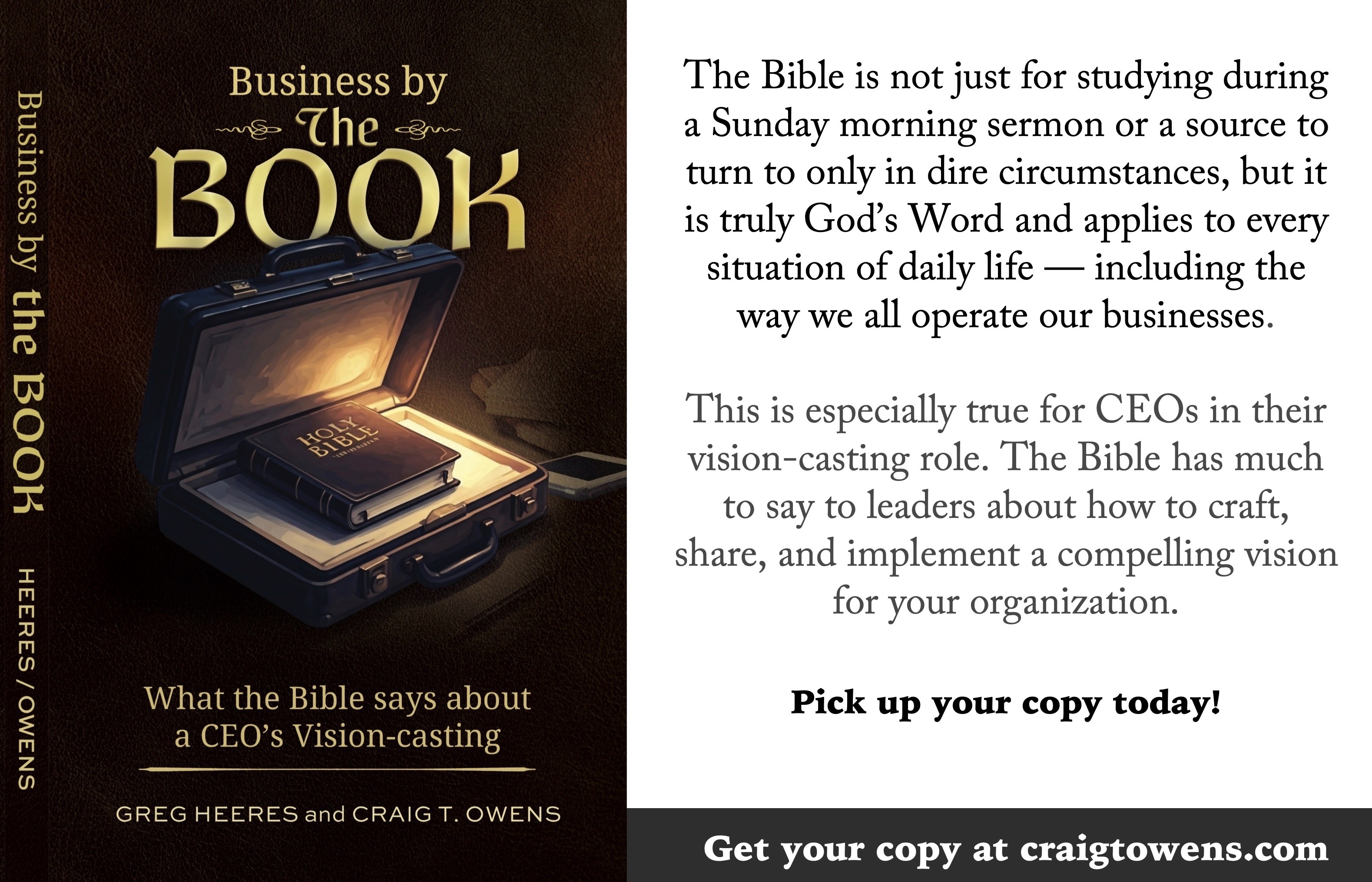
Greg Heeres is my lifelong friend and co-host of The Craig and Greg Show leadership podcast. We have just released the first book in our series called Business by the Book. These books will help business leaders see how relevant the Bible is for the day-to-day wisdom they need to make impactful decisions for their organizations. 

I write chapters one, three, and five with a biblical example of the book’s focal point, and then Greg writes a business application of those examples in chapters two, four, and six. 

Our first book is about the CEO’s vital role of vision-casting. 

We wanted to give you a taste of what these books are all about, so here is the first chapter in this book entitled “Eyes on the Prize”—

Where there is no vision, the people are unrestrained. (Proverbs 29:18)

It All Starts with You 

     It all starts with you as the leader of your organization. If you have a clear vision in mind for both your personal life as well as for your organization, your people will join you on this journey, no matter how long or difficult it may seem. 

     On the other hand, the number one cause of both personal and corporate failure is drifting away from the vision that brought success. 

     God gives vision. He doesn’t give a vision to a leader so that a leader can have a better life, but so that leader can help people get to a better place. Vision is always through the leader to the people. Solomon said, “Where there is no vision, the people are unrestrained” (Proverbs 29:18). 

     Another translation of this verse carries even more weight, “Where there is no vision, the people perish.” 

Eye Discipline 

     In almost every sport that involves a ball, the tried-and-true maxim is, “The ball goes where your eyes go.” 

     Greg and I first met on a basketball court. There were a group of guys that got together to play basketball every day at lunchtime. Because Greg and I were about the same height, we were almost always placed on opposite teams and I had the unenviable assignment of guarding this exceptional athlete. 

     One of the things I noticed right away about Greg’s game was how good he was “in traffic.” He could exploit a small gap between defenders and dribble the ball through that opening to give himself a good look at the hoop. That good look usually meant success in scoring. 

     I did my best to match Greg shot for shot, but I usually came out on the losing side of these match-ups. There is something about competition that causes me to focus on my task—both in business and on the basketball court. So as I guarded Greg, I studied what made him so successful. Eventually I spotted one of the main differences between us: It was his eyes. 

     As Greg drove through traffic, he kept his eyes on the basketball rim, so when he was ready to shoot, the ball went where his eyes already were. I noticed about myself that when I tried to navigate through all the bodies on the court, my eyes went down to the basketball, and only when I thought I was in the clear did I move my eyes to the rim. 

     The more consistently you keep your eyes on your vision, the better your likelihood of making it real. Your life and your organization are going to go where your eyes are fixed. You must have a clear vision for your own life, a vision that is lived out with integrity through good days and bad days, to earn the right to lead people. 

Nehemiah the Vision-caster

     The nation of Israel was being allowed to return to their homeland after 70 years in exile. The capital city Jerusalem was in a shambles—the walls had been knocked down, the gates were burned, and their temple of worship had been demolished. 

    When Nehemiah arrived in Jerusalem, he made a careful inspection of the situation. He undertook his first assessment by himself at night; he didn’t share his findings with the people right away. 

     Nehemiah was a man of personal integrity. Throughout the historical account of his leadership, we see him handling his position of authority, the funds entrusted to him for the rebuilding project, his own personal finances, and even the “competitors” that wanted the Israelites to fail, with godly wisdom and impeccable character. 

     With his personal life in order, Nehemiah then approached the people of Israel. In his journal, recorded for us in the Book of Nehemiah in the Bible, he wrote— 

Then I said to them, “You see the trouble we are in: Jerusalem lies in ruins, and its gates have been burned with fire. Come, let us rebuild the wall of Jerusalem, and we will no longer be in disgrace.” I also told them about the gracious hand of my God on me and what the king had said to me. (Nehemiah 2:17-18) 

     Because Nehemiah went first, the people readily accepted his vision of a rebuilt city: “So they said, ‘Let us rise up and build.’ Then they set their hands to this good work” (Nehemiah 2:18). 

     A mark of a godly leader is one who can inspire all sorts of people to pursue the same vision. Nehemiah did such a good job casting the vision God had given him that people from all professions and persuasions joined in. 

     Although the vision was to rebuild the walls around Jerusalem, most of those who joined Nehemiah in pursuing this vision were anything but builders. They were priests, goldsmiths, perfume makers, and merchants. They were young and old, men and women, native-born Israelites and God-fearing foreigners, those who lived in the city and those who lived in the countryside (see Nehemiah 3). With one voice they cried out, “Let’s rise up and build!” and they got down to business. 

     All these different people bought into one godly leader’s vision. 

What’s Your Vision? 

     Do you have a clear vision for your own life? What about for your organization? You need to have your eyes on a prize that will stand the test of time and will have lasting—even eternal—significance. 

     If you cannot readily identify a compelling vision for either yourself or your organization, I would like to suggest three places you could start. You could say, “My/our vision is . . . 

     (1) . . . to do good. Peter summed up the entirety of Jesus’s public ministry by saying, “Jesus went around doing good and healing all who were oppressed by the devil” (Acts 10:38 NLT). 

     (2) . . . to do what is right, to love mercy, and to walk humbly with your God. This is an exact quotation of the vision statement God gave through the prophet Micah (Micah 6:8 NLT). 

     (3) . . . to bring life where there is death and to set captive people free. This was what Jesus stated as His personal vision for His public ministry (Luke 4:18-19). 

     Find your personal vision and keep your eyes on the prize. This will give you moral authority for the vision you will share with your team. Your vision as the leader is the key to unlocking your organization’s success. 

You can check out this episode of The Craig and Greg Show where we talk more about this project. And then pick up a copy of Business by the Book: A CEO’s Vision-casting. 

►► Would you please prayerfully consider supporting this ministry? My Patreon supporters get behind-the-scenes access to exclusive materials. ◀︎◀︎
The Craig And Greg Show: Sales Armageddon

Listen to the podcast of this post by clicking on the player below, and you can also subscribe on AppleSpotify, or Audible.

I am so excited to announce that my co-host Greg has written a new book called Sales Armageddon. As anyone in the profession knows, sales can be a battlefield. Through fables and insightful teaching Greg’s book will equip you with new strategies you can implement right away to keep yourself and your team in the fight.

  • [0:30] Greg’s new book is out.
  • [1:40] The book contains a business fable based on real people.
  • [3:39] Salespeople can learn from this book how to work well and grow because of others.
  • [5:52] This is a very entertaining book that helps us learn.
  • [7:16] All salespeople need o learn to work with their peers.
  • [8:40] Sales Armageddon is not just a soft story but it shares the science of sales as well.
  • [9:35] Here is a teaser of a key chapter on developing a robust sales pipeline.
  • [12:46] This book has both the emotion and the hard skills of excelling in sales.
  • [14:47] Greg says that each chapter is going to remind you of someone you’ve worked with before, or it may even remind you or yourself!
  • [16:37] This is not a “heavy” read, but this is something that you are going to be able to immediately apply to your sales work.

The Father’s Business

Listen to the podcast of this post by clicking on the player below, and you can also subscribe on AppleSpotify, or Audible. 

The Holy Spirit’s involvement in our lives isn’t reserved for just the “big” things, but He wants us to be aware of and tuned in to His voice and His thoughts all the time. There shouldn’t be a secular-sacred divide in our activities, but we should make every place holy ground and every moment a divine opportunity for God to be glorified. Or said another way, we shouldn’t have times of work and times of worship, but our worship should be seen in every single thing we do. 

I think everyone of us has experienced at one time or another a poor employer or manager. Maybe it’s an employer that demands results but doesn’t give you the training or the tools to do the job. Or maybe you have the training and tools but you don’t know exactly how much you are able to use these things without crossing a line. 

Maybe you have known a boss that is barely present, but when they do stop by the worksite, they aren’t happy with the work that has been done. On the opposite side, maybe it’s a boss who does everything and then gets mad that you aren’t keeping up or working as hard as them. It’s drudgery working for someone like this! 

But, somewhat surprisingly, Jesus used more work examples to talk about the Kingdom of God than He did worship examples. He talked about farmers, bakers, builders, employers, managers, and employees way more than about worshiping, singing, or preaching. 

One of the few glimpses we have of the early life of Jesus shows Him talking about His mission while on earth. Consider the story of Jesus in the temple in Jerusalem when He was 12 years old (Luke 2:41-49). The phrase in the NIV where Jesus says that He must be “in My Father’s house” can be translated…

  • about My Father’s business (NKJV) 
  • dealing with the things of My Father (MSG) 
  • occupied about My Father’s business (AMPC) 

(Check out all of the Scriptures in this post by clicking here.)

Jesus was consistent about this idea of working while He was on earth (John 5:17, 36; 9:4; 17:4). For Jesus, His work was a delight because it was directed by the Holy Spirit (Luke 3:21-22; 4:1, 18-19; Acts 10:38). 

Remember that I mentioned the unreasonable employer that gives us no training, no tools, no goals for which to aim, but expects us to work for his benefit alone. This was not the case with Jesus! He trained us, provided us with the Holy Spirit to guide us, told us the goal for which we were to aim, and said that both His Father would be glorified and we would be rewarded by our Kingdom work done on earth. 

Jesus wants us to work as He did, and He promised that the Holy Spirit would help us in this (John 14:10-12, 24:49; Mark 16:19-20). 

We saw that Luke 2:49 in the AMPC has Jesus saying, “occupied about My Father’s business.” In Luke 19:13 Jesus tells us to “occupy till I come” (KJV). This word is also translated into phrases like: 

  • put this money to work (NIV) 
  • do business (NKJV) 
  • invest this (NLT) 

Jesus is talking about the “talents” given to His stewards (Luke 19:11-13, 16-23). Every servant received the same thing: one mina. We all have been given one life to live; we all have been given 24 hours in a day; we all have been given opportunities to be occupied about our Father’s business. 

The Holy Spirit as our Counselor is there at every moment, every conversation, every decision to help us hear His voice, think His thoughts, and sanctify every experience. Jesus says that He will reward our occupying until He returns. Just doing things like feeding the hungry, giving water to the thirsty, taking care of those in need. This sounds a lot like the work of Jesus in Luke 4:18-19 and Acts 10:38. This Spirit-empowered work earns the commendation from our Master, “Well done, good and faithful servant! Enter into your Master’s happiness!” 

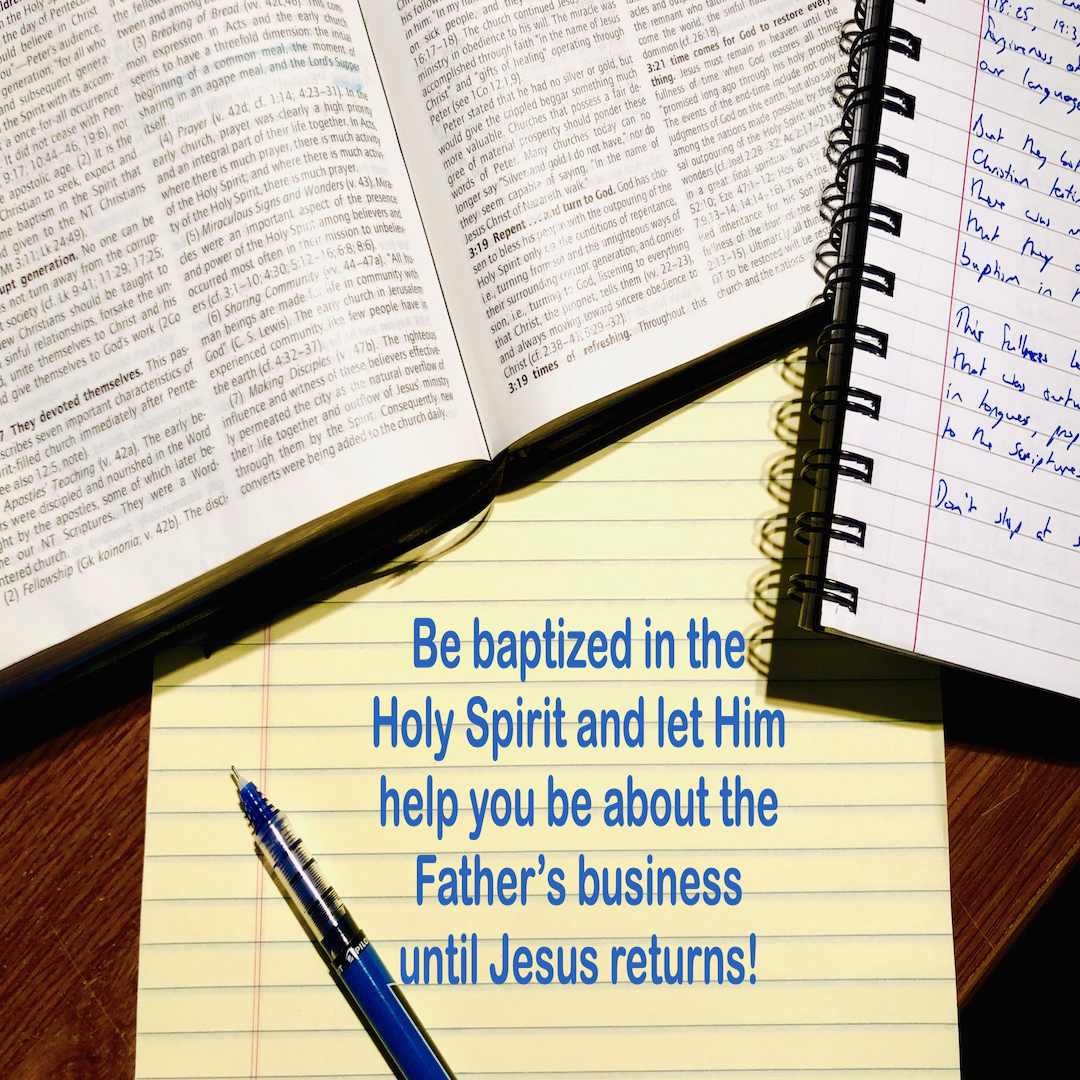
Be baptized in the Holy Spirit and let Him help you be about your Father’s business until Jesus returns. 

If you’ve missed any of the messages in our We Are: Pentecostal series, you can check them all out here. 

►► Would you please prayerfully consider supporting this ministry? My Patreon supporters get behind-the-scenes access to exclusive materials. ◀︎◀︎
Links & Quotes

There is something very important that mature leaders need to remind themselves of so that they can help emerging leaders become successful. You can watch out this full conversation about mulligans and do-overs on the most recent episode of The Craig and Greg Show. Be sure to check out all of my videos on my YouTube channel.

In my sermon on Sunday, I talked about the sovereignty of God over world affairs and world leaders. This is a great reminder from John Newton:

Merat Sultan was born in the shah of Iran’s palace in 1876. He became the chief of police and of the army in Tabriz, Iran. When the Russians invaded and occupied that area, they made plans to execute Sultan. How he escaped actually led him to a relationship with Jesus as Sultan became a Christian. Check out this fascinating story from the website Praying For Muslims. I would also urge you to check out their weekly prayer guide.

My wife and I are reading through the He Gets Us devotional series on YouVersion. I love this picture of Jesus that comes from He Gets Us #3: Questions Jesus Asked

“No voice. No contribution. No significance. No meaning.

“Invisible.

“That’s the way many women probably felt at the time Jesus lived. And every person with an illness—cancer, leprosy, epilepsy, mental disabilities—every one of those people were marginalized. In Jesus’ day, what careers were on the lowest rung of the corporate ladder?—fishermen and shepherds. Yet when you read every account of Jesus, who do you see Him hanging around? Fishermen, shepherds, women, and people dealing with health issues.

“Jesus wanted it that way. He took every opportunity He had to bring people in from the fringes and give them His full attention. He saw them. He listened to them. He loved them in ways they’ve never been loved before. They had never experienced anything like it.”

T.M. Moore wrote, “We are becoming so accustomed to the forsaking of traditional values, the undermining and fragmenting of long-established institutions, and the breakdown of morality and civility that we can begin to think that these conditions are the new normal, the best we can hope for in an age in flight from God. Everywhere we look in our day, the prophetic words of William Butler Yeats, in his 1919 poem, ‘The Second Coming,’ seem to be coming true: ‘Things fall apart; the centre cannot hold;/Mere anarchy is loosed upon the world./The blood-dimmed tide is loosed, and everywhere/the ceremony of innocence is drowned.’ But the appearances, which press upon us daily, are only a matter of perspective.” Check out the rest of his post.

When things are going well, how can we talk about our success in a way that glorifies God? John Piper had a thoughtful answer to a businessman who asked how he could talk about the success of his business and make God look great while he was doing so.

Shepherd Leadership 5-Star Reviews

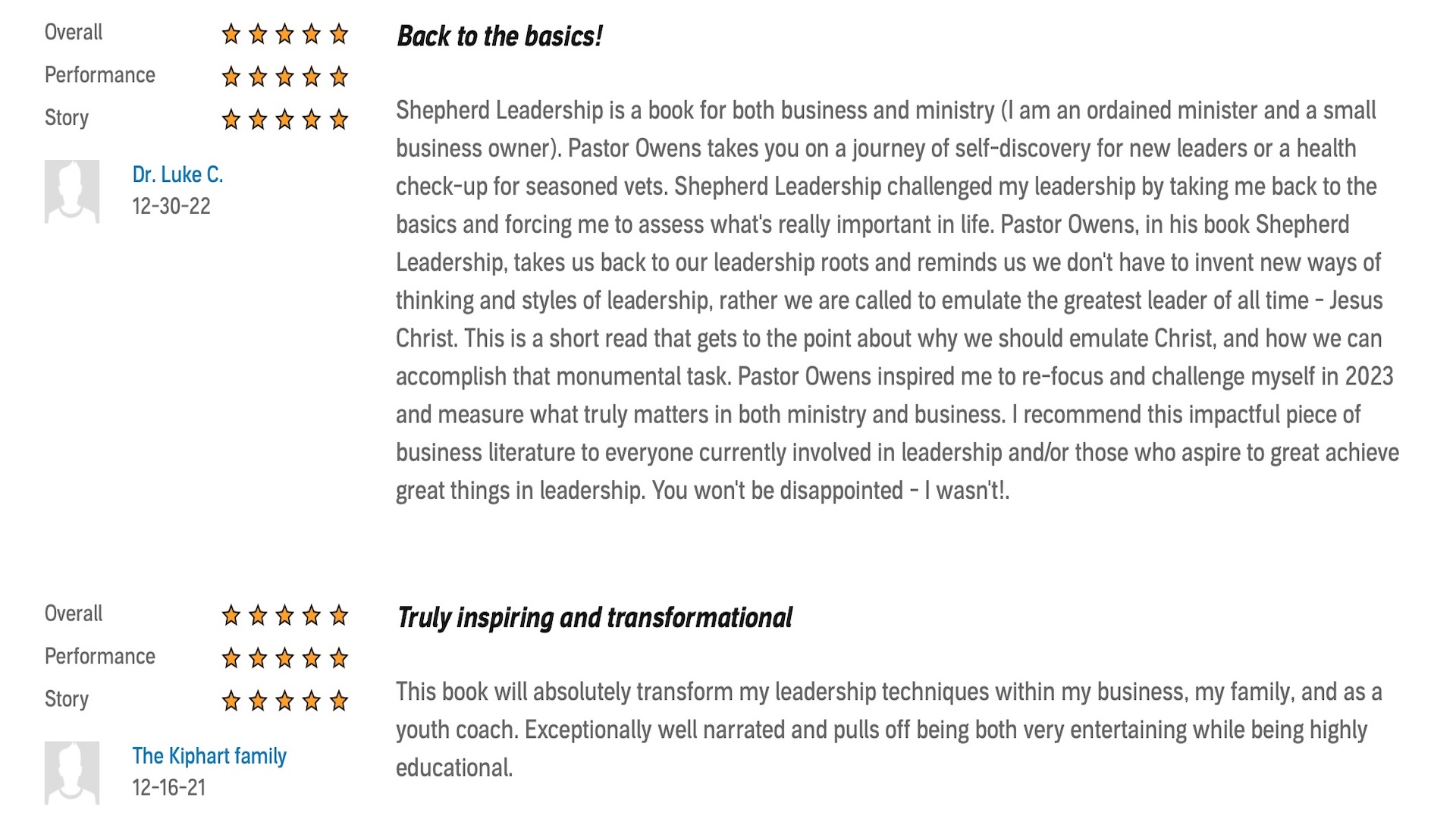
I wrote Shepherd Leadership mainly with pastors and ministry leaders in mind, but I’ve heard from stay-at-home moms, nurses, coaches, and business leaders that they’ve benefitted from the concepts I unpack in this book. 

I’m so honored that my book has nearly all 5-star ratings on Amazon. Here are two reviews from business leaders.

You can find my series of posts on godly leadership by clicking here.

The special offer I have for pastors is found by clicking here.

Growing The Wrong Thing

Listen to the podcast of this post by clicking on the player below, and you can also subscribe on AppleSpotify, or Audible. 

In a recent teaching time with some ministry interns, I discussed the two main metrics that we can use to measure growth: quantity and quality. Sadly, too many churches and ministries have gotten so caught up in the “numbers game” of more-more-more being the only metric of success, that they’ve forgotten about quality. Or maybe they do focus on quality, but only as a means to the end of more-more-more. 

This is never a metric of success that is discussed in the Bible. Check this out…

In the chapter entitled ‘Don’t Try to Grow Your Ministry’ in my book Shepherd Leadership: The Metrics That Really Matter I wrote this—

Businesses think in terms of quantitative gains—things they can count—but churches and nonprofits should be thinking in terms of qualitative gains—a quality improvement that isn’t as easily counted. I think we all know this, and yet we still persist in wanting to define success in a church or a nonprofit by those quantitative standards such as attendance growth, donations, and the like. When we think qualitative over quantitative, suddenly what seemed “small” is so significant and so valuable that it cannot be calculated! What if one of those babies that weren’t aborted discovers a cure for cancer, or deciphers a dialect to take the Gospel to an unreached people group, or becomes the loving next-door neighbor that leads your son or daughter to a relationship with Jesus? 

Just as you cannot put a price tag on a life, you cannot put a price tag on a sheep. Make no mistake about it, God views His sheep—every single one of them—as invaluable. Because His valuation is so high, we can understand why He gets so angry at those who are more concerned about their success than they are about the health of the sheep. When God uses the word “Woe!” we should definitely take that seriously. He uses that very word to warn shepherd leaders who were shirking their responsibility when He said, “Woe to those shepherds who only take care of themselves” (Ezekiel 34:2). 

When we map out our plan for success, or when we try to define success solely by quantitative measurements, we ultimately become more committed to our plans than to God’s sheep. God pulls no punches when He calls leaders with this attitude evil, mere hired hands, or even thieves (Jeremiah 23:3; John 10:8, 12). And most sobering of all, God says, “I will hold them accountable” (Ezekiel 34:10). 

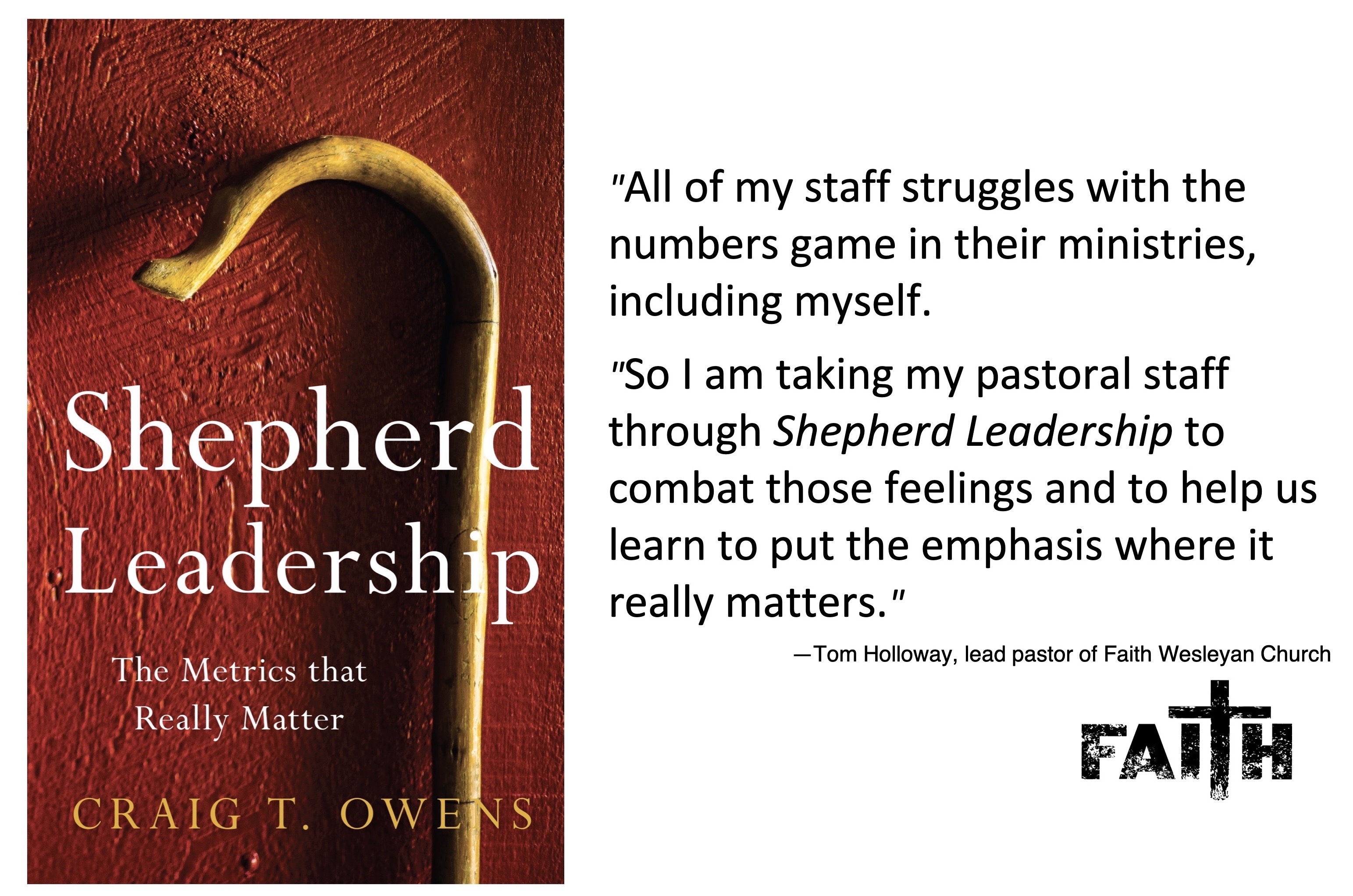
Friends, let’s make sure we are focused on the metrics that really matter. Recently, a pastor shared honestly with me about his frustration with the “numbers game,” and purchased five copies of my book to use as a discussion starter with his church staff. I hope you will consider using Shepherd Leadership in a similar way. If I can be of assistance, please let me know. 

Shepherd Leadership is available in print or ebook, and in audiobook through either Audible or Apple. 

►► Would you please prayerfully consider supporting this ministry? My Patreon supporters get behind-the-scenes access to exclusive materials. ◀︎◀︎

The Craig And Greg Show: When Craig Met Greg

Listen to the audio-only version of this podcast by clicking on the player below, or scroll down to watch the video.

On this episode of “The Craig And Greg Show” we talk about: 

  • [0:40] Who are we and how did we meet?
  • [2:00] A little bit of Greg’s biography as he headed to college
  • [4:10] A little bit of my biography as I headed to college
  • [5:40] How Greg tweaked his major while at Hope College
  • [6:57] I added an additional major while at Oral Roberts University
  • [7:28] Greg was drafted by two professional sports teams
  • [9:14] Transitions are important for leaders
  • [10:29] Self-reflection + coach ability = superpower 
  • [11:02] Greg’s first business venture was only an entry point to his career
  • [13:37] Another decision further refined Greg’s niche in business
  • [15:03] The unforeseen changes that brought me to West Michigan where I met Greg
  • [15:59] One of the first ministries that we worked on together
  • [20:00] A leadership lesson we tried to teach to the students at an urban youth center
  • [20:40] The dream list for us going forward
  • [22:40] What do we do as consultants?
  • [24:02] Greg has some cool keynote addresses that he presents
  • [25:53] How we can help you grow your leadership capacity

Check out this episode and subscribe on YouTube so you can watch all of the upcoming episodes. You can also listen to our podcast on Spotify and Apple.

Who Says Elephants Can’t Dance? (book review)

Listen to the podcast of this post by clicking on the player below, and you can also subscribe on AppleSpotify, or Audible. 

Just as I was beginning my business career, Louis Gerstner was at the top of his career. Mr. Gerstner stepped in as the CEO of IBM when Big Blue was at a perilous time: This massive company was on the brink of either crumbling or soaring. Gerstner unpacks the impressive turnaround story in his book Who Says Elephants Can’t Dance? 

When I was in my teenage years, several family members were encouraging me to consider IBM for my career path. They explained that a job at IBM would become a lucrative, influential, and lifelong position. Indeed, since its founding in the early twentieth century, it had grown into a worldwide behemoth of technology. You could tell IBM employees by their distinct dress, confidence, and loyalty to Big Blue. 

But adhering to the rigid principles that both Thomas Watson Sr. and Thomas Watson Jr. had preached turned into inflexible practices that were losing the true soul of this once-great company. By the early 1990s, IBM was floundering, hemorrhaging cash, and about to experience one of the most epic collapses any organization had ever seen. 

Enter Louis Gerstner. He had developed a stellar reputation at American Express and RJR Nabisco, and was highly sought as the CEO of IBM. Except Mr. Gerstner initially didn’t want to take on this challenge. He knew how difficult it would be to lead change in an organization that was so entrenched in its nearly 100-year-old ways. 

Eventually, he did agree to step into this role, and over the next decade led one of the most comprehensive and impressive turnarounds in business history. IBM shook off stodgy practices while returning to its founding principles, refocused on customers’ needs, and as a result, regained its dominance in the technology field. 

Any organization—whether for-profit or non-profit—can get stuck in a rut. Its once-beneficial principles can morph into practices which are merely attempting to keep the machinery running, but are no longer meaningful for either team members or other stakeholders. 

Mr. Gerstner’s refocusing of the elephant-sized IBM will give any leader some invaluable insights into how to keep their organization from sliding into ineffectiveness and irrelevance. I would highly recommend this book to all leaders. 

►► Would you please prayerfully consider supporting this ministry? My Patreon supporters get behind-the-scenes access to exclusive materials. ◀︎◀︎
Links & Quotes

link quote

“In this version of the Lord’s Prayer (Luke 11:2-4) Jesus says, ‘When you pray say’ … and then in verse 4 He includes this petition, ‘and forgive us our sins.’ So, if you connect the beginning of the prayer with the middle, what He says is, ‘Whenever you pray say … forgive us our sins.’ I take this to mean that this should be as much a part of all our praying as ‘Hallowed be Thy name.’ Which means that Jesus assumes that we need to seek forgiveness virtually every time we pray. In other words, we are always sinners. … It doesn’t matter how obedient we have been before we pray. We always come to the Lord as sinners—all of us. And God does not turn away the prayers of sinners when they pray like this.” —John Piper

“What if I say that it is not unjust but according to law that when a woman gets into debt her husband should bear it? And with the church of God sinning, it was but right that her Husband, who had espoused her unto Himself, should become the debtor on her behalf. The Lord Jesus stood in the relationship of a married Husband unto His church, and it was not, therefore, a strange thing that He should bear her burdens.” —Charles Spurgeon

“We can have confidence in our ability, through reason, to help our unbelieving friends consider the Good News of Jesus Christ and His Kingdom. We know this because God Himself is reasonable, and we believe He commends the use of reason in making Himself and His will known to men.” —T.M. Moore

“Listen to your conscience. Don’t be afraid not to join the mob—if you feel inside it’s wrong. Don’t confuse being ‘soft’ with seeing the other guy’s point of view. … Avoid self-righteously turning on a friend, but have your friendship mean enough that you would be willing to share with your friend your judgment. Don’t assign away your judgment to achieve power.” —George H.W. Bush, in a letter to his sons during the Watergate scandal

Some interesting lessons in Fast Company’s list of the 50 most well-liked CEOs in the United States.

“satan has tripped up many Christians by convincing them they’ve lost something in the Lord.” But David Wilkerson urges us to forget those things!

If you are praying for one of your loved ones to accept Jesus as their Savior, Tim Dilena has an encouraging word for you in The Amazing Now Becomes More Amazing.

[VIDEO] Conrad Mbewe shows how the so-called prosperity gospel isn’t honest with the entirety of Scripture—

Poetry Saturday―Don’t You?

Edmund Vance CookeWhen the plan which I have, to grow suddenly rich
Grows weary of leg and drops into the ditch,
And scheme follows scheme
Like the web of a dream
To glamour and glimmer and shimmer and seem,…
Only seem;
And then, when the world looks unfadably blue,
If my rival sails by
With his head in the sky,
And sings “How is business?” Why, what do I do?
Well, I claim that I aim to be honest and true,
But I sometimes lie. Don’t you?

When something at home is decidedly wrong,
When somebody sings a false note in the song,
Too low or too high,
And, you hardly know why,
But it wrangles and jangles and runs all awry,…
Aye, awry!
And then, at the moment when things are askew,
Some cousin sails in
With a face all a-grin,
And a “Do I intrude? Oh, I see that I do!”
Well, then, though I aim to be honest and true,
Still I sometimes lie. Don’t you?

When a man whom I need has some foible or fad,
Not very commendable, not very bad;
Perhaps it’s his daughter,
And some one has taught her
To daub up an “oil” or to streak up a “water”!
And her grass is green green and her sky is blue blue,
But her father, with pride,
In a stagey aside
Asks my “candid opinion.” Then what do I do?
Well, I claim that I aim to be honest and true,
But I sometimes lie. Don’t you? —Edmund Vance Cooke