[Each chapter in the Book of Proverbs contains thoughts that fit into a theme; they are not just random thoughts gathered together. In this “Saturday In The Proverbs” series, I will share a theme that I see in each chapter. But the cool thing about God’s Word is that you may see an entirely different theme. That’s great! If you do, I would love for you to share it in the comments below.]
A soft answer turns away wrath, but a harsh word stirs up anger (Proverbs 15:1).
Here’s how to defuse potentially volatile situations with other people—
Speak gently (vv. 1, 28)
Speak truthfully (v. 2)
Remember that God is watching (vv. 3, 9, 11, 25, 26)
Speak helpful words or stay silent (vv. 4, 7, 14, 23, 30)
Receive correction from others (vv. 5, 12, 31, 32)
Find ways to add value to other people (v. 6)
Ask for God’s help (vv. 8, 29)
Be gentle (v. 10)
Develop emotional intelligence (vv. 13, 15, 21)
Don’t envy others (vv. 16, 17, 27)
Guard against getting angry (v. 18)
Remember: good relationships take work (vv. 19, 24)
Use all the wisdom you have… (v. 20)
…get all the wisdom that others have too (v. 22)
Stay humble (v. 33)
Relationships can be one of the greatest treasures in our life, or they can be one of the biggest disappointments in our life.
Put the ball in your court, and YOU work on making your relationships treasures!
All across the world on Sunday morning, people met for church? But what exactly is church? Is it a place we go to? Is it something that only happens on Sundays?
The Greek word for church is ekklesia. It meant an assembly of citizens. Luke used the term when he recorded a government official saying, “If there is anything further you want to bring up, it must be settled in a legal assembly” (Acts 19:39). But in the New Testament, it came to mean “a community based on a special religious idea and established in a special way” (Dr. Marvin Vincent). It can also mean either a local group of Christians or “the whole body of Christians scattered throughout the earth” (Dr. James Strong).
Church never means a building. Nowhere does the phrase “go to church” appear in the New Testament. Instead, church carried the idea of a living, growing organism because church was wherever a follower of Jesus was. Sometimes the church met collectively in one location, and sometimes individual believers were out in the community. But wherever the Spirit of God went, church was happening.
If church is not something we go to, it’s also not something that takes place only one day per week. Look at what Jesus did on the Sabbath day:
But we also see Jesus doing all of these things EVERY day of the week.
For Jesus, neither the day of the week nor the location determined the way He lived. Peter summed it up this way, “God anointed Jesus of Nazareth with the Holy Spirit and with power. Then Jesus went around doing good and healing all who were oppressed by the devil, for God was with Him” (Acts 10:38).
In fact, before they were called Christians the church was simply called “the Way” letting us know that the church was a way of life, not a day of the week.
Based on how Jesus lived and how the Apostle taught, I think we can see the Church Way like this:
In other words, EVERY day and in EVERY place the followers of Jesus were being enriched in their own lives so that they could reach out to the hurting so that they could come to know Jesus personally so that their lives could be enriched so that they too could reach out to others, and on, and on, and on it goes!
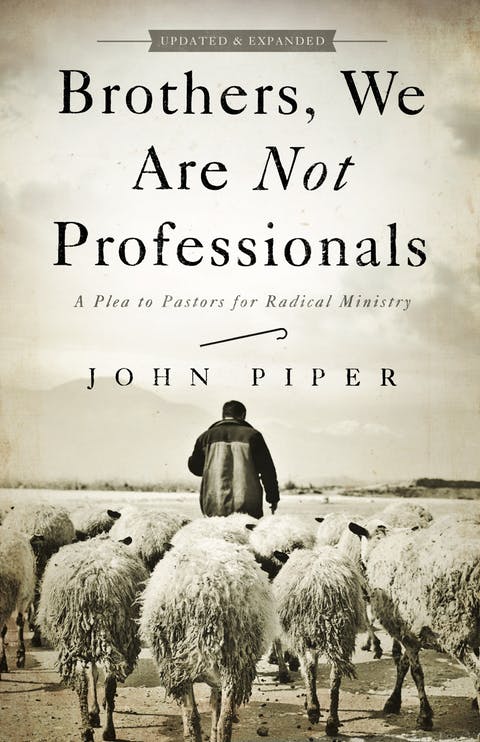
Those in pastoral ministry are ministers; they are not professional, career-minded, corporate ladder-climbers. John Piper has written a book that I believe every pastor should read: Brothers, We Are Not Professionals. Here are a few more quotes from this excellent book.
“Is not our most painful failure in the pastorate the inability to weep over the unbelievers in our neighborhoods and the carnal members of our churches? …
“I must feel the truth of hell—that it exists and is terrible and horrible beyond imaginings forever and ever. ‘These will go away into eternal punishment’ (Matthew 25:46). Even if I try to make the ‘lake of fire’ (Revelation 20:15) or the ‘fiery furnace’ (Matthew 13:42) a symbol, I am confronted with the terrifying thought that symbols are not overstatements but understatements of reality. …
“I say to you, on the authority of Scripture, remember, remember, remember the horrid condition of being separated from Christ, without hope and without God, on the brink of hell. ‘Remember that you were at that time separated from Christ, alienated from the commonwealth of Israel and strangers to the covenants of promise, having no hope and without God in the world’ (Ephesians 2:12). …
“When the heart no longer feels the truth of hell, the gospel passes from good news to simply news.”
“Warning has value in stirring us up to take the glories of holiness and heaven seriously so that we come to see them for what they are and delight in them. But it is the delight in them that causes the true grief when we fall short.”
“Pastors, you will know your people’s souls best by knowing your own. So try to be ruthlessly honest with yourself.”
“If the heart is without passion, it will produce lifeless, jargon-laden spontaneity. And if the heart is aflame, no form will quench it.”
“We ought to experience the deepest emotions about the deepest things. And we ought to speak often, and publicly, about what means most to us, in a way that shows its value.”
“Eating, exercising, and sleeping are more spiritually relevant in the ministry than we may think. … The point is that we be intentional about how our eating affects the ability of our body to be a helpful partner in seeing the glory of God.”
“When we say that what we do on Sunday morning is to ‘go hard after God,’ what we mean is that we are going hard after satisfaction in God, and going hard after God as our prize, and going hard after God as our treasure, our soul-food, our heart-delight, our spirit’s pleasure. Or to put Christ in His rightful place—it means that we are going hard after all that God is for us in Jesus Christ, crucified and risen.”
“It will transform your pastoral leadership in worship if you teach your people that the basic attitude of worship on Sunday morning is not to come with your hands full to give to God but with your hands empty to receive from God.”
“Brothers, we are leaders, and the burden of change lies most heavily on us.”
You can read my full book review of Brothers, We Are Not Professionals by clicking here, and you can check out some other quotes from this book here.
Caleb is a dog. I’m not kidding: his name literally means dog. To be more specific his name actually means a rabid dog. What?! Yeah, but it totally fits his life.
Caleb first shows up on the scene when the Israelites are getting ready to explore Canaan for the first time. They have just been delivered from Egypt and in about two months have arrived at the border of their promised land. Moses wants to send a representative from each tribe to scout out the land.
So the first thing we learn about Caleb is that he is a leader of the largest, most powerful tribe in Israel (Numbers 13:1-3, 6).
After scouting the land for 40 days, these men come back with a report for everyone. Halfway through their report, Caleb interrupts everyone—“We should go take the land right now, for we can certainly do it!” (13:30). Caleb was outspoken for God’s favor. He firmly believed that God was for them.
Unfortunately, nearly all the other scouts (except Joshua) disagreed with Caleb. They warned that there were giants in the land that would eat them for lunch. In essence, the same people who had seen God deliver them from the Egyptians and part the Red Sea for them now thought that God wasn’t able to defeat giants. This vocal majority turned the entire nation against Moses and wanted to return to Egypt!
So God promised that none of the adults would enter the promised land, with only two exceptions: Joshua and Caleb. God pointed out that Caleb “has a different spirit and follows Me wholeheartedly” (Numbers 14:24). This is where we first learn that Caleb is rabid. The term rabid means zealous, intense, fanatical, inspired. Caleb is a man who is focused—intensely, wholeheartedly focused—on God. In fact, this word wholehearted is used about Caleb three more times (see Joshua 14: 8, 9, 14).
Along with the rest of the Israelite community, Caleb wandered in the wilderness for 40 years. He never thought God had forgotten him; he never lost his intense wholeheartedness; he stayed rabid the whole time. He had a trust in God that never diminished. His motto might have been: “God said it; I believe it.”
After 40 years in the wilderness, and then five more years fighting to claim their promised land, Caleb was still raring to go. He told Joshua, “I am still just as strong as I was 45 years ago. I’m 85 years old and still ready to take on giants. Let me at ‘em!” And he did it! Caleb drove out three giants in order to claim his territory (Judges 1:20).
But Caleb wasn’t done yet. He then used God’s favor to be a blessing to others. The Apostle Paul tell something that Caleb lived out: God will generously provide all you need. Then you will always have everything you need AND plenty left over to share with others (2 Corinthians 9:8). Without a word of complaint, Caleb gladly accepted not only the responsibility of letting the Levities live in the town he had conquered, but he also took on the added duties of making that city of Hebron a “city of refuge.” In this city, Caleb would keep anyone safe from those seeking their lives until a proper trial could be held.
Caleb was successful for nearly 90 years because he was convinced that God was for him.
Nothing could distract him from wholeheartedly clinging to God’s favor!
Caleb was a warrior for God’s favor, and he was a successful warrior because of God’s favor. The same can be said of you IF you will decide to cling to God’s favor wholeheartedly.
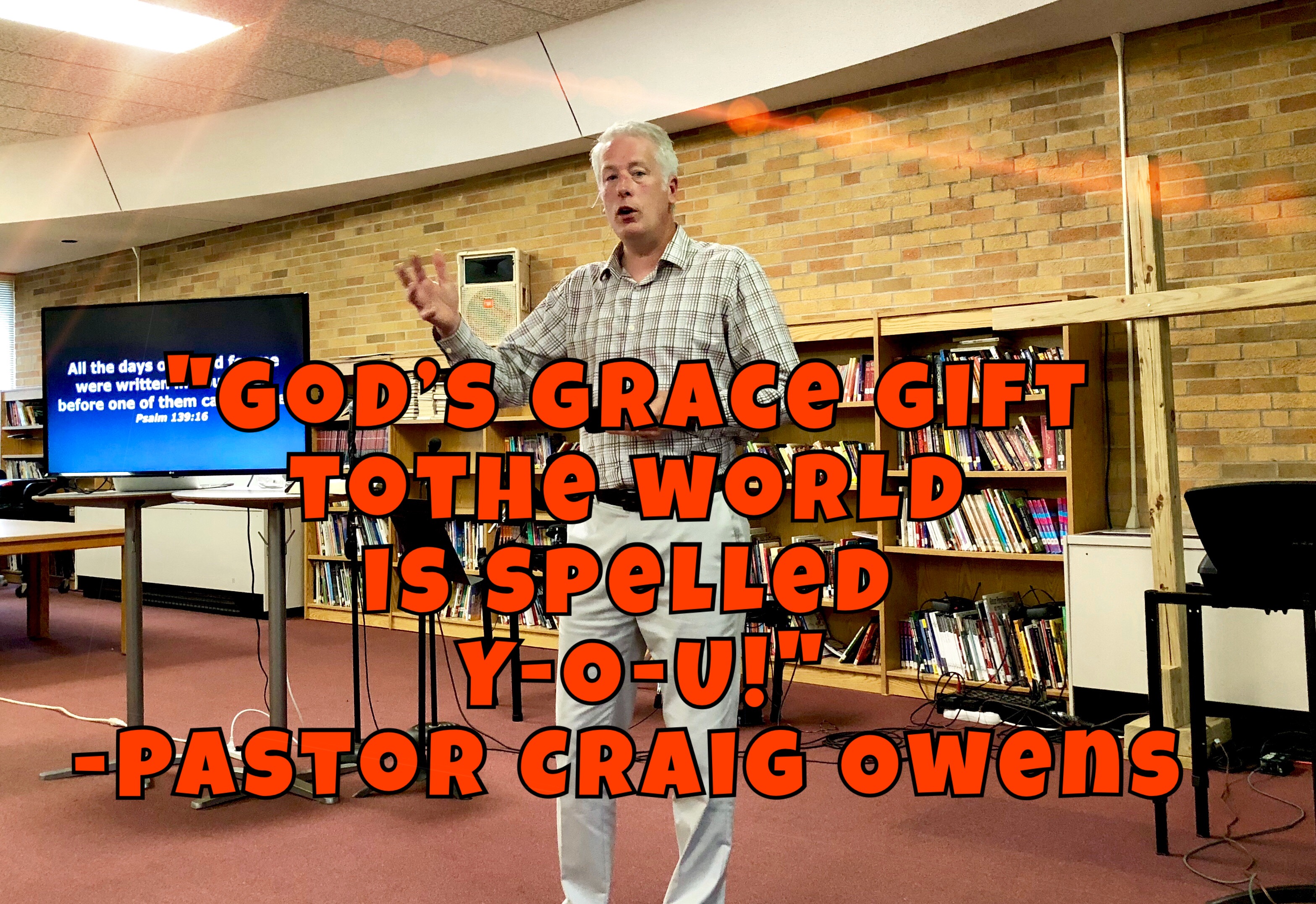
You are a gift. You are God’s grace gift to the world.
Max Lucado said it this way: “You are you-nique.”
God made you on purpose and for a purpose.
God implanted unique abilities in you from conception (see Psalm 139:13). And check out what God said to Jeremiah, “Before I formed you in the womb I knew and approved of you…” (Jeremiah 1:5). Before you were even conceived, God already knew all about you AND He approved of you!
Why did God implant these unique abilities in you? Because He knew of the unique opportunities you would face during your lifetime (see Psalm 139:16). Because God is for you, He gave you all that you would need to successfully face every opportunity that came your way.
Every one of us has been given these grace gifts of unique talents and opportunities. The Bible says, “to each one of us grace has been given as Christ apportioned it” (Ephesians 4:7). If God is for you, and God is for me, then that means that you have been gifted to be a blessing to me and I have been gifted to be a blessing to you (Romans 12:3-6; 1 Corinthians 12:4-7).
Let me state it again: every one of us has been entrusted by God with unique talents in order to successfully face the unique opportunities that He knew we would face. Jon Bloom reminds us, “Some are given more, some are given less, but all are given much.”
So what do we do with what we’ve been entrusted? There are two possibilities: (1) We can invest our talents and abilities in a way that glorifies God, or (2) We can squander the talents God has given us.
How do you squander the grace gift of your life?
Not discovering it—I have a gift?
Devaluing it—I’m nothing special.
Overvaluing it—I’m super-important. I don’t need anyone else.
Laziness—I don’t want to mess it up, so there’s no need for me to invest my gift.
Short-sightedness—My gift is just for me, so it doesn’t matter what I do with it.
I hope we can all say what Erma Bombeck wrote: “When I stand before God at the end of my life, I would hope that I would not have a single bit of talent left but could say, ‘I used everything You gave me.’”
How do you honor God with your you-niqueness? I can tell you in just three simple words—You be you!
If you will just be who God made you—not downplaying your talents, not wishing you had someone else’s talents—that’s when you will feel fulfilled, and God will be glorified, and the rest of the world will be blessed! So…
This is a weekly series with things I’m reading and pondering from Oswald Chambers. You can read the original seed thought here, or type “Thursdays With Oswald” in the search box to read more entries.
Jeremiah 5
[These are notes from Oswald Chambers’ lecture on Jeremiah 5.]
The Bible is not so much a revelation about God as a revelation of God who is adequate to deal with the worst. …
The tumbling and turmoil in human history is caused everywhere by the consuming fire of God rather than by the futile rage of the devil. In reading history the saint sees that the great presence and power is God, not the devil. …
Hordes of barbarians and powers of worldly dominion are unconscious of God, but God uses them for His own purpose. Nothing happens by chance. When our Lord stood before Pilate He said, “You would have no power over Me if it were not given to you from above” (John 19:11). The tyranny of the Roman Empire over God’s people was the providential order of God, and Jesus recognized that this was so, He did not start a revolution, or say, “We must fight against this” (John 18:36). Perils are clear to God’s mind alone, but they mean panic to everyone who does not know the mind of God. …
We learn the marvelous truth that we may become more than conquerors through our right relationship to God over everything that may come against us. …
In order to make proper changes in a nation’s life, you must change the people’s wants.
All over the globe, it appears that evil is holding sway and that sin is running rampant. It could appear as if the devil is winning, and Christians are just desperately trying to hold on to the end. But is that what it means when the Bible says that we are more than conquerors?
Let’s be clear about this—God is in control.
God may use barbarians, dictators, and evil people to accomplish His purposes, but they are all under His control. These forces have bounds past which they may not go. Any power they have has been given to them from above.
If we forget this, we can easily fall into a hand-wringing panic. But let’s remind ourselves again and again that God is in control! If our relationship with Him is right, then we truly soar over these temporal upheavals; we become more than conquerors through Him Who loves us!
There can be no healing if there isn’t first an admission of need.
This psalmist recognizes:
the dryness of his soul
his depression
the taunts of his enemies
the ‘good ol’ days’
He not only questions his soul, but he admits to himself and to God, “My soul is cast down within me.” But each time he has this conversation with himself, he reminds himself of the same conclusion—“God is worthy of praise and I can put my hope in Him!”
We have to stop listening to crippling self-pity and begin talking to ourselves about our well-placed confidence in God. He is worthy of our praise! He will satisfy me like nothing else can. He is the only One in whom I can put my hope.
As Augustine reminded himself, “Thou hast formed us for Thyself, and our hearts are restless till they find rest in Thee.”
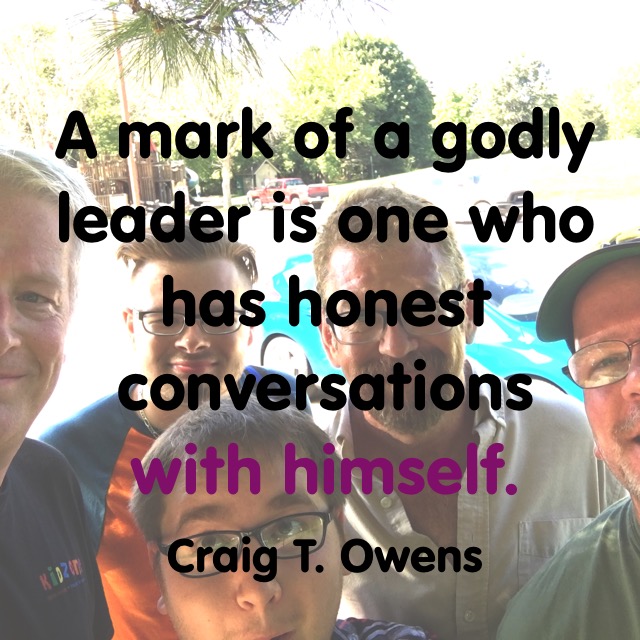
A mark of a godly leader is one who has honest conversations with himself.
Don’t listen to your downcast thoughts; talk back to your downcast thoughts and tell yourself the only place where real hope can be found.
This is part 23 in my series on godly leadership. You can check out all of my posts on this topic by clicking here.
Listen to the podcast of this post by clicking on the player below, and you can also subscribe on Apple, Spotify, or Audible.
If you’ve been reading or watching my series on God’s favor the last few weeks, I hope you truly know this: God is for you!
But the key question for Christians comes down to this—Do others know that you know that God is for you?
You see, God is for you because God is joyful and happy, and He wants you to not only know this but to radiate this joy and happiness to those around you.
Here’s how it works:
(1) Joy is an inside job. The dictionary defines joy as “a feeling of great delight caused by something exceptionally good or satisfying.” When we know by our personal experience with Him how good God is, joy is birthed in our hearts as we see Him as All-Good and All-Satisfying.
(2) Joy is regardless of my external circumstances. Some people try to pursue happiness apart from joy. Trying to get happy without having the foundation of joy is like having a flower that has been picked from the plant. Happiness may be pretty for a short while, but it is already fading because it is completely dependent on the environment around it. True happiness isn’t dependent on external circumstances because it is rooted in something far greater.
(3) Knowing God’s favor fuels our joy. There is a Hebrew word for know which means “knowledge through intimate, personal experience.” Psalm 100 describes happy people and their joyful praise. Their joy comes from this: They knowthat their Lord is God and that He is good. This joy comes from seeing and savoring God’s favor.
(4) Our internal joy should bubble up into external happiness. All throughout the Bible, we read how those who are filled with joy as they get to know this exceptionally good, all-satisfying God cannot help but burst out in songs of happy praise (see Psalm 28:7 and Luke 10:21).
(5) Our external happiness becomes our testimony. In Psalm 126 we read that God’s people who were full of God’s joy burst out into happy praise. When they did the people around them recognized that God had done great things for them.
Check this out—
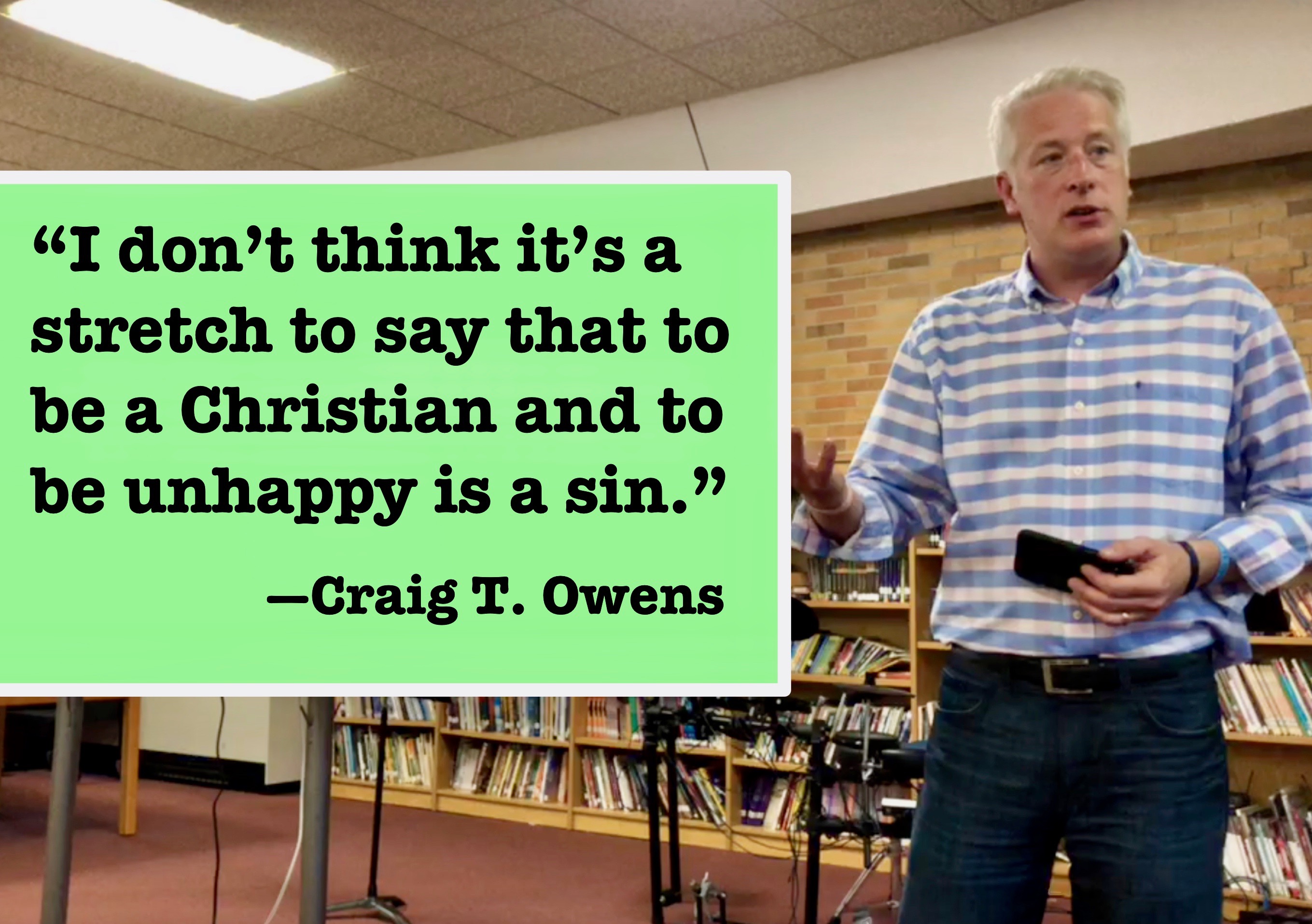
“I don’t think it’s a stretch to say that to be a Christian and to be unhappy is a sin. An unhappy Christian gives God no praise, robs Him of glory, and paints God in a bad light. A happy Christian knows the Lord is his strength, his comfort, his supply. The happy Christian lifts God high and invites others to know this All-Good, All-Happy God too!” —Craig T. Owens
So let me ask you again: If you call yourself a Christian, do people know that you know that God is for you? Are you making God look All-Good and All-Satisfying by your deeply fueled joy and your face-brightening happiness?
What a testimony it is when God’s people are happy in Him!
If you’ve been reading my series of posts on God’s favor, I hope you are becoming more aware of how strongly I want you to know this: God is for you! He’s not looking for opportunities to blast you, but to bless you. (If you want to read some of these previous posts, check out the link at the bottom of this post.)
In writing his account of the birth of Jesus, Luke is captured with the idea of God’s favor. Luke uses the word favor more than any of the other gospel writers, and he uses the word quite frequently as he relates the events leading up to the birth of Jesus. During his narrative we meet two women—Elizabeth and Mary. Here are five lessons we can learn from these two mothers.
(1) “Favor” is not the same thing as “favorite.” To say, “I am the one on whom God’s favor rests” is not the same as saying, “I am God’s favorite.” Elizabeth recognized God’s favor on both herself and on Mary (Luke 1:25 & 43), and Mary also recognized God’s favor on herself (Luke 1:28, 30, 48-49). But nowhere did these women think they were God’s favorites. God has no favorites, but instead He showers His abundant, never-ending favor on everyone!
(2) “Favor” probably didn’t look like what they would have planned for themselves. Elizabeth didn’t get pregnant until the age when she should have been a grandmother, and Mary got pregnant before she was even married. I’m sure neither of them thought their lives would go this way! But God knew what He was doing all along (see Isaiah 45:7-9; Psalm 139:16).
(3) They needed humility, obedience, and perseverance to remain in the place where they could recognize God’s favor. No one can stop God’s favor, but the devil would love to keep you from recognizing God’s favor. One way satan does this is by trying to get us to appeal to our pride (“I think I can do this better”) because then obedience to God and perseverance through the trying times is very difficult to maintain.
(4) God’s favor is for God’s glory (not necessarily for our comfort). God is accomplishing HIS plan through us. His favor toward us places us where He needs us, when He needs us there, and with the talents we need to respond correctly when we get to that moment. Mary spoke the words that I’m sure were also in Elizabeth’s heart: “I am the Lord’s servant. May it be to me just as you have said.”
(5) God’s favor doesn’t necessarily answer all our questions. Even though God’s favor places us in the right place, at the right time, with the right skills, we will still undoubtedly have questions about why God is doing what He’s doing. If you feel that way, you’re not alone—Hebrews 11 is full of people who felt the same way. But hang in there and keep trusting God: He knows what He’s doing! In the meantime remember this: God is able to make ALL grace abound toward you, that you, ALWAYS having ALL sufficiency in ALL things, may have an abundance for EVERY good work (2 Corinthians 9:8).
Check out this video of the full message I shared on these lessons from the life of Elizabeth and Mary.
Join me this Sunday as we continue looking at God’s favor. You can join me either in person or on Facebook Live.
If you’ve missed any of my previous posts on God’s favor, check out:
[Each chapter in the Book of Proverbs contains thoughts that fit into a theme; they are not just random thoughts gathered together. In this “Saturday In The Proverbs” series, I will share a theme that I see in each chapter. But the cool thing about God’s Word is that you may see an entirely different theme. That’s great! If you do, I would love for you to share it in the comments below.]
This collection of proverbs prompts quite a bit of self-examination.
Have I made commitments that are going to entrap me (vv. 1-2)? If so, I should plead for mercy to get out of them (vv. 3-5).
Am I less-than-diligent in my work—what Solomon calls a sluggard? Consider the diligence and initiative of the ant (vv. 6-8), and then consider the outcome if I don’t make better decisions with my time and my work ethic (vv. 9-11).
Am I a person of integrity, or am I a fast-talking, double-dealer (vv. 12-14)? I better consider the “therefore” (v. 15)!
Is my heart pure? Consider that an evil heart is at the heart of what God hates—shedding innocent blood, doing evil, lying, pride (vv. 16-19). Do I want God’s anger directed at me?
Do my eyes stray toward women who aren’t my wife (v. 25)? God’s wisdom can keep me pure (vv. 20-24), but I also need to consider the devastating consequences of continuing in this immorality (vv. 26-35).
Are you willing to honestly ask yourself these questions in the presence of God’s Holy Spirit?



 Here’s how to defuse potentially volatile situations with other people—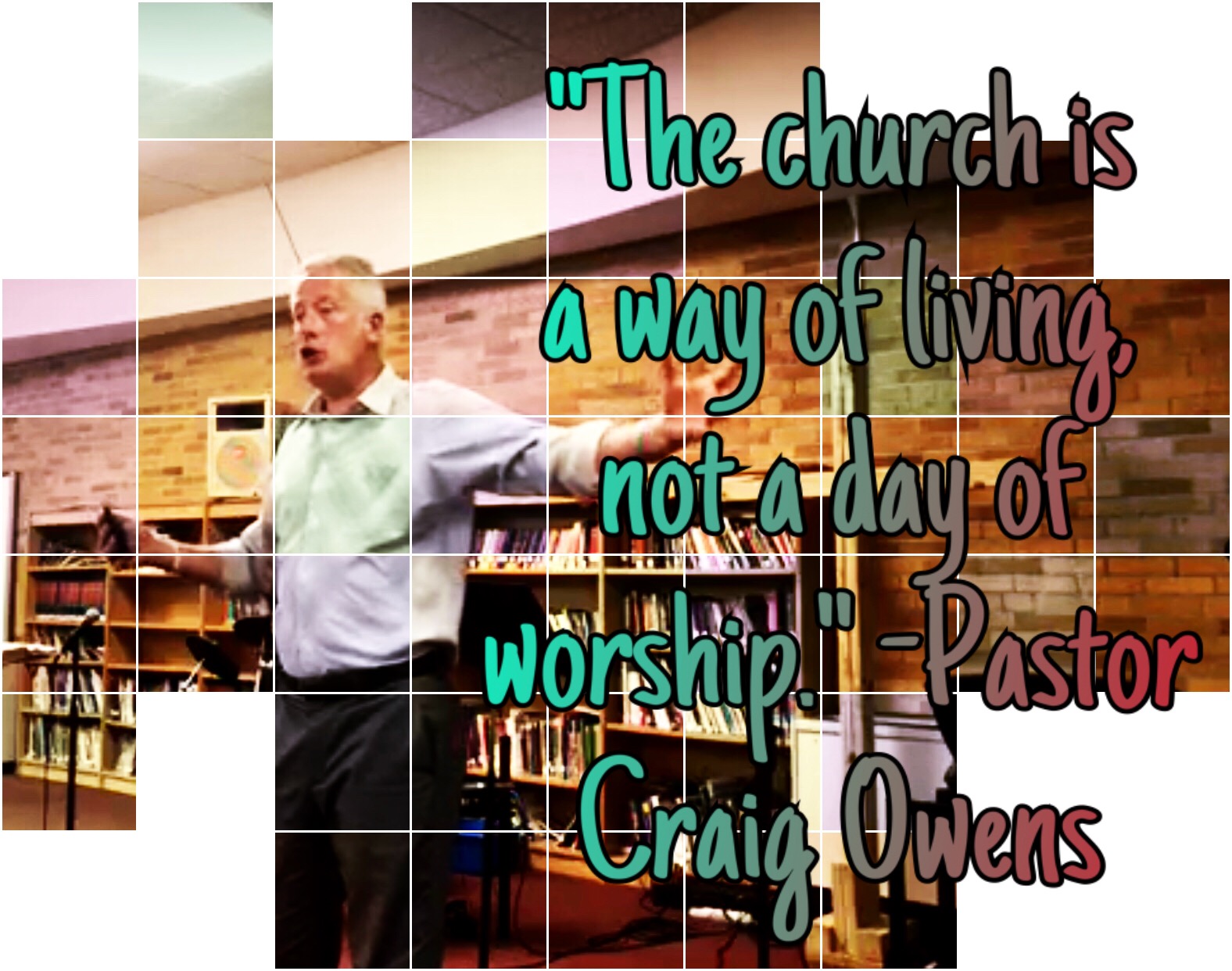






 Craig T. Owens