7 More Quotes From “Defiant Joy”

It may sound like an oxymoron—defiant joy—but it’s a powerful combination that Stasi Eldredge unpacks in her book. Check out my full review of Defiant Joy by clicking here. 

“Times of testing can also be times of refining and growth. The counterintuitive truth is that suffering can deepen our hope. It enlarges our hearts so that we can know the love and presence of Jesus in ways that we would not if we did not go through the stretching the process.” 

“The waiting can be hard when you are hungry, but when you know a feast is coming, you know that the waiting won’t last forever. Dear ones, the waiting is not going to last. But there is no shame in being hungry while you wait. … In our waiting God often deepens our hunger as well.” 

“We are alive. And to be alive means that we will feel. We don’t need to deny it, and we don’t need to have it rule us. We dare not marry it to cynicism, and we must not fuel it with fatalism. It is not the end of our reality. It is instead a clue that we are strangers in a strange land. And we are passing through. Sadness touches us all, but God can use it to enhance the beauty and joy of the lives we are living. Sadness can fuel our hope. It can arouse our expectancy.” 

“God displayed His fierce, constant love for us once and for all on the Cross of Calvary. The essence of His heart is no longer up for question. Because of all that Jesus won for us and our choice to receive it, God promises that we actually have nothing to fear.” 

“satan comes to rob us of our joy, our peace, and our connection to and faith in God. He whispers lies to us when we are vulnerable and does his best to warp our perception of our lives with his depressing and evil spin. His endless attacks can wear a person down if they are aware that the perceptions being suggested are coming straight from hell.

“satan is very good at stealing. He’s devoted all his malice to separating us from intimacy with our good Father and the experience of deep joy that comes straight from Jesus’ heart. The evil one uses the circumstances of our lives and of the world to bring discouragement and despair. That is why we must remember that though happiness is rooted in our circumstances, joy is rooted in eternity.” 

“Depth of character doesn’t come easily. It doesn’t come at all to those who refuse to admit the difficulties in their lives are painful. It comes when we fix our gaze on Jesus and the reality that this life is only part of the grand scheme of things.” 

“There is something forged in all of us that can only be forged through fire. Perhaps intense periods of struggle, pain, betrayal, persecution, and rejection are the times when the baptism by fire that Jesus talks about occurs. When we cling to Jesus and proclaim He is good in the midst of the licking flames, our spirits rise in a strength that is proven unshakable, and God is glorified beyond reckoning. Our pain becomes the terrain of God. It becomes sacred.” 

Check out some more quotes I shared from Defiant Joy here.

15 Quotes On Prayer From J.C. Ryle

In my current Bible reading time, I am reading J.C. Ryle’s Expository Thoughts On The Gospels as a read-along companion with my Bible. Bishop Ryle correctly feels the weight and effectiveness of prayer in the life of a Christian. Here are some of his quotes regarding prayer. 

“If afflictions drive us nearer to Christ, the Bible, and prayer, they are positive blessings.” 

“It is not for us to prescribe either the time or the way in which our requests are to be answered.… Let us rather ‘continue in prayer,’ ‘watch unto prayer,’ ‘pray always and not faint.’” 

“Why is it that there is so much apparent religious working and yet so little result in positive conversions to God—so many sermons, and so few souls saved—so much machinery, and so little effect produced—so much running here and there and yet so few brought to Christ? Why is all this? The reply is short and simple: there is not enough private prayer. The cause of Christ does not need less working, but it does need among the workers more praying. … The most successful workmen in the Lord’s vineyard are those who are, like their Master, often and much upon their knees.” 

“If we would have good ministers we must remember our Lord’s example and pray for them. Their work is heavy. Their responsibility is enormous. Their strength is small. Let us see that we support them and hold up their hands by our prayers.” 

“Let us bear these rules in mind every Sunday morning before we go to hear the Word of God preached. Let us not rush into God’s presence careless, reckless, and unprepared, as if it mattered not in what way such work was done. Let us carry with us faith, reverence, and prayer. If these three are our companions, we shall hear with profit and return with praise.” 

“Let a petition for more faith form a part of all our daily prayers. As ever we would have peace, and calmness, and quietness of spirit, let us often say, ‘Lord, increase our faith.’” 

“Let us strive and pray that the same mind may be in us which was in our blessed Master. Like Him, let us be willing to go anywhere, do anything, suffer anything when the path of duty is clear and the voice of God calls. Let us set our faces steadfastly to our work when our work is plainly marked out, and drink our bitter cups patiently when they come from a Father’s hand.” 

“We must seek to have knowledge as well as zeal. Zeal without knowledge is an army without a general, and a ship without a rudder. We must pray that we may understand how to make a right application of Scripture.”

“Prayer is one of the best and most powerful means of helping forward the cause of Christ in the world. … Not all believers have money to give to missions. Very few have great intellectual gifts or extensive influence among men. But all believers can pray for the success of the Gospel—and they ought to pray for it daily.” 

“Prayer is one of the principal weapons which the minister of the Gospel ought to use. To be a true successor of the apostles, he must give himself to prayer as well as to the ministry of the Word (Acts 6:4). He must not only use the sword of the Spirit, but pray always, with all prayer and supplication (Ephesians 6:17, 18). This is the way to win a blessing on his own ministry. This, above all, is the way to procure helpers to carry on Christ’s work.” 

“Daily bread and daily mercy are by far the first and principal things that mortal man needs. He is the rich man who possesses them. He is the wise man who is not ashamed to pray for them every day.” 

“Nothing that concerns God’s people is too little for Him to manage or for them to bring before Him in prayer.”

“‘He spoke a parable to this end: that men ought always to pray, and not to give up.’ These words, be it remembered, are closely connected with the solemn doctrine of the second advent, with which the preceding chapter concludes. It is prayer without fainting during the long weary intervals between the first and second advents which Jesus is urging His disciples to keep up.” 

“Let us often pray that we may have wisdom from above in order to answer rightly when perplexing questions are put to us. The servant of Christ must expect a portion like his Master. He must count it no strange thing if the wicked and worldly-minded endeavor to entangle him in his talk, and to provoke him to speak unadvisedly with his lips.” 

“Whatever other means of relief we use, let us pray. The first Friend we should turn to ought to be God. The first message we should send ought to be to the throne of grace.” 

8 Quotes From “Defiant Joy”

For anyone going through a trying time, Stasi Eldredge has given us a timely reminder of how we can tenaciously and defiantly cling to the joy the God gives us. Check out my full book review by clicking here. 

“Ignoring reality does not breed joy. Pretending that what is true does not exist is not holy defiance. The seeds of joy can only be firmly planted in the pungent soil of the here and now while at the same time being tethered to eternity. Joy is fully rooted in the truth. Joy embraces all the senses and is fully awake to the laughter, the wonder, and the beauty present in the moment as well as the sorrow, the angst, and the fear. Joy says, ‘Even so, I have a reason to celebrate.’” 

“Defiant may not be a word we would normally associate with the living God, but it can actually be quite fitting. Defiance means resistance, opposition, noncompliance, disobedience, dissent, and rebellion. And when it comes to things that would destroy our souls, that is exactly the right response.” 

“Joy is not happiness on steroids. It is not happiness squared. … Joy is connected to God and reserved for those who are tapping into His reservoir, who are connected to His life. Joy is rooted in God and His kingdom, in the surety of His goodness, His love for us. It is immovable. Unshakable. Joy is available at all times, day and night, because God and His kingdom are always available to us. … Joy is the heartbeat of heaven, the very light that emanates from Jesus’ heart, so as we grow closer in relationship with God, we’ll also grow in joy.” 

“Joy and breakthrough are not opposed to suffering But are available in the midst of it. Suffering is not a failure of faith on our part; its presence does not mean the absence of the presence of God. We can live with suffering and joy simultaneously.” 

“Joy is deeply rooted in the availability of God and His kingdom right here, right now. Sometimes we find breakthrough. Sometimes we find a deeper knowing of God in our suffering.” 

“Here is the truth we must remember in the middle of this sometimes painful healing process: we matter to the heart of God. He hasn’t taken His eyes off us. He thinks of us constantly. He has hopes and dreams for us. God planned on us before He made the stars, and He planned on us being His. He planned on us sharing our lives with Him on this wild adventure. And His plans are good.” 

“God drops things in our laps at just the right time. He puts barriers in our paths that look like roadblocks but are really gifts in disguise, beckoning us to take a closer look at what’s going on inside of us. We can either step over them or choose to pick them up and examine them for the potential they may hold.” 

“When the sadness refuses to be silenced and the feelings arise that this is not the life we had signed up for, we can either go to shame or go to God.” 

I’ll be sharing more quotes in the near future, so stay tuned…

Defiant Joy (book review)

I’m always intrigued by oxymorons. You probably know what these are—when two seemingly opposite things are put together to make something memorable. Like a fine mess, or deafening silence, or seriously funny. Or defiant joy.

Usually “joy” is paired with descriptives like pleasurable, or bubbly, or uncontainable. But “defiant”? Stasi Eldredge makes the case that we need to fight to hang on to joy—that our pursuit of joy against all odds should be, as her book is entitled, Defiant Joy. 

Stasi shares many of her painful life lessons that led her to the conclusion that joy has to be clung to tenaciously or it can be stripped away quickly. Defiantly clinging to joy doesn’t mean a bury-your-head-in-the-sand denial view of life. It is facing the challenges squarely and honestly, and still recognizing that the joy Jesus gives is greater than those circumstances. 

In fact, one of the first quotes Stasi shares in her book is this truism from C.S. Lewis: “Joy is the serious business of Heaven.” Talk about a powerful oxymoron! 

I so appreciate the transparency and candor Stasi exhibits as she pulls back the curtains of her own battles for joy. She honestly shares her darker moments with us, tells us where she’s still working, where’s she had breakthroughs, and the applicable lessons we can all use. 

I’m sure everyone one of us will have to face joy-threatening circumstances. The principles in Defiant Joy will help you overcome those circumstances while still tenaciously clinging to joy. Read this book for yourself or read it with a friend going through a difficult time. You’ll be glad you did.

I’m a Thomas Nelson book reviewer. 

Thursdays With Oswald—Difficult Times Reveal Our Habits

Oswald ChambersThis is a weekly series with things I’m reading and pondering from Oswald Chambers. You can read the original seed thought here, or type “Thursdays With Oswald” in the search box to read more entries.

Difficult Times Reveal Our Habits 

     Practice means continually doing that which no one sees or knows but ourselves. Habit is the result of practice, by continually doing a thing it becomes second nature. The difference between men is not a difference of personal power, but that some men are disciplined and others are not. The difference is not the degree of mental power but the degree of mental discipline. If we have taught ourselves how to think, we will have mental power plus the discipline of having it under control. Beware of impulse. Impulsiveness is the characteristic of a child, but it ought not to be the characteristic of a man, it means he has not disciplined himself. Undeterred impulse is undisciplined power.

     Every habit is purely mechanical, and whenever we form a habit it makes a material difference in the brain. The material of the brain alters very slowly, but it does alter, and by repeatedly doing a thing a groove is formed in the material of the brain so that it becomes easier to do it again, until at last we become unconscious of doing it. When we are regenerated we can reform by the power and presence of God every habit that is not in accordance with His life. … We have to learn to form habits according to the dictates of the Spirit of God. The power and the practice must go together. … If we keep practicing, what we practice becomes our second nature, and in a crisis we will find that not only does God’s grace stand by us, but our own nature also. The practicing is ours not God’s and the crisis reveals whether or not we have been practicing. [See Matthew 5:31-37.]

From Studies In The Sermon On The Mount

All of us have blind spots. These are typically habits that we have left in place, unchallenged and unchanged. That “groove” in our brain is operating on auto-pilot, but those blind-spot habits aren’t serving us well. 

The role of the Holy Spirit in the life of a Christian is to help us notice these habits in which we are unconsciously incompetent. But once the Spirit of God points these out, then we must practice, and practice, and practice until the new healthy habit has overwritten the old groove of the unhealthy habit. 

Then we will find, as Chambers points out, that in a time of crisis “not only does God’s grace stand by us, but our own nature also.” 

Times of difficulty will reveal habits—both the unhealthy and the healthy. The question then becomes: what are you going to do about the unhealthy habits? 

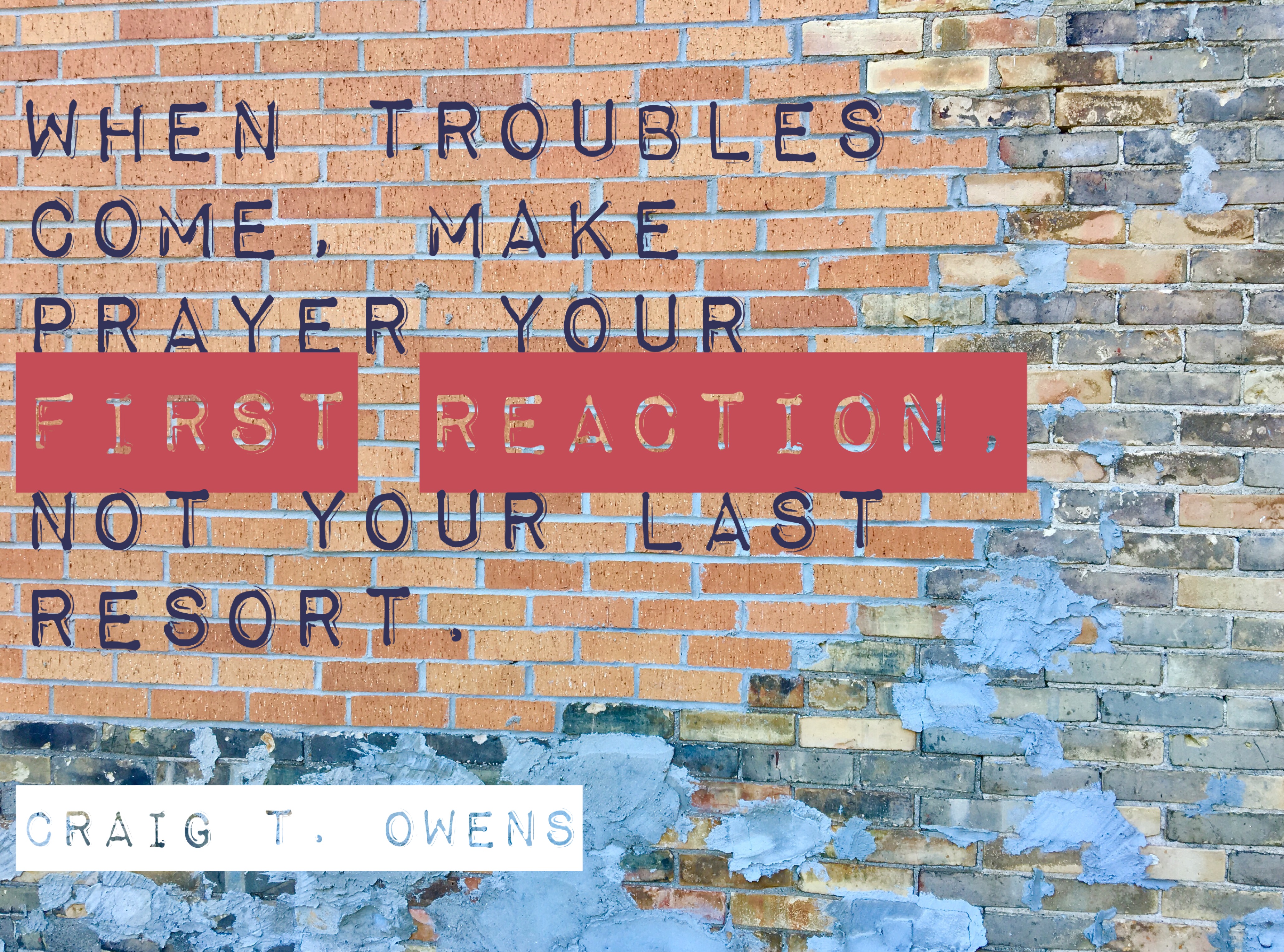
First Reaction

“…Be patient in trouble, and keep on praying” (Romans 12:12).

When trouble comes, is our first response “I’ve got to do something” or “I’ve got to pray”?

Let’s make prayer our first reaction, not our last resort.

Amen!

Poetry Saturday—Smiles

Smile a little, smile a little, 
    As you go along, 
Not alone when life is pleasant, 
    But when things go wrong. 
Care delights to see you frowning, 
    Loves to hear you sigh; 
Turn a smiling face upon her, 
    Quick the dame will fly.

Smile a little, smile a little, 
    All along the road; 
Every life must have its burden, 
    Every heart its load. 
Why sit down in gloom and darkness, 
    With your grief to sup? 
As you drink Fate’s bitter tonic 
    Smile across the cup.

Smile upon the troubled pilgrims 
    Whom you pass and meet; 
Frowns are thorns, and smiles are blossoms 
    Oft for weary feet. 
Do not make the way seem harder 
    By a sullen face, 
Smile a little, smile a little, 
    Brighten up the place.

Smile upon your undone labor; 
    Not for one who grieves 
O’er his task, waits wealth or glory; 
    He who smiles achieves. 
Though you meet with loss and sorrow 
    In the passing years, 
Smile a little, smile a little, 
    Even through your tears. —Ella Wheeler Wilcox

11 Quotes On The Gospel Of Mark

Alongside my daily Bible study time in the Gospels of the New Testament, I have been reading J.C. Ryle’s Expository Thoughts On The Gospels. You can check out my review of this book by clicking here. 

These are a few of the quotes I especially appreciated from Ryle’s comments on the Gospel of Mark. 

“We should always read the Old Testament with the desire to find something in it about Jesus Christ.” [cf John 5:39] 

“It will always be found that when prayers are few, grace, strength, peace, and hope are small. We shall do well to watch our habits of prayer with a holy watchfulness. Here is the pulse of our Christianity. Here is the true test of our state before God. Here true religion begins in the soul, when it does begin. Here it decays and goes backward, when a man backslides from God. Let us walk in the steps of our blessed Master in this respect as well as in every other. Like Him, let us be diligent in our private devotion. Let us know what it is to ‘depart into solitary places and pray.’” 

“What extravagant importance is attached to trifles by those who are mere formalists in religion!” 

“Christ’s service does not exempt His servants from storms.” 

“The assaults of persecution from without have never done half so much harm to the church as the rise of false doctrines within. False prophets and false teachers within the camp have done far more mischief in Christendom than all the bloody persecutions of the emperors of Rome. The sword of the foe has never done such damage to the cause of truth as the tongue and the pen.” 

“Incredible is the bondage in which men live to the opinion of the world! Let us all pray daily for faith and courage to confess Christ before men. … In spite of laughter, mockery, and hard words, let us boldly avow that we serve Christ.” 

“It is a dreadful fact, whether we like to allow it or not, that pride is one of the commonest sins which beset human nature. We are all born Pharisees. We all naturally think far better of ourselves than we ought. We all naturally imagine that we deserve something better than we have. It is an old sin. It began in the garden of Eden, when Adam and Eve thought they had not got everything that their merits deserved. It is a subtle sin. It rules and rains in many a heart without being detected, and can even wear the garb of humility. It is a most soul-ruining sin. It prevents repentance, keeps men back from Christ, checks brotherly love, and nips in the bud spiritual desires. Let us watch against it, and be on our guard. Of all garments, none is so graceful, none wears so well, and none is so rare as true humility.” 

“It is not so much the having money, as the trusting in it, which ruins the soul. Let us pray for contentment with such things as we have.” 

“Above all, let all who desire to walk in Christ’s steps labor to be useful to others. … Let them never forget that true greatness does not consist in being an admiral, or a general, a statesman, or an artist. It consists in devoting ourselves, body, and soul, and spirit to the blessed work of making our fellow man more holy and more happy. … Let us strive to leave the world better, holier, happier than it was when we were born.” 

“The dark ages of Christendom were times when the Bible was kept back from the people. The Protestant Reformation was mainly effected by translating and circulating the Bible. The churches which are most flourishing at this day are churches which honor the Bible. The nations which enjoy the most moral light are nations in which the Bible is most known. … The godliest families are Bible-reading families. The holiest men and women are Bible-reading people.” 

“Let us remember that for our sakes Jesus voluntarily endured the most painful, horrible, and disgraceful death. Surely the thought of this love should constrain us daily to live not unto ourselves but unto Christ.” 

You can read the quotes I shared from Ryle’s thoughts on the Gospel of Matthew by clicking here. 

Reversing The Distress Cycle

God wants you to live in a place where your heart has unshakable security and tranquility. The Hebrew word is shalom, and the Bible gives us a “Shalom Cycle” that keeps us centered and grounded in God’s peace. 

But the Shalom Cycle begins to break down when…

  • …gratitude is replaced by grumbling 
  • …trust in God’s future grace is replaced by unbelief
  • …taking our worries to God is replaced by self-reliance

Anxiety causes our mind to race through all sorts of “what if” scenarios. My friend Josh Schram points out, “There are no benefits at all to having anxieties!” 

The disciples of Jesus were in an anxiety-producing situation—they were in a boat going through stormy seas. Jesus was in the boat with them, but He was sound asleep. Instead of going to Jesus with their worries, the disciples tried to get themselves out of the situation. As they did, the “what ifs” began to mount. 

What if the boat sinks … What if we get smashed on the rocks … What if not everyone can swim … What if (gasp!) Jesus doesn’t make it out alive … What if … What if… WHAT IF?!?

Until finally they screamed at Jesus, “Don’t You even care?!” 

Sadly, their last thought was to go to Jesus, instead of making Him their first thought. 

But Jesus cared more than they knew. Years later, Peter—who was in this storm-tossed boat—wrote, “Casting all your cares—all your anxieties, all your worries, and all your concerns, once and for all—on Him, for He cares about you with deepest affection, and watches over you very carefully (1 Peter 5:7). 

Not—only your big concerns. 

Not—most of your concerns. 

But—ALL of your concerns; every single thing that robs you of even a moment’s peace. 

“Jesus, do You even care?” And Jesus responds with a loving, resounding, “YES! I care about every single thing that causes you anxiety, and worry, and care. Give them all to Me!” 

Paul wrote, “Don’t worry about anything; instead, pray about everything. Tell God what you need, and thank Him for all he has done” (Philippians 4:6). 

If we allow the Shalom Cycle to break down, the inevitable result in the exact opposite: The Distress Cycle


The arrows are going the wrong way, and we’re being pulled farther and farther down. We need an about-face, a 180-degree-turn, a new direction. The Bible has a word for this: repentance. Instead of the wrong direction, turn around and go the right direction: 

  • Instead of anxiety—prayer
  • Instead of worry—worship
  • Instead of tests—testimonies 

“Jesus is more concerned about changing our hearts than about changing our circumstances. He uses our circumstances to change our hearts, IF we will trust Him.” —Josh Schram

Life Is Hard! Now What?

Jesus told Peter, and now Peter tells us—Christians are going to be insulted and persecuted for believing in Jesus. So the fact that life is hard shouldn’t come as a surprise. Peter then goes on to elaborate on how Christians should live in spite of the mistreatment. 

“The more Christians are unlike the world, the more it hates us; the more we are like our Lord, the more the world will persecute us.” —Horatius Bonar

How should Christians respond to insults and persecution? Peter outlines the Christian’s response in 1 Peter 4:12-19

dear friends, do not be surprised (v. 12). I like this verse in the Amplified Bible: Do not be amazed and bewildered at the fiery ordeal which is taking place to test your quality, as though something strange (unusual and alien to you and your position) were befalling you. After all, Jesus told us this was coming (see John 15:18-20). 

but rejoice that you participate in the sufferings of Christ (v. 13a). Notice that this should be the sufferings OF Christ, not of our own making. 

—let suffering lead to Spirit-led reflection (notice the if’s in vv. 14-18, and the if’s in what Jesus said in John 15:18-20). We need to make sure our suffering is because we’re standing for Jesus, not because we’re being jerks! David asked God to check if his actions were the cause of his persecution (Psalm 7:3-4) and we should too. If we discover that we’re the one to blame, quickly apologize, ask for forgiveness, and make things right.  

keep your focus on when His glory is revealed (v. 13b). Time is short, and the rewards are sure so don’t remain focused on the immediate pain, but look up to the longterm gain.  

do not be ashamed to suffer for Jesus (v. 16). Jesus told us not to be ashamed of Him because He is not ashamed of us (Luke 9:26; Hebrews 2:11). 

stay committed to your faithful Creator (v. 19a). Staying committed means getting even closer to God in the hard times.

continue to do good (v. 19b). What does continue to do good look like? Peter lists things like being self-controlled, helping others that are being persecuted, showing proper respect, having a good work ethic, not trading insult for insult, and many other commands. Bottom line: doing good means living like Jesus lived while He was on Earth (see Acts 10:38). 

So, Christian, I’ve got two questions for you—

How are you handling insults and persecution? Are you continuing to do good despite the mistreatment? 

Remember Jesus is coming soon, and His rewards are with Him for how we have lived. “Behold, I am coming soon, and I shall bring My wages and rewards with Me, to repay and render to each one just what his own actions and his own work merit.” —Jesus (Revelation 22:12) 

Join me this Sunday as we continue to learn how Christians are to live as aliens and strangers while we visit Earth. If you’ve missed any messages in this series, you may find the complete list by clicking here.